Applications and Mathematical Modelling
5. Review and Integrated Problem Solving
Learning outcomes
- I can select the most efficient method for solving a system.
- I can solve multi-step problems involving systems of equations.
- I can justify my mathematical reasoning.
- I can communicate complete and organized solutions.
- I can apply systems of equations confidently in unfamiliar situations.
Introduction
Systems of equations are among the most useful tools in algebra because they allow us to investigate situations involving several unknown quantities and multiple relationships.
Throughout this unit, we have explored how to solve systems using:
-
Graphing
-
Substitution
-
Elimination
-
Matrices and technology
-
Algebraic manipulation of nonlinear equations
-
Mathematical modelling
We have also applied systems to geometry, science, business, economics, and everyday problems.
The challenge in advanced problem-solving is not simply knowing how to use these methods. It is knowing which method to choose, why it is appropriate, and how to apply it accurately.
A skilled problem-solver can examine a system, identify its structure, select an efficient strategy, complete the necessary calculations, and explain what the solution means.
In unfamiliar problems, the equations may not be given directly. We may need to define variables, interpret information, construct relationships, and combine several mathematical ideas before solving.
This lesson brings these skills together through a comprehensive review of methods, multi-step worked examples, error analysis, and integrated applications.
Understanding What It Means to Solve a System
A system of equations consists of two or more equations involving shared unknown quantities.
A solution must satisfy every equation in the system simultaneously.
For example:
2x + y = 11
x − y = 1
Adding the equations:
3x = 12
x = 4
Substituting into the second equation:
4 − y = 1
y = 3
The solution is:
(x, y) = (4, 3)
Verification
First equation:
2(4) + 3 = 11
Second equation:
4 − 3 = 1
Both are satisfied.
A complete solution should show not only the final values but also the mathematical reasoning used to obtain them.
The Main Methods for Solving Systems
Graphing
Graphing represents each equation visually.
For a system of two straight lines, the intersection point gives the solution.
Best used when:
-
A visual interpretation is important.
-
The equations are easy to graph.
-
An approximate solution is acceptable.
-
The number of intersections needs to be investigated.
Limitation: Exact coordinates may be difficult to determine from a graph.
Substitution
Substitution involves isolating one variable and replacing it in another equation.
Best used when:
-
One variable is already isolated.
-
A coefficient is 1 or −1.
-
One equation can be rearranged easily.
-
A nonlinear equation is combined with a linear equation.
Elimination
Elimination involves adding or subtracting equations to remove a variable.
Best used when:
-
Coefficients are equal or opposite.
-
Coefficients can be matched using small multipliers.
-
Both equations are in standard form.
-
Fractions can be avoided through suitable multiplication.
Matrix methods
Matrix methods represent systems using coefficients and constants.
Best used when:
-
There are three or more unknowns.
-
Many equations must be solved.
-
The same coefficient structure is used repeatedly.
-
Technology is available.
Technology
Graphing calculators, spreadsheets, and mathematical software can solve complex systems efficiently.
However, technology should support mathematical reasoning rather than replace it.
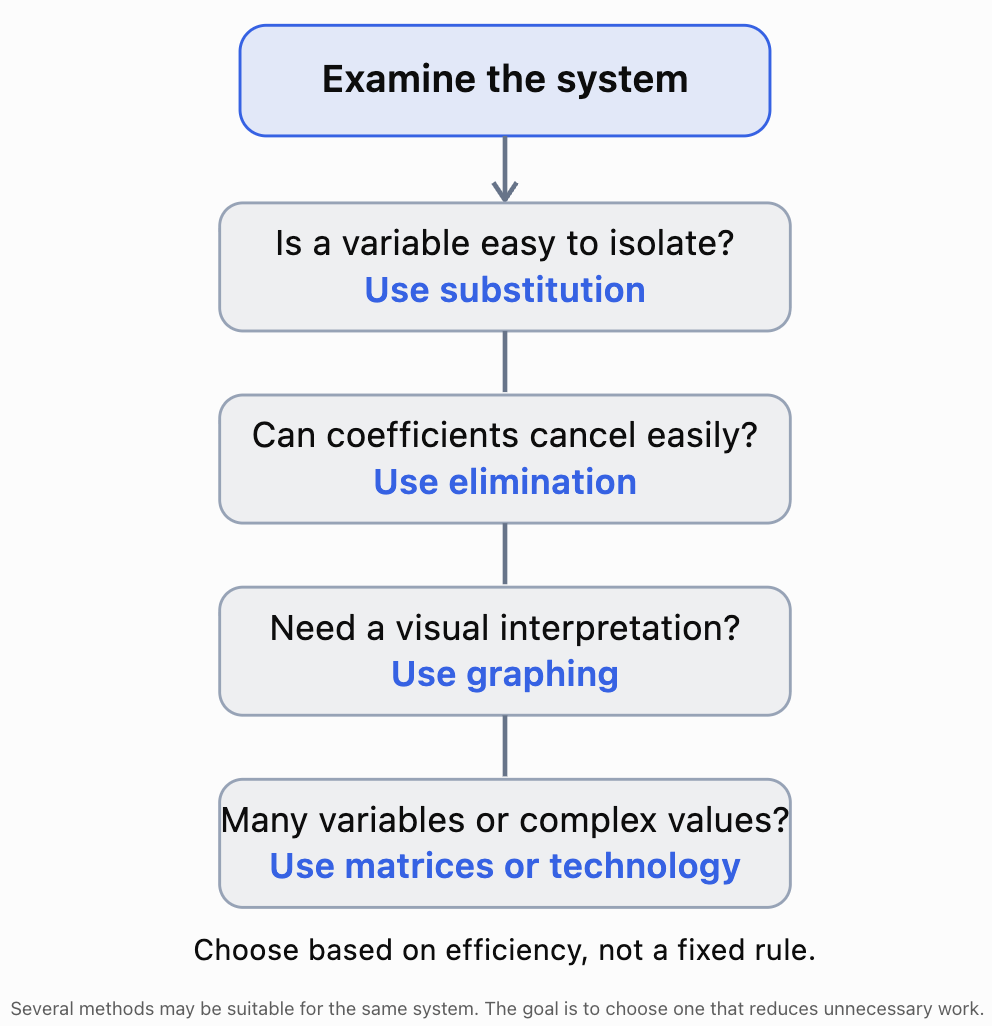
Choosing the Most Efficient Method
There is no single best method for every system.
The most efficient choice depends on the structure of the equations.
|
System |
Recommended method |
Reason |
|---|---|---|
|
y = 3x + 2 and x + y = 14 |
Substitution |
One variable is isolated |
|
4x + 3y = 19 and 4x − 2y = 4 |
Elimination |
x-coefficients already match |
|
y = 2x + 1 and y = −x + 7 |
Substitution or graphing |
Both equations are in slope-intercept form |
|
x + y + z = 12 with two additional linear equations |
Elimination or matrices |
Three unknown quantities |
|
x² + y² = 25 and y = 3 |
Substitution |
A linear equation simplifies a nonlinear equation |
|
Two cost functions |
Graphing and algebra |
The intersection has a practical meaning |
A practical decision guide
Worked Example: Comparing Substitution and Elimination
Solve:
3x + 2y = 18
x + y = 7
Method 1: Substitution
From the second equation:
y = 7 − x
Substitute into the first:
3x + 2(7 − x) = 18
3x + 14 − 2x = 18
x = 4
Then:
y = 7 − 4 = 3
Solution: (4, 3)
Method 2: Elimination
Multiply the second equation by 2:
2x + 2y = 14
Subtract from the first:
x = 4
Then:
4 + y = 7
y = 3
Solution: (4, 3)
Which method is more efficient?
Both methods require only a few steps.
Elimination avoids expanding brackets, while substitution uses the easily isolated variable.
Either is a reasonable choice.
Verification
3(4) + 2(3) = 18
4 + 3 = 7
Both equations are satisfied.
Important principle: Efficiency is not always about using the fewest written lines. A method that is easier to understand and less likely to produce errors may be the better choice.
Worked Example: Elimination with Different Coefficients
Solve:
3x + 4y = 25
5x − 2y = 7
Step 1: Identify the variable to eliminate
The y-coefficients are 4 and −2.
Multiplying the second equation by 2 creates opposite coefficients.
10x − 4y = 14
Step 2: Add the equations
3x + 4y = 25
10x − 4y = 14
Add:
13x = 39
x = 3
Step 3: Find y
Substitute into:
5x − 2y = 7
5(3) − 2y = 7
15 − 2y = 7
−2y = −8
y = 4
Step 4: Verify
3(3) + 4(4) = 9 + 16 = 25
5(3) − 2(4) = 15 − 8 = 7
Answer: (3, 4)
Why elimination is efficient
Only one equation needs to be multiplied.
The y-terms then cancel immediately, producing a simple equation in x.
Worked Example: A System Containing Fractions
Solve:
x/2 + y/3 = 5
x/4 − y/6 = 1
Step 1: Eliminate fractions
The least common multiple of 2 and 3 is 6.
Multiply the first equation by 6:
3x + 2y = 30
The least common multiple of 4 and 6 is 12.
Multiply the second equation by 12:
3x − 2y = 12
Step 2: Add
6x = 42
x = 7
Step 3: Find y
3(7) + 2y = 30
21 + 2y = 30
2y = 9
y = 9/2 = 4.5
Step 4: Verify
First equation:
7/2 + 4.5/3 = 3.5 + 1.5 = 5
Second equation:
7/4 − 4.5/6 = 1.75 − 0.75 = 1
Answer: x = 7, y = 4.5
Strategy lesson
When a system contains fractions, multiplying each equation by its least common denominator can simplify the calculations significantly.
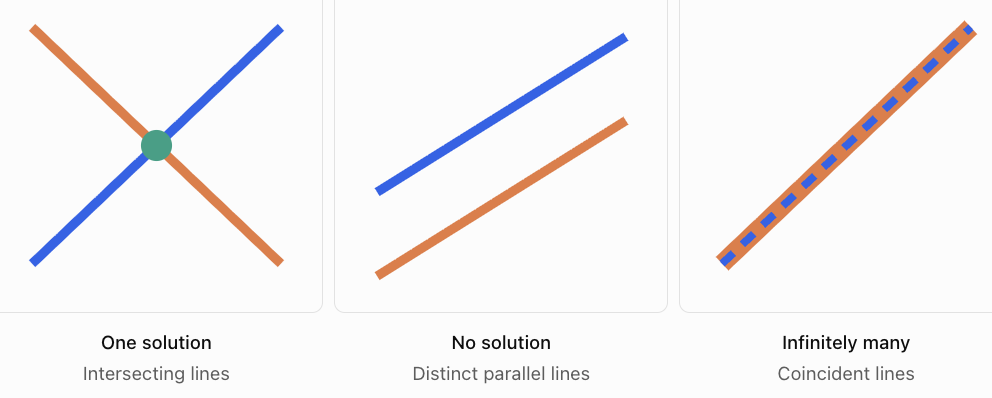
Recognising the Number of Solutions
A system does not always have exactly one solution.
Unique solution
Consider:
x + y = 8
x − y = 2
Adding:
2x = 10
x = 5
y = 3
The system has one solution.
No solution
Consider:
2x + 4y = 12
x + 2y = 9
Multiplying the second equation by 2 gives:
2x + 4y = 18
But the first equation requires:
2x + 4y = 12
The equations contradict one another.
Conclusion: No solution.
Infinitely many solutions
Consider:
2x + 4y = 12
x + 2y = 6
Multiplying the second equation by 2 produces the first equation.
The equations represent the same line.
Conclusion: Infinitely many solutions.
Geometric interpretation
Integrated Problem: Three-Variable Systems
Some problems involve three unknown quantities and require several stages of elimination.
Solve:
x + y + z = 12
2x + 3y + z = 23
3x + y + 2z = 21
Step 1: Eliminate z
Subtract the first equation from the second:
x + 2y = 11
Multiply the first equation by 2:
2x + 2y + 2z = 24
Subtract this from the third equation:
x − y = −3
The reduced system is:
x + 2y = 11
x − y = −3
Step 2: Solve the reduced system
Subtract the second equation from the first:
3y = 14
y = 14/3
Substitute:
x − 14/3 = −3
x = 5/3
Step 3: Find z
x + y + z = 12
5/3 + 14/3 + z = 12
19/3 + z = 36/3
z = 17/3
Step 4: Verify
First equation:
5/3 + 14/3 + 17/3 = 36/3 = 12
Second equation:
2(5/3) + 3(14/3) + 17/3
= 10/3 + 14 + 17/3
= 27/3 + 14 = 23
Third equation:
3(5/3) + 14/3 + 2(17/3)
= 5 + 48/3 = 21
Answer: x = 5/3, y = 14/3, z = 17/3.
Strategy lesson
Three-variable systems can often be reduced to two-variable systems.
The most important step is eliminating the same variable from two different pairs of equations.
Integrated Problem: Nonlinear Systems
Solve:
x² + y² = 25
y = x + 1
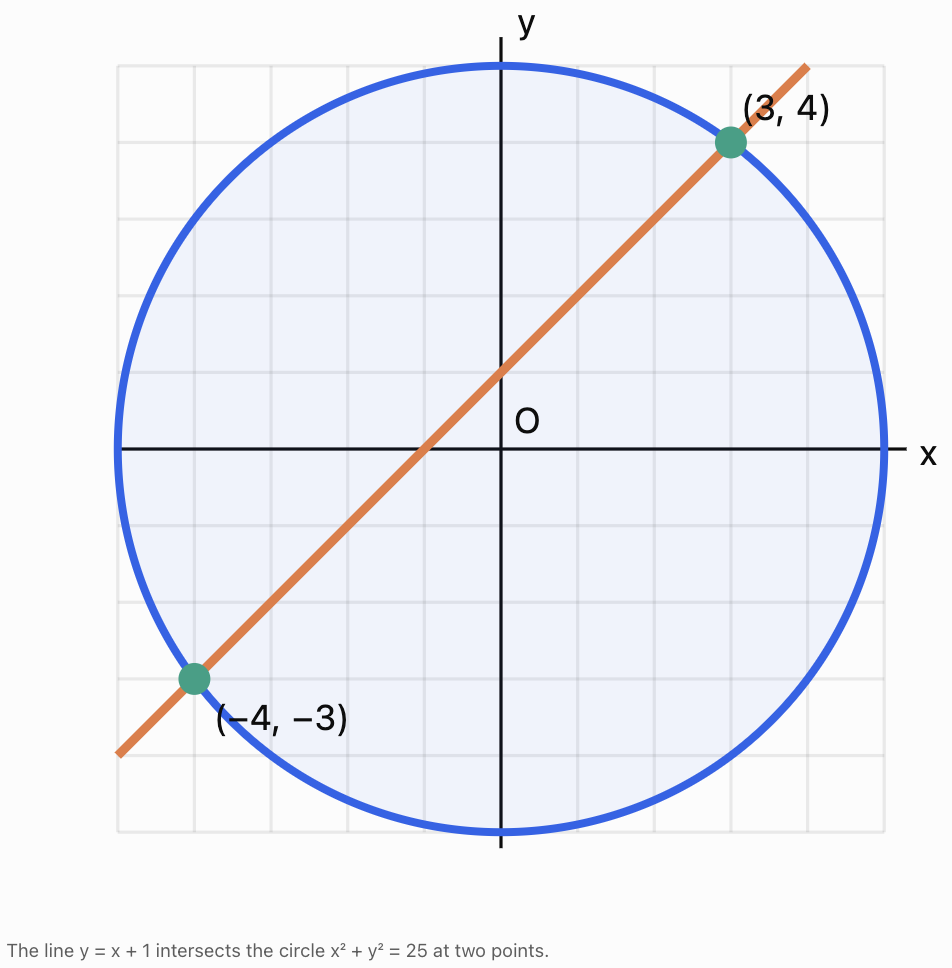
This system contains a circle and a straight line.
Step 1: Choose a method
Substitution is appropriate because y is already isolated.
Step 2: Substitute
x² + (x + 1)² = 25
Expand:
x² + x² + 2x + 1 = 25
2x² + 2x − 24 = 0
Divide by 2:
x² + x − 12 = 0
Step 3: Factor
(x + 4)(x − 3) = 0
Therefore:
x = −4 or x = 3
Step 4: Find y-values
If x = −4:
y = −3
If x = 3:
y = 4
Step 5: Verify
For (−4, −3):
16 + 9 = 25
−3 = −4 + 1
For (3, 4):
9 + 16 = 25
4 = 3 + 1
Answers: (−4, −3) and (3, 4).
Interpretation
The line intersects the circle at two points.
Both solutions are necessary because the original problem asks for all intersections.
Integrated Problem: Business and Economics
A company manufactures two products, A and B.
Each unit of Product A requires 3 hours of labour and 2 kg of material.
Each unit of Product B requires 2 hours of labour and 4 kg of material.
The company uses 160 labour-hours and 160 kg of material.
Determine the number of units manufactured.
Step 1: Define variables
x = number of units of Product A
y = number of units of Product B
Step 2: Construct equations
Labour:
3x + 2y = 160
Materials:
2x + 4y = 160
Step 3: Select a method
Elimination is efficient because the second equation can be divided by 2.
x + 2y = 80
Subtract this from the labour equation:
2x = 80
x = 40
Step 4: Find y
40 + 2y = 80
2y = 40
y = 20
Step 5: Verify
Labour:
3(40) + 2(20) = 160 hours
Materials:
2(40) + 4(20) = 160 kg
Answer: 40 units of Product A and 20 units of Product B.
Evaluate the model
The result is reasonable because both quantities are nonnegative whole numbers.
However, the model assumes constant resource requirements, no waste, and that all recorded resources were used to manufacture these products.
Integrated Problem: Geometry and Algebra
A rectangular garden has a perimeter of 50 m and an area of 150 m².
Find its dimensions.
Step 1: Define variables
l = length, in metres
w = width, in metres
Step 2: Construct equations
Perimeter:
2l + 2w = 50
l + w = 25
Area:
lw = 150
Step 3: Choose a method
Substitution is appropriate because the perimeter equation can easily be rearranged.
l = 25 − w
Step 4: Substitute
(25 − w)w = 150
25w − w² = 150
w² − 25w + 150 = 0
Factor:
(w − 10)(w − 15) = 0
w = 10 or w = 15
The two values represent the same rectangle with the dimensions interchanged.
Answer: The garden measures 15 m by 10 m.
Step 5: Verify
Perimeter:
2(15) + 2(10) = 50 m
Area:
15(10) = 150 m²
Why this problem is important
It requires recognising that one geometric relationship is linear and another is nonlinear.
The problem cannot be solved using ordinary linear elimination alone without additional algebraic manipulation.
Integrated Problem: Science and Experimental Data
A scientist models the position of an object using:
s = vt + s₀
where:
-
s = position, in metres.
-
v = constant velocity, in m/s.
-
t = time, in seconds.
-
s₀ = initial position, in metres.
Measurements show:
|
Time (s) |
Position (m) |
|---|---|
|
2 |
11 |
|
6 |
27 |
Determine the velocity and initial position.
Step 1: Construct the equations
11 = 2v + s₀
27 = 6v + s₀
Step 2: Select a method
Elimination is efficient because both equations contain the same coefficient for s₀.
Subtract:
16 = 4v
v = 4 m/s
Step 3: Find initial position
11 = 2(4) + s₀
s₀ = 3 m
Step 4: Write the model
s = 4t + 3
Step 5: Verify
At t = 2 s:
s = 4(2) + 3 = 11 m
At t = 6 s:
s = 4(6) + 3 = 27 m
Answer: Velocity = 4 m/s and initial position = 3 m.
Evaluate
The model assumes constant velocity.
Two measurements determine the parameters of a linear model, but additional measurements are needed to test whether the motion is actually uniform.
Integrated Problem: An Unfamiliar Situation
A wildlife researcher counts two species of animals in a habitat.
Species A has 4 legs per animal.
Species B has 2 legs per animal.
There are 75 animals and 220 legs in total.
Find the number of animals of each species.
Step 1: Understand the situation
The problem does not initially provide algebraic equations.
We must identify the unknown quantities and translate the information into a mathematical model.
Step 2: Define variables
x = number of Species A animals
y = number of Species B animals
Step 3: Construct equations
Total animals:
x + y = 75
Total legs:
4x + 2y = 220
Step 4: Solve
Multiply the first equation by 2:
2x + 2y = 150
Subtract:
2x = 70
x = 35
Then:
y = 75 − 35
y = 40
Step 5: Verify
Total animals:
35 + 40 = 75
Total legs:
4(35) + 2(40)
= 140 + 80
= 220
Answer: 35 animals of Species A and 40 animals of Species B.
Step 6: Evaluate
The model assumes that the habitat contains only these two species and that every animal has the expected number of legs.
In an actual field investigation, sampling error or incomplete observations may affect the results.
General lesson
Unfamiliar problems become easier when we focus on identifying quantities and relationships rather than trying to memorise a particular question type.
Justifying Mathematical Reasoning
A mathematical justification explains why a particular step or method is valid.
Compare these two solutions.
Incomplete explanation
x = 5
y = 3
Complete explanation
The system is:
x + y = 8
x − y = 2
Elimination is efficient because the y-coefficients are opposites.
Adding the equations eliminates y:
2x = 10
Therefore:
x = 5
Substituting into x + y = 8:
y = 3
Checking:
5 + 3 = 8
5 − 3 = 2
Both equations are satisfied, so the solution is (5, 3).
The complete explanation identifies the method, justifies its selection, shows the calculations, and verifies the result.
What makes a strong justification?
A strong mathematical explanation should demonstrate:
-
Why the equations represent the problem.
-
Why the chosen method is suitable.
-
Why each algebraic transformation is valid.
-
How the solution satisfies the original conditions.
-
What the answer means in context.
Communicating Organised Solutions
A useful structure for written solutions is:
Understand → Define → Model → Solve → Verify → Interpret
Understand
Identify the known information and what must be determined.
Define
Introduce variables with clear meanings and units.
Model
Write the equations representing the relationships.
Solve
Choose an efficient method and show the algebraic steps.
Verify
Substitute the values into the original equations.
Interpret
Explain the answer in the original context.
For real-world problems, add an evaluation of the assumptions and limitations.
This structure makes solutions easier to follow, check, and communicate.
Common Errors in Integrated Problems
Error 1: Choosing an unnecessarily complicated method
Consider:
y = 2x + 3
x + y = 18
Using elimination without rearranging is possible, but substitution is more direct because y is already isolated.
Error 2: Incorrect distribution
Incorrect:
3(x + 2) = 3x + 2
Correct:
3(x + 2) = 3x + 6
Error 3: Changing only one term when multiplying an equation
Incorrect:
2x + y = 10
Multiply by 3:
6x + y = 30
Correct:
6x + 3y = 30
Every term must be multiplied.
Error 4: Losing a negative sign
Incorrect:
−2y = 8
y = 4
Correct:
y = −4
Error 5: Ignoring a second solution
A quadratic equation may produce two valid solutions.
For example:
x² = 16
x = −4 or x = 4
Both must be considered unless the original problem imposes restrictions.
Error 6: Confusing no solution with infinitely many solutions
A contradiction such as:
0 = 5
means no solution.
An identity such as:
0 = 0
means that the eliminated equation provides no additional restriction. In a two-variable linear system where both equations are equivalent, this leads to infinitely many solutions.
Error 7: Failing to interpret units
If x represents time in hours, the answer x = 4 should be communicated as 4 hours.
Error 8: Accepting an unrealistic result
A mathematical solution may be incompatible with the context.
Negative dimensions or fractional counts of complete objects should be investigated rather than automatically accepted.
Strategies for Unfamiliar Problems
When a problem appears unfamiliar, use the following reasoning process.
Identify quantities rather than keywords. Determine what is known and unknown.
Look for conservation relationships. Totals involving mass, cost, distance, or quantity often provide equations.
Look for comparisons. Statements such as “twice as many,” “five greater,” or “20% less” can be translated into equations.
Use a table when appropriate. Organising information often makes the relationships clearer.
Check the number of independent relationships. A unique solution generally requires enough independent information to determine the unknowns.
Choose a method based on the equation structure. Do not automatically use the same method for every problem.
Verify before interpreting. An algebraic error can lead to an incorrect real-world conclusion.
Evaluate the answer. Ask whether the values make sense and satisfy any practical restrictions.
Key Terms
-
System of equations: Two or more equations solved simultaneously.
-
Simultaneous solution: Values satisfying every equation in a system.
-
Substitution: Replacing a variable with an equivalent expression.
-
Elimination: Combining equations to remove a variable.
-
Graphical method: Solving or representing a system using graphs.
-
Matrix method: Representing and solving a system using matrices.
-
Linear system: A system consisting of linear equations.
-
Nonlinear system: A system containing at least one nonlinear equation.
-
Unique solution: Exactly one solution satisfying the system.
-
Inconsistent system: A system with no solution.
-
Dependent equations: Equations that do not provide independent information.
-
Equivalent equations: Equations having exactly the same solution set.
-
Mathematical model: A mathematical representation of a real-world situation.
-
Constraint: A restriction on possible solutions.
-
Verification: Checking whether a solution satisfies the original equations.
-
Interpretation: Explaining the mathematical result in context.
-
Justification: Explaining why a mathematical method or step is valid.
-
Efficiency: Solving a problem with a suitable balance of simplicity, accuracy, and clarity.
-
Extraneous solution: A candidate solution that does not satisfy the original problem.
-
Independent information: Information that contributes a new mathematical restriction.
Key Takeaways
-
Different systems may be best solved using different methods.
-
Substitution is often efficient when a variable is isolated.
-
Elimination is often efficient when coefficients can cancel.
-
Graphing provides a visual interpretation of solutions.
-
Matrix methods and technology are useful for larger systems.
-
Three-variable systems can often be reduced to two-variable systems.
-
Nonlinear systems may produce multiple solutions.
-
Some systems have no solution or infinitely many solutions.
-
Real-world problems require variables, equations, constraints, and interpretation.
-
Mathematical reasoning should be justified and clearly communicated.
-
Every solution should be checked against the original equations.
-
Unfamiliar problems can be approached systematically by identifying quantities and relationships.
Check Your Understanding
For each problem, select an efficient method, show your working, and verify your solution. For application questions, explain what your answer means in context.
Part A: Selecting Methods
1. Identify the most efficient method for solving each system and explain your choice.
a) y = 4x − 3 and x + y = 17
b) 3x + 2y = 16 and 5x − 2y = 8
c) y = x² − 4 and y = 2x − 4
d) x + y + z = 12, 2x − y + z = 9, and x + 2y − z = 3
2. Explain why elimination is usually efficient when two equations contain opposite coefficients for one variable.
3. Explain why graphing may not always provide an exact solution.
Part B: Algebraic Systems
4. Solve:
2x + 3y = 19
4x − 3y = 5
5. Solve:
y = 3x − 2
2x + y = 18
6. Solve:
x/2 + y/4 = 5
x/3 − y/6 = 1
7. Determine whether the following system has one solution, no solution, or infinitely many solutions:
3x + 6y = 18
x + 2y = 6
8. Determine the number of solutions:
2x − 4y = 10
x − 2y = 8
Part C: Advanced Systems
9. Solve:
x + y + z = 10
2x − y + z = 9
x + 2y − z = 3
10. Find all intersection points of:
x² + y² = 25
y = x + 1
11. Solve:
xy = 24
x + y = 10
Part D: Integrated Applications
12. A school sells adult tickets for $18 and student tickets for $12.
A total of 150 tickets are sold, generating $2,250.
Determine the number of each ticket type.
13. A rectangle has a perimeter of 46 cm and an area of 120 cm².
Find its dimensions.
14. Two vehicles travel in opposite directions from the same starting point.
After 3 hours, they are 270 km apart.
One vehicle travels 10 km/h faster than the other.
Find their speeds.
15. A laboratory needs 400 mL of a 30% solution.
It has a 20% solution and a 50% solution.
Assuming compatible concentrations and additive volumes, determine how much of each is required.
16. A company manufactures two products.
Product A requires 4 labour-hours and 3 units of material.
Product B requires 2 labour-hours and 5 units of material.
The company uses 100 labour-hours and 110 units of material.
Determine the production quantities and evaluate whether the result is realistic.
Part E: Analysis and Mathematical Reasoning
17. A student solves:
2x + y = 12
x − y = 3
and obtains x = 3, y = 6.
Identify the error by checking the solution, then find the correct answer.
18. A system produces the solution:
x = −5
y = 12
Explain why this may be acceptable in coordinate geometry but unacceptable in a problem involving physical dimensions.
19. A scientist constructs a two-variable model using two experimental measurements. The model has a unique solution, but a third measurement does not agree with its predictions.
Explain what the scientist should investigate.
20. Integrated Challenge
A school sells three types of merchandise:
-
Pens for $2 each.
-
Notebooks for $5 each.
-
T-shirts for $12 each.
A total of 100 items are sold for $500.
The number of pens sold is twice the number of T-shirts.
Determine the number of each item, verify your answer, and explain why a three-variable system is appropriate.
Answers to Check Your Understanding
1. Selecting methods
a) Substitution. The first equation already isolates y.
b) Elimination. The y-coefficients are +2 and −2, so they cancel immediately.
c) Substitution. Both equations express y in terms of x, allowing the expressions to be set equal.
d) Elimination or matrices. Three unknowns require combining equations systematically.
2. Why opposite coefficients help
When the equations are added, the terms with opposite coefficients cancel, leaving an equation with fewer unknowns.
This reduces the amount of algebra required.
3. Graphing limitations
A graph may show only approximate intersection coordinates.
The graphing window, display resolution, and scale can also affect accuracy.
Algebraic methods are often preferable when exact values are required.
4. Elimination
2x + 3y = 19
4x − 3y = 5
Add:
6x = 24
x = 4
Substitute:
2(4) + 3y = 19
3y = 11
y = 11/3
Answer: (4, 11/3).
Verification:
2(4) + 3(11/3) = 19
4(4) − 3(11/3) = 5
5. Substitution
y = 3x − 2
2x + y = 18
Substitute:
2x + 3x − 2 = 18
5x = 20
x = 4
y = 3(4) − 2 = 10
Answer: (4, 10).
6. Fractions
x/2 + y/4 = 5
Multiply by 4:
2x + y = 20
x/3 − y/6 = 1
Multiply by 6:
2x − y = 6
Add:
4x = 26
x = 13/2
Then:
y = 20 − 2(13/2)
y = 7
Answer: x = 13/2, y = 7.
Verification:
(13/2)/2 + 7/4 = 13/4 + 7/4 = 5
(13/2)/3 − 7/6 = 13/6 − 7/6 = 1
7. Infinitely many solutions
3x + 6y = 18
x + 2y = 6
Multiplying the second equation by 3 produces the first.
Answer: Infinitely many solutions.
The equations represent the same line.
8. No solution
2x − 4y = 10
x − 2y = 8
Multiply the second equation by 2:
2x − 4y = 16
The same expression cannot equal both 10 and 16.
Answer: No solution.
9. Three-variable system
x + y + z = 10
2x − y + z = 9
x + 2y − z = 3
Subtract the first equation from the second:
x − 2y = −1
Add the first and third equations:
2x + 3y = 13
From the first reduced equation:
x = 2y − 1
Substitute:
2(2y − 1) + 3y = 13
7y − 2 = 13
7y = 15
y = 15/7
Then:
x = 2(15/7) − 1 = 23/7
Using the first original equation:
z = 10 − 23/7 − 15/7
z = 32/7
Answer: x = 23/7, y = 15/7, z = 32/7.
Verification:
First equation: (23 + 15 + 32)/7 = 10
Second equation: (46 − 15 + 32)/7 = 9
Third equation: (23 + 30 − 32)/7 = 3
10. Line-circle intersections
Substitute y = x + 1:
x² + (x + 1)² = 25
2x² + 2x − 24 = 0
x² + x − 12 = 0
(x + 4)(x − 3) = 0
x = −4 or x = 3
Corresponding y-values:
y = −3 or y = 4
Answer: (−4, −3) and (3, 4).
11. Product and sum
xy = 24
x + y = 10
Rearrange:
y = 10 − x
Substitute:
x(10 − x) = 24
10x − x² = 24
x² − 10x + 24 = 0
(x − 4)(x − 6) = 0
x = 4 or x = 6
Answers: (4, 6) and (6, 4).
Both satisfy the original system.
12. Ticket sales
Let:
a = adult tickets
s = student tickets
a + s = 150
18a + 12s = 2250
Multiply the first equation by 12:
12a + 12s = 1800
Subtract:
6a = 450
a = 75
Then:
s = 75
Answer: 75 adult tickets and 75 student tickets.
Verification:
18(75) + 12(75) = $2250
13. Rectangle dimensions
Let:
l = length
w = width
Perimeter:
l + w = 23
Area:
lw = 120
Substitute l = 23 − w:
(23 − w)w = 120
w² − 23w + 120 = 0
(w − 8)(w − 15) = 0
Answer: 15 cm by 8 cm.
Verification:
2(15) + 2(8) = 46 cm
15(8) = 120 cm²
14. Vehicle speeds
Let:
x = slower speed
y = faster speed
3x + 3y = 270
x + y = 90
y − x = 10
Add:
2y = 100
y = 50
x = 40
Answer: 40 km/h and 50 km/h.
Verification:
3(40) + 3(50) = 270 km
15. Solution mixture
Let:
x = volume of 20% solution
y = volume of 50% solution
x + y = 400
0.20x + 0.50y = 120
Substitute x = 400 − y:
80 − 0.20y + 0.50y = 120
0.30y = 40
y = 400/3 ≈ 133.33 mL
Then:
x = 800/3 ≈ 266.67 mL
Answer: Approximately 266.67 mL of 20% solution and 133.33 mL of 50% solution.
Use the exact fractional values for verification to avoid rounding error.
16. Manufacturing
Let:
x = Product A units
y = Product B units
Labour:
4x + 2y = 100
Materials:
3x + 5y = 110
Divide the labour equation by 2:
2x + y = 50
Therefore:
y = 50 − 2x
Substitute:
3x + 5(50 − 2x) = 110
3x + 250 − 10x = 110
−7x = −140
x = 20
Then:
y = 10
Answer: 20 units of Product A and 10 units of Product B.
Verification:
4(20) + 2(10) = 100 hours
3(20) + 5(10) = 110 units of material
The quantities are nonnegative whole numbers, so they are feasible under the stated assumptions.
17. Error analysis
The student's proposed solution is:
x = 3, y = 6
Check the first equation:
2(3) + 6 = 12
This is correct.
Check the second equation:
3 − 6 = −3
But the equation requires +3.
Therefore, the proposed values do not solve the system.
To correct the solution:
2x + y = 12
x − y = 3
Add:
3x = 15
x = 5
Then:
5 − y = 3
y = 2
Correct answer: (5, 2).
Both equations are satisfied.
18. Negative solutions
Negative coordinates are valid in coordinate geometry.
For example, x = −5 may represent a point 5 units to the left of the y-axis.
However, a negative physical length or width is not meaningful in ordinary geometric measurement.
The context determines whether a negative value is acceptable.
19. Model evaluation
The scientist should investigate whether the model's assumptions are appropriate.
Possible issues include measurement uncertainty, incorrect data, changing experimental conditions, or a relationship that is not truly linear.
Additional measurements and a revised model may be necessary.
20. Integrated challenge
Let:
p = number of pens
n = number of notebooks
t = number of T-shirts
Total items:
p + n + t = 100
Revenue:
2p + 5n + 12t = 500
Quantity relationship:
p = 2t
Substitute into the first equation:
2t + n + t = 100
n = 100 − 3t
Substitute into the revenue equation:
2(2t) + 5(100 − 3t) + 12t = 500
4t + 500 − 15t + 12t = 500
t = 0
Then:
p = 0
n = 100
Answer: 0 pens, 100 notebooks, and 0 T-shirts.
Verification:
Total items:
0 + 100 + 0 = 100
Revenue:
2(0) + 5(100) + 12(0) = $500
Quantity relationship:
0 = 2(0)
All conditions are satisfied.
The system requires three variables because the school sells three different types of merchandise.
The result is mathematically valid, although it is a boundary case in which only notebooks were sold. If the problem required at least one of every item, the information would be inconsistent with that additional requirement.
Final Summary
Solving systems of equations confidently requires more than memorising algebraic procedures.
It involves recognising mathematical structures, choosing efficient methods, constructing models, justifying calculations, and interpreting solutions.
The strongest problem-solvers are flexible. They can use substitution when a variable is isolated, elimination when coefficients can cancel, graphing when visual interpretation is useful, and technology when systems become more complex.
They also recognise when a system has no solution, infinitely many solutions, or multiple solutions arising from nonlinear relationships.
Most importantly, they verify their calculations and communicate their conclusions clearly.
Successful integrated problem-solving means choosing an appropriate strategy, applying it accurately, explaining why it works, and determining whether the result makes sense.