Systems with Three Variables
3. Applications of Three Variables
Learning outcomes
- I can model real-world situations using three variables.
- I can write systems from practical problems.
- I can solve application problems.
- I can interpret solutions.
- I can explain my reasoning.
Introduction
Many real-world problems involve three unknown quantities that are connected by several relationships. These problems appear in shopping, business, transport, science, engineering, agriculture, and everyday decision-making.
For example, a school might sell three types of tickets, a business might manufacture three different products, or a scientist might combine three substances to create a mixture.
When three unknown quantities must be determined simultaneously, we can often represent the situation using a system of three linear equations.
By solving the system, we can determine values that satisfy all the conditions of the problem.
However, solving the equations is only part of the process. We must also interpret the answers, include appropriate units, and check that the results make sense in the original situation.
Why Three Variables Are Useful
Consider a school shop that sells notebooks, pens, and pencils.
Suppose we want to determine the price of each item.
We have three unknown prices:
-
Price of one notebook.
-
Price of one pen.
-
Price of one pencil.
We can represent these using:
n = notebook price
p = pen price
c = pencil price
If customers purchase different combinations of these items, each purchase can provide an equation.
With three suitable independent equations, we can often determine all three prices.
A simple example
Suppose:
-
One notebook, one pen, and one pencil cost $9.
-
Two notebooks, one pen, and one pencil cost $13.
-
One notebook, two pens, and one pencil cost $12.
The equations are:
n + p + c = 9
2n + p + c = 13
n + 2p + c = 12
Subtract the first equation from the second:
n = 4
Subtract the first equation from the third:
p = 3
Substitute into the first equation:
4 + 3 + c = 9
c = 2
Therefore:
Notebook = $4, pen = $3, pencil = $2.
Verification:
4 + 3 + 2 = 9
2(4) + 3 + 2 = 13
4 + 2(3) + 2 = 12
All three purchases are represented correctly.
This demonstrates how information from several situations can be combined to determine unknown values.
The Mathematical Structure of Three-Variable Applications
A linear equation in three variables has the general form:
ax + by + cz = d
where:
-
x, y, and z represent unknown quantities.
-
a, b, and c are coefficients.
-
d is a constant.
A three-variable system contains several equations involving the same unknowns.
For example:
2x + 3y + z = 20
x + 2y + 4z = 19
3x + y + 2z = 23
The equations may represent quantities, costs, distances, masses, or other relationships.
A solution is an ordered triple:
(x, y, z)
that satisfies every equation.
Conditions for a meaningful solution
A successful application solution must satisfy two requirements.
Mathematical correctness: The values satisfy all the equations.
Contextual correctness: The values make sense in the real-world situation.
For example, a negative number of tickets is mathematically possible as an algebraic result, but it cannot represent an actual ticket sale.
Similarly, 12.5 students is not a valid count of individual students.
Translating Word Problems into Equations
The most important part of an application problem is often constructing the equations correctly.
Consider these common phrases:
|
Written information |
Mathematical representation |
|---|---|
|
The total is 100 |
x + y + z = 100 |
|
The combined cost is $250 |
ax + by + cz = 250 |
|
There are twice as many A as B |
x = 2y |
|
There are 10 more A than C |
x = z + 10 |
|
A and B together equal C |
x + y = z |
|
The total mass is 500 g |
x + y + z = 500 |
|
The total time is 6 hours |
x + y + z = 6 |
|
The average is 20 |
(x + y + z)/3 = 20 |
Notice that some relationships involve only two variables. They can still form part of a three-variable system.
A General Strategy for Application Problems
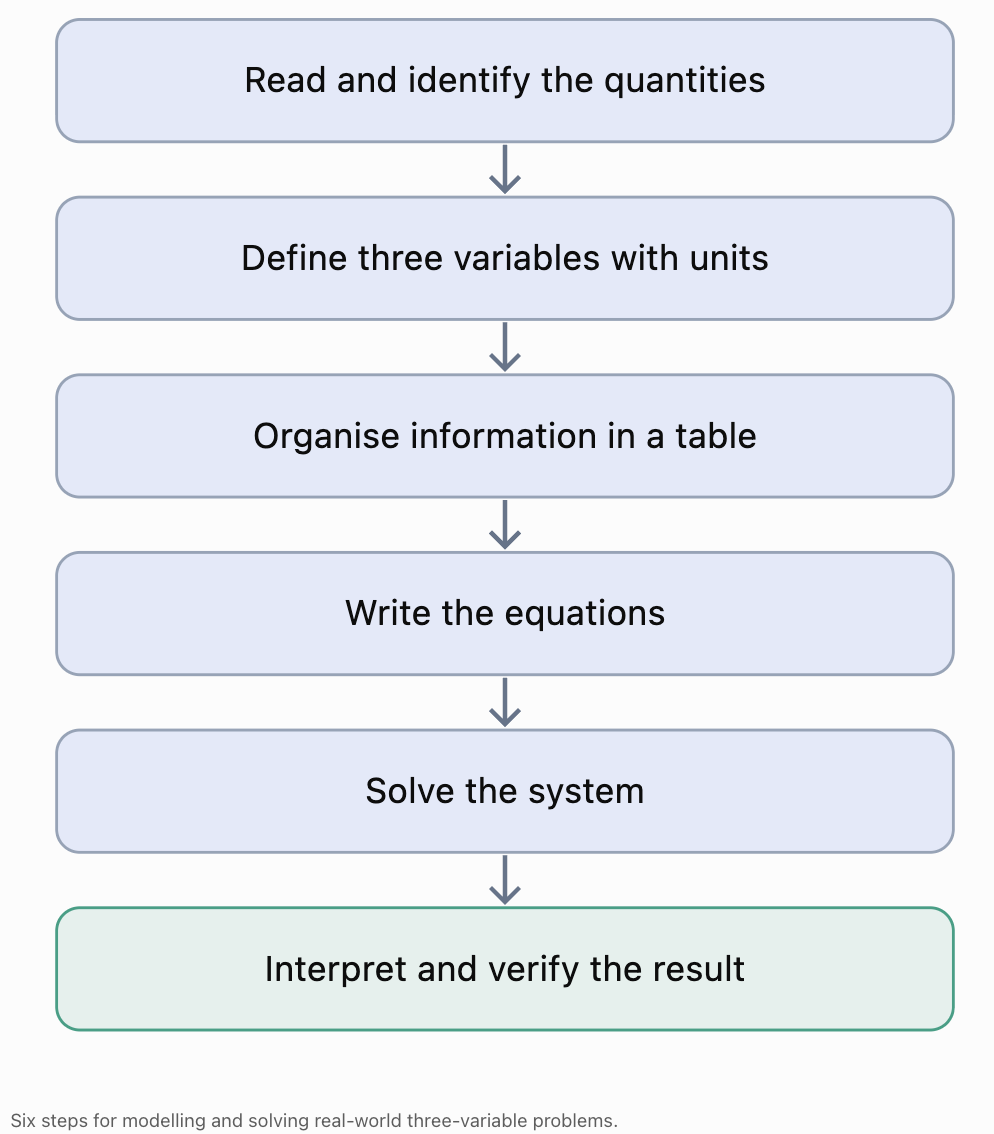
Step 1: Identify the unknown quantities
Determine exactly what must be calculated.
Step 2: Define variables
Use clear definitions and include units.
For example:
x = number of adult tickets
y = number of student tickets
z = number of child tickets
Step 3: Organise the information
Use a table when several categories or measurements are involved.
Step 4: Construct equations
Translate each independent piece of information into an equation.
Step 5: Solve the system
Use elimination, substitution, or a combination of both.
Step 6: Interpret and verify
Explain the answer in words, check the original equations, and evaluate whether the values are realistic.
Application: Finding the Prices of Three Products
A school stationery shop sells notebooks, pens, and pencils.
Three customers make the following purchases:
-
Customer A buys 2 notebooks, 1 pen, and 3 pencils for $16.
-
Customer B buys 1 notebook, 3 pens, and 2 pencils for $15.
-
Customer C buys 3 notebooks, 2 pens, and 1 pencil for $23.
Find the price of each item.
Step 1: Define variables
n = price of one notebook in dollars
p = price of one pen in dollars
c = price of one pencil in dollars
Step 2: Organise the information
|
Customer |
Notebooks |
Pens |
Pencils |
Total |
|---|---|---|---|---|
|
A |
2 |
1 |
3 |
$16 |
|
B |
1 |
3 |
2 |
$15 |
|
C |
3 |
2 |
1 |
$23 |
Step 3: Construct equations
A: 2n + p + 3c = 16
B: n + 3p + 2c = 15
C: 3n + 2p + c = 23
Step 4: Eliminate n
Multiply B by 2:
2n + 6p + 4c = 30
Subtract A:
5p + c = 14
Call this D.
Multiply B by 3:
3n + 9p + 6c = 45
Subtract C:
7p + 5c = 22
Call this E.
Step 5: Solve D and E
D: 5p + c = 14
E: 7p + 5c = 22
From D:
c = 14 − 5p
Substitute into E:
7p + 5(14 − 5p) = 22
7p + 70 − 25p = 22
−18p = −48
p = 8/3
Then:
c = 14 − 5(8/3)
c = 2/3
Step 6: Find n
Use B:
n + 3p + 2c = 15
n + 3(8/3) + 2(2/3) = 15
n + 8 + 4/3 = 15
n = 17/3
Step 7: Interpret
Notebook price = $17/3, approximately $5.67
Pen price = $8/3, approximately $2.67
Pencil price = $2/3, approximately $0.67
These are exact mathematical prices; the rounded amounts should not be substituted back as if they were exact cent-based prices.
Step 8: Verify using exact values
A:
2(17/3) + 8/3 + 3(2/3)
= 34/3 + 8/3 + 6/3
= 48/3 = 16
B:
17/3 + 3(8/3) + 2(2/3)
= 17/3 + 24/3 + 4/3
= 45/3 = 15
C:
3(17/3) + 2(8/3) + 2/3
= 51/3 + 16/3 + 2/3
= 69/3 = 23
Answer: Notebook = $17/3, pen = $8/3, pencil = $2/3.
The mathematical solution is valid, although a real shop pricing items to the nearest cent would need additional pricing constraints.
Application: Ticket Sales at a School Event
A school sells three types of tickets for a concert.
-
Adult tickets cost $15.
-
Student tickets cost $10.
-
Child tickets cost $5.
A total of 150 tickets are sold, generating $1,500 in revenue.
The number of student tickets is twice the number of child tickets.
Find how many tickets of each type were sold.
Step 1: Define variables
a = number of adult tickets
s = number of student tickets
c = number of child tickets
Step 2: Construct equations
Total tickets:
a + s + c = 150
Total revenue:
15a + 10s + 5c = 1500
Relationship between student and child tickets:
s = 2c
Step 3: Substitute the relationship
Substitute s = 2c into the first equation:
a + 2c + c = 150
a + 3c = 150
Therefore:
a = 150 − 3c
Step 4: Substitute into the revenue equation
15(150 − 3c) + 10(2c) + 5c = 1500
2250 − 45c + 20c + 5c = 1500
2250 − 20c = 1500
−20c = −750
c = 37.5
Then:
s = 75
a = 37.5
Step 5: Interpret
The system has a unique algebraic solution:
a = 37.5
s = 75
c = 37.5
However, ticket quantities must be whole numbers.
Therefore, the information does not produce a valid real-world solution.
This is an important distinction between solving an equation and solving a practical problem.
Adjusting the information
Suppose the total revenue had been $1,450 instead.
Then:
2250 − 20c = 1450
20c = 800
c = 40
s = 80
a = 150 − 120 = 30
Verification:
30 + 80 + 40 = 150 tickets
15(30) + 10(80) + 5(40)
= 450 + 800 + 200
= $1450
With the revised revenue, the school sold 30 adult tickets, 80 student tickets, and 40 child tickets.
Application: Mixing Three Solutions
Systems of three variables are especially useful in chemistry and manufacturing.
Suppose a laboratory needs to prepare 100 litres of a solution with a concentration of 30%.
Three available solutions have concentrations of:
-
10%
-
30%
-
50%
The laboratory must use twice as much 10% solution as 50% solution.
How many litres of each solution should be used?
Step 1: Define variables
x = volume of 10% solution, in litres
y = volume of 30% solution, in litres
z = volume of 50% solution, in litres
Step 2: Construct the volume equation
The total volume is 100 litres.
x + y + z = 100
Step 3: Construct the concentration equation
The amount of dissolved substance in each solution is:
10% solution: 0.10x
30% solution: 0.30y
50% solution: 0.50z
The final mixture contains:
0.30 × 100 = 30 litres of dissolved substance
Therefore:
0.10x + 0.30y + 0.50z = 30
This model assumes volumes are additive.
Step 4: Construct the relationship equation
The volume of 10% solution is twice the volume of 50% solution:
x = 2z
Step 5: Simplify the concentration equation
Multiply by 10:
x + 3y + 5z = 300
Subtract the total volume equation:
(x + 3y + 5z) − (x + y + z) = 300 − 100
2y + 4z = 200
Divide by 2:
y + 2z = 100
Step 6: Use the relationship equation
Substitute x = 2z into the volume equation:
2z + y + z = 100
y + 3z = 100
We now have:
y + 2z = 100
y + 3z = 100
Subtract:
z = 0
Then:
x = 0
y = 100
Step 7: Interpret
The mathematical solution is:
-
10% solution: 0 litres
-
30% solution: 100 litres
-
50% solution: 0 litres
This is mathematically valid, but it does not involve combining all three solutions.
If the laboratory must use a positive amount of every solution, the conditions are impossible.
Why does this happen?
The final concentration is 30%, which is exactly the concentration of the middle solution.
To balance 10% and 50% solutions around 30%, equal volumes of the two would be needed.
However, the problem requires twice as much 10% solution as 50% solution.
These conditions can only be satisfied when neither of those two solutions is used.
This demonstrates how algebra can reveal limitations in a proposed scientific procedure.
Application: A Three-Ingredient Mixture
A food manufacturer produces a 100 kg mixture using three ingredients.
Ingredient A costs $2 per kilogram.
Ingredient B costs $4 per kilogram.
Ingredient C costs $6 per kilogram.
The mixture costs $380 in total.
The manufacturer uses 10 kg more of Ingredient A than Ingredient C.
Determine the mass of each ingredient.
Step 1: Define variables
x = mass of Ingredient A, in kg
y = mass of Ingredient B, in kg
z = mass of Ingredient C, in kg
Step 2: Construct equations
Total mass:
x + y + z = 100
Total cost:
2x + 4y + 6z = 380
Relationship:
x − z = 10
Step 3: Simplify the cost equation
Divide by 2:
x + 2y + 3z = 190
Subtract the mass equation:
y + 2z = 90
Step 4: Use the relationship equation
x = z + 10
Substitute into the mass equation:
(z + 10) + y + z = 100
y + 2z = 90
This is the same equation obtained from the cost information.
Step 5: Interpret the result
We have:
x = z + 10
y = 90 − 2z
The solutions are:
(x, y, z) = (z + 10, 90 − 2z, z)
For nonnegative ingredient masses:
0 ≤ z ≤ 45
Therefore, there are infinitely many possible mixtures.
For example:
|
Ingredient A |
Ingredient B |
Ingredient C |
|---|---|---|
|
10 kg |
90 kg |
0 kg |
|
30 kg |
50 kg |
20 kg |
|
50 kg |
10 kg |
40 kg |
All three mixtures have a mass of 100 kg and cost $380.
What does this teach us?
Three equations do not necessarily provide three independent pieces of information.
In this example, one equation is redundant.
An additional independent condition is needed to determine a unique mixture.
Application: Three Vehicles and Travel Distances
A delivery company uses three vehicles.
Vehicle A travels at 40 km/h.
Vehicle B travels at 60 km/h.
Vehicle C travels at 80 km/h.
Each vehicle travels for a different amount of time.
Together, they travel for 12 hours and cover 720 km.
Vehicle A travels for twice as long as Vehicle C.
Determine how long each vehicle travels.
Step 1: Define variables
x = travel time of Vehicle A, in hours
y = travel time of Vehicle B, in hours
z = travel time of Vehicle C, in hours
Step 2: Construct equations
Total travel time:
x + y + z = 12
Total distance:
40x + 60y + 80z = 720
Relationship:
x = 2z
Step 3: Simplify the distance equation
Divide by 20:
2x + 3y + 4z = 36
Multiply the time equation by 2:
2x + 2y + 2z = 24
Subtract:
y + 2z = 12
Step 4: Substitute the relationship
From x = 2z:
2z + y + z = 12
y + 3z = 12
Subtract the reduced equations:
z = 0
Then:
x = 0
y = 12
Step 5: Interpret
The only nonnegative solution is:
Vehicle A: 0 hours
Vehicle B: 12 hours
Vehicle C: 0 hours
This result satisfies the algebra but is unsuitable if all three vehicles were required to operate.
It also makes sense physically: the required average speed is 720/12 = 60 km/h. The stated relationship between the slower and faster vehicles prevents their contributions from balancing unless both are zero.
Improving the model
If the company instead specifies that Vehicle A travels for the same amount of time as Vehicle C:
x = z
Then:
x + y + z = 12
2x + 3y + 4z = 36
x = z
Substitute x = z:
2z + y = 12
6z + 3y = 36
Dividing the second equation by 3 gives the same relationship.
This modified system also has infinitely many solutions.
The important lesson is that the equations must provide independent information to determine a unique result.
Application: Production Planning in a Factory
A factory manufactures three types of products: A, B, and C.
During one production period:
-
The factory manufactures 200 products in total.
-
Product A requires 2 machine-hours, Product B requires 3 machine-hours, and Product C requires 5 machine-hours.
-
The total machine time used is 650 hours.
-
The factory manufactures 20 more units of Product A than Product C.
Find the number of each product manufactured.
Step 1: Define variables
x = number of Product A units
y = number of Product B units
z = number of Product C units
Step 2: Construct equations
Total products:
x + y + z = 200
Total machine-hours:
2x + 3y + 5z = 650
Quantity relationship:
x − z = 20
Step 3: Eliminate x
Multiply the first equation by 2:
2x + 2y + 2z = 400
Subtract from the machine-hours equation:
y + 3z = 250
Step 4: Use the third equation
x = z + 20
Substitute into the total products equation:
z + 20 + y + z = 200
y + 2z = 180
Step 5: Solve
Subtract:
(y + 3z) − (y + 2z) = 250 − 180
z = 70
Then:
y + 2(70) = 180
y = 40
And:
x = 70 + 20
x = 90
Step 6: Verify
Total products:
90 + 40 + 70 = 200
Machine-hours:
2(90) + 3(40) + 5(70)
= 180 + 120 + 350
= 650
Quantity difference:
90 − 70 = 20
Answer: The factory manufactures 90 units of A, 40 units of B, and 70 units of C.
This is a practical example of using three variables to make production and resource-planning decisions.
Application: Three Types of Transport Tickets
A transport company sells single, day, and weekly passes.
-
A single ticket costs $3.
-
A day pass costs $8.
-
A weekly pass costs $20.
During a sales period, the company sells 100 passes and tickets, earning $800.
It sells 20 more single tickets than day passes.
Determine how many of each type are sold.
Step 1: Define variables
x = number of single tickets
y = number of day passes
z = number of weekly passes
Step 2: Construct equations
Total sales:
x + y + z = 100
Total revenue:
3x + 8y + 20z = 800
Relationship:
x − y = 20
Step 3: Substitute
x = y + 20
From the total sales equation:
(y + 20) + y + z = 100
z = 80 − 2y
Step 4: Solve
Substitute into the revenue equation:
3(y + 20) + 8y + 20(80 − 2y) = 800
3y + 60 + 8y + 1600 − 40y = 800
1660 − 29y = 800
29y = 860
y = 860/29
Then:
x = 1440/29
z = 600/29
Step 5: Interpret
These values are not whole numbers.
Since tickets and passes are sold as complete items, the model does not produce a valid solution for actual sales.
A business could use this finding to identify inconsistent records or incorrect assumptions.
Application: A Three-Subject Examination
A student completes three assessments in mathematics, science, and English.
The total of the three scores is 240 points.
The mathematics score is 10 points higher than the science score.
The English score is 20 points lower than the mathematics score.
Find the student's score in each subject.
Step 1: Define variables
m = mathematics score
s = science score
e = English score
Step 2: Construct equations
Total:
m + s + e = 240
Mathematics compared with science:
m − s = 10
English compared with mathematics:
m − e = 20
Step 3: Express variables in terms of m
s = m − 10
e = m − 20
Step 4: Substitute
m + (m − 10) + (m − 20) = 240
3m − 30 = 240
3m = 270
m = 90
Then:
s = 80
e = 70
Step 5: Verify
90 + 80 + 70 = 240
90 − 80 = 10
90 − 70 = 20
Answer: Mathematics = 90 points, Science = 80 points, English = 70 points.
This example demonstrates that not every three-variable application requires complicated elimination. Substitution may be more efficient when two relationships already express variables in terms of another.
Application: Agricultural Planning
A farmer plants three crops: corn, wheat, and vegetables.
The farmer has 50 hectares available.
-
Corn requires 4 labour-hours per hectare.
-
Wheat requires 2 labour-hours per hectare.
-
Vegetables require 6 labour-hours per hectare.
The farmer has 190 labour-hours available.
The area planted with corn is 5 hectares greater than the area planted with vegetables.
Determine the area used for each crop.
Step 1: Define variables
c = hectares planted with corn
w = hectares planted with wheat
v = hectares planted with vegetables
Step 2: Construct equations
Total land:
c + w + v = 50
Total labour:
4c + 2w + 6v = 190
Relationship:
c − v = 5
Step 3: Eliminate w
Multiply the land equation by 2:
2c + 2w + 2v = 100
Subtract from the labour equation:
2c + 4v = 90
Divide by 2:
c + 2v = 45
Step 4: Use the relationship equation
c = v + 5
Substitute:
(v + 5) + 2v = 45
3v + 5 = 45
3v = 40
v = 40/3
Step 5: Find the other variables
c = 40/3 + 5
c = 55/3
Then:
w = 50 − 55/3 − 40/3
w = 55/3
Step 6: Interpret
Corn: 55/3 hectares, approximately 18.33 ha
Wheat: 55/3 hectares, approximately 18.33 ha
Vegetables: 40/3 hectares, approximately 13.33 ha
Step 7: Verify
Total land:
55/3 + 55/3 + 40/3 = 150/3 = 50 ha
Total labour:
4(55/3) + 2(55/3) + 6(40/3)
= 220/3 + 110/3 + 240/3
= 570/3 = 190 hours
Difference:
55/3 − 40/3 = 15/3 = 5 ha
Answer: Corn = 55/3 ha, wheat = 55/3 ha, vegetables = 40/3 ha.
Unlike counts of people or tickets, fractional hectares are reasonable because land area is a continuous quantity.
How to Explain Mathematical Reasoning
A complete solution should communicate the reasoning behind the equations, not just the calculations.
Consider a school that sells three types of meals.
A complete explanation should identify:
What the variables represent
For example:
x = number of vegetarian meals
y = number of chicken meals
z = number of fish meals
Why each equation is appropriate
If 120 meals were sold:
x + y + z = 120
If the meals cost $6, $8, and $10 respectively, and total revenue is $920:
6x + 8y + 10z = 920
If 10 more vegetarian meals than fish meals were sold:
x − z = 10
How the system is solved
Explain whether elimination or substitution is being used, and show the important intermediate steps.
What the solution means
Write the number of each type of meal in words.
Why the solution is reasonable
Check that the quantities are nonnegative whole numbers and that the totals match the original information.
This approach makes mathematical work easier to follow and evaluate.
Comparing Different Application Types
|
Application |
Typical variables |
Important relationships |
|---|---|---|
|
Shopping |
Prices of three items |
Total cost |
|
Ticket sales |
Quantities of three ticket types |
Total tickets and revenue |
|
Mixtures |
Amounts of three ingredients |
Total mass and concentration |
|
Manufacturing |
Quantities of three products |
Total production and resource use |
|
Transport |
Numbers of tickets or vehicles |
Total quantity and cost |
|
Assessment scores |
Three subject scores |
Total and score differences |
|
Agriculture |
Areas planted with three crops |
Total land and resource use |
The same algebraic methods can be applied across many different contexts.
Recognising When a Model Is Incomplete
Sometimes a problem does not contain enough independent information to determine all three unknowns.
For example:
x + y + z = 100
2x + 2y + 2z = 200
x − y = 10
The second equation is twice the first.
It does not provide any new information.
Therefore, the system has infinitely many real-number solutions.
Why this matters in real life
If a business uses incomplete information, it may be unable to determine exact quantities.
If a scientist has insufficient experimental measurements, several combinations of substances may fit the data.
If a school has incomplete sales records, it may be impossible to determine the number of each ticket type sold.
Mathematics helps identify when additional information is needed.
Recognising Inconsistent Information
Consider:
x + y + z = 100
x + y + z = 120
The equations contradict each other.
The same three quantities cannot have two different totals at the same time.
Therefore, no solution exists.
In a real-world situation, this might indicate:
-
A recording error.
-
An incorrect assumption.
-
Inconsistent measurements.
-
Missing or inaccurate information.
Recognising inconsistencies is an important practical application of systems of equations.
Common Mistakes
Defining variables unclearly
Always explain what each variable represents and include units where appropriate.
Constructing the wrong equation
Read statements carefully. "Twice as many" means multiplication, while "two more" means addition.
Confusing quantity and cost
The number of items and their prices are different quantities.
Ignoring units
Mass, volume, distance, time, and money must be handled consistently.
Assuming three equations always produce one solution
Dependent or inconsistent equations may prevent a unique solution.
Stopping after finding two variables
A three-variable problem requires values for all three unknowns unless the system has no unique solution.
Accepting impossible values
Negative quantities of products or fractional numbers of people may be invalid.
Rounding too early
Keep exact fractions during calculations, especially when verifying answers.
Failing to explain the meaning of the result
A final answer should state what each value represents.
Not checking the original conditions
Substitute values into all original equations and verify contextual restrictions.
Key Terms
-
Mathematical model: A representation of a real-world situation using mathematical relationships.
-
Three-variable system: A system of equations involving three unknown quantities.
-
Variable: A symbol representing an unknown quantity.
-
Coefficient: A number multiplying a variable.
-
Linear equation: An equation in which variables occur only to the first power and are not multiplied together.
-
System of equations: Two or more equations solved simultaneously.
-
Ordered triple: Three values written in a specified order.
-
Elimination: Removing a variable by combining equations.
-
Substitution: Replacing a variable with an equivalent expression or known value.
-
Independent equations: Equations providing distinct mathematical information.
-
Dependent equations: Equations containing redundant information.
-
Consistent system: A system with at least one solution.
-
Inconsistent system: A system with no solution.
-
Constraint: A restriction on allowable values.
-
Revenue: Money received from sales.
-
Unit price: The cost of one unit of a product.
-
Concentration: The amount of a substance relative to the amount of solution.
-
Resource allocation: Distributing available resources among different uses.
-
Verification: Checking that a solution satisfies the original conditions.
-
Interpretation: Explaining what a mathematical result means in context.
Key Takeaways
-
Three-variable systems can represent many practical situations involving three unknown quantities.
-
Variables must be defined clearly before equations are constructed.
-
Tables help organise complex information.
-
Each equation should represent a specific relationship from the problem.
-
Elimination and substitution can be used to solve three-variable systems.
-
A unique solution requires sufficient independent information.
-
Some systems have no solution or infinitely many solutions.
-
Mathematical solutions must be interpreted using appropriate units.
-
Contextual restrictions may exclude algebraically valid answers.
-
Verification requires checking every original condition.
-
Clear explanations connect mathematical calculations to real-world meaning.
Check Your Understanding
Recall and Understanding
1. Why are three variables useful in real-world mathematical problems?
2. Explain why variables should be defined before constructing equations.
3. What is the difference between a mathematically correct solution and a contextually valid solution?
4. Why might a system of three equations fail to produce a unique solution?
5. Explain how tables can help when constructing equations from word problems.
Application
6. A shop sells notebooks, pens, and pencils.
-
One notebook, one pen, and one pencil cost $10.
-
Two notebooks, one pen, and one pencil cost $15.
-
One notebook, two pens, and one pencil cost $13.
Find the price of each item.
7. A theatre sells adult tickets for $15, student tickets for $10, and child tickets for $5.
A total of 100 tickets are sold, generating $1,000.
There are twice as many student tickets as child tickets.
Find the number of each ticket type.
8. A company manufactures three products.
Product A requires 2 machine-hours per unit.
Product B requires 3 machine-hours per unit.
Product C requires 4 machine-hours per unit.
The company manufactures 100 units using 280 machine-hours.
It produces 10 more units of A than C.
Determine the number of each product.
9. Three numbers add to 90.
The first number is twice the second.
The third number is 15 greater than the second.
Find the numbers.
10. A student scores a total of 255 points across three tests.
The mathematics score is 10 points higher than the science score.
The English score is 5 points lower than the science score.
Find the three scores.
Analysis and Challenge
11. A laboratory combines three solutions with concentrations of 10%, 20%, and 40%.
The total volume is 100 litres, and the final concentration is 25%.
The laboratory uses equal volumes of the 10% and 40% solutions.
Find the volume of each solution.
12. A farmer plants corn, wheat, and vegetables across 60 hectares.
Corn requires 4 labour-hours per hectare, wheat requires 2, and vegetables require 6.
The total labour requirement is 240 hours.
The corn area is twice the wheat area.
Determine the area of each crop.
13. A school sells three types of lunch.
Vegetarian meals cost $6, chicken meals cost $8, and fish meals cost $10.
A total of 120 meals are sold, generating $960.
The number of vegetarian meals equals the number of fish meals.
Determine whether the system has a unique solution.
14. A company records:
x + y + z = 150
2x + 2y + 2z = 320
x − y = 10
Explain why the system has no solution.
15. A transport company sells single tickets for $3, day passes for $8, and weekly passes for $20.
A total of 100 tickets and passes are sold, generating $800.
There are 20 more single tickets than day passes.
Construct the system, solve it algebraically, and explain whether the solution is valid in context.
Answers to Check Your Understanding
1. Three variables allow us to represent three unknown quantities simultaneously, such as three prices, three product quantities, or three ingredient amounts.
2. Defining variables ensures that each equation represents the correct quantities and allows the final answer to be interpreted clearly.
3. A mathematically correct solution satisfies the equations. A contextually valid solution also satisfies real-world restrictions such as nonnegative quantities, whole-number counts, and appropriate units.
4. The equations may be dependent or inconsistent. Three equations do not guarantee three independent pieces of information.
5. Tables organise quantities, coefficients, and totals, making it easier to translate information accurately into equations.
6.
Let n = notebook price, p = pen price, and c = pencil price.
n + p + c = 10
2n + p + c = 15
n + 2p + c = 13
Subtract the first equation from the second:
n = 5
Subtract the first from the third:
p = 3
Substitute:
5 + 3 + c = 10
c = 2
Answer: Notebook = $5, pen = $3, pencil = $2.
Verification:
5 + 3 + 2 = 10
2(5) + 3 + 2 = 15
5 + 2(3) + 2 = 13
7.
Let a = adult tickets, s = student tickets, and c = child tickets.
a + s + c = 100
15a + 10s + 5c = 1000
s = 2c
Substitute s = 2c:
a + 3c = 100
a = 100 − 3c
Substitute into revenue:
15(100 − 3c) + 10(2c) + 5c = 1000
1500 − 45c + 20c + 5c = 1000
1500 − 20c = 1000
c = 25
Then:
s = 50
a = 25
Answer: 25 adult tickets, 50 student tickets, and 25 child tickets.
Verification:
25 + 50 + 25 = 100
15(25) + 10(50) + 5(25) = 1000
8.
Let x = Product A, y = Product B, and z = Product C.
x + y + z = 100
2x + 3y + 4z = 280
x − z = 10
Multiply the first equation by 2 and subtract:
y + 2z = 80
From the third equation:
x = z + 10
Substitute into the total quantity equation:
y + 2z = 90
The reduced equations contradict each other:
y + 2z = 80
y + 2z = 90
Answer: No solution. The production information is inconsistent.
9.
Let x, y, and z represent the three numbers.
x + y + z = 90
x = 2y
z = y + 15
Substitute:
2y + y + y + 15 = 90
4y = 75
y = 18.75
Then:
x = 37.5
z = 33.75
Answer: 37.5, 18.75, and 33.75.
Verification:
37.5 + 18.75 + 33.75 = 90
10.
Let m = mathematics, s = science, and e = English.
m + s + e = 255
m = s + 10
e = s − 5
Substitute:
(s + 10) + s + (s − 5) = 255
3s + 5 = 255
3s = 250
s = 250/3
Then:
m = 280/3
e = 235/3
Answer: Mathematics = 93⅓ points, Science = 83⅓ points, English = 78⅓ points.
These satisfy the equations. If the tests award only whole points, the given conditions would not have a valid whole-number solution.
11.
Let x, y, and z be the volumes of 10%, 20%, and 40% solutions.
x + y + z = 100
0.10x + 0.20y + 0.40z = 25
x = z
Substitute x = z into the volume equation:
y + 2z = 100
Therefore:
y = 100 − 2z
Substitute into the concentration equation:
0.10z + 0.20(100 − 2z) + 0.40z = 25
0.10z + 20 − 0.40z + 0.40z = 25
0.10z = 5
z = 50
Then:
x = 50
y = 0
Answer: 50 L of 10% solution, 0 L of 20% solution, and 50 L of 40% solution.
Verification:
Total volume = 100 L
Dissolved substance = 5 + 20 = 25 L
Concentration = 25%
12.
Let c = corn area, w = wheat area, and v = vegetable area.
c + w + v = 60
4c + 2w + 6v = 240
c = 2w
Substitute:
2w + w + v = 60
v = 60 − 3w
Into the labour equation:
4(2w) + 2w + 6(60 − 3w) = 240
8w + 2w + 360 − 18w = 240
−8w = −120
w = 15
Then:
c = 30
v = 15
Answer: Corn = 30 ha, wheat = 15 ha, vegetables = 15 ha.
Verification:
30 + 15 + 15 = 60
4(30) + 2(15) + 6(15) = 240
13.
Let v = vegetarian meals, c = chicken meals, and f = fish meals.
v + c + f = 120
6v + 8c + 10f = 960
v = f
Substitute f = v:
2v + c = 120
The revenue equation becomes:
16v + 8c = 960
Divide by 8:
2v + c = 120
Both equations provide the same information.
Therefore, the system does not have a unique solution.
Let v = t.
Then:
f = t
c = 120 − 2t
Answer: Infinitely many nonnegative real solutions, with 0 ≤ t ≤ 60. For whole meal counts, t must be an integer, giving 61 possible combinations.
14.
The first equation states:
x + y + z = 150
Multiplying by 2 gives:
2x + 2y + 2z = 300
But the second equation states:
2x + 2y + 2z = 320
This is a contradiction.
Answer: No solution. The information is inconsistent.
15.
Let x = single tickets, y = day passes, and z = weekly passes.
x + y + z = 100
3x + 8y + 20z = 800
x − y = 20
From the third equation:
x = y + 20
Substitute into the total quantity equation:
z = 80 − 2y
Substitute into revenue:
3(y + 20) + 8y + 20(80 − 2y) = 800
3y + 60 + 8y + 1600 − 40y = 800
−29y = −860
y = 860/29
Then:
x = 1440/29
z = 600/29
The exact algebraic solution is:
x = 1440/29
y = 860/29
z = 600/29
These values are not integers.
Answer: The system has a unique algebraic solution but no valid whole-number ticket solution.
Final Summary
Three-variable systems are powerful tools for representing real-world situations involving three unknown quantities.
They can be applied to prices, ticket sales, mixtures, manufacturing, transport, assessment scores, agriculture, and many other practical problems.
The essential process is to identify the unknown quantities, construct accurate equations, solve the system, and interpret the results using the original context.
Not every practical problem produces a unique or realistic solution. Sometimes the information is incomplete, inconsistent, or incompatible with real-world restrictions.
A successful mathematical model must do more than satisfy equations. It must also provide an explanation that makes sense in the situation being studied.