Special Systems and Applications
5. Distance, Speed, and Motion Problems
Learning outcomes
- I can represent motion problems with systems.
- I can identify relevant variables.
- I can solve travel problems using systems.
- I can interpret solutions with units.
- I can verify whether answers are reasonable.
Introduction
Motion is an important part of everyday life. People travel by walking, cycling, driving, flying, and using public transport. Scientists and engineers also study the motion of objects such as vehicles, satellites, and machines.
Many motion problems involve two moving objects or two unknown quantities. These situations can be represented using systems of equations.
For example:
-
Two cyclists travel towards each other. When will they meet?
-
A faster car starts behind a slower car. When will it catch up?
-
Two trains leave different stations at different times. Where will they meet?
-
A boat travels downstream and upstream. What is its speed in still water?
-
A traveller covers a journey using two different speeds. How far was travelled at each speed?
-
Two objects move along a straight line. When will they occupy the same position?
Systems of equations allow us to model these situations mathematically, solve for unknown values, and interpret the results.
The most important skills are identifying variables, constructing equations from motion information, solving the system, and checking whether the answer makes sense.
Understanding Distance, Speed, and Time
The fundamental relationship used in travel problems is:
Distance = Speed × Time
Using symbols:
d = vt
where:
-
d = distance travelled.
-
v = speed.
-
t = time taken.
This equation assumes the speed is constant over the time interval, or that v represents the average speed for the interval.
We can rearrange the equation to find speed or time.
Calculating speed
v = d/t
Example:
A car travels 180 km in 3 hours.
v = 180/3
v = 60 km/h
Calculating time
t = d/v
Example:
A cyclist travels 45 km at 15 km/h.
t = 45/15
t = 3 hours
Calculating distance
d = vt
Example:
A train travels at 80 km/h for 2.5 hours.
d = 80 × 2.5
d = 200 km
These relationships form the foundation of most introductory motion problems.
Distance and Displacement
Before constructing motion equations, we must distinguish between distance and displacement.
Distance is the total length of the path travelled.
It is a scalar quantity and has magnitude but no direction.
Displacement is the change in position from the starting point to the ending point.
It is a vector quantity and includes direction.
For example, suppose a student walks 100 m east and then 40 m west.
Total distance:
100 + 40 = 140 m
Displacement:
100 − 40 = 60 m east
The student travels 140 m but ends 60 m east of the starting point.
This distinction becomes important when objects move in opposite directions.
Speed and Velocity
Speed describes how quickly distance is travelled.
Velocity describes the rate of change of displacement and includes direction.
For motion along a straight line, we often choose one direction as positive.
For example:
-
East may be positive.
-
West may be negative.
An object moving east at 20 km/h has velocity +20 km/h.
An object moving west at 20 km/h has velocity −20 km/h.
The speeds are equal, but the velocities are different.
Why signs matter
When modelling position, direction determines whether velocity is positive or negative.
A position equation for constant velocity is:
x = x₀ + vt
where:
-
x = position at time t.
-
x₀ = initial position.
-
v = signed velocity.
-
t = elapsed time.
For an object moving in the positive direction:
x = 10 + 5t
For an object moving in the negative direction:
x = 50 − 5t
These equations can be solved simultaneously to determine when the objects occupy the same position.
Choosing Appropriate Units
Motion calculations require consistent units.
Common units include:
|
Quantity |
Common units |
|---|---|
|
Distance |
metres (m), kilometres (km) |
|
Displacement |
metres (m), kilometres (km), with direction |
|
Speed |
m/s, km/h |
|
Velocity |
m/s, km/h, with direction |
|
Time |
seconds (s), minutes (min), hours |
If speed is measured in km/h, time should be expressed in hours to obtain distance in kilometres.
If speed is measured in m/s, time should be expressed in seconds to obtain distance in metres.
Converting time
30 minutes = 0.5 hours
45 minutes = 0.75 hours
90 minutes = 1.5 hours
15 minutes = 0.25 hours
Converting speed
1 m/s = 3.6 km/h
To convert m/s into km/h:
Multiply by 3.6.
To convert km/h into m/s:
Divide by 3.6.
Example
A vehicle travels at 72 km/h.
Convert to m/s:
72/3.6 = 20 m/s
Therefore:
72 km/h = 20 m/s
Identifying Variables in Motion Problems
The first step is deciding what the unknown quantities represent.
Consider:
"Two vehicles travel towards each other from towns 240 km apart. One travels at 50 km/h and the other at 70 km/h."
We may define:
t = time until the vehicles meet, in hours
d₁ = distance travelled by the first vehicle, in kilometres
d₂ = distance travelled by the second vehicle, in kilometres
Their distances satisfy:
d₁ = 50t
d₂ = 70t
Since the vehicles travel towards each other:
d₁ + d₂ = 240
These equations describe the motion.
Choosing variables carefully
Good variable definitions should:
-
Clearly identify the unknown quantity.
-
Include the correct units.
-
Distinguish between the different objects.
-
Specify whether the variable represents distance, displacement, speed, time, or position.
-
Identify the starting time when necessary.
For example, "t = time in hours after the first train leaves" is clearer than simply writing "t = time."
Constructing Systems from Motion Situations
There are several common types of travel problems.
Objects travelling towards each other
When two objects move towards each other along a straight line, the distances they travel before meeting add to the original separation.
d₁ + d₂ = D
where D is their initial separation.
Objects travelling in the same direction
When a faster object catches a slower object, both occupy the same position at the meeting time.
x₁ = x₂
If the faster object starts behind, it must close the initial separation.
Objects travelling in opposite directions away from each other
If two objects start together and move in opposite directions:
Separation = d₁ + d₂
Round trips
When an object travels out and returns, the total time is the sum of the outward and return travel times.
t₁ + t₂ = T
If the outward and return distances are equal:
v₁t₁ = v₂t₂
These relationships can be used to construct systems of equations.
A General Strategy for Solving Motion Problems
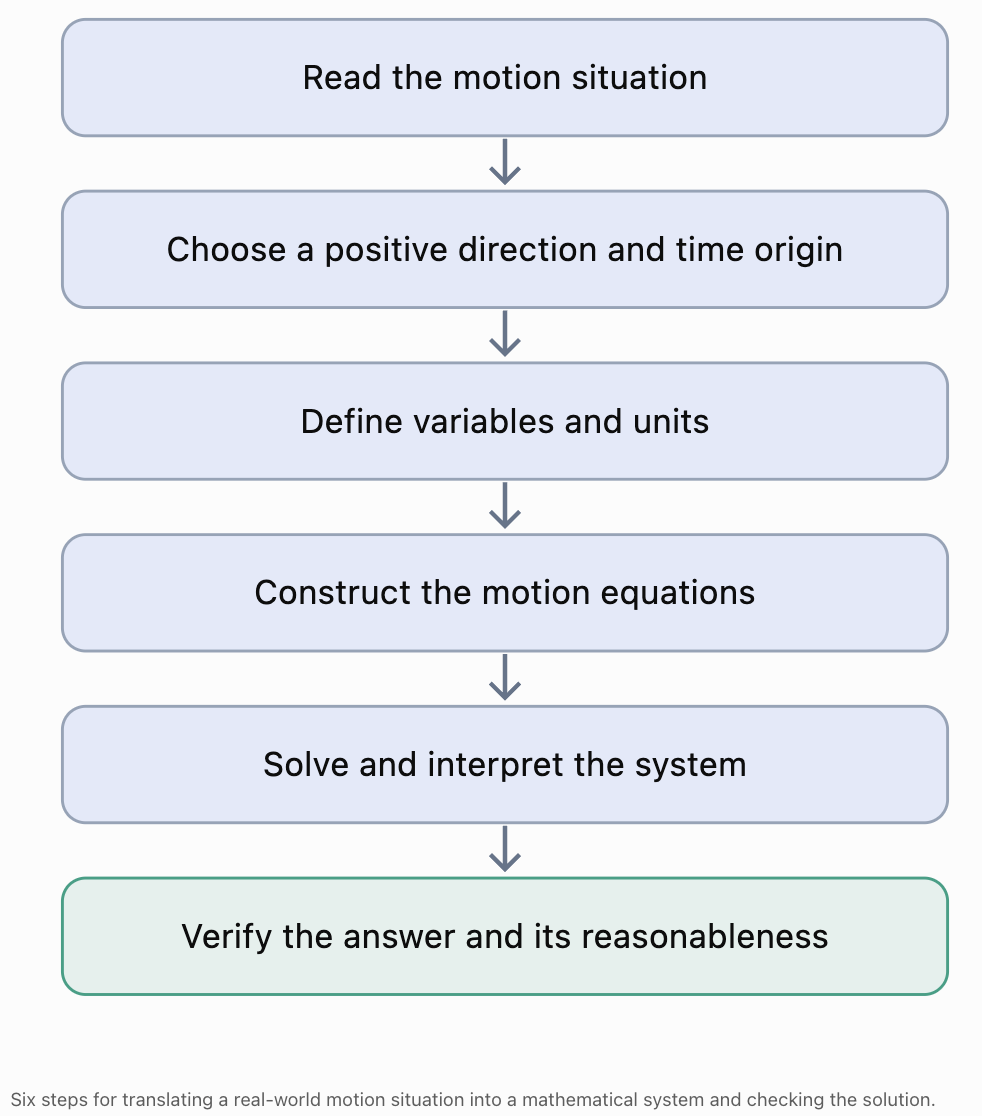
The equations should always reflect the physical situation.
A system may be solved correctly algebraically but still produce an unreasonable answer if the original motion relationships were constructed incorrectly.
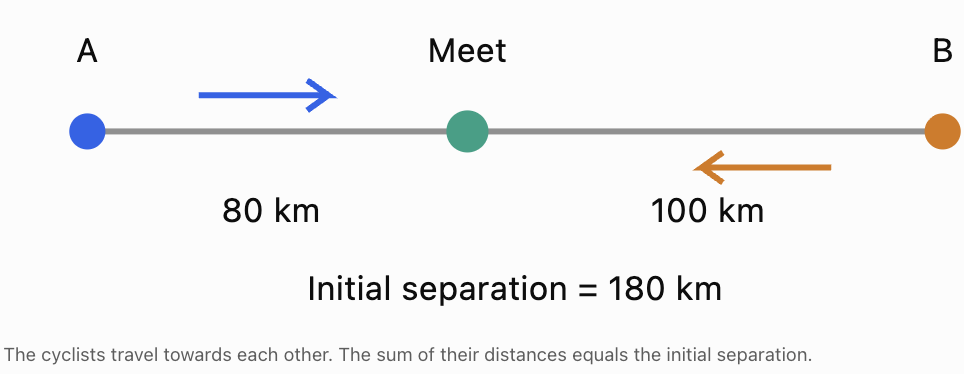
Worked Example: Two Cyclists Travelling Towards Each Other
Two cyclists start at the same time from towns 180 km apart.
Cyclist A travels at 40 km/h.
Cyclist B travels at 50 km/h.
They travel towards each other.
How long will it take them to meet, and how far does each cyclist travel?
Step 1: Define variables
t = time until meeting, in hours
d₁ = distance travelled by Cyclist A, in kilometres
d₂ = distance travelled by Cyclist B, in kilometres
Step 2: Write the distance equations
Cyclist A:
d₁ = 40t
Cyclist B:
d₂ = 50t
Since the cyclists travel towards each other:
d₁ + d₂ = 180
Step 3: Solve
Substitute:
40t + 50t = 180
90t = 180
t = 2
Step 4: Calculate distances
Cyclist A:
d₁ = 40(2) = 80 km
Cyclist B:
d₂ = 50(2) = 100 km
Step 5: Interpret
The cyclists meet after 2 hours.
Cyclist A travels 80 km.
Cyclist B travels 100 km.
Step 6: Verify
80 + 100 = 180 km
Both cyclists travel for 2 hours.
Their distances match their speeds.
Answer: They meet after 2 hours, 80 km from Cyclist A's starting point.
Worked Example: A Faster Car Catching a Slower Car
Car A starts from a town and travels at 60 km/h.
One hour later, Car B leaves the same town travelling in the same direction at 90 km/h.
How long after Car B starts will it catch Car A?
Step 1: Identify the important information
Car A has a one-hour head start.
During that hour, Car A travels:
60 × 1 = 60 km
Therefore, when Car B starts, Car A is already 60 km ahead.
Step 2: Define variables
t = time after Car B starts, in hours
d = distance from the town, in kilometres
Step 3: Write position equations
Car A:
d = 60t + 60
Car B:
d = 90t
At the catch-up point, both cars have the same position.
Step 4: Solve the system
60t + 60 = 90t
60 = 30t
t = 2
Step 5: Find the meeting position
Car B:
d = 90(2)
d = 180 km
Car A:
d = 60(2) + 60
d = 180 km
Step 6: Interpret
Car B catches Car A 2 hours after Car B starts.
This is 3 hours after Car A starts.
They meet 180 km from the town.
Step 7: Verify
Car A:
60 km/h × 3 h = 180 km
Car B:
90 km/h × 2 h = 180 km
Both reach the same position.
Answer: Car B catches Car A after 2 hours, 180 km from the starting town.
Understanding Relative Speed
Relative speed describes how quickly the separation between two objects changes.
Moving towards each other
If two objects move towards each other, their closing speed is the sum of their speeds.
Relative speed = v₁ + v₂
For the cyclists:
40 + 50 = 90 km/h
Time to meet:
180/90 = 2 hours
Moving in the same direction
If a faster object follows a slower object, the closing speed is the difference between their speeds.
Relative speed = Faster speed − Slower speed
For the cars:
90 − 60 = 30 km/h
Initial separation:
60 km
Catch-up time:
60/30 = 2 hours
Relative speed provides a shortcut, but it comes from the same equations used in the system.
Worked Example: Two Trains Travelling Towards Each Other
Two trains depart simultaneously from stations 420 km apart.
Train A travels at 80 km/h.
Train B travels at 60 km/h.
They travel towards each other.
Find the meeting time and location.
Step 1: Define variables
t = time after departure, in hours
x = position measured from Station A, in kilometres
Take the direction from Station A towards Station B as positive.
Step 2: Write position equations
Train A begins at x = 0 and travels in the positive direction:
x = 80t
Train B begins at x = 420 and travels in the negative direction:
x = 420 − 60t
Step 3: Solve
At the meeting point:
80t = 420 − 60t
140t = 420
t = 3
Step 4: Calculate position
x = 80(3)
x = 240 km
Step 5: Verify
Train A travels:
80 × 3 = 240 km
Train B travels:
60 × 3 = 180 km
Total:
240 + 180 = 420 km
Answer: The trains meet after 3 hours, 240 km from Station A and 180 km from Station B.
Worked Example: Two Objects with Different Starting Positions
Two objects move along the same straight track.
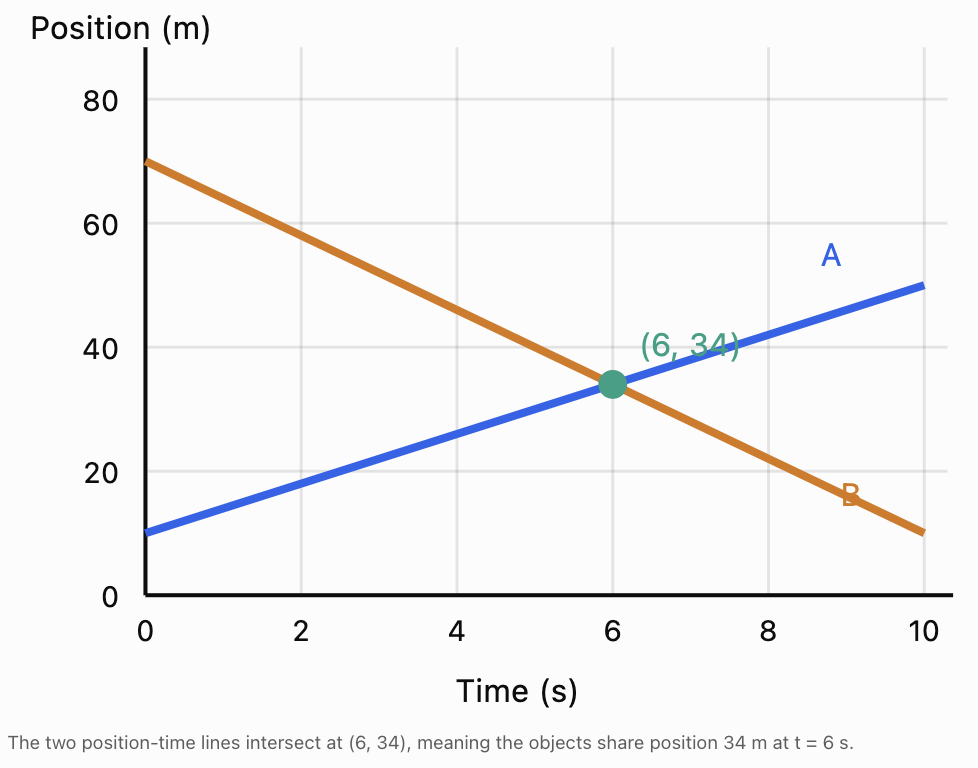
Object A starts at position 10 m and moves at 4 m/s.
Object B starts at position 70 m and moves towards Object A at 6 m/s.
When and where do they meet?
Step 1: Define variables
t = time in seconds
x = position in metres
Choose the direction from Object A towards Object B as positive.
Step 2: Write position equations
Object A:
x = 10 + 4t
Object B:
x = 70 − 6t
Step 3: Solve
10 + 4t = 70 − 6t
10t = 60
t = 6
Step 4: Calculate position
x = 10 + 4(6)
x = 34 m
Check Object B:
x = 70 − 6(6)
x = 34 m
Interpretation
The objects meet after 6 seconds at position 34 m.
Answer: t = 6 s; x = 34 m.
Graphing Motion Systems
Position-time graphs are especially useful for visualising systems of motion equations.
Consider the previous example:
Object A:
x = 10 + 4t
Object B:
x = 70 − 6t
Interpreting the graph
-
The slope of each line represents velocity.
-
A positive slope represents motion in the chosen positive direction.
-
A negative slope represents motion in the opposite direction.
-
The vertical intercept represents initial position.
-
The intersection represents the meeting time and position.
The intersection is a solution to both equations.
Worked Example: Finding Two Unknown Speeds
Two cyclists travel towards each other from towns 150 km apart.
They meet after 2 hours.
Cyclist A travels 15 km/h faster than Cyclist B.
Find their speeds.
Step 1: Define variables
x = speed of Cyclist A in km/h
y = speed of Cyclist B in km/h
Step 2: Write the speed relationship
Cyclist A travels 15 km/h faster:
x − y = 15
Step 3: Write the distance relationship
They travel for 2 hours and cover a combined distance of 150 km.
2x + 2y = 150
Divide by 2:
x + y = 75
Step 4: Solve using elimination
x − y = 15
x + y = 75
Add:
2x = 90
x = 45
Then:
y = 75 − 45
y = 30
Step 5: Interpret
Cyclist A travels at 45 km/h.
Cyclist B travels at 30 km/h.
Step 6: Verify
Difference in speed:
45 − 30 = 15 km/h
Distances:
Cyclist A: 45 × 2 = 90 km
Cyclist B: 30 × 2 = 60 km
Total:
90 + 60 = 150 km
Answer: Cyclist A = 45 km/h; Cyclist B = 30 km/h.
This example is particularly important because the unknown quantities are speeds rather than times or distances.
Worked Example: Journey at Two Different Speeds
A delivery driver travels a total of 180 km.
Part of the journey is completed at 60 km/h.
The remaining distance is completed at 90 km/h.
The total driving time is 2.5 hours.
Find the distance travelled at each speed.
Step 1: Define variables
x = distance travelled at 60 km/h, in kilometres
y = distance travelled at 90 km/h, in kilometres
Step 2: Write the distance equation
x + y = 180
Step 3: Write the time equation
Time = Distance / Speed
Time at 60 km/h:
x/60
Time at 90 km/h:
y/90
Total time:
x/60 + y/90 = 2.5
Step 4: Eliminate fractions
Multiply the second equation by 180:
3x + 2y = 450
The system is:
x + y = 180
3x + 2y = 450
Step 5: Solve
Multiply the first equation by 2:
2x + 2y = 360
Subtract:
x = 90
Then:
y = 180 − 90
y = 90
Step 6: Verify
Total distance:
90 + 90 = 180 km
Total time:
90/60 + 90/90
= 1.5 + 1
= 2.5 hours
Answer: 90 km at 60 km/h and 90 km at 90 km/h.
Important distinction
The driver spends different amounts of time travelling at the two speeds.
Time at 60 km/h = 1.5 hours
Time at 90 km/h = 1 hour
Although the distances are equal, the times are not.
Worked Example: A Boat Travelling Upstream and Downstream
A boat travels along a river.
Its speed in still water is unknown.
The river current also has an unknown speed.
The boat travels downstream at 18 km/h and upstream at 10 km/h.
Find the boat's speed in still water and the speed of the current.
Step 1: Define variables
b = boat speed in still water, in km/h
c = river current speed, in km/h
Step 2: Write equations
When travelling downstream, the current helps the boat:
b + c = 18
When travelling upstream, the current opposes the boat:
b − c = 10
Step 3: Solve using elimination
Add the equations:
(b + c) + (b − c) = 18 + 10
2b = 28
b = 14
Substitute:
14 + c = 18
c = 4
Step 4: Interpret
Boat speed in still water:
14 km/h
River current speed:
4 km/h
Step 5: Verify
Downstream speed:
14 + 4 = 18 km/h
Upstream speed:
14 − 4 = 10 km/h
Answer: Boat speed = 14 km/h; current speed = 4 km/h.
Worked Example: Round Trip with Different Speeds
A boat travels 24 km downstream and then returns 24 km upstream.
The downstream journey takes 1 hour.
The upstream journey takes 2 hours.
Find the boat's speed in still water and the river current speed.
Step 1: Calculate the travel speeds
Downstream:
v = 24/1 = 24 km/h
Upstream:
v = 24/2 = 12 km/h
Step 2: Define variables
b = boat speed in still water
c = current speed
Step 3: Construct the system
b + c = 24
b − c = 12
Step 4: Solve
Add:
2b = 36
b = 18
Then:
c = 24 − 18
c = 6
Step 5: Verify
Downstream:
18 + 6 = 24 km/h
Upstream:
18 − 6 = 12 km/h
Travel times:
24/24 = 1 hour
24/12 = 2 hours
Answer: Boat speed = 18 km/h; current speed = 6 km/h.
Worked Example: Aircraft and Wind Speed
An aircraft travels at 650 km/h relative to the air.
With a tailwind, its ground speed is 720 km/h.
What is the wind speed?
Let:
a = aircraft speed relative to the air
w = wind speed
For a tailwind:
a + w = 720
Given:
a = 650
Substitute:
650 + w = 720
w = 70
Answer: The tailwind speed is 70 km/h.
Now suppose the aircraft's speed relative to the air is unknown, but its ground speed is:
-
720 km/h with a tailwind.
-
580 km/h with an equal-strength headwind.
Then:
a + w = 720
a − w = 580
Add:
2a = 1300
a = 650
Then:
w = 70
Answer: Aircraft airspeed = 650 km/h; wind speed = 70 km/h.
This simplified model assumes the aircraft flies directly along or against a steady wind.
Worked Example: Two Runners on a Circular Track
Two runners start together at the same point on a 400 m circular track.
They run in the same direction.
Runner A runs at 6 m/s.
Runner B runs at 4 m/s.
When will Runner A first lap Runner B?
Step 1: Identify the important relationship
Runner A must travel one complete lap farther than Runner B.
Therefore:
Distance A − Distance B = 400 m
Step 2: Define variables
t = time in seconds
d₁ = distance travelled by Runner A
d₂ = distance travelled by Runner B
Step 3: Construct equations
d₁ = 6t
d₂ = 4t
d₁ − d₂ = 400
Step 4: Solve
6t − 4t = 400
2t = 400
t = 200
Step 5: Verify
Runner A travels:
6(200) = 1200 m
Runner B travels:
4(200) = 800 m
Difference:
1200 − 800 = 400 m
Answer: Runner A first laps Runner B after 200 seconds, or 3 minutes 20 seconds.
This example shows how relative speed can be used for circular motion when both runners maintain constant speeds.
Worked Example: Determining Whether Two Objects Will Meet
Two cars travel along the same straight road.
Car A starts at position 20 km and travels at 60 km/h.
Car B starts at position 100 km and travels at 80 km/h.
Both travel in the same direction.
Will Car A ever catch Car B after the start of the observation?
Step 1: Write position equations
Car A:
x = 20 + 60t
Car B:
x = 100 + 80t
Step 2: Solve the system
20 + 60t = 100 + 80t
−80 = 20t
t = −4
Step 3: Interpret
The algebraic intersection occurs at t = −4 hours.
However, t represents time after the observation begins.
Therefore, the practical domain is:
t ≥ 0
A negative meeting time lies outside the relevant domain.
Physical explanation
Car B starts ahead of Car A and travels faster.
The separation increases rather than decreases.
Answer: Car A will not catch Car B after the observation begins.
This is an important example of a mathematically valid intersection that does not represent a future meeting.
Solving Motion Problems Using Graphs
Graphs are useful because they show how motion changes over time.
For constant-velocity motion, the position-time graph is a straight line.
The general equation is:
x = x₀ + vt
This has the same mathematical structure as:
y = mx + b
The correspondence is:
|
Linear graph feature |
Motion interpretation |
|---|---|
|
x-axis |
Time |
|
y-axis |
Position |
|
Slope |
Velocity |
|
y-intercept |
Initial position |
|
Intersection |
Same position at the same time |
|
Parallel lines |
Equal velocities |
|
Coincident lines |
Same position at every time |
Parallel position-time graphs
Suppose:
Object A:
x = 5t + 10
Object B:
x = 5t + 30
Both objects move at 5 m/s.
Their initial positions differ by 20 m.
The graphs are parallel.
The objects never meet because they maintain a constant separation of 20 m.
Coincident position-time graphs
Suppose:
Object A:
x = 5t + 10
Object B:
2x = 10t + 20
Simplify Object B:
x = 5t + 10
The equations are identical.
Both objects have the same position at every time in the model.
Their position-time graphs are coincident.
Intersecting position-time graphs
Suppose:
Object A:
x = 4t + 10
Object B:
x = 2t + 30
Set equal:
4t + 10 = 2t + 30
2t = 20
t = 10
Position:
x = 4(10) + 10
x = 50 m
The objects meet after 10 seconds at position 50 m.
Choosing the Correct Equations
Different motion problems require different relationships.
|
Situation |
Useful relationship |
|---|---|
|
Constant speed |
d = vt |
|
Constant velocity |
x = x₀ + vt |
|
Moving towards each other |
d₁ + d₂ = initial separation |
|
Catching up |
x₁ = x₂ |
|
Same starting point, opposite directions |
Separation = d₁ + d₂ |
|
Two-stage journey |
d₁ + d₂ = total distance |
|
Two-stage travel time |
t₁ + t₂ = total time |
|
Boat downstream |
b + c = downstream speed |
|
Boat upstream |
b − c = upstream speed |
|
Aircraft with tailwind |
a + w = ground speed |
|
Aircraft with headwind |
a − w = ground speed |
These equations are useful starting points, but the exact system must always match the situation described.
Interpreting Motion Solutions
A solution should always include the correct units.
For example, if a system produces:
t = 4
x = 240
and t is measured in hours while x is measured in kilometres, the interpretation is:
"The objects meet after 4 hours at position 240 km."
Simply writing "(4, 240)" is incomplete because it does not explain the physical meaning.
Important questions
After solving, ask:
-
Does the time represent seconds, minutes, or hours?
-
Is the position measured from the correct starting point?
-
Is the direction correct?
-
Is the time positive?
-
Does the object travel a realistic distance?
-
Does the solution satisfy both motion equations?
-
Does the solution occur within the stated time interval?
These questions help distinguish a correct mathematical calculation from a meaningful physical answer.
Checking Whether Answers Are Reasonable
Checking travel time
If two objects start 100 km apart and approach each other at a combined speed of 50 km/h, they should meet after:
100/50 = 2 hours
An answer of 20 hours would be unreasonable.
Checking meeting position
If two objects meet between towns 200 km apart, the distances travelled towards each other should add to 200 km.
Checking speed
If a car travels 120 km in 2 hours, its average speed is:
120/2 = 60 km/h
A result of 600 km/h would suggest an error in the calculation or units.
Checking negative values
Negative position can be valid if the coordinate system allows it.
Negative velocity can also be valid because it indicates direction.
However, negative elapsed time is generally not valid when the question asks about events after the starting moment.
Checking assumptions
Most introductory motion systems assume constant speeds or velocities.
In real life, vehicles accelerate, decelerate, stop, and change direction.
The model is useful only when its assumptions are reasonable for the situation.
Real-World Applications
Transport planning
Travel equations can estimate meeting times, journey durations, and distances.
They can help compare routes and travel speeds.
Logistics and delivery
Businesses use motion models to estimate delivery times, vehicle positions, and travel schedules.
Sports
Relative speed can be used to study runners, cyclists, and racing vehicles.
Aviation
Aircraft ground speed depends on airspeed and wind velocity.
Marine transport
Boat speed relative to the ground depends on the boat's speed through water and the river current.
Physics and engineering
Position-time equations are used to model moving objects and understand their relative motion.
More advanced models include acceleration and nonlinear motion.
Common Mistakes
Confusing distance with displacement
Distance is the total path length, while displacement includes direction.
Confusing speed with velocity
Speed is scalar; velocity includes direction.
Using inconsistent units
For example, multiplying km/h by seconds without converting time will produce an incorrect result.
Forgetting a head start
If one object begins earlier, it may already be some distance ahead when the second starts.
Adding speeds when they should be subtracted
For objects moving towards each other, closing speed is usually the sum of speeds.
For objects moving in the same direction, closing speed is the difference.
Using the wrong sign for velocity
Motion in the negative direction should have negative velocity in the position equation.
Confusing meeting time with total travel time
An object that starts earlier has travelled longer by the time the objects meet.
Assuming every algebraic intersection represents a future meeting
A negative meeting time may fall outside the problem's domain.
Ignoring initial positions
The equation x = vt applies when the initial position is zero.
Otherwise, use x = x₀ + vt.
Failing to verify
Always substitute the answer into both original motion equations.
Key Terms
-
Motion: A change in position over time.
-
Distance: The total length of the path travelled.
-
Displacement: The change in position, including direction.
-
Speed: Distance travelled per unit time.
-
Velocity: Rate of change of displacement.
-
Average speed: Total distance divided by total time.
-
Constant speed: Motion in which speed does not change.
-
Constant velocity: Motion with unchanged speed and direction.
-
Position: Location relative to a chosen reference point.
-
Initial position: Position at the starting time.
-
Relative speed: The rate at which separation between objects changes.
-
Closing speed: The rate at which two objects approach each other.
-
Meeting point: The position where two objects occupy the same location at the same time.
-
Catch-up time: The time required for a faster object to reach a slower object.
-
Position-time graph: A graph showing position as a function of time.
-
Slope: The gradient of a line; velocity on a position-time graph.
-
System of equations: Two or more equations solved simultaneously.
-
Substitution: Solving by replacing one variable with an equivalent expression.
-
Elimination: Solving by combining equations to remove a variable.
-
Domain: The set of allowed input values.
-
Verification: Checking that the answer satisfies the original conditions.
Key Takeaways
-
Motion problems can be represented using systems of linear equations.
-
The fundamental relationship is d = vt.
-
Constant-velocity position equations take the form x = x₀ + vt.
-
Variables must be clearly defined with appropriate units.
-
Objects moving towards each other have a closing speed equal to the sum of their speeds.
-
Objects moving in the same direction may have a closing speed equal to the difference between their speeds.
-
A meeting point occurs when two objects have the same position at the same time.
-
Position-time graphs allow motion systems to be interpreted visually.
-
The slope of a position-time graph represents velocity.
-
Substitution and elimination can determine unknown speeds, times, and positions.
-
Solutions must be interpreted using the original context.
-
Every answer should be verified for mathematical correctness and physical reasonableness.
Check Your Understanding
Recall and Understanding
1. State the relationship between distance, speed, and time.
2. Explain the difference between distance and displacement.
3. Why must units be consistent when solving motion problems?
4. What does the intersection of two position-time graphs represent?
5. Explain the difference between relative speed for objects moving towards each other and objects moving in the same direction.
Application
6. Two cyclists start 120 km apart and travel towards each other at 25 km/h and 35 km/h. How long will it take them to meet, and how far will each cyclist travel?
7. A car travels at 70 km/h. Another car starts from the same location 2 hours later at 105 km/h. How long after the second car starts will it catch the first car?
8. Two trains start 360 km apart and travel towards each other at 80 km/h and 100 km/h. Determine their meeting time and the distance travelled by each train.
9. A boat travels downstream at 24 km/h and upstream at 16 km/h. Find the boat's speed in still water and the river current speed.
10. A driver travels 240 km. Part of the journey is completed at 60 km/h and the remainder at 80 km/h. The total driving time is 3.5 hours. Find the distance travelled at each speed.
Analysis and Challenge
11. Two runners start at the same point on a 400 m circular track and run in the same direction at 7 m/s and 5 m/s. When will the faster runner first lap the slower runner?
12. Two objects move according to:
x = 15 + 6t
x = 75 − 4t
Find the meeting time and position.
13. Two vehicles travel in the same direction:
Vehicle A: x = 20 + 50t
Vehicle B: x = 100 + 70t
Determine whether Vehicle A catches Vehicle B for t ≥ 0.
14. Two cyclists travel towards each other from towns 210 km apart. They meet after 3 hours. One cyclist travels 10 km/h faster than the other. Find their speeds.
15. An aircraft travels at 760 km/h with a tailwind and 640 km/h against a headwind of the same magnitude. Find its speed relative to the air and the wind speed.
Answers to Check Your Understanding
1.
Distance = Speed × Time
d = vt
2. Distance is the total path length travelled. Displacement is the change in position and includes direction.
3. Units must be consistent so that the calculated quantities have the correct dimensions. For example, km/h multiplied by hours gives kilometres.
4. The intersection represents the time and position at which two objects occupy the same location.
5. When objects move towards each other, the closing speed is the sum of their speeds. When they move in the same direction, the closing speed is the difference between their speeds, provided the faster object is behind.
6.
Combined speed:
25 + 35 = 60 km/h
Meeting time:
t = 120/60 = 2 hours
Distances:
Cyclist A:
25(2) = 50 km
Cyclist B:
35(2) = 70 km
Verification:
50 + 70 = 120 km
Answer: They meet after 2 hours. The cyclists travel 50 km and 70 km.
7.
The first car's head start is:
70 × 2 = 140 km
Let t = time after the second car starts.
First car position:
d = 70t + 140
Second car position:
d = 105t
Set equal:
70t + 140 = 105t
140 = 35t
t = 4
Answer: The second car catches the first after 4 hours, or 6 hours after the first car departed.
Verification:
First car: 70 × 6 = 420 km
Second car: 105 × 4 = 420 km
8.
Combined speed:
80 + 100 = 180 km/h
Meeting time:
t = 360/180 = 2 hours
Train A distance:
80 × 2 = 160 km
Train B distance:
100 × 2 = 200 km
Answer: They meet after 2 hours, having travelled 160 km and 200 km.
9.
Let b = boat speed in still water and c = current speed.
b + c = 24
b − c = 16
Add:
2b = 40
b = 20
Then:
c = 4
Answer: Boat speed = 20 km/h; current speed = 4 km/h.
10.
Let x = distance at 60 km/h and y = distance at 80 km/h.
x + y = 240
x/60 + y/80 = 3.5
Multiply the second equation by 240:
4x + 3y = 840
Multiply the first equation by 3:
3x + 3y = 720
Subtract:
x = 120
Then:
y = 120
Verification:
120/60 + 120/80
= 2 + 1.5
= 3.5 hours
Answer: 120 km at each speed.
11.
Relative speed:
7 − 5 = 2 m/s
The faster runner must gain one full lap:
400 m
Time:
t = 400/2
t = 200 seconds
Answer: 200 seconds, or 3 minutes 20 seconds.
12.
Set positions equal:
15 + 6t = 75 − 4t
10t = 60
t = 6 seconds
Position:
x = 15 + 6(6)
x = 51 m
Verification:
75 − 4(6) = 51 m
Answer: They meet after 6 seconds at position 51 m.
13.
Set positions equal:
20 + 50t = 100 + 70t
−80 = 20t
t = −4
The solution lies outside the domain t ≥ 0.
Vehicle B starts ahead and moves faster.
Answer: Vehicle A never catches Vehicle B after the observation begins.
14.
Let x = faster speed and y = slower speed.
Speed difference:
x − y = 10
Combined distance:
3x + 3y = 210
Divide by 3:
x + y = 70
Add equations:
2x = 80
x = 40
Then:
y = 30
Verification:
40 − 30 = 10 km/h
3(40) + 3(30) = 120 + 90 = 210 km
Answer: The cyclists travel at 40 km/h and 30 km/h.
15.
Let a = aircraft speed relative to the air and w = wind speed.
With tailwind:
a + w = 760
Against headwind:
a − w = 640
Add:
2a = 1400
a = 700
Substitute:
700 + w = 760
w = 60
Verification:
700 + 60 = 760 km/h
700 − 60 = 640 km/h
Answer: Aircraft airspeed = 700 km/h; wind speed = 60 km/h.
Final Summary
Distance, speed, and motion problems demonstrate how systems of equations can model moving objects and predict when and where they meet.
By combining the relationship d = vt with position equations and information about direction, starting positions, and travel times, we can solve a wide variety of practical problems.
These methods are useful in transport, logistics, sports, aviation, marine travel, and physics.
The central principle is that two objects meet when they occupy the same position at the same time. Systems of equations allow us to determine exactly when and where that happens, provided the model's assumptions are satisfied.