Special Systems and Applications
1. Parallel and Coincident Lines
Learning outcomes
- I can identify parallel lines from equations.
- I can identify coincident lines.
- I can relate slopes to the number of solutions.
- I can determine whether a system has no solution or infinitely many solutions.
- I can explain these relationships graphically.
Introduction
When solving a system of linear equations, we are trying to find values of x and y that satisfy two equations at the same time.
Graphically, this means finding points that lie on both lines.
Some pairs of lines intersect at exactly one point. Others never intersect, while some lie directly on top of each other.
These three possibilities determine how many solutions a system of linear equations has.
-
Intersecting lines: Exactly one solution.
-
Parallel lines: No solution.
-
Coincident lines: Infinitely many solutions.
Understanding these relationships allows us to determine the number of solutions without always needing to draw a graph or solve the equations completely.
The key mathematical ideas involve slope, y-intercepts, and the relationship between equations representing straight lines.
Understanding Linear Equations
A linear equation in two variables represents a straight line when graphed on the coordinate plane.
One common form is:
y = mx + b
where:
-
m is the slope or gradient.
-
b is the y-intercept.
-
x is the independent variable.
-
y is the dependent variable.
The slope tells us how steep the line is and whether it rises or falls.
The y-intercept tells us where the line crosses the y-axis.
Example
Consider:
y = 2x + 3
The slope is:
m = 2
The y-intercept is:
b = 3
The line rises by 2 units for every increase of 1 unit in x and crosses the y-axis at (0, 3).
Now consider:
y = 2x − 1
This line also has slope 2, but its y-intercept is −1.
Both lines rise at the same rate, but they cross the y-axis at different points.
This creates an important relationship: two distinct nonvertical lines with the same slope are parallel.
What Are Parallel Lines?
Parallel lines are distinct straight lines in the same plane that never intersect.
They remain the same perpendicular distance apart.
For nonvertical lines, parallel lines have equal slopes but different y-intercepts.
Example
Consider:
Line A: y = 2x + 3
Line B: y = 2x − 1
Compare their slopes:
m₁ = 2
m₂ = 2
The slopes are equal.
Compare their y-intercepts:
b₁ = 3
b₂ = −1
The y-intercepts are different.
Therefore, the lines are parallel.
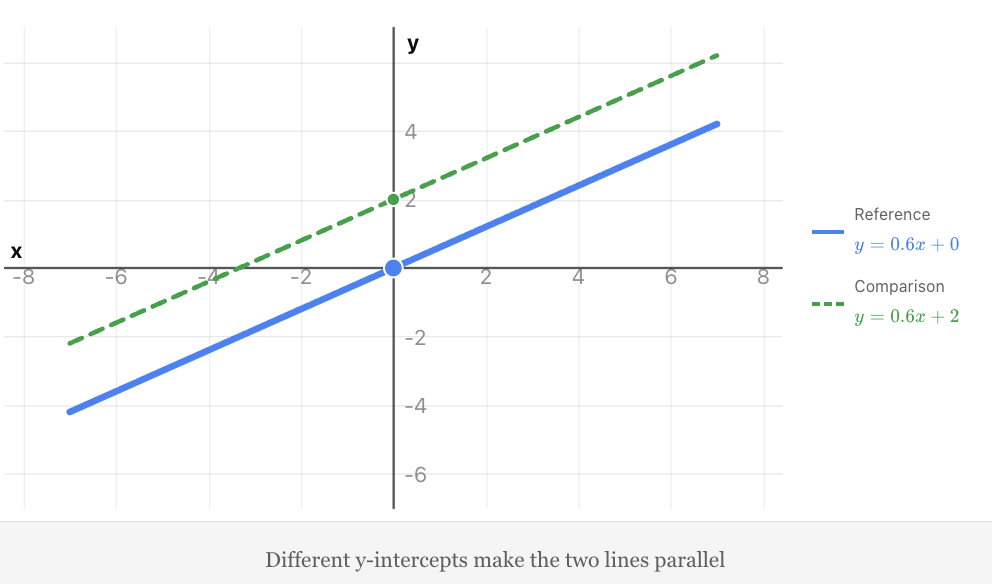
The visualization illustrates how changing the y-intercept moves a line upward or downward without changing its slope.
As long as the lines have the same slope and different y-intercepts, they remain parallel.
Mathematical condition
For two nonvertical lines:
Line 1: y = m₁x + b₁
Line 2: y = m₂x + b₂
The lines are distinct and parallel when:
m₁ = m₂ and b₁ ≠ b₂
Equal slopes mean the lines have the same direction.
Different y-intercepts mean they occupy different positions.
Identifying Parallel Lines from Equations
The easiest way to identify parallel nonvertical lines is to compare their slopes.
Worked Example: Equations in slope-intercept form
Determine whether the following lines are parallel.
Line A: y = 3x + 5
Line B: y = 3x − 2
Step 1: Identify the slopes
For Line A:
m₁ = 3
For Line B:
m₂ = 3
Step 2: Compare the y-intercepts
For Line A:
b₁ = 5
For Line B:
b₂ = −2
Step 3: State the conclusion
The slopes are equal, but the y-intercepts are different.
Therefore:
The lines are parallel.
They never intersect.
Identifying Parallel Lines in Standard Form
Linear equations are not always written in slope-intercept form.
They may be written as:
Ax + By = C
To compare slopes, we can rearrange the equations into y = mx + b.
Worked Example
Determine whether these lines are parallel:
Line A: 2x + y = 7
Line B: 4x + 2y = 6
Step 1: Rearrange Line A
2x + y = 7
Subtract 2x:
y = −2x + 7
Slope:
m₁ = −2
Step 2: Rearrange Line B
4x + 2y = 6
Subtract 4x:
2y = −4x + 6
Divide by 2:
y = −2x + 3
Slope:
m₂ = −2
Step 3: Compare
Both slopes equal −2.
The y-intercepts are 7 and 3.
Therefore:
The lines are parallel.
Shortcut using standard form
For a nonvertical line written as:
Ax + By = C
where B ≠ 0:
y = −(A/B)x + C/B
Therefore, the slope is:
m = −A/B
This allows us to compare slopes without fully rearranging each equation.
However, we must still check whether the equations represent different lines or the same line.
What Are Coincident Lines?
Coincident lines are two equations that represent exactly the same straight line.
They overlap completely.
Every point on one line is also a point on the other.
For example:
Line A: y = 2x + 3
Line B: 2y = 4x + 6
Rearrange Line B:
2y = 4x + 6
Divide by 2:
y = 2x + 3
This is identical to Line A.
Therefore, the lines are coincident.
Important distinction
Parallel lines and coincident lines both have equal slopes, but they are not the same situation.
-
Distinct parallel lines never meet.
-
Coincident lines overlap at every point.
For nonvertical lines, coincident lines have both equal slopes and equal y-intercepts.
Mathematical condition
Two nonvertical lines are coincident when:
m₁ = m₂ and b₁ = b₂
This means they have exactly the same equation when written in slope-intercept form.
Identifying Coincident Lines from Equations
Worked Example
Determine whether the following equations represent coincident lines.
Equation A:
3x + 2y = 12
Equation B:
6x + 4y = 24
Step 1: Compare the equations
Multiply Equation A by 2:
2(3x + 2y) = 2(12)
This gives:
6x + 4y = 24
This is exactly Equation B.
Step 2: State the conclusion
Both equations represent the same line.
Therefore:
The lines are coincident.
Another method: Rearranging into slope-intercept form
Equation A:
3x + 2y = 12
2y = −3x + 12
y = −1.5x + 6
Equation B:
6x + 4y = 24
4y = −6x + 24
y = −1.5x + 6
Both equations have:
-
Slope = −1.5
-
y-intercept = 6
Therefore, the lines are coincident.
Comparing Parallel and Coincident Lines
|
Feature |
Parallel lines |
Coincident lines |
|---|---|---|
|
Slopes |
Equal |
Equal |
|
y-intercepts (nonvertical) |
Different |
Equal |
|
Graphs |
Separate lines |
Same line |
|
Intersection points |
None |
Infinitely many |
|
Solutions to the system |
No solution |
Infinitely many solutions |
The key difference is whether the equations represent different positions or exactly the same line.
Systems of Linear Equations
A system of linear equations consists of two or more linear equations considered together.
For example:
y = 2x + 1
y = −x + 7
A solution must satisfy both equations simultaneously.
Graphically, the solution is a point where the two lines intersect.
For two linear equations in x and y, there are three possibilities:
-
Exactly one solution.
-
No solution.
-
Infinitely many solutions.
Intersecting Lines: One Solution
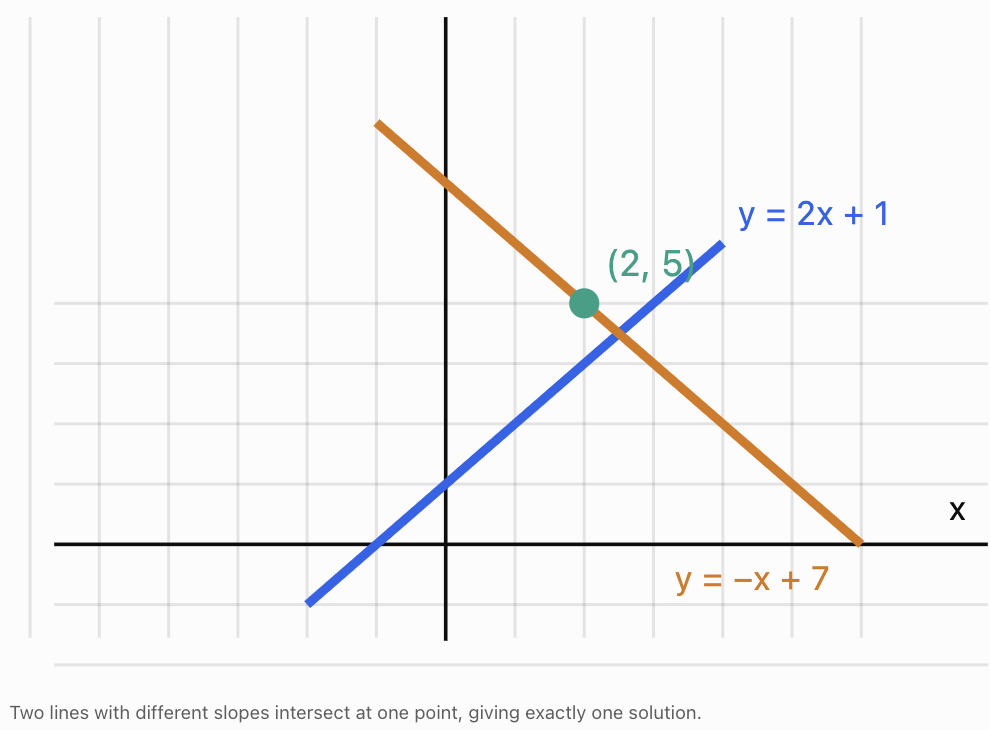
Two nonvertical lines with different slopes intersect at exactly one point.
Consider:
Line A: y = 2x + 1
Line B: y = −x + 7
The slopes are:
m₁ = 2
m₂ = −1
Because the slopes are different, the lines intersect exactly once.
Worked Example: Finding the intersection
Set the equations equal:
2x + 1 = −x + 7
Add x to both sides:
3x + 1 = 7
Subtract 1:
3x = 6
Divide by 3:
x = 2
Substitute into either equation:
y = 2(2) + 1
y = 5
Therefore:
Solution: (2, 5)
Check using the second equation:
y = −2 + 7 = 5
The point (2, 5) satisfies both equations.
Parallel Lines: No Solution
Consider the system:
y = 2x + 1
y = 2x + 5
Both lines have slope 2, but different y-intercepts.
Therefore, they are parallel.
Since parallel lines never intersect, there is no point that satisfies both equations.
The system has no solution.
Algebraic explanation
Set the equations equal:
2x + 1 = 2x + 5
Subtract 2x from both sides:
1 = 5
This statement is false.
No value of x can make it true.
Therefore:
No solution exists.
Why a contradiction means no solution
When solving a system, the variables may disappear and leave an impossible statement.
Examples include:
-
0 = 4
-
3 = −2
-
5 = 10
These contradictions show that the equations cannot both be satisfied.
For a system of two linear equations in two variables representing distinct parallel lines, the solution set is empty.
Coincident Lines: Infinitely Many Solutions
Consider:
y = 3x − 2
2y = 6x − 4
Rearrange the second equation:
y = 3x − 2
Both equations are identical.
Therefore, every point on the line satisfies both equations.
Examples include:
|
x |
y = 3x − 2 |
Point |
|---|---|---|
|
0 |
−2 |
(0, −2) |
|
1 |
1 |
(1, 1) |
|
2 |
4 |
(2, 4) |
|
−1 |
−5 |
(−1, −5) |
All these points satisfy both equations.
There are infinitely many possible x-values, so there are infinitely many solutions.
Algebraic explanation
Set the equations equal:
3x − 2 = 3x − 2
Subtract 3x:
−2 = −2
This is always true.
The equation is an identity.
It confirms that the two equations describe the same line.
Important distinction
An identity such as 0 = 0 indicates infinitely many solutions in this situation because the original equations describe the same line.
It does not mean that every ordered pair (x, y) is a solution.
Only points lying on the shared line satisfy the system.
For example, for y = 3x − 2:
(0, −2) is a solution.
But (0, 5) is not.
Comparing the Three Possible Systems
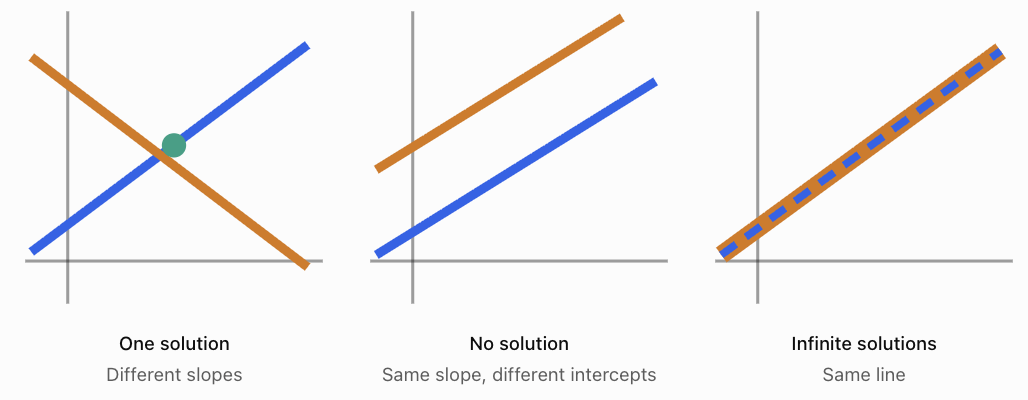
|
Relationship |
Slope comparison |
Number of solutions |
|---|---|---|
|
Intersecting |
Different slopes |
One |
|
Parallel |
Equal slopes, different intercepts |
Zero |
|
Coincident |
Equal slopes, equal intercepts |
Infinitely many |
This comparison applies directly to nonvertical lines.
Vertical lines require a slightly different approach because their slopes are undefined.
Special Case: Vertical Lines
Vertical lines have equations of the form:
x = a
For example:
x = 2
This represents every point whose x-coordinate is 2.
Examples include:
(2, 0), (2, 3), and (2, −5).
Vertical lines do not have a defined slope.
Therefore, we cannot use the ordinary slope comparison formula to classify them.
Parallel vertical lines
Consider:
x = 2
x = 5
These are distinct vertical lines.
They never intersect.
Therefore:
The system has no solution.
Coincident vertical lines
Consider:
x = 3
2x = 6
The second equation simplifies to:
x = 3
Both equations represent the same vertical line.
Therefore:
The system has infinitely many solutions.
Intersecting vertical and nonvertical lines
Consider:
x = 2
y = 3x + 1
Substitute x = 2:
y = 3(2) + 1
y = 7
Therefore:
Solution: (2, 7)
A vertical line and a nonvertical line intersect exactly once.
Classifying Systems in Standard Form
A system may be written as:
A₁x + B₁y = C₁
A₂x + B₂y = C₂
We can classify the system without graphing.
Different line directions
Calculate:
D = A₁B₂ − A₂B₁
If D ≠ 0, the lines intersect at exactly one point.
This expression is called the determinant of the coefficient matrix.
When D = 0
If D = 0, the coefficient pairs are proportional.
The lines are either parallel or coincident.
We then check whether the constants follow the same proportional relationship.
For example:
2x + 3y = 8
4x + 6y = 16
Every coefficient and the constant in the second equation is twice the corresponding value in the first.
Therefore, the lines are coincident.
But:
2x + 3y = 8
4x + 6y = 10
The variable coefficients are proportional, but the constants are not.
Therefore, the lines are distinct and parallel.
Summary
-
D ≠ 0: one solution.
-
D = 0 and the complete equations are proportional: infinitely many solutions.
-
D = 0 and the complete equations are not proportional: no solution.
This method works for vertical as well as nonvertical lines, provided each equation genuinely represents a line.
Solving Systems Using Substitution
Substitution is an algebraic method for solving systems of equations.
It can also reveal whether a system has no solution or infinitely many solutions.
Worked Example: No solution
Solve:
y = 4x + 2
2y = 8x − 6
Substitute y = 4x + 2 into the second equation:
2(4x + 2) = 8x − 6
Expand:
8x + 4 = 8x − 6
Subtract 8x:
4 = −6
This is a contradiction.
Therefore:
The system has no solution.
The lines are parallel.
Worked Example: Infinitely many solutions
Solve:
y = −2x + 5
3y = −6x + 15
Substitute:
3(−2x + 5) = −6x + 15
Expand:
−6x + 15 = −6x + 15
Subtract the matching terms:
0 = 0
This is an identity.
Therefore:
The system has infinitely many solutions.
The lines are coincident.
Solving Systems Using Elimination
Elimination is another method for solving systems.
It involves adding or subtracting equations to remove one variable.
Worked Example: Parallel lines
Solve:
2x + 3y = 12
4x + 6y = 30
Multiply the first equation by 2:
4x + 6y = 24
Compare with the second equation:
4x + 6y = 30
Subtract:
0 = 6
This is impossible.
Therefore:
No solution.
The lines are parallel.
Worked Example: Coincident lines
Solve:
3x − 2y = 8
6x − 4y = 16
Multiply the first equation by 2:
6x − 4y = 16
This is exactly the second equation.
Subtracting gives:
0 = 0
Therefore:
Infinitely many solutions.
The lines are coincident.
A Systematic Method for Classifying Two Lines
When given two linear equations, follow these steps.
Step 1: Check whether either line is vertical.
If both are vertical, compare their x-values.
If only one is vertical, the lines intersect once.
Step 2: Rearrange nonvertical equations into slope-intercept form.
Write both as:
y = mx + b
Step 3: Compare the slopes.
If the slopes are different, the lines intersect once.
Step 4: If the slopes are equal, compare the y-intercepts.
Different y-intercepts mean distinct parallel lines.
Equal y-intercepts mean coincident lines.
Step 5: State the number of solutions.
-
Intersecting: one.
-
Parallel: zero.
-
Coincident: infinitely many.
Step 6: Explain the graphical meaning.
Describe whether the lines cross once, never cross, or overlap completely.
Worked Example: Classifying Several Systems
Determine the number of solutions for each system.
System A
y = 5x + 1
y = −2x + 4
Slopes:
5 and −2
The slopes are different.
Therefore:
One solution.
System B
y = −3x + 7
y = −3x − 2
Slopes:
−3 and −3
The y-intercepts differ.
Therefore:
No solution.
System C
2x + y = 9
4x + 2y = 18
Multiply the first equation by 2:
4x + 2y = 18
The equations are identical.
Therefore:
Infinitely many solutions.
System D
x = 4
x = −1
These are distinct vertical lines.
Therefore:
No solution.
System E
x = 2
y = 3x − 5
Substitute x = 2:
y = 6 − 5 = 1
Therefore:
One solution: (2, 1).
Real-World Application: Comparing Two Pricing Plans
Suppose two companies offer equipment rental.
Company A charges a fixed fee of $20 plus $5 per hour.
Company B charges a fixed fee of $35 plus $5 per hour.
Their cost equations are:
A = 5h + 20
B = 5h + 35
Both have slope 5.
However, their y-intercepts are different.
Therefore, their graphs are parallel.
Interpretation
Both companies charge the same additional amount per hour.
However, Company B always charges $15 more than Company A.
There is no rental duration for which the two costs are equal.
This is a real-world example of parallel lines representing a system with no solution.
Real-World Application: Equivalent Pricing Plans
Suppose another company offers:
Plan A:
C = 4h + 12
Plan B:
2C = 8h + 24
Simplify Plan B:
C = 4h + 12
Both plans have the same equation.
Their graphs are coincident.
Interpretation
The two plans have identical costs for every rental duration.
There are infinitely many combinations of rental time and cost satisfying both equations.
The equations look different, but they describe exactly the same pricing relationship.
Real-World Application: Motion at Constant Velocity
Suppose two objects move along the same straight track.
Their positions are modeled by:
Object A:
d₁(t) = 3t + 5
Object B:
d₂(t) = 3t + 12
where:
-
d is position in metres.
-
t is time in seconds.
Both objects move at a constant velocity of 3 m/s.
Their initial positions differ by 7 m.
Therefore, their position-time graphs are parallel.
Interpretation
The objects move at the same velocity and maintain a constant separation of 7 m.
They never occupy the same position at the same time under the model.
Now suppose Object B instead follows:
d₂(t) = 3t + 5
The equations would be identical.
The position-time graphs would be coincident.
The two objects would have the same modeled position at every time.
Common Mistakes
Assuming equal slopes always mean distinct parallel lines
Equal slopes may also indicate coincident lines.
Always compare intercepts or check whether the equations are equivalent.
Comparing slopes before rearranging equations correctly
For example:
2x + y = 5
has slope −2, not 2.
Assuming different y-intercepts always mean parallel lines
Lines with different slopes can have different y-intercepts and still intersect.
Confusing no solution with infinitely many solutions
No solution means the lines never meet.
Infinitely many solutions means the lines overlap completely.
Treating 0 = 0 as a unique solution
An identity does not identify one ordered pair. For two coincident lines, it means every point on the shared line is a solution.
Treating 0 = 5 as a valid solution
A contradiction means the system is inconsistent.
Ignoring vertical lines
Vertical lines have undefined slopes and must be handled separately.
Assuming two equations that look different represent different lines
Multiplying every term of an equation by the same nonzero number does not change its graph.
Confusing the number of intersection points with the number of equations
Two equations do not necessarily have two solutions.
Key Terms
-
Linear equation: An equation whose graph is a straight line.
-
System of linear equations: Two or more linear equations considered simultaneously.
-
Solution of a system: An ordered pair satisfying every equation in the system.
-
Parallel lines: Distinct coplanar lines that never intersect.
-
Coincident lines: Lines that overlap completely.
-
Intersecting lines: Lines that meet at a point.
-
Slope: The rate of change of a line.
-
Gradient: Another term for slope.
-
y-intercept: The point where a line crosses the y-axis.
-
Slope-intercept form: A linear equation written as y = mx + b.
-
Standard form: A linear equation written as Ax + By = C.
-
Consistent system: A system with at least one solution.
-
Inconsistent system: A system with no solution.
-
Independent system: A system of two linear equations with exactly one solution.
-
Dependent system: A system whose equations represent the same line and have infinitely many solutions.
-
Contradiction: A false mathematical statement obtained during solving.
-
Identity: A statement that is true for all relevant values of its variables.
-
Substitution: A method of solving equations by replacing one expression with an equivalent expression.
-
Elimination: A method of solving systems by removing a variable through addition or subtraction.
-
Vertical line: A line with equation x = a and undefined slope.
-
Determinant: A numerical expression used to analyse whether a linear system has a unique solution.
Key Takeaways
-
Two distinct nonvertical lines are parallel when they have equal slopes and different y-intercepts.
-
Coincident lines have equal slopes and equal y-intercepts.
-
Parallel lines never intersect and produce no solution.
-
Coincident lines overlap completely and produce infinitely many solutions.
-
Nonvertical lines with different slopes intersect exactly once.
-
Vertical lines have undefined slopes and must be classified using their equations.
-
A contradiction such as 0 = 5 indicates no solution.
-
An identity such as 0 = 0 can indicate coincident lines in a two-line system.
-
Equations that are nonzero multiples of one another represent the same line.
-
Slope comparisons allow us to classify many systems without graphing.
-
Graphs provide a visual explanation of why systems have one, zero, or infinitely many solutions.
Check Your Understanding
Recall and Understanding
1. What is the relationship between the slopes of two distinct parallel nonvertical lines?
2. Explain the difference between parallel lines and coincident lines.
3. How many solutions does a system of two intersecting lines have?
4. Why does a system of two distinct parallel lines have no solution?
5. What does it mean when solving a system produces an identity such as 0 = 0?
Application
6. Determine whether the lines y = 4x + 2 and y = 4x − 7 are parallel, coincident, or intersecting.
7. Determine whether the equations 2x + y = 8 and 4x + 2y = 16 represent parallel or coincident lines.
8. Determine the number of solutions for:
y = −3x + 5
y = 2x − 1
9. Determine the number of solutions for:
3x + 2y = 12
6x + 4y = 30
10. Determine whether the lines x = 3 and x = −2 are parallel, coincident, or intersecting.
Analysis and Challenge
11. A student claims that two lines with the same slope must have no solution. Explain why the claim is incorrect.
12. Find the value of k that makes these lines parallel but not coincident:
y = 5x + 3
y = kx − 4
13. Find the value of k that makes the following equations coincident:
2x + 3y = 9
4x + 6y = k
14. Two companies charge according to:
A = 6h + 15
B = 6h + 25
Explain whether the costs can ever be equal and justify your answer graphically.
15. Classify the following systems and state the number of solutions:
A.
2x + y = 5
4x + 2y = 10
B.
3x − y = 7
6x − 2y = 10
C.
y = 2x + 1
y = −x + 7
Answers to Check Your Understanding
1. Two distinct parallel nonvertical lines have equal slopes.
2. Parallel lines are separate and never intersect. Coincident lines overlap completely and represent the same line.
3. Exactly one solution.
4. A solution must lie on both lines. Distinct parallel lines never intersect, so no point satisfies both equations.
5. An identity indicates that the equations are compatible for all values satisfying the remaining relationship. In a system of two coincident lines, this means infinitely many solutions along the shared line.
6.
y = 4x + 2
y = 4x − 7
Both slopes equal 4.
The y-intercepts differ.
Answer: Parallel lines; no solution.
7.
2x + y = 8
4x + 2y = 16
Multiply the first equation by 2:
4x + 2y = 16
This is identical to the second equation.
Answer: Coincident lines; infinitely many solutions.
8.
y = −3x + 5
y = 2x − 1
The slopes are −3 and 2.
Since they differ, the lines intersect once.
Answer: One solution.
To find it:
−3x + 5 = 2x − 1
6 = 5x
x = 6/5
Substitute:
y = 2(6/5) − 1 = 7/5
Intersection: (6/5, 7/5)
9.
3x + 2y = 12
6x + 4y = 30
Multiply the first equation by 2:
6x + 4y = 24
The second equation states:
6x + 4y = 30
This produces a contradiction.
Answer: Parallel lines; no solution.
10.
x = 3 and x = −2 are distinct vertical lines.
They never intersect.
Answer: Parallel lines; no solution.
11. Equal slopes do not automatically mean no solution. If the lines also have the same y-intercept, they are coincident and have infinitely many solutions. Equal slopes with different y-intercepts produce distinct parallel lines and no solution.
12.
y = 5x + 3
y = kx − 4
For the lines to be parallel:
k = 5
The y-intercepts are already different, so the lines are not coincident.
Answer: k = 5
13.
2x + 3y = 9
4x + 6y = k
Multiply the first equation by 2:
4x + 6y = 18
Therefore:
k = 18
14.
A = 6h + 15
B = 6h + 25
Both lines have slope 6.
Their y-intercepts differ.
Therefore, the graphs are parallel and never intersect.
Algebraically:
6h + 15 = 6h + 25
Subtract 6h:
15 = 25
This is impossible.
The costs are never equal. Company B always charges $10 more than Company A.
15A.
2x + y = 5
4x + 2y = 10
The second equation is twice the first.
Coincident lines; infinitely many solutions.
15B.
3x − y = 7
6x − 2y = 10
Doubling the first equation gives:
6x − 2y = 14
This contradicts the second equation.
Parallel lines; no solution.
15C.
y = 2x + 1
y = −x + 7
The slopes are different, so the lines intersect.
Set equal:
2x + 1 = −x + 7
3x = 6
x = 2
Substitute:
y = 2(2) + 1 = 5
Intersecting lines; one solution at (2, 5).
Final Summary
Parallel and coincident lines reveal an important connection between the equations of straight lines and the number of solutions in a linear system.
By comparing slopes and intercepts, we can determine whether two lines intersect once, never intersect, or overlap completely.
These relationships can be verified algebraically through substitution or elimination and explained graphically using the positions of the lines.
The central principle is that the number of solutions to a system of two linear equations is determined by the number of points shared by their graphs.