Introduction to Systems of Equations
2. Solutions to Systems
Learning outcomes
- I can define the solution of a system of equations.
- I can explain why a solution satisfies both equations.
- I can verify whether an ordered pair is a solution.
- I can distinguish between solutions and non-solutions.
- I can interpret solutions in context.
Solutions to Systems
A system of equations is a set of two or more equations involving the same variables. A solution to a system is a set of values that makes every equation in the system true at the same time.
For a system involving x and y, a solution is usually written as an ordered pair:
(x, y)
For example, consider:
x + y = 7
x − y = 1
The ordered pair:
(4, 3)
is a solution because it satisfies both equations.


Learning Targets
- I can define the solution of a system of equations.
- I can explain why a solution satisfies both equations.
- I can verify whether an ordered pair is a solution.
- I can distinguish between solutions and non-solutions.
- I can interpret solutions in context.
What Is a System of Equations?
A system of equations consists of equations that are considered together.
For example:
y = 2x + 1
y = −x + 7
Both equations contain the variables x and y.
We are interested in finding values of x and y that satisfy both equations simultaneously.
We can write the system as:
y = 2x + 1
y = −x + 7
The solution must work in the first equation and the second equation.
What Does It Mean to Satisfy an Equation?
A value satisfies an equation when substituting that value makes the equation true.
Consider:
y = 2x + 1
Is:
(2, 5)
a solution?
Substitute:
x = 2
and:
y = 5
Then:
5 = 2(2) + 1
5 = 4 + 1
5 = 5
The statement is true.
Therefore:
(2, 5) satisfies the equation.
A Solution Must Satisfy Both Equations
This is the most important idea when working with systems.
Suppose the system is:
x + y = 7
x − y = 1
Test:
(4, 3)
First equation:
4 + 3 = 7
7 = 7
True.
Second equation:
4 − 3 = 1
1 = 1
True.
Because the ordered pair satisfies both equations, it is a solution to the system.
Satisfying Only One Equation Is Not Enough
Consider the same system:
x + y = 7
x − y = 1
Now test:
(5, 2)
First equation:
5 + 2 = 7
True.
Second equation:
5 − 2 = 3
But the equation requires:
1
Therefore, the second equation is false.
So:
(5, 2)
is not a solution to the system.
Even though it satisfies one equation, a solution must satisfy both.


Understanding Ordered Pairs
Solutions to systems with variables x and y are commonly written as ordered pairs:
(x, y)
The order matters.
For:
(3, 5)
the first coordinate tells us:
x = 3
and the second tells us:
y = 5
Therefore:
(3, 5)
and:
(5, 3)
are usually different points.


Always check which value represents x and which represents y before substituting.
Verifying a Solution
To verify whether an ordered pair is a solution:
- Identify the x-coordinate.
- Identify the y-coordinate.
- Substitute both values into the first equation.
- Determine whether the equation is true.
- Substitute the same values into the second equation.
- Determine whether that equation is also true.
If both equations are true, the ordered pair is a solution.
If either equation is false, it is not a solution.
Worked Example — Verifying a Solution
Determine whether:
(3, 4)
is a solution to:
x + y = 7
2x + y = 10
Substitute into the first equation:
3 + 4 = 7
7 = 7
True.
Now test the second:
2(3) + 4 = 10
6 + 4 = 10
10 = 10
True.
Therefore:
(3, 4) is a solution to the system.
Worked Example — Identifying a Non-Solution
Determine whether:
(2, 5)
is a solution to:
x + y = 7
3x − y = 4
First equation:
2 + 5 = 7
True.
Second equation:
3(2) − 5 = 4
6 − 5 = 4
1 = 4
False.
Therefore:
(2, 5) is not a solution to the system.
Solutions on a Graph
Each linear equation can be represented by a line on a coordinate plane.
Every point on a line satisfies that line's equation.
When two lines intersect, the intersection point lies on both lines.
Therefore, the intersection satisfies both equations.
That intersection point is the solution to the system.
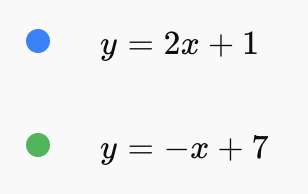
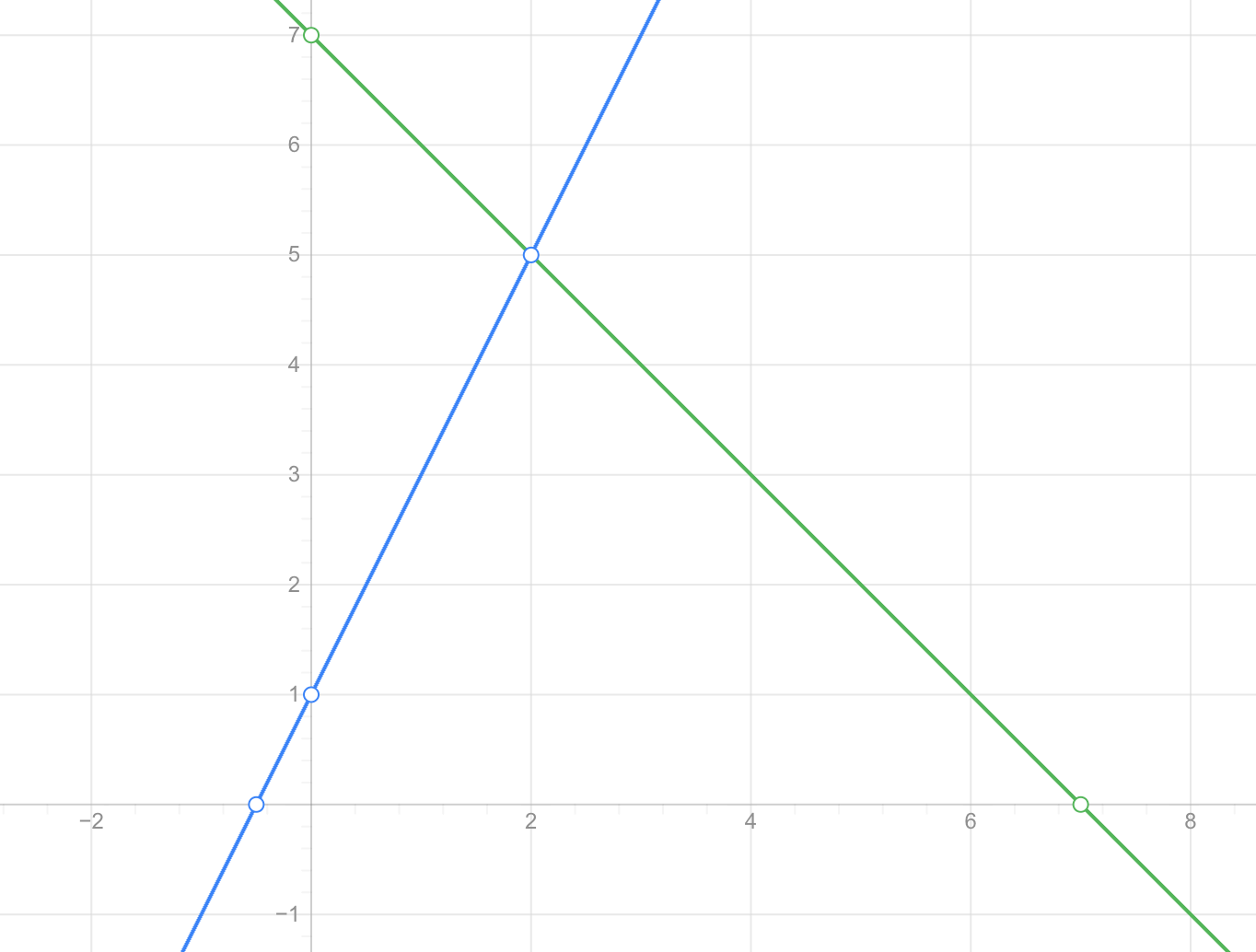
For the system shown above:
y = 2x + 1
y = −x + 7
the two lines meet at:
(2, 5)
Therefore:
(2, 5)
is the solution.
Why the Intersection Is the Solution
Consider the first line:
y = 2x + 1
Every point on this line satisfies that equation.
Consider the second line:
y = −x + 7
Every point on this line satisfies the second equation.
At the intersection, the point belongs to both lines simultaneously.
Therefore, its coordinates satisfy both equations.
This connects the algebraic meaning of a solution with its graphical meaning.
Checking the Intersection Algebraically
For:
y = 2x + 1
and:
y = −x + 7
the graph suggests the solution:
(2, 5)
Check the first equation:
5 = 2(2) + 1
5 = 5
True.
Check the second equation:
5 = −2 + 7
5 = 5
True.
The graphical and algebraic results agree.
Solution or Non-Solution?
Consider:
y = x + 3
y = 2x + 1
Test:
(2, 5)
First equation:
5 = 2 + 3
True.
Second equation:
5 = 2(2) + 1
5 = 5
True.
Therefore:
(2, 5) is a solution.
Now test:
(3, 6)
First equation:
6 = 3 + 3
True.
Second equation:
6 = 2(3) + 1
6 = 7
False.
Therefore:
(3, 6) is not a solution.
A Table Can Help
Suppose we have:
y = x + 2
and:
y = 2x
We can calculate values for both equations.
For x = 0:
First equation gives:
y = 2
Second equation gives:
y = 0
Not the same.
For x = 1:
First equation gives:
y = 3
Second equation gives:
y = 2
Not the same.
For x = 2:
First equation gives:
y = 4
Second equation gives:
y = 4
The equations produce the same value.
Therefore:
(2, 4)
is the solution.

Systems Can Represent Real Situations
Systems of equations are useful because many real-world problems involve two conditions that must be true at the same time.
Examples include:
- Comparing phone plans
- Comparing taxi fares
- Finding when two objects meet
- Comparing wages
- Finding quantities and prices
- Determining break-even points
- Comparing savings plans
- Finding dimensions
- Analyzing supply and demand
The solution tells us where the two conditions occur simultaneously.
Worked Example — Comparing Taxi Companies
Suppose two taxi companies use different pricing systems.
Company A charges:
C = 3d + 5
Company B charges:
C = 2d + 10
where:
C = total cost
and:
d = distance in kilometres
The system is:
C = 3d + 5
C = 2d + 10
The solution tells us the distance at which the two companies charge the same amount.
Set the costs equal:
3d + 5 = 2d + 10
Subtract 2d:
d + 5 = 10
Subtract 5:
d = 5
Now calculate the cost:
C = 3(5) + 5
C = 20
Therefore, the solution is:
(5, 20)
In context, this means:
At a distance of 5 km, both taxi companies charge $20.


Interpreting a Solution in Context
Finding an ordered pair is not always the final step.
You should explain what each coordinate represents.
Suppose the solution to a problem is:
(8, 42)
That could mean many different things.
Perhaps:
8 hours and $42
or:
8 kilometres and 42 litres
or:
8 tickets and $42
The meaning depends on the variables in the original problem.
A complete answer should include the units and context.
Worked Example — Savings Plans
Two students are saving money.
Student A starts with $40 and saves $10 each week:
A = 10w + 40
Student B starts with $70 and saves $5 each week:
B = 5w + 70
The solution occurs when:
A = B
So:
10w + 40 = 5w + 70
Subtract 5w:
5w + 40 = 70
Subtract 40:
5w = 30
Therefore:
w = 6
Calculate the amount:
A = 10(6) + 40
A = 100
The solution is:
(6, 100)
In context:
After 6 weeks, both students will have $100.
Worked Example — Two Moving Objects
Imagine two cyclists travelling along the same route.
Cyclist A's distance is:
d = 12t
Cyclist B has a 20 km head start and travels at 8 km/h:
d = 8t + 20
The solution tells us when they are at the same location at the same time.
Set the equations equal:
12t = 8t + 20
Subtract 8t:
4t = 20
Therefore:
t = 5
Calculate the distance:
d = 12(5)
d = 60
The solution is:
(5, 60)
In context:
After 5 hours, both cyclists are 60 km from the starting point.


Not Every System Has One Solution
Two lines do not always intersect once.
A system of two linear equations can have:
- One solution
- No solution
- Infinitely many solutions
These possibilities can be understood by looking at the graphs.


One Solution
If two lines intersect at exactly one point, the system has one solution.
For example:
y = x + 1
y = −x + 5
The lines have different slopes and intersect once.
Their intersection represents the single ordered pair that satisfies both equations.
No Solution
Consider:
y = 2x + 1
y = 2x + 5
Both lines have the same slope but different y-intercepts.
They are parallel.
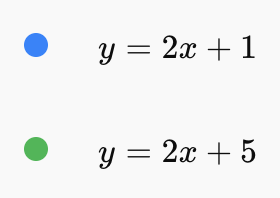
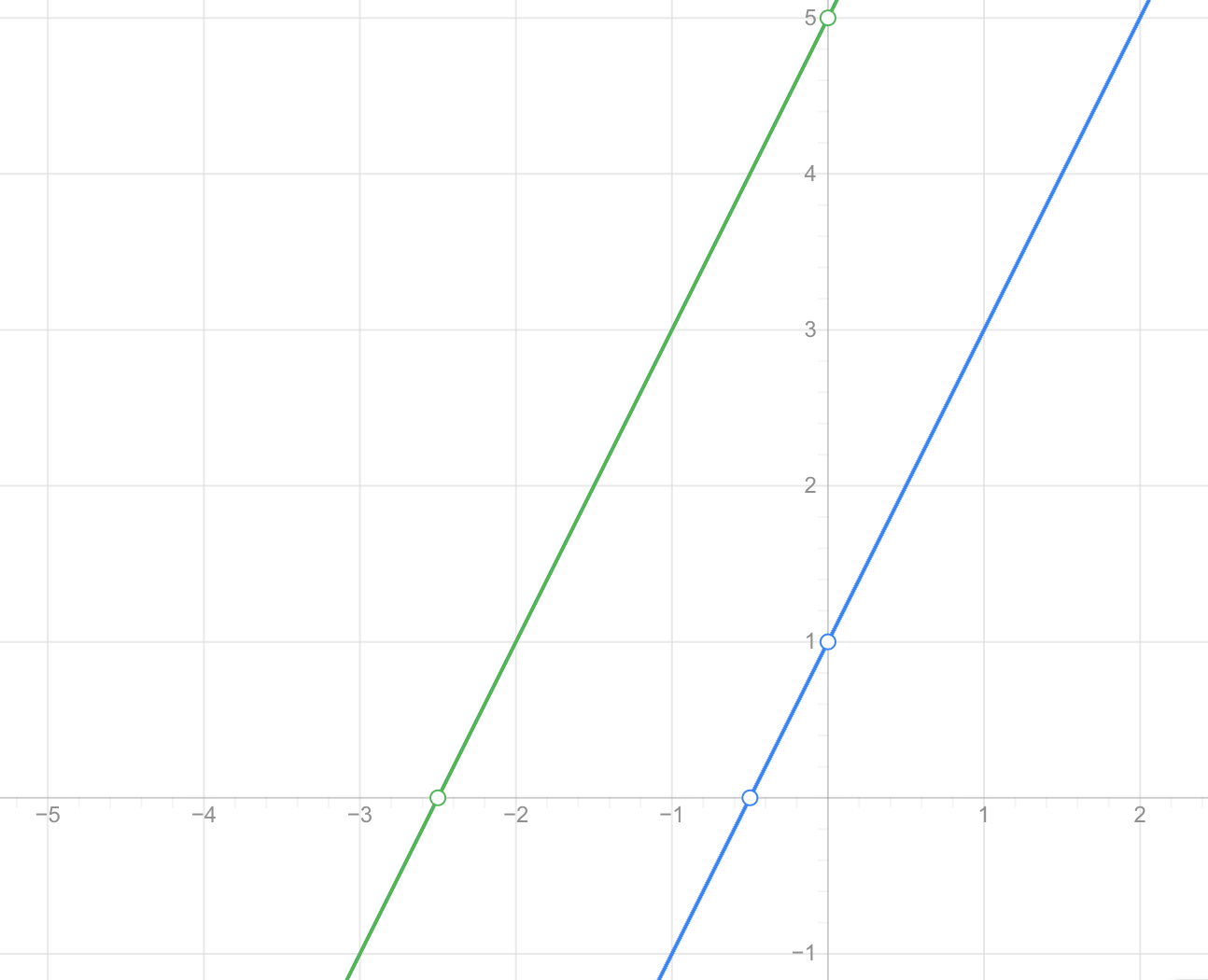
The lines never intersect.
Therefore, there is no ordered pair that lies on both lines.
The system has:
No solution
Infinitely Many Solutions
Consider:
y = 2x + 4
and:
2y = 4x + 8
Simplify the second equation by dividing everything by 2:
y = 2x + 4
The equations are actually the same.
Their graphs lie directly on top of each other.
Every point on one line is also on the other line.
Therefore, the system has:
Infinitely many solutions
Recognizing the Three Possibilities
Graphically:
Intersecting lines → one solution
Parallel lines → no solution
Same line → infinitely many solutions
This gives us another way to interpret what a "solution" to a system really means.
Verifying Solutions Efficiently
Suppose you are given the system:
2x + y = 11
x − y = 1
and asked whether:
(4, 3)
is a solution.
You do not need to solve the entire system.
Simply substitute the values.
First equation:
2(4) + 3 = 11
11 = 11
True.
Second equation:
4 − 3 = 1
1 = 1
True.
Therefore:
(4, 3) is a solution.
Verification can often be much quicker than solving.
Using a Solution to Check Your Work
Suppose you solve a system and obtain:
(3, 7)
Before accepting your answer, substitute:
x = 3
and:
y = 7
into both original equations.
If both equations become true statements, your answer is verified.
If either equation becomes false, there is an error somewhere in your solution.
This makes substitution a powerful checking strategy.
Common Mistakes
Mistake: Checking Only One Equation
An ordered pair may satisfy one equation but not the other.
A solution to a system must satisfy every equation in the system.
Mistake: Reversing the Coordinates
For:
(3, 7)
use:
x = 3
and:
y = 7
not the other way around.
Mistake: Substituting Only x
Both coordinates must be substituted correctly.
Mistake: Ignoring Negative Values
If the point is:
(−2, 5)
then x is −2, not 2.
Using brackets can help:
3(−2) + 5
Mistake: Assuming Every System Has One Solution
Some systems have:
No solution
or:
Infinitely many solutions
Mistake: Giving an Ordered Pair Without Context
If the solution to a real-world problem is:
(5, 20)
explain what 5 and 20 actually represent.
Key Terms
System of equations – two or more equations considered together.
Solution – values that satisfy every equation in a system simultaneously.
Ordered pair – two coordinates written as (x, y).
Satisfy – make an equation true when values are substituted.
Substitution – replacing variables with known values.
Intersection – the point where two graphs meet.
One solution – exactly one ordered pair satisfies both equations.
No solution – no ordered pair satisfies both equations.
Infinitely many solutions – every point on one equation's graph also satisfies the other equation.
Verify – check that a proposed solution satisfies the original equations.
Check Your Understanding
1. What does it mean for an ordered pair to be a solution to a system of equations?
2. Determine whether:
(3, 4)
is a solution to:
x + y = 7
2x + y = 10
3. Determine whether:
(2, 5)
is a solution to:
x + y = 7
x + 2y = 11
4. Why is satisfying only one equation not enough?
5. Determine whether:
(−1, 3)
satisfies:
y = 2x + 5
6. Determine whether:
(4, 2)
is a solution to:
x + y = 6
2x − y = 6
7. Two lines intersect at:
(5, 8)
What does this tell you about the corresponding system of equations?
8. What does it mean if the graphs of two equations never intersect?
9. What does it mean if two equations produce exactly the same line?
10. Explain why substitution can be used to verify a solution.
11. A system describing two savings plans has solution:
(10, 250)
If x represents weeks and y represents money saved, explain the meaning of the solution.
12. A system describing two vehicles has solution:
(3, 180)
If x represents time in hours and y represents distance in kilometres, interpret the solution.
13. Explain the relationship between the intersection of two graphs and the solution of a system.
14. A student checks a proposed solution in the first equation and finds that it works. The student immediately says the ordered pair is a solution to the system. Explain the error.
Key Takeaways
- A system of equations contains two or more equations considered together.
- A solution must satisfy all equations simultaneously.
- For two variables, solutions are often written as ordered pairs (x, y).
- The order of the coordinates matters.
- An ordered pair can be verified by substituting its values into each equation.
- Satisfying only one equation is not enough.
- Graphically, a solution is a point that belongs to both graphs.
- For two intersecting lines, the solution is their intersection point.
- Parallel lines have no solution.
- Identical lines have infinitely many solutions.
- Substitution is an effective way to check a proposed solution.
- In real-world systems, the coordinates of a solution represent actual quantities.
- A complete interpretation should explain what each coordinate means and include appropriate units.
- Systems of equations are useful whenever two conditions must be satisfied at the same time.
Did You Know?
Systems of equations are used in navigation, engineering, economics, computer graphics, and science. GPS technology, for example, uses several simultaneous mathematical relationships to determine location. The underlying idea is similar to solving a system: finding values that satisfy multiple conditions at the same time.