Transformations of Graphs
2. Reflections
Learning outcomes
- I can reflect graphs across the x-axis.
- I can reflect graphs across the y-axis.
- I can predict reflected equations.
- I can compare original and reflected graphs.
- I can identify reflections from graphs.
Introduction
A reflection is a transformation that produces a mirror image of a graph across a line.
In coordinate geometry, two of the most important reflections are:
-
Reflection across the x-axis.
-
Reflection across the y-axis.
Reflections change the orientation of a graph while preserving its shape and size.
For example, consider the quadratic function:
y = x²
Its graph is a parabola opening upward.
If we reflect it across the x-axis, the equation becomes:
y = −x²
The new parabola opens downward.
Now consider:
y = (x − 2)²
Reflecting this graph across the y-axis gives:
y = (x + 2)²
The vertex moves from (2, 0) to (−2, 0).
Reflections are important because they help us understand how negative signs affect functions, how graphs behave under transformations, and how algebraic equations are connected to geometric symmetry.
In this topic, we will explore how to reflect graphs, predict reflected equations, compare original and transformed functions, and recognise reflections from graphs.
What Is a Reflection?
A reflection is a transformation in which every point on a graph is moved to the opposite side of a fixed line, called the line of reflection.
Each point and its reflected image are the same perpendicular distance from the line of reflection.
For example, if a point lies 3 units above the x-axis, its reflection across the x-axis lies 3 units below it.
During a reflection:
-
The shape remains unchanged.
-
The size remains unchanged.
-
Distances between points remain unchanged.
-
The graph's orientation is reversed.
-
Points on the line of reflection remain fixed.
A reflection is therefore a rigid transformation, also called an isometry.
Visualising Reflections
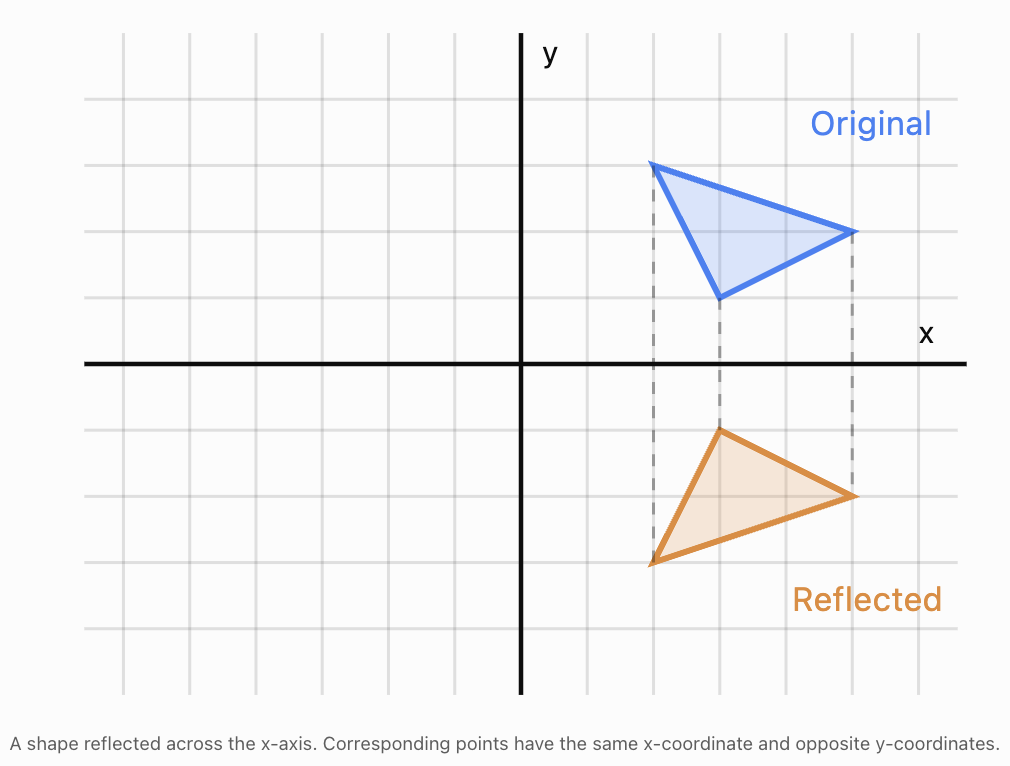
The same principle applies to graphs of mathematical functions.
Reflections Across the x-Axis
A reflection across the x-axis changes the sign of every y-coordinate.
The coordinate rule is:
(x, y) → (x, −y)
For example:
-
(2, 3) becomes (2, −3).
-
(−4, 5) becomes (−4, −5).
-
(3, −2) becomes (3, 2).
-
(0, 0) remains (0, 0).
The x-coordinate does not change.
Equation rule
If the original function is:
y = f(x)
its reflection across the x-axis is:
y = −f(x)
The negative sign is placed outside the entire function.
This means every output is multiplied by −1.
Worked Example: Reflecting a parabola
Original:
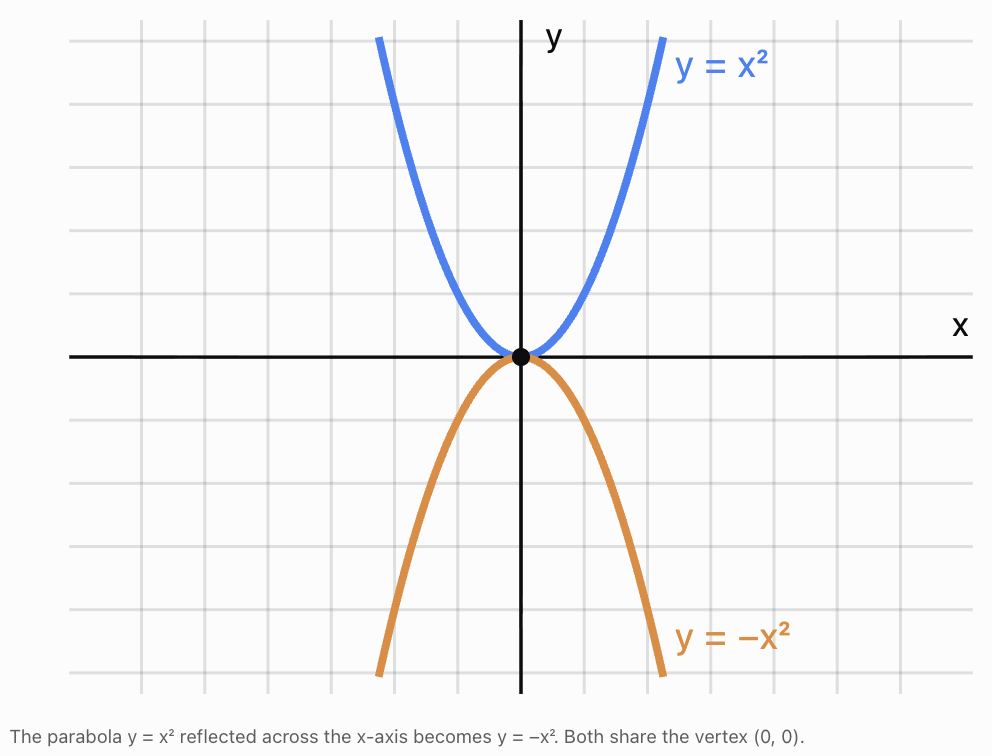
y = x²
Reflection across the x-axis:
y = −x²
The original graph opens upward.
The reflected graph opens downward.
|
x |
Original y = x² |
Reflected y = −x² |
|---|---|---|
|
−2 |
4 |
−4 |
|
−1 |
1 |
−1 |
|
0 |
0 |
0 |
|
1 |
1 |
−1 |
|
2 |
4 |
−4 |
Every y-value changes sign.
Reflecting More Complicated Functions Across the x-Axis
The reflection rule applies to the entire function, not just one term.
Worked Example: Linear function
Original:
y = 2x + 3
Reflection across the x-axis:
y = −(2x + 3)
Distribute the negative sign:
y = −2x − 3
The original line has gradient 2 and y-intercept 3.
The reflected line has gradient −2 and y-intercept −3.
Worked Example: Quadratic function
Original:
y = x² − 4x + 1
Reflection across the x-axis:
y = −(x² − 4x + 1)
Expand:
y = −x² + 4x − 1
Every term changes sign.
Worked Example: Absolute value function
Original:
y = |x − 3| + 2
Reflection across the x-axis:
y = −(|x − 3| + 2)
Simplify:
y = −|x − 3| − 2
The original graph has a minimum at (3, 2).
The reflected graph has a maximum at (3, −2).
Reflections Across the y-Axis
A reflection across the y-axis changes the sign of every x-coordinate.
The coordinate rule is:
(x, y) → (−x, y)
For example:
-
(3, 4) becomes (−3, 4).
-
(−2, 5) becomes (2, 5).
-
(4, −3) becomes (−4, −3).
-
(0, 2) remains (0, 2).
The y-coordinate does not change.
Equation rule
If the original function is:
y = f(x)
its reflection across the y-axis is:
y = f(−x)
We replace every occurrence of x with −x.
Worked Example: Reflecting a linear function
Original:
y = 3x + 2
Replace x with −x:
y = 3(−x) + 2
Simplify:
y = −3x + 2
The original line has gradient 3.
The reflected line has gradient −3.
The y-intercept remains 2 because points on the y-axis are unchanged.
Worked Example: Reflecting a parabola
Original:
y = (x − 4)²
Reflect across the y-axis:
y = (−x − 4)²
Factor out −1 inside the bracket:
y = [−(x + 4)]²
Since squaring removes the negative sign:
y = (x + 4)²
The original vertex is (4, 0).
The reflected vertex is (−4, 0).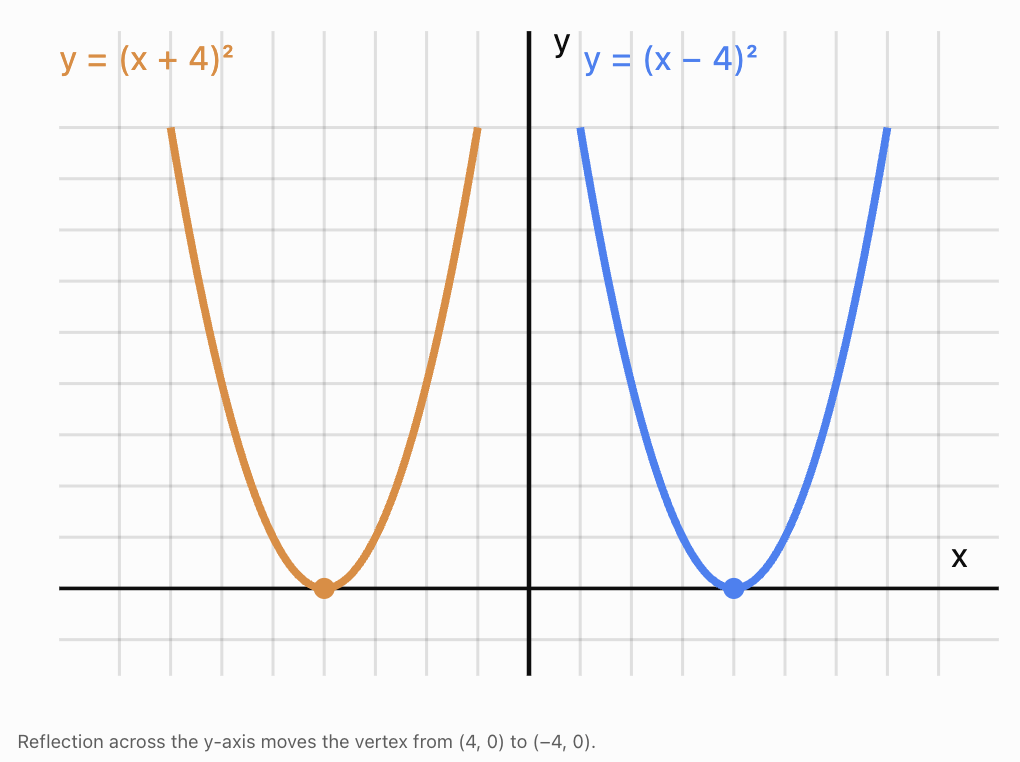
Reflecting Polynomial Functions Across the y-Axis
When reflecting a polynomial across the y-axis, replace every x with −x and simplify.
Worked Example
Original:
y = x³ + 2x² − 5x + 4
Replace x with −x:
y = (−x)³ + 2(−x)² − 5(−x) + 4
Simplify each term:
(−x)³ = −x³
(−x)² = x²
−5(−x) = 5x
Therefore:
y = −x³ + 2x² + 5x + 4
Notice:
-
Odd powers of x change sign.
-
Even powers of x do not change sign.
-
Constant terms remain unchanged.
This pattern can make reflections of polynomial functions much faster.
Comparing Reflections Across the x-Axis and y-Axis
Although both transformations create mirror images, they affect coordinates and equations differently.
|
Feature |
Reflection across x-axis |
Reflection across y-axis |
|---|---|---|
|
Coordinate rule |
(x, y) → (x, −y) |
(x, y) → (−x, y) |
|
Function rule |
y = −f(x) |
y = f(−x) |
|
Coordinate that changes sign |
y |
x |
|
Axis containing fixed points |
x-axis |
y-axis |
|
Effect on outputs |
Negates outputs |
Reverses inputs |
|
Example from y = 2x + 3 |
y = −2x − 3 |
y = −2x + 3 |
The distinction is especially important when reflecting functions that are not symmetric.
Even and Odd Functions
Some graphs have natural symmetry.
This can cause a reflection to produce exactly the same graph.
Even functions
A function is even if:
f(−x) = f(x)
Its graph is symmetric about the y-axis.
Examples include:
-
f(x) = x²
-
f(x) = x⁴
-
f(x) = |x|
-
f(x) = cos x
For example:
f(x) = x²
f(−x) = (−x)² = x²
Therefore, reflecting y = x² across the y-axis produces the same graph.
Odd functions
A function is odd if:
f(−x) = −f(x)
Its graph is symmetric about the origin.
Examples include:
-
f(x) = x
-
f(x) = x³
-
f(x) = sin x
For example:
f(x) = x³
f(−x) = (−x)³ = −x³
Therefore:
f(−x) = −f(x)
A reflection of an odd function across the y-axis produces the same graph as reflecting it across the x-axis.
Reflecting Absolute Value Functions
Absolute value graphs are particularly useful for understanding reflections because they have a distinctive V-shape.
Worked Example: Across the x-axis
Original:
y = |x|
Reflected:
y = −|x|
The original graph opens upward.
The reflected graph opens downward.
The vertex remains at (0, 0).
Worked Example: Across the y-axis
Original:
y = |x − 3|
Reflected:
y = |−x − 3|
Simplify:
y = |x + 3|
The vertex moves from (3, 0) to (−3, 0).
Worked Example: A translated absolute value function
Original:
y = |x − 2| + 4
Reflect across the x-axis:
y = −(|x − 2| + 4)
y = −|x − 2| − 4
Reflect the original across the y-axis instead:
y = |−x − 2| + 4
y = |x + 2| + 4
These transformations produce different graphs.
Reflecting Square Root Functions
Square root functions have restricted domains, making them useful for understanding how reflections affect domain and range.
Worked Example: Across the x-axis
Original:
y = √x
Domain:
x ≥ 0
Range:
y ≥ 0
Reflect across the x-axis:
y = −√x
Domain:
x ≥ 0
Range:
y ≤ 0
The graph is now below or on the x-axis.
Worked Example: Across the y-axis
Original:
y = √x
Reflect across the y-axis:
y = √(−x)
For the square root to be defined:
−x ≥ 0
Therefore:
x ≤ 0
Domain:
x ≤ 0
Range:
y ≥ 0
The graph now extends to the left of the y-axis.
Worked Example: Reflecting a translated square root function
Original:
y = √(x − 4) + 2
Its starting point is (4, 2).
Reflect across the y-axis:
y = √(−x − 4) + 2
The starting point becomes:
(−4, 2)
The reflected domain is:
x ≤ −4
The range remains:
y ≥ 2
Reflecting Exponential Functions
Exponential graphs can also be reflected.
Consider:
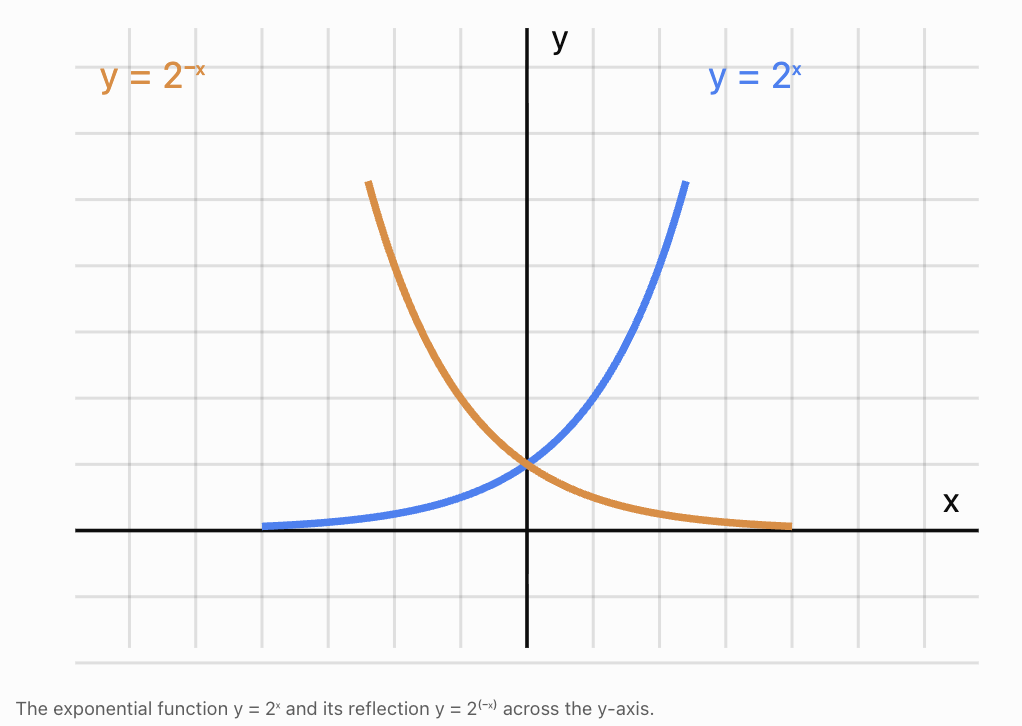
y = 2ˣ
Reflection across the x-axis
y = −2ˣ
This means y = −(2ˣ).
The graph lies below the x-axis.
Its horizontal asymptote remains y = 0.
Reflection across the y-axis
y = 2⁽⁻ˣ⁾
This can also be written as:
y = (1/2)ˣ
The original function increases as x increases.
The reflected function decreases as x increases.
Reflecting Graphs with Translations
Reflections can be combined with horizontal and vertical translations.
Consider:
y = −(x − 3)² + 4
Starting with:
y = x²
We can describe the transformations as:
-
Translate 3 units right.
-
Reflect across the x-axis.
-
Translate 4 units up.
The final vertex is:
(3, 4)
The parabola opens downward.
The transformations must be interpreted carefully because changing their order can sometimes change the final result.
Worked Example: Combining transformations
Start with:
y = |x|
Reflect across the x-axis:
y = −|x|
Translate 2 units left:
y = −|x + 2|
Translate 3 units down:
y = −|x + 2| − 3
The final vertex is (−2, −3).
The graph opens downward.
Identifying Reflections from Graphs
Sometimes we are given two graphs rather than equations.
To determine whether one is a reflection of the other, compare corresponding points and key features.
Reflection across the x-axis
Look for:
-
Matching x-coordinates.
-
Opposite y-coordinates.
-
Equal distances above and below the x-axis.
-
Reversed vertical orientation.
For example:
Original vertex: (2, 5)
Reflected vertex: (2, −5)
This is consistent with reflection across the x-axis.
Reflection across the y-axis
Look for:
-
Opposite x-coordinates.
-
Matching y-coordinates.
-
Equal distances left and right of the y-axis.
-
Reversed horizontal orientation.
For example:
Original vertex: (4, −2)
Reflected vertex: (−4, −2)
This is consistent with reflection across the y-axis.
Important limitation
A single matching pair of points does not prove that an entire graph has been reflected.
To confirm a reflection, the same coordinate rule must apply to every corresponding point.
Reflecting Graphs Step by Step
A reliable sketching method is:
Identify the original function.
Recognise its basic shape and important features.
Choose the line of reflection.
Determine whether the reflection is across the x-axis or y-axis.
Apply the coordinate rule.
Across the x-axis:
(x, y) → (x, −y)
Across the y-axis:
(x, y) → (−x, y)
Reflect important points.
These may include vertices, endpoints, intercepts, and turning points.
Sketch the reflected graph.
Preserve the original shape and size.
Check symmetry.
Corresponding points should be equally distant from the reflection axis.
Reflections and the Domain and Range
Reflections can affect the domain and range of functions.
Reflection across the x-axis
The x-values remain unchanged, so the domain remains the same.
The y-values change sign, so the range is reflected across zero.
Example:
Original:
y = x² + 2
Domain: all real numbers
Range: y ≥ 2
Reflected:
y = −x² − 2
Domain: all real numbers
Range: y ≤ −2
Reflection across the y-axis
The y-values remain unchanged, so the range remains the same.
The x-values change sign, so the domain is reflected across zero.
Example:
Original:
y = √(x − 3)
Domain: x ≥ 3
Range: y ≥ 0
Reflected:
y = √(−x − 3)
Domain: x ≤ −3
Range: y ≥ 0
These rules are particularly important for functions with restricted domains and ranges.
Reflecting Across Both Axes
A graph can be reflected across the x-axis and then across the y-axis.
Starting with:
y = f(x)
Reflect across the x-axis:
y = −f(x)
Then reflect across the y-axis:
y = −f(−x)
The coordinate rule is:
(x, y) → (−x, −y)
This is equivalent to a rotation of 180° about the origin.
Worked Example
Original:
y = x³ + 2
Reflect across both axes:
y = −f(−x)
Substitute:
y = −[(−x)³ + 2]
Simplify:
y = −[−x³ + 2]
y = x³ − 2
The final graph is equivalent to translating the original cubic graph downward by 4 units, although the transformation used here is a pair of reflections.
Applications of Reflections
Physics: Opposite directions
Suppose the vertical position of an object relative to a reference level is represented by:
y = f(t)
If we reverse the sign convention for vertical position, the new coordinate becomes:
y = −f(t)
The graph is reflected across the horizontal axis.
This is useful when comparing upward-positive and downward-positive coordinate systems.
Economics: Profit and loss
Suppose a function P(x) represents profit.
The function:
L(x) = −P(x)
represents the negative of profit, which may be interpreted as a loss balance under a suitable sign convention.
The graph of L(x) is the reflection of P(x) across the x-axis.
Signal processing
Signals can be reflected in two important ways.
Amplitude inversion:
g(t) = −f(t)
This reflects the signal across the horizontal axis.
Time reversal:
g(t) = f(−t)
This reflects the signal across the vertical axis.
These transformations are important in mathematics, physics, electronics, and signal analysis.
Common Mistakes
Confusing reflections across the two axes
Across the x-axis, change the sign of the output.
Across the y-axis, change the sign of the input.
Negating only one term
For an x-axis reflection:
y = −(x² + 3x + 2)
Correct:
y = −x² − 3x − 2
Not:
y = −x² + 3x + 2
Forgetting to replace every x
For a y-axis reflection, every occurrence of x must be replaced by −x.
Assuming all reflections change the graph
Some functions are symmetric about an axis, so reflecting them across that axis produces the same graph.
Confusing reflections with translations
Translations move graphs without reversing their orientation. Reflections produce mirror images.
Incorrectly simplifying powers
(−x)² = x²
(−x)³ = −x³
Ignoring domain and range changes
Reflections may change domain or range restrictions.
Assuming the reflection of every function is different
Even functions are unchanged by y-axis reflection.
Key Terms
-
Reflection: A transformation that produces a mirror image across a line.
-
Line of reflection: The fixed line across which a graph is reflected.
-
x-axis reflection: A transformation changing (x, y) to (x, −y).
-
y-axis reflection: A transformation changing (x, y) to (−x, y).
-
Transformation: A change to the position, size, or orientation of a graph.
-
Rigid transformation: A transformation preserving distances and shape.
-
Coordinate rule: A rule describing how points move under a transformation.
-
Function notation: A way of representing functions using symbols such as f(x).
-
Even function: A function satisfying f(−x) = f(x).
-
Odd function: A function satisfying f(−x) = −f(x).
-
Symmetry: A property in which a graph matches itself under a specified transformation.
-
Vertex: A turning point of a parabola or the corner of an absolute value graph.
-
Domain: The set of permitted input values.
-
Range: The set of possible output values.
-
Intercept: A point where a graph meets a coordinate axis.
-
Asymptote: A line that a graph approaches in a specified limiting direction.
-
Amplitude inversion: A transformation changing f(x) to −f(x).
-
Time reversal: A transformation changing f(t) to f(−t).
Key Takeaways
-
Reflections produce mirror images of graphs.
-
Reflecting across the x-axis changes (x, y) to (x, −y).
-
Reflecting across the y-axis changes (x, y) to (−x, y).
-
The equation for an x-axis reflection is y = −f(x).
-
The equation for a y-axis reflection is y = f(−x).
-
Reflections preserve the shape and size of a graph.
-
Reflecting across the x-axis changes the sign of every output.
-
Reflecting across the y-axis reverses the sign of every input.
-
Even functions are symmetric about the y-axis.
-
Odd functions are symmetric about the origin.
-
Reflections can be combined with translations and other transformations.
-
Domain and range restrictions must be considered when reflecting graphs.
-
Reflected graphs can be identified by comparing corresponding points and their distances from the reflection axis.
Check Your Understanding
Recall and Understanding
1. Define a reflection and explain which properties of a graph remain unchanged.
2. State the coordinate rule for reflection across the x-axis.
3. State the coordinate rule for reflection across the y-axis.
4. Explain the difference between y = −f(x) and y = f(−x).
Application
5. Reflect the point (4, −7) across the x-axis.
6. Reflect the point (−3, 5) across the y-axis.
7. Write the equation obtained by reflecting y = 3x + 4 across the x-axis.
8. Write the equation obtained by reflecting y = x² − 6x + 2 across the y-axis.
9. Reflect y = |x − 5| + 3 across the x-axis. State the vertex of the reflected graph.
10. Reflect y = √(x − 4) across the y-axis. State the domain of the reflected function.
Analysis and Challenge
11. A parabola has equation y = (x − 3)² − 4. Reflect it across the y-axis and state its new vertex.
12. A function is defined by f(x) = x³ − 2x. Determine whether it is even, odd, or neither.
13. Reflect y = 2ˣ across both the x-axis and y-axis. Write the resulting equation.
14. A graph passes through (−2, 3), (0, −1), and (4, 5). Find the coordinates of the reflected points after reflection across the x-axis.
15. A student claims that reflecting y = x² + 4 across the y-axis produces y = −x² + 4. Explain the error and give the correct equation.
Answers to Check Your Understanding
1. A reflection produces a mirror image across a line. Shape, size, and distances between points remain unchanged.
2.
(x, y) → (x, −y)
3.
(x, y) → (−x, y)
4.
y = −f(x) reflects a graph across the x-axis by negating the outputs.
y = f(−x) reflects a graph across the y-axis by reversing the inputs.
5.
(4, −7) → (4, 7)
6.
(−3, 5) → (3, 5)
7.
Original:
y = 3x + 4
Reflected:
y = −(3x + 4)
y = −3x − 4
8.
Original:
y = x² − 6x + 2
Replace x with −x:
y = (−x)² − 6(−x) + 2
y = x² + 6x + 2
9.
Original:
y = |x − 5| + 3
Reflect across the x-axis:
y = −(|x − 5| + 3)
y = −|x − 5| − 3
Vertex:
(5, −3)
10.
Original:
y = √(x − 4)
Reflect across the y-axis:
y = √(−x − 4)
For the square root to be defined:
−x − 4 ≥ 0
Domain: x ≤ −4
11.
Original:
y = (x − 3)² − 4
Reflect across the y-axis:
y = (−x − 3)² − 4
Simplify:
y = (x + 3)² − 4
New vertex:
(−3, −4)
12.
f(x) = x³ − 2x
Calculate:
f(−x) = (−x)³ − 2(−x)
= −x³ + 2x
= −(x³ − 2x)
Therefore:
f(−x) = −f(x)
The function is odd.
13.
Original:
y = 2ˣ
Reflect across the x-axis:
y = −2ˣ
Reflect across the y-axis:
y = −2⁽⁻ˣ⁾
Equivalent form:
y = −(1/2)ˣ
14.
Reflect across the x-axis using:
(x, y) → (x, −y)
(−2, 3) → (−2, −3)
(0, −1) → (0, 1)
(4, 5) → (4, −5)
15.
The student has confused reflection across the y-axis with reflection across the x-axis.
For a y-axis reflection, replace x with −x:
y = (−x)² + 4
Since (−x)² = x²:
y = x² + 4
The original graph is symmetric about the y-axis, so the reflection produces the same graph.
Final Summary
Reflections are fundamental graph transformations that produce mirror images across coordinate axes.
Understanding how reflections affect coordinates and function equations allows us to predict, sketch, and compare transformed graphs accurately.
The two most important rules are:
Across the x-axis: y = −f(x)
Across the y-axis: y = f(−x)
These principles provide an important foundation for understanding symmetry, function transformations, and more advanced mathematical relationships.