Algebraic Identities and Factorization
5. Algebraic Patterns and Identities
Learning outcomes
- I can recognize common algebraic identities.
- I can choose the correct identity.
- I can simplify expressions efficiently.
- I can explain why identities always work.
- I can apply identities in problem solving.
Introduction
Algebra is full of patterns. When we recognise these patterns, we can often simplify expressions, perform calculations, and solve problems much more efficiently.
For example, consider:
(x + 5)²
We could multiply the two binomials using the distributive property. However, recognising a familiar algebraic pattern allows us to expand immediately:
(x + 5)² = x² + 10x + 25
Similarly, consider:
(x + 7)(x − 7)
Rather than multiplying every term, we can recognise a difference-of-squares pattern:
(x + 7)(x − 7) = x² − 49
These relationships are examples of algebraic identities.
An algebraic identity is an equation that remains true for every permitted value of its variables.
Understanding identities is important because they help us:
-
Expand algebraic expressions efficiently.
-
Factor polynomials.
-
Simplify complicated expressions.
-
Recognise mathematical patterns.
-
Solve equations.
-
Perform mental arithmetic.
-
Understand geometric relationships.
-
Apply algebra in science, engineering, and other fields.


What Is an Algebraic Identity?
An algebraic identity is an equation that is true for every value of its variables for which both sides are defined.
Consider:
2(x + 3) = 2x + 6
This equation is true regardless of the value of x.
For x = 1:
Left side = 2(1 + 3) = 8
Right side = 2(1) + 6 = 8
For x = 5:
Left side = 2(5 + 3) = 16
Right side = 2(5) + 6 = 16
For x = −2:
Left side = 2(−2 + 3) = 2
Right side = 2(−2) + 6 = 2
The two expressions always produce the same value.
This is because the distributive property guarantees their equivalence.
Identity Versus Equation
Not every equation is an identity.
Consider:
x + 3 = 7
This equation is true only when x = 4.
It is not an identity.
Compare:
|
Algebraic Identity |
Equation with Specific Solutions |
|---|---|
|
(x + 2)² = x² + 4x + 4 |
x² = 16 |
|
True for every real x |
True only for x = ±4 |
|
Describes equivalent expressions |
Describes a condition to be satisfied |
Important Observation
An identity describes a relationship that is always true, while an ordinary equation may be true only for particular values.
Why Are Algebraic Identities Useful?
Algebraic identities allow us to recognise the structure of expressions.
For example:
(a + b)² = a² + 2ab + b²
Once we know this identity, we can apply it to many different expressions.
Examples:
(x + 3)² = x² + 6x + 9
(2x + 5)² = 4x² + 20x + 25
(3a + 4b)² = 9a² + 24ab + 16b²
The variables a and b in the identity can represent numbers, variables, or entire algebraic expressions.
Important Observation
Learning an identity means understanding a general relationship, not memorising a separate rule for every example.
The Distributive Identity
One of the most fundamental algebraic identities is the distributive property.
a(b + c) = ab + ac
Similarly:
a(b − c) = ab − ac
This identity allows multiplication to be distributed across addition or subtraction.
Worked Example
Expand:
4(x + 7)
Apply the distributive property:
4(x + 7) = 4x + 28
Worked Example
Expand:
−3(2x − 5)
Distribute −3:
−3(2x) + (−3)(−5)
= −6x + 15
Important Observation
The distributive property is the foundation of many more advanced algebraic identities.
The Square of a Sum Identity
One of the most frequently used identities is:
(a + b)² = a² + 2ab + b²
This identity describes the square of a binomial containing addition.
Worked Example
Expand:
(x + 6)²
Identify:
a = x
b = 6
Apply the identity:
(x + 6)² = x² + 2(x)(6) + 6²
Simplify:
(x + 6)² = x² + 12x + 36
Another Example
Expand:
(3x + 2)²
Identify:
a = 3x
b = 2
Substitute:
(3x + 2)² = (3x)² + 2(3x)(2) + 2²
= 9x² + 12x + 4
Important Observation
The middle term is twice the product of the two terms in the original binomial.
Understanding the Square of a Sum Geometrically
Consider a square with side length a + b.
Its area is:
A = (a + b)²
The square can be divided into four smaller regions.
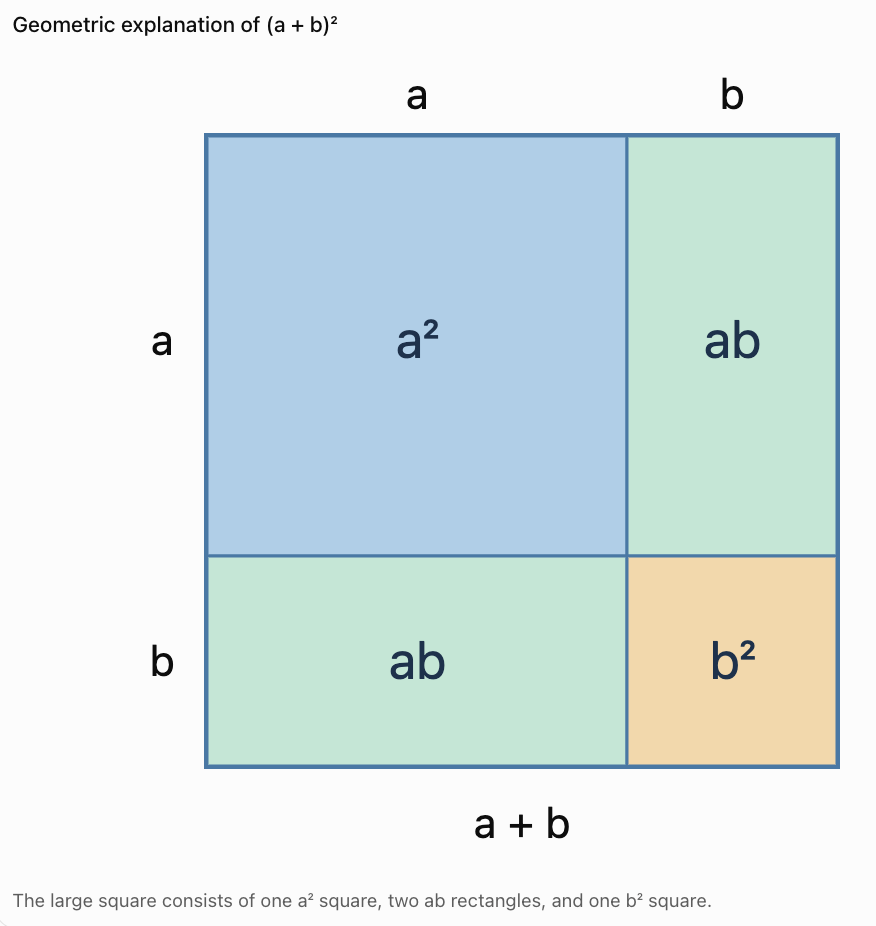
The total area is:
a² + ab + ab + b²
Combine like terms:
a² + 2ab + b²
Therefore:
(a + b)² = a² + 2ab + b²
Important Observation
The identity works because the four smaller regions exactly fill the larger square without gaps or overlaps.
The Square of a Difference Identity
The second important identity is:
(a − b)² = a² − 2ab + b²
This identity describes the square of a binomial containing subtraction.
Worked Example
Expand:
(x − 7)²
Identify:
a = x
b = 7
Apply the identity:
(x − 7)² = x² − 2(x)(7) + 7²
Simplify:
(x − 7)² = x² − 14x + 49
Another Example
Expand:
(4x − 3)²
Identify:
a = 4x
b = 3
Substitute:
(4x − 3)² = (4x)² − 2(4x)(3) + 3²
= 16x² − 24x + 9
Important Observation
The final term is positive because squaring a negative quantity produces a nonnegative result.
Why the Square of a Difference Works
We can prove the identity using multiplication.
Start with:
(a − b)²
Rewrite:
(a − b)(a − b)
Apply the distributive property:
= a² − ab − ab + b²
Combine the middle terms:
= a² − 2ab + b²
Therefore:
(a − b)² = a² − 2ab + b²
This proof works for all real values of a and b.
Important Observation
Algebraic identities can be proved using fundamental operations rather than relying only on examples.
Comparing the Two Square Identities
The square of a sum and square of a difference are closely related.
|
Square of a Sum |
Square of a Difference |
|---|---|
|
(a + b)² |
(a − b)² |
|
a² + 2ab + b² |
a² − 2ab + b² |
|
Positive middle term |
Negative middle term |
|
Positive final term |
Positive final term |
Example
(x + 5)² = x² + 10x + 25
(x − 5)² = x² − 10x + 25
Only the sign of the middle term changes.
Important Observation
Recognising the sign pattern helps prevent mistakes when expanding squared binomials.
The Difference of Two Squares Identity
Another extremely useful identity is:
a² − b² = (a − b)(a + b)
This identity allows us to factor the difference between two squared quantities.
Worked Example
Factor:
x² − 49
Recognise:
x² = (x)²
49 = 7²
Apply the identity:
x² − 49 = (x − 7)(x + 7)
Worked Example
Factor:
25x² − 16
Recognise:
25x² = (5x)²
16 = 4²
Therefore:
25x² − 16 = (5x − 4)(5x + 4)
Important Observation
The difference-of-squares identity applies when two squared expressions are separated by subtraction.
Why the Difference of Squares Identity Works
Start with:
(a − b)(a + b)
Expand:
= a² + ab − ab − b²
The middle terms cancel:
+ab − ab = 0
Therefore:
(a − b)(a + b) = a² − b²
The identity is true because the cross-products are equal in magnitude and opposite in sign.
Geometric Interpretation
Imagine a large square of side length a and a smaller square of side length b.
When a ≥ b ≥ 0, the difference in their areas is:
a² − b²
The remaining area can be rearranged into a rectangle with dimensions:
a − b and a + b

Therefore:
a² − b² = (a − b)(a + b)
The Product of Two Binomials with a Common Term
Another useful identity is:
(x + a)(x + b) = x² + (a + b)x + ab
This identity is especially useful when expanding or factoring quadratic expressions.
Worked Example
Expand:
(x + 3)(x + 8)
Apply the identity:
= x² + (3 + 8)x + (3)(8)
= x² + 11x + 24
Another Example
Expand:
(x − 4)(x + 7)
Treat a = −4 and b = 7.
= x² + (−4 + 7)x + (−4)(7)
= x² + 3x − 28
Important Observation
The coefficient of x is the sum of the two constants, while the constant term is their product.
The Cube of a Sum
Algebraic identities also apply to powers greater than two.
One important identity is:
(a + b)³ = a³ + 3a²b + 3ab² + b³
Worked Example
Expand:
(x + 2)³
Identify:
a = x
b = 2
Apply the identity:
(x + 2)³ = x³ + 3(x²)(2) + 3(x)(2²) + 2³
Simplify:
= x³ + 6x² + 12x + 8
Important Observation
The coefficients 1, 3, 3, 1 form a pattern that also appears in Pascal's triangle.
The Cube of a Difference
The corresponding identity is:
(a − b)³ = a³ − 3a²b + 3ab² − b³
Worked Example
Expand:
(x − 3)³
Substitute:
= x³ − 3(x²)(3) + 3(x)(3²) − 3³
Simplify:
x³ − 9x² + 27x − 27
Important Observation
The signs alternate in the cube-of-a-difference identity.
The Sum and Difference of Cubes
Two further identities are useful for factoring cubic expressions.
Sum of Cubes
a³ + b³ = (a + b)(a² − ab + b²)
Difference of Cubes
a³ − b³ = (a − b)(a² + ab + b²)
Worked Example: Sum of Cubes
Factor:
x³ + 8
Recognise:
8 = 2³
Apply the identity:
x³ + 8 = (x + 2)(x² − 2x + 4)
Worked Example: Difference of Cubes
Factor:
x³ − 27
Recognise:
27 = 3³
Apply the identity:
x³ − 27 = (x − 3)(x² + 3x + 9)
Important Observation
Unlike the sum of two squares, the sum of two cubes can be factored using a standard identity.
Choosing the Correct Algebraic Identity
A major skill in algebra is recognising which identity is appropriate.
The best choice depends on the structure of the expression.
|
Expression Pattern |
Identity |
|---|---|
|
(a + b)² |
Square of a sum |
|
(a − b)² |
Square of a difference |
|
a² − b² |
Difference of squares |
|
(x + a)(x + b) |
Product of binomials with a common term |
|
(a + b)³ |
Cube of a sum |
|
(a − b)³ |
Cube of a difference |
|
a³ + b³ |
Sum of cubes |
|
a³ − b³ |
Difference of cubes |
Example
Consider:
(2x + 5)²
The entire binomial is squared.
Choose the square-of-a-sum identity.
Example
Consider:
9x² − 25
There are two squared terms separated by subtraction.
Choose the difference-of-squares identity.
Example
Consider:
x³ + 64
There are two cubes separated by addition.
Choose the sum-of-cubes identity.
Important Observation
Identifying the structure of an expression is often more important than immediately beginning calculations.
A Practical Strategy for Recognising Identities
When examining an algebraic expression, ask yourself:
Does the expression contain brackets raised to a power?
If yes, check whether it matches a square or cube identity.
Does the expression contain two terms?
Check for a difference of squares or a sum/difference of cubes.
Does the expression contain three terms?
Check whether it is a perfect square trinomial.
Does the expression contain two multiplied binomials?
Check for conjugate factors, repeated factors, or a common variable term.
Do all terms have a common factor?
Factor out the greatest common factor before applying another identity.
Worked Example
Simplify:
3x² − 75
First, factor out the common factor:
3(x² − 25)
Recognise the difference of squares:
x² − 25 = (x − 5)(x + 5)
Therefore:
3x² − 75 = 3(x − 5)(x + 5)
Important Observation
Some expressions require more than one algebraic technique.
Common Mistakes in Recognising Identities
Confusing a sum of squares with a difference of squares
x² + 25 does not factor using the difference-of-squares identity over the real numbers.
Forgetting the middle term when squaring
Incorrect:
(x + 4)² = x² + 16
Correct:
(x + 4)² = x² + 8x + 16
Using the wrong sign in a cube identity
The signs in (a − b)³ alternate.
Confusing squares and cubes
x² − 8 is not a difference of cubes.
Applying an identity before removing a common factor
Expressions may become easier to recognise after factoring out a common factor.
Memorising formulas without understanding them
Understanding how identities are derived helps prevent errors and makes them easier to remember.
Part 1 Summary
The most important algebraic identities introduced in this part are:
-
Distributive property: a(b + c) = ab + ac
-
Square of a sum: (a + b)² = a² + 2ab + b²
-
Square of a difference: (a − b)² = a² − 2ab + b²
-
Difference of squares: a² − b² = (a − b)(a + b)
-
Product of binomials: (x + a)(x + b) = x² + (a + b)x + ab
-
Cube of a sum: (a + b)³ = a³ + 3a²b + 3ab² + b³
-
Cube of a difference: (a − b)³ = a³ − 3a²b + 3ab² − b³
-
Sum of cubes: a³ + b³ = (a + b)(a² − ab + b²)
-
Difference of cubes: a³ − b³ = (a − b)(a² + ab + b²)
These identities are useful because they represent general mathematical relationships that can be applied to many different expressions.
Simplifying Expressions Using Algebraic Identities
Algebraic simplification means rewriting an expression in an equivalent, often more useful form.
The goal is not always to make an expression shorter. Sometimes we want to make it easier to factor, evaluate, or solve.
Worked Example: Simplifying Two Squared Binomials
Simplify:
(x + 4)² − (x − 4)²
We could expand both expressions separately.
First:
(x + 4)² = x² + 8x + 16
Second:
(x − 4)² = x² − 8x + 16
Subtract:
(x² + 8x + 16) − (x² − 8x + 16)
Remove brackets carefully:
x² + 8x + 16 − x² + 8x − 16
Combine like terms:
16x
A More Efficient Method
Recognise that the entire expression is a difference of two squares.
Let:
a = x + 4
b = x − 4
Apply:
a² − b² = (a − b)(a + b)
Therefore:
[(x + 4) − (x − 4)][(x + 4) + (x − 4)]
Simplify each bracket:
(8)(2x)
= 16x
Both methods give the same answer, but recognising the identity reduces the amount of work.
Important Observation
The most efficient method is often the one that recognises a larger algebraic pattern before expanding individual terms.
Recognising Hidden Difference-of-Squares Patterns
Sometimes the two squared quantities are themselves algebraic expressions.
Worked Example
Simplify:
(3x + 2)² − (3x − 2)²
Let:
a = 3x + 2
b = 3x − 2
Apply the difference-of-squares identity:
(a − b)(a + b)
First bracket:
(3x + 2) − (3x − 2) = 4
Second bracket:
(3x + 2) + (3x − 2) = 6x
Multiply:
4 × 6x = 24x
Final Answer: 24x
Another Example
Simplify:
(a + b)² − (a − b)²
Apply the same method:
[(a + b) − (a − b)][(a + b) + (a − b)]
= (2b)(2a)
= 4ab
This produces another useful identity:
(a + b)² − (a − b)² = 4ab
Using Identities to Simplify Algebraic Fractions
Algebraic identities are especially useful when simplifying fractions containing polynomials.
The key strategy is to factor the numerator and denominator before cancelling common factors.
Worked Example
Simplify:
(x² − 36)/(x + 6)
Recognise the numerator as a difference of squares:
x² − 36 = (x − 6)(x + 6)
Substitute:
[(x − 6)(x + 6)]/(x + 6)
Cancel the common factor:
x − 6
However, the original denominator cannot equal zero.
x + 6 ≠ 0
Therefore:
Final Answer: x − 6, where x ≠ −6
Important Observation
Cancelling a common factor does not remove restrictions from the original expression.
Simplifying Fractions with Perfect Square Trinomials
Worked Example
Simplify:
(x² + 10x + 25)/(x² − 25)
First, factor the numerator.
x² + 10x + 25 = (x + 5)²
Next, factor the denominator.
x² − 25 = (x − 5)(x + 5)
Substitute:
[(x + 5)(x + 5)]/[(x − 5)(x + 5)]
Cancel one common factor:
(x + 5)/(x − 5)
The original denominator is zero when x = 5 or x = −5.
Therefore:
Final Answer: (x + 5)/(x − 5), where x ≠ 5 and x ≠ −5
Important Observation
The expression may look simpler after cancellation, but all restrictions from the original denominator remain.
Simplifying Fractions Using Cubic Identities
Worked Example
Simplify:
(x³ − 8)/(x − 2)
Recognise the numerator as a difference of cubes.
x³ − 8 = x³ − 2³
Apply:
a³ − b³ = (a − b)(a² + ab + b²)
Therefore:
x³ − 8 = (x − 2)(x² + 2x + 4)
Substitute:
[(x − 2)(x² + 2x + 4)]/(x − 2)
Cancel:
x² + 2x + 4
Restriction:
x ≠ 2
Final Answer
x² + 2x + 4, where x ≠ 2
Important Observation
Recognising cubic identities can simplify expressions that would otherwise require polynomial division.
Proving Algebraic Identities
An algebraic identity must be true for every permitted value of its variables.
Testing several numerical values can provide evidence, but it does not constitute a general proof.
To prove an identity, we can transform one side algebraically until it matches the other.
Worked Example
Prove:
(a + b)² − (a − b)² = 4ab
Start with the left-hand side:
(a + b)² − (a − b)²
Expand both squares:
(a² + 2ab + b²) − (a² − 2ab + b²)
Remove the second set of brackets:
a² + 2ab + b² − a² + 2ab − b²
Combine like terms:
4ab
This matches the right-hand side.
Therefore, the identity is proved.
Important Observation
A proof demonstrates why an identity works for all permitted values, not merely for selected examples.
Proving an Identity Using Two Different Methods
Sometimes the same expression can be simplified in two ways.
Consider:
(a + b)² + (a − b)²
Method A: Expansion
Expand:
(a² + 2ab + b²) + (a² − 2ab + b²)
Combine like terms:
2a² + 2b²
Factor out 2:
2(a² + b²)
Therefore:
(a + b)² + (a − b)² = 2(a² + b²)
Method B: Geometric Interpretation
For real a and b, the quantities (a + b)² and (a − b)² represent the areas of squares with side lengths |a + b| and |a − b|.
Their combined area equals twice the sum of the squares of a and b.
This gives the same relationship:
(a + b)² + (a − b)² = 2(a² + b²)

Important Observation
Algebraic identities often have geometric interpretations that provide additional insight into why they work.
Proving the Difference of Cubes Identity
We can prove:
a³ − b³ = (a − b)(a² + ab + b²)
Start with the right-hand side:
(a − b)(a² + ab + b²)
Distribute a:
a³ + a²b + ab²
Distribute −b:
−a²b − ab² − b³
Combine:
a³ + a²b + ab² − a²b − ab² − b³
The middle terms cancel:
a³ − b³
Therefore, the identity is proved.
Important Observation
The signs in the second factor are arranged so that the unwanted terms cancel during expansion.
Recognising Patterns in Consecutive Numbers
Algebraic identities can reveal useful relationships between integers.
Worked Example
Find the difference between the squares of two consecutive integers.
Let the smaller integer be n.
The next integer is n + 1.
The difference between their squares is:
(n + 1)² − n²
Expand:
n² + 2n + 1 − n²
Simplify:
2n + 1
Therefore, the difference between the squares of consecutive integers is always odd.
Numerical Examples
|
Consecutive Integers |
Difference of Squares |
|---|---|
|
2 and 3 |
9 − 4 = 5 |
|
5 and 6 |
36 − 25 = 11 |
|
8 and 9 |
81 − 64 = 17 |
|
12 and 13 |
169 − 144 = 25 |
Every result is odd.
Important Observation
Algebraic identities can be used to prove number patterns rather than merely observing them.
Difference of Squares and Consecutive Odd Numbers
Consider two consecutive odd integers.
Let the smaller integer be:
2n + 1
The next odd integer is:
2n + 3
Their squares differ by:
(2n + 3)² − (2n + 1)²
Use the difference-of-squares identity:
[(2n + 3) − (2n + 1)][(2n + 3) + (2n + 1)]
Simplify:
(2)(4n + 4)
= 8n + 8
Factor:
8(n + 1)
Therefore, the difference between the squares of consecutive odd integers is always divisible by 8.
Example
7² − 5² = 49 − 25 = 24
24 is divisible by 8.
Important Observation
Algebraic identities can reveal divisibility properties that are not immediately obvious.
Efficient Mental Arithmetic Using Squares
Perfect square identities can simplify calculations involving numbers close to convenient values.
Worked Example: 104²
Rewrite:
104 = 100 + 4
Apply:
(a + b)² = a² + 2ab + b²
Therefore:
104² = (100 + 4)²
= 100² + 2(100)(4) + 4²
= 10000 + 800 + 16
104² = 10816
Worked Example: 97²
Rewrite:
97 = 100 − 3
Apply:
(a − b)² = a² − 2ab + b²
Therefore:
97² = (100 − 3)²
= 10000 − 600 + 9
97² = 9409
Important Observation
Numbers close to powers of 10 are often good candidates for perfect square identities.
Efficient Multiplication Using Conjugate Numbers
Consider:
58 × 62
These numbers are equally spaced around 60.
Rewrite:
58 = 60 − 2
62 = 60 + 2
Apply the difference-of-squares identity:
(60 − 2)(60 + 2)
= 60² − 2²
= 3600 − 4
58 × 62 = 3596
Another Example: 997 × 1003
997 = 1000 − 3
1003 = 1000 + 3
Therefore:
997 × 1003 = 1000² − 3²
= 1000000 − 9
= 999991
Important Observation
The difference-of-squares identity is especially efficient when multiplying numbers that are equally distant from a convenient central value.
Solving Quadratic Equations Using Identities
Algebraic identities can transform equations into forms that are easier to solve.
Worked Example
Solve:
x² − 49 = 0
Recognise a difference of squares:
(x − 7)(x + 7) = 0
Apply the zero-product property:
x − 7 = 0
or
x + 7 = 0
Therefore:
x = 7 or x = −7
Verification
For x = 7:
7² − 49 = 0
For x = −7:
(−7)² − 49 = 0
Both solutions are correct.
Solving Perfect Square Equations
Worked Example
Solve:
x² + 12x + 36 = 0
Recognise a perfect square trinomial:
(x + 6)² = 0
Therefore:
x + 6 = 0
x = −6
Important Observation
A perfect square quadratic equation set equal to zero has a repeated root.
Solving Equations with a Nonzero Right-Hand Side
Worked Example
Solve:
(x + 3)² = 25
Take square roots:
x + 3 = ±5
Case 1:
x + 3 = 5
x = 2
Case 2:
x + 3 = −5
x = −8
Final Answer
x = 2 or x = −8
Verification
For x = 2:
(2 + 3)² = 25
For x = −8:
(−8 + 3)² = 25
Both solutions are correct.
Important Observation
When taking the square root of a positive number, remember both the positive and negative possibilities.
Solving Cubic Equations Using Identities
Worked Example
Solve:
x³ − 27 = 0
Recognise:
x³ − 27 = x³ − 3³
Factor using the difference-of-cubes identity:
(x − 3)(x² + 3x + 9) = 0
The first factor gives:
x − 3 = 0
x = 3
The quadratic factor has discriminant:
D = 3² − 4(1)(9)
= 9 − 36
= −27
Since D is negative, the quadratic factor has no real roots.
Therefore, the only real solution is:
x = 3
Important Observation
Factoring a cubic expression can reduce a higher-degree equation to simpler equations.
Applying Identities to Expressions with Multiple Variables
Algebraic identities work with expressions containing more than one variable.
Worked Example
Expand:
(2a + 3b)²
Apply:
(a + b)² = a² + 2ab + b²
Treat the first term as 2a and the second as 3b.
Therefore:
(2a + 3b)² = (2a)² + 2(2a)(3b) + (3b)²
= 4a² + 12ab + 9b²
Worked Example
Factor:
16x² − 81y²
Recognise:
16x² = (4x)²
81y² = (9y)²
Therefore:
16x² − 81y² = (4x − 9y)(4x + 9y)
Important Observation
The symbols a and b in an identity can represent entire algebraic expressions, not just individual variables.
Applying Identities to Higher Powers
Some expressions contain powers greater than two but still follow familiar identities.
Worked Example
Factor:
x⁴ − 81
Recognise:
x⁴ = (x²)²
81 = 9²
Apply the difference-of-squares identity:
x⁴ − 81 = (x² − 9)(x² + 9)
The first factor is another difference of squares:
x² − 9 = (x − 3)(x + 3)
Therefore:
x⁴ − 81 = (x − 3)(x + 3)(x² + 9)
Important Observation
Some expressions can be factored repeatedly using the same identity.
Combining Multiple Identities
More advanced problems sometimes require two or more identities.
Worked Example
Simplify:
(x + 2)² − (x − 2)² + (x + 3)(x − 3)
First, simplify the difference of squared binomials:
(x + 2)² − (x − 2)² = 8x
Next, simplify the conjugate product:
(x + 3)(x − 3) = x² − 9
Combine:
8x + x² − 9
Write in descending powers:
x² + 8x − 9
Important Observation
Identities can be applied to individual parts of a larger expression before combining the results.
Choosing Between Expansion and Factorisation
A major part of efficient algebra is knowing when to expand and when to factor.
Expansion Is Often Useful When:
-
Combining algebraic expressions.
-
Removing brackets.
-
Writing expressions in standard polynomial form.
-
Comparing coefficients.
-
Simplifying sums and differences.
Factorisation Is Often Useful When:
-
Solving equations set equal to zero.
-
Simplifying rational expressions.
-
Finding common factors.
-
Identifying roots.
-
Recognising geometric relationships.
Example
Consider:
(x + 4)(x − 4)
If the goal is to write a polynomial in standard form, expand:
x² − 16
If the goal is to solve:
x² − 16 = 0
factor:
(x − 4)(x + 4) = 0
Then:
x = ±4
Important Observation
The best algebraic form depends on what we want to accomplish.
Verifying Identities Using Numerical Substitution
Numerical substitution is useful for checking calculations and detecting mistakes.
Worked Example
Check:
(a + b)² = a² + 2ab + b²
Choose:
a = 4
b = 3
Left-hand side:
(4 + 3)² = 49
Right-hand side:
4² + 2(4)(3) + 3²
= 16 + 24 + 9
= 49
Both sides agree.
However, this checks only one pair of values.
Important Observation
Numerical examples can support an identity, but algebraic proof is required to establish that it always works.
Detecting Incorrect Identities
Sometimes an expression looks like a familiar identity but contains an error.
Consider the incorrect statement:
(a + b)² = a² + b²
Choose:
a = 2
b = 3
Left-hand side:
(2 + 3)² = 25
Right-hand side:
2² + 3² = 13
Since 25 ≠ 13, the statement is false.
A single counterexample is enough to disprove a proposed identity.
Important Observation
To prove an identity, we need a general argument. To disprove a claimed identity, one valid counterexample is sufficient.
Using Identities to Compare Expressions
Sometimes we want to determine whether two expressions are equivalent.
Worked Example
Determine whether:
(x + 5)² − 10x
is equivalent to:
x² + 25
Expand:
(x + 5)² − 10x
= x² + 10x + 25 − 10x
Combine like terms:
= x² + 25
Therefore:
(x + 5)² − 10x = x² + 25
The expressions are equivalent for all real x.
Important Observation
Two expressions may look different but represent exactly the same mathematical relationship.
Part 2 Practice
Try these questions before moving to Part 3.
Simplification
-
Simplify (x + 6)² − (x − 6)².
-
Simplify (2x + 3)(2x − 3).
-
Simplify (a + b)² + (a − b)².
-
Factor completely: 2x² − 50.
-
Simplify (x³ − 64)/(x − 4), stating restrictions.
Proof and Reasoning
-
Prove that (a + b)² − (a − b)² = 4ab.
-
Explain why the difference between consecutive square numbers is always odd.
-
Give a counterexample to the incorrect statement (a − b)² = a² − b².
-
Explain why checking three numerical values does not prove an identity.
-
Describe when factoring is more useful than expanding.
Applications
-
Calculate 106² using an identity.
-
Calculate 49 × 51 using an identity.
-
Solve x² − 121 = 0.
-
Solve (x − 4)² = 36.
-
Factor completely: x⁴ − 16.
Answers
|
Question |
Answer |
|---|---|
|
1 |
24x |
|
2 |
4x² − 9 |
|
3 |
2a² + 2b² |
|
4 |
2(x − 5)(x + 5) |
|
5 |
x² + 4x + 16, x ≠ 4 |
|
6 |
Expand both squares and simplify to 4ab |
|
7 |
(n + 1)² − n² = 2n + 1, which is odd |
|
8 |
a = 3, b = 1 gives 4 ≠ 8 |
|
9 |
Finite examples cannot establish a statement for every permitted value |
|
10 |
When solving zero-product equations or cancelling common factors |
|
11 |
11236 |
|
12 |
2499 |
|
13 |
x = ±11 |
|
14 |
x = 10 or x = −2 |
|
15 |
(x − 2)(x + 2)(x² + 4) |
Algebraic Identities in Geometry
Many algebraic identities can be understood through geometric relationships involving lengths and areas.
For example, the square-of-a-sum identity:
(a + b)² = a² + 2ab + b²
describes the area of a square with side length a + b.
The square can be divided into four regions:
-
A square with area a²
-
Two rectangles, each with area ab
-
A smaller square with area b²
The total area is:
a² + ab + ab + b²
Therefore:
(a + b)² = a² + 2ab + b²
Worked Example: Expanding a Square Garden
A square garden has an original side length of x metres.
The school increases each side by 4 metres.
The new side length is:
x + 4
The new area is:
A = (x + 4)²
Apply the square-of-a-sum identity:
A = x² + 2(x)(4) + 4²
A = x² + 8x + 16
Interpreting the Expression
-
x² represents the original area.
-
8x represents the combined area of two rectangular extensions.
-
16 represents the additional corner square.
The increase in area is:
(x² + 8x + 16) − x²
Increase = 8x + 16
If the original side length is 10 m:
Increase = 8(10) + 16
= 80 + 16
Increase = 96 m²
Important Observation
An algebraic identity can explain not only how to calculate an area but also where each part of the area comes from.
Difference of Squares in Geometry
The difference-of-squares identity is:
a² − b² = (a − b)(a + b)
It can be interpreted as the difference between the areas of two squares.

Worked Example: A Square Courtyard
A large square courtyard has side length 15 m.
A smaller square flower bed has side length 7 m.
Calculate the area of the courtyard not occupied by the flower bed.
Area of large square:
15² = 225 m²
Area of flower bed:
7² = 49 m²
Remaining area:
225 − 49 = 176 m²
Using the difference-of-squares identity:
15² − 7² = (15 − 7)(15 + 7)
= 8 × 22
Remaining area = 176 m²
Important Observation
The identity gives the same answer as calculating the two areas separately, but it can reduce the arithmetic.
Algebraic Identities in Mental Mathematics
Algebraic identities are useful for calculations involving numbers close to convenient reference values.
Worked Example: Calculate 103²
Rewrite:
103 = 100 + 3
Apply:
(a + b)² = a² + 2ab + b²
Therefore:
103² = (100 + 3)²
= 10000 + 600 + 9
103² = 10609
Worked Example: Calculate 98²
Rewrite:
98 = 100 − 2
Apply:
(a − b)² = a² − 2ab + b²
98² = (100 − 2)²
= 10000 − 400 + 4
98² = 9604
Worked Example: Calculate 47 × 53
Recognise that the numbers are equally spaced around 50.
47 = 50 − 3
53 = 50 + 3
Apply:
(a − b)(a + b) = a² − b²
47 × 53 = 50² − 3²
= 2500 − 9
47 × 53 = 2491
Important Observation
Recognising numerical patterns can make calculations faster without changing their mathematical meaning.
Algebraic Identities in Physics
Algebraic identities appear frequently when scientific equations contain squared quantities.
One example is kinetic energy.
Eₖ = ½mv²
where:
-
Eₖ is kinetic energy in joules (J).
-
m is mass in kilograms (kg).
-
v is speed in metres per second (m/s).
Suppose an object has initial velocity u and constant acceleration a.
After time t:
v = u + at
Substitute into the kinetic energy equation:
Eₖ = ½m(u + at)²
Apply the square-of-a-sum identity:
(u + at)² = u² + 2uat + a²t²
Therefore:
Eₖ = ½m(u² + 2uat + a²t²)
Distribute:
Eₖ = ½mu² + muat + ½ma²t²
This expression shows how kinetic energy depends on initial velocity, acceleration, and elapsed time.
Worked Numerical Example
A 2 kg object has an initial velocity of 3 m/s and accelerates at 2 m/s² for 4 seconds.
Final velocity:
v = 3 + 2(4)
v = 11 m/s
Kinetic energy:
Eₖ = ½(2)(11²)
Eₖ = 121 J
Using the expanded identity:
Eₖ = ½(2)(3²) + (2)(3)(2)(4) + ½(2)(2²)(4²)
= 9 + 48 + 64
Eₖ = 121 J
Both methods agree.
Important Observation
Algebraic identities help transform scientific equations into equivalent forms that reveal relationships between variables.
Algebraic Identities in Engineering and Design
Engineers frequently use algebraic expressions to calculate dimensions, areas, volumes, and changes in measurements.

Worked Example: Expanding a Metal Plate
A square metal plate has side length x cm.
After heating, each side increases by d cm.
The new area is:
A = (x + d)²
Expand:
A = x² + 2xd + d²
The increase in area is:
ΔA = (x² + 2xd + d²) − x²
ΔA = 2xd + d²
If d is very small compared with x, the d² term is much smaller than 2xd.
Engineers may therefore use the approximation:
ΔA ≈ 2xd
For example, if:
x = 100 cm
d = 0.1 cm
Exact increase:
ΔA = 2(100)(0.1) + (0.1)²
= 20 + 0.01
ΔA = 20.01 cm²
Approximation:
ΔA ≈ 20 cm²
The approximation is close to the exact result.
Important Observation
Algebraic identities can help identify when certain terms are small enough to be neglected in practical approximations.
Applying Identities to Quadratic Functions
Quadratic functions can be written in different forms.
For example:
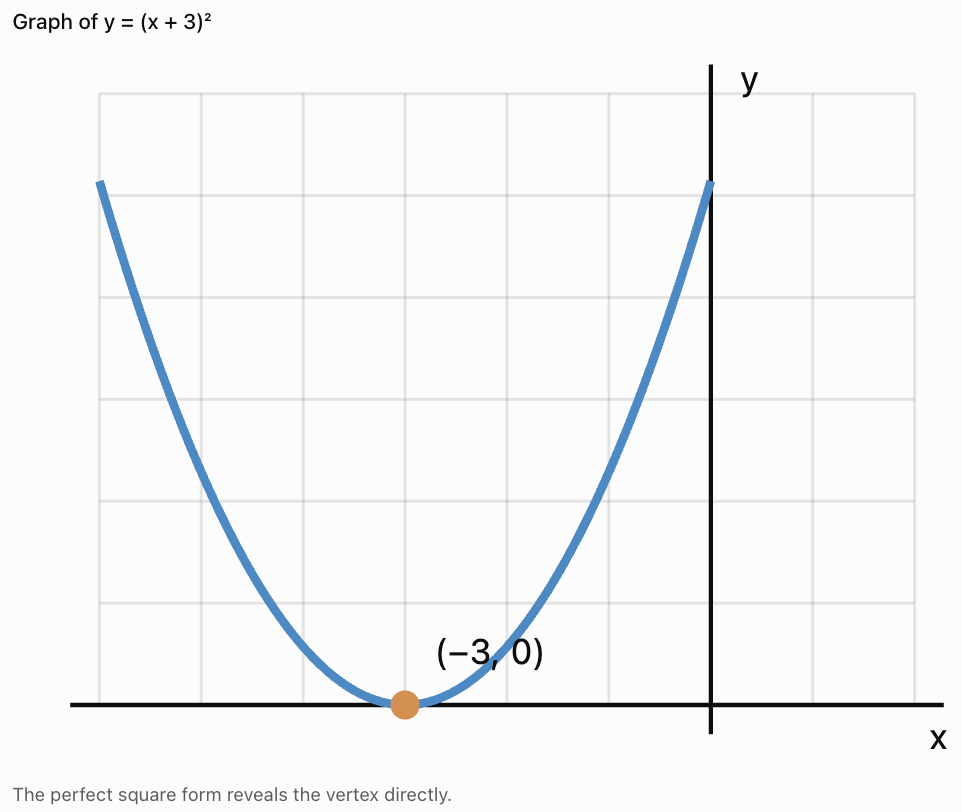
y = x² + 6x + 9
Recognise the perfect square trinomial:
y = (x + 3)²
The second form immediately reveals that:
-
The parabola opens upward.
-
Its minimum value is 0.
-
The minimum occurs when x = −3.
-
The vertex is (−3, 0).
Important Observation
Equivalent algebraic forms can reveal different properties of the same function.
Multi-Step Problem Solving with Identities
Some expressions contain more than one recognisable pattern.
Worked Example
Simplify:
(x + 5)² − (x − 5)² + (x + 2)(x − 2)
First, recognise:
(a + b)² − (a − b)² = 4ab
Therefore:
(x + 5)² − (x − 5)² = 20x
Next:
(x + 2)(x − 2) = x² − 4
Combine:
20x + x² − 4
Write in standard form:
x² + 20x − 4
Verification by Expansion
(x + 5)² = x² + 10x + 25
(x − 5)² = x² − 10x + 25
(x + 2)(x − 2) = x² − 4
Substitute:
x² + 10x + 25 − x² + 10x − 25 + x² − 4
Combine:
x² + 20x − 4
The result is verified.
Choosing the Most Efficient Identity
Different expressions require different strategies.
Expression
Best Strategy
(x + 8)²
Square of a sum
(3x − 2)²
Square of a difference
25x² − 49
Difference of squares
(x + 4)(x + 9)
Common-term binomial product
x³ + 125
Sum of cubes
x³ − 64
Difference of cubes
(x + 6)² − (x − 6)²
Difference of squares or paired-square identity
4x² − 100
Common factor, then difference of squares
A Useful Decision-Making Process
-
Look for a common factor.
-
Count the terms.
-
Identify powers and signs.
-
Look for a recognised identity.
-
Apply the identity.
-
Simplify the result.
-
Verify when appropriate.
Important Observation
Efficient algebra depends on recognising the structure of the problem before choosing a method.
Common Mistakes
Forgetting the Middle Term
Incorrect:
(x + 7)² = x² + 49
Correct:
(x + 7)² = x² + 14x + 49
The middle term comes from multiplying the two cross-products.
Using the Wrong Sign
Incorrect:
(x − 5)² = x² − 25
Correct:
(x − 5)² = x² − 10x + 25
The square of a difference is not the difference of two squares.
Confusing Squares and Cubes
Incorrect:
x³ + 8 = (x + 2)(x² + 4)
Correct:
x³ + 8 = (x + 2)(x² − 2x + 4)
Assuming a Sum of Squares Factors Like a Difference of Squares
Incorrect:
x² + 16 = (x + 4)(x − 4)
The right-hand side actually equals x² − 16.
Over the real numbers, x² + 16 cannot be factored into linear factors.
Forgetting Common Factors
Consider:
4x² − 36
Factor out 4:
4(x² − 9)
Then factor the difference of squares:
4(x − 3)(x + 3)
Cancelling Terms Instead of Factors
Incorrect:
(x² + 4x)/x² = x + 4
Correct, for x ≠ 0:
(x² + 4x)/x²
= x(x + 4)/x²
= (x + 4)/x
Only common multiplicative factors can be cancelled.
Forgetting Restrictions
When simplifying rational expressions, values that make the original denominator zero must remain excluded.
Assuming Numerical Checks Prove an Identity
Testing a few values does not prove an identity.
A general algebraic proof is needed.
Applying Identities Without Checking the Pattern
An identity must match the structure of the expression.
For example, x² + 5x + 6 is not a perfect square trinomial, even though it is a factorable quadratic.
Not Verifying the Final Result
Expanding a factorisation or substituting values can help identify errors.
Key Terms
-
Algebraic Identity: Equation true for every permitted value of its variables.
-
Algebraic Expression: Combination of numbers, variables, and mathematical operations.
-
Equivalent Expressions: Expressions that produce the same value for every permitted input.
-
Distributive Property: Rule that distributes multiplication across addition or subtraction.
-
Expansion: Rewriting a product as a sum of terms.
-
Factorisation: Rewriting an expression as a product of factors.
-
Binomial: Algebraic expression containing two terms.
-
Trinomial: Algebraic expression containing three terms.
-
Perfect Square Trinomial: Trinomial that can be expressed as the square of a binomial.
-
Square of a Sum: Identity (a + b)² = a² + 2ab + b².
-
Square of a Difference: Identity (a − b)² = a² − 2ab + b².
-
Difference of Squares: Identity a² − b² = (a − b)(a + b).
-
Conjugate Binomials: Two binomials with identical terms but opposite signs.
-
Cube of a Sum: Identity (a + b)³ = a³ + 3a²b + 3ab² + b³.
-
Cube of a Difference: Identity (a − b)³ = a³ − 3a²b + 3ab² − b³.
-
Sum of Cubes: Identity a³ + b³ = (a + b)(a² − ab + b²).
-
Difference of Cubes: Identity a³ − b³ = (a − b)(a² + ab + b²).
-
Like Terms: Terms with identical variable parts and exponents.
-
Coefficient: Numerical factor multiplying a variable.
-
Constant: Term without a variable.
-
Simplification: Rewriting an expression into an equivalent, more useful form.
-
Verification: Checking that a mathematical result is correct.
-
Algebraic Proof: Logical demonstration that a mathematical statement is always true.
-
Counterexample: Example showing that a proposed general statement is false.
-
Zero-Product Property: If a product equals zero, at least one factor must equal zero.
-
Quadratic Function: Function represented by a second-degree polynomial.
-
Vertex: Turning point of a parabola.
-
Approximation: Value close to an exact mathematical result.
Key Takeaways
-
Algebraic identities describe relationships that are true for every permitted value of their variables.
-
Recognising patterns makes algebraic calculations faster and more accurate.
-
The distributive property provides the foundation for many identities.
-
The square-of-a-sum and square-of-a-difference identities contain three terms when expanded.
-
The difference-of-squares identity can factor expressions containing two squared terms separated by subtraction.
-
Cubic identities extend these ideas to expressions involving third powers.
-
Algebraic identities can be proved by expansion and simplification.
-
Numerical examples can help verify calculations but do not prove identities.
-
A single counterexample can disprove an incorrect proposed identity.
-
Identities are useful for mental arithmetic, geometry, algebraic fractions, and equations.
-
Equivalent forms can reveal different mathematical properties.
-
Factoring is often useful when solving equations or simplifying fractions.
-
Expansion is often useful when combining terms or writing polynomials in standard form.
-
Always check for common factors and restrictions.
-
Choosing the correct identity is often more important than performing calculations quickly.
Check Your Understanding
Recognising Identities
-
What is an algebraic identity?
-
Write the square-of-a-sum identity.
-
Write the square-of-a-difference identity.
-
Write the difference-of-squares identity.
-
Explain the difference between an identity and an equation that is true only for certain values.
Expanding Expressions
-
Expand (x + 6)².
-
Expand (x − 8)².
-
Expand (2x + 5)².
-
Expand (3a − 2b)².
-
Expand (x + 2)³.
Factoring Expressions
-
Factor x² − 81.
-
Factor 16x² − 25.
-
Factor x² + 14x + 49.
-
Factor x³ − 64.
-
Factor x³ + 27.
Simplifying Expressions
-
Simplify (x + 4)² − (x − 4)².
-
Simplify (3x + 2)(3x − 2).
-
Simplify (a + b)² + (a − b)².
-
Simplify (x² − 16)/(x − 4), stating restrictions.
-
Simplify (x³ − 27)/(x − 3), stating restrictions.
Proof and Applications
-
Prove that (a + b)² − (a − b)² = 4ab.
-
Explain why the difference between consecutive square numbers is always odd.
-
Calculate 105² using an identity.
-
Calculate 48 × 52 using an identity.
-
Explain why (a + b)² = a² + b² is not an identity.
Check Your Understanding — Answer Key
Question
Answer
1
An equation true for every permitted value of its variables
2
(a + b)² = a² + 2ab + b²
3
(a − b)² = a² − 2ab + b²
4
a² − b² = (a − b)(a + b)
5
An identity is always true; an ordinary equation may be true only for particular values
6
x² + 12x + 36
7
x² − 16x + 64
8
4x² + 20x + 25
9
9a² − 12ab + 4b²
10
x³ + 6x² + 12x + 8
11
(x − 9)(x + 9)
12
(4x − 5)(4x + 5)
13
(x + 7)²
14
(x − 4)(x² + 4x + 16)
15
(x + 3)(x² − 3x + 9)
16
16x
17
9x² − 4
18
2a² + 2b²
19
x + 4, where x ≠ 4
20
x² + 3x + 9, where x ≠ 3
21
Expand both squares and simplify to 4ab
22
(n + 1)² − n² = 2n + 1, which is odd
23
11025
24
2496
25
The correct expansion includes 2ab; for example, a = 1 and b = 1 gives 4 ≠ 2
Extended Challenge
1. Simplify (2x + 5)² − (2x − 5)².
2. Factor completely: 9x⁴ − 144.
3. Simplify (a + b)³ + (a − b)³.
4. Prove that (a + b)² + (a − b)² = 2(a² + b²).
5. Calculate 999² without using a calculator.
6. Calculate 996 × 1004 using an algebraic identity.
7. Solve x² − 196 = 0.
8. Solve (2x − 3)² = 49.
9. Simplify (x³ + 8)/(x + 2), stating restrictions.
10. Explain why x² + 4 cannot be factored into real linear factors.
Extended Challenge Answers
Question
Answer
1
40x
2
9(x − 2)(x + 2)(x² + 4)
3
2a³ + 6ab²
4
Expand both squares; the middle terms cancel
5
998001
6
999984
7
x = ±14
8
x = 5 or x = −2
9
x² − 2x + 4, where x ≠ −2
10
Its discriminant is negative, so it has no real roots
Final Investigation: Designing a School Courtyard
A school plans to renovate a square courtyard.
The original courtyard has side length x metres.
The school is considering two designs.
Design A: Increase each side length by 5 metres.
Design B: Increase each side length by 3 metres.
The school wants to compare the resulting areas and understand how algebraic identities can simplify the calculations.
Part A: Developing the Models
-
Write an expression for the original courtyard area.
-
Write an expression for the side length of Design A.
-
Write an expression for the side length of Design B.
-
Write an expression for the area of Design A.
-
Write an expression for the area of Design B.
Part B: Applying Identities
-
Expand the area expression for Design A.
-
Expand the area expression for Design B.
-
Simplify both expressions.
-
Write an expression for the difference between the two areas.
-
Simplify the difference using algebraic identities.
Part C: Creating a Table
-
Calculate the areas of both designs when x = 5, 10, 15, and 20.
-
Organise the results in a table.
-
Calculate the difference between the areas for each value.
-
Describe how the difference changes as x increases.
-
Explain why the difference is not constant.
Part D: Problem Solving
-
The original courtyard has side length 12 m. Calculate the area of Design A.
-
Calculate the area of Design B.
-
Find the difference between the areas.
-
Verify the difference using your simplified algebraic expression.
-
Explain which algebraic identity made the comparison most efficient.
Investigation Answer Check
Original Courtyard
Original area:
A₀ = x²
Design A
Side length:
x + 5
Area:
A₁ = (x + 5)²
Expand:
A₁ = x² + 10x + 25
Design B
Side length:
x + 3
Area:
A₂ = (x + 3)²
Expand:
A₂ = x² + 6x + 9
Difference in Area
ΔA = A₁ − A₂
= (x + 5)² − (x + 3)²
Apply the difference-of-squares identity:
[(x + 5) − (x + 3)][(x + 5) + (x + 3)]
Simplify:
(2)(2x + 8)
ΔA = 4x + 16
Completed Table
Original Side x (m)
Design A Area (m²)
Design B Area (m²)
Difference (m²)
5
100
64
36
10
225
169
56
15
400
324
76
20
625
529
96
Interpretation
As x increases by 5 m, the difference in area increases by 20 m².
The difference is not constant, but it increases linearly with x.
This agrees with:
ΔA = 4x + 16
When x = 12 m
Design A:
A₁ = (12 + 5)²
= 17²
A₁ = 289 m²
Design B:
A₂ = (12 + 3)²
= 15²
A₂ = 225 m²
Difference:
289 − 225 = 64 m²
Using the simplified identity:
ΔA = 4(12) + 16
= 48 + 16
ΔA = 64 m²
Both methods agree.
Final Reflection
Algebraic identities are powerful mathematical tools because they allow us to recognise relationships that remain true for every permitted value of their variables.
They connect expansion, factorisation, equation solving, geometry, numerical calculation, and scientific modelling.
A strong understanding of algebraic identities involves five important abilities:
-
Recognising familiar patterns.
-
Selecting the correct identity.
-
Simplifying expressions efficiently.
-
Explaining why an identity always works.
-
Applying identities to unfamiliar problems.
The most useful identities to remember are:
(a + b)² = a² + 2ab + b²
(a − b)² = a² − 2ab + b²
a² − b² = (a − b)(a + b)
(x + a)(x + b) = x² + (a + b)x + ab
(a + b)³ = a³ + 3a²b + 3ab² + b³
(a − b)³ = a³ − 3a²b + 3ab² − b³
a³ + b³ = (a + b)(a² − ab + b²)
a³ − b³ = (a − b)(a² + ab + b²)
The goal is not to memorise these expressions without understanding them. Instead, we should recognise how they arise from the distributive property and how they can be used to make mathematical problem-solving more efficient.
-

