Algebraic Identities and Factorization
4. Factoring Quadratic Expressions
Learning outcomes
- I can factor simple quadratic expressions.
- I can identify suitable factor pairs.
- I can verify my factorization.
- I can recognize unfactorable expressions.
- I can use factoring to simplify problems.
Factoring Quadratic Expressions
Introduction
In algebra, we often need to rewrite expressions in different forms to make them easier to understand or solve.
One of the most important algebraic techniques is factorisation, which involves rewriting an expression as a product of simpler expressions.
Consider:
x² + 5x + 6
This quadratic expression can be written as:
(x + 2)(x + 3)
Both expressions are equivalent, but the factored form is especially useful for solving equations, simplifying algebraic fractions, and identifying important features of quadratic functions.
Factorisation is the reverse of expansion.
For example:
Expansion:
(x + 2)(x + 3) = x² + 5x + 6
Factorisation:
x² + 5x + 6 = (x + 2)(x + 3)
Learning to recognise factor pairs and algebraic patterns makes factorisation faster and more accurate.


What Is a Quadratic Expression?
A quadratic expression is a polynomial expression in one variable whose highest power is 2.
The general form is:
ax² + bx + c
where:
-
a, b, and c are constants.
-
a ≠ 0.
-
x is the variable.
Examples include:
-
x² + 7x + 10
-
x² − 5x + 6
-
2x² + 7x + 3
-
3x² − 12x
-
x² − 16
Understanding the Terms
In:
2x² + 5x + 3
-
2x² is the quadratic term.
-
5x is the linear term.
-
3 is the constant term.
Important Observation
Quadratic expressions contain an x² term, but the linear or constant term may be absent.
What Does Factoring Mean?
Factoring means expressing a quantity as a product of factors.
Numerical Example
12 = 3 × 4
The numbers 3 and 4 are factors of 12.
Algebraic Example
x² + 7x + 12 = (x + 3)(x + 4)
The expressions x + 3 and x + 4 are factors of the quadratic expression.
Why Factor?
Factoring is useful because it can help us:
-
Solve quadratic equations.
-
Simplify rational expressions.
-
Find the zeros of quadratic functions.
-
Analyse graphs.
-
Recognise algebraic patterns.
-
Solve practical problems.
Understanding Factor Pairs
A factor pair consists of two numbers whose product equals a given number.
Example: Factor Pairs of 12
|
Factor Pair |
Product |
|---|---|
|
1 and 12 |
12 |
|
2 and 6 |
12 |
|
3 and 4 |
12 |
|
−1 and −12 |
12 |
|
−2 and −6 |
12 |
|
−3 and −4 |
12 |
Important Observation
Positive numbers can be produced by multiplying two positive numbers or two negative numbers.
Negative numbers are produced by multiplying numbers with opposite signs.
Factoring Quadratics with a Leading Coefficient of 1
The simplest quadratic expressions have the form:
x² + bx + c
We want to rewrite them as:
(x + m)(x + n)
Expanding:
(x + m)(x + n)
= x² + nx + mx + mn
= x² + (m + n)x + mn
Therefore, we need two numbers that:
-
Add to b.
-
Multiply to c.
General Rule
For x² + bx + c:
m + n = b
mn = c
Then:
x² + bx + c = (x + m)(x + n)
Factoring When Both Signs Are Positive
Worked Example: x² + 7x + 12
Find two numbers that:
-
Multiply to 12.
-
Add to 7.
Possible positive factor pairs:
1 and 12 → sum = 13
2 and 6 → sum = 8
3 and 4 → sum = 7
The correct pair is 3 and 4.
Therefore:
x² + 7x + 12 = (x + 3)(x + 4)
Verification
Expand:
(x + 3)(x + 4)
= x² + 4x + 3x + 12
= x² + 7x + 12
The factorisation is correct.
Factoring with a Negative Constant
When the constant term is negative, the factors must have opposite signs.
Worked Example: x² + 2x − 15
Find two numbers that:
-
Multiply to −15.
-
Add to 2.
Possible pairs:
5 and −3 → sum = 2
−5 and 3 → sum = −2
The correct pair is 5 and −3.
Therefore:
x² + 2x − 15 = (x + 5)(x − 3)
Verification
(x + 5)(x − 3)
= x² − 3x + 5x − 15
= x² + 2x − 15
Important Observation
When the constant is negative, the two binomial factors contain opposite signs.
Factoring with a Negative Middle Term
Worked Example: x² − 9x + 20
Find two numbers that:
-
Multiply to 20.
-
Add to −9.
Since the product is positive and the sum is negative, both numbers must be negative.
Possible pairs:
−1 and −20 → sum = −21
−2 and −10 → sum = −12
−4 and −5 → sum = −9
Therefore:
x² − 9x + 20 = (x − 4)(x − 5)
Verification
(x − 4)(x − 5)
= x² − 5x − 4x + 20
= x² − 9x + 20
Factoring When Both the Middle and Constant Terms Are Negative
Worked Example: x² − 4x − 21
Find two numbers that:
-
Multiply to −21.
-
Add to −4.
The correct pair is −7 and 3.
Therefore:
x² − 4x − 21 = (x − 7)(x + 3)
Verification
(x − 7)(x + 3)
= x² + 3x − 7x − 21
= x² − 4x − 21
Important Observation
The sign of the sum helps determine which factor has the larger absolute value.
A Systematic Factor-Pair Strategy
Consider:
x² + 11x + 24
Step 1: Identify b and c
b = 11
c = 24
Step 2: List Factor Pairs of 24
|
Pair |
Sum |
|---|---|
|
1 and 24 |
25 |
|
2 and 12 |
14 |
|
3 and 8 |
11 |
|
4 and 6 |
10 |
Step 3: Choose the Pair with the Correct Sum
3 and 8
Step 4: Write the Factors
(x + 3)(x + 8)
Step 5: Verify
(x + 3)(x + 8)
= x² + 11x + 24
Important Observation
A systematic factor-pair table is particularly helpful when the constant has several possible factor pairs.
Factoring Using an Area Model
Quadratic factorisation can also be represented geometrically.
Consider:
x² + 5x + 6
We can arrange algebra tiles to form a rectangle.
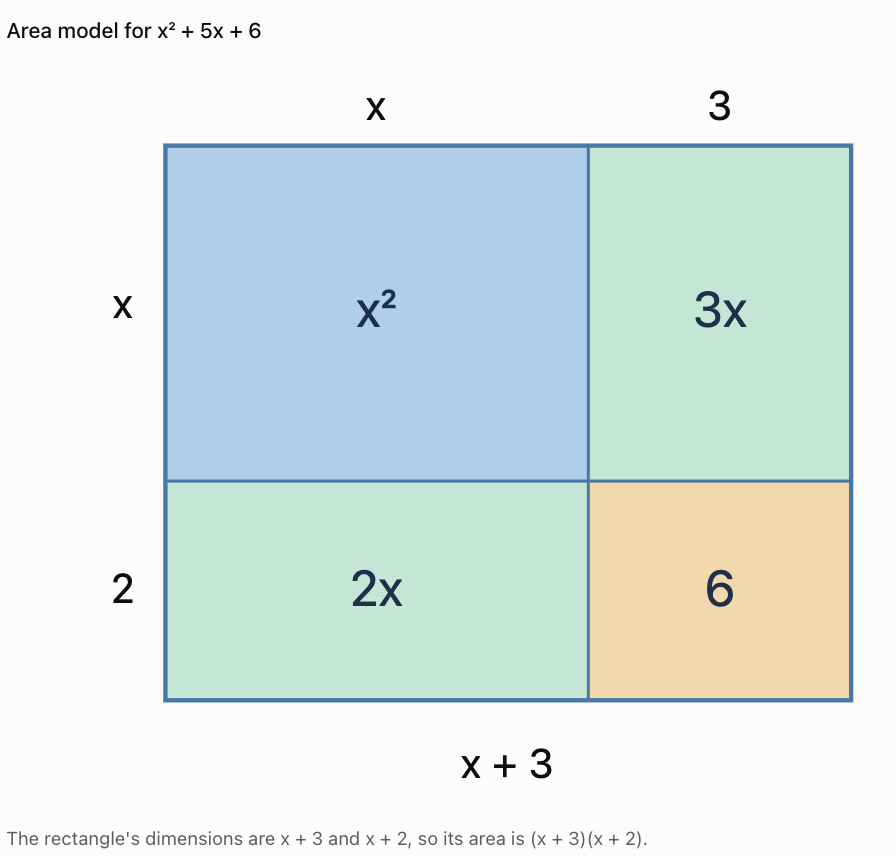
The area can be written as:
x² + 3x + 2x + 6
Combine like terms:
x² + 5x + 6
Therefore:
x² + 5x + 6 = (x + 3)(x + 2)
Important Observation
Factoring can be interpreted as finding the dimensions of a rectangle from its area expression.
Factoring Out a Greatest Common Factor
Before factoring a quadratic, always check whether all terms share a common factor.
Worked Example: 3x² + 12x
Both terms contain 3x.
Factor out 3x:
3x² + 12x = 3x(x + 4)
Verification
3x(x + 4)
= 3x² + 12x
Worked Example: 2x² + 10x + 12
All terms share a factor of 2.
Factor out 2:
2(x² + 5x + 6)
Now factor the quadratic:
x² + 5x + 6 = (x + 2)(x + 3)
Therefore:
2x² + 10x + 12 = 2(x + 2)(x + 3)
Important Observation
Factoring out the greatest common factor first often makes the remaining quadratic easier to factor.
Factoring Quadratics with Leading Coefficients Greater Than 1
Some quadratic expressions have the form:
ax² + bx + c
where a is greater than 1.
These require a slightly different strategy.
Worked Example: 2x² + 7x + 3
We want two binomials whose product gives the original expression.
Step 1: Multiply a and c
a × c = 2 × 3 = 6
Step 2: Find Two Numbers
We need two numbers that:
-
Multiply to 6.
-
Add to 7.
The numbers are 6 and 1.
Step 3: Split the Middle Term
2x² + 6x + x + 3
Step 4: Factor by Grouping
2x(x + 3) + 1(x + 3)
Step 5: Factor the Common Binomial
(2x + 1)(x + 3)
Verification
(2x + 1)(x + 3)
= 2x² + 6x + x + 3
= 2x² + 7x + 3
The AC Method
The previous strategy is often called the AC method.
For:
ax² + bx + c
follow these steps:
-
Multiply a × c.
-
Find two numbers whose product is ac and whose sum is b.
-
Split the middle term using those numbers.
-
Factor by grouping.
-
Factor out the common binomial.
Worked Example
Factor:
3x² + 11x + 6
a × c = 3 × 6 = 18
Find two numbers that multiply to 18 and add to 11.
The numbers are 9 and 2.
Split the middle term:
3x² + 9x + 2x + 6
Group:
3x(x + 3) + 2(x + 3)
Factor:
(3x + 2)(x + 3)
Factoring with Negative Coefficients
Worked Example
Factor:
2x² − 5x − 3
a × c = 2 × (−3) = −6
Find two numbers that:
-
Multiply to −6.
-
Add to −5.
The numbers are −6 and 1.
Split:
2x² − 6x + x − 3
Group:
2x(x − 3) + 1(x − 3)
Factor:
(2x + 1)(x − 3)
Verification
(2x + 1)(x − 3)
= 2x² − 6x + x − 3
= 2x² − 5x − 3
Special Case: Difference of Two Squares
Some quadratic expressions contain only two terms.
For example:
x² − 25
This is a difference of two squares.
Use the identity:
a² − b² = (a − b)(a + b)
Therefore:
x² − 25 = (x − 5)(x + 5)
Another Example
Factor:
9x² − 16
Recognise:
9x² = (3x)²
16 = 4²
Therefore:
9x² − 16 = (3x − 4)(3x + 4)
Important Observation
Recognising special patterns can make factorisation faster than using a general method.
Special Case: Perfect Square Trinomials
Some quadratic expressions are the squares of binomials.
Example
x² + 10x + 25
Recognise:
x² = (x)²
25 = 5²
Middle term:
2(x)(5) = 10x
Therefore:
x² + 10x + 25 = (x + 5)²
Another Example
4x² − 12x + 9
Recognise:
4x² = (2x)²
9 = 3²
Middle term:
−2(2x)(3) = −12x
Therefore:
4x² − 12x + 9 = (2x − 3)²
Recognising Unfactorable Expressions
Not every quadratic expression can be factored using integer coefficients.
Consider:
x² + 3x + 1
To factor over the integers, we need two integers that:
-
Multiply to 1.
-
Add to 3.
The integer factor pairs of 1 are:
1 and 1
−1 and −1
Their sums are 2 and −2.
Neither gives 3.
Therefore:
x² + 3x + 1 cannot be factored into binomials with integer coefficients.
However, it can be factored using irrational real numbers.
Important Observation
An expression that cannot be factored using integers may still be factorable over the real or complex numbers.
Using the Discriminant to Recognise Factorability
For a quadratic expression:
ax² + bx + c
the discriminant is:
D = b² − 4ac
The discriminant provides information about the roots of the corresponding quadratic equation.
Interpretation
-
D > 0: Two distinct real roots.
-
D = 0: One repeated real root.
-
D < 0: No real roots.
For quadratic expressions with integer coefficients, a nonnegative perfect-square discriminant indicates that the expression can be factored into linear factors with rational coefficients.
Example
Consider:
x² + 3x + 1
a = 1
b = 3
c = 1
D = 3² − 4(1)(1)
D = 9 − 4
D = 5
Since 5 is not a perfect square, the expression cannot be factored into linear factors with rational coefficients.
Important Observation
The discriminant helps distinguish between expressions that factor neatly over the rational numbers and those that require irrational or complex roots.
Quadratics That Cannot Be Factored Over the Real Numbers
Consider:
x² + 4
The corresponding equation is:
x² + 4 = 0
x² = −4
There is no real number whose square equals −4.
Therefore, x² + 4 cannot be factored into real linear factors.
Over the complex numbers:
x² + 4 = (x − 2i)(x + 2i)
Important Observation
Whether an expression is factorable depends on the number system being used.
Verifying Factorisation by Expansion
One of the most reliable ways to check factorisation is to multiply the factors.
Worked Example
Verify:
x² + 9x + 20 = (x + 4)(x + 5)
Expand:
(x + 4)(x + 5)
= x² + 5x + 4x + 20
= x² + 9x + 20
The expanded expression matches the original.
Therefore, the factorisation is correct.
Verifying by Substitution
We can also substitute a value for x.
Example
Check:
x² + 7x + 10 = (x + 2)(x + 5)
Choose x = 3.
Original expression:
3² + 7(3) + 10
= 9 + 21 + 10
= 40
Factored expression:
(3 + 2)(3 + 5)
= 5 × 8
= 40
Both expressions give the same result.
Important Observation
Substitution is useful for detecting mistakes, but checking one value does not prove that two expressions are equivalent for all values.
Using Factorisation to Solve Quadratic Equations
Factoring is especially useful when solving equations.
Worked Example
Solve:
x² + 5x + 6 = 0
Factor:
(x + 2)(x + 3) = 0
Apply the zero-product property.
If a product equals zero, at least one factor must equal zero.
Therefore:
x + 2 = 0
or
x + 3 = 0
Solutions:
x = −2 or x = −3
Solving Quadratic Equations with Coefficients
Worked Example
Solve:
2x² + 7x + 3 = 0
Factor:
(2x + 1)(x + 3) = 0
Set each factor equal to zero.
2x + 1 = 0
2x = −1
x = −1/2
Or:
x + 3 = 0
x = −3
Final Answer
x = −1/2 or x = −3
Simplifying Algebraic Fractions
Factorisation is useful when simplifying rational expressions.
Worked Example
Simplify:
(x² + 5x + 6)/(x + 2)
Factor the numerator:
(x + 2)(x + 3)/(x + 2)
Cancel the common factor:
x + 3
However, the original denominator cannot equal zero.
Therefore:
Final Answer: x + 3, where x ≠ −2
Important Observation
When simplifying algebraic fractions, only common factors may be cancelled.
Simplifying More Complex Rational Expressions
Worked Example
Simplify:
(x² − 9)/(x² + 6x + 9)
Factor the numerator:
x² − 9 = (x − 3)(x + 3)
Factor the denominator:
x² + 6x + 9 = (x + 3)²
Therefore:
[(x − 3)(x + 3)]/[(x + 3)(x + 3)]
Cancel one common factor:
(x − 3)/(x + 3), where x ≠ −3
Important Observation
Restrictions from the original denominator must be preserved after cancellation.
Factoring and Quadratic Graphs
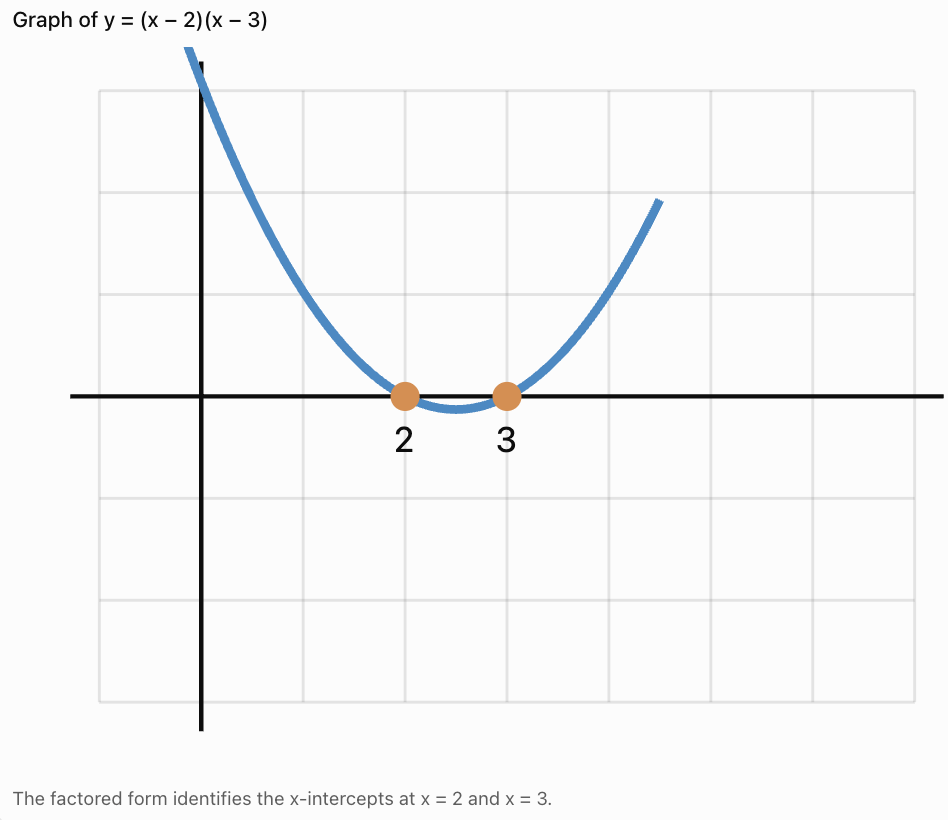
Factoring helps identify where a quadratic graph crosses the x-axis.
Consider:
y = x² − 5x + 6
Factor:
y = (x − 2)(x − 3)
The graph crosses the x-axis where y = 0.
Therefore:
x − 2 = 0 or x − 3 = 0
x = 2 or x = 3
Important Observation
Factoring a quadratic function makes its zeros easier to identify.
Applications in Geometry
Quadratic expressions often represent areas of rectangles.

Worked Example
A rectangular garden has an area of:
x² + 9x + 20
Find expressions for its length and width.
Step 1: Factor the Area Expression
Find two numbers that:
-
Multiply to 20.
-
Add to 9.
The numbers are 4 and 5.
Therefore:
x² + 9x + 20 = (x + 4)(x + 5)
Step 2: Interpret the Factors
Possible dimensions are:
Length = x + 5
Width = x + 4
Important Observation
Factoring an area expression can reveal possible dimensions of a rectangle.
Applications in Number Problems
Factorisation can help solve problems involving unknown numbers.
Worked Example
The product of two consecutive positive integers is 56.
Find the integers.
Let x = smaller integer.
The next integer is x + 1.
Therefore:
x(x + 1) = 56
Expand:
x² + x = 56
Rearrange:
x² + x − 56 = 0
Factor:
(x + 8)(x − 7) = 0
Therefore:
x = −8 or x = 7
Since the integers must be positive:
The numbers are 7 and 8.
Common Mistakes
Choosing factors with the correct product but incorrect sum
Both conditions must be satisfied.
Ignoring negative factor pairs
Negative numbers are often required when factoring expressions with negative coefficients.
Forgetting the greatest common factor
Always check whether a common factor can be removed first.
Confusing factoring with expansion
Factoring rewrites a sum as a product. Expansion rewrites a product as a sum.
Making sign errors
For example:
x² − 5x + 6 = (x − 2)(x − 3)
not (x + 2)(x + 3).
Assuming every quadratic factors over the integers
Some quadratics require irrational or complex roots.
Failing to factor completely
An expression may contain a common factor or another factorable pattern.
Cancelling terms instead of factors
Only common multiplicative factors may be cancelled in rational expressions.
Forgetting restrictions
When simplifying fractions, preserve excluded values from the original denominator.
Not verifying
Expand the factors to confirm that they reproduce the original expression.
Key Terms
-
Quadratic Expression: Polynomial expression with highest variable power 2.
-
Factorisation: Rewriting an expression as a product of factors.
-
Factor: Quantity multiplied by another quantity to form a product.
-
Factor Pair: Two numbers whose product equals a specified value.
-
Coefficient: Numerical factor multiplying a variable.
-
Constant Term: Term without a variable.
-
Leading Coefficient: Coefficient of the highest-power term.
-
Greatest Common Factor: Largest factor shared by all terms.
-
Expansion: Multiplying factors to produce an equivalent expression.
-
Distributive Property: Rule that distributes multiplication across addition or subtraction.
-
AC Method: Factoring method involving the product of the leading coefficient and constant term.
-
Factoring by Grouping: Rewriting and grouping terms to identify common factors.
-
Perfect Square Trinomial: Trinomial that is the square of a binomial.
-
Difference of Squares: Expression of the form a² − b².
-
Zero-Product Property: If a product equals zero, at least one factor must equal zero.
-
Quadratic Equation: Equation containing a quadratic expression.
-
Root: Value that satisfies an equation.
-
Zero of a Function: Input value that makes the function equal zero.
-
Discriminant: Quantity b² − 4ac used to analyse quadratic roots.
-
Rational Expression: Fraction containing algebraic expressions.
-
Excluded Value: Value that makes a denominator equal to zero.
-
Verification: Checking that a mathematical result is correct.
-
Unfactorable over the Integers: Expression that cannot be written as a product of lower-degree polynomials with integer coefficients.
-
Parabola: Graph of a quadratic function.
-
x-Intercept: Point where a graph crosses or touches the x-axis.
Key Takeaways
-
Factoring is the reverse of expansion.
-
Quadratic expressions have the general form ax² + bx + c.
-
For x² + bx + c, find two numbers that add to b and multiply to c.
-
Positive constants may require two positive or two negative factors.
-
Negative constants require factors with opposite signs.
-
The greatest common factor should be removed first.
-
The AC method can factor quadratics with leading coefficients greater than 1.
-
Special patterns include perfect square trinomials and differences of squares.
-
Not every quadratic factors over the integers.
-
The discriminant helps identify the nature of quadratic roots.
-
Factorisation can be verified by expansion.
-
Factoring is useful for solving quadratic equations.
-
Factoring can simplify algebraic fractions.
-
Factored form helps identify x-intercepts of quadratic graphs.
-
Factoring is useful in geometry, number problems, and other real-world applications.
Check Your Understanding
Understanding Factorisation
-
What does it mean to factor a quadratic expression?
-
What is the general form of a quadratic expression?
-
What two conditions must factor pairs satisfy when factoring x² + bx + c?
-
Why should the greatest common factor be checked first?
-
How can factorisation be verified?
Basic Factorisation
-
Factor x² + 5x + 6.
-
Factor x² + 9x + 20.
-
Factor x² − 7x + 12.
-
Factor x² + x − 12.
-
Factor x² − 2x − 15.
More Advanced Factorisation
-
Factor 2x² + 7x + 3.
-
Factor 3x² + 10x + 3.
-
Factor 2x² − 5x − 3.
-
Factor completely: 2x² + 14x + 24.
-
Factor x² − 49.
Applications
-
Solve x² + 7x + 12 = 0.
-
Solve x² − 5x + 6 = 0.
-
Simplify (x² + 5x + 6)/(x + 2), stating restrictions.
-
Explain why x² + 3x + 1 cannot be factored using integer coefficients.
-
Explain how factorisation helps identify the x-intercepts of a quadratic graph.
Answer Key
|
Question |
Answer |
|---|---|
|
1 |
Rewriting an expression as a product of factors |
|
2 |
ax² + bx + c, where a ≠ 0 |
|
3 |
Sum = b and product = c |
|
4 |
It simplifies the remaining expression |
|
5 |
Expand the factors |
|
6 |
(x + 2)(x + 3) |
|
7 |
(x + 4)(x + 5) |
|
8 |
(x − 3)(x − 4) |
|
9 |
(x + 4)(x − 3) |
|
10 |
(x − 5)(x + 3) |
|
11 |
(2x + 1)(x + 3) |
|
12 |
(3x + 1)(x + 3) |
|
13 |
(2x + 1)(x − 3) |
|
14 |
2(x + 3)(x + 4) |
|
15 |
(x − 7)(x + 7) |
|
16 |
x = −3 or −4 |
|
17 |
x = 2 or 3 |
|
18 |
x + 3, where x ≠ −2 |
|
19 |
No integer factor pair multiplies to 1 and adds to 3 |
|
20 |
Setting each linear factor equal to zero gives the x-intercepts |
Extended Challenge
1. Factor completely: 4x² + 20x + 24.
2. Factor: 6x² + 11x + 3.
3. Factor: 8x² − 2x − 3.
4. Factor completely: 3x² − 27.
5. Factor: 9x² − 24x + 16.
6. Solve: 2x² + 9x + 7 = 0.
7. Solve: 3x² − 13x + 4 = 0.
8. Simplify (x² − 16)/(x² + 8x + 16), stating restrictions.
9. Determine whether x² + 4x + 7 can be factored into real linear factors.
10. A rectangle has area x² + 13x + 42. Find possible expressions for its dimensions.
Extended Challenge Answers
|
Question |
Answer |
|---|---|
|
1 |
4(x + 2)(x + 3) |
|
2 |
(3x + 1)(2x + 3) |
|
3 |
(4x − 3)(2x + 1) |
|
4 |
3(x − 3)(x + 3) |
|
5 |
(3x − 4)² |
|
6 |
x = −1 or −7/2 |
|
7 |
x = 4 or 1/3 |
|
8 |
(x − 4)/(x + 4), x ≠ −4 |
|
9 |
No; discriminant = −12 |
|
10 |
x + 6 and x + 7 |
Final Investigation: Designing a Rectangular Garden
A school is designing a rectangular garden.
The area is represented by:
A = x² + 11x + 30
The school wants to determine possible dimensions of the garden.
Part A: Understanding the Expression
-
Identify the quadratic, linear, and constant terms.
-
Identify the coefficient of x².
-
Identify the coefficient of x.
-
Identify the constant term.
-
Explain why this is a quadratic expression.
Part B: Finding Factor Pairs
-
List the positive factor pairs of 30.
-
Calculate the sum of each pair.
-
Identify the pair that adds to 11.
-
Factor the quadratic expression.
-
Explain how the factors represent possible dimensions.
Part C: Verifying
-
Expand the factored expression.
-
Combine like terms.
-
Compare the result with the original expression.
-
Explain why the factorisation is correct.
Part D: Applying the Model
-
Calculate the garden's dimensions when x = 2.
-
Calculate the area directly using length × width.
-
Calculate the area using the quadratic expression.
-
Compare the results.
-
Explain why both methods agree.
-
Describe how the area changes as x increases.
Investigation Answer Check
Original Expression
A = x² + 11x + 30
Finding Factor Pairs
We need two numbers that:
-
Multiply to 30.
-
Add to 11.
The numbers are 5 and 6.
Therefore:
A = (x + 5)(x + 6)
Dimensions
Possible dimensions are:
Length = x + 6
Width = x + 5
Verification
(x + 5)(x + 6)
= x² + 6x + 5x + 30
= x² + 11x + 30
The factorisation is correct.
When x = 2
Length = 2 + 6 = 8 m
Width = 2 + 5 = 7 m
Area = 8 × 7
Area = 56 m²
Using the quadratic expression:
A = 2² + 11(2) + 30
= 4 + 22 + 30
A = 56 m²
Both methods agree.
Final Reflection
Factoring quadratic expressions is an important algebraic skill that connects multiplication, polynomial structure, equation solving, and graph analysis.
By identifying suitable factor pairs, checking for common factors, recognising special patterns, and verifying results through expansion, we can factor quadratic expressions accurately and efficiently.
Factorisation also helps us solve equations, simplify rational expressions, and interpret real-world problems involving areas and unknown quantities.
The most important principle is that factoring rewrites a quadratic expression as a product of simpler factors while preserving its mathematical value.