Algebraic Identities and Factorization
3. Expanding Binomials
Learning outcomes
- I can multiply two binomials.
- I can organize terms systematically.
- I can simplify expanded expressions.
- I can identify common mistakes.
- I can verify expansions.
Expanding Binomials
Introduction
Algebra often involves expressions containing two or more terms. Learning how to multiply these expressions is an essential skill for working with polynomials, solving equations, and understanding quadratic functions.
A binomial is an algebraic expression containing two terms.
Examples include:
-
x + 3
-
x − 5
-
2x + 7
-
3a − 4b
When two binomials are multiplied, we use a process called expansion.
For example:
(x + 2)(x + 3)
Expanding this expression gives:
x² + 5x + 6
The expanded expression is equivalent to the original product, but it is written as a sum of terms rather than a multiplication of factors.
Expanding binomials is important because it allows us to:
-
Simplify algebraic expressions.
-
Develop quadratic equations.
-
Understand polynomial multiplication.
-
Calculate areas of geometric shapes.
-
Verify factorisation.
-
Solve practical problems involving changing quantities.
What Is a Binomial?
A binomial is a polynomial containing exactly two terms.
Examples:
x + 4
Terms: x and 4
3x − 7
Terms: 3x and −7
2a + 5b
Terms: 2a and 5b
x² − 9
Terms: x² and −9
A binomial may contain variables, coefficients, constants, and powers.
Important Observation
A binomial contains two terms, but those terms do not have to be simple numbers or variables.
Understanding Multiplication of Binomials
Consider:
(x + 2)(x + 3)
This means:
(x + 2) multiplied by (x + 3).
Each term in the first binomial must multiply each term in the second binomial.
There are four individual products:
-
x × x = x²
-
x × 3 = 3x
-
2 × x = 2x
-
2 × 3 = 6
Add the results:
x² + 3x + 2x + 6
Combine like terms:
x² + 5x + 6
Important Observation
Multiplying two binomials normally produces four intermediate products, although some terms can be combined.
The Distributive Property
The distributive property is the foundation of expanding algebraic expressions.
For numbers:
a(b + c) = ab + ac
For example:
3(4 + 5) = 3 × 4 + 3 × 5
= 12 + 15
= 27
The same rule applies to algebra.
Example
Expand:
2x(x + 4)
Distribute 2x:
2x × x + 2x × 4
= 2x² + 8x
Important Observation
Every term inside the brackets must be multiplied by the term outside.
The Double Distributive Property
When multiplying two binomials, we apply the distributive property twice.
Worked Example
Expand:
(x + 2)(x + 5)
Step 1: Distribute the First Term
x(x + 5) = x² + 5x
Step 2: Distribute the Second Term
2(x + 5) = 2x + 10
Step 3: Combine
x² + 5x + 2x + 10
Step 4: Collect Like Terms
x² + 7x + 10
This method works for all products of binomials.
The Area Model for Expanding Binomials
Multiplication of binomials can also be understood geometrically.
Imagine a rectangle with side lengths:
x + 3 and x + 2
Its area is:
A = (x + 3)(x + 2)
We can divide the rectangle into four smaller regions.
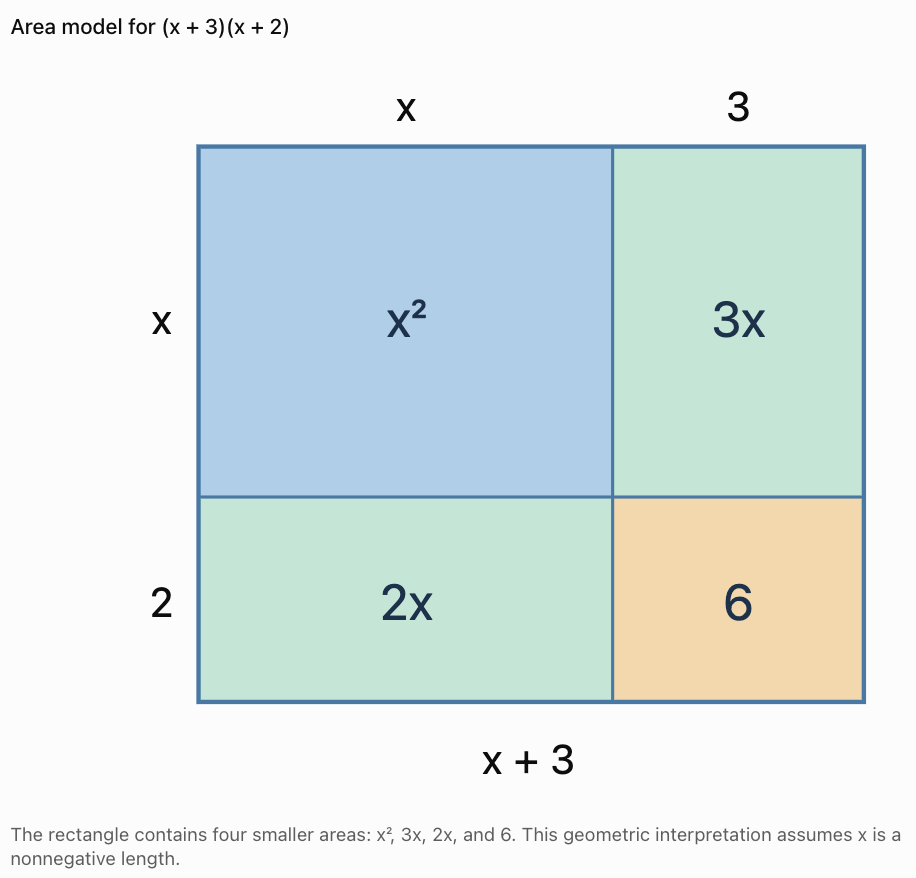
The total area is:
A = x² + 3x + 2x + 6
Combine like terms:
A = x² + 5x + 6
Therefore:
(x + 3)(x + 2) = x² + 5x + 6
Important Observation
The area model helps explain why each term in one binomial must multiply every term in the other binomial.
The FOIL Method
FOIL is a useful memory aid for multiplying two binomials.
FOIL stands for:
-
F — First: Multiply the first terms.
-
O — Outer: Multiply the outer terms.
-
I — Inner: Multiply the inner terms.
-
L — Last: Multiply the last terms.
Worked Example
Expand:
(x + 4)(x + 7)
First:
x × x = x²
Outer:
x × 7 = 7x
Inner:
4 × x = 4x
Last:
4 × 7 = 28
Combine:
x² + 7x + 4x + 28
Final Answer: x² + 11x + 28
Important Observation
FOIL is a convenient method for multiplying two binomials. The distributive property is more general and also works for expressions containing more than two terms.
Organising Terms Systematically
A systematic approach reduces errors.
Worked Example
Expand:
(2x + 3)(x + 5)
|
Multiplication |
Result |
|---|---|
|
2x × x |
2x² |
|
2x × 5 |
10x |
|
3 × x |
3x |
|
3 × 5 |
15 |
Add:
2x² + 10x + 3x + 15
Combine like terms:
2x² + 13x + 15
Important Observation
Writing all four products before simplifying helps prevent missing terms.
Expanding Binomials with Positive Terms
Worked Example
Expand:
(x + 6)(x + 2)
First:
x × x = x²
Outer:
x × 2 = 2x
Inner:
6 × x = 6x
Last:
6 × 2 = 12
Combine:
x² + 2x + 6x + 12
Final Answer: x² + 8x + 12
Another Example
Expand:
(3x + 4)(2x + 5)
First:
3x × 2x = 6x²
Outer:
3x × 5 = 15x
Inner:
4 × 2x = 8x
Last:
4 × 5 = 20
Combine:
6x² + 23x + 20
Expanding Binomials with Negative Terms
Negative signs require careful attention.
Worked Example
Expand:
(x − 3)(x + 5)
First:
x × x = x²
Outer:
x × 5 = 5x
Inner:
−3 × x = −3x
Last:
−3 × 5 = −15
Combine:
x² + 5x − 3x − 15
Final Answer: x² + 2x − 15
Important Observation
Treat subtraction as addition of a negative term.
This helps avoid sign errors.
Expanding Two Binomials with Negative Terms
Worked Example
Expand:
(x − 4)(x − 6)
First:
x × x = x²
Outer:
x × (−6) = −6x
Inner:
−4 × x = −4x
Last:
−4 × (−6) = +24
Combine:
x² − 6x − 4x + 24
Final Answer: x² − 10x + 24
Important Observation
The product of two negative numbers is positive.
Sign Rules in Binomial Expansion
Remember the multiplication rules:
|
Multiplication |
Result |
|---|---|
|
Positive × Positive |
Positive |
|
Positive × Negative |
Negative |
|
Negative × Positive |
Negative |
|
Negative × Negative |
Positive |
Example
Expand:
(2x − 5)(3x − 4)
Products:
2x × 3x = 6x²
2x × (−4) = −8x
−5 × 3x = −15x
−5 × (−4) = +20
Combine:
6x² − 8x − 15x + 20
Final Answer: 6x² − 23x + 20
Combining Like Terms
After expansion, some terms can be combined.
Like terms have the same variables raised to the same powers.
Examples:
-
3x and 7x are like terms.
-
5x² and −2x² are like terms.
-
4ab and 9ab are like terms.
However:
-
x and x² are not like terms.
-
x and y are not like terms.
-
xy and x² are not like terms.
Worked Example
Simplify:
3x² + 5x + 2x² − 7x + 4
Group like terms:
(3x² + 2x²) + (5x − 7x) + 4
Simplify:
5x² − 2x + 4
Important Observation
Only terms with identical variable parts can be combined by addition or subtraction.
Expanding Binomials with Different Variables
Binomials may contain more than one variable.
Worked Example
Expand:
(a + b)(a + 3b)
First:
a × a = a²
Outer:
a × 3b = 3ab
Inner:
b × a = ab
Last:
b × 3b = 3b²
Combine:
a² + 3ab + ab + 3b²
Final Answer: a² + 4ab + 3b²
Another Example
Expand:
(2x − y)(3x + 4y)
Products:
2x × 3x = 6x²
2x × 4y = 8xy
−y × 3x = −3xy
−y × 4y = −4y²
Combine:
6x² + 5xy − 4y²
Expanding Binomials Containing Powers
The terms inside a binomial may already contain powers.
Worked Example
Expand:
(x² + 3)(x + 4)
First:
x² × x = x³
Outer:
x² × 4 = 4x²
Inner:
3 × x = 3x
Last:
3 × 4 = 12
Therefore:
x³ + 4x² + 3x + 12
Worked Example
Expand:
(2x² − 3x)(x + 5)
Products:
2x² × x = 2x³
2x² × 5 = 10x²
−3x × x = −3x²
−3x × 5 = −15x
Combine:
2x³ + 7x² − 15x
Important Observation
When multiplying powers with the same base, add their exponents.
For example:
x² × x³ = x⁵
The General Binomial Product
The distributive property can be expressed using a general formula.
(a + b)(c + d) = ac + ad + bc + bd
This formula works for numbers, variables, and algebraic expressions.
Example
Expand:
(2x + 5)(3x + 7)
Using the general formula:
= (2x)(3x) + (2x)(7) + (5)(3x) + (5)(7)
= 6x² + 14x + 15x + 35
= 6x² + 29x + 35
Important Observation
FOIL is simply a specific way of applying this general distributive pattern.
Using an Algebraic Grid
An algebraic grid provides another systematic method for multiplication.
Worked Example
Expand:
(2x + 3)(x + 4)
|
× |
x |
4 |
|---|---|---|
|
2x |
2x² |
8x |
|
3 |
3x |
12 |
Add the four products:
2x² + 8x + 3x + 12
Combine:
2x² + 11x + 12
Advantages of the Grid Method
-
Organises every multiplication.
-
Reduces the chance of missing terms.
-
Makes signs easier to track.
-
Extends naturally to larger polynomials.
Important Observation
The grid method and FOIL produce identical results because both use the distributive property.
Special Case: Squaring a Binomial
Sometimes the two binomials are identical.
Example
(x + 4)(x + 4)
This can be written:
(x + 4)²
Expand:
x² + 4x + 4x + 16
= x² + 8x + 16
This is a perfect square trinomial.
General Identity
(a + b)² = a² + 2ab + b²
Another Example
(x − 5)² = x² − 10x + 25
Important Observation
The square of a binomial includes a middle term. It is not simply the sum of the squares of its terms.
Special Case: Conjugate Binomials
Conjugate binomials contain the same terms but opposite signs.
For example:
(x + 4)(x − 4)
Expand:
x² − 4x + 4x − 16
The middle terms cancel.
= x² − 16
This is called the difference of two squares.
General Identity
(a + b)(a − b) = a² − b²
Another Example
(3x + 5)(3x − 5)
= 9x² − 25
Important Observation
Recognising conjugate binomials allows us to expand without writing all four intermediate products.
Comparing Common Expansion Patterns
|
Expression |
Expansion |
|---|---|
|
(a + b)² |
a² + 2ab + b² |
|
(a − b)² |
a² − 2ab + b² |
|
(a + b)(a − b) |
a² − b² |
|
(x + a)(x + b) |
x² + (a + b)x + ab |
|
(x − a)(x − b) |
x² − (a + b)x + ab |
These patterns are useful shortcuts, but they all come from the distributive property.
Verifying Expansions by Factorisation
Expansion and factorisation are inverse operations.
Worked Example
Expand:
(x + 3)(x + 5)
Result:
x² + 8x + 15
To verify, factor the expanded expression.
We need two numbers that:
-
Multiply to 15.
-
Add to 8.
The numbers are 3 and 5.
Therefore:
x² + 8x + 15 = (x + 3)(x + 5)
The expansion is correct.
Important Observation
Factoring the result back into the original binomials is one way to verify an expansion.
Verifying Expansions by Substitution
A numerical check can help detect mistakes.
Worked Example
Verify:
(x + 2)(x + 6) = x² + 8x + 12
Choose x = 3.
Original Expression
(3 + 2)(3 + 6)
= 5 × 9
= 45
Expanded Expression
3² + 8(3) + 12
= 9 + 24 + 12
= 45
Both expressions produce the same result.
Important Observation
Substitution is useful for checking an expansion, but a single numerical test does not prove an identity.
Algebraic expansion provides a complete verification.
Verifying with a Second Method
A particularly reliable strategy is to expand using one method and check using another.
Example
Expand:
(3x − 2)(2x + 5)
Using FOIL:
6x² + 15x − 4x − 10
= 6x² + 11x − 10
Check with an algebraic grid:
|
× |
2x |
5 |
|---|---|---|
|
3x |
6x² |
15x |
|
−2 |
−4x |
−10 |
The same four terms appear.
Therefore, the expansion is correct.
Applications in Geometry
Binomial multiplication is useful for calculating the areas of rectangles.

Worked Example
A rectangular garden has:
Length = x + 7 metres
Width = x + 3 metres
Find an expression for its area.
Area = Length × Width
A = (x + 7)(x + 3)
Expand:
A = x² + 3x + 7x + 21
A = x² + 10x + 21
Interpretation
The area depends on the value of x.
If x = 5:
A = 5² + 10(5) + 21
= 25 + 50 + 21
A = 96 m²
Applications in Number Calculations
Binomial multiplication can simplify mental arithmetic.
Worked Example: 23 × 14
Rewrite:
23 = 20 + 3
14 = 10 + 4
Therefore:
23 × 14 = (20 + 3)(10 + 4)
Expand:
= 200 + 80 + 30 + 12
= 322
Worked Example: 48 × 52
Rewrite:
48 = 50 − 2
52 = 50 + 2
Apply the difference-of-squares identity:
(50 − 2)(50 + 2)
= 50² − 2²
= 2500 − 4
= 2496
Important Observation
Recognising useful binomial patterns can make calculations faster and more efficient.
Applications in Science
Binomial expansion appears when scientific equations contain sums or differences.
Example: Kinetic Energy
The kinetic energy of an object is:
Eₖ = ½mv²
Suppose velocity is:
v = u + at
Substitute:
Eₖ = ½m(u + at)²
Expand:
(u + at)² = u² + 2uat + a²t²
Therefore:
Eₖ = ½mu² + muat + ½ma²t²
This expression shows how kinetic energy depends on initial velocity, acceleration, and time when acceleration is constant.
Important Observation
Algebraic expansion is essential for rearranging and analysing many scientific equations.
Applications in Quadratic Functions
Multiplying two linear factors often produces a quadratic expression.
Example
Consider:
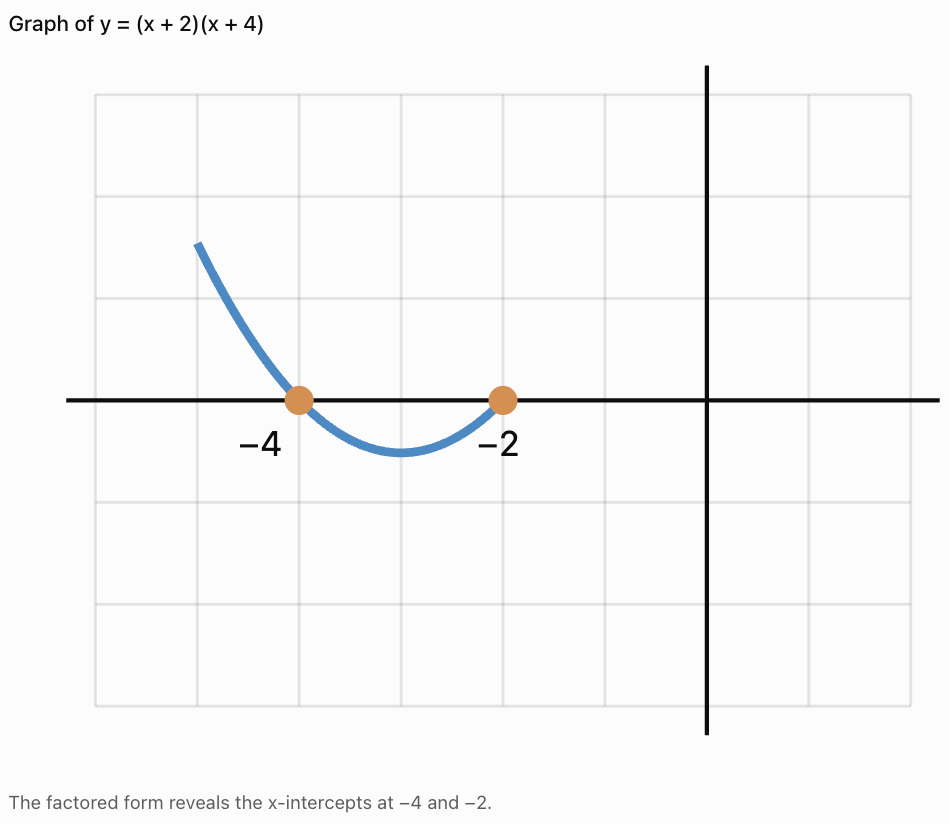
y = (x + 2)(x + 4)
Expand:
y = x² + 6x + 8
This is a quadratic function.
Its graph is a parabola.
The original factored form shows that the function equals zero when:
x = −2 or x = −4
The expanded form shows the coefficients of the quadratic.
Important Observation
Factored and expanded forms provide different useful information about the same quadratic function.
Common Mistakes
Forgetting One of the Four Products
Incorrect:
(x + 2)(x + 3) = x² + 6
Correct:
(x + 2)(x + 3) = x² + 5x + 6
Multiplying Only the First and Last Terms
Every term in the first binomial must multiply every term in the second binomial.
Incorrect Sign Rules
Incorrect:
(x − 4)(x − 2) = x² − 6x − 8
Correct:
(x − 4)(x − 2) = x² − 6x + 8
Combining Unlike Terms
Incorrect:
x² + 3x = 4x²
Correct:
x² + 3x cannot be combined into one term.
Forgetting Exponent Rules
Incorrect:
x × x = 2x
Correct:
x × x = x²
Forgetting the Middle Term When Squaring
Incorrect:
(x + 5)² = x² + 25
Correct:
(x + 5)² = x² + 10x + 25
Not Simplifying Completely
An expansion should normally be simplified by combining all like terms.
Failing to Verify
Use substitution, factorisation, or a second multiplication method to check your result.
Key Terms
-
Binomial: Algebraic expression containing two terms.
-
Polynomial: Algebraic expression formed from terms containing variables with nonnegative integer powers.
-
Expansion: Rewriting a product as a sum of terms.
-
Distributive Property: Rule that distributes multiplication across addition or subtraction.
-
Double Distribution: Applying the distributive property to multiply two binomials.
-
FOIL: Method involving First, Outer, Inner, and Last products.
-
Term: Part of an algebraic expression separated by addition or subtraction.
-
Coefficient: Numerical factor multiplying a variable.
-
Constant: Term without a variable.
-
Like Terms: Terms with identical variable parts and exponents.
-
Simplification: Rewriting an expression in an equivalent, more convenient form.
-
Algebraic Grid: Table used to organise polynomial multiplication.
-
Area Model: Geometric representation of multiplication using rectangular regions.
-
Perfect Square Trinomial: Trinomial formed by squaring a binomial.
-
Conjugate Binomials: Binomials with the same terms and opposite signs.
-
Difference of Squares: Identity (a + b)(a − b) = a² − b².
-
Factorisation: Rewriting an expression as a product.
-
Verification: Checking that a mathematical result is correct.
-
Quadratic Expression: Polynomial expression with highest variable power 2.
-
Quadratic Function: Function represented by a second-degree polynomial.
Key Takeaways
-
A binomial contains two terms.
-
Expanding means multiplying algebraic expressions and rewriting the result as a sum.
-
Every term in one binomial must multiply every term in the other.
-
FOIL is a useful method for multiplying two binomials.
-
The distributive property is the foundation of binomial expansion.
-
Algebraic grids help organise multiplication systematically.
-
Negative signs must be handled carefully.
-
Like terms should be combined after expansion.
-
When multiplying powers with the same base, add the exponents.
-
Squaring a binomial produces a perfect square trinomial.
-
Multiplying conjugate binomials produces a difference of squares.
-
Expansion and factorisation are inverse processes.
-
Substitution can help check an expansion.
-
Binomial expansion is useful in geometry, arithmetic, science, and quadratic functions.
Check Your Understanding
Basic Expansion
-
What is a binomial?
-
What does FOIL stand for?
-
Expand (x + 2)(x + 4).
-
Expand (x + 3)(x + 7).
-
Expand (x + 5)(x + 6).
Negative Terms
-
Expand (x − 2)(x + 5).
-
Expand (x − 4)(x − 3).
-
Expand (x + 6)(x − 2).
-
Expand (2x − 3)(x + 4).
-
Expand (3x − 2)(2x − 5).
Coefficients and Variables
-
Expand (2x + 3)(3x + 4).
-
Expand (4x + 1)(2x + 5).
-
Expand (a + b)(a + 2b).
-
Expand (2x − y)(x + 3y).
-
Expand (x² + 2)(x + 3).
Special Patterns and Verification
-
Expand (x + 5)².
-
Expand (x − 7)².
-
Expand (x + 4)(x − 4).
-
Explain why (x + 3)² is not equal to x² + 9.
-
Describe two methods for verifying an expansion.
Answer Key
|
Question |
Answer |
|---|---|
|
1 |
Algebraic expression containing two terms |
|
2 |
First, Outer, Inner, Last |
|
3 |
x² + 6x + 8 |
|
4 |
x² + 10x + 21 |
|
5 |
x² + 11x + 30 |
|
6 |
x² + 3x − 10 |
|
7 |
x² − 7x + 12 |
|
8 |
x² + 4x − 12 |
|
9 |
2x² + 5x − 12 |
|
10 |
6x² − 19x + 10 |
|
11 |
6x² + 17x + 12 |
|
12 |
8x² + 22x + 5 |
|
13 |
a² + 3ab + 2b² |
|
14 |
2x² + 5xy − 3y² |
|
15 |
x³ + 3x² + 2x + 6 |
|
16 |
x² + 10x + 25 |
|
17 |
x² − 14x + 49 |
|
18 |
x² − 16 |
|
19 |
The expansion must include the middle term 6x |
|
20 |
Factorisation, substitution, or a second multiplication method |
Extended Challenge
1. Expand (4x + 7)(3x + 2).
2. Expand (5a − 3b)(2a + 4b).
3. Expand (x² + 3x)(2x − 5).
4. Expand (2x² − 3)(x² + 4).
5. Expand (3x − 4)².
6. Expand (5a + 2b)².
7. Expand (4x + 7)(4x − 7).
8. Verify by expansion that (x + 2)(x + 6) = x² + 8x + 12.
9. A rectangle has dimensions 2x + 3 and x + 5. Find an expression for its area.
10. Explain why multiplying two first-degree binomials usually produces a quadratic expression.
Extended Challenge Answers
|
Question |
Answer |
|---|---|
|
1 |
12x² + 29x + 14 |
|
2 |
10a² + 14ab − 12b² |
|
3 |
2x³ + x² − 15x |
|
4 |
2x⁴ + 5x² − 12 |
|
5 |
9x² − 24x + 16 |
|
6 |
25a² + 20ab + 4b² |
|
7 |
16x² − 49 |
|
8 |
x² + 6x + 2x + 12 = x² + 8x + 12 |
|
9 |
2x² + 13x + 15 |
|
10 |
The product of the variable terms creates an x² term |
Final Investigation: Designing a Rectangular Garden
A school plans to create a rectangular garden.
The length is:
x + 6 metres
The width is:
x + 4 metres
Part A: Building the Expression
-
Write an expression for the garden's area.
-
Expand the expression using FOIL.
-
Simplify the result.
-
Expand the expression using an algebraic grid.
-
Compare the two results.
Part B: Creating a Table
-
Calculate the area when x = 1, 2, 3, 4, and 5.
-
Organise the results in a table.
-
Determine how the area changes as x increases.
-
Explain whether the relationship is linear or nonlinear.
-
Explain why the expanded expression contains x².
Part C: Applying the Model
-
Calculate the garden's area when x = 6.
-
Calculate the garden's area when x = 10.
-
Find the difference between these two areas.
-
Explain how increasing x changes both dimensions.
-
Explain why the area increases faster as x becomes larger.
Part D: Verification
-
Choose one value of x.
-
Calculate the area directly using length × width.
-
Calculate the area using the expanded expression.
-
Compare the results.
-
Explain why the two methods must agree.
Investigation Answer Check
Original Expression
A = (x + 6)(x + 4)
Expansion
A = x² + 4x + 6x + 24
A = x² + 10x + 24
Completed Table
|
x |
Length (m) |
Width (m) |
Area (m²) |
|---|---|---|---|
|
1 |
7 |
5 |
35 |
|
2 |
8 |
6 |
48 |
|
3 |
9 |
7 |
63 |
|
4 |
10 |
8 |
80 |
|
5 |
11 |
9 |
99 |
The area increases by:
13, 15, 17, 19 m²
The differences are not constant.
Therefore, the relationship is nonlinear.
When x = 6
A = 6² + 10(6) + 24
= 36 + 60 + 24
A = 120 m²
When x = 10
A = 10² + 10(10) + 24
= 100 + 100 + 24
A = 224 m²
Difference in Area
224 − 120 = 104 m²
Verification
When x = 6:
Length = 12 m
Width = 10 m
Area = 12 × 10
Area = 120 m²
This agrees with the expanded expression.
Final Reflection
Expanding binomials is an essential algebraic skill that connects multiplication, simplification, factorisation, geometry, and quadratic functions.
By applying the distributive property systematically, we can multiply algebraic expressions accurately and simplify the results.
FOIL, algebraic grids, and area models are different ways of organising the same mathematical process.
The most important principle is that every term in one binomial must multiply every term in the other binomial, and all like terms must then be combined correctly.