Acids, Bases, and Equilibrium Systems

3. Buffer Solutions

Learning outcomes
  • I can define a buffer solution.
  • I can explain how buffers resist changes in pH.
  • I can describe the importance of buffers in living systems.
  • I can identify common buffer systems.
  • I can explain buffer action using equilibrium concepts.

Buffer Solutions

A buffer solution is a solution that resists large changes in pH when small amounts of acid or base are added.

Buffers do not keep pH perfectly constant. Instead, they make the change in pH much smaller than it would be in an unbuffered solution.

Buffers are extremely important in:

  • living organisms
  • blood
  • cells
  • medicines
  • foods
  • chemical laboratories
  • industrial processes

The central idea is:

added acid or base is consumed by components of the buffer

↓

the H₃O⁺ concentration changes only slightly

↓

pH changes only slightly


Why Buffers Are Needed

The pH of an ordinary solution can change significantly when even a relatively small amount of strong acid or strong base is added.

For example:

acid added → [H₃O⁺] increases → pH decreases

base added → [OH⁻] increases → pH increases

A buffer contains substances capable of reacting with these added ions before they cause a large change in pH.

This gives the solution a degree of pH stability.


What Is in a Buffer?

A common acidic buffer contains:

  • a weak acid
  • its conjugate base

For a general weak acid HA:

HA + H₂O ⇌ H₃O⁺ + A⁻

The buffer therefore contains significant amounts of:

HA

and:

A⁻

These two substances work together.

HA can react with added base.

A⁻ can react with added acid.


Example: Ethanoic Acid Buffer

A common example consists of:

  • ethanoic acid, CH₃COOH
  • ethanoate ions, CH₃COO⁻

The equilibrium is:

CH₃COOH + H₂O ⇌ H₃O⁺ + CH₃COO⁻

Ethanoic acid is weak, so it only partially ionizes.

Therefore, significant quantities of both:

CH₃COOH

and:

CH₃COO⁻

can be present.

This allows the solution to resist both added acid and added base.


What Happens When Acid Is Added?

Suppose a small amount of strong acid is added to a buffer.

The added acid increases the amount of:

H₃O⁺

The conjugate base component of the buffer reacts with this added H₃O⁺:

A⁻ + H₃O⁺ → HA + H₂O

The added H₃O⁺ is therefore largely consumed.

Instead of remaining in solution and causing a major decrease in pH, much of it is converted into the weak acid HA.

Therefore:

acid added → A⁻ consumes much of the added H₃O⁺ → small pH decrease


What Happens When Base Is Added?

Suppose a small amount of strong base is added.

The added OH⁻ reacts with the weak acid component:

HA + OH⁻ → A⁻ + H₂O

The OH⁻ is largely consumed.

Therefore:

base added → HA consumes much of the added OH⁻ → small pH increase

The buffer can therefore resist changes in either direction.


Buffer Action at the Particle Level

Imagine a buffer containing many particles of:

HA and A⁻

Acid is added

Extra H₃O⁺ enters the solution.

A⁻ particles react with it:

A⁻ + H₃O⁺ → HA + H₂O

The number of A⁻ particles decreases slightly.

The number of HA particles increases slightly.

But the increase in free H₃O⁺ is limited.

Base is added

Extra OH⁻ enters the solution.

HA reacts with it:

HA + OH⁻ → A⁻ + H₂O

The number of HA particles decreases slightly.

The number of A⁻ particles increases slightly.

Again, the pH changes only slightly.


Comparing Buffered and Unbuffered Solutions

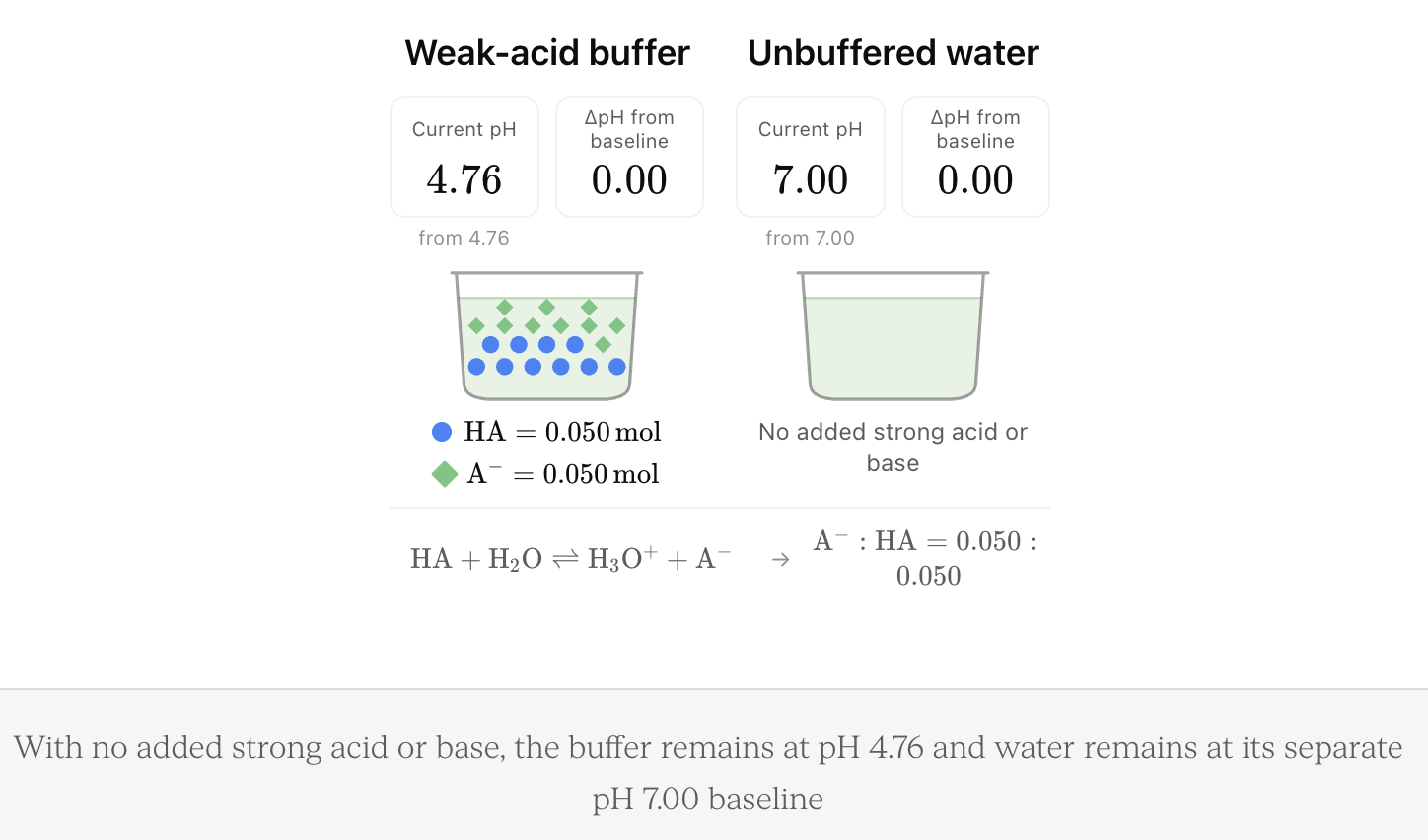
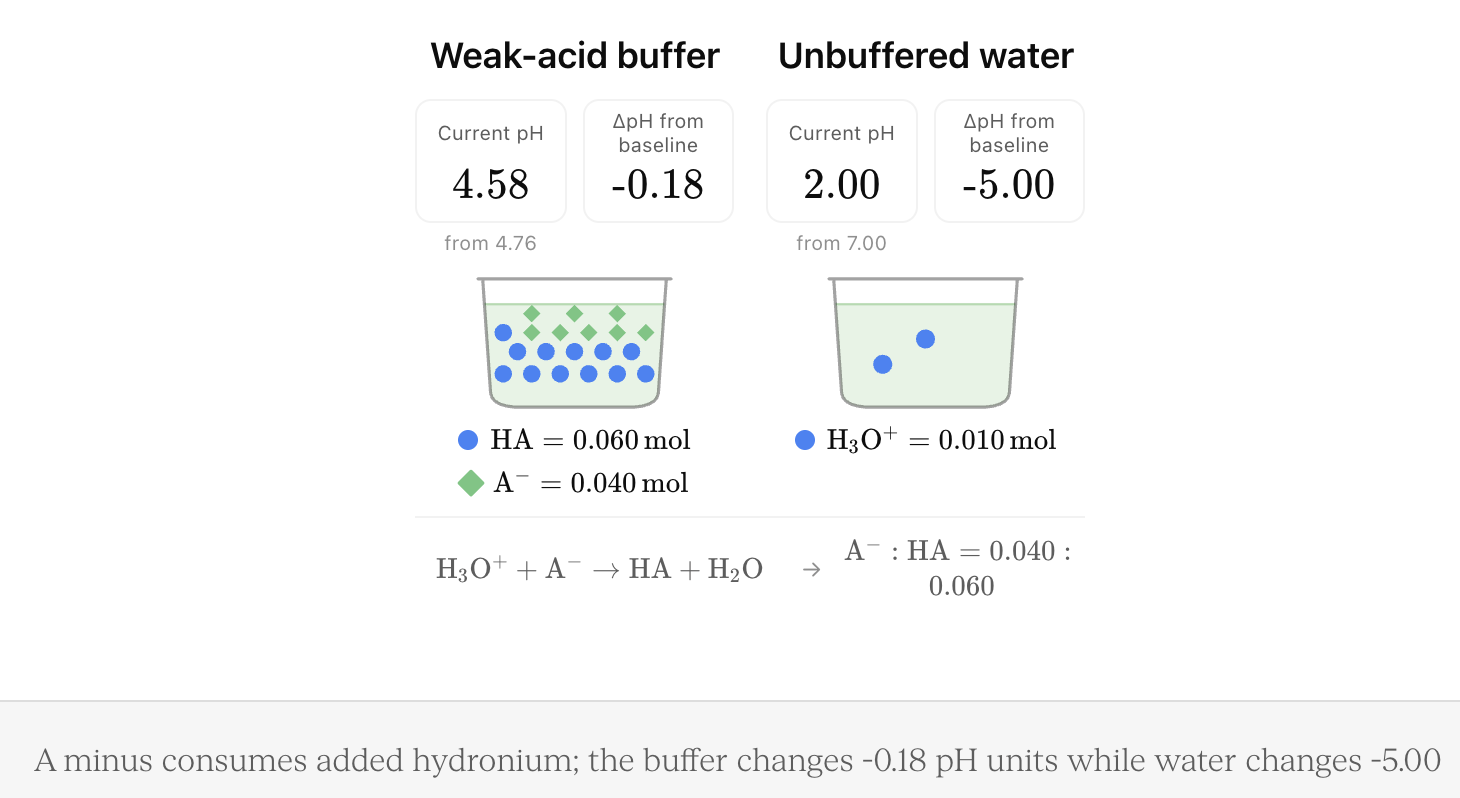
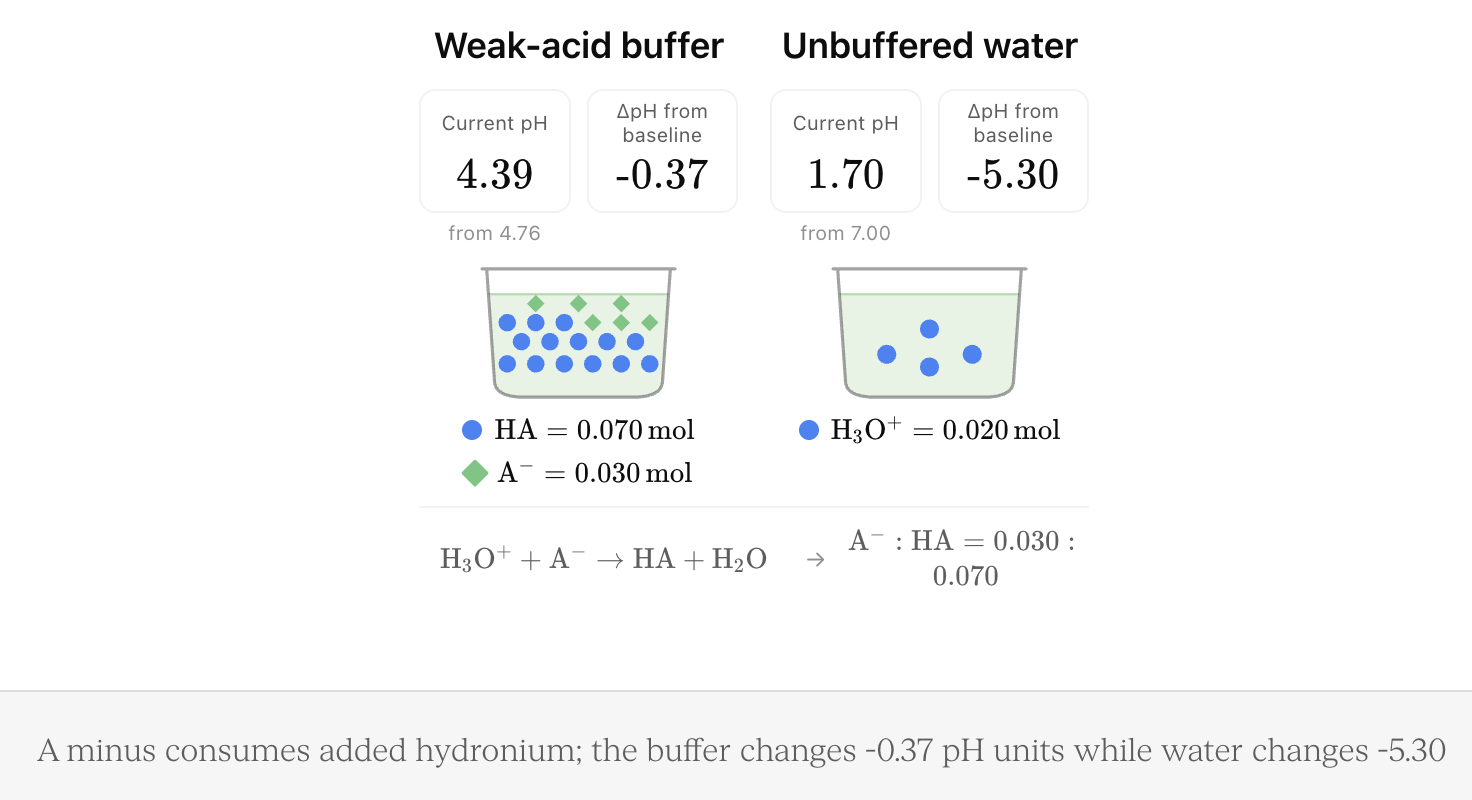
The difference becomes clear if the same small amount of strong acid or base is added to buffered and unbuffered solutions.
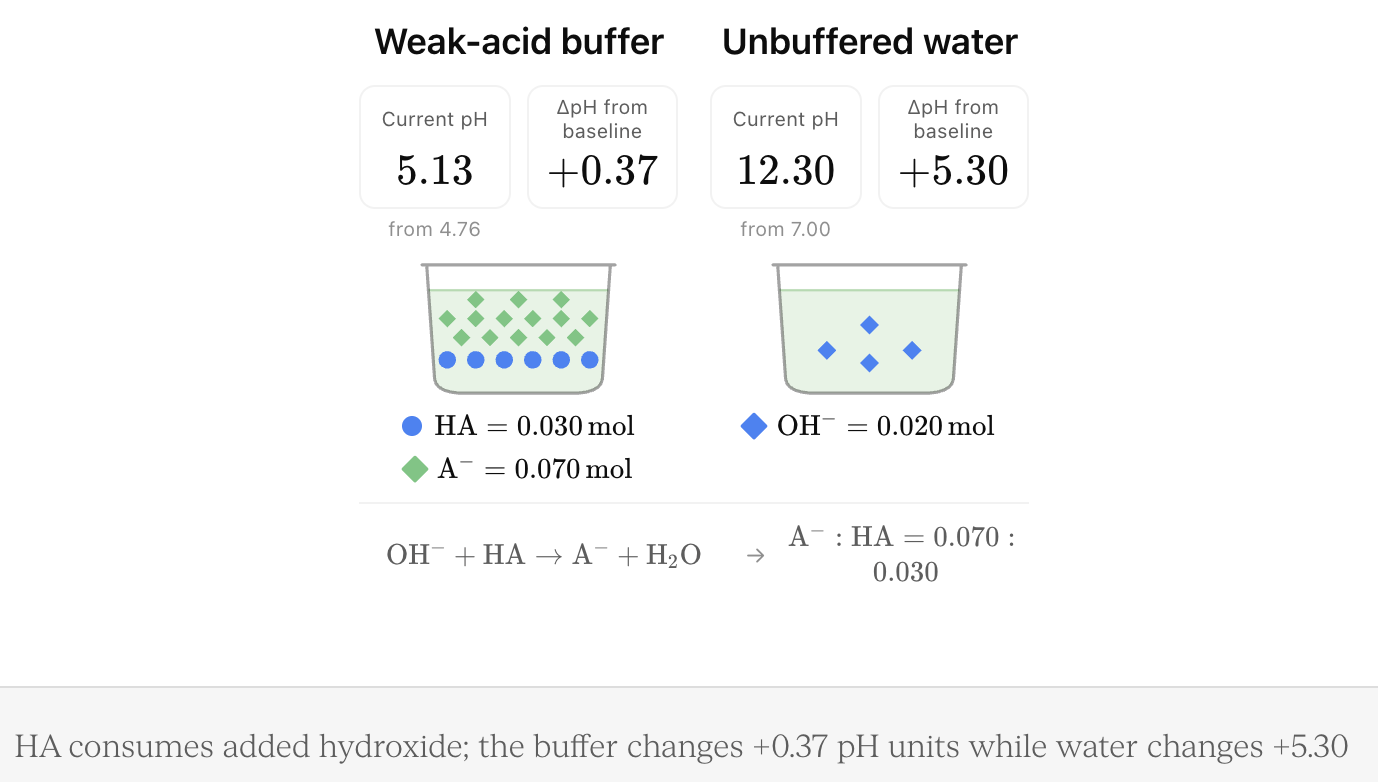
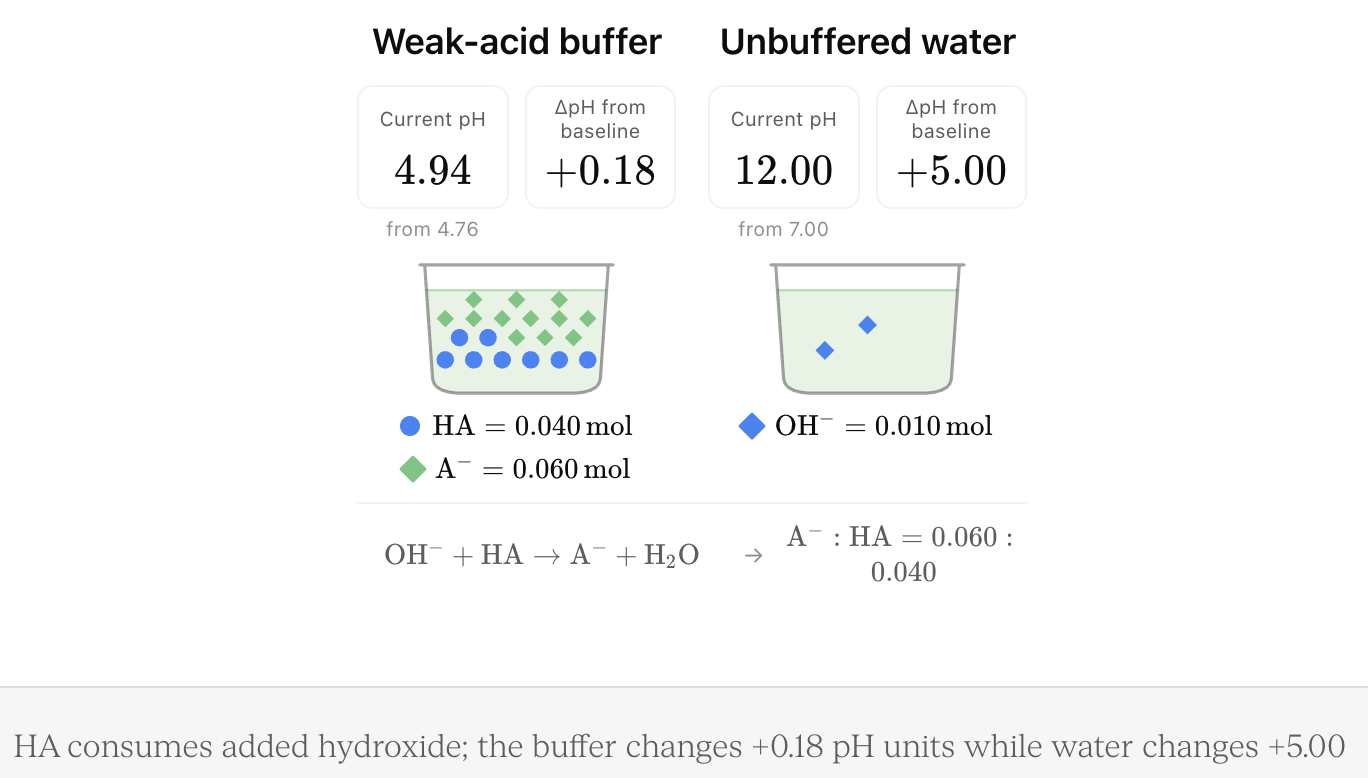
An unbuffered solution has little capacity to remove the added H₃O⁺ or OH⁻.

A buffer contains a chemical reserve capable of reacting with the added substance.

This is why its pH changes much less.


Buffer Action and Equilibrium

Buffers are excellent examples of Le Châtelier's Principle.

Consider:

HA + H₂O ⇌ H₃O⁺ + A⁻

Suppose acid is added.

The concentration of H₃O⁺ increases.

According to Le Châtelier's Principle, the equilibrium responds by favouring the reverse direction:

shift left

H₃O⁺ combines with A⁻, producing more HA.

This helps reduce the effect of the added acid.


Adding Base and Equilibrium

Now suppose OH⁻ is added.

OH⁻ reacts with H₃O⁺:

H₃O⁺ + OH⁻ → 2H₂O

This removes H₃O⁺ from the equilibrium system.

For:

HA + H₂O ⇌ H₃O⁺ + A⁻

removing H₃O⁺ encourages the equilibrium to shift:

right

More HA ionizes, replacing some of the H₃O⁺ that was removed.

Another useful way to describe the same process is:

HA + OH⁻ → A⁻ + H₂O

The weak acid directly neutralizes much of the added base.


The Two Components Have Different Jobs

An acidic buffer needs both components.

Weak acid, HA

Protects against added:

OH⁻

Conjugate base, A⁻

Protects against added:

H₃O⁺

Therefore:

HA protects against base

A⁻ protects against acid

This is one of the most useful ways to remember buffer action.


Why a Weak Acid Alone Is Not as Effective

Suppose a solution contains only a weak acid.

It can react with added OH⁻.

However, an effective buffer also needs a significant concentration of the conjugate base so that added H₃O⁺ can be removed efficiently.

A useful buffer therefore contains appreciable quantities of both members of a conjugate acid-base pair.


Basic Buffers

Buffers can also be prepared using:

  • a weak base
  • its conjugate acid

Consider:

B + H₂O ⇌ BH⁺ + OH⁻

For example:

NH₃ + H₂O ⇌ NH₄⁺ + OH⁻

A buffer containing ammonia and ammonium ions can resist pH changes.

Here:

NH₃ = weak base

NH₄⁺ = conjugate acid


Ammonia-Ammonium Buffer

Suppose acid is added.

NH₃ can accept the added proton:

NH₃ + H₃O⁺ → NH₄⁺ + H₂O

This removes much of the added acid.

If base is added, NH₄⁺ can react with OH⁻:

NH₄⁺ + OH⁻ → NH₃ + H₂O

This removes much of the added base.

Therefore, the NH₃/NH₄⁺ pair can act as a buffer.


Common Buffer Systems

Examples include:

Buffer system Components
Ethanoic acid / ethanoate CH₃COOH / CH₃COO⁻
Carbonic acid / hydrogencarbonate H₂CO₃ / HCO₃⁻
Dihydrogen phosphate / hydrogen phosphate H₂PO₄⁻ / HPO₄²⁻
Ammonia / ammonium NH₃ / NH₄⁺

Different buffer systems are useful over different pH ranges.


Buffers in Living Systems

Living organisms depend on carefully controlled chemical conditions.

Many biological molecules function properly only within a limited pH range.

Changes in pH can affect:

  • enzyme activity
  • protein structure
  • chemical reaction rates
  • membrane processes
  • cellular metabolism

Buffers help prevent sudden changes in biological pH.


Blood as a Buffered System

Human blood must remain within a relatively narrow pH range for normal physiological function.

One important buffering system involves:

carbon dioxide, carbonic acid, and hydrogencarbonate ions

A simplified equilibrium is:

H₂CO₃ ⇌ H⁺ + HCO₃⁻

A more complete representation includes dissolved carbon dioxide:

CO₂ + H₂O ⇌ H₂CO₃ ⇌ H⁺ + HCO₃⁻

This system helps resist changes in blood pH.


The Hydrogencarbonate Buffer

If excess acid is introduced, hydrogencarbonate can react with H⁺:

HCO₃⁻ + H⁺ → H₂CO₃

Carbonic acid can then be related to carbon dioxide and water:

H₂CO₃ ⇌ CO₂ + H₂O

This helps reduce the effect of excess acid.

If conditions become more basic, carbonic acid can supply H⁺, helping oppose the pH increase.


The Lungs and Blood pH

The carbon dioxide equilibrium connects blood chemistry with respiration.

Carbon dioxide can be removed through the lungs.

Changes in breathing can therefore affect the amount of CO₂ in the blood and influence acid-base equilibria.

This demonstrates an important idea:

biological pH regulation involves chemistry working together with body systems.


Phosphate Buffers

Phosphate ions provide another important biological buffering system.

One relevant equilibrium is:

H₂PO₄⁻ ⇌ H⁺ + HPO₄²⁻

Here:

H₂PO₄⁻

can donate H⁺ when conditions become more basic.

And:

HPO₄²⁻

can accept H⁺ when conditions become more acidic.

Phosphate buffering is particularly important in cells and in kidney-related acid-base regulation.


Buffers and Enzymes

Enzymes depend strongly on pH.

A change in pH can alter:

  • charges on amino acid groups
  • interactions within a protein
  • shape of the active site
  • substrate binding
  • enzyme activity

Buffers help maintain a suitable chemical environment for enzymes.

This is why laboratory experiments involving enzymes commonly use buffer solutions.


Buffers in Cells

Cells contain many simultaneous chemical reactions.

These reactions can produce or consume acidic and basic substances.

Without buffering, cellular pH could fluctuate significantly.

Several buffer systems help stabilize the internal environment.

This supports homeostasis — maintenance of relatively stable internal conditions.


Buffers in Laboratories

Buffers are frequently used when experiments require a controlled pH.

Examples include:

  • enzyme investigations
  • protein studies
  • biochemical reactions
  • microbial cultures
  • analytical chemistry
  • pharmaceutical testing

A researcher may choose a buffer designed to maintain a particular approximate pH.


Buffers in Medicines

Many pharmaceutical products require controlled pH.

Buffers may help:

  • maintain chemical stability
  • improve product performance
  • maintain suitable conditions for active ingredients
  • control conditions during manufacturing

The particular buffer chosen depends on the chemistry and intended application.


Buffers in Foods

Food chemistry also involves pH control.

Buffers can influence:

  • flavour
  • preservation
  • fermentation
  • texture
  • chemical stability

Food itself often contains naturally occurring weak acids and conjugate bases that contribute to buffering behaviour.


Buffer Capacity

A buffer cannot absorb unlimited amounts of acid or base.

Its ability to resist pH change is called its buffer capacity.

A buffer has a limited supply of:

  • weak acid
  • conjugate base

Eventually one component can become depleted.

When that happens, the buffer becomes much less effective.


Example of Buffer Capacity

Suppose a buffer contains:

100 units HA

and:

100 units A⁻

If 5 units of strong acid are added, approximately 5 units of A⁻ can react:

A⁻ + H₃O⁺ → HA + H₂O

The buffer still contains substantial amounts of both components.

It remains effective.

But if an enormous amount of acid is added, most of the A⁻ could eventually be consumed.

Once little A⁻ remains, the solution can no longer effectively resist additional acid.


Buffer Failure

A buffer works well only within its capacity.

If too much strong acid is added:

A⁻ becomes depleted

If too much strong base is added:

HA becomes depleted

Once one component becomes too scarce:

pH begins changing much more dramatically.

Therefore:

buffer ≠ constant pH forever


What Determines Buffer Capacity?

Buffer capacity generally increases when larger amounts of the buffering components are present.

For example, a solution containing relatively large concentrations of both HA and A⁻ can neutralize more added acid or base than a very dilute buffer containing the same pair.

Therefore:

more buffer components → greater buffer capacity

provided both components are available in useful amounts.


Buffer pH and the Acid-Base Ratio

For an acidic buffer:

HA ⇌ H⁺ + A⁻

the pH depends partly on the relative amounts of:

HA and A⁻

If the amounts are similar, the buffer usually works effectively around the characteristic pKa of the weak acid.

A buffer does not work equally well at every possible pH.


The Henderson-Hasselbalch Relationship

At a more advanced level, buffer pH can be estimated using:

pH = pKa + log([A⁻]/[HA])

where:

  • pH describes the acidity of the solution
  • pKa is related to the strength of the weak acid
  • [A⁻] is the conjugate-base concentration
  • [HA] is the weak-acid concentration

You do not need this equation to understand basic buffer action, but it shows mathematically why the ratio of conjugate base to weak acid is important.


Equal Acid and Conjugate Base

If:

[A⁻] = [HA]

then:

[A⁻]/[HA] = 1

and:

log(1) = 0

Therefore:

pH = pKa

This is an especially useful buffer condition because substantial quantities of both components are available.


Adding Acid Changes the Ratio

Suppose acid is added:

A⁻ + H₃O⁺ → HA + H₂O

Therefore:

  • A⁻ decreases slightly
  • HA increases slightly

The ratio:

[A⁻]/[HA]

decreases.

Therefore, pH decreases.

But because both substances were initially present in significant quantities, the ratio changes only moderately when a small amount of acid is added.

Thus the pH changes only slightly.


Adding Base Changes the Ratio

Suppose OH⁻ is added:

HA + OH⁻ → A⁻ + H₂O

Therefore:

  • HA decreases slightly
  • A⁻ increases slightly

The ratio:

[A⁻]/[HA]

increases.

Therefore, pH increases.

Again, the change is relatively small if the buffer has sufficient capacity.


Worked Example: Adding Acid

A buffer contains HA and A⁻.

A small amount of HCl is added.

Step 1: Identify what HCl adds

HCl provides H₃O⁺ in water.

Step 2: Identify the buffer component that reacts

A⁻ reacts with H₃O⁺.

Step 3: Write the reaction

A⁻ + H₃O⁺ → HA + H₂O

Step 4: Predict the effect

Much of the added H₃O⁺ is removed.

Conclusion

pH decreases only slightly.


Worked Example: Adding Base

A small amount of NaOH is added to the same buffer.

NaOH provides:

OH⁻

The weak acid reacts:

HA + OH⁻ → A⁻ + H₂O

Much of the added OH⁻ is consumed.

Therefore:

pH increases only slightly.


Worked Example: Ammonia Buffer

Consider:

NH₃ / NH₄⁺

If acid is added:

NH₃ + H₃O⁺ → NH₄⁺ + H₂O

If base is added:

NH₄⁺ + OH⁻ → NH₃ + H₂O

Therefore, both components contribute to resisting pH change.


Worked Example: Buffer or Not?

Consider the following mixtures.

HCl + NaCl

HCl is a strong acid.

This is not the usual weak-acid/conjugate-base buffer system.

CH₃COOH + CH₃COO⁻

Weak acid + conjugate base.

Buffer

NH₃ + NH₄⁺

Weak base + conjugate acid.

Buffer

NaOH + KOH

Two strong bases.

Not a buffer

The important pattern is:

weak acid + conjugate base

or:

weak base + conjugate acid


Buffer Action and Le Châtelier's Principle

Consider again:

HA + H₂O ⇌ H₃O⁺ + A⁻

Add H₃O⁺

Equilibrium shifts:

left

Remove H₃O⁺ by adding OH⁻

Equilibrium shifts:

right

The equilibrium responds to disturbances in a direction that reduces their effect.

This makes buffer solutions an excellent real-world application of Le Châtelier's Principle.


Buffer Action Does Not Eliminate the Disturbance

Suppose acid is added.

The pH still decreases.

The buffer simply makes the decrease:

smaller

Similarly, adding base still causes pH to increase.

The increase is simply:

smaller

Therefore, it is incorrect to say:

"The pH does not change."

A better statement is:

"The buffer resists a large change in pH."


Dilution and Buffers

Dilution decreases the concentrations of the buffer components.

However, if both HA and A⁻ are diluted by the same factor, their ratio may remain approximately unchanged.

This means the buffer's pH may change relatively little from dilution alone.

However:

buffer capacity decreases

because fewer buffer particles are present per unit volume to neutralize added acid or base.

So dilution can make a buffer easier to overwhelm.


Buffers and Equilibrium Constants

The weak acid in a buffer has an acid ionization constant:

Ka

For:

HA + H₂O ⇌ H₃O⁺ + A⁻

Ka describes the position of the weak-acid equilibrium at a particular temperature.

Adding the conjugate base does not change Ka.

Instead, it changes the equilibrium composition.

Similarly, adding acid or base does not change Ka as long as temperature remains constant.


Choosing an Appropriate Buffer

A useful buffer should contain:

  • a suitable weak acid/base pair
  • sufficient amounts of both components
  • an equilibrium appropriate for the desired pH range

For example, a buffer intended to maintain a solution near neutral conditions should use a system whose equilibrium properties are appropriate for that region.

Therefore, different buffer systems are selected for different applications.


Common Mistakes

Buffers Keep pH Perfectly Constant

Incorrect.

Buffers resist pH changes.

The pH still changes slightly.


Buffers Can Absorb Unlimited Acid or Base

Incorrect.

Buffers have limited capacity.


A Buffer Must Have pH 7

Incorrect.

Buffers can operate at acidic, near-neutral, or basic pH values.


Buffers Are Always Neutral

Incorrect.

An acidic buffer may have pH below 7.

A basic buffer may have pH above 7.


A Strong Acid and Strong Base Make a Buffer

Not normally.

A typical buffer requires a weak acid/conjugate base pair or weak base/conjugate acid pair.


The Weak Acid Removes Added Acid

For an acidic buffer, the conjugate base A⁻ is primarily responsible for consuming added H₃O⁺.


The Conjugate Base Removes Added Base

For an acidic buffer, HA reacts with added OH⁻.

Remember:

A⁻ handles added acid

HA handles added base


Equilibrium Stops in a Buffer

Incorrect.

Buffer action depends on dynamic equilibrium.

Forward and reverse reactions continue.


Adding Acid Does Not Change the Buffer

It does.

Some A⁻ is converted into HA.

The change is simply small enough that the pH remains relatively stable.


Dilution Destroys a Buffer Immediately

Not necessarily.

The ratio of buffer components may remain similar, but buffer capacity decreases.


Check Your Understanding

  1. Define a buffer solution.
  2. Does a buffer keep pH perfectly constant?
  3. What two components are commonly found in an acidic buffer?
  4. What two components are commonly found in a basic buffer?
  5. Write the general weak-acid equilibrium for HA.
  6. What happens when H₃O⁺ is added to an HA/A⁻ buffer?
  7. Which buffer component reacts with added acid?
  8. Write the reaction between A⁻ and H₃O⁺.
  9. Which buffer component reacts with added OH⁻?
  10. Write the reaction between HA and OH⁻.
  11. Why does a buffer resist large decreases in pH?
  12. Why does a buffer resist large increases in pH?
  13. Explain buffer action using Le Châtelier's Principle.
  14. What happens to the equilibrium when H₃O⁺ is added?
  15. What happens when H₃O⁺ is removed?
  16. Give an example of an acidic buffer system.
  17. Give an example of a basic buffer system.
  18. Explain how NH₃/NH₄⁺ acts as a buffer.
  19. Why are buffers important in living organisms?
  20. Name an important buffer system associated with blood.
  21. What role does carbon dioxide play in blood acid-base chemistry?
  22. Why are buffers important for enzyme activity?
  23. What is buffer capacity?
  24. What happens when a buffer's capacity is exceeded?
  25. How can increasing buffer concentration affect buffer capacity?
  26. What does the ratio [A⁻]/[HA] tell us about a buffer?
  27. What happens to this ratio when acid is added?
  28. What happens to this ratio when base is added?
  29. Why does dilution generally reduce buffer capacity?
  30. Explain how buffers demonstrate the principles of dynamic equilibrium.

Key Terms

Buffer solution — Solution that resists large changes in pH when small amounts of acid or base are added.

Buffer action — Chemical processes through which a buffer consumes added acid or base and limits changes in pH.

Weak acid — Acid that ionizes only partially in water.

Conjugate base — Species produced when an acid donates H⁺.

Weak base — Base that reacts only partially with water.

Conjugate acid — Species formed when a base accepts H⁺.

Dynamic equilibrium — State in which forward and reverse reactions continue at equal rates.

Buffer capacity — Amount of acid or base that a buffer can absorb before its pH changes substantially.

Hydrogencarbonate ion (HCO₃⁻) — Important component of the carbon dioxide/carbonic acid buffering system in blood.

Phosphate buffer — Buffer system involving conjugate phosphate species such as H₂PO₄⁻ and HPO₄²⁻.

Ka — Acid ionization constant describing the equilibrium behaviour of a weak acid.

pKa — Logarithmic measure related to Ka and commonly used when describing buffer systems.

Henderson-Hasselbalch equation — Relationship connecting buffer pH, pKa, and the ratio of conjugate base to weak acid.

Homeostasis — Maintenance of relatively stable internal conditions in a living organism.


Key Takeaways

  • A buffer solution resists large changes in pH.
  • Buffers do not keep pH perfectly constant.
  • A common acidic buffer contains a weak acid and its conjugate base.
  • A common basic buffer contains a weak base and its conjugate acid.
  • An HA/A⁻ buffer contains both members of a conjugate acid-base pair.
  • When acid is added, A⁻ consumes much of the added H₃O⁺.
  • When base is added, HA consumes much of the added OH⁻.
  • Therefore:

A⁻ protects against added acid.

HA protects against added base.

  • Buffer action is based on reversible reactions and dynamic equilibrium.
  • Le Châtelier's Principle helps explain how buffers respond to disturbances.
  • Adding H₃O⁺ to a weak-acid equilibrium favours the reverse reaction.
  • Removing H₃O⁺ encourages the forward reaction.
  • Buffer pH depends partly on the ratio of conjugate base to weak acid.
  • When [A⁻] = [HA], pH = pKa.
  • Buffers have limited capacity.
  • Once one buffer component is largely depleted, the pH can change rapidly.
  • More concentrated buffers generally have greater buffer capacity.
  • Dilution can reduce buffer capacity even when the acid/base ratio remains similar.
  • The carbon dioxide/carbonic acid/hydrogencarbonate system is important in blood.
  • Phosphate systems provide important biological buffering.
  • Buffers help maintain suitable conditions for enzymes and cellular reactions.
  • Buffers are also important in laboratories, medicines, foods, and industrial processes.

The essential buffer mechanism is:

Weak acid + conjugate base

↓

Acid added → conjugate base consumes H₃O⁺

Base added → weak acid consumes OH⁻

↓

equilibrium adjusts

↓

pH changes only slightly.