Introduction to Chemical Equilibrium
2. Dynamic Equilibrium
Learning outcomes
- I can define dynamic equilibrium.
- I can explain why reactions continue at equilibrium.
- I can distinguish between static and dynamic systems.
- I can describe particle behavior at equilibrium.
- I can explain how equilibrium is established.
What Is Dynamic Equilibrium?
A dynamic equilibrium can occur when a reversible reaction takes place in a closed system.
Recall that a reversible reaction can proceed in both directions:
reactants ⇌ products
The reactants form products in the forward reaction, while the products can react to reform the original reactants in the reverse reaction.
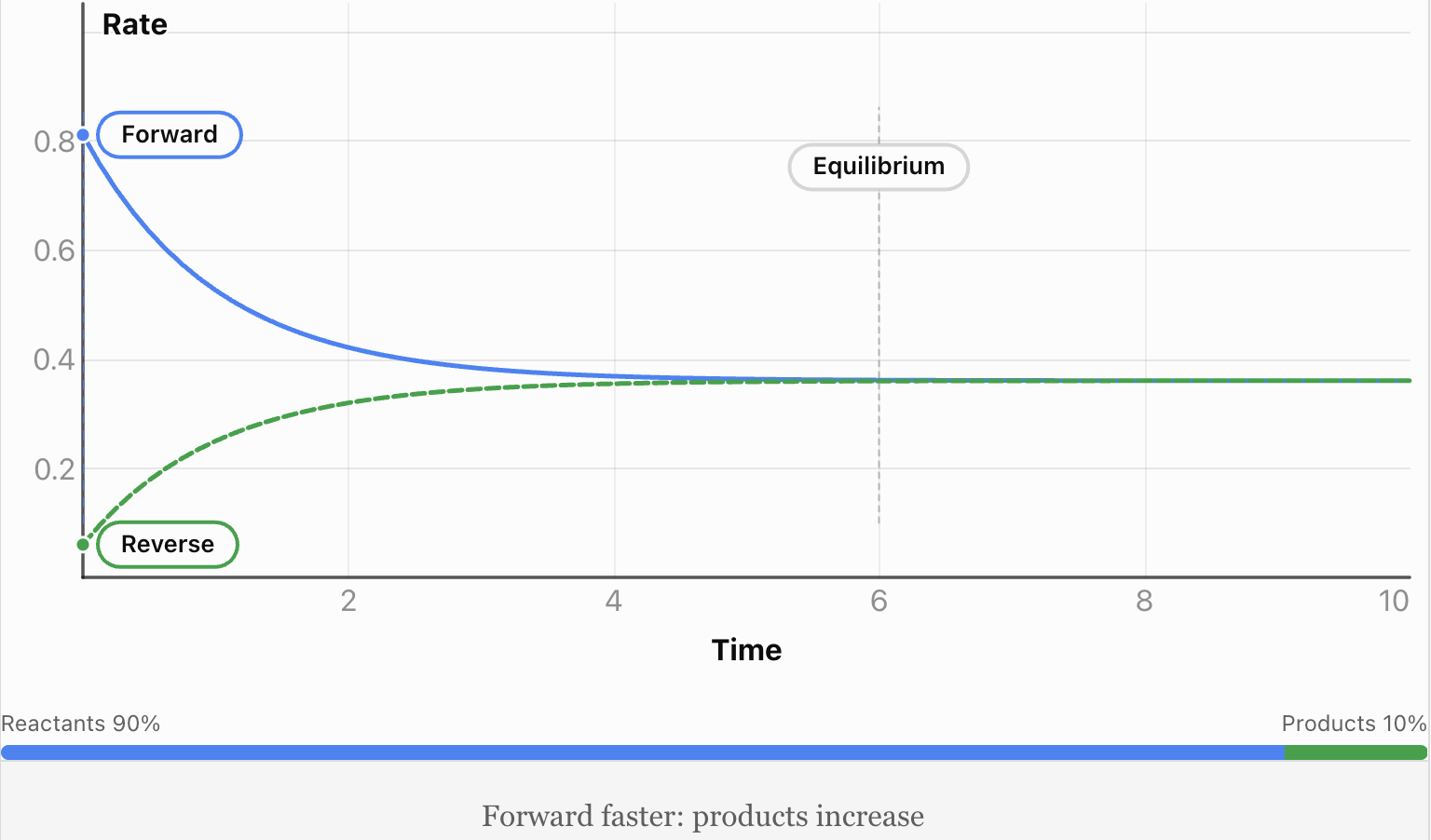
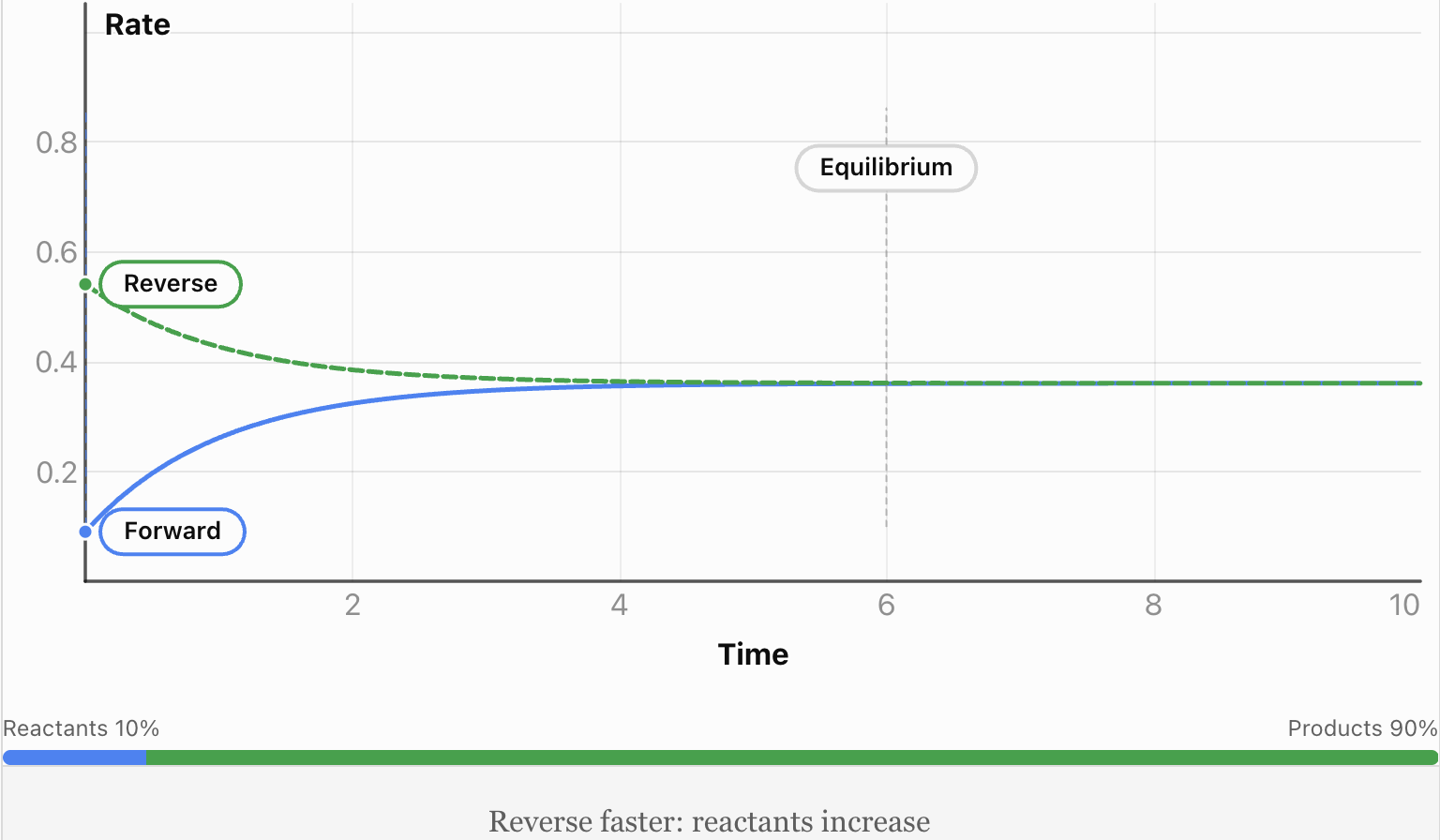
At first, these reactions usually occur at different rates. Over time, however, the system can reach a state where:
rate of forward reaction = rate of reverse reaction
This state is called dynamic equilibrium.
The word dynamic is important. The reactions have not stopped. Both reactions continue to occur, but because they occur at equal rates, there is no overall change in the amounts of reactants and products.
The Key Features of Dynamic Equilibrium
For a chemical system to be at dynamic equilibrium:
- the reaction must be reversible
- the system must be closed
- the forward reaction must continue
- the reverse reaction must continue
- the forward and reverse reaction rates must be equal
- the concentrations of reactants and products remain constant
Notice that constant concentration does not mean equal concentration.
A system might contain much more product than reactant and still be at equilibrium.
Forward and Reverse Reactions
Consider the general reversible reaction:
A + B ⇌ C + D
The forward reaction is:
A + B → C + D
The reverse reaction is:
C + D → A + B
At dynamic equilibrium, both reactions continue simultaneously.
At the particle level, A and B particles continue forming C and D, while C and D particles continue forming A and B.
There is continuous chemical activity even though the overall composition of the mixture appears unchanged.
How Is Equilibrium Established?
Imagine that a reversible reaction begins with only reactants:
A + B ⇌ C + D
At the beginning:
- there are many A and B particles
- there are almost no C and D particles
- the forward reaction occurs rapidly
- the reverse reaction is very slow or cannot yet occur
As the reaction continues:
- A and B are consumed
- C and D are produced
- the concentrations of A and B decrease
- the concentrations of C and D increase
As more products accumulate, the reverse reaction becomes increasingly important.
Eventually:
forward reaction rate = reverse reaction rate
Dynamic equilibrium has now been established.
Stage 1: At the Beginning
Suppose we start with reactants A and B:
A + B ⇌ C
Initially, there may be no C present.
Therefore:
Forward reaction: fast
Reverse reaction: essentially zero at the very beginning
Why?
There are plenty of A and B particles available to collide, but there are initially no C particles available to undergo the reverse reaction.
Stage 2: Products Begin to Accumulate
As A and B react:
A + B → C
the concentration of C increases.
Now C particles can undergo the reverse reaction:
C → A + B
As time passes:
- the forward reaction tends to become slower
- the reverse reaction tends to become faster
This happens because the relative numbers and concentrations of the particles are changing.
Stage 3: Dynamic Equilibrium
Eventually, the two reaction rates become equal:
rate of forward reaction = rate of reverse reaction
At this point:
- reactants continue forming products
- products continue forming reactants
- concentrations stop changing overall
- the system has reached dynamic equilibrium
If 100 forward reactions occur during a certain period, approximately 100 reverse reactions occur during the same period.
There is therefore no net change in composition.
What Happens to Concentrations?
Consider:
A ⇌ B
Suppose the system begins with mostly A.
Initially:
[A] is high
and:
[B] is low
As the forward reaction occurs:
- [A] decreases
- [B] increases
Eventually both concentrations become constant.
The graph levels off because there is no longer any net change in concentration.
However, A and B are still continuously being converted into each other.
Constant Does Not Mean Equal
This is one of the most important ideas about equilibrium.
At equilibrium:
reactant concentrations are constant
and:
product concentrations are constant
But they do not have to be equal.
For example, an equilibrium mixture might contain:
80% reactants and 20% products
or:
20% reactants and 80% products
or:
50% reactants and 50% products
All three could represent equilibrium.
What matters is:
forward rate = reverse rate
not:
amount of reactants = amount of products
Dynamic vs Static
The word dynamic means that change or activity is still occurring.
A static system, in contrast, has no ongoing change.
Static situation
Imagine a book resting on a table.
Its position remains unchanged because it is not moving.
Dynamic situation
Imagine two escalators carrying exactly 20 people per minute in opposite directions between two floors.
The number of people on each floor could remain constant even though people are continuously moving.
That is similar to dynamic equilibrium.
There is activity at the microscopic level, but no overall change at the macroscopic level.
A Useful Analogy: Two Rooms
Imagine two rooms connected by doors.
There are:
40 people in Room A
and:
20 people in Room B
Suppose every minute:
- 5 people move from A to B
- 5 people move from B to A
After one minute:
Room A still has 40 people.
Room B still has 20 people.
But people have definitely moved.
This represents a dynamic system.
Notice something else important:
The number of people in the rooms is not equal.
Yet the numbers remain constant because the rates of movement are equal.
This is similar to chemical equilibrium.
Particle Behaviour at Equilibrium
At equilibrium, particles are still:
- moving
- colliding
- reacting
- forming products
- reforming reactants
Suppose:
A₂ + B₂ ⇌ 2AB
At equilibrium, some A₂ and B₂ molecules collide successfully and form AB.
At the same time, some AB molecules react to recreate A₂ and B₂.
Because these processes occur at equal rates, the concentrations remain constant.
Why Don't We See Anything Happening?
Chemical reactions happen at the level of atoms, ions, and molecules.
At equilibrium, enormous numbers of particles may still be reacting every second.
However, because the forward and reverse reactions balance one another, there is no overall change that we can easily observe.
For example:
- colour may remain constant
- pressure may remain constant
- concentrations may remain constant
- visible amounts of substances may remain constant
This can make equilibrium appear static even though it is actually highly dynamic.
The Importance of a Closed System
Dynamic equilibrium normally requires a closed system.
A closed system prevents matter from freely entering or leaving.
Consider:
A(g) ⇌ B(g)
If B can escape from the container, then B is continually removed.
There may not be enough B available to maintain the reverse reaction at the equilibrium rate.
In a sealed container, both A and B remain available.
The forward and reverse reactions can therefore establish equilibrium.
Open and Closed Systems
Open system
Matter can enter or leave.
Examples might include:
- an uncovered beaker
- an open bottle
- a reaction vessel releasing gas
Closed system
Matter cannot freely enter or leave.
Examples include:
- a sealed flask
- a sealed reaction vessel
- a closed bottle
Energy may still be transferred between a closed system and its surroundings.
This distinction is important because equilibrium depends on keeping the reacting substances available.
Example: Hydrogen and Iodine
A classic reversible reaction is:
H₂(g) + I₂(g) ⇌ 2HI(g)
Hydrogen and iodine react to form hydrogen iodide.
At the same time, hydrogen iodide can decompose to form hydrogen and iodine.
In a closed system at equilibrium:
rate of H₂ + I₂ → 2HI
equals:
rate of 2HI → H₂ + I₂
The concentrations of H₂, I₂, and HI therefore remain constant.
Example: The Haber Process
The industrial production of ammonia involves the reversible reaction:
N₂(g) + 3H₂(g) ⇌ 2NH₃(g)
In a closed reaction system:
- nitrogen and hydrogen form ammonia
- ammonia can decompose back into nitrogen and hydrogen
Eventually, equilibrium can be established.
Understanding this equilibrium is extremely important because ammonia is widely used to manufacture fertilizers and other chemicals.
Example: Carbon Dioxide in a Sealed Drink
A familiar analogy involves carbon dioxide in a sealed carbonated drink.
A simplified process can be represented as:
CO₂(g) ⇌ CO₂(aq)
Carbon dioxide moves between:
- the gas above the liquid
- carbon dioxide dissolved in the liquid
In a sealed bottle, opposing processes can reach a dynamic balance.
When the bottle is opened, the system is changed and carbon dioxide can escape into the surroundings.
That is why bubbles form and the drink eventually becomes flat.
Physical Dynamic Equilibrium
Dynamic equilibrium can also occur in physical processes.
Consider water in a sealed container:
H₂O(l) ⇌ H₂O(g)
Some liquid water molecules evaporate:
liquid → gas
At the same time, some water vapour molecules condense:
gas → liquid
Eventually:
rate of evaporation = rate of condensation
The amount of liquid and vapour remains constant even though molecules continue moving between the two states.
This is an excellent example of a dynamic physical equilibrium.
Reaction Rate at Equilibrium
Consider a reaction beginning with mostly reactants.
At first:
forward rate > reverse rate
As products accumulate:
- forward rate decreases
- reverse rate increases
Eventually:
forward rate = reverse rate
At that point, equilibrium has been established.
The important detail is that both rates are greater than zero.
If both rates were zero, the system would be static rather than dynamically reacting.
Worked Example 1: Is It at Equilibrium?
Suppose a reversible reaction has:
Forward rate = 8 mol/s
Reverse rate = 3 mol/s
Is the system at equilibrium?
No.
The rates are different.
There is still a net change toward the products.
Later:
Forward rate = 5 mol/s
Reverse rate = 5 mol/s
Now:
forward rate = reverse rate
Answer
The system is at dynamic equilibrium.
Worked Example 2: Constant Concentrations
A reaction mixture contains:
0.60 mol/dm³ reactant
and:
0.20 mol/dm³ product
Measurements show that both concentrations remain constant.
The forward and reverse reactions are occurring at equal rates.
Is the system at equilibrium?
Yes.
The concentrations do not need to be equal.
They only need to remain constant while the forward and reverse reactions occur at equal rates.
Worked Example 3: Particle Behaviour
Consider:
A ⇌ B
During one second:
- 150 A particles become B
- 150 B particles become A
What happens to the total amounts of A and B?
There is no overall change.
For every 150 A particles consumed, another 150 A particles are produced.
The same is true for B.
Therefore, the system is at dynamic equilibrium.
Worked Example 4: Not Yet at Equilibrium
Suppose:
A ⇌ B
During one second:
- 200 A particles become B
- 80 B particles become A
The reactions are occurring in both directions, but the rates are not equal.
There is a net conversion of:
200 − 80 = 120 particles
from A toward B.
Therefore:
the system is not yet at equilibrium.
This is an important distinction.
A reaction can be reversible without currently being at equilibrium.
Reversible Reaction vs Dynamic Equilibrium
These terms are related but do not mean exactly the same thing.
Reversible reaction
A reaction that can occur in both directions.
Dynamic equilibrium
A particular state of a reversible system in which:
forward rate = reverse rate
Therefore:
reversible does not automatically mean at equilibrium.
A reversible reaction may need time to reach equilibrium.
Static Equilibrium vs Dynamic Equilibrium
The word equilibrium is used in different areas of science.
Static equilibrium
Nothing is changing.
For example, an object resting with balanced forces may be described as being in static equilibrium.
Dynamic equilibrium
Opposing processes continue, but they occur at equal rates.
In chemical dynamic equilibrium:
- particles continue reacting
- forward and reverse reactions continue
- no overall concentration change occurs
The system appears unchanged even though microscopic activity continues.
Macroscopic and Microscopic Views
Dynamic equilibrium becomes easier to understand when we distinguish between two scales.
Macroscopic level
This is what we can observe or measure directly.
At equilibrium:
- concentration appears constant
- colour may remain constant
- pressure may remain constant
- other measurable properties remain constant
Microscopic level
This describes atoms, molecules, and ions.
At equilibrium:
- particles continue moving
- collisions continue
- bonds continue breaking and forming
- forward reactions continue
- reverse reactions continue
So:
macroscopically constant does not mean microscopically inactive.
How Do We Know Equilibrium Has Been Reached?
Suppose scientists monitor the concentration of reactants and products over time.
Initially, the concentrations change.
Eventually, they become constant.
If the reaction is reversible and the system is closed, this constant composition can indicate that dynamic equilibrium has been established.
Scientists can also consider the reaction rates.
At equilibrium:
forward rate = reverse rate
This provides the microscopic explanation for the constant concentrations.
Common Mistakes
Mistake 1: Thinking equilibrium means the reaction has stopped
Incorrect.
At dynamic equilibrium:
forward reaction continues
and:
reverse reaction continues
The reactions occur at equal rates.
Mistake 2: Thinking reactant and product concentrations must be equal
They do not.
For example:
[reactant] = 0.80 mol/dm³
and:
[product] = 0.20 mol/dm³
could still represent equilibrium.
What must be equal are the reaction rates.
Mistake 3: Thinking a reversible reaction is always at equilibrium
A reaction may be reversible but not yet have reached equilibrium.
Before equilibrium:
forward rate ≠ reverse rate
At equilibrium:
forward rate = reverse rate
Mistake 4: Thinking nothing happens at equilibrium
A great deal can be happening at the particle level.
Particles continue colliding and reacting.
There is simply no net change.
Mistake 5: Thinking equilibrium can only happen with equal numbers of particles
Equal numbers are not required.
The equilibrium composition depends on the particular reaction and conditions.
Mistake 6: Ignoring the closed system
If substances continuously leave the system, the reverse reaction may not be able to balance the forward reaction.
A closed system is therefore an important condition for establishing chemical dynamic equilibrium.
Key Terms
Dynamic equilibrium — A state in a closed reversible system where the forward and reverse reactions occur at equal rates.
Reversible reaction — A reaction that can proceed in both directions.
Forward reaction — The reaction converting reactants into products as the equation is written.
Reverse reaction — The reaction converting products back into reactants.
Reaction rate — How quickly reactants are converted into products.
Closed system — A system in which matter does not freely enter or leave.
Static — Not changing or moving.
Dynamic — Involving continuing activity or change.
Macroscopic — Describing properties observable on a large scale.
Microscopic — Describing behaviour at the particle level.
Concentration — The amount of a substance present per unit volume.
Net change — The overall change after opposing processes are considered together.
Check Your Understanding
-
Define dynamic equilibrium.
-
What two reaction rates are equal at dynamic equilibrium?
-
Does a chemical reaction stop when equilibrium is reached? Explain.
-
Explain why equilibrium is described as dynamic.
-
What is the difference between a static system and a dynamic system?
-
Consider:
A + B ⇌ C
Describe what particles are doing at equilibrium.
-
A reaction has a forward rate of 12 mol/s and a reverse rate of 7 mol/s. Is it at equilibrium? Explain.
-
Later, both rates become 9 mol/s. Is the system now at equilibrium? Explain.
-
At equilibrium, a mixture contains 75% reactants and 25% products. Explain why this is possible.
-
Explain why reactant and product concentrations remain constant at equilibrium.
-
Why is a closed system important for dynamic equilibrium?
-
Explain how equilibrium develops when a reversible reaction begins with only reactants.
-
What happens to the forward reaction rate as reactants are consumed?
-
What happens to the reverse reaction rate as products accumulate?
-
Explain the difference between a reversible reaction and a system that has actually reached dynamic equilibrium.
-
In one second, 300 particles undergo the forward reaction while 300 particles undergo the reverse reaction. Explain what happens to the overall composition.
-
In another system, 300 particles undergo the forward reaction while only 100 undergo the reverse reaction. Is the system at equilibrium? Explain.
-
Use evaporation and condensation in a sealed container to explain dynamic equilibrium.
Key Takeaways
- Dynamic equilibrium occurs in a closed reversible system.
- The forward and reverse reactions continue at equilibrium.
- At equilibrium, forward reaction rate = reverse reaction rate.
- Both reaction rates remain greater than zero.
- There is therefore no net change in the amounts of reactants and products.
- Reactant and product concentrations remain constant, but they do not have to be equal.
- Equilibrium is dynamic, not static.
- At the microscopic level, particles continue moving, colliding, breaking bonds, and forming bonds.
- At the macroscopic level, the system appears unchanged.
- A reversible reaction is not necessarily at equilibrium.
- Equilibrium develops as the forward reaction slows relative to its initial rate and the reverse reaction becomes increasingly significant until their rates become equal.
- A closed system is important because the reacting substances must remain available for both forward and reverse reactions.
Did You Know?
At chemical equilibrium, an apparently unchanged mixture can contain an enormous amount of microscopic activity. Countless molecules may react in the forward direction every second while a matching number react in the reverse direction. To an observer, nothing seems to change—but at the molecular level, the system is continuously active.