Structure Determines Properties

1. Comparing Bond Types

Learning outcomes
  • I can compare ionic, covalent, and metallic bonding.
  • I can identify bonding types from chemical formulas and structures.
  • I can explain the similarities and differences among bond types.
  • I can relate bond type to material properties.
  • I can classify substances according to bonding.

Why Bonding Matters

The properties of a substance depend strongly on:

  • The particles it contains.
  • How those particles are arranged.
  • The forces or bonds holding them together.

Three major types of chemical bonding are:

ionic bonding

covalent bonding

metallic bonding

Understanding the bonding allows us to predict many properties of a substance, including:

  • Melting and boiling point.
  • Electrical conductivity.
  • Hardness.
  • Brittleness.
  • Malleability and ductility.
  • Solubility.
https://images.openai.com/static-rsc-4/d5zjhEvwxtR93Xf5cxtqKcnshqpORKp_APxrgyMkb0RcKtP9pq4WEamrQAgrzITemTmi-vXMWlsDkYTx85MQmq_uHUbxk1SHZPBczwSr3gM23QKgHahS1pKy0XdWRfrAtBfEQbCkYI3cSqy_AtLqf9W4HA78zl08yPY6Tl2xlt4e7LCfAK5VNUTGlFpSgiX5?purpose=fullsize
 
https://images.openai.com/static-rsc-4/CtV1MLQTwjHWs60G7TOw6qqZxESeRzU1z1ywi0x9ZaI-kCiSya7AUTFomow2BxfWC6msBhRA7thjxGEHXU3Yc138gHLdUU3xDLKmlpMl7a58vQP2HR0JOPJ49VNrQDCJ0ikTp0-6CxhNYuc_O2p9qT7JsufmyehNhjidclOy_GZ0Wzq-2L0h_m6oYgxD3eTp?purpose=fullsize
 
https://images.openai.com/static-rsc-4/algCVzfLVaFEhrQvZe7dA7xjT-zlRvR-Eip_JV609NPjyPHan5Z33PFYzG48rhVEYQSv0GWqAWSmBx4WNRJioQXsX59lDMBdMqouL98DbLFg3_xE05jLLgV9s_sl8BT6DCWj2LTYlPLMPrGp2egOPr9ItarItjPfJABN4-OAF8A7D5mkLW4tliZIDVOckgMl?purpose=fullsize
 
4

The Role of Valence Electrons

All three bonding types involve valence electrons.

Valence electrons are the electrons in the outer energy level of an atom.

Atoms can achieve more stable electron arrangements by:

  • Transferring electrons.
  • Sharing electrons.
  • Allowing electrons to become delocalized.

The way electrons behave helps determine the type of bonding.


Ionic Bonding

Ionic bonding usually occurs between:

metal + nonmetal

Electrons are transferred from the metal atoms to the nonmetal atoms.

This produces charged particles called ions.

The metal forms a:

positive ion (cation)

The nonmetal forms a:

negative ion (anion)

The oppositely charged ions attract one another.

This electrostatic attraction is called an ionic bond.


Example: Sodium Chloride

Sodium has one valence electron.

Chlorine has seven valence electrons.

Sodium transfers one electron to chlorine.

This produces:

Na⁺

and:

Cl⁻

The oppositely charged ions attract.

The formula is:

NaCl

https://images.openai.com/static-rsc-4/Y5iGiaNUyHizSpYxkbVJbcBQN2V3I3nkHwc9FFwaTMA1o141maXb_L5_jKeLamnIDepYkanrpaUUjBYt7a5KvGCbObFPmiTICgZU-GVJDHWJEM9yeSNMPO6tnmd4Wh8Obk0U83hshBxmBEWwCSz8CsLJXa5SZv3EpsmRkAA_I1oaSFC8zipPRUicKUQXUqK4?purpose=fullsize
 
https://images.openai.com/static-rsc-4/MCNWseJZJCMVraEZohbbyMw7vOc249KEvkRaGFwpl_ZzEG8_SMnnduIlBmLhiJzfbEsg31Na6GYpDChD0fp_Vt4CV3KyNwDp-JM7QtUtP9O8M7p8dKNwAOcrAvFyBksXHWYDCDExd0-wognwk-mxvDLj8Kub0JqIDk4tAiIBDHcbKYRqqMA3vYOuM3RT6OdB?purpose=fullsize
 
https://images.openai.com/static-rsc-4/2IkjTl6iEC27dqy8gTzrVcWp_k1hsvCrSNCtG9yDR2iowFRirn3mmw1WgAbXnXzPkFNu1vu1KJsiol7RhOaIPdeeG7hJQ8BrjJY9kN4onBlbpzh5Ev5dX0zT1HboPyMRyyoShJQPktWvD8cPLcby2GtO1FSJHRwv5TJt1ee65bAGPeW32CamVmREZ5BIeY8G?purpose=fullsize
 
5

Ionic Structures

Ionic substances do not normally exist as separate molecules.

Instead, large numbers of positive and negative ions form a repeating three-dimensional structure called a:

giant ionic lattice

Each ion is surrounded by ions of opposite charge.

Strong electrostatic attractions act throughout the lattice.


Properties of Ionic Substances

Ionic substances commonly have:

  • High melting points.
  • High boiling points.
  • Hard crystalline structures.
  • Brittle behavior.
  • Electrical conductivity when molten.
  • Electrical conductivity when dissolved in water, if soluble.
  • No electrical conductivity when solid.

These properties can be explained using their structure.


Why Ionic Compounds Have High Melting Points

The ions in an ionic lattice are held together by strong electrostatic attractions.

A large amount of energy is required to overcome these attractions.

Therefore, many ionic substances have relatively high melting and boiling points.


Why Solid Ionic Compounds Do Not Conduct

Ions are charged particles.

However, in a solid ionic lattice, the ions are held in fixed positions.

They cannot move through the material.

Therefore:

solid ionic compound → no mobile charge carriers → does not conduct

When melted, the ions become mobile.

Therefore:

molten ionic compound → mobile ions → conducts electricity


Why Ionic Substances Are Brittle

When a force causes layers of ions to shift, ions with the same charge can become aligned.

For example:

positive beside positive

or:

negative beside negative

Like charges repel.

This repulsion can split the lattice.

Therefore, many ionic solids are:

hard but brittle


Covalent Bonding

Covalent bonding usually occurs between:

nonmetal + nonmetal

Instead of transferring electrons, atoms:

share pairs of electrons

The shared electrons are attracted to both nuclei.

This attraction holds the atoms together.

A shared pair of electrons forms a:

covalent bond

https://images.openai.com/static-rsc-4/vm0zyEc8ETAUy6Kt7e6aBKgv01Z8BXRgl6Yc6g-XrBPu1UfB6Lv0KDZS83MgI2jdkOo8nRiKk1JoyqM_1vW0zE7lmdutqyxSh2ldiu4PsObjAPlmm_Ad9m1g6lDGImlxVUc9dmcs05mrJmYqjLrDPDAU43PWCzji59ZVac_als6XyRB2oPaw11rUCb9h1Tpn?purpose=fullsize
 
https://images.openai.com/static-rsc-4/1glp6Z8Ht-bjWowc24Je9hswhZ1O05Roelqnte7kqZu1Tsx7qNTBTOk8G1c0Nq6BacDRk1fQ95ffxdy_3r4wFa0MPi8el9FN_4L-Put80SBIczQfS5gVXDvqkd2jx7P76Bz-XEEmJMRquEVK8TrfhZsgpfKItHjUhB0aruB6X3B-qaZiaf5WDh_ZJ5bJWDeJ?purpose=fullsize
 
https://images.openai.com/static-rsc-4/FdHyvmjrZq2XVuCr_l0Wi93khZs8RATT9RtO-NlIr9BSBczr--GXAewLILkEJZCYZqi3dAgrVEqE2PULLm9wYHJ1l4QJaGi3jTqVTRApE5Rgm1JbSTgwJnKTVgQmKWFUGWw3RTMGom6flnT9yk20elgbr-uicPdVozuaOb6Z7cZio_QcoSFeFPpiVXpFAn65?purpose=fullsize
 
5

Example: Hydrogen

Each hydrogen atom has one electron.

Two hydrogen atoms can share their electrons.

This creates a shared pair.

The resulting molecule is:

H₂

The two atoms are joined by a single covalent bond.


Example: Water

A water molecule contains:

two hydrogen atoms + one oxygen atom

Formula:

H₂O

The oxygen atom forms covalent bonds with the two hydrogen atoms.

The electrons are shared rather than completely transferred.


Molecular Covalent Substances

Many covalent substances consist of individual molecules.

Examples include:

  • H₂O.
  • CO₂.
  • CH₄.
  • O₂.
  • N₂.

Strong covalent bonds hold the atoms together within each molecule.

However, the attractions between separate molecules are usually much weaker than the covalent bonds inside them.

This distinction is extremely important.


Properties of Simple Molecular Substances

Many simple molecular substances have:

  • Relatively low melting points.
  • Relatively low boiling points.
  • Poor electrical conductivity.

Why?

When a molecular substance melts or boils, it is mainly the intermolecular attractions that are overcome.

The covalent bonds inside the molecules usually remain intact.


Covalent Does Not Always Mean Low Melting Point

Some covalent substances form giant covalent structures rather than separate molecules.

Examples include:

  • Diamond.
  • Graphite.
  • Silicon dioxide.

In these substances, enormous networks of atoms are connected by covalent bonds.

https://images.openai.com/static-rsc-4/r8H0fYA8bH-CAfX_PP5LZ_ebL7KNZ90etc-vtGzVUNA6Gnjx9LwMdfYg64aFROHuoDebv9Eo4_tNOGTysAWFGiZ4mNaxhv7Bv_ciYjG0Gda-sNpKUS0RZxHQmRviRVi1VCXwqbAKR-GQWkh1jm_u_NgvATC--1SN7YekRzoQvwtqHvVuxJfrhfzzp73u8HDQ?purpose=fullsize
 
https://images.openai.com/static-rsc-4/CUfBeJHVUBSXhMkI7eWvLxNxsGYymb7LPvBDwKhNndKHJU7T4xsS7S1z-bCJadELltdcnwk3Wii0YeAJqYoXadlNIvdlyRgdM3TiZEgghKmTJ-htALoo2-DI5fUL8ddcgDDIVBf0zpmKJvxe21CsNb1hv4pN-gfSQ0hszHKCxGMmWUicBrdtVO8y1Wg7mjhN?purpose=fullsize
 
https://images.openai.com/static-rsc-4/o_pczG50A9beXBKVij4jRR0nLYtgGF4l0DlHES9DEfs6x4nO7_Ls6lrJEHRlzpyKn56Fh9MQBdynoK1Ph9AI5AOg9SrTdv7NSrUaoMq7lpoldKjoQ5YyKstcbsJlhJbVge8pq_jSaxNr6x3XC__EOG5Pch9FiSRT6h_uqnRLWZRnuPjbniBk0SlD1Qh41-K5?purpose=fullsize
 
4

These substances can have very different properties from simple molecular substances.


Diamond

Diamond consists of carbon atoms joined in a three-dimensional network.

Each carbon atom forms four covalent bonds.

The structure contains many strong covalent bonds.

Therefore, diamond is:

  • Extremely hard.
  • High melting/sublimation temperature.
  • A poor electrical conductor under ordinary conditions.

Its electrons are localized within covalent bonds and are not free to move throughout the structure.


Graphite

Graphite is also made entirely of carbon.

However, its structure is different.

Each carbon atom bonds to three others, forming layers.

Graphite contains delocalized electrons that can move along the layers.

Therefore, graphite can conduct electricity.

This is an important exception to the general statement that covalent substances do not conduct.


Metallic Bonding

Metallic bonding occurs in metals and alloys.

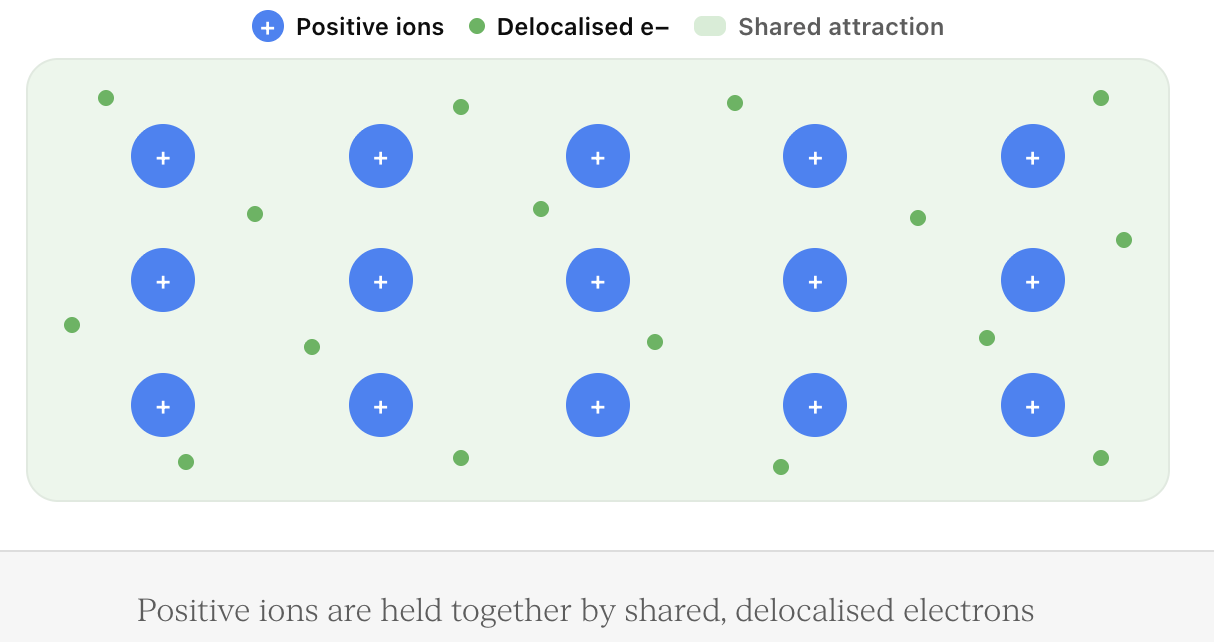
Metal atoms contribute valence electrons to a shared system of:

delocalized electrons

The metal can be modeled as:

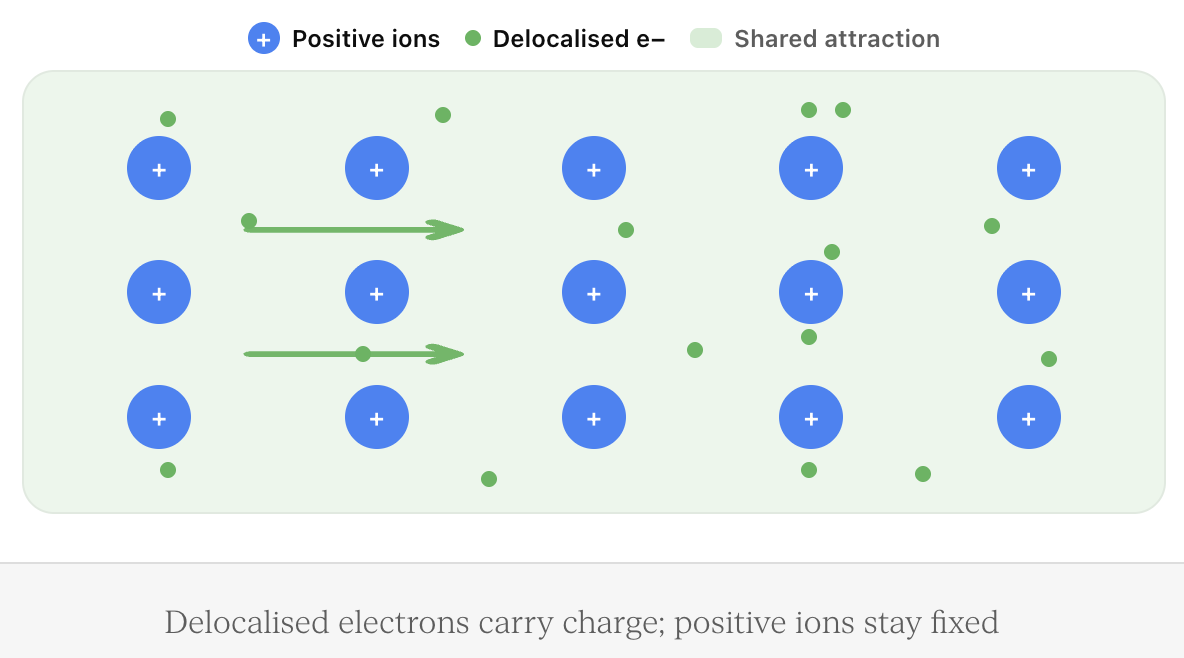
positive metal ions surrounded by mobile delocalized electrons

The attraction between the positive ions and negative electrons holds the structure together.
Properties of Metals

Metallic bonding helps explain why many metals have:

  • High electrical conductivity.
  • High thermal conductivity.
  • Malleability.
  • Ductility.
  • Strength.
  • Relatively high melting points.

Different metals vary considerably, but these are common metallic properties.


Why Metals Conduct Electricity

The delocalized electrons can move throughout the metallic structure.

When a potential difference is applied, the electrons develop an overall drift.

Therefore:

mobile electrons → movement of charge → electrical current

Metals can conduct while solid because the electrons are already mobile.


Why Metals Are Malleable

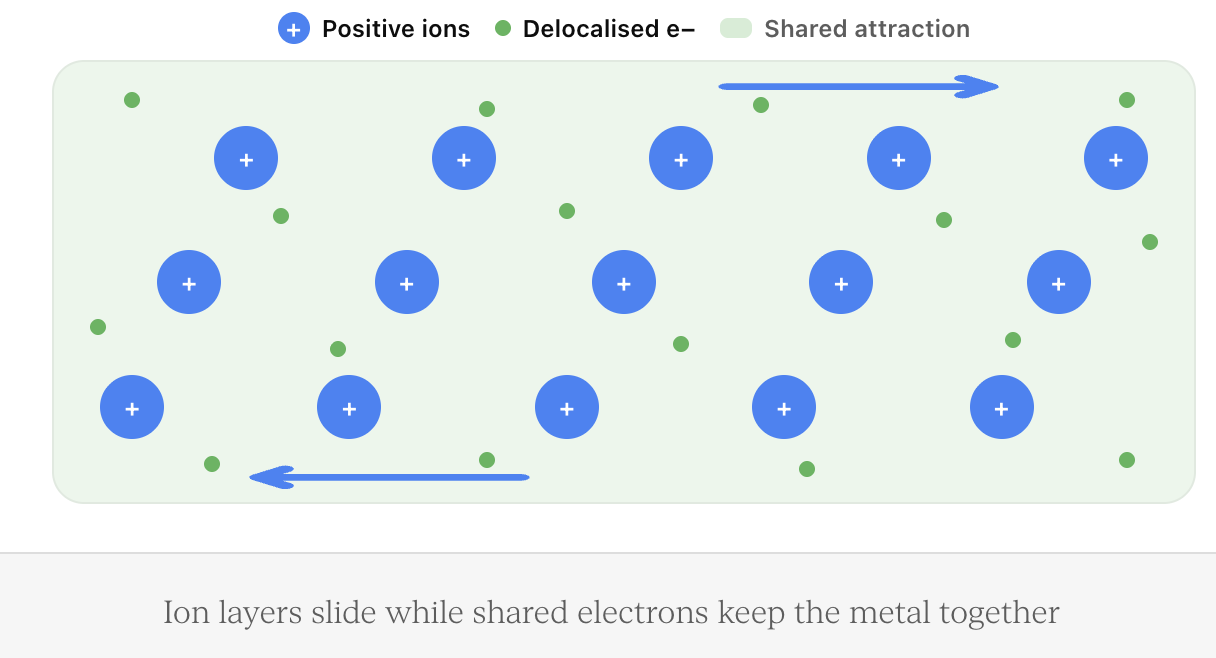
Layers of positive metal ions can move relative to one another.

The delocalized electrons remain throughout the structure.

Therefore, the electrostatic attraction between the ions and electrons can continue even after the layers move.

The metal can change shape without immediately shattering.


Comparing What Happens to Electrons

The three bonding types can be distinguished by what happens to valence electrons.

Ionic

electrons transferred

Covalent

electrons shared between atoms

Metallic

electrons delocalized throughout the structure

A useful summary is:

Ionic → transfer

Covalent → share

Metallic → delocalize


Comparing the Particles

Bond Type Main Particles/Structure What Happens to Electrons?
Ionic Positive and negative ions Transferred
Covalent Atoms joined by shared electron pairs Shared
Metallic Positive metal ions and delocalized electrons Delocalized

Comparing Typical Element Combinations

A useful first clue is the types of elements present.

Ionic

Usually:

metal + nonmetal

Example:

MgO

Covalent

Usually:

nonmetal + nonmetal

Example:

CO₂

Metallic

Metal atoms only, including mixtures of metals in alloys.

Example:

Cu

These rules are useful for introductory classification, although real chemical bonding can be more complex than three completely separate categories.


Identifying Bonding from Formulas

Consider:

NaCl

Na is a metal.

Cl is a nonmetal.

Therefore:

ionic


Consider:

CO₂

C is a nonmetal.

O is a nonmetal.

Therefore:

covalent


Consider:

Mg

Magnesium is a metal element.

Therefore:

metallic


Consider:

MgCl₂

Mg is a metal.

Cl is a nonmetal.

Therefore:

ionic


Consider:

CH₄

Carbon and hydrogen are nonmetals.

Therefore:

covalent


A Quick Classification Method

When given a simple chemical formula:

Step 1: Identify the elements.

Step 2: Determine whether each element is a metal or nonmetal.

Then use:

metal + nonmetal → usually ionic

nonmetal + nonmetal → usually covalent

metal only → metallic

This method works well for many introductory examples.


Important Exception: Polyatomic Ions

Some ionic compounds contain groups of covalently bonded atoms.

For example:

NaNO₃

The compound contains:

Na⁺ and NO₃⁻

The attraction between these ions is ionic.

However, the atoms inside the nitrate ion are covalently bonded.

Therefore, a substance can contain more than one type of bonding.


Comparing Melting Points

Ionic substances

Often high because strong electrostatic attractions must be overcome.

Simple molecular substances

Often relatively low because melting mainly involves overcoming intermolecular attractions.

Giant covalent substances

Often very high because many strong covalent bonds are involved in the structure.

Metals

Often moderate to high, although values vary widely, because metallic attractions hold the lattice together.


Comparing Electrical Conductivity

Substance Type Solid Molten
Ionic Usually no Yes
Simple covalent molecular Usually no Usually no
Metallic Yes Yes
Giant covalent Usually no, with important exceptions Depends on substance

Graphite is a major exception because it contains mobile delocalized electrons.


Comparing Mechanical Properties

Ionic

Often:

hard and brittle

Simple molecular

Often:

soft or easily melted, depending on the substance.

Giant covalent

Can be:

extremely hard

as in diamond.

Metallic

Often:

strong, malleable and ductile

These properties arise from differences in bonding and structure.


Bonding and Solubility

Solubility is more complicated than simply identifying the bond type.

Many ionic compounds dissolve in water, but not all do.

Many molecular substances have different solubilities depending on their polarity.

A useful principle for molecular substances is:

like dissolves like

Polar substances tend to dissolve more readily in polar solvents.

Nonpolar substances tend to dissolve more readily in nonpolar solvents.

Therefore, bonding and molecular structure both influence solubility.


Worked Example: NaCl

Formula:

NaCl

Elements:

sodium = metal

chlorine = nonmetal

Classification:

ionic

Expected properties:

  • Crystalline solid.
  • Relatively high melting point.
  • Brittle.
  • Does not conduct as a solid.
  • Conducts when molten.

Worked Example: CO₂

Formula:

CO₂

Elements:

carbon = nonmetal

oxygen = nonmetal

Classification:

covalent molecular

Expected properties:

  • Exists as separate molecules.
  • Relatively weak attractions between molecules.
  • Low melting and boiling temperatures compared with ionic lattices.
  • Poor electrical conductivity.

At room conditions, carbon dioxide is a gas.


Worked Example: Copper

Symbol:

Cu

Copper is a metal.

Classification:

metallic

Expected properties include:

  • High electrical conductivity.
  • High thermal conductivity.
  • Malleability.
  • Ductility.

This makes copper especially useful for electrical wiring.


Worked Example: Diamond

Diamond contains only carbon.

Carbon is a nonmetal.

Bonding:

covalent

However, diamond does not consist of separate C molecules.

Instead, it forms a:

giant covalent structure

Therefore, diamond has very different properties from simple molecular substances.

Its strong three-dimensional network makes it extremely hard.


Worked Example: Magnesium Oxide

Formula:

MgO

Magnesium:

metal

Oxygen:

nonmetal

Therefore:

ionic bonding

Magnesium transfers electrons and forms Mg²⁺ ions.

Oxygen gains electrons and forms O²⁻ ions.

The oppositely charged ions attract in a giant ionic lattice.


Worked Example: Aluminum

Aluminum contains only metal atoms.

Therefore:

metallic bonding

Its structure contains positive metal ions surrounded by delocalized electrons.

This helps explain why aluminum:

  • Conducts electricity.
  • Conducts thermal energy.
  • Is malleable.
  • Is ductile.

Worked Example: Which Conducts as a Solid?

Consider:

NaCl, Cu and CO₂

NaCl

Ions cannot move in the solid lattice.

Does not conduct.

Cu

Contains mobile delocalized electrons.

Conducts.

CO₂

Does not contain mobile charged particles.

Does not conduct.

Therefore, copper is the conductor when these substances are in their ordinary solid/molecular forms.


Worked Example: Predicting Brittleness

Compare sodium chloride and copper.

Sodium chloride

If layers shift, like-charged ions may become aligned.

Repulsion causes the lattice to fracture.

Therefore:

brittle

Copper

Layers can move while attraction between metal ions and delocalized electrons remains.

Therefore:

malleable and ductile

The difference in mechanical properties can be explained by bonding.


Similarities Among the Bond Types

Although ionic, covalent and metallic bonding differ, they also have similarities.

All involve:

  • Electrons.
  • Electrostatic forces.
  • Interactions involving atoms or ions.
  • Arrangements that can lower the energy of the system compared with separated particles.

All three can form stable substances.

The major differences involve how the electrons and charged particles are arranged.


Bonding Is a Model

The categories ionic, covalent and metallic are extremely useful models.

However, real bonding is not always perfectly divided into three completely separate types.

For example, many bonds have both:

ionic character + covalent character

Bonding is better understood as a continuum in more advanced chemistry.

For introductory chemistry, however, classifying substances as predominantly ionic, covalent or metallic is extremely useful.


From Bonding to Properties

One of the most important skills in chemistry is explaining properties from structure.

Instead of memorizing:

“metals conduct electricity”

explain:

metals contain mobile delocalized electrons → electrons carry charge → metals conduct electricity

Instead of memorizing:

“ionic compounds are brittle”

explain:

layers shift → like charges align → electrostatic repulsion occurs → lattice fractures

This connects microscopic structure to observable behavior.


Structure → Property → Application

Bonding can ultimately explain why materials are useful.

Copper

metallic bonding

↓

mobile electrons + movable layers

↓

conductive + ductile

↓

electrical wire

Sodium chloride

ionic lattice

↓

strong attractions between ions

↓

high melting point

Diamond

giant covalent network

↓

strong bonds throughout structure

↓

extreme hardness

↓

cutting and abrasive applications

This type of reasoning is central to materials chemistry.


Common Mistakes

Saying Ionic Bonds Involve Shared Electrons

Ionic bonding involves attraction between oppositely charged ions formed after electron transfer.

Saying Covalent Bonds Involve Electron Transfer

Covalent bonds involve shared electron pairs.

Saying Metals Have No Bonds

Metals are held together by strong metallic bonding.

Saying All Covalent Substances Have Low Melting Points

Giant covalent structures can have extremely high melting temperatures.

Saying Ionic Solids Conduct Electricity

Their ions are charged but cannot move while held in the solid lattice.

Saying Ionic Compounds Are Made of Molecules

They generally form giant ionic lattices rather than individual molecules.

Saying All Covalent Substances Are Electrical Insulators

Graphite is an important exception.

Classifying a Substance from Its Properties Alone

Use its composition and structure whenever possible.

Forgetting That Some Substances Contain More Than One Bond Type

Compounds containing polyatomic ions can contain both ionic and covalent bonding.


Check Your Understanding

1. Name the three major bonding types discussed here.

2. What happens to electrons during ionic bonding?

3. What happens to electrons during covalent bonding?

4. What happens to electrons during metallic bonding?

5. What combination of elements commonly produces ionic bonding?

6. What combination commonly produces covalent bonding?

7. Describe the structure of a metal.

8. Classify NaCl as ionic, covalent or metallic.

9. Classify CO₂.

10. Classify Cu.

11. Classify MgO.

12. Classify H₂O.

13. Why do ionic compounds often have high melting points?

14. Why does solid NaCl not conduct electricity?

15. Why does molten NaCl conduct electricity?

16. Why does copper conduct electricity while solid?

17. Why are many ionic solids brittle?

18. Why are many metals malleable?

19. Why do many simple molecular substances have relatively low boiling points?

20. Why does diamond have very different properties from many other covalent substances?

21. Why can graphite conduct electricity?

22. Explain why NaNO₃ contains both ionic and covalent bonding.

23. A substance is a solid conductor that can be drawn into wire. Which bonding type is most likely?

24. A substance is brittle, has a high melting point and conducts when molten but not when solid. Which bonding type is most likely?

25. Explain how bonding can be used to predict material properties.


Key Terms

  • Ionic bond – electrostatic attraction between oppositely charged ions.
  • Covalent bond – attraction involving a shared pair of electrons between atoms.
  • Metallic bond – electrostatic attraction between positive metal ions and delocalized electrons.
  • Ion – charged particle formed when an atom or group gains or loses electrons.
  • Cation – positively charged ion.
  • Anion – negatively charged ion.
  • Valence electron – electron in the outer energy level of an atom.
  • Delocalized electron – electron able to move throughout a larger structure.
  • Ionic lattice – repeating three-dimensional arrangement of oppositely charged ions.
  • Molecule – discrete group of atoms joined by covalent bonds.
  • Giant covalent structure – large network of atoms connected by covalent bonds.
  • Intermolecular force – attraction acting between molecules.
  • Electrical conductivity – ability of a substance to allow electrical charge to move.
  • Brittle – likely to fracture with relatively little plastic deformation.
  • Malleable – able to be hammered, pressed or rolled into shape.
  • Ductile – able to be drawn into wire.

Key Takeaways

  • Ionic, covalent and metallic bonding all involve electrostatic interactions involving charged particles.
  • Ionic bonding usually occurs between metals and nonmetals.
  • Ionic bonding involves electron transfer followed by attraction between oppositely charged ions.
  • Covalent bonding usually occurs between nonmetals.
  • Covalent bonds contain shared pairs of electrons.
  • Metallic bonding involves positive metal ions and delocalized electrons.
  • Ionic compounds usually form giant ionic lattices.
  • Covalent substances can form individual molecules or giant covalent structures.
  • Metals form giant metallic structures.
  • Ionic substances often have high melting points because of strong electrostatic attractions.
  • Ionic solids do not conduct because their ions cannot move.
  • Molten ionic substances conduct because their ions become mobile.
  • Metals conduct because they contain mobile delocalized electrons.
  • Metals are often malleable and ductile because layers can move while metallic attraction remains.
  • Simple molecular substances often have relatively low melting and boiling points because intermolecular attractions are weaker than the covalent bonds within molecules.
  • Giant covalent substances can have very different properties from molecular substances.
  • Graphite is an important covalent substance that conducts electricity.
  • Some compounds contain more than one type of bonding.
  • Chemical formulas and structures can often be used to identify the dominant bonding type.
  • Bonding models allow us to explain and predict material properties.
  • A useful summary is:

ionic → electrons transferred

covalent → electrons shared

metallic → electrons delocalized