Metallic Bonding and Materials
1. Metallic Bonding
Learning outcomes
- I can describe the structure of metallic bonding.
- I can explain the role of delocalized electrons.
- I can compare metallic bonding with ionic and covalent bonding.
- I can explain why metallic bonding is strong.
- I can relate metallic bonding to metal properties.
What Is Metallic Bonding?
Metallic bonding is the type of bonding found in metals and metal alloys.
In a solid metal, atoms are packed closely together in a large, repeating structure called a giant metallic lattice.
The outer electrons of the metal atoms become delocalized. This means that they are no longer associated with one particular atom.
The structure can be described as:
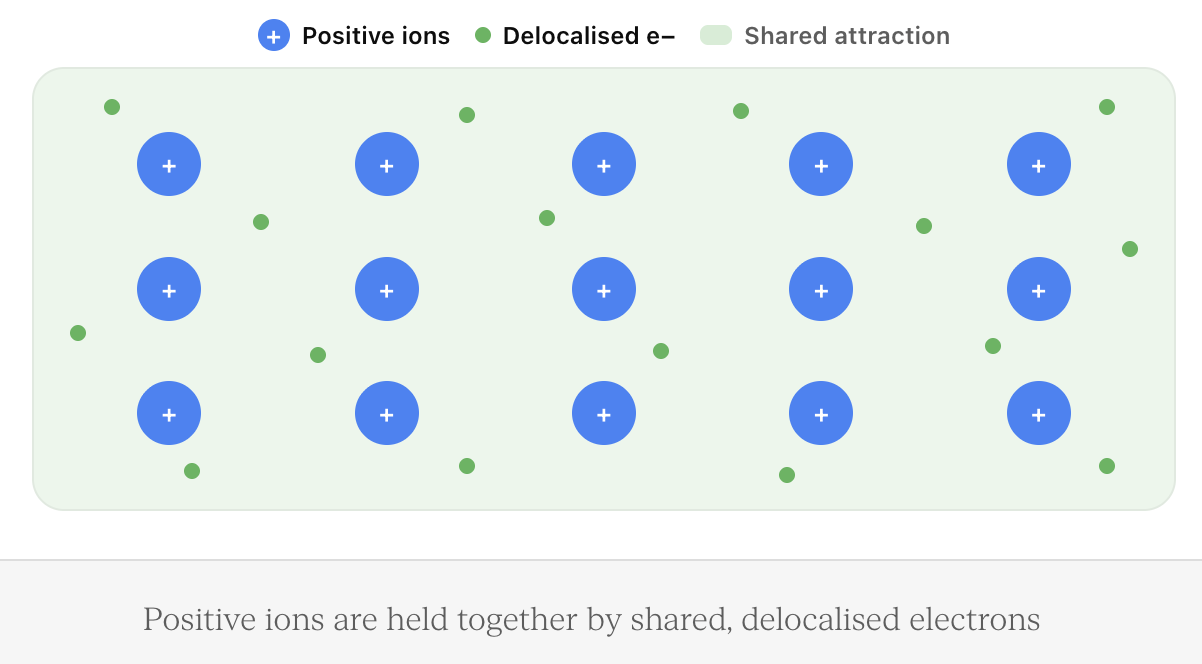
a lattice of positive metal ions surrounded by a sea of delocalized electrons
The strong electrostatic attraction between the positive metal ions and the negatively charged delocalized electrons holds the metal together.
The Metallic Lattice
When metal atoms form a metallic structure, their outer electrons become delocalized.
This leaves behind positively charged metal ions.
For example, a simplified model of a metal can be represented as:
positive metal ions + mobile delocalized electrons
The positive ions occupy relatively fixed positions in the solid lattice.
The electrons can move throughout the structure.
This arrangement extends throughout the entire piece of metal rather than forming separate molecules.
Delocalized Electrons
A delocalized electron is an electron that is not restricted to a single atom or a single covalent bond.
Instead, it can move throughout the metallic structure.
These electrons are sometimes described as forming an:
electron sea
The positive metal ions are surrounded by this electron sea.
The delocalized electrons are essential for explaining many properties of metals, including:
- Electrical conductivity
- Thermal conductivity
- Malleability
- Ductility
- Strength


Electrostatic Attraction
Metallic bonding is based on electrostatic attraction.
Opposite electrical charges attract.
In a metal:
- Metal ions are positive.
- Delocalized electrons are negative.
Therefore:
positive metal ions ↔ delocalized electrons
There is strong attraction throughout the lattice.
This attraction is the metallic bond.
Why Metallic Bonding Is Strong
Metallic bonding can be very strong because each positive metal ion is attracted to many delocalized electrons surrounding it.
The attraction is not limited to one pair of atoms.
Instead, the electrostatic attraction extends throughout the giant metallic structure.
A large amount of energy may therefore be required to separate the particles.
This contributes to many metals having relatively:
- High melting points.
- High boiling points.
- Strong solid structures.
However, the strength of metallic bonding varies considerably between different metals.
Factors Affecting Metallic Bond Strength
Metallic bonding tends to become stronger when there is:
- Greater positive charge on the metal ions.
- A larger number of delocalized electrons.
- A smaller distance between the positive ions and delocalized electrons.
Stronger electrostatic attraction generally produces stronger metallic bonding.
Example: Magnesium
A magnesium atom has two outer electrons.
In a metallic structure, these outer electrons can become delocalized.
We can represent this in a simplified way as:
Mg → Mg²⁺ + 2e⁻
The electrons are not transferred permanently to another specific atom as they would be in a simple ionic model.
Instead, they become part of the shared sea of delocalized electrons throughout the metal.
Metallic Bonding and Electrical Conductivity
Metals are excellent electrical conductors.
Why?
Because their delocalized electrons are free to move through the metallic lattice.
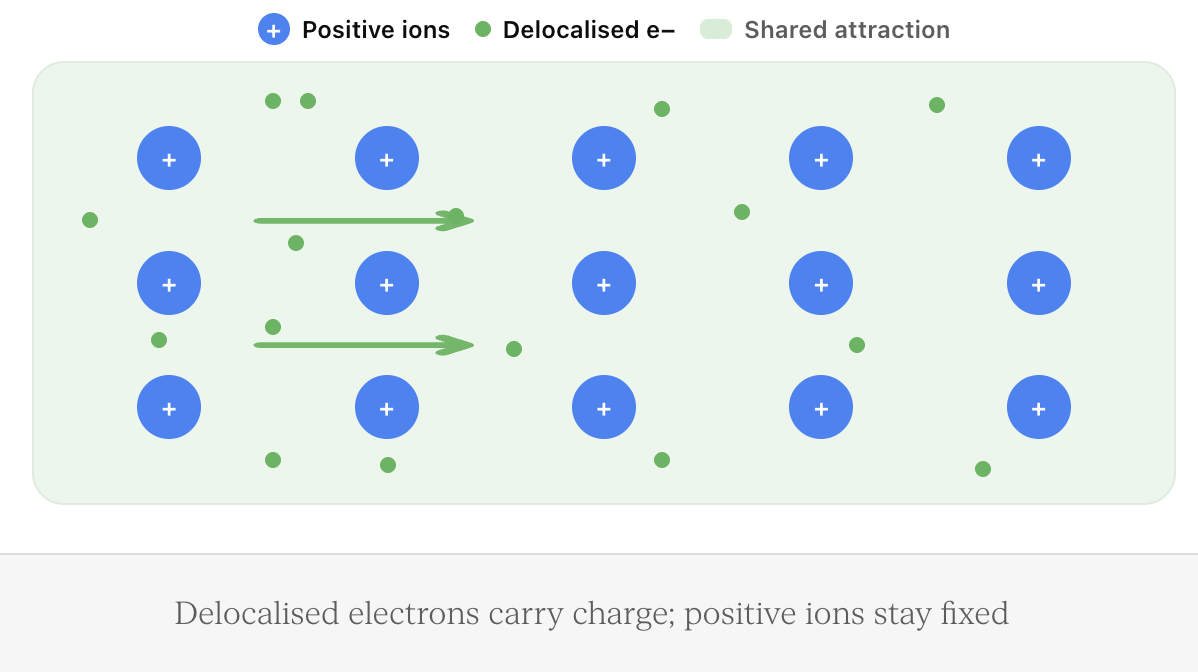
When a potential difference is applied, the electrons can move through the metal and carry electrical charge.


The positive metal ions do not need to move through the solid.
It is primarily the movement of the delocalized electrons that produces electrical conduction.
Why Solid Metals Conduct Electricity
This provides an important contrast with ionic compounds.
A solid ionic compound usually does not conduct electricity because its ions are held in fixed positions.
A solid metal does conduct because its delocalized electrons can move.
Therefore:
solid metal → mobile electrons → conducts
solid ionic compound → fixed ions → does not normally conduct
Metallic Bonding and Thermal Conductivity
Most metals are also good conductors of thermal energy.
The mobile electrons can rapidly transfer energy through the metallic structure.
Vibrations of the closely packed ions also contribute to energy transfer.
This helps explain why metals are commonly used in:
- Cooking pans.
- Heat exchangers.
- Radiators.
- Electronic cooling systems.


Malleability
Malleability is the ability of a material to be hammered, pressed, or rolled into different shapes without breaking.
Many metals are highly malleable.
Examples include metals formed into:
- Sheets.
- Foil.
- Car body panels.
- Containers.
Metallic bonding helps explain this property.
Why Metals Are Malleable
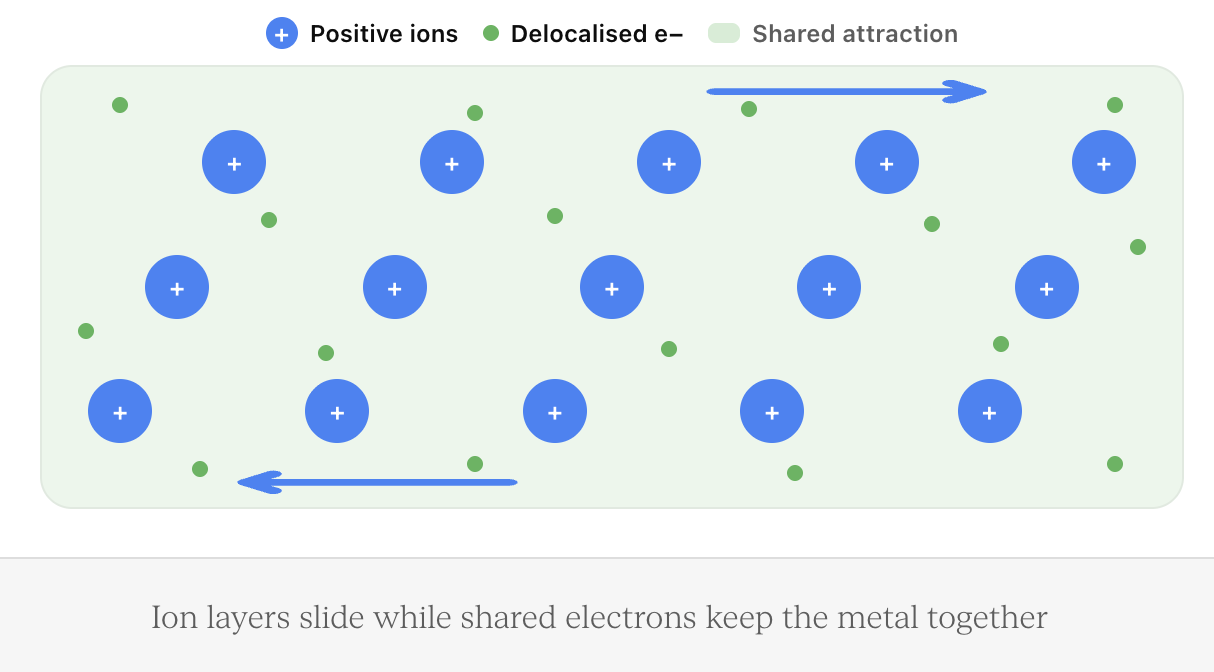
Metal ions are arranged in layers.
When a force is applied, these layers can slide past one another.
The delocalized electrons continue to attract the positive ions even after the ions have changed position.
Therefore, the metallic bonding can remain intact while the metal changes shape.
The structure bends or reshapes rather than immediately shattering.
This is very different from the behavior of many ionic crystals.
Ductility
Ductility is the ability of a material to be drawn into a wire.
Many metals are ductile.
Examples include:
- Copper electrical wire.
- Aluminum wiring.
- Steel cables.
Again, layers of metal ions can move while the delocalized electrons continue to maintain electrostatic attraction throughout the structure.


Why Metals Do Not Usually Shatter When Layers Move
This becomes clearer when metallic and ionic bonding are compared.
In a metal, layers of positive ions can slide.
The surrounding electrons continue attracting the ions.
The bonding remains effective.
In an ionic crystal, shifting layers can bring:
positive ions beside positive ions
and:
negative ions beside negative ions
Like charges repel.
This can cause the ionic crystal to fracture.
Metallic Bonding and Melting Point
To melt a metal, enough energy must be supplied to allow the particles to move more freely despite the strong metallic attractions.
Many metals therefore have relatively high melting points.
For example, metals used in buildings and machinery must often remain solid over a wide range of temperatures.
However:
not all metals have high melting points.
Mercury, for example, is liquid at room temperature.
Different metals have different metallic bond strengths.
Metallic Bonding and Boiling Point
Turning a liquid metal into a gas requires particles to become widely separated.
This requires overcoming strong attractions within the metallic structure.
Many metals therefore also have high boiling points.
Again, the exact values depend on the particular metal.
Metallic Luster
Many metals have a characteristic shiny appearance called metallic luster.
Delocalized electrons interact with incoming electromagnetic radiation, including visible light.
Much of the visible light can be reflected.
This contributes to the shiny appearance of polished metal surfaces.


Comparing Metallic and Ionic Bonding
Both metallic and ionic bonding involve electrostatic attraction.
However, the particles involved are different.
| Metallic Bonding | Ionic Bonding |
|---|---|
| Positive metal ions and delocalized electrons | Positive and negative ions |
| Giant metallic lattice | Giant ionic lattice |
| Electrons are mobile | Ions are fixed in a solid |
| Conducts when solid | Usually does not conduct when solid |
| Usually malleable | Usually brittle |
| Usually ductile | Not ductile |
Comparing Metallic and Covalent Bonding
Metallic and covalent bonding both involve electrons, but the electrons behave differently.
Covalent bonding
Electrons are shared between particular atoms.
For example:
H–H
The bonding electrons are localized between the bonded atoms.
Metallic bonding
Outer electrons become delocalized.
They are shared throughout the entire metallic structure rather than between one specific pair of atoms.
Comparing the Three Major Bonding Types
| Property | Metallic | Ionic | Covalent Molecular |
|---|---|---|---|
| Main particles | Metal ions + electrons | Positive + negative ions | Molecules |
| Main attraction | Ions ↔ delocalized electrons | Oppositely charged ions | Shared electrons within molecules |
| Giant structure? | Yes | Yes | Usually no |
| Conducts as solid? | Yes | No | Usually no |
| Malleable? | Usually | No | Usually not applicable in the same way |
| Typical melting point | Often high | Often high | Often lower |
These are general patterns rather than absolute rules.
Metallic Bonding Is Non-Directional
Covalent bonds usually act between particular atoms in particular directions.
Metallic bonding is different.
The positive ions are attracted to the surrounding sea of electrons in many directions.
This non-directional nature of metallic bonding helps explain why layers of ions can move without completely destroying the bonding.
This is an important reason metals can be reshaped.
Metals and Alloys
An alloy is a mixture containing a metal and one or more other elements.
Examples include:
- Steel.
- Brass.
- Bronze.
- Stainless steel.
The added atoms can alter the structure of the metallic lattice.


Why Alloys Can Be Harder
In a pure metal, similarly sized atoms can form relatively regular layers.
These layers may slide over one another comparatively easily.
In an alloy, atoms of different sizes can distort the regular lattice.
This can make it more difficult for layers to slide.
As a result, some alloys are:
harder and stronger than the pure metals from which they are made.
Example: Steel
Steel consists mainly of:
iron + carbon
Small amounts of other elements may also be present.
Carbon atoms alter the arrangement and movement within the iron lattice.
Different compositions and processing methods can produce steels with very different properties.
Steel is widely used because its properties can be adjusted for different purposes.
Example: Brass
Brass is mainly an alloy of:
copper + zinc
Its properties differ from those of pure copper or pure zinc.
Brass can combine useful characteristics such as:
- Workability.
- Corrosion resistance.
- Attractive appearance.
Its properties depend on its composition.
Example: Copper Wiring
Copper is widely used for electrical wiring.
Metallic bonding explains several useful properties.
Electrical conductivity
Delocalized electrons carry electrical charge.
Ductility
Copper can be drawn into thin wires.
Strength
Metallic bonding keeps the structure together.
This is a good example of how microscopic bonding explains a material's practical use.


Example: Aluminum
Aluminum is widely used in:
- Aircraft.
- Drink cans.
- Foil.
- Buildings.
- Electrical transmission cables.
Its useful properties include:
- Relatively low density.
- Good conductivity.
- Malleability.
- Ductility.
- Corrosion resistance.
Metallic bonding helps explain its conductivity, malleability, and ductility.
Metallic Bonding and Metal Properties
The metallic bonding model helps connect structure to observable properties:
delocalized electrons
↓
electrical and thermal conductivity
strong ion-electron attraction
↓
strong metallic structure and often high melting point
non-directional bonding
↓
layers can move while attraction remains
↓
malleability and ductility
This structure-property relationship is central to understanding metals.
Worked Example: Electrical Conductivity
Question: Why does copper conduct electricity when solid?
Copper contains delocalized electrons.
These electrons are free to move throughout the metallic lattice.
When a potential difference is applied, electrons move through the structure and carry electrical charge.
Therefore:
copper conducts electricity because its metallic structure contains mobile delocalized electrons.
Worked Example: Malleability
Question: Why can aluminum be rolled into thin sheets?
The positive metal ions are arranged in layers and surrounded by delocalized electrons.
When a force is applied, layers of ions can slide.
The delocalized electrons continue attracting the positive ions in their new positions.
Therefore, the metallic structure can change shape without immediately breaking apart.
Worked Example: Metallic Bond Strength
Suppose Metal A forms ions with a greater positive charge and contributes more delocalized electrons than a similar Metal B.
If the other structural factors are similar, Metal A may experience stronger electrostatic attraction between:
positive ions ↔ delocalized electrons
We would therefore expect stronger metallic bonding.
This may contribute to properties such as a higher melting point.
Structure and Properties
When explaining the properties of metals, use a complete chain of reasoning.
Instead of:
“Metals conduct because they have metallic bonds.”
A stronger explanation is:
“Metals contain delocalized electrons that are free to move through the metallic lattice. These mobile electrons can carry electrical charge, so metals conduct electricity.”
Similarly, instead of:
“Metals are malleable because of metallic bonding.”
Explain:
“Layers of positive metal ions can slide while remaining attracted to the sea of delocalized electrons, allowing the metal to change shape without the structure immediately breaking apart.”
Common Mistakes
Saying Metals Contain Neutral Atoms Surrounded by Electrons
The metallic bonding model describes:
positive metal ions surrounded by delocalized electrons.
Saying Delocalized Electrons Belong to One Atom
Delocalized electrons are free to move throughout the metallic structure.
Saying Metals Conduct Because the Positive Ions Move
In a solid metal, the positive ions remain in lattice positions.
The mobile electrons carry electrical charge.
Confusing Metallic and Ionic Bonding
Metallic bonding involves:
positive ions + delocalized electrons
Ionic bonding involves:
positive ions + negative ions
Saying Metals Are Malleable Because Their Bonds Break Easily
Metallic bonding can remain effective as layers of ions move.
Malleability does not mean the metal has weak bonding.
Assuming Every Metal Has a Very High Melting Point
Metallic bond strength varies between metals.
Saying Covalent and Metallic Electrons Behave the Same Way
Covalent bonding generally involves electrons shared between particular atoms.
Metallic bonding involves electrons delocalized throughout a much larger structure.
Check Your Understanding
1. Define metallic bonding.
2. Describe the structure of a metal.
3. What is a delocalized electron?
4. What particles make up a metallic lattice?
5. What electrostatic attraction holds a metal together?
6. Explain why metallic bonding can be strong.
7. Why can metals conduct electricity when solid?
8. What particles carry electrical charge through a solid metal?
9. Explain why metals are generally good thermal conductors.
10. Define malleability.
11. Explain why many metals are malleable.
12. Define ductility.
13. Explain why metals can be drawn into wires.
14. Why can an ionic crystal shatter when its layers move?
15. Compare metallic bonding with ionic bonding.
16. Compare metallic bonding with covalent bonding.
17. Why do many metals have relatively high melting points?
18. Why do different metals have different melting points?
19. What is an alloy?
20. Explain why some alloys are harder than pure metals.
21. Explain why copper is useful for electrical wiring.
22. Explain why metallic bonding is described as non-directional.
23. How do delocalized electrons help explain both electrical and thermal conductivity?
24. Describe the relationship between metallic structure and the physical properties of metals.
Key Terms
- Metallic bonding – electrostatic attraction between positive metal ions and delocalized electrons.
- Metallic lattice – giant repeating arrangement of positive metal ions surrounded by delocalized electrons.
- Delocalized electron – electron that is not associated with one particular atom or bond and can move throughout the metallic structure.
- Electrostatic attraction – attraction between opposite electrical charges.
- Malleability – ability of a material to be hammered, pressed, or rolled into shape.
- Ductility – ability of a material to be drawn into wire.
- Electrical conductivity – ability to allow electrical charge to move through a material.
- Thermal conductivity – ability to transfer thermal energy.
- Metallic luster – characteristic shiny appearance of many metals.
- Alloy – mixture containing a metal and one or more other elements.
- Giant structure – continuous structure containing very large numbers of bonded or interacting particles.
Key Takeaways
- Metals have a giant metallic lattice.
- The lattice contains positive metal ions surrounded by delocalized electrons.
- Delocalized electrons are not associated with one particular atom.
- Metallic bonding is the electrostatic attraction between positive metal ions and negatively charged delocalized electrons.
- This attraction acts throughout the metallic structure and can be very strong.
- Metals conduct electricity because their delocalized electrons can move and carry charge.
- Delocalized electrons also contribute to the high thermal conductivity of metals.
- Many metals have relatively high melting and boiling points because considerable energy is required to overcome metallic attractions.
- Metallic bonding is non-directional.
- Layers of metal ions can move while remaining attracted to the surrounding delocalized electrons.
- This helps explain malleability.
- It also helps explain ductility.
- Metallic bonding differs from ionic bonding because metals contain delocalized electrons rather than alternating positive and negative ions.
- Metallic bonding differs from covalent bonding because the electrons are delocalized throughout the metallic structure rather than shared between particular pairs of atoms.
- Alloys contain a metal mixed with one or more other elements.
- Different-sized atoms in an alloy can disrupt regular layers and make sliding more difficult.
- This can make alloys harder than pure metals.
- The metallic bonding model connects microscopic structure directly to observable properties.
- Structure → bonding → properties → uses is the key reasoning pattern for understanding metals.