Covalent Bonding
5. Covalent Networks
Learning outcomes
- I can describe giant covalent structures.
- I can explain the structures of diamond, graphite, and silicon dioxide.
- I can compare network covalent solids with molecular substances.
- I can explain why some covalent structures are extremely hard.
- I can relate network structures to their uses.
What Is a Covalent Network?
A covalent network, also called a giant covalent structure, is a continuous arrangement of atoms joined by strong covalent bonds.
Unlike a molecular substance, a covalent network does not contain separate, individual molecules. Its covalent bonds extend throughout the entire solid, forming a giant two-dimensional or three-dimensional lattice.
Examples include:
- Diamond
- Graphite
- Graphene
- Silicon dioxide
- Silicon carbide
Because covalent bonds are strong, considerable energy is generally required to break apart these structures.
Structure Determines Properties
The properties of a covalent network depend on:
- How many bonds each atom forms
- The strength of those bonds
- Whether the structure is two-dimensional or three-dimensional
- Whether the structure contains mobile, delocalized electrons
- Whether layers can slide over one another
A useful chain of reasoning is:
Bonding and arrangement → structure → properties → uses
For example:
Four bonds per carbon → rigid 3D network → extreme hardness → cutting tools
Diamond


Diamond is a giant covalent form, or allotrope, of carbon.
Structure of Diamond
In diamond:
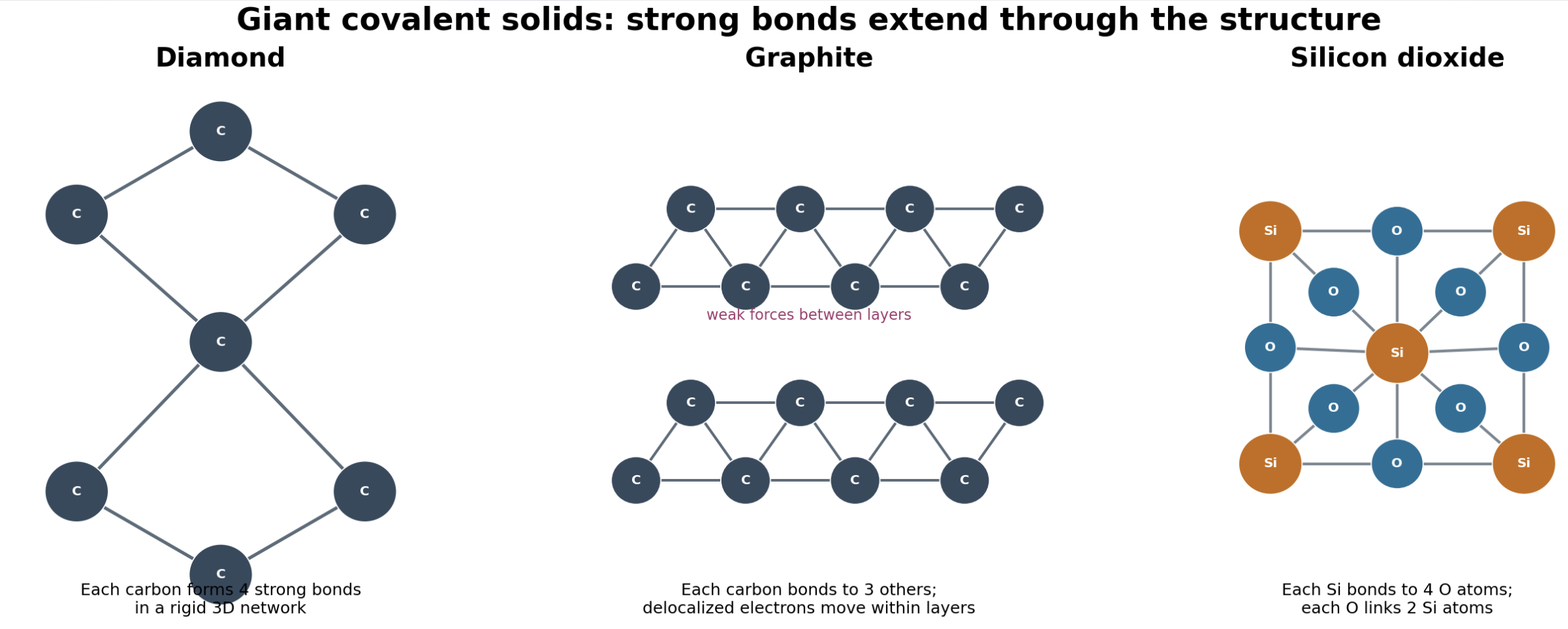
- Every carbon atom forms four covalent bonds.
- Each carbon is bonded to four other carbon atoms.
- The bonds point toward the corners of a tetrahedron.
- The bonding continues in every direction, producing a rigid three-dimensional network.
- There are no separate diamond molecules.
A chemical formula of
describes the type of atom present, but it does not mean that diamond consists of individual one-atom molecules.
Properties of Diamond
Extreme hardness
Diamond is extremely hard because:
- Carbon–carbon covalent bonds are strong.
- Every carbon atom is held firmly in a rigid 3D arrangement.
- Scratching or deforming the structure requires many strong bonds to be broken or rearranged.
- There are no weak layers that can slide over one another.
Very high melting or sublimation temperature
A large amount of energy is needed to separate the carbon atoms because strong covalent bonds extend throughout the structure.
Diamond does not behave like an ordinary molecular solid when heated. At atmospheric pressure, it tends to transform or sublime before forming an ordinary liquid.
Electrical insulation
Diamond does not normally conduct electricity because all four outer electrons from each carbon atom are involved in covalent bonds. There are no freely moving charged particles.
High thermal conductivity
Although diamond does not conduct electricity, it transfers thermal energy very effectively through vibrations in its rigid lattice.
Uses of Diamond
Diamond is used in:
- Cutting and drilling tools
- Abrasive powders
- Saw blades
- Polishing equipment
- Heat spreaders in electronics
- Jewellery
Its use in tools is connected to its hardness, while its use in electronics is connected to its ability to transfer heat.
Important: Hardness is resistance to scratching or deformation. It is not the same as toughness. Diamond is extremely hard but can still crack or split along particular planes.
Graphite


Graphite is another allotrope of carbon, but its structure is very different from that of diamond.
Structure of Graphite
In graphite:
- Each carbon atom forms three covalent bonds.
- The carbon atoms form flat sheets of connected hexagonal rings.
- Strong covalent bonds hold the atoms together within each sheet.
- Weak intermolecular attractions act between neighbouring sheets.
- One outer electron from each carbon is delocalized and can move through a sheet.
Graphite is therefore a layered giant covalent structure.
Properties of Graphite
Soft and slippery
The covalent bonds within each layer are strong, but the forces between layers are much weaker. The layers can slide past one another relatively easily.
This makes graphite:
- Soft
- Slippery
- Suitable as a dry lubricant
- Able to leave marks on paper
When a pencil is used, thin layers and particles of graphite are transferred to the paper.
Electrical conductivity
Graphite conducts electricity because it contains delocalized electrons that can move along its layers.
Its conductivity is greater along the layers than across them because the electrons move most easily within the carbon sheets.
High melting temperature
Graphite still has a very high melting or sublimation temperature. Melting it requires strong carbon–carbon covalent bonds within the layers to be overcome—not merely the weak forces between layers.
Uses of Graphite
Graphite is used in:
- Pencil “lead”
- Electrodes
- Batteries
- Motor brushes
- High-temperature crucibles
- Dry lubricants
- Refractory furnace linings
Its applications arise from its combination of electrical conductivity, thermal stability, and layered structure.
Diamond and Graphite Are Both Carbon
Diamond and graphite contain only carbon atoms, but they have dramatically different properties because their atoms are arranged and bonded differently.
| Property | Diamond | Graphite |
|---|---|---|
| Bonds per carbon | 4 | 3 |
| Overall structure | Rigid 3D network | Flat layers |
| Hardness | Extremely hard | Soft and slippery |
| Electrical conductivity | Does not normally conduct | Conducts along its layers |
| Mobile electrons | None | Delocalized electrons present |
| Common uses | Cutting tools and abrasives | Electrodes, pencils and lubricants |
This comparison demonstrates an important chemical principle:
A substance’s properties depend not only on which atoms it contains, but also on how those atoms are bonded and arranged.
Silicon Dioxide


Silicon dioxide,
, is also called silica. It occurs naturally in quartz and is a major component of many types of sand and rock.
Structure of Silicon Dioxide
In silicon dioxide:
- Each silicon atom is covalently bonded to four oxygen atoms.
- The oxygen atoms are arranged approximately tetrahedrally around each silicon atom.
- Each oxygen atom connects two silicon atoms.
- The bonding continues through a three-dimensional network.
- The overall ratio is one silicon atom for every two oxygen atoms.
The formula
represents the simplest whole-number ratio of silicon to oxygen. It does not normally represent a separate, individual
molecule in solid quartz.
Properties of Silicon Dioxide
Silicon dioxide is generally:
- Hard
- Rigid
- Insoluble in water
- An electrical insulator
- Resistant to chemical attack
- High-melting
These properties arise from its extensive network of strong silicon–oxygen covalent bonds.
Uses of Silicon Dioxide
Silicon dioxide is used in:
- Glass
- Ceramics
- Concrete and construction materials
- Optical fibres
- Laboratory glassware
- Electronic and semiconductor components
Quartz has an ordered crystalline network. Ordinary glass also contains a silicon–oxygen network, but its atoms do not have the same long-range repeating order, so it is described as amorphous.
Why Are Some Covalent Networks So Hard?
Hardness depends on how strongly atoms are held in position and whether parts of the structure can move.
Diamond and crystalline silicon dioxide are hard because:
- They contain many strong covalent bonds.
- Their bonds extend through rigid three-dimensional networks.
- Their atoms cannot move without several bonds being stretched, broken, or rearranged.
- They do not contain weakly connected layers.
Graphite is the important exception. It contains strong covalent bonds, but its layers are connected by much weaker attractions. The layers can slide, making graphite soft.
Therefore, it is not enough to say:
“All giant covalent structures are hard.”
A more accurate statement is:
Rigid three-dimensional covalent networks are generally very hard, while layered covalent networks may be soft between their layers.
Network Covalent and Molecular Substances
A molecular substance consists of separate molecules. Strong covalent bonds hold the atoms together inside each molecule, but the forces between different molecules are usually much weaker.
A network covalent substance has covalent bonds extending through the entire structure.
| Feature | Network covalent solid | Molecular substance |
|---|---|---|
| Basic structure | Continuous network of atoms | Separate molecules |
| Forces overcome when melting | Many strong covalent bonds | Mainly weaker intermolecular forces |
| Typical melting point | Very high | Often low or moderate |
| Typical hardness | Often hard | Usually softer |
| Electrical conductivity | Usually low; graphite is an exception | Usually low |
| Examples | Diamond, graphite, | Water, carbon dioxide, methane |
Example: Silicon Dioxide and Carbon Dioxide
Silicon dioxide and carbon dioxide both contain oxygen, but their structures are completely different.
- Solid silicon dioxide is a giant covalent network.
- Carbon dioxide consists of separatemolecules.
- Strong bonds extend throughout silicon dioxide.
- Weak intermolecular attractions exist between carbon dioxide molecules.
- Silicon dioxide is a hard, high-melting solid.
- Carbon dioxide is a gas at room temperature.
This difference is caused by structure and bonding, not simply by the elements present.
Applying Structure–Property Reasoning
Example: Why is diamond used on drill bits?
Structure: Diamond has a rigid, three-dimensional carbon network.
Bonding: Each carbon atom forms four strong covalent bonds.
Property: The structure strongly resists scratching and deformation.
Use: Diamond can cut or grind many other materials.
Example: Why is graphite used in electrodes?
Structure: Graphite contains delocalized electrons within its carbon layers.
Property: These electrons can move and carry electrical charge.
Use: Graphite can conduct current in batteries, electrolysis cells, and electric motors.
Example: Why is graphite used as a lubricant?
Structure: Graphite consists of strongly bonded sheets separated by weak attractions.
Property: The sheets can slide over one another.
Use: Graphite reduces friction between moving surfaces.
Example: Why is silicon dioxide used in glassware?
Structure: Silicon and oxygen form a strong three-dimensional network.
Properties: The material is rigid, heat resistant, and chemically stable.
Use: Silica-based glass can be used for containers, windows, and laboratory equipment.
Common Misconceptions
- “Diamond is one enormous molecule.”
It is more accurate at this level to describe diamond as a continuous giant covalent lattice rather than a collection of separate molecules. - “All carbon substances have the same properties.”
Diamond and graphite are both carbon, but different bonding arrangements give them different properties. - “Graphite is soft because its covalent bonds are weak.”
The bonds inside each layer are strong. Graphite is soft because weak attractions allow entire layers to slide. - “Graphite has free carbon ions.”
Graphite conducts using delocalized electrons, not moving carbon ions. - “Hard materials cannot break.”
Hardness and toughness are different. Diamond resists scratching but can fracture. - “The 2 in means one molecule contains three atoms.”
In network silicon dioxide, the formula shows the overall silicon-to-oxygen ratio rather than describing a separate molecule.
Did You Know?
A single sheet separated from graphite is called graphene. It is only one atom thick, yet it has remarkable strength and conducts electricity effectively. Its properties have led to research into sensors, flexible electronics, composite materials, and energy-storage devices.
Key Terms
- Giant covalent structure: A continuous structure in which atoms are connected by covalent bonds.
- Network covalent solid: Another name for a solid containing a giant covalent network.
- Lattice: A regular or extended arrangement of particles in a solid.
- Tetrahedral arrangement: A geometry in which four bonds point toward the corners of a tetrahedron.
- Allotrope: One of two or more structural forms of the same element.
- Delocalized electron: An electron that is not confined to one bond and can move through part of a structure.
- Intermolecular forces: Attractions acting between separate particles or molecules.
- Hardness: Resistance to scratching or permanent surface deformation.
- Brittleness: The tendency of a material to fracture instead of bending.
- Electrical conductor: A material containing charged particles that can move and carry current.
- Electrical insulator: A material that does not contain easily moving charged particles.
- Silica: The common name for silicon dioxide,.
Key Takeaways
- Giant covalent substances contain strong covalent bonds extending throughout their structures.
- Diamond has four bonds per carbon and forms a rigid 3D network.
- Graphite has three bonds per carbon and forms layers containing delocalized electrons.
- Silicon dioxide forms a 3D network in which each silicon bonds to four oxygen atoms and each oxygen links two silicon atoms.
- Diamond is hard because deforming it requires many strong bonds to be disrupted.
- Graphite is soft because weak attractions allow its layers to slide.
- Network covalent solids generally have much higher melting temperatures than molecular substances.
- A material’s structure determines its properties, and its properties determine its uses.