Covalent Bonding
4. Molecular Compounds
Learning outcomes
- I can identify common molecular compounds.
- I can distinguish between molecules and ionic compounds.
- I can describe the properties of molecular substances.
- I can explain why many molecular compounds have low melting points.
- I can relate molecular structure to observable properties.
What is a molecular compound?
A molecular compound consists of separate groups of atoms joined by covalent bonds.
Within each molecule:
- Atoms share electron pairs.
- Strong covalent bonds hold the atoms together.
- The molecule has a specific number and arrangement of atoms.
Molecular compounds usually form between non-metal elements.
Examples include:
- Water, H₂O.
- Carbon dioxide, CO₂.
- Methane, CH₄.
- Ammonia, NH₃.
- Hydrogen chloride, HCl.
- Sulfur dioxide, SO₂.
- Ethanol, C₂H₅OH.
- Glucose, C₆H₁₂O₆.
Molecules and compounds
A molecule is a group of two or more atoms held together by covalent bonds.
A compound contains atoms of two or more different elements chemically combined.
Therefore, not every molecule is a compound.
| Substance | Molecule? | Compound? | Explanation |
|---|---|---|---|
| O₂ | Yes | No | Contains only oxygen atoms |
| N₂ | Yes | No | Contains only nitrogen atoms |
| H₂O | Yes | Yes | Contains hydrogen and oxygen |
| CO₂ | Yes | Yes | Contains carbon and oxygen |
| CH₄ | Yes | Yes | Contains carbon and hydrogen |
| NaCl | No discrete molecules | Yes | Contains sodium and chloride ions in a lattice |
Oxygen gas consists of molecules, but it is an element rather than a compound.
Water consists of molecules and is also a compound.
Common molecular compounds


Molecular models show how atoms are connected and arranged in three dimensions.
| Compound | Formula | Main bonds | Shape or structure |
|---|---|---|---|
| Water | H₂O | O—H single bonds | Bent |
| Carbon dioxide | CO₂ | C=O double bonds | Linear |
| Methane | CH₄ | C—H single bonds | Tetrahedral |
| Ammonia | NH₃ | N—H single bonds | Trigonal pyramidal |
| Hydrogen chloride | HCl | H—Cl single bond | Linear |
| Sulfur dioxide | SO₂ | S—O bonding | Bent |
| Ethanol | C₂H₅OH | Mainly single bonds | Multi-atom molecule |
| Glucose | C₆H₁₂O₆ | Mainly single bonds | Ring or chain forms |
The molecular formula shows the number and types of atoms. A structural formula also shows how the atoms are connected.
Molecular substances and ionic compounds
Molecular and ionic compounds contain different particles and structures.
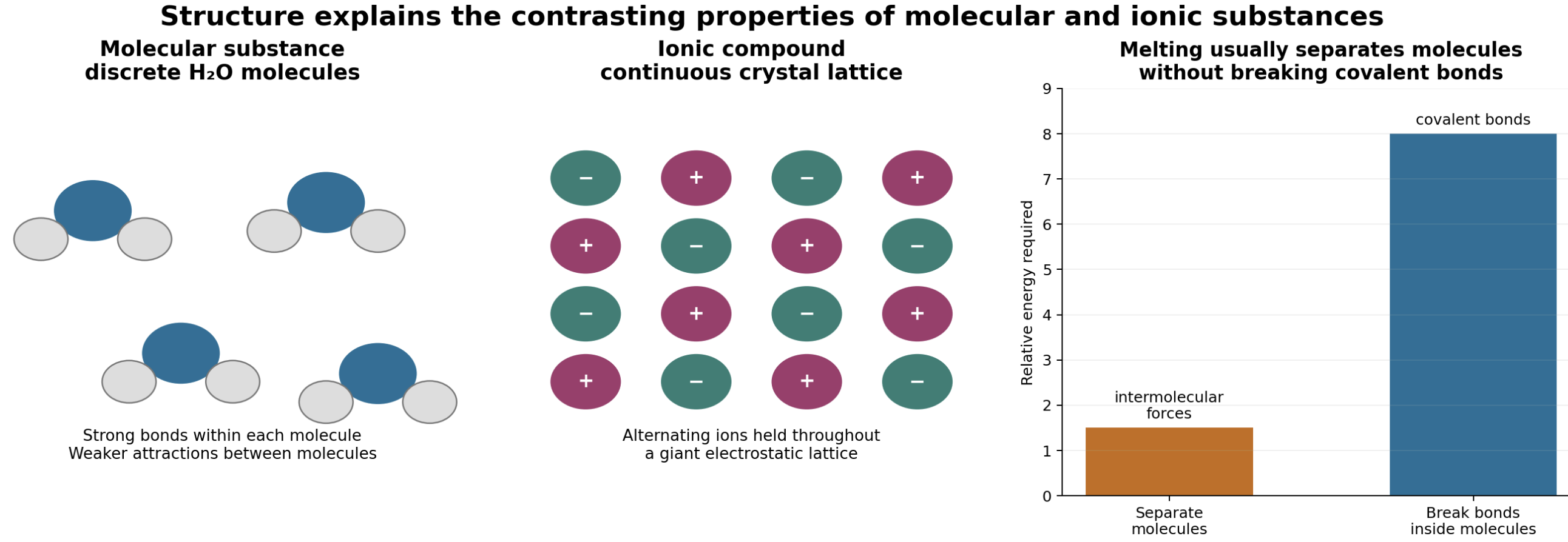
A molecular substance contains separate molecules. An ionic compound contains a repeating arrangement of oppositely charged ions.
How molecular compounds form
Molecular compounds form through electron sharing.
For example, water contains two O—H covalent bonds. Each bond consists of a shared pair of electrons.
A simple structural formula is:
H—O—H
The atoms remain connected as one identifiable H₂O molecule.
How ionic compounds form
Ionic compounds usually form through electron transfer between a metal and a non-metal.
For example, sodium transfers an electron to chlorine:
Na → Na⁺ + e⁻
Cl + e⁻ → Cl⁻
The oppositely charged ions attract one another and form a giant ionic lattice.
Solid sodium chloride does not consist of separate NaCl molecules. Its formula shows the simplest whole-number ratio of ions:
NaCl means Na⁺ : Cl⁻ = 1 : 1


A salt crystal contains a regular lattice of ions, while liquid water contains separate H₂O molecules moving among one another.
Comparing molecular and ionic compounds
| Property | Molecular compounds | Ionic compounds |
|---|---|---|
| Elements commonly involved | Non-metal with non-metal | Metal with non-metal |
| Main particle | Molecule | Positive and negative ions |
| Structure | Separate molecules | Giant ionic lattice |
| Bonding | Covalent bonds within molecules | Electrostatic attraction throughout lattice |
| Typical melting point | Often low | Usually high |
| Electrical conductivity | Usually poor | Conduct when molten or dissolved |
| State at room temperature | Often gas, liquid or low-melting solid | Usually crystalline solid |
| Formula meaning | Actual numbers of atoms in a molecule | Simplest ratio of ions |
These are general patterns. Individual substances may show exceptions depending on their structure.
Intramolecular and intermolecular forces
Two different types of attraction must be distinguished.
Intramolecular bonds
Intramolecular means “within a molecule.”
Strong covalent bonds join the atoms inside each molecule.
For example, water contains strong O—H covalent bonds within each H₂O molecule.
Intermolecular forces
Intermolecular means “between molecules.”
Intermolecular forces attract one molecule to another.
They are usually weaker than the covalent bonds within the molecules.
This difference explains many properties of molecular substances.
Why many molecular compounds have low melting points
When a molecular solid melts:
- The molecules separate and move past one another.
- Intermolecular forces are overcome.
- The covalent bonds inside each molecule usually remain intact.
Because intermolecular forces are often much weaker than covalent bonds, less energy is required to melt many molecular substances.
The melting process usually does not break the molecules into their atoms.
For example, when ice melts:
H₂O(s) → H₂O(l)
The particles remain H₂O molecules. The arrangement and motion of the molecules change.
Why many molecular compounds have low boiling points
Boiling separates molecules from one another to form a gas.
The stronger the intermolecular attractions, the more energy is required and the higher the boiling point.
Many small molecular compounds have relatively weak intermolecular attractions, so they are gases or liquids at room temperature.
Examples include:
- Carbon dioxide: gas.
- Methane: gas.
- Ammonia: gas.
- Water: liquid.
- Ethanol: liquid.
Comparing bond strength and melting point
A molecular substance can contain strong covalent bonds and still have a low melting point.
This is because different forces are involved:
- Covalent bonds hold atoms together within molecules.
- Intermolecular forces hold separate molecules near one another.
When methane boils, the C—H bonds do not break. The CH₄ molecules simply move farther apart.
A low melting point does not mean that the covalent bonds inside a molecule are weak.
Types of intermolecular forces
The strength of intermolecular attractions depends on molecular structure.
London dispersion forces
London dispersion forces occur between all atoms and molecules.
They are especially important in non-polar substances.
Their strength generally increases when molecules:
- Contain more electrons.
- Are larger.
- Have greater surface area in contact with neighbouring molecules.
Permanent dipole–dipole forces
Polar molecules have regions of partial positive and partial negative charge.
The oppositely charged regions of neighbouring molecules attract one another.
These attractions are called permanent dipole–dipole forces.
Hydrogen bonding
Hydrogen bonding is a particularly strong intermolecular attraction that occurs when hydrogen is covalently bonded to:
- Nitrogen.
- Oxygen.
- Fluorine.
Water, ammonia and ethanol can form hydrogen bonds.
Water as an unusual molecular compound
Water is a small molecular compound, but it has a much higher boiling point than many similarly sized molecules.
This is because water molecules form hydrogen bonds with one another.


Hydrogen bonding contributes to several important properties of water:
- It is liquid at ordinary room temperature.
- It has a relatively high boiling point.
- It has a high surface tension.
- It requires substantial energy to evaporate.
- Ice forms an open structure that is less dense than liquid water.
Water still has a much lower melting point than typical ionic compounds such as sodium chloride.
Molecular size and boiling point
Larger molecules often have stronger dispersion forces because they contain more electrons.
Compare the halogens:
| Substance | Formula | State near room temperature |
|---|---|---|
| Fluorine | F₂ | Gas |
| Chlorine | Cl₂ | Gas |
| Bromine | Br₂ | Liquid |
| Iodine | I₂ | Solid |
The particles are all non-polar diatomic molecules, but intermolecular attractions become stronger as molecular size increases.
Although F₂, Cl₂, Br₂ and I₂ are molecules, they are elemental substances rather than molecular compounds.
Molecular shape and intermolecular attractions
Shape affects how closely molecules can approach one another.
Long, relatively straight molecules may have greater surface contact than highly branched molecules of similar mass. Greater contact can strengthen dispersion forces and increase boiling point.
Molecular shape also affects:
- Polarity.
- Packing in a solid.
- Solubility.
- Viscosity.
- Biological activity.
Two substances with the same molecular formula can sometimes have different structures and properties. These substances are called isomers.
Polarity
A covalent bond may be polar if one atom attracts the shared electrons more strongly than the other.
A molecule’s overall polarity depends on:
- The polarity of its bonds.
- Its three-dimensional shape.
- Whether the bond dipoles cancel.
Water
Water has polar O—H bonds and a bent shape. The bond dipoles do not cancel, so water is polar.
Carbon dioxide
Carbon dioxide has polar C=O bonds, but the molecule is linear and symmetrical:
O=C=O
The two bond dipoles cancel, making the molecule non-polar overall.
A molecule can therefore contain polar bonds without being a polar molecule.
Solubility of molecular compounds
A useful general rule is:
Substances tend to dissolve in solvents with similar polarity.
This is sometimes expressed as “like dissolves like.”
Polar molecular compounds
Many polar substances dissolve in polar solvents such as water.
Examples include:
- Ethanol.
- Sugar.
- Some small organic acids.
Non-polar molecular compounds
Non-polar substances often dissolve more readily in non-polar solvents.
Examples include:
- Oils.
- Waxes.
- Many hydrocarbons.
Oil and water do not mix well because their intermolecular attractions differ.


Solubility depends on more than whether a substance is molecular. Polarity, molecular size and the solvent all matter.
Electrical conductivity
Most pure molecular substances do not conduct electricity.
To conduct, a substance needs mobile charged particles.
Molecular substances usually contain:
- Neutral molecules.
- Electrons held within covalent bonds.
- No freely moving ions or delocalized electrons.
Therefore, they are usually poor electrical conductors as solids and liquids.
Important conductivity exceptions
Some molecular compounds react with water to produce ions.
For example, hydrogen chloride consists of HCl molecules as a gas. When dissolved in water, it ionizes:
HCl + H₂O → H₃O⁺ + Cl⁻
The resulting solution conducts electricity because it contains mobile ions.
The conductivity comes from ions in solution, not from intact neutral HCl molecules.
Some molecular substances, such as graphite-like extended structures, require separate explanations because they are not simple molecular substances.
Physical states at room temperature
Many molecular substances are gases, liquids or low-melting solids at room temperature.
Molecular gases
Examples include:
- CO₂.
- CH₄.
- NH₃.
Their molecules experience relatively weak attractions under ordinary conditions.
Molecular liquids
Examples include:
- H₂O.
- Ethanol.
- Bromine, which is molecular but elemental.
Molecular solids
Examples include:
- Ice.
- Sugar.
- Iodine, which is molecular but elemental.
- Many pharmaceutical compounds.
Molecular solids may be soft, brittle, flexible or crystalline depending on their structures and intermolecular forces.
Carbon dioxide
Carbon dioxide is a molecular compound with formula CO₂.
Its structural formula is:
O=C=O
Properties include:
- Colourless gas at room temperature.
- Non-flammable under ordinary conditions.
- Poor electrical conductivity.
- Linear molecular shape.
- Overall non-polar molecule.
- Sublimation of solid CO₂ at atmospheric pressure.


Solid carbon dioxide is called dry ice. It changes directly from solid to gas under ordinary atmospheric pressure.
Methane
Methane has the formula CH₄.
Properties include:
- Colourless gas at room temperature.
- Tetrahedral molecular shape.
- Non-polar overall.
- Low boiling point.
- Poor electrical conductivity.
- Flammable.
Methane’s low boiling point is related to its small size and weak intermolecular attractions.
Ammonia
Ammonia has the formula NH₃.
Properties include:
- Gas at room temperature.
- Pungent smell.
- Polar molecule.
- Trigonal pyramidal shape.
- Hydrogen bonding between molecules.
- High solubility in water.
- Formation of an alkaline solution in water.
Ammonia has a higher boiling point than many similar-sized molecules because of hydrogen bonding.
Ethanol
Ethanol has the formula:
C₂H₅OH
It contains:
- A non-polar carbon-based region.
- A polar O—H region.
- Hydrogen bonding between molecules.
Properties include:
- Liquid at room temperature.
- Miscible with water in all proportions.
- Lower boiling point than water.
- Flammable.
- Ability to dissolve some polar and non-polar substances.
This combination makes ethanol useful as a solvent.
Glucose
Glucose has the molecular formula:
C₆H₁₂O₆
It is a molecular compound with many O—H groups.
Properties include:
- Solid at room temperature.
- Soluble in water.
- Relatively high melting behaviour for a molecular substance.
- Poor electrical conductivity in pure form.
- Important role in cellular respiration.
Its many polar groups allow strong attractions, including hydrogen bonding, with water molecules.
Simple molecular and giant covalent structures
Not every covalently bonded substance consists of separate molecules.
Simple molecular substances
These contain identifiable molecules.
Examples include:
- H₂O.
- CO₂.
- CH₄.
- NH₃.
Their melting and boiling usually involve overcoming intermolecular forces.
Giant covalent structures
These contain continuous networks of covalent bonds rather than separate molecules.
Examples include:
- Diamond.
- Silicon dioxide.
- Graphite.
Giant covalent substances often have very high melting points because many strong covalent bonds must be broken.


The phrase “covalent substance” does not automatically mean low melting point. The distinction between discrete molecules and a giant covalent network is essential.
Relating structure to observable properties
A useful explanation follows this chain:
Structure → particles and forces → energy or mobility → observable property
Example: low boiling point of methane
- Methane consists of small, separate CH₄ molecules.
- Weak dispersion forces act between them.
- Little energy is needed to separate the molecules.
- Methane has a low boiling point and is a gas at room temperature.
Example: water’s relatively high boiling point
- Water consists of polar H₂O molecules.
- Hydrogen bonds form between neighbouring molecules.
- More energy is needed to separate them.
- Water remains liquid at room temperature and boils at a higher temperature than many similar-sized molecules.
Example: poor electrical conductivity
- A molecular liquid contains neutral molecules.
- It has no mobile ions or delocalized electrons.
- Charge cannot move through the substance.
- The liquid does not conduct electricity effectively.
Identifying an unknown substance
Suppose an unknown substance:
- Melts at 18°C.
- Does not conduct electricity as a liquid.
- Consists only of non-metals.
- Evaporates easily.
This evidence suggests a molecular substance because:
- Its melting point is low.
- It lacks mobile charged particles.
- Its atoms are likely joined through covalent bonds.
- Relatively weak intermolecular forces allow easy evaporation.
One property alone may not provide enough evidence. A stronger identification uses several properties together.
Common misconceptions
- “Every molecule is a compound.” O₂ and N₂ are molecules of elements.
- “Ionic compounds consist of molecules.” They normally consist of extended ionic lattices.
- “Molecular substances have weak covalent bonds.” Their low melting points usually result from weak intermolecular forces.
- “Melting breaks covalent bonds.” Melting a simple molecular substance normally separates intact molecules.
- “All molecular compounds are gases.” They can be gases, liquids or solids.
- “All molecular compounds have very low melting points.” Larger molecules and strong intermolecular forces can raise melting points.
- “All polar bonds produce a polar molecule.” Molecular shape determines whether bond dipoles cancel.
- “All substances containing covalent bonds have low melting points.” Giant covalent structures usually have very high melting points.
- “Molecular solutions never conduct electricity.” Some molecular compounds ionize when dissolved.
Did you know?
Many smells come from molecular substances that evaporate easily.
For a substance to reach receptors in the nose, molecules must enter the gas phase and travel through the air. Volatile molecular compounds often have recognizable odours because their intermolecular forces allow them to evaporate at ordinary temperatures.
Key terms
- Molecule: A group of atoms joined by covalent bonds.
- Molecular compound: A substance containing discrete molecules made from different elements.
- Covalent bond: A strong attraction involving a shared electron pair and two nuclei.
- Ionic compound: A substance containing positive and negative ions in a lattice.
- Intermolecular force: An attraction between separate molecules.
- Intramolecular bond: A bond joining atoms within a molecule.
- Polarity: Unequal distribution of electrical charge within a bond or molecule.
- Dipole: A separation of partial positive and partial negative charge.
- Hydrogen bonding: A strong intermolecular attraction involving hydrogen bonded to nitrogen, oxygen or fluorine.
- Dispersion force: An attraction caused by temporary variations in electron distribution.
- Volatility: Tendency of a substance to evaporate.
- Simple molecular structure: A structure consisting of separate molecules.
- Giant covalent structure: A continuous network of covalently bonded atoms.
Key takeaways
- Molecular compounds contain discrete groups of covalently bonded non-metal atoms.
- A molecule may be an element or a compound.
- Ionic compounds contain lattices of positive and negative ions rather than separate molecules.
- Strong covalent bonds act within molecules.
- Weaker intermolecular forces act between molecules.
- Melting and boiling simple molecular substances usually overcome intermolecular forces.
- Molecular size, shape and polarity affect melting point, boiling point and solubility.
- Most molecular substances conduct electricity poorly because they lack mobile charged particles.
- Giant covalent substances have different properties from simple molecular substances.
- Observable properties can be explained by connecting structure, forces and particle behaviour.