Covalent Bonding
3. Single, Double, and Triple Bonds
Learning outcomes
- I can distinguish between single, double, and triple covalent bonds.
- I can explain how bond order affects molecular structure.
- I can identify examples of molecules containing different bond types.
- I can compare bond strength among different covalent bonds.
- I can represent multiple bonds in structural diagrams.
What is a covalent bond?
A covalent bond forms when atoms share a pair of electrons.
Covalent bonding usually occurs between non-metal atoms. The shared electrons are attracted to the nuclei of both bonded atoms, holding the atoms together.
Atoms often share electrons to achieve stable outer electron arrangements similar to those of noble gases.
Depending on how many pairs are shared, the atoms may form:
- A single covalent bond.
- A double covalent bond.
- A triple covalent bond.
Bond order
Bond order describes the number of shared electron pairs between two bonded atoms.
| Bond type | Bond order | Shared electron pairs | Shared electrons | Structural symbol |
|---|---|---|---|---|
| Single bond | 1 | 1 | 2 | — |
| Double bond | 2 | 2 | 4 | = |
| Triple bond | 3 | 3 | 6 | ≡ |
A greater bond order means that more electron density is concentrated between the bonded nuclei.
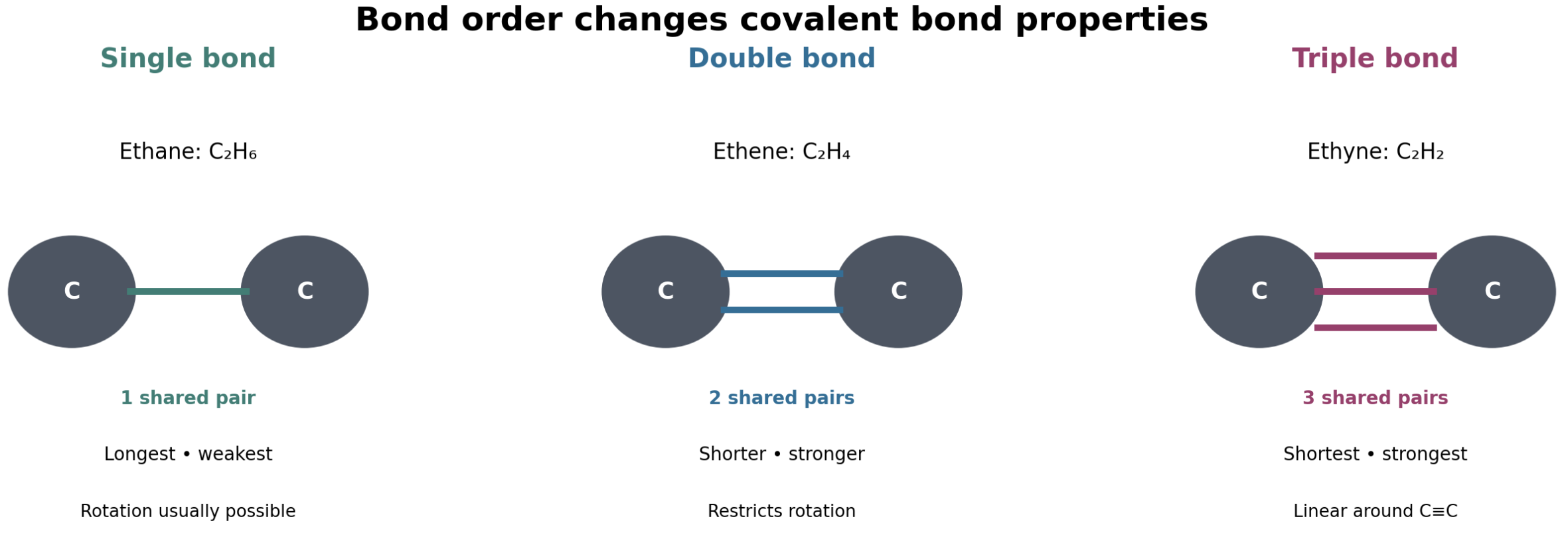
For bonds between the same types of atoms, increasing bond order generally makes the bond shorter and stronger.
Single covalent bonds
A single bond consists of one shared pair of electrons.
It is represented by one line:
A—B
Each line in a structural formula represents one shared electron pair.
Hydrogen
Two hydrogen atoms share one pair of electrons:
H—H
Each hydrogen contributes one electron to the shared pair. Each atom then has access to two electrons in its first shell.
Molecular formula:
H₂
Chlorine
Each chlorine atom has seven valence electrons. Two chlorine atoms share one pair:
Cl—Cl
Each chlorine atom then has access to eight valence electrons.
Molecular formula:
Cl₂


Hydrogen and chlorine are examples of diatomic molecules containing single bonds.
Methane
Carbon has four valence electrons and normally forms four covalent bonds.
In methane, one carbon atom shares an electron pair with each of four hydrogen atoms:
    H
    |
H — C — H
    |
    H
Molecular formula:
CH₄
Methane contains four single C—H bonds.
Its atoms are arranged in a three-dimensional tetrahedral shape around carbon, with bond angles of approximately 109.5°.
A flat structural formula shows the bonding connections but does not fully represent the molecule’s three-dimensional shape.
Ethane
Ethane contains a single bond between two carbon atoms:
CH₃—CH₃
Each carbon forms:
- One C—C single bond.
- Three C—H single bonds.
Molecular formula:
C₂H₆
The single carbon–carbon bond usually allows rotation, so different spatial arrangements can form without breaking the bond.
Double covalent bonds
A double bond consists of two shared electron pairs.
It is represented by two parallel lines:
A=B
A double bond contains four shared electrons.
Oxygen
Each oxygen atom has six valence electrons and needs two more electrons to complete its outer shell.
Two oxygen atoms share two pairs:
O=O
Molecular formula:
O₂
The double bond allows each oxygen atom to achieve a stable outer arrangement.


Oxygen contains one double bond. Carbon dioxide contains two carbon–oxygen double bonds.
Carbon dioxide
A carbon atom needs four additional electrons to complete its outer shell. Each oxygen atom needs two.
Carbon shares two pairs with each oxygen:
O=C=O
Molecular formula:
CO₂
Carbon dioxide contains:
- Two C=O double bonds.
- No single bonds between carbon and oxygen.
- A linear molecular arrangement.
The O—C—O bond angle is 180°.
Ethene
Ethene contains a carbon–carbon double bond:
CH₂=CH₂
Molecular formula:
C₂H₄
Each carbon atom forms:
- Two C—H single bonds.
- One C=C double bond.
The atoms around each double-bonded carbon have an approximately trigonal planar arrangement, with bond angles near 120°.
The double bond also restricts rotation. Rotating one end independently would require disruption of part of the bond.


The restricted rotation around C=C bonds helps explain why some compounds can exist as different geometric isomers.
Triple covalent bonds
A triple bond consists of three shared electron pairs.
It is represented by three lines:
A≡B
A triple bond contains six shared electrons.
Nitrogen
Each nitrogen atom has five valence electrons and needs three more to complete its outer shell.
Two nitrogen atoms share three electron pairs:
N≡N
Molecular formula:
N₂
The N≡N bond is very strong. Considerable energy is required to break it, which contributes to the relatively low reactivity of nitrogen gas under ordinary conditions.


Nitrogen and ethyne are common examples of molecules containing triple bonds.
Ethyne
Ethyne, also called acetylene, contains a carbon–carbon triple bond:
H—C≡C—H
Molecular formula:
C₂H₂
Each carbon forms:
- One C—H single bond.
- One C≡C triple bond.
The arrangement around each triple-bonded carbon is linear, producing a bond angle of 180°.
Acetylene burns in oxygen with a very hot flame and is used in some welding and metal-cutting equipment.
Comparing ethane, ethene, and ethyne
These three hydrocarbons contain two carbon atoms but different carbon–carbon bond orders.
| Molecule | Formula | Carbon–carbon bond | General arrangement around carbon |
|---|---|---|---|
| Ethane | C₂H₆ | C—C | Tetrahedral |
| Ethene | C₂H₄ | C=C | Trigonal planar |
| Ethyne | C₂H₂ | C≡C | Linear |
As carbon–carbon bond order increases:
- Fewer hydrogen atoms can bond to the carbon atoms.
- The carbon–carbon bond becomes shorter.
- The carbon–carbon bond becomes stronger.
- Rotation becomes more restricted.
- The local molecular arrangement changes.
Bond length
Bond length is the average distance between the nuclei of two bonded atoms.
For the same pair of atoms:
Single bond > double bond > triple bond in length
For carbon–carbon bonds, typical average values are approximately:
| Bond | Approximate length |
|---|---|
| C—C | 154 pm |
| C=C | 134 pm |
| C≡C | 120 pm |
One picometre, pm, is:
1 pm = 10⁻¹² m
A higher bond order pulls the bonded nuclei closer together because more electron density lies between them.
Actual bond lengths vary somewhat depending on the rest of the molecule.
Bond strength
Bond strength describes how much energy is required to break a bond.
For the same pair of atoms:
Triple bond > double bond > single bond in strength
Typical carbon–carbon bond energies are approximately:
| Bond | Approximate bond energy |
|---|---|
| C—C | 350 kJ/mol |
| C=C | 610 kJ/mol |
| C≡C | 840 kJ/mol |
A triple bond is stronger than a double bond, and a double bond is stronger than a single bond.
However:
- A double bond is not exactly twice as strong as a single bond.
- A triple bond is not exactly three times as strong.
- Bond energy depends on the atoms and the surrounding molecular structure.
Bond strength and chemical reactions
Strong bonds require more energy to break.
Nitrogen gas contains a strong N≡N triple bond. Breaking this bond requires substantial energy, so nitrogen is relatively unreactive at room temperature.
Unsaturated hydrocarbons such as ethene and ethyne still undergo many addition reactions. Their multiple bonds contain components that are more exposed and can react with other substances.
Therefore, a stronger total bond does not mean that a molecule can never be reactive.
Sigma and pi bonds
A more detailed bonding model describes covalent bonds using sigma bonds and pi bonds.
Single bond
A single bond contains:
- One sigma, σ, bond.
Double bond
A double bond contains:
- One sigma bond.
- One pi, π, bond.
Triple bond
A triple bond contains:
- One sigma bond.
- Two pi bonds.
Sigma bonding occurs directly along the line between the nuclei. Pi bonding occurs through sideways overlap above and below that line.
The pi component explains why rotation around a double bond is restricted. Rotation would disrupt the sideways overlap.
Bond order and molecular structure
Bond order affects molecular structure in several ways.
Rotation
Single bonds often allow rotation.
Double and triple bonds restrict free rotation because rotating the atoms would disrupt pi bonding.
Bond angles
Bonding around carbon often follows these patterns:
- Four single-bond regions: tetrahedral, approximately 109.5°.
- One double bond and two other regions: trigonal planar, approximately 120°.
- One triple bond and one other region: linear, 180°.
Planarity
Atoms around a carbon–carbon double bond tend to lie in the same plane.
Rigidity
Multiple bonds create more rigid parts of molecules. This can influence:
- Molecular shape.
- Biological function.
- Material properties.
- Chemical reactivity.
Structural formulae
A structural formula uses lines to show covalent bonds between atoms.
Examples include:
- H—H
- Cl—Cl
- O=O
- N≡N
- O=C=O
- H—C≡N
- CH₃—CH₃
- CH₂=CH₂
- HC≡CH
Structural formulae provide more bonding information than molecular formulae.
For example, C₂H₆, C₂H₄ and C₂H₂ show the numbers of atoms, but their structural formulae reveal the carbon–carbon bond type.
Lewis structures
A Lewis structure shows:
- Valence electrons.
- Shared bonding pairs.
- Unshared lone pairs.
A line may replace one shared pair of electrons.
Oxygen
..   ..
O = O
..   ..
Each oxygen atom has:
- Two shared electron pairs in the double bond.
- Two lone pairs.
Nitrogen
:N≡N:Each nitrogen atom has:
- Three shared electron pairs.
- One lone pair.
Carbon dioxide
..     ..
O = C = O
..     ..
Each oxygen has two lone pairs. Carbon has no lone pairs in the usual structure.
Drawing a Lewis structure
A useful procedure is:
- Count all available valence electrons.
- Choose the central atom where appropriate.
- Connect atoms using single bonds.
- Complete the outer shells of terminal atoms.
- Place remaining electrons on the central atom.
- Form double or triple bonds if the central atom still lacks a complete outer shell.
- Check the total number of electrons.
Worked example: carbon dioxide
Carbon contributes four valence electrons.
Two oxygen atoms contribute:
2 × 6 = 12 electrons
Total:
4 + 12 = 16 valence electrons
Begin with:
O—C—O
After filling the oxygen outer shells, carbon does not yet have eight electrons around it. Move one lone pair from each oxygen into a shared pair with carbon.
The result is:
O=C=O
The molecule has two double bonds and uses all 16 valence electrons.
Worked example: hydrogen cyanide
Hydrogen cyanide has the formula HCN.
Valence electrons:
- H contributes 1.
- C contributes 4.
- N contributes 5.
Total:
1 + 4 + 5 = 10 electrons
Hydrogen forms only one bond, so the arrangement is:
H—C—N
To complete the outer shells, carbon and nitrogen form a triple bond:
H—C≡N:
The structure contains:
- One H—C single bond.
- One C≡N triple bond.
- One lone pair on nitrogen.
The molecule is linear.
Identifying bond types from a formula
A molecular formula alone may not always show the bond arrangement. A structural or Lewis formula provides more information.
| Molecule | Structural formula | Bond types present |
|---|---|---|
| Hydrogen | H—H | Single |
| Water | H—O—H | Single |
| Oxygen | O=O | Double |
| Nitrogen | N≡N | Triple |
| Carbon dioxide | O=C=O | Double |
| Ethene | CH₂=CH₂ | Single and double |
| Ethyne | H—C≡C—H | Single and triple |
| Hydrogen cyanide | H—C≡N | Single and triple |
Multiple bonds and saturation
Hydrocarbons containing only carbon–carbon single bonds are called saturated hydrocarbons.
Examples include:
- Methane.
- Ethane.
- Propane.
Hydrocarbons containing one or more carbon–carbon double or triple bonds are unsaturated.
Examples include:
- Ethene.
- Propene.
- Ethyne.
Unsaturated compounds can often undergo addition reactions in which atoms are added across the multiple bond.
Real-world connection: ethene and polymers
Ethene contains a C=C double bond:
CH₂=CH₂
During polymerization, the double bond opens and many ethene molecules join to form poly(ethene).
A simplified section of the polymer is:
—CH₂—CH₂—CH₂—CH₂—


Poly(ethene) is used in bags, bottles, containers, pipes and electrical insulation.
The presence of the double bond in ethene allows the monomers to join into long chains.
Real-world connection: nitrogen fixation
Nitrogen gas makes up most of Earth’s atmosphere, but many organisms cannot use N₂ directly.
The strong N≡N triple bond must be broken before nitrogen can form compounds such as ammonia.
Industrial nitrogen fixation uses:
- High pressure.
- Elevated temperature.
- A catalyst.
Biological nitrogen fixation is performed by certain microorganisms using specialized enzymes.
The energy required is related partly to the strength of the nitrogen triple bond.
Common misconceptions
- “A double bond contains two electrons.” It contains two shared pairs, or four shared electrons.
- “A triple bond contains three electrons.” It contains three shared pairs, or six shared electrons.
- “A double bond is twice as strong as a single bond.” It is stronger, but not usually exactly twice as strong.
- “More lines mean a longer bond.” Greater bond order generally produces a shorter bond.
- “Every molecule contains only one type of bond.” Many molecules contain both single and multiple bonds.
- “A molecular formula shows the complete structure.” Different structures can sometimes have the same molecular formula.
- “All single bonds produce a linear molecule.” Molecular geometry depends on all electron regions around an atom.
- “A triple bond means three separate atoms are involved.” It describes three shared pairs between two atoms.
Did you know?
The bond order between two atoms does not always have to be a whole number.
In some molecules and ions, electrons are spread across several bonds. This is called delocalization, and it can produce average bond orders such as 1.5.
Benzene is a familiar example in which all six carbon–carbon bonds have the same intermediate length.
Key terms
- Covalent bond: An electrostatic attraction involving a shared pair of electrons and two nuclei.
- Single bond: A covalent bond containing one shared electron pair.
- Double bond: A covalent bond containing two shared electron pairs.
- Triple bond: A covalent bond containing three shared electron pairs.
- Bond order: Number of shared electron pairs between two bonded atoms.
- Bond length: Average distance between the nuclei of bonded atoms.
- Bond energy: Energy required to break a particular type of bond.
- Structural formula: A representation using lines to show how atoms are bonded.
- Lewis structure: A diagram showing bonding pairs and lone pairs of valence electrons.
- Lone pair: A pair of valence electrons not used in a bond.
- Sigma bond: A covalent bond formed by direct orbital overlap along the line between nuclei.
- Pi bond: A bond formed by sideways orbital overlap.
- Unsaturated compound: A compound containing carbon–carbon multiple bonds.
- Restricted rotation: Limited ability to rotate around a multiple bond.
Key takeaways
- A single bond contains one shared pair, a double bond two and a triple bond three.
- Bond order is represented using one, two or three lines.
- For the same atom pair, higher bond order generally means a shorter, stronger bond.
- Multiple bonds restrict rotation and influence molecular geometry.
- O₂ contains a double bond, while N₂ contains a triple bond.
- Ethane, ethene and ethyne contain different carbon–carbon bond orders.
- Structural and Lewis diagrams reveal bond types more clearly than molecular formulae.
- Bond strength, length and molecular structure all depend on bond order.