Special Sequences and Mathematical Patterns
2. Pascal's Triangle
Learning outcomes
- I can construct Pascal's Triangle correctly.
- I can identify patterns within Pascal's Triangle.
- I can explain how each number in the triangle is generated.
- I can use Pascal's Triangle to find values in simple counting problems.
- I can recognize connections between Pascal's Triangle and other mathematical topics.
Introduction
Mathematics contains many patterns that connect seemingly different topics. One particularly fascinating example is Pascal's Triangle, a triangular arrangement of numbers constructed using a remarkably simple rule: each interior number is the sum of the two numbers immediately above it.
Although Pascal's Triangle is easy to construct, it contains connections to addition, multiplication, number sequences, combinations, probability, algebra, and even the Fibonacci sequence.
For example, Pascal's Triangle can help us answer questions such as:
-
How many different ways can we select three students from a group of seven?
-
How many possible paths are there through a grid?
-
What coefficients appear when expanding (a + b)⁵?
-
Why do powers of 2 appear in the sums of its rows?
-
How can the Fibonacci sequence be discovered inside the triangle?
Pascal's Triangle is named after the French mathematician Blaise Pascal, who studied its properties in the 17th century. However, the triangle was known to mathematicians in China, India, Persia, and other regions centuries earlier.
In this lesson, we will learn how to construct Pascal's Triangle, investigate its patterns, use it to solve counting problems, and explore its connections to other mathematical ideas.
What Is Pascal's Triangle?
Pascal's Triangle is a triangular arrangement of whole numbers.
It begins with a single 1 at the top.
Each new row starts and ends with 1.
Every interior number is obtained by adding the two numbers directly above it.
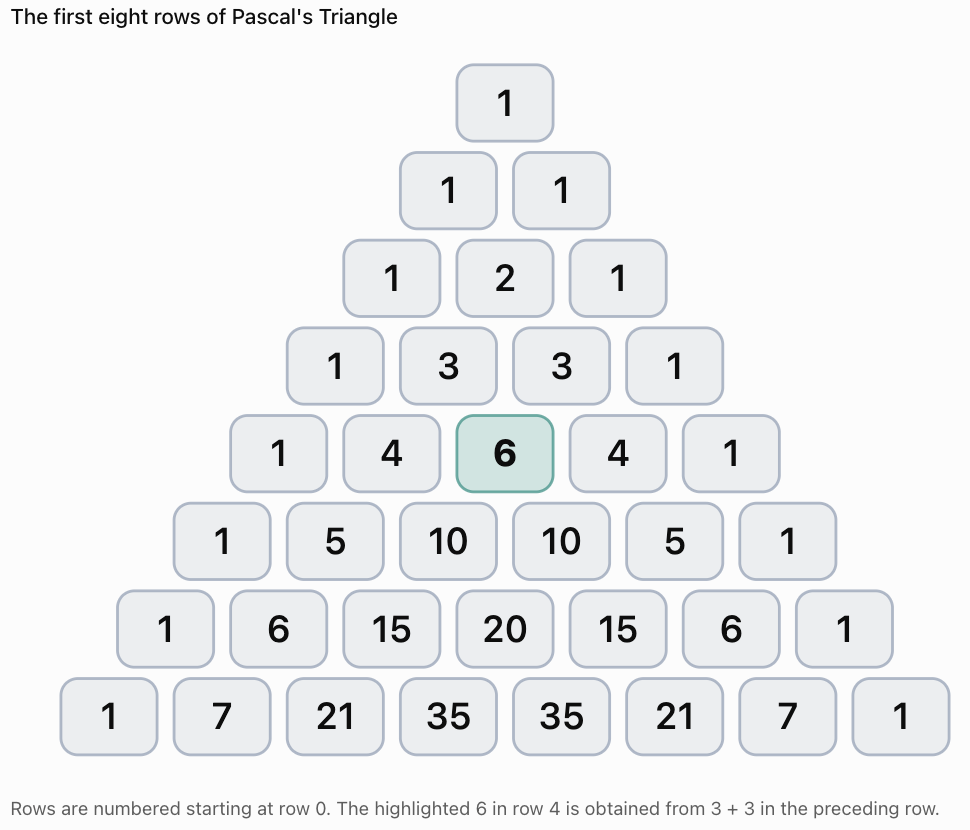
The first few rows are:
|
Row number |
Numbers |
|---|---|
|
0 |
1 |
|
1 |
1, 1 |
|
2 |
1, 2, 1 |
|
3 |
1, 3, 3, 1 |
|
4 |
1, 4, 6, 4, 1 |
|
5 |
1, 5, 10, 10, 5, 1 |
|
6 |
1, 6, 15, 20, 15, 6, 1 |
|
7 |
1, 7, 21, 35, 35, 21, 7, 1 |
Notice that row 0 contains one number, row 1 contains two numbers, and row 2 contains three numbers.
In general:
Row n contains n + 1 numbers.
Constructing Pascal's Triangle
Pascal's Triangle follows three simple rules.
-
Begin with 1 at the top.
-
Place 1 at the beginning and end of every new row.
-
Find each interior number by adding the two numbers directly above it.
Understanding the addition rule
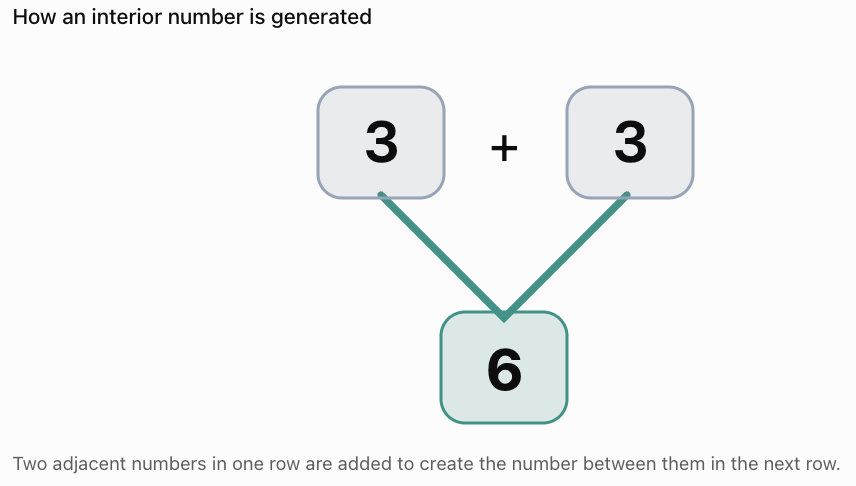
Consider the transition from row 3 to row 4.
Row 3:
1, 3, 3, 1
Row 4:
1, 4, 6, 4, 1
The interior values are calculated as follows:
1 + 3 = 4
3 + 3 = 6
3 + 1 = 4
The outside values remain 1.
Worked Example 1: Constructing the Next Row
Given row 5:
1, 5, 10, 10, 5, 1
Construct row 6.
Step 1: Place 1 at each end.
1, __, __, __, __, __, 1
Step 2: Add adjacent pairs from row 5.
1 + 5 = 6
5 + 10 = 15
10 + 10 = 20
10 + 5 = 15
5 + 1 = 6
Step 3: Write the complete row.
1, 6, 15, 20, 15, 6, 1
Worked Example 2: Constructing Row 7
Start with row 6:
1, 6, 15, 20, 15, 6, 1
Calculate:
1 + 6 = 7
6 + 15 = 21
15 + 20 = 35
20 + 15 = 35
15 + 6 = 21
6 + 1 = 7
Add the outside 1s.
Row 7: 1, 7, 21, 35, 35, 21, 7, 1
The method works for every row, regardless of how large the numbers become.
Exploring Patterns in Pascal's Triangle
Pascal's Triangle contains several important number patterns.
Pattern 1: Every row begins and ends with 1
The outside edges of Pascal's Triangle contain only 1s.
This follows directly from the construction rule.
Pattern 2: The triangle is symmetrical
Each row reads the same from left to right and from right to left.
For example:
1, 5, 10, 10, 5, 1
The first and last values are equal.
The second and second-last values are equal.
This is called mirror symmetry.
Pattern 3: Counting numbers appear in the second diagonal
Reading the second diagonal gives:
1, 2, 3, 4, 5, 6, 7, ...
These are the positive integers.
Pattern 4: Triangular numbers appear in the third diagonal
Reading the next diagonal gives:
1, 3, 6, 10, 15, 21, 28, ...
These are triangular numbers.
A triangular number counts the number of objects that can be arranged into a triangular pattern.
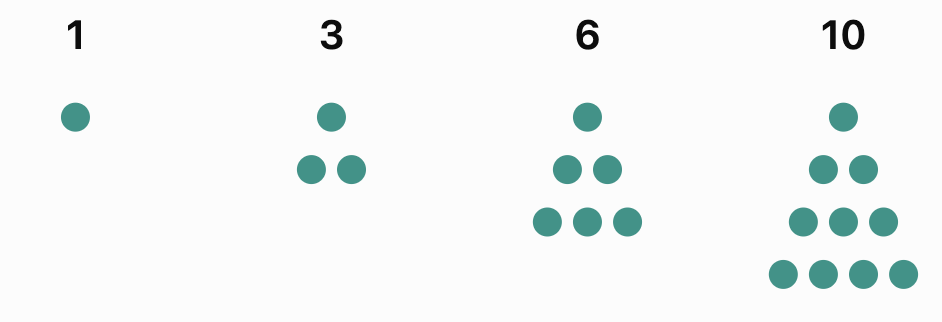
The nth triangular number is:
Tₙ = n(n + 1)/2
Worked Example 3: Finding a Triangular Number
Find the eighth triangular number.
T₈ = 8(8 + 1)/2
T₈ = 8 × 9/2
T₈ = 36
The number 36 appears in the triangular-number diagonal of Pascal's Triangle.
Pattern 5: The Sum of Each Row Is a Power of 2
Add the numbers in each row.
|
Row |
Numbers |
Sum |
|---|---|---|
|
0 |
1 |
1 = 2⁰ |
|
1 |
1, 1 |
2 = 2¹ |
|
2 |
1, 2, 1 |
4 = 2² |
|
3 |
1, 3, 3, 1 |
8 = 2³ |
|
4 |
1, 4, 6, 4, 1 |
16 = 2⁴ |
|
5 |
1, 5, 10, 10, 5, 1 |
32 = 2⁵ |
|
6 |
1, 6, 15, 20, 15, 6, 1 |
64 = 2⁶ |
The pattern is:
Sum of row n = 2ⁿ
Worked Example 4: Finding a Row Sum
Find the sum of all the numbers in row 10.
Use:
Sum = 2ⁿ
Substitute n = 10:
Sum = 2¹⁰
Sum = 1,024
We do not need to calculate every number in row 10.
This illustrates how recognising a pattern can make a calculation much more efficient.
Why does the pattern work?
Every number in a row contributes to two numbers in the next row, including the contributions to the two edges.
Therefore, the sum of each new row is twice the sum of the preceding row.
Starting from a sum of 1:
1, 2, 4, 8, 16, 32, 64, ...
This is a geometric sequence with common ratio 2.
Pattern 6: Fibonacci Numbers Hidden in Pascal's Triangle
The Fibonacci sequence is:
0, 1, 1, 2, 3, 5, 8, 13, 21, ...
Surprisingly, these numbers can be obtained by adding certain shallow diagonals of Pascal's Triangle.
For example, the diagonal sums begin:
1
1
1 + 1 = 2
1 + 2 = 3
1 + 3 + 1 = 5
1 + 4 + 3 = 8
1 + 5 + 6 + 1 = 13
The resulting sequence is:
1, 1, 2, 3, 5, 8, 13, ...
These are Fibonacci numbers.
This is an important connection between two mathematical topics that initially appear unrelated.
Pattern 7: Odd and Even Numbers Form a Fractal Pattern
If we colour odd numbers one colour and even numbers another, an interesting triangular pattern emerges.
The arrangement resembles the Sierpiński triangle, a famous fractal pattern.
A fractal is a structure containing patterns that repeat at different scales.
This connection shows how simple arithmetic rules can produce complex geometric structures.
Pascal's Triangle and Counting Problems
One of the most useful applications of Pascal's Triangle is counting the number of ways to choose objects from a group.
Suppose we have five students and want to choose two students for a committee.
Does the order matter?
No.
Choosing Alice and Ben is the same group as choosing Ben and Alice.
This is a combination problem.
Combinations
The number of ways to choose r objects from n distinct objects, without regard to order, is written:
C(n, r)
or:
nCr
The formula is:
C(n, r) = n!/[r!(n − r)!]
where ! represents factorial.
For example:
5! = 5 × 4 × 3 × 2 × 1 = 120
Finding combinations using Pascal's Triangle
The values in row n give the number of ways to choose 0, 1, 2, ..., n objects from a group of n objects.
For example, row 5 is:
1, 5, 10, 10, 5, 1
These represent:
|
Selection |
Number of ways |
|---|---|
|
Choose 0 from 5 |
1 |
|
Choose 1 from 5 |
5 |
|
Choose 2 from 5 |
10 |
|
Choose 3 from 5 |
10 |
|
Choose 4 from 5 |
5 |
|
Choose 5 from 5 |
1 |
Worked Example 5: Choosing Students
A class has five students.
How many different groups of two students can be formed?
We need:
C(5, 2)
Look at row 5:
1, 5, 10, 10, 5, 1
The third number corresponds to choosing 2 objects.
Answer: 10 groups
We can verify using the formula:
C(5, 2) = 5!/(2!3!)
= (5 × 4)/(2 × 1)
C(5, 2) = 10
Worked Example 6: Choosing a Committee
Seven students volunteer for a committee.
How many different committees of three students can be selected?
We need:
C(7, 3)
Row 7 is:
1, 7, 21, 35, 35, 21, 7, 1
The value for choosing 3 objects is 35.
Answer: 35 committees
The combination formula confirms:
C(7, 3) = 7!/(3!4!)
= (7 × 6 × 5)/(3 × 2 × 1)
C(7, 3) = 35
Why Pascal's Triangle Works for Combinations
Pascal's Triangle follows a mathematical identity:
C(n, r) = C(n − 1, r − 1) + C(n − 1, r)
This is known as Pascal's identity.
Understanding the reasoning
Suppose we are choosing r students from a group of n students.
Select one particular student, such as Alex.
Every possible committee falls into one of two groups:
-
Committees that include Alex.
-
Committees that do not include Alex.
If Alex is included, we must choose r − 1 additional students from the remaining n − 1 students.
Number of ways:
C(n − 1, r − 1)
If Alex is not included, we must choose all r students from the remaining n − 1 students.
Number of ways:
C(n − 1, r)
Adding the two cases gives:
C(n, r) = C(n − 1, r − 1) + C(n − 1, r)
This explains why each interior number is the sum of the two numbers above it.
Pascal's Triangle and Probability
Pascal's Triangle is also useful when calculating probabilities involving repeated events with two possible outcomes.
For example, consider tossing a fair coin three times.
There are:
2³ = 8
equally likely possible outcomes.
Row 3 of Pascal's Triangle is:
1, 3, 3, 1
These numbers count the outcomes with different numbers of heads.
|
Number of heads |
Number of outcomes |
Probability |
|---|---|---|
|
0 |
1 |
1/8 |
|
1 |
3 |
3/8 |
|
2 |
3 |
3/8 |
|
3 |
1 |
1/8 |
Worked Example 7: Coin Tossing
A fair coin is tossed four times.
What is the probability of obtaining exactly two heads?
Step 1: Identify the appropriate row.
Four tosses correspond to row 4:
1, 4, 6, 4, 1
Step 2: Find the number of outcomes with exactly two heads.
The coefficient is:
C(4, 2) = 6
Step 3: Find the total number of outcomes.
2⁴ = 16
Step 4: Calculate the probability.
P(exactly 2 heads) = 6/16
= 3/8
Answer: 0.375 or 37.5%
This is a simple example of the binomial distribution.
Pascal's Triangle and Algebra
Pascal's Triangle provides the coefficients when expanding powers of binomial expressions.
A binomial is an algebraic expression containing two terms, such as:
a + b
Consider:
(a + b)²
Expanding:
(a + b)(a + b)
= a² + ab + ab + b²
= a² + 2ab + b²
The coefficients are:
1, 2, 1
These are the numbers in row 2 of Pascal's Triangle.
For:
(a + b)³
The expansion is:
a³ + 3a²b + 3ab² + b³
The coefficients are:
1, 3, 3, 1
These are the numbers in row 3.
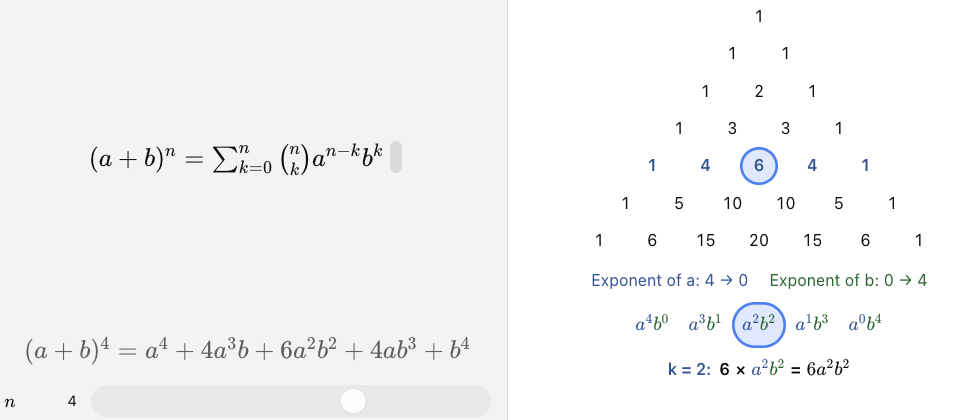
Exploring binomial coefficients
Worked Example 8: Expanding a Binomial
Expand:
(x + 2)⁴
Step 1: Identify the coefficients.
Row 4:
1, 4, 6, 4, 1
Step 2: Write the powers.
The power of x decreases from 4 to 0.
The power of 2 increases from 0 to 4.
Therefore:
(x + 2)⁴
= 1x⁴ + 4x³(2) + 6x²(2²) + 4x(2³) + 1(2⁴)
Step 3: Simplify.
= x⁴ + 8x³ + 24x² + 32x + 16
Answer: x⁴ + 8x³ + 24x² + 32x + 16
Pascal's Triangle makes binomial expansion faster and more organised.
Pascal's Triangle and Grid Paths
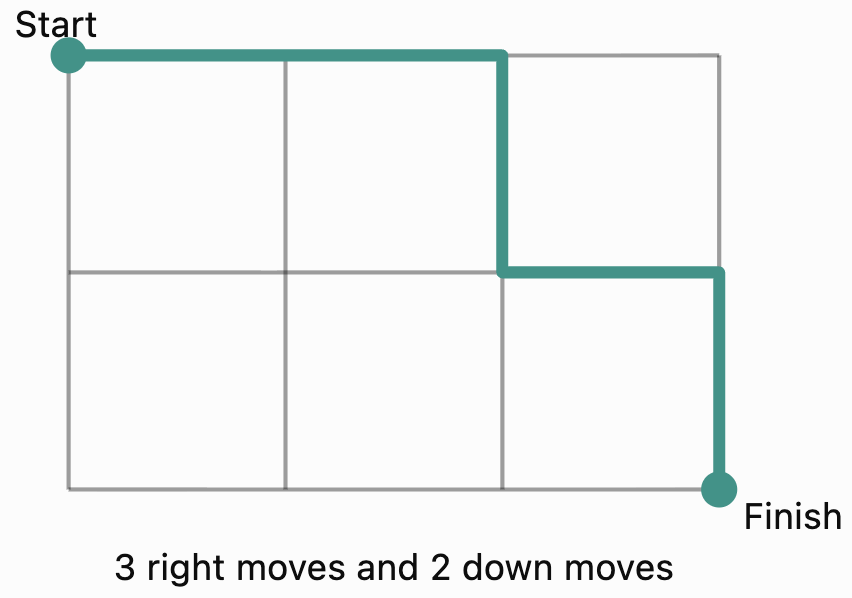
Pascal's Triangle can also help count paths through a grid.
Suppose a person moves only right or down along a rectangular grid.
How many different routes are possible from one corner to the opposite corner?
For a grid requiring 3 right moves and 2 down moves, every route contains five moves.
The problem becomes choosing which two of the five moves are downward moves.
Number of routes:
C(5, 2)
Answer: 10 routes
Visualising a grid path problem
Worked Example 9: Counting Grid Routes
A grid requires four moves right and three moves down.
How many different shortest routes are possible?
Total moves:
4 + 3 = 7
Choose the positions of the three downward moves:
C(7, 3)
From row 7:
1, 7, 21, 35, 35, 21, 7, 1
Answer: 35 routes
This application connects geometry, counting, and combinations.
Further Patterns: Hockey-Stick Identity
Another interesting pattern in Pascal's Triangle is the hockey-stick identity.
Adding a diagonal sequence of numbers produces a number farther down in the next diagonal.
For example:
1 + 3 + 6 + 10 = 20
The number 20 appears in row 6.
More generally:
C(r, r) + C(r + 1, r) + ... + C(n, r) = C(n + 1, r + 1)
This identity is useful for finding sums of combinations without calculating every term separately.
Worked Example 10: Using the Hockey-Stick Identity
Calculate:
1 + 4 + 10 + 20 + 35
Direct addition gives:
1 + 4 = 5
5 + 10 = 15
15 + 20 = 35
35 + 35 = 70
Answer: 70
This sum also corresponds to:
C(8, 4) = 70
The identity provides a useful shortcut when recognising appropriate diagonal patterns.
Real-World Applications
Choosing teams and committees
Pascal's Triangle helps calculate how many different groups can be formed when order does not matter.
Probability
The triangle provides the number of ways different outcomes can occur in repeated independent trials with two possible outcomes.
Computer science
Combinations and binomial coefficients appear in algorithms, data structures, and counting problems.
Algebra
The triangle provides coefficients for binomial expansions.
Geometry and networks
Grid path counting can be solved using combinations.
Mathematical investigations
Patterns involving triangular numbers, Fibonacci numbers, powers of 2, and fractals provide opportunities to explore relationships between different areas of mathematics.
Common Mistakes
Mistake 1: Forgetting the outside 1s
Every row must begin and end with 1.
Mistake 2: Adding numbers from the wrong positions
Each interior number comes from two adjacent numbers in the preceding row.
Mistake 3: Confusing row numbers
When the first row is numbered 0, row 4 contains five numbers.
Mistake 4: Assuming every number is calculated using addition
The edge values are always 1; they are not formed from two entries within the preceding row.
Mistake 5: Reading combinations from the wrong position
In row n, the first value corresponds to choosing 0 objects, not 1 object.
Mistake 6: Confusing combinations with permutations
Combinations ignore order.
Permutations consider order.
Mistake 7: Assuming all counting problems use Pascal's Triangle
Pascal's Triangle is most directly useful for choosing objects without regard to order.
Mistake 8: Using the wrong binomial coefficients
For (a + b)⁴, use row 4, not row 5.
Mistake 9: Forgetting powers during binomial expansion
The exponent of the first term decreases while the exponent of the second term increases.
Mistake 10: Assuming all observed patterns prove a universal rule
Patterns should be justified mathematically rather than accepted only because they appear in a few examples.
Key Terms
-
Pascal's Triangle: Triangular arrangement of numbers generated by adding adjacent values from the preceding row.
-
Row: Horizontal arrangement of numbers in Pascal's Triangle.
-
Interior Number: Number located between the two outside edges of a row.
-
Symmetry: Property of a pattern that is unchanged under a particular transformation, such as reflection.
-
Sequence: Ordered list of numbers following a rule.
-
Arithmetic Sequence: Sequence with a constant difference.
-
Geometric Sequence: Sequence with a constant ratio.
-
Triangular Number: Number representing a triangular arrangement of objects.
-
Fibonacci Sequence: Sequence in which each term is the sum of the two preceding terms.
-
Combination: Selection of objects where order does not matter.
-
Factorial: Product of all positive integers up to a given positive integer, with 0! = 1.
-
Binomial: Algebraic expression containing two terms.
-
Binomial Coefficient: Number used as a coefficient in a binomial expansion.
-
Binomial Theorem: Rule for expanding powers of binomial expressions.
-
Pascal's Identity: Relationship expressing a combination as the sum of two combinations.
-
Probability: Mathematical measure of how likely an event is to occur.
-
Grid Path: Route through a grid following specified movement rules.
-
Fractal: Mathematical pattern containing structure repeated at different scales.
-
Sierpiński Triangle: Fractal triangular pattern connected to the parity of Pascal's Triangle.
-
Hockey-Stick Identity: Identity relating diagonal sums of combinations to another combination.
Key Takeaways
-
Pascal's Triangle begins with a single 1.
-
Every row starts and ends with 1.
-
Each interior number is the sum of the two numbers directly above it.
-
Row n contains n + 1 numbers.
-
Every row is symmetrical.
-
The second diagonal contains counting numbers.
-
The third diagonal contains triangular numbers.
-
The sum of row n is 2ⁿ.
-
Fibonacci numbers can be found by adding shallow diagonals.
-
Odd and even numbers form patterns related to the Sierpiński triangle.
-
Pascal's Triangle can be used to calculate combinations.
-
Row n contains the values C(n, 0), C(n, 1), ..., C(n, n).
-
The triangle helps solve probability and grid path problems.
-
Pascal's Triangle provides the coefficients for binomial expansions.
-
Simple numerical rules can reveal deep connections between different mathematical topics.
Check Your Understanding
Questions
Question 1: Constructing Pascal's Triangle
Write rows 0 to 6 of Pascal's Triangle.
Question 2: Finding the Next Row
Given:
1, 5, 10, 10, 5, 1
Construct the next row.
Question 3: Missing Numbers
Complete the row:
1, 7, __, 35, __, 21, 7, 1
Question 4: Row Patterns
Explain why every row of Pascal's Triangle is symmetrical.
Question 5: Row Sums
Calculate the sum of all numbers in row 9 without constructing the entire row.
Question 6: Triangular Numbers
Find the tenth triangular number.
Explain its connection to Pascal's Triangle.
Question 7: Fibonacci Connection
Explain how Fibonacci numbers can be obtained from Pascal's Triangle.
Question 8: Counting Students
A class contains six students.
How many different groups of two students can be selected?
Question 9: Choosing a Committee
Eight students volunteer for a committee.
How many different committees of three students can be formed?
Question 10: Coin Tossing
A fair coin is tossed five times.
Calculate the probability of obtaining exactly three heads.
Question 11: Binomial Expansion
Expand:
(x + 1)³
using Pascal's Triangle.
Question 12: Binomial Coefficients
Write the coefficients of:
(a + b)⁶
Question 13: Grid Paths
A rectangular grid requires five moves right and three moves down.
How many different shortest routes are possible?
Question 14: Pascal's Identity
Verify:
C(6, 2) = C(5, 1) + C(5, 2)
Question 15: Integrated Challenge
Consider row 8 of Pascal's Triangle.
a) Write the complete row.
b) Calculate its sum.
c) Explain why the row is symmetrical.
d) Determine the number of ways to select four objects from eight objects.
e) State the coefficient of a⁴b⁴ in the expansion of (a + b)⁸.
Fully Worked Answers
Answer 1: Constructing Pascal's Triangle
Starting with row 0:
Row 0: 1
Row 1: 1, 1
Row 2: 1, 2, 1
Row 3: 1, 3, 3, 1
Row 4: 1, 4, 6, 4, 1
Row 5: 1, 5, 10, 10, 5, 1
Row 6: 1, 6, 15, 20, 15, 6, 1
Each interior number is calculated by adding adjacent numbers from the previous row.
Answer 2: Finding the Next Row
Given:
1, 5, 10, 10, 5, 1
Calculate the interior numbers:
1 + 5 = 6
5 + 10 = 15
10 + 10 = 20
10 + 5 = 15
5 + 1 = 6
Add 1 at each end.
Answer: 1, 6, 15, 20, 15, 6, 1
Answer 3: Missing Numbers
Given:
1, 7, __, 35, __, 21, 7, 1
Row 7 of Pascal's Triangle is:
1, 7, 21, 35, 35, 21, 7, 1
Missing numbers: 21 and 35
Answer 4: Row Patterns
Every row is symmetrical because the construction begins with equal outside values and applies the same addition rule on both sides.
If a row is symmetrical, the next row will also be symmetrical.
For example:
1, 4, 6, 4, 1
reads the same in either direction.
This pattern continues for every row.
Answer 5: Row Sums
The sum of row n is:
Sum = 2ⁿ
For row 9:
Sum = 2⁹
Answer: 512
Answer 6: Triangular Numbers
Use:
Tₙ = n(n + 1)/2
For n = 10:
T₁₀ = 10(11)/2
T₁₀ = 110/2
Answer: 55
Triangular numbers appear in the third diagonal of Pascal's Triangle, counting the outside diagonal of 1s as the first.
Answer 7: Fibonacci Connection
Fibonacci numbers can be obtained by adding numbers along shallow diagonals of Pascal's Triangle.
For example:
1 + 2 = 3
1 + 3 + 1 = 5
1 + 4 + 3 = 8
These sums form part of the Fibonacci sequence.
This demonstrates a connection between recursive sequences and combinations.
Answer 8: Counting Students
We need to select two students from six.
Use:
C(6, 2)
From row 6:
1, 6, 15, 20, 15, 6, 1
The value for choosing two objects is 15.
Answer: 15 groups
Verification:
C(6, 2) = 6!/(2!4!)
= (6 × 5)/(2 × 1)
= 15
Answer 9: Choosing a Committee
We need:
C(8, 3)
Using the combination formula:
C(8, 3) = 8!/(3!5!)
= (8 × 7 × 6)/(3 × 2 × 1)
= 336/6
Answer: 56 committees
Answer 10: Coin Tossing
A fair coin is tossed five times.
Total possible outcomes:
2⁵ = 32
Row 5 is:
1, 5, 10, 10, 5, 1
The number of outcomes with exactly three heads is:
C(5, 3) = 10
Therefore:
P(exactly 3 heads) = 10/32
= 5/16
Answer: 0.3125 or 31.25%
Answer 11: Binomial Expansion
Expand:
(x + 1)³
Row 3 provides the coefficients:
1, 3, 3, 1
Therefore:
(x + 1)³ = x³ + 3x²(1) + 3x(1²) + 1³
Simplify:
Answer: x³ + 3x² + 3x + 1
Answer 12: Binomial Coefficients
For:
(a + b)⁶
Use row 6:
1, 6, 15, 20, 15, 6, 1
Answer: 1, 6, 15, 20, 15, 6, 1
The complete expansion is:
a⁶ + 6a⁵b + 15a⁴b² + 20a³b³ + 15a²b⁴ + 6ab⁵ + b⁶
Answer 13: Grid Paths
Five moves right and three moves down give:
5 + 3 = 8 moves
We need to choose which three of the eight moves are downward moves.
Number of routes:
C(8, 3)
= 8!/(3!5!)
= (8 × 7 × 6)/(3 × 2 × 1)
Answer: 56 routes
Answer 14: Pascal's Identity
We want to verify:
C(6, 2) = C(5, 1) + C(5, 2)
Calculate the left side:
C(6, 2) = 15
Calculate the right side:
C(5, 1) = 5
C(5, 2) = 10
Therefore:
5 + 10 = 15
Both sides are equal.
Pascal's identity is verified for this example.
Answer 15: Integrated Challenge
Part a: Write row 8
Row 8 is:
1, 8, 28, 56, 70, 56, 28, 8, 1
Part b: Calculate the sum
Sum = 2⁸
Sum = 256
Part c: Explain symmetry
The row is symmetrical because the construction rule produces equal values on opposite sides.
The row reads the same from left to right and right to left.
Part d: Choose four objects from eight
We need:
C(8, 4)
Using row 8:
C(8, 4) = 70
Therefore, there are 70 different groups of four objects.
Part e: Find the coefficient of a⁴b⁴
In the expansion of (a + b)⁸, the coefficient of a⁴b⁴ is:
C(8, 4)
Answer: 70
This is the same number obtained in part d because binomial coefficients and combinations are connected through Pascal's Triangle.
Final Reflection
Pascal's Triangle is an excellent example of how a simple mathematical rule can generate an extraordinary collection of patterns and relationships.
Beginning with just 1 and repeatedly adding adjacent numbers, we obtain a structure connected to number sequences, triangular numbers, Fibonacci numbers, powers of 2, combinations, probability, algebra, geometry, and fractals.
Learning to construct Pascal's Triangle develops accuracy and pattern recognition. Investigating its properties develops mathematical reasoning. Applying it to counting and probability problems demonstrates how patterns can become useful problem-solving tools.
The most important lesson is that mathematical patterns are not isolated facts. They often reveal connections between different areas of mathematics, allowing us to solve problems more efficiently and understand why mathematical relationships work.