Arithmetic Sequences and Series
4. Arithmetic Series
Learning outcomes
- I can define an arithmetic series as the sum of the terms in an arithmetic sequence.
- I can distinguish between a sequence and a series.
- I can calculate the sum of a finite arithmetic series by adding terms directly.
- I can represent arithmetic series using mathematical notation.
- I can solve simple problems involving arithmetic series.
Arithmetic Series
Introduction
An arithmetic series is the sum of the terms in an arithmetic sequence.
For example, consider the arithmetic sequence:
3, 7, 11, 15, 19
Each term increases by 4.
When we add the terms together, we create an arithmetic series:
3 + 7 + 11 + 15 + 19 = 55
The sequence describes the individual numbers and their order. The series describes their sum.
Arithmetic series are useful whenever quantities increase or decrease by a constant amount and we need to determine their combined total.
Examples include calculating total savings over several weeks, finding the total number of seats in a stadium, counting tiles in growing patterns, and determining total production over a period of time.


What Is an Arithmetic Sequence?
An arithmetic sequence is an ordered list of numbers in which the difference between consecutive terms is constant.
Consider:
5, 8, 11, 14, 17, ...
The difference between consecutive terms is:
8 − 5 = 3
11 − 8 = 3
14 − 11 = 3
17 − 14 = 3
The common difference is:
d = 3
The terms follow a regular pattern.
An arithmetic sequence may increase, decrease, or remain constant.
Increasing Sequence
2, 5, 8, 11, 14, ...
Common difference: d = 3
Decreasing Sequence
20, 16, 12, 8, 4, ...
Common difference: d = −4
Constant Sequence
6, 6, 6, 6, 6, ...
Common difference: d = 0
All three are arithmetic sequences.
What Is an Arithmetic Series?
An arithmetic series is formed by adding the terms of an arithmetic sequence.
Consider:
4, 9, 14, 19, 24
The corresponding series is:
4 + 9 + 14 + 19 + 24
Calculate the sum:
4 + 9 = 13
13 + 14 = 27
27 + 19 = 46
46 + 24 = 70
Therefore:
4 + 9 + 14 + 19 + 24 = 70
The sum of the first five terms is 70.
Sequence Versus Series
|
Arithmetic sequence |
Arithmetic series |
|---|---|
|
2, 5, 8, 11, 14 |
2 + 5 + 8 + 11 + 14 |
|
Lists the terms |
Adds the terms |
|
Has individual term values |
Has a total sum |
|
Uses an nth term formula |
Uses addition or a sum formula |
Important Distinction
A sequence is a list of terms.
A series is the addition of those terms.
The terms themselves do not change. Only the way we use them changes.
Finite and Infinite Arithmetic Series
A finite arithmetic series contains a specified number of terms.
Example:
2 + 5 + 8 + 11 + 14
There are five terms.
The sum is:
2 + 5 + 8 + 11 + 14 = 40
An infinite arithmetic series continues without a final term.
Example:
2 + 5 + 8 + 11 + 14 + ...
For an infinite series, we must consider whether its partial sums approach a finite value.
A nonzero arithmetic sequence does not produce a convergent infinite series. Its terms do not approach zero, which is necessary for an infinite series to converge.
Even a constant nonzero sequence produces a series whose partial sums grow without bound in magnitude.
In this topic, we will focus on finite arithmetic series, where a specific number of terms is added.
Understanding Partial Sums
A partial sum is the sum of the first n terms of a sequence.
The symbol Sₙ represents the sum of the first n terms.
Consider:
3, 6, 9, 12, 15, ...
We can calculate different partial sums.
|
Number of terms |
Addition |
Partial sum |
|---|---|---|
|
1 |
3 |
S₁ = 3 |
|
2 |
3 + 6 |
S₂ = 9 |
|
3 |
3 + 6 + 9 |
S₃ = 18 |
|
4 |
3 + 6 + 9 + 12 |
S₄ = 30 |
|
5 |
3 + 6 + 9 + 12 + 15 |
S₅ = 45 |
Notice that each new partial sum includes the previous total plus the next term.
For example:
S₄ = S₃ + a₄
S₄ = 18 + 12
S₄ = 30
In general:
Sₙ = Sₙ₋₁ + aₙ, for n ≥ 2.
This relationship is useful when building a series one term at a time.
Calculating Arithmetic Series by Direct Addition
The simplest method for finding the sum of a short arithmetic series is to add its terms directly.
Worked Example
Find the sum of:
6 + 10 + 14 + 18 + 22
Add the first two terms:
6 + 10 = 16
Add the third term:
16 + 14 = 30
Add the fourth term:
30 + 18 = 48
Add the fifth term:
48 + 22 = 70
Therefore:
S₅ = 70
Another Example
Find the sum of:
25 + 20 + 15 + 10 + 5
25 + 20 = 45
45 + 15 = 60
60 + 10 = 70
70 + 5 = 75
Therefore:
S₅ = 75
When Is Direct Addition Useful?
Direct addition works well when:
-
The series contains only a few terms.
-
The values are easy to calculate.
-
We want to verify a result.
-
We are first learning what a series represents.
For longer series, a formula is usually more efficient.
Using a Table to Calculate a Series
Tables help organise both the individual terms and their cumulative sums.
Worked Example
A sequence begins at 4 and increases by 3.
The first six terms are:
4, 7, 10, 13, 16, 19
Create a table.
|
Term number |
Term value |
Running total |
|---|---|---|
|
1 |
4 |
4 |
|
2 |
7 |
11 |
|
3 |
10 |
21 |
|
4 |
13 |
34 |
|
5 |
16 |
50 |
|
6 |
19 |
69 |
The running total is also called the cumulative sum.
The sum of the first six terms is:
S₆ = 69
What Does the Table Show?
The term value increases by 3 each time.
However, the running total increases by the value of each new term.
For example:
S₅ = 50
S₆ = 50 + 19 = 69
This shows why a sequence and its series behave differently.
Representing Arithmetic Series with Mathematical Notation
We use several symbols to describe arithmetic series.
Term Notation
The terms of a sequence are represented by:
a₁, a₂, a₃, ..., aₙ
where:
-
a₁ is the first term.
-
a₂ is the second term.
-
aₙ is the nth term.
Sum Notation
The sum of the first n terms is represented by:
Sₙ = a₁ + a₂ + a₃ + ... + aₙ
For example:
S₄ = 5 + 9 + 13 + 17
S₄ = 44
Sigma Notation
The Greek capital letter sigma, Σ, represents summation.
For example:
This means:
(3 × 1 + 1) + (3 × 2 + 1) + (3 × 3 + 1) + (3 × 4 + 1) + (3 × 5 + 1)
= 4 + 7 + 10 + 13 + 16
= 50
Understanding the Symbols
In the expression Σ from k = 1 to 5 of (3k + 1):
-
Σ means add the terms.
-
k is the index or counting variable.
-
k = 1 is the starting value.
-
5 is the final value.
-
3k + 1 tells us how to calculate each term.
Sigma notation is especially useful for representing long series without writing every term individually.
Writing a Series Using Sigma Notation
Worked Example
Write the series:
2 + 5 + 8 + 11 + 14
using sigma notation.
Step 1: Find the nth Term Formula
The first term is:
a₁ = 2
The common difference is:
d = 3
Therefore:
aₙ = 2 + (n − 1)(3)
aₙ = 3n − 1
Step 2: Identify the Number of Terms
There are five terms.
Step 3: Write the Summation
This represents the same series.
Another Example
Write:
10 + 8 + 6 + 4 + 2
in sigma notation.
First term:
a₁ = 10
Common difference:
d = −2
nth term:
aₙ = 10 + (n − 1)(−2)
aₙ = 12 − 2n
Therefore:
Both the expanded series and sigma notation represent the same total.
Discovering a Faster Way to Add an Arithmetic Series
Direct addition is useful for short series, but it becomes inefficient when there are many terms.
Consider:
1 + 2 + 3 + 4 + 5 + 6 + 7 + 8 + 9 + 10
Instead of adding every term individually, pair terms from opposite ends:
1 + 10 = 11
2 + 9 = 11
3 + 8 = 11
4 + 7 = 11
5 + 6 = 11
There are five pairs, each with a sum of 11.
Therefore:
S₁₀ = 5 × 11 = 55
This pairing method works because the terms of an arithmetic sequence are equally spaced.
Another Example
Find:
4 + 7 + 10 + 13 + 16 + 19
Pair the terms:
4 + 19 = 23
7 + 16 = 23
10 + 13 = 23
There are three pairs.
Therefore:
S₆ = 3 × 23
S₆ = 69
This agrees with the result obtained through direct addition.
What If There Is an Odd Number of Terms?
Consider:
2 + 5 + 8 + 11 + 14
Pair the outer terms:
2 + 14 = 16
5 + 11 = 16
The middle term is 8.
Therefore:
S₅ = 16 + 16 + 8
S₅ = 40
We can also think of this as five terms with an average value of 8:
S₅ = 5 × 8 = 40
This observation leads to the arithmetic series formula.
The Arithmetic Series Sum Formula
For a finite arithmetic series, the sum equals the number of terms multiplied by the average of the first and last terms.
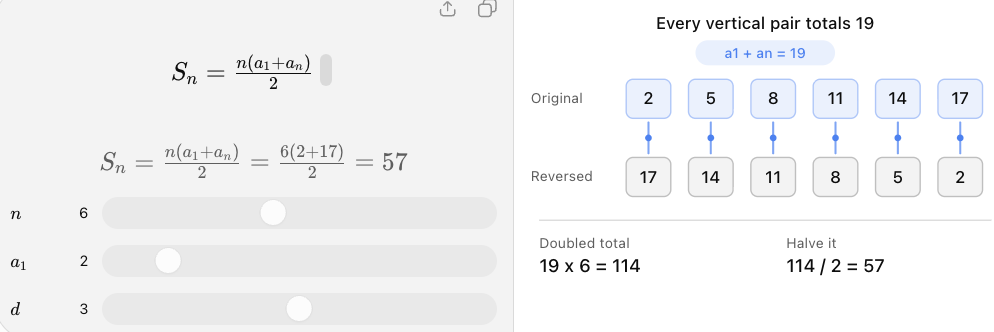
The formula is:
Sₙ = n(a₁ + aₙ)/2
where:
-
Sₙ is the sum of the first n terms.
-
n is the number of terms.
-
a₁ is the first term.
-
aₙ is the last term being added.
Why Does This Formula Work?
Consider the series:
3 + 7 + 11 + 15 + 19
Write the same terms in reverse:
19 + 15 + 11 + 7 + 3
Add the corresponding terms:
3 + 19 = 22
7 + 15 = 22
11 + 11 = 22
15 + 7 = 22
19 + 3 = 22
There are five pairs, each with a sum of 22.
Adding the original series and its reverse gives:
2S₅ = 5 × 22
2S₅ = 110
S₅ = 55
The method works because each pair has the same sum: the first term plus the last term.
Alternative Formula
If we know the first term and common difference, we can use:
Sₙ = n[2a₁ + (n − 1)d]/2
This comes from substituting the nth term formula:
aₙ = a₁ + (n − 1)d
into the sum formula.
Both versions calculate the same total.
Using the Sum Formula
Worked Example: Sum of the First Ten Terms
Find the sum of:
5 + 8 + 11 + ... + 32
Step 1: Identify the Information
First term:
a₁ = 5
Last term:
aₙ = 32
Common difference:
d = 3
Step 2: Determine the Number of Terms
Use:
aₙ = a₁ + (n − 1)d
32 = 5 + (n − 1)(3)
27 = 3(n − 1)
9 = n − 1
n = 10
Step 3: Calculate the Sum
Sₙ = n(a₁ + aₙ)/2
S₁₀ = 10(5 + 32)/2
S₁₀ = 10(37)/2
S₁₀ = 185
Verification
The complete series is:
5 + 8 + 11 + 14 + 17 + 20 + 23 + 26 + 29 + 32
Adding these terms gives 185.
Finding the Sum from the First Term and Common Difference
Worked Example
Find the sum of the first 20 terms of:
4, 10, 16, 22, ...
First term:
a₁ = 4
Common difference:
d = 6
Number of terms:
n = 20
Use:
Sₙ = n[2a₁ + (n − 1)d]/2
Substitute:
S₂₀ = 20[2(4) + 19(6)]/2
S₂₀ = 10[8 + 114]
S₂₀ = 10(122)
S₂₀ = 1,220
Check Using the Last Term
a₂₀ = 4 + 19(6)
a₂₀ = 118
Then:
S₂₀ = 20(4 + 118)/2
S₂₀ = 10(122)
S₂₀ = 1,220
Both methods agree.
Arithmetic Series with Negative Terms
Arithmetic series may contain negative numbers.
Worked Example
Find the sum:
15 + 10 + 5 + 0 − 5 − 10
There are six terms.
Direct addition:
15 + 10 = 25
25 + 5 = 30
30 + 0 = 30
30 − 5 = 25
25 − 10 = 15
Therefore:
S₆ = 15
Using the formula:
S₆ = 6(15 + (−10))/2
S₆ = 6(5)/2
S₆ = 15
Another Example
Find:
−12 − 8 − 4 + 0 + 4 + 8 + 12
The terms are symmetric around zero.
The negative and positive terms cancel:
−12 + 12 = 0
−8 + 8 = 0
−4 + 4 = 0
The middle term is zero.
Therefore:
S₇ = 0
Important Observation
A series containing both positive and negative terms may have a positive, negative, or zero sum.
We must consider all terms rather than assuming the total follows the direction of the sequence.
Visualising Arithmetic Series with Growing Patterns
Consider a staircase pattern made from square tiles.
The first row has 1 tile, the second row has 2 tiles, the third row has 3 tiles, and so on.
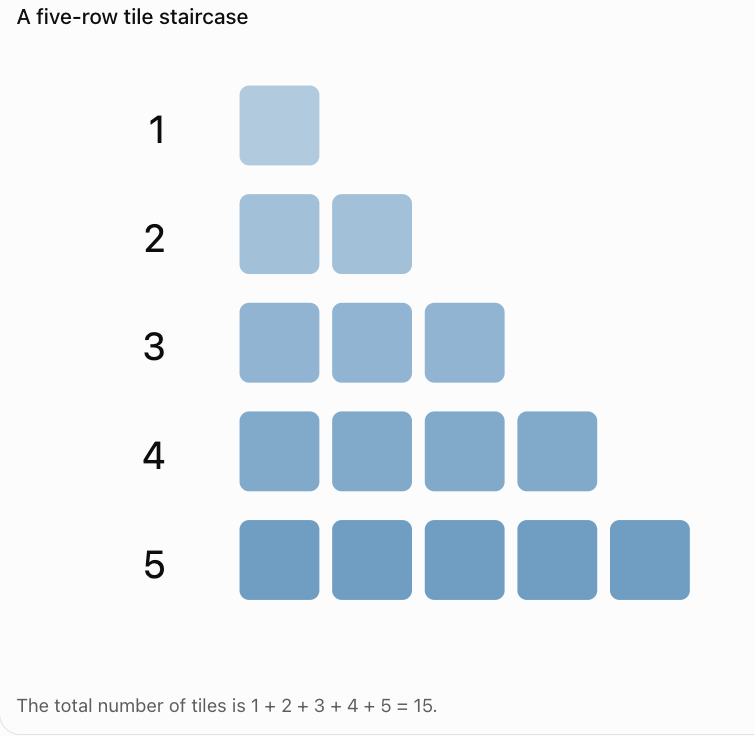
The number of tiles in each row forms the arithmetic sequence:
1, 2, 3, 4, 5
The total number of tiles forms the arithmetic series:
1 + 2 + 3 + 4 + 5 = 15
Extending the Pattern
What if the staircase contains 20 rows?
The number of tiles is:
1 + 2 + 3 + ... + 20
Use the sum formula:
S₂₀ = 20(1 + 20)/2
S₂₀ = 10(21)
S₂₀ = 210 tiles
The formula saves us from counting every tile individually.
Connecting an Arithmetic Series to Its Sequence
The nth term and the sum of the first n terms describe different quantities.
Consider:
2, 5, 8, 11, 14, ...
The nth term formula is:
aₙ = 3n − 1
The sum formula is:
Sₙ = n(3n + 1)/2
We can compare the results:
|
n |
nth term aₙ |
Sum Sₙ |
|---|---|---|
|
1 |
2 |
2 |
|
2 |
5 |
7 |
|
3 |
8 |
15 |
|
4 |
11 |
26 |
|
5 |
14 |
40 |
|
6 |
17 |
57 |
Notice:
-
The nth term increases by a constant amount.
-
The sum increases by the value of each new term.
-
The sum grows faster because it accumulates all earlier terms.
The relationship is:
Sₙ − Sₙ₋₁ = aₙ
For example:
S₅ − S₄ = 40 − 26 = 14
This is exactly the fifth term.
Real-World Application: Stadium Seating
A stadium has 18 seats in its first row. Each new row has 4 more seats than the previous row.
The number of seats per row is:
18, 22, 26, 30, ...
Suppose the stadium has 15 rows.
Finding the Number of Seats in the Last Row
a₁₅ = 18 + (15 − 1)(4)
a₁₅ = 18 + 56
a₁₅ = 74
The 15th row contains 74 seats.
Finding the Total Number of Seats
S₁₅ = 15(18 + 74)/2
S₁₅ = 15(92)/2
S₁₅ = 690
The stadium contains 690 seats in total.
Interpreting the Results
-
The arithmetic sequence describes the seats in individual rows.
-
The arithmetic series describes the total seats across all rows.
This distinction is essential when interpreting word problems.
Real-World Application: Weekly Savings
A student saves $10 in the first week and increases the amount saved by $5 each week.
The weekly savings are:
$10, $15, $20, $25, ...
How much money does the student save in total over 12 weeks?
Find the 12th Term
a₁₂ = 10 + 11(5)
a₁₂ = 65
The student saves $65 during week 12.
Calculate the Total
S₁₂ = 12(10 + 65)/2
S₁₂ = 6(75)
S₁₂ = $450
The student saves $450 over the 12 weeks.
Important Distinction
The 12th term is $65.
The sum of the first 12 terms is $450.
These represent different quantities.
Real-World Application: Production Planning
A factory produces 120 items on its first day.
Production increases by 10 items each day.
The daily production follows:
120, 130, 140, 150, ...
Find the total production over 10 days.
Find Day 10 Production
a₁₀ = 120 + 9(10)
a₁₀ = 210
Find Total Production
S₁₀ = 10(120 + 210)/2
S₁₀ = 5(330)
S₁₀ = 1,650 items
The factory produces 1,650 items over the first 10 days.
The arithmetic series allows the total to be calculated without adding each day's production separately.
Common Mistakes
Confusing a sequence with a series
A sequence lists numbers. A series adds numbers.
Confusing aₙ with Sₙ
aₙ represents one term. Sₙ represents the sum of the first n terms.
Using the wrong number of terms
For example, 5 + 10 + 15 + 20 contains four terms, not five.
Forgetting the first term
When calculating a series, include every term from the specified starting position.
Using n instead of n − 1 in the nth term formula
The number of common differences between the first and nth terms is n − 1.
Adding the common difference instead of the terms
The common difference determines how the terms change, but the series adds the actual term values.
Ignoring negative signs
Negative terms must be subtracted correctly.
Forgetting to divide by 2
The sum formula uses the average of the first and last terms.
Confusing the last term with the number of terms
In 3 + 6 + 9 + 12, the last term is 12, but there are only four terms.
Assuming all series are arithmetic
The underlying sequence must have a constant common difference.
Key Terms
-
Arithmetic Sequence: An ordered list of numbers with a constant difference between consecutive terms.
-
Arithmetic Series: The sum of terms from an arithmetic sequence.
-
Term: An individual value in a sequence.
-
First Term: The term at position n = 1.
-
Last Term: The final term included in a finite series.
-
Common Difference: The constant change between consecutive terms.
-
Finite Series: A sum containing a specified number of terms.
-
Infinite Series: A sum extending through infinitely many terms.
-
Partial Sum: Sum of the first n terms of a sequence.
-
Sₙ: Symbol representing the sum of the first n terms.
-
aₙ: Symbol representing the nth term of a sequence.
-
Summation: The process of adding terms together.
-
Sigma Notation: Compact notation using Σ to represent a sum.
-
Index: Variable indicating which term is being included in a summation.
-
Cumulative Sum: Running total obtained by adding successive terms.
-
Pairing Method: Method of combining terms from opposite ends of an arithmetic series.
-
Average of End Terms: Half the sum of the first and last terms.
-
nth Term Formula: Formula used to calculate an individual term.
-
Sum Formula: Formula used to calculate the total of a finite series.
-
Mathematical Model: Mathematical representation of a real-world situation.
Key Takeaways
-
An arithmetic series is the sum of the terms of an arithmetic sequence.
-
A sequence lists terms, while a series adds them.
-
Arithmetic sequences have a constant common difference.
-
The symbol Sₙ represents the sum of the first n terms.
-
Short arithmetic series can be calculated through direct addition.
-
Tables can be used to organise terms and cumulative sums.
-
Sigma notation provides a compact way to represent a series.
-
Pairing the first and last terms reveals a useful pattern.
-
The sum of a finite arithmetic series equals the number of terms multiplied by the average of the first and last terms.
-
The arithmetic series formula is Sₙ = n(a₁ + aₙ)/2.
-
An alternative formula is Sₙ = n[2a₁ + (n − 1)d]/2.
-
The nth term and the sum of the first n terms are different quantities.
-
Arithmetic series are useful for calculating totals in savings, seating, production, and growing patterns.
Check Your Understanding
Sequence or Series?
-
Explain the difference between an arithmetic sequence and an arithmetic series.
-
Write the arithmetic series corresponding to the sequence 4, 7, 10, 13, 16.
-
Identify the common difference in the series 5 + 9 + 13 + 17.
-
How many terms are included in 3 + 6 + 9 + 12 + 15 + 18?
Direct Addition
-
Calculate 2 + 4 + 6 + 8 + 10.
-
Calculate 7 + 11 + 15 + 19.
-
Calculate 20 + 15 + 10 + 5 + 0.
-
Calculate −6 − 3 + 0 + 3 + 6.
Mathematical Notation
-
What does S₅ represent?
-
Write 3 + 7 + 11 + 15 using Sₙ notation.
-
Expand the summation Σ from k = 1 to 4 of (2k + 1).
-
Write 5 + 10 + 15 + 20 + 25 using sigma notation.
Using the Sum Formula
-
Find the sum of the first 10 positive integers.
-
Find the sum of 4 + 8 + 12 + ... + 40.
-
Find the sum of the first 12 terms of 3, 8, 13, 18, ...
-
Find the sum of the first 8 terms of 30, 27, 24, 21, ...
Applications
-
A theatre has 10 seats in its first row and adds 2 seats per row. How many seats are there in the first 8 rows?
-
A student saves $5 in week 1 and increases savings by $5 each week. What is the total saved over 6 weeks?
-
A factory produces 50 items on day 1 and 10 additional items each day. How many items are produced in total over 5 days?
-
Explain why finding the 20th term is different from finding the sum of the first 20 terms.
Answer Key
|
Question |
Answer |
|---|---|
|
1 |
A sequence lists terms; a series adds terms |
|
2 |
4 + 7 + 10 + 13 + 16 |
|
3 |
4 |
|
4 |
6 terms |
|
5 |
30 |
|
6 |
52 |
|
7 |
50 |
|
8 |
0 |
|
9 |
The sum of the first five terms |
|
10 |
S₄ = 3 + 7 + 11 + 15 = 36 |
|
11 |
3 + 5 + 7 + 9 = 24 |
|
12 |
Σ from k = 1 to 5 of 5k |
|
13 |
55 |
|
14 |
220 |
|
15 |
366 |
|
16 |
156 |
|
17 |
136 seats |
|
18 |
$105 |
|
19 |
350 items |
|
20 |
The 20th term is one value; the sum combines the first 20 values |
Extended Challenge
Understanding Arithmetic Series
-
Explain why 2 + 4 + 8 + 16 is not an arithmetic series.
-
Write the first six terms of an arithmetic sequence with a₁ = 7 and d = 5, then calculate their sum.
-
Create a decreasing arithmetic sequence with five terms and calculate its sum.
-
Construct an arithmetic series containing both positive and negative terms with a total of zero.
-
Explain why pairing terms from opposite ends is useful.
Calculating Sums
-
Find the sum of the first 50 positive integers.
-
Find the sum of the first 25 even positive integers.
-
Calculate 7 + 14 + 21 + ... + 140.
-
Calculate 100 + 95 + 90 + ... + 5.
-
Find the sum of the first 30 terms of the sequence 4, 10, 16, 22, ...
Using Mathematical Notation
-
Write 6 + 10 + 14 + 18 + 22 using sigma notation.
-
Expand and evaluate Σ from k = 1 to 6 of (3k − 2).
-
Explain what the lower and upper limits of a summation mean.
-
Write an expression for the sum of the first n terms of 5, 8, 11, 14, ...
-
Show that Sₙ − Sₙ₋₁ = aₙ.
Real-World Applications
-
A stadium has 25 seats in its first row and 5 additional seats in each successive row. Find the total seats in 20 rows.
-
A student saves $10 in the first week and increases weekly savings by $3. Find the total saved over 15 weeks.
-
A factory produces 200 units on day 1 and 20 additional units each day. Find total production over 12 days.
-
A staircase has 30 steps. The first step uses 2 blocks, and each successive step uses 2 additional blocks. Find the total blocks required.
-
A theatre has 15 rows containing 18, 21, 24, ... seats. Find the total seating capacity.
Final Challenge: Planning a School Auditorium
A school auditorium has 16 seats in its first row.
Each successive row contains 3 more seats than the previous row.
There are 20 rows altogether.
Complete the investigation.
-
Write the first six terms of the seating sequence.
-
Identify the first term.
-
Identify the common difference.
-
Explain why the seating pattern is arithmetic.
-
Write the nth term formula.
-
Calculate the number of seats in row 10.
-
Calculate the number of seats in row 20.
-
Write the addition expression for the first five rows.
-
Calculate the total number of seats in the first five rows.
-
Explain the difference between the number of seats in row 20 and the total seats in the auditorium.
-
Identify the values of n, a₁, and aₙ for the complete auditorium.
-
Use the arithmetic series formula to find the total seating capacity.
-
Verify the result using the alternative sum formula.
-
Determine the average number of seats per row.
-
Explain how the average relates to the first and last rows.
-
Write the seating series using sigma notation.
-
Explain how the pairing method could be used to calculate the total.
-
Predict how the total seating capacity would change if another five rows were added.
-
Explain why the total number of seats grows faster than the number of seats in a single row.
-
Describe how arithmetic series could help an architect or school administrator plan seating capacity.
Further Investigation: Create Your Own Arithmetic Series
Design a real-world situation involving an arithmetic series.
Your situation might involve savings, seating, production, tiles, or another quantity that changes by a constant amount.
Then:
-
Describe the situation.
-
Identify the first term.
-
Identify the common difference.
-
Specify the number of terms.
-
Write the arithmetic sequence.
-
Write the corresponding arithmetic series.
-
Calculate the sum through direct addition for a small number of terms.
-
Determine the nth term formula.
-
Calculate the last term.
-
Use the sum formula to calculate the complete total.
-
Explain the meaning of the total in context.
-
Identify any limitations of your mathematical model.