Arithmetic Sequences and Series
2. The nth Term Formula
Learning outcomes
- I can explain the purpose of an nth term formula.
- I can determine the nth term formula for an arithmetic sequence.
- I can use the nth term formula to find specific terms.
- I can predict distant terms without listing the entire sequence.
- I can verify whether a formula correctly describes a sequence.
The nth Term Formula
Introduction
A sequence is an ordered list of numbers that follows a particular pattern or rule.
For example:
3, 7, 11, 15, 19, ...
Each term is 4 greater than the previous term.
We can continue the sequence by repeatedly adding 4, but what if we want to find the 50th term, the 100th term, or the 1,000th term?
Writing out every term would be inefficient.
Instead, we can use an nth term formula, which allows us to calculate any term directly from its position in the sequence.
For the sequence above, the nth term formula is:
aₙ = 4n − 1
To find the 100th term:
a₁₀₀ = 4(100) − 1
a₁₀₀ = 399
Therefore, the 100th term is 399.
The nth term formula is an important tool in algebra because it connects number patterns, arithmetic sequences, linear relationships, and mathematical modelling.


What Is a Sequence?
A sequence is an ordered list of numbers called terms.
Each term occupies a particular position.
Consider:
5, 9, 13, 17, 21, ...
|
Term number |
Term value |
|---|---|
|
1 |
5 |
|
2 |
9 |
|
3 |
13 |
|
4 |
17 |
|
5 |
21 |
The position of a term is represented by n.
The value of the term is represented by aₙ.
For example:
-
a₁ = 5 means the first term is 5.
-
a₂ = 9 means the second term is 9.
-
a₃ = 13 means the third term is 13.
-
a₅ = 21 means the fifth term is 21.
The subscript identifies the position of the term. It does not mean multiplication.
For example, a₅ means the fifth term, not a × 5.
Finite and Infinite Sequences
A finite sequence has a limited number of terms.
Example:
2, 4, 6, 8, 10
An infinite sequence continues indefinitely.
Example:
2, 4, 6, 8, 10, ...
The three dots indicate that the pattern continues.
What Is an Arithmetic Sequence?
An arithmetic sequence is a sequence in which the difference between consecutive terms is constant.
This fixed difference is called the common difference.
Example
Consider:
4, 10, 16, 22, 28, ...
Find the differences:
10 − 4 = 6
16 − 10 = 6
22 − 16 = 6
28 − 22 = 6
Every difference is 6.
Therefore, this is an arithmetic sequence with:
-
First term: a₁ = 4.
-
Common difference: d = 6.
Another Example
Consider:
20, 16, 12, 8, 4, ...
The common difference is:
d = 16 − 20 = −4
This is also an arithmetic sequence.
The negative common difference means that the terms decrease.
Important Observation
An arithmetic sequence may:
-
Increase when d > 0.
-
Decrease when d < 0.
-
Remain constant when d = 0.
The common difference can be positive, negative, or zero.
Understanding the Purpose of an nth Term Formula
The nth term formula provides a direct rule for calculating a term from its position.
Instead of finding all previous terms, we substitute the required term number into the formula.
Example
Consider:
7, 12, 17, 22, 27, ...
The first term is 7.
The common difference is 5.
The nth term formula is:
aₙ = 5n + 2
To find the 30th term:
a₃₀ = 5(30) + 2
= 150 + 2
= 152
To find the 200th term:
a₂₀₀ = 5(200) + 2
= 1,000 + 2
= 1,002
We do not need to list the first 199 terms.
Why Is This Useful?
An nth term formula helps us:
-
Find specific terms quickly.
-
Predict distant terms.
-
Describe number patterns algebraically.
-
Compare different sequences.
-
Determine whether a number belongs to a sequence.
-
Solve real-world problems involving regular increases or decreases.
-
Connect sequences to linear functions.
The nth Term Formula for an Arithmetic Sequence
For an arithmetic sequence, the nth term is calculated from the first term, common difference, and term position.
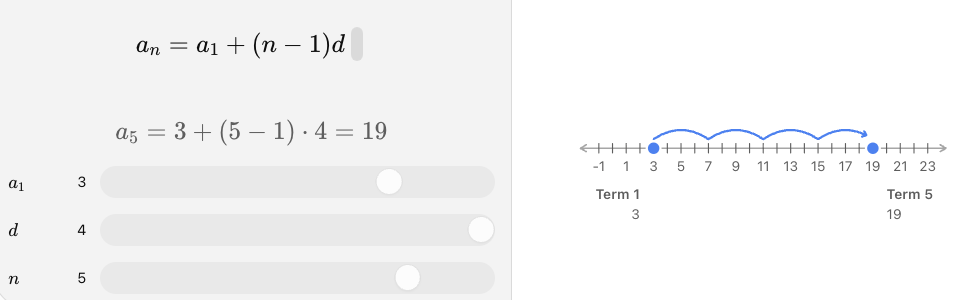
Here:
-
aₙ represents the nth term.
-
a₁ represents the first term.
-
n represents the term number.
-
d represents the common difference.
Why Do We Use n − 1?
Consider the sequence:
3, 7, 11, 15, 19, ...
The first term is 3.
To reach the second term, we add 4 once.
To reach the third term, we add 4 twice.
To reach the fourth term, we add 4 three times.
|
Position |
Calculation |
Term |
|---|---|---|
|
1 |
3 + 0(4) |
3 |
|
2 |
3 + 1(4) |
7 |
|
3 |
3 + 2(4) |
11 |
|
4 |
3 + 3(4) |
15 |
|
5 |
3 + 4(4) |
19 |
To reach term n from term 1, we make n − 1 additions.
That is why the formula uses n − 1, rather than n.
Deriving the nth Term Formula
We can derive the formula by examining the structure of an arithmetic sequence.
Suppose the first term is a₁ and the common difference is d.
The first few terms are:
a₁ = a₁
a₂ = a₁ + d
a₃ = a₁ + 2d
a₄ = a₁ + 3d
a₅ = a₁ + 4d
Notice the pattern:
The number of common differences added is always one less than the term number.
Therefore:
aₙ = a₁ + (n − 1)d
This is called an explicit formula because it calculates a term directly from n.
Recursive Formula Compared with Explicit Formula
A recursive rule describes how to get the next term from the previous term.
For example:
a₁ = 3
aₙ = aₙ₋₁ + 4, for n ≥ 2
This tells us to add 4 each time.
The explicit formula is:
aₙ = 4n − 1
This allows us to calculate any term directly.
Both rules describe the same sequence, but the explicit formula is more efficient for finding distant terms.
Finding the nth Term Formula from a Sequence
Worked Example
Find the nth term formula for:
5, 9, 13, 17, 21, ...
Step 1: Identify the First Term
a₁ = 5
Step 2: Find the Common Difference
d = 9 − 5
d = 4
Step 3: Substitute into the Formula
aₙ = a₁ + (n − 1)d
aₙ = 5 + (n − 1)(4)
Step 4: Expand
aₙ = 5 + 4n − 4
Step 5: Simplify
aₙ = 4n + 1
Step 6: Verify
For n = 1:
a₁ = 4(1) + 1 = 5
For n = 2:
a₂ = 4(2) + 1 = 9
For n = 3:
a₃ = 4(3) + 1 = 13
The formula produces the correct terms.
A Shortcut for Finding the nth Term
Arithmetic sequences can also be written in the form:
aₙ = dn + c
where:
-
d is the common difference.
-
c is a constant.
To find c, use the first term:
a₁ = d + c
Therefore:
c = a₁ − d
Example
Find the nth term formula for:
8, 13, 18, 23, ...
The common difference is 5.
Begin with:
aₙ = 5n + c
Substitute n = 1 and a₁ = 8:
8 = 5(1) + c
8 = 5 + c
c = 3
Therefore:
aₙ = 5n + 3
Verification
n = 1 → 8
n = 2 → 13
n = 3 → 18
n = 4 → 23
The formula is correct.
Important Distinction
The common difference is the coefficient of n in the simplified nth term formula.
However, the constant term is not usually the first term.
For example:
aₙ = 5n + 3
has first term 8, not 3.
Finding the nth Term of a Decreasing Sequence
An arithmetic sequence may decrease instead of increase.
Worked Example
Find the nth term formula for:
30, 25, 20, 15, 10, ...
Step 1: Identify the First Term
a₁ = 30
Step 2: Find the Common Difference
d = 25 − 30
d = −5
Step 3: Substitute
aₙ = 30 + (n − 1)(−5)
Step 4: Simplify
aₙ = 30 − 5n + 5
aₙ = 35 − 5n
Verification
a₁ = 35 − 5 = 30
a₂ = 35 − 10 = 25
a₃ = 35 − 15 = 20
The formula correctly describes the decreasing sequence.
Important Reminder
When a sequence decreases, the common difference is negative.
Using a positive difference would produce an incorrect formula.
Finding Specific Terms Using the nth Term Formula
Once an nth term formula is known, we can calculate any term by substituting its position.
Worked Example
The nth term formula for a sequence is:
aₙ = 6n − 4
Find the 15th term.
Substitute n = 15:
a₁₅ = 6(15) − 4
= 90 − 4
a₁₅ = 86
Another Example
A sequence has the formula:
aₙ = 50 − 3n
Find the 12th term.
a₁₂ = 50 − 3(12)
= 50 − 36
a₁₂ = 14
Finding Several Terms
For:
aₙ = 4n + 7
we can calculate:
|
Term |
Calculation |
Value |
|---|---|---|
|
a₁ |
4(1) + 7 |
11 |
|
a₅ |
4(5) + 7 |
27 |
|
a₁₀ |
4(10) + 7 |
47 |
|
a₂₅ |
4(25) + 7 |
107 |
|
a₁₀₀ |
4(100) + 7 |
407 |
The formula makes finding distant terms straightforward.
Predicting Distant Terms
One of the greatest advantages of an nth term formula is that we can predict terms far beyond those initially listed.
Worked Example
Consider:
12, 19, 26, 33, 40, ...
Find the 500th term.
Step 1: Identify the Pattern
First term:
a₁ = 12
Common difference:
d = 7
Step 2: Develop the Formula
aₙ = 12 + (n − 1)(7)
aₙ = 12 + 7n − 7
aₙ = 7n + 5
Step 3: Find the 500th Term
a₅₀₀ = 7(500) + 5
= 3,500 + 5
a₅₀₀ = 3,505
We have found the 500th term without calculating the previous 499 terms.
Another Example
A sequence begins:
1,000, 992, 984, 976, ...
Find the 100th term.
First term:
a₁ = 1,000
Common difference:
d = −8
Therefore:
aₙ = 1,000 + (n − 1)(−8)
aₙ = 1,008 − 8n
For n = 100:
a₁₀₀ = 1,008 − 800
a₁₀₀ = 208
This illustrates how the formula can predict distant terms in decreasing sequences.
Finding the Term Number from a Given Value
Sometimes we know the value of a term and want to determine its position.
Instead of substituting n, we solve an equation for n.
Worked Example
The nth term formula is:
aₙ = 5n + 3
Which term has a value of 78?
Step 1: Substitute the Given Value
78 = 5n + 3
Step 2: Subtract 3
75 = 5n
Step 3: Divide by 5
n = 15
Final Answer
78 is the 15th term.
Another Example
Consider:
aₙ = 40 − 3n
Which term has a value of 7?
7 = 40 − 3n
−33 = −3n
n = 11
Therefore:
7 is the 11th term.
Important Observation
A valid term number must be a positive integer when the sequence begins at n = 1.
A calculation producing n = 4.5 does not identify a term position.
Determining Whether a Number Belongs to a Sequence
We can use an nth term formula to check whether a particular number occurs in a sequence.
Worked Example
Does 103 belong to the sequence:
4, 10, 16, 22, ...?
Step 1: Find the nth Term Formula
a₁ = 4
d = 6
aₙ = 4 + (n − 1)(6)
aₙ = 6n − 2
Step 2: Set the Formula Equal to 103
103 = 6n − 2
105 = 6n
n = 17.5
Step 3: Interpret
Term positions must be positive integers.
Because 17.5 is not an integer:
103 is not a term in the sequence.
Check Another Number
Does 106 belong to the sequence?
106 = 6n − 2
108 = 6n
n = 18
Therefore:
106 is the 18th term.
Key Principle
To determine whether a number belongs to an arithmetic sequence:
-
Set the nth term formula equal to that number.
-
Solve for n.
-
Check whether n is a positive integer.
Finding a Formula When Two Terms Are Known
Sometimes the first few terms are not given.
Instead, we may know the values of two terms at different positions.
We can still determine the arithmetic sequence.
Worked Example
The 4th term is 17 and the 10th term is 41.
Find the nth term formula.
Step 1: Find the Common Difference
From the 4th term to the 10th term, there are:
10 − 4 = 6 intervals
The term value increases by:
41 − 17 = 24
Therefore:
d = 24/6
d = 4
Step 2: Find the First Term
Use:
a₄ = a₁ + 3d
17 = a₁ + 3(4)
17 = a₁ + 12
a₁ = 5
Step 3: Write the Formula
aₙ = 5 + (n − 1)(4)
aₙ = 4n + 1
Step 4: Verify
Fourth term:
a₄ = 4(4) + 1 = 17
Tenth term:
a₁₀ = 4(10) + 1 = 41
Both given terms are correct.
General Method
If two terms aₚ and aₛ are known, their common difference is:
d = (aₛ − aₚ)/(s − p)
Once d is known, substitute into the nth term formula to determine the first term.
Using the nth Term Formula with Negative and Fractional Values
Arithmetic sequences do not need to contain only positive integers.
They may contain negative numbers, fractions, or decimals.
Worked Example: Negative Terms
Find the nth term formula for:
−8, −3, 2, 7, 12, ...
First term:
a₁ = −8
Common difference:
d = 5
Therefore:
aₙ = −8 + (n − 1)(5)
aₙ = −8 + 5n − 5
aₙ = 5n − 13
Worked Example: Fractions
Find the nth term formula for:
1/2, 1, 3/2, 2, 5/2, ...
First term:
a₁ = 1/2
Common difference:
d = 1/2
Therefore:
aₙ = 1/2 + (n − 1)(1/2)
Simplify:
aₙ = n/2
Worked Example: Decimals
Find the nth term formula for:
1.2, 1.7, 2.2, 2.7, ...
First term:
a₁ = 1.2
Common difference:
d = 0.5
Therefore:
aₙ = 1.2 + (n − 1)(0.5)
aₙ = 1.2 + 0.5n − 0.5
aₙ = 0.5n + 0.7
Connecting the nth Term Formula to Linear Functions
Arithmetic sequences have a close connection to linear functions.
Consider:
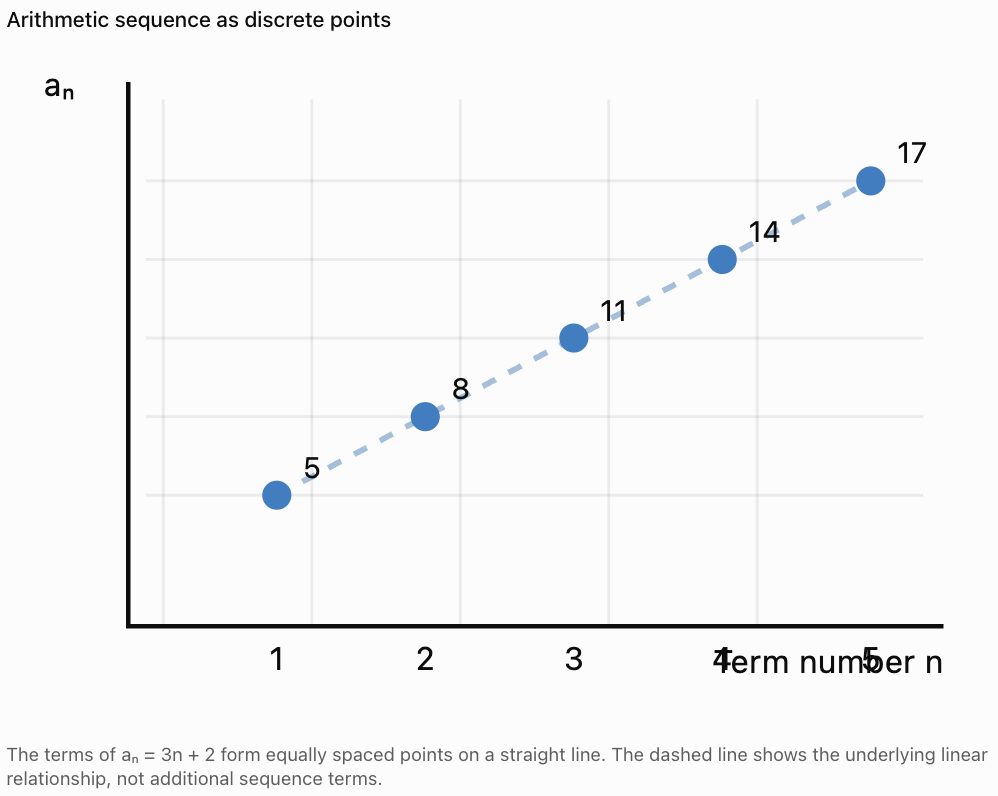
aₙ = 3n + 2
This resembles the linear equation:
y = 3x + 2
Both have a constant rate of change of 3.
The important difference is that a sequence uses positive integer term positions:
n = 1, 2, 3, 4, ...
A linear function may allow any real input.
Example
For:
aₙ = 3n + 2
|
n |
aₙ |
|---|---|
|
1 |
5 |
|
2 |
8 |
|
3 |
11 |
|
4 |
14 |
|
5 |
17 |
When plotted, the points lie on a straight line.
However, the sequence consists of discrete points, rather than every point along the line.
Connection to Slope
For an arithmetic sequence:
aₙ = dn + c
the common difference d corresponds to the slope of the underlying linear relationship.
The constant c corresponds to the value at n = 0 if the rule is extended to that position.
The first term is:
a₁ = d + c
This explains why the constant term in the simplified formula is not necessarily the first term.
Recognising Sequences That Are Not Arithmetic
Not every sequence has a constant difference.
Example
Consider:
2, 4, 8, 16, 32, ...
Find the differences:
4 − 2 = 2
8 − 4 = 4
16 − 8 = 8
32 − 16 = 16
The differences are not constant.
Therefore, this is not an arithmetic sequence.
It is a geometric sequence, in which each term is multiplied by 2.
Another Example
Consider:
1, 4, 9, 16, 25, ...
The differences are:
3, 5, 7, 9
They are not constant.
This sequence follows the formula:
aₙ = n²
It is a quadratic sequence, not an arithmetic sequence.
Important Reminder
The arithmetic nth term formula applies only when the common difference is constant.
Other types of sequences require different formulas.
Real-World Application: Stadium Seating
A small stadium has 18 seats in the first row.
Each following row contains 4 more seats than the previous row.

Step 1: Identify the Sequence
The number of seats in successive rows is:
18, 22, 26, 30, 34, ...
First term:
a₁ = 18
Common difference:
d = 4
Step 2: Find the nth Term Formula
aₙ = 18 + (n − 1)(4)
aₙ = 18 + 4n − 4
aₙ = 4n + 14
Step 3: Find the Number of Seats in Row 25
a₂₅ = 4(25) + 14
= 100 + 14
a₂₅ = 114
Therefore, row 25 contains 114 seats.
Step 4: Determine Which Row Has 154 Seats
154 = 4n + 14
140 = 4n
n = 35
Row 35 contains 154 seats.
Important Distinction
The nth term formula gives the number of seats in a particular row.
It does not give the total number of seats in all rows combined. That requires a formula for the sum of an arithmetic sequence.
Real-World Application: Weekly Savings
A student saves $15 during the first week.
Each following week, the student saves $5 more than the previous week.
The weekly savings form the sequence:
15, 20, 25, 30, 35, ...
Find the Formula
a₁ = 15
d = 5
aₙ = 15 + (n − 1)(5)
aₙ = 5n + 10
Find the Amount Saved During Week 20
a₂₀ = 5(20) + 10
a₂₀ = $110
Interpretation
The student saves $110 during week 20.
This is not the total amount saved over the first 20 weeks.
The nth term describes the amount saved in one particular week.
Real-World Application: Building a Tile Pattern
A designer creates a growing pattern using square tiles.
The first design contains 6 tiles.
Each new design adds 3 tiles.

The number of tiles forms the sequence:
6, 9, 12, 15, 18, ...
Find the nth Term
a₁ = 6
d = 3
aₙ = 6 + (n − 1)(3)
aₙ = 3n + 3
Predict the 50th Design
a₅₀ = 3(50) + 3
a₅₀ = 153
Therefore, the 50th design contains 153 tiles.
Determine the Design Number
Which design contains 303 tiles?
303 = 3n + 3
300 = 3n
n = 100
The 100th design contains 303 tiles.
This is a useful example of how a visual growing pattern can be represented by an algebraic formula.
Real-World Application: Decreasing Temperature
Suppose a controlled cooling process begins at 80°C.
The temperature decreases by 3°C every minute.
The recorded temperatures at the end of each minute are:
77, 74, 71, 68, ...
Find the nth Term Formula
The first recorded temperature is:
a₁ = 77
The common difference is:
d = −3
Therefore:
aₙ = 77 + (n − 1)(−3)
aₙ = 80 − 3n
Predict the Temperature After 15 Minutes
a₁₅ = 80 − 3(15)
= 80 − 45
a₁₅ = 35°C
Model Limitations
This formula assumes the temperature decreases by exactly 3°C every minute.
Real cooling processes often slow down as an object approaches the surrounding temperature.
Therefore, this arithmetic model is useful only while the constant-rate assumption is reasonable.
Verifying an nth Term Formula
An nth term formula should reproduce the given sequence.
Worked Example
A student claims that the sequence:
7, 11, 15, 19, ...
has the formula:
aₙ = 4n + 3
Test the formula.
For n = 1:
a₁ = 4(1) + 3 = 7
For n = 2:
a₂ = 4(2) + 3 = 11
For n = 3:
a₃ = 4(3) + 3 = 15
For n = 4:
a₄ = 4(4) + 3 = 19
The formula reproduces the listed terms.
It also has common difference 4.
Therefore, it correctly describes the arithmetic sequence.
Testing an Incorrect Formula
Suppose another student suggests:
aₙ = 4n + 7
For n = 1:
a₁ = 11
But the first term should be 7.
Therefore, the formula is incorrect.
A Reliable Verification Method
For an arithmetic sequence, check:
-
Does the formula produce the correct first term?
-
Does it produce the correct common difference?
-
Does it agree with other known terms?
For a formula of the form aₙ = dn + c, the difference between consecutive terms is d.
Therefore, verifying the first term and the common difference is sufficient to establish that the formula describes the entire arithmetic sequence.
Common Mistakes
Using n instead of n − 1
The first term requires zero additions of the common difference.
Confusing the first term with the constant term
For aₙ = 5n + 2, the first term is 7, not 2.
Using the wrong common difference
Always subtract consecutive terms in the correct order:
d = a₂ − a₁
Forgetting negative differences
A decreasing arithmetic sequence has a negative common difference.
Confusing the term number with the term value
In a₁₀ = 47, the position is 10 and the value is 47.
Assuming every sequence is arithmetic
Check that consecutive differences are constant before applying the formula.
Using a non-integer term position
For sequences indexed from n = 1, valid positions are positive integers.
Confusing a specific term with a sum
The 20th term is not the same as the sum of the first 20 terms.
Failing to verify the formula
Substitute known term positions and check that the values match.
Assuming a real-world pattern continues forever
Mathematical predictions are only as reliable as the assumptions used to construct the model.
Key Terms
-
Sequence: An ordered list of numbers following a rule or pattern.
-
Term: An individual number in a sequence.
-
Term Number: The position of a term in a sequence.
-
nth Term: The term at position n.
-
nth Term Formula: Algebraic rule used to calculate a term directly from its position.
-
Arithmetic Sequence: Sequence with a constant difference between consecutive terms.
-
Common Difference: Fixed amount added to each term to obtain the next term.
-
First Term: The term at position n = 1.
-
Explicit Formula: Formula that calculates a term directly from its position.
-
Recursive Formula: Rule that calculates a term using one or more previous terms.
-
Constant Sequence: Arithmetic sequence with common difference zero.
-
Increasing Sequence: Sequence whose terms become larger.
-
Decreasing Sequence: Sequence whose terms become smaller.
-
Term Position: Positive integer identifying a term's location.
-
Linear Relationship: Relationship with a constant rate of change.
-
Slope: Rate of change of a linear relationship.
-
Discrete Data: Values occurring at separate, specified inputs.
-
Verification: Checking that a formula produces the expected terms.
-
Prediction: Using a mathematical rule to determine an unknown term.
-
Geometric Sequence: Sequence with a constant ratio between consecutive terms.
-
Quadratic Sequence: Sequence commonly described by a second-degree formula and having constant second differences.
-
Mathematical Model: Formula or relationship representing a real-world situation.
Key Takeaways
-
An nth term formula allows any term of a sequence to be calculated directly.
-
An arithmetic sequence has a constant common difference.
-
The first term is represented by a₁.
-
The common difference is represented by d.
-
The term position is represented by n.
-
The arithmetic nth term formula is aₙ = a₁ + (n − 1)d.
-
The expression n − 1 represents the number of steps from the first term.
-
An arithmetic sequence can also be written as aₙ = dn + c.
-
In the simplified formula, the coefficient of n is the common difference.
-
A negative common difference produces a decreasing sequence.
-
The nth term formula makes distant-term predictions efficient.
-
The formula can be rearranged to find a term's position.
-
A number belongs to a sequence only if it corresponds to a valid term position.
-
Two known terms at different positions can be used to determine an arithmetic sequence.
-
Arithmetic sequences are related to linear functions, but their inputs are discrete term positions.
-
A formula can be verified by checking its first term and common difference.
-
Arithmetic nth term formulas do not apply to sequences without constant differences.
Check Your Understanding
Identifying Arithmetic Sequences
-
Find the common difference of 4, 9, 14, 19, ...
-
Find the common difference of 30, 24, 18, 12, ...
-
Is 3, 6, 12, 24, ... an arithmetic sequence?
-
Identify the first term and common difference of −5, −1, 3, 7, ...
Finding nth Term Formulas
-
Find the nth term formula for 2, 5, 8, 11, ...
-
Find the nth term formula for 7, 12, 17, 22, ...
-
Find the nth term formula for 20, 16, 12, 8, ...
-
Find the nth term formula for −3, 2, 7, 12, ...
Finding Specific Terms
-
Find the 10th term of aₙ = 4n + 3.
-
Find the 25th term of aₙ = 6n − 2.
-
Find the 50th term of aₙ = 100 − 2n.
-
Find the 100th term of 5, 12, 19, 26, ...
Finding Term Positions
-
Which term of aₙ = 3n + 4 has value 49?
-
Which term of aₙ = 5n − 2 has value 98?
-
Does 75 belong to the sequence 4, 10, 16, 22, ...?
-
Does 82 belong to the sequence 4, 10, 16, 22, ...?
Verification and Reasoning
-
Verify that aₙ = 5n + 1 describes 6, 11, 16, 21, ...
-
Explain why the arithmetic nth term formula uses n − 1.
-
The 3rd term is 14 and the 8th term is 34. Find the nth term formula.
-
Explain the difference between the 20th term and the sum of the first 20 terms.
Answer Key
|
Question |
Answer |
|---|---|
|
1 |
5 |
|
2 |
−6 |
|
3 |
No; the differences are not constant |
|
4 |
a₁ = −5, d = 4 |
|
5 |
aₙ = 3n − 1 |
|
6 |
aₙ = 5n + 2 |
|
7 |
aₙ = 24 − 4n |
|
8 |
aₙ = 5n − 8 |
|
9 |
43 |
|
10 |
148 |
|
11 |
0 |
|
12 |
698 |
|
13 |
15th term |
|
14 |
20th term |
|
15 |
No; n = 77/6 is not an integer |
|
16 |
Yes; it is the 14th term |
|
17 |
Substitution gives 6, 11, 16, 21 and common difference 5 |
|
18 |
There are n − 1 steps from the first term to the nth term |
|
19 |
aₙ = 4n + 2 |
|
20 |
The 20th term is one value; the sum combines the first 20 values |
Extended Challenge
Developing Formulas
-
Find the nth term formula for 11, 18, 25, 32, ...
-
Find the nth term formula for 50, 43, 36, 29, ...
-
Find the nth term formula for −12, −5, 2, 9, ...
-
Find the nth term formula for 1.5, 2.25, 3, 3.75, ...
-
Find the nth term formula for 3/4, 5/4, 7/4, 9/4, ...
Distant Terms
-
Find the 250th term of 6, 14, 22, 30, ...
-
Find the 1,000th term of 12, 17, 22, 27, ...
-
Find the 150th term of 500, 496, 492, 488, ...
-
Find the 75th term of aₙ = 12n − 7.
-
Find the 500th term of aₙ = 1,000 − 3n.
Term Positions
-
Which term of aₙ = 7n + 5 has value 355?
-
Does 500 belong to the sequence 8, 15, 22, 29, ...?
-
Which term of aₙ = 200 − 4n has value 60?
-
Determine whether −50 occurs in the sequence 30, 24, 18, 12, ...
-
Find the first term greater than 1,000 in the sequence 9, 17, 25, 33, ...
Finding Formulas from Given Terms
-
The 5th term is 23 and the 12th term is 58. Find the nth term formula.
-
The 3rd term is 40 and the 9th term is 16. Find the nth term formula.
-
The 10th term is 72 and the 20th term is 142. Find the nth term formula.
-
A sequence has a₇ = −2 and a₁₅ = 30. Determine a₁ and d.
-
Two arithmetic sequences have formulas aₙ = 3n + 10 and bₙ = 5n − 6. Find the term position at which they have equal values.
Real-World Applications
-
A theatre has 24 seats in its first row and 3 additional seats in each successive row. How many seats are in row 40?
-
A student saves $12 in week 1 and increases weekly savings by $4. How much is saved during week 30?
-
A staircase pattern contains 7 blocks in the first design and adds 5 blocks for each new design. Which design contains 157 blocks?
-
A machine produces 500 units on its first day and 10 fewer units on each successive day. Find the production on day 25.
-
Explain why a constant-difference model may not remain appropriate indefinitely for a real-world situation.
Final Challenge: Investigating an Arithmetic Sequence
A growing pattern begins:
13, 20, 27, 34, 41, ...
Complete the investigation.
-
Identify the first term.
-
Determine the common difference.
-
Explain why the sequence is arithmetic.
-
Write the recursive rule.
-
Write the explicit nth term formula.
-
Simplify the formula.
-
Verify the formula using the first three terms.
-
Calculate the 15th term.
-
Calculate the 50th term.
-
Calculate the 100th term.
-
Determine which term has value 153.
-
Determine whether 200 belongs to the sequence.
-
Determine whether 300 belongs to the sequence.
-
Find the first term greater than 500.
-
Write the corresponding linear equation using x and y.
-
Explain the meaning of its slope.
-
Explain why the sequence is represented by discrete points.
-
Determine the term at position n + 1.
-
Show algebraically that consecutive terms differ by 7.
-
Explain why the nth term formula is more efficient than repeatedly adding 7 when finding distant terms.
Further Investigation: Create Your Own Sequence
Create an arithmetic sequence that satisfies the following conditions:
-
The first term is negative.
-
The common difference is positive.
-
The 10th term is greater than 20.
-
The 50th term is greater than 100.
Then:
-
Write the first six terms.
-
Identify the first term and common difference.
-
Develop the nth term formula.
-
Simplify the formula.
-
Verify the first six terms.
-
Find the 25th term.
-
Find the 100th term.
-
Determine when the sequence first becomes positive.
-
Determine whether 250 belongs to your sequence.
-
Explain how the formula describes the relationship between term position and term value.