Ratios, Proportions, and Linear Relationships
2. Solving Proportions
Learning outcomes
- I can identify proportional relationships.
- I can solve missing-value problems using proportions.
- I can use equivalent ratios to solve problems.
- I can apply cross multiplication correctly.
- I can verify solutions to proportional relationships.
Solving Proportions
Introduction
Proportions are used to compare quantities that maintain the same relationship. They help us solve problems involving recipes, maps, measurements, prices, scale drawings, and many other everyday situations.
For example, if 3 notebooks cost $12, how much would 8 notebooks cost at the same price per notebook?
We can solve this problem using a proportion.
A proportion is an equation stating that two ratios are equal.
Understanding proportions allows us to calculate missing values, recognise proportional relationships, and check whether quantities are being compared correctly.


What Is a Proportion?
A proportion is an equation showing that two ratios are equivalent.
For example:
2/3 = 4/6
Both fractions represent the same relationship.
The first ratio compares 2 parts to 3 parts.
The second ratio compares 4 parts to 6 parts.
Because both quantities were multiplied by 2, the ratios are equivalent.
Writing Proportions
A proportion can be written using fractions:
a/b = c/d
or using ratio notation:
a : b = c : d
For these expressions, b and d must not equal zero.
Example
3 : 5 = 9 : 15
This can also be written as:
3/5 = 9/15
Important Observation
The order of the quantities must remain consistent in both ratios.
Identifying Proportional Relationships
Two quantities have a proportional relationship when one quantity is always a constant multiple of the other.
For example, suppose pencils cost $2 each.
|
Number of pencils |
Total cost ($) |
|---|---|
|
1 |
2 |
|
2 |
4 |
|
3 |
6 |
|
4 |
8 |
|
5 |
10 |
To determine whether the relationship is proportional, divide the total cost by the number of pencils.
2/1 = 2
4/2 = 2
6/3 = 2
8/4 = 2
10/5 = 2
The ratio is always 2.
Therefore, the quantities are proportional.
General Equation
A proportional relationship can be written as:
y = kx
where:
-
x = independent variable
-
y = dependent variable
-
k = constant of proportionality
For the pencil example:
C = 2n
where C is the total cost and n is the number of pencils.
Important Observation
In a proportional relationship, the ratio y/x remains constant for all nonzero values of x in the domain.
Recognising Proportional Relationships in Tables
Tables can help us determine whether two quantities are proportional.
Example A
|
x |
y |
|---|---|
|
2 |
6 |
|
4 |
12 |
|
6 |
18 |
|
8 |
24 |
Calculate y/x:
6/2 = 3
12/4 = 3
18/6 = 3
24/8 = 3
The ratio is constant.
Therefore:
y = 3x
The relationship is proportional.
Example B
|
x |
y |
|---|---|
|
2 |
7 |
|
4 |
13 |
|
6 |
19 |
|
8 |
25 |
Calculate y/x:
7/2 = 3.5
13/4 = 3.25
19/6 ≈ 3.17
25/8 = 3.125
The ratios are not equal.
Therefore, the relationship is not proportional.
Important Observation
A relationship can increase at a constant rate without being proportional.
For example, y = 3x + 1 is linear but not proportional because it does not pass through the origin.
Recognising Proportions from Graphs
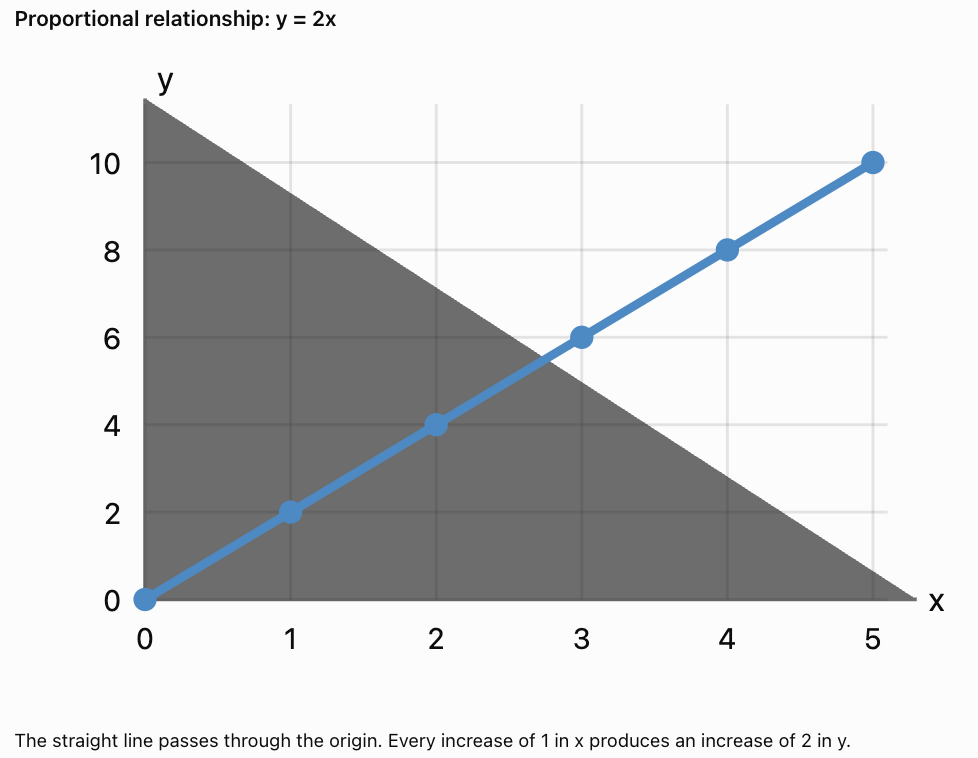
A proportional relationship produces a straight-line graph passing through the origin (0, 0).
Important Characteristics
A proportional graph:
-
Is a straight line.
-
Passes through the origin.
-
Has a constant slope.
-
Can be represented by y = kx.
A straight line that does not pass through the origin is not a proportional relationship.
Equivalent Ratios
Equivalent ratios represent the same comparison.
For example:
2 : 5 = 4 : 10 = 6 : 15 = 8 : 20
To create equivalent ratios, multiply or divide both terms by the same nonzero number.
Worked Example
Find an equivalent ratio to 3 : 7 where the first term is 15.
Step 1: Find the Multiplier
15 ÷ 3 = 5
Step 2: Multiply the Second Term
7 × 5 = 35
Final Answer
3 : 7 = 15 : 35
Checking
15/35 simplifies to 3/7.
Therefore, the ratios are equivalent.
Solving Missing-Value Problems Using Equivalent Ratios
A missing value can often be found by identifying the scale factor.
Worked Example
Solve:
4/9 = 20/x
Step 1: Compare the Numerators
4 × 5 = 20
The scale factor is 5.
Step 2: Apply the Same Factor
9 × 5 = 45
Final Answer
x = 45
Verification
4/9 = 20/45
Simplify:
20/45 = 4/9
The solution is correct.
Important Observation
Using equivalent ratios is often the quickest method when the scale factor is easy to recognise.
What Is Cross Multiplication?
Cross multiplication is a method used to solve equations containing two equal fractions.
For the proportion:
a/b = c/d
where b ≠ 0 and d ≠ 0:
a × d = b × c
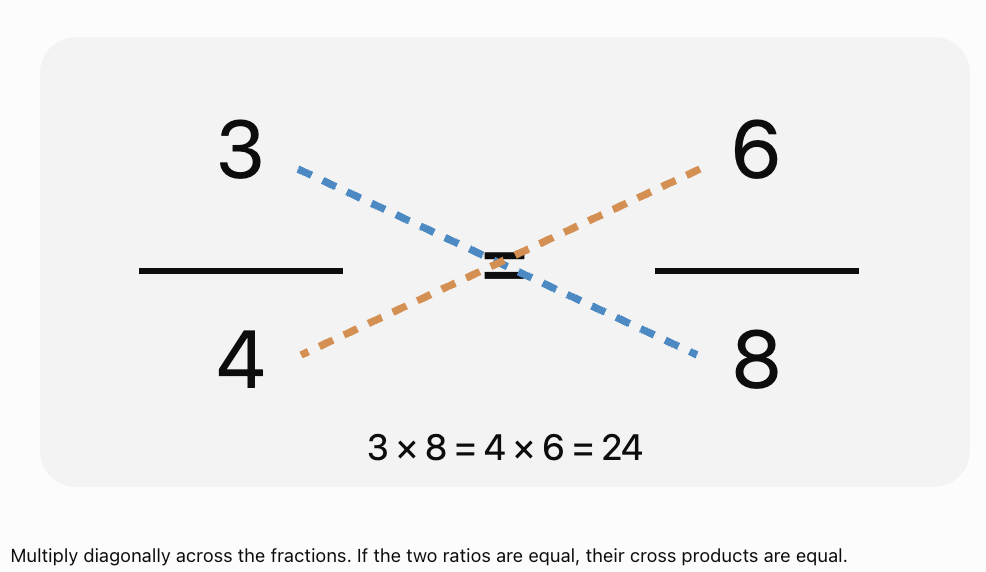
This is called cross multiplication because the numerator of each fraction is multiplied by the denominator of the other fraction.
Example
3/4 = 6/8
Cross multiply:
3 × 8 = 4 × 6
24 = 24
The products are equal.
Therefore, the proportion is true.
Why Does Cross Multiplication Work?
Starting with:
a/b = c/d
Multiply both sides by bd:
ad = bc
Cross multiplication is therefore a consequence of multiplying both sides of an equation by the same nonzero quantity.
Visualising Cross Multiplication
Solving Proportions Using Cross Multiplication
Worked Example
Solve:
5/8 = x/24
Step 1: Cross Multiply
5 × 24 = 8 × x
120 = 8x
Step 2: Divide Both Sides by 8
x = 120 ÷ 8
x = 15
Step 3: Verify
5/8 = 15/24
Simplify 15/24:
15/24 = 5/8
The ratios are equivalent.
Cross Multiplication with an Unknown Denominator
Worked Example
Solve:
7/x = 14/18
Step 1: Cross Multiply
7 × 18 = 14x
126 = 14x
Step 2: Solve
x = 126 ÷ 14
x = 9
Step 3: Check
7/9 = 14/18
Simplify 14/18:
14/18 = 7/9
The solution is correct.
Important Observation
The unknown may appear in either the numerator or denominator.
The cross-multiplication procedure remains the same, provided the denominators are nonzero.
Cross Multiplication with Expressions
Sometimes the unknown is part of an algebraic expression.
Worked Example
Solve:
(x + 2)/5 = 4/3
Step 1: Cross Multiply
3(x + 2) = 5 × 4
3(x + 2) = 20
Step 2: Expand
3x + 6 = 20
Step 3: Solve
3x = 14
x = 14/3
Step 4: Verify
x + 2 = 14/3 + 6/3 = 20/3
Left side:
(20/3)/5 = 4/3
Right side:
4/3
Both sides are equal.
Solving Proportions with Decimals
Worked Example
Solve:
2.5/4 = x/12
Step 1: Cross Multiply
2.5 × 12 = 4x
30 = 4x
Step 2: Solve
x = 30 ÷ 4
x = 7.5
Verification
2.5/4 = 0.625
7.5/12 = 0.625
The solution is correct.
Important Observation
Proportions can involve whole numbers, fractions, decimals, and algebraic expressions.
Proportions in Recipes
Recipes frequently involve proportional relationships.

Worked Example
A recipe requires 3 cups of flour to make 12 muffins.
How much flour is needed to make 20 muffins, assuming the recipe scales proportionally?
Step 1: Define the Unknown
Let x = cups of flour required.
Step 2: Write the Proportion
3/12 = x/20
Step 3: Cross Multiply
3 × 20 = 12x
60 = 12x
Step 4: Solve
x = 5
Interpretation
The recipe requires 5 cups of flour to make 20 muffins.
Checking
12 muffins require 3 cups.
20 muffins require more flour.
Five cups is reasonable.
Proportions in Maps and Scale Drawings
Scale drawings use proportional relationships to represent actual dimensions.

Worked Example
A map uses a scale of:
1 cm : 5 km
Two towns are 7 cm apart on the map.
Find the actual distance.
Step 1: Set Up the Proportion
1/5 = 7/x
Step 2: Cross Multiply
x = 5 × 7
x = 35
Interpretation
The towns are 35 kilometres apart.
Important Observation
Always ensure that corresponding measurements occupy the same positions in the ratios.
Proportions in Shopping
Unit prices allow us to compare products and calculate costs.

Worked Example
A 3 kg bag of rice costs $9.
How much would 8 kg cost at the same price per kilogram?
Step 1: Write the Proportion
3/9 = 8/x
Step 2: Cross Multiply
3x = 9 × 8
3x = 72
Step 3: Solve
x = 24
Interpretation
Eight kilograms would cost $24 at the same unit price.
Checking with Unit Rate
9 ÷ 3 = $3/kg
8 × 3 = $24
Both methods agree.
Proportions in Speed and Distance
Proportions can be used when speed remains constant.
Worked Example
A cyclist travels 24 kilometres in 2 hours.
How far will the cyclist travel in 5 hours at the same average speed?
Step 1: Set Up the Proportion
24/2 = x/5
Step 2: Cross Multiply
24 × 5 = 2x
120 = 2x
Step 3: Solve
x = 60 km
Interpretation
The cyclist will travel 60 kilometres in 5 hours if the speed remains constant.
Important Observation
A proportion can only be used directly when the relevant relationship remains proportional.
If speed changes, the same proportion may no longer apply.
Proportional and Non-Proportional Situations
Not every relationship is proportional.
Example A: Proportional
A worker earns $15 per hour with no fixed bonus.
Earnings:
E = 15h
The ratio E/h is constant.
Therefore, the relationship is proportional.
Example B: Non-Proportional
A taxi charges a $5 starting fee plus $2 per kilometre.
Cost:
C = 2d + 5
The ratio C/d is not constant.
Therefore, the relationship is not proportional.
Comparison
|
Situation |
Proportional? |
Reason |
|---|---|---|
|
$3 per notebook |
Yes |
Constant unit price |
|
$10 starting fee plus $2/km |
No |
Fixed starting fee |
|
5 litres per minute |
Yes, for constant flow from zero |
Constant rate |
|
Temperature in °C and °F |
No |
Conversion includes an added constant |
|
Distance at constant speed |
Yes, from zero distance and zero time |
Constant speed |
Important Observation
A constant rate of change does not always mean that two quantities are proportional.
A proportional relationship must have the form y = kx.
Verifying Solutions to Proportions
After solving a proportion, substitute the answer into the original equation.
Example
Solve:
6/11 = 18/x
Cross multiply:
6x = 11 × 18
6x = 198
x = 33
Verify
6/11 = 18/33
Simplify 18/33:
18/33 = 6/11
The solution is correct.
Alternative Check
Cross products:
6 × 33 = 198
11 × 18 = 198
Both cross products are equal.
Important Observation
Checking solutions helps detect arithmetic mistakes, incorrect cross multiplication, and reversed ratios.
Choosing the Best Method
There are several ways to solve proportions.
|
Method |
Best used when |
|---|---|
|
Equivalent ratios |
An obvious scale factor exists |
|
Unit rate |
One quantity per unit is easy to calculate |
|
Cross multiplication |
The scale factor is not obvious |
|
Algebraic equation |
A proportional relationship can be written as y = kx |
|
Graphing |
Comparing several pairs of proportional quantities |
Example
Solve:
4/7 = 12/x
Using equivalent ratios:
4 × 3 = 12
7 × 3 = 21
x = 21
Using cross multiplication:
4x = 7 × 12
4x = 84
x = 21
Both methods produce the same answer.
A General Method for Solving Proportions
-
Identify the quantities. Determine what is being compared.
-
Check proportionality. Confirm that the relationship has a constant ratio.
-
Write the proportion. Keep corresponding quantities in matching positions.
-
Choose a method. Use equivalent ratios, unit rates, or cross multiplication.
-
Solve the equation. Show each calculation clearly.
-
Verify. Substitute the result into the original proportion.
-
Interpret. State the answer with appropriate units and explain its meaning.
Common Mistakes
Reversing one ratio
Corresponding quantities must appear in the same order in both ratios.
Cross multiplying incorrectly
Multiply each numerator by the opposite denominator.
Forgetting to solve the final equation
Cross multiplication produces an equation that must still be solved.
Ignoring units
Convert measurements when necessary before constructing proportions.
Assuming every linear relationship is proportional
A linear relationship with a nonzero starting value is not proportional.
Dividing only one term of a ratio
Equivalent ratios require the same multiplier or divisor for both terms.
Using a proportion when the relationship changes
Proportions require a constant multiplicative relationship.
Forgetting to verify
Substituting the answer helps confirm that the ratios are equivalent.
Confusing direct and inverse relationships
If one quantity doubles while another halves, the relationship may be inversely proportional rather than directly proportional.
Key Terms
-
Proportion: Equation stating that two ratios are equal.
-
Ratio: Comparison of quantities using division.
-
Equivalent Ratios: Ratios representing the same comparison.
-
Proportional Relationship: Relationship where one quantity is a constant multiple of another.
-
Constant of Proportionality: Fixed ratio between corresponding quantities.
-
Cross Multiplication: Method of solving proportions by multiplying diagonally across two fractions.
-
Numerator: Top number of a fraction.
-
Denominator: Bottom number of a fraction.
-
Scale Factor: Multiplier used to produce an equivalent ratio or measurement.
-
Unit Rate: Rate expressed per one unit of another quantity.
-
Direct Proportion: Relationship where y = kx.
-
Inverse Proportion: Relationship where the product of two quantities remains constant.
-
Variable: Symbol representing an unknown or changing quantity.
-
Equation: Mathematical statement showing equality.
-
Verification: Process of checking whether a solution satisfies the original equation.
-
Substitution: Replacing a variable with a known value.
-
Scale Drawing: Drawing representing actual dimensions proportionally.
-
Graph of a Proportion: Straight line passing through the origin.
-
Cross Product: Product of a numerator and the opposite denominator in a proportion.
Key Takeaways
-
A proportion states that two ratios are equal.
-
Equivalent ratios can be created by multiplying or dividing both terms by the same nonzero number.
-
Proportional relationships have a constant ratio between corresponding quantities.
-
A proportional relationship can be written as y = kx.
-
The graph of a proportional relationship is a straight line passing through the origin.
-
Missing values can be calculated using equivalent ratios.
-
Cross multiplication is useful when the scale factor is not obvious.
-
The cross products of equal ratios are equal.
-
Proportions are useful in recipes, shopping, maps, and constant-speed problems.
-
Not every linear relationship is proportional.
-
Units and corresponding quantities must be arranged consistently.
-
Solutions should always be checked by substitution or equivalent ratios.
-
Mathematical answers should be interpreted using the real-world context.
Check Your Understanding
Identifying Proportions
-
What is a proportion?
-
Are 2/3 and 6/9 equivalent ratios?
-
Is y = 4x a proportional relationship?
-
Is y = 4x + 2 a proportional relationship?
-
What must be true about y/x in a proportional relationship?
Equivalent Ratios
-
Complete 3 : 5 = 12 : x.
-
Complete 4 : 7 = x : 21.
-
Are 8 : 12 and 10 : 15 equivalent?
-
Find an equivalent ratio to 5 : 9 where the first term is 20.
-
Simplify 18 : 30.
Cross Multiplication
-
Solve 3/4 = x/20.
-
Solve 5/8 = 15/x.
-
Solve 7/9 = x/27.
-
Solve 2/5 = (x + 1)/15.
-
Solve 4/x = 12/21.
Practical Problems
-
A recipe uses 2 cups of flour for 8 muffins. How much flour is needed for 20 muffins?
-
A map uses a scale of 1 cm : 4 km. What actual distance does 6 cm represent?
-
Five notebooks cost $15. How much would 9 notebooks cost at the same unit price?
-
A cyclist travels 36 km in 3 hours. How far will the cyclist travel in 5 hours at the same speed?
-
Explain one method for verifying a proportion.
Answer Key
|
Question |
Answer |
|---|---|
|
1 |
An equation showing two equal ratios |
|
2 |
Yes |
|
3 |
Yes |
|
4 |
No |
|
5 |
It must remain constant for nonzero x |
|
6 |
x = 20 |
|
7 |
x = 12 |
|
8 |
Yes |
|
9 |
20 : 36 |
|
10 |
3 : 5 |
|
11 |
x = 15 |
|
12 |
x = 24 |
|
13 |
x = 21 |
|
14 |
x = 5 |
|
15 |
x = 7 |
|
16 |
5 cups |
|
17 |
24 km |
|
18 |
$27 |
|
19 |
60 km |
|
20 |
Substitute the solution or compare cross products |
Extended Challenge
-
Solve 7/12 = x/36.
-
Solve 9/x = 15/25.
-
Solve (x + 3)/8 = 5/4.
-
Solve 2.5/6 = x/18.
-
Determine whether the table (2, 7), (4, 14), (6, 21), (8, 28) represents a proportional relationship.
-
A recipe requires 450 g of flour for 18 cookies. How much flour is required for 30 cookies?
-
A map uses a scale of 1 : 250,000. Find the actual distance represented by 6 cm.
-
A worker earns $135 for 9 hours. Calculate the earnings for 14 hours at the same hourly rate.
-
A machine produces 240 items in 8 minutes. How many items will it produce in 15 minutes at the same rate?
-
Explain why a taxi fare consisting of a fixed fee plus a distance charge is not directly proportional to distance.
Final Investigation: Planning a School Fundraiser
A school is organising a fundraiser and needs to purchase supplies, prepare food, and arrange transportation.
The organisers must use proportions to calculate quantities and costs.
Part A: Food Preparation
A recipe makes 12 servings using:
-
300 g flour
-
200 mL milk
-
4 eggs
The school needs 48 servings.
-
Determine the scale factor.
-
Calculate the amount of flour required.
-
Calculate the amount of milk required.
-
Calculate the number of eggs required.
-
Verify that all ingredient quantities have been scaled proportionally.
Part B: Purchasing Supplies
A supplier sells 5 notebooks for $12.50.
-
Calculate the unit price.
-
Write a proportion to determine the cost of 18 notebooks.
-
Solve the proportion using cross multiplication.
-
Verify the answer using the unit price.
-
Explain why the cost is proportional to the number of notebooks.
Part C: Transportation
A bus travels 120 kilometres in 2 hours at a constant average speed.
-
Calculate the average speed.
-
Write a proportion to determine the distance travelled in 3.5 hours.
-
Solve the proportion.
-
Calculate the time required to travel 300 kilometres at the same speed.
-
Explain why the proportion may not accurately predict travel time if traffic conditions change.
Part D: Scale Drawings
A school hall is represented on a plan using the scale:
1 cm : 2 m
The hall measures 9 cm by 6 cm on the plan.
-
Calculate the actual length.
-
Calculate the actual width.
-
Determine the actual floor area.
-
Explain why the scale factor must be applied to both dimensions.
-
Write a conclusion explaining how proportions help solve practical problems.
Investigation Check
Food preparation
-
Scale factor = 4
-
Flour = 1200 g
-
Milk = 800 mL
-
Eggs = 16
Supplies
-
Unit price = $2.50
-
Cost of 18 notebooks = $45
Transportation
-
Average speed = 60 km/h
-
Distance in 3.5 hours = 210 km
-
Time for 300 km = 5 hours
Scale drawing
-
Actual length = 18 m
-
Actual width = 12 m
-
Actual floor area = 216 m²