Coordinates, Transformations, and Symmetry
1. The Coordinate Plane
Learning outcomes
- I can identify the x-axis, y-axis, and origin on a coordinate plane.
- I can read and write ordered pairs correctly.
- I can plot points on a coordinate grid.
- I can determine the coordinates of points on a graph.
- I can use coordinates to describe locations and positions.
What Is a Coordinate Plane?
A coordinate plane is a two-dimensional grid used to describe the exact location of points.
It is formed by two number lines that meet at right angles:
- The horizontal x-axis
- The vertical y-axis
These axes divide the coordinate plane into four regions called quadrants.
Coordinate planes allow us to represent positions using numbers rather than descriptions such as "a little to the right" or "near the top."


The x-Axis
The x-axis is the horizontal number line.
Values increase as you move:
right
and decrease as you move:
left
Therefore:
- Positive x-values are to the right of the origin.
- Negative x-values are to the left of the origin.
The x-axis itself can be described by:
y = 0
because every point on the x-axis has a y-coordinate of zero.
The y-Axis
The y-axis is the vertical number line.
Values increase as you move:
up
and decrease as you move:
down
Therefore:
- Positive y-values are above the origin.
- Negative y-values are below the origin.
The y-axis can be described by:
x = 0
because every point on the y-axis has an x-coordinate of zero.
The Origin
The origin is the point where the x-axis and y-axis intersect.
Its coordinates are:
(0, 0)
The origin is the reference point from which positions on the coordinate plane are measured.
Ordered Pairs
A point on a coordinate plane is described using an ordered pair.
An ordered pair is written:
(x, y)
The first number gives the:
x-coordinate
The second number gives the:
y-coordinate
The order matters.
For example:
(4, 2)
means:
- Move 4 units along the x-axis.
- Move 2 units along the y-axis.
x Comes Before y
A useful rule is:
(x, y)
Always read the x-coordinate first.
One memory aid is:
Across first, then up or down.
For:
(3, 5)
move:
3 right
then:
5 up
For:
(−3, 5)
move:
3 left
then:
5 up
Plotting Points
To plot a point means to place it at the correct location on a coordinate plane.
Suppose we want to plot:
A(3, 2)
Start at the origin.
Move:
3 units right
because x = 3.
Then move:
2 units up
because y = 2.
Mark the location and label it:
A
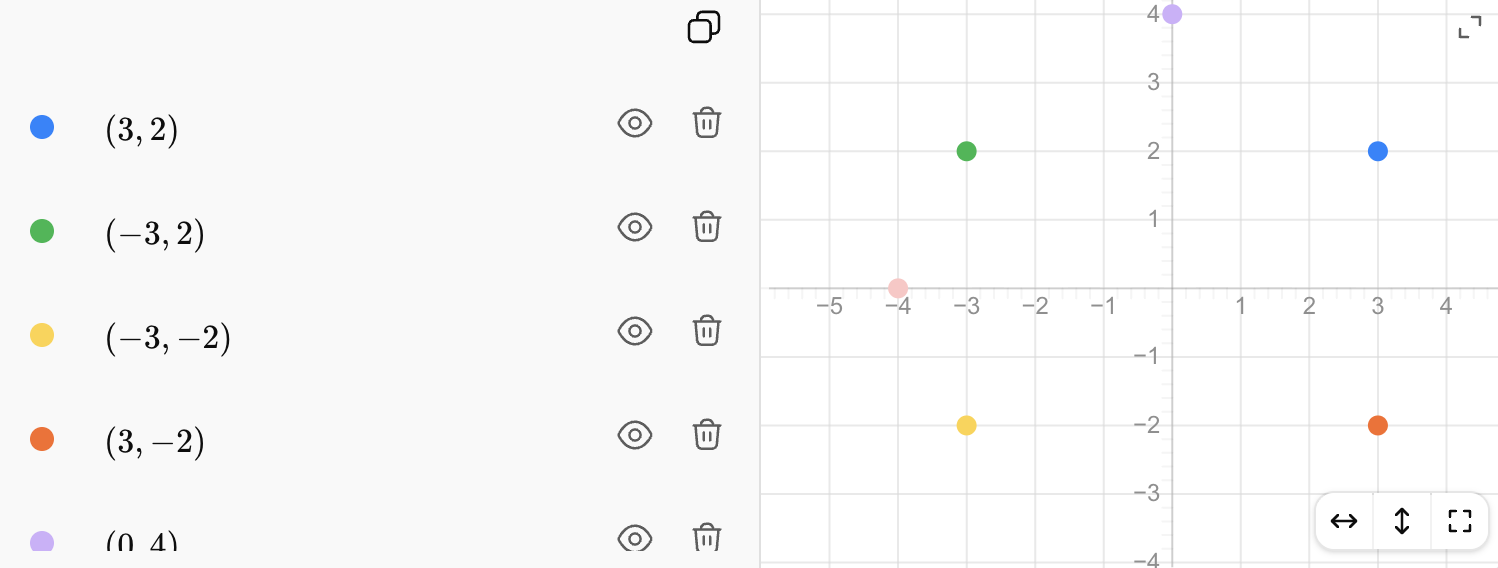
An Interactive Coordinate Example
The points below show how positive and negative coordinates determine position.