Exploring Shapes and Geometry
3. Triangles
Learning outcomes
- I can classify triangles according to their side lengths.
- I can classify triangles according to their angle measures.
- I can identify the properties of equilateral, isosceles, and scalene triangles.
- I can identify the properties of acute, right, and obtuse triangles.
- I can use triangle properties to solve geometric problems.
What Is a Triangle?
A triangle is a polygon with:
- 3 straight sides.
- 3 vertices.
- 3 interior angles.
Triangles can have many different shapes and sizes, but every triangle has these basic characteristics.
Triangles can be classified in two different ways:
- By their side lengths.
- By their angle measures.
This means that one triangle can have two classifications at the same time.
For example, a triangle could be:
isosceles and acute
or:
scalene and right


Classifying Triangles by Side Length
Triangles can be classified according to whether their sides have equal lengths.
The three main classifications are:
- Equilateral.
- Isosceles.
- Scalene.
Equilateral Triangles
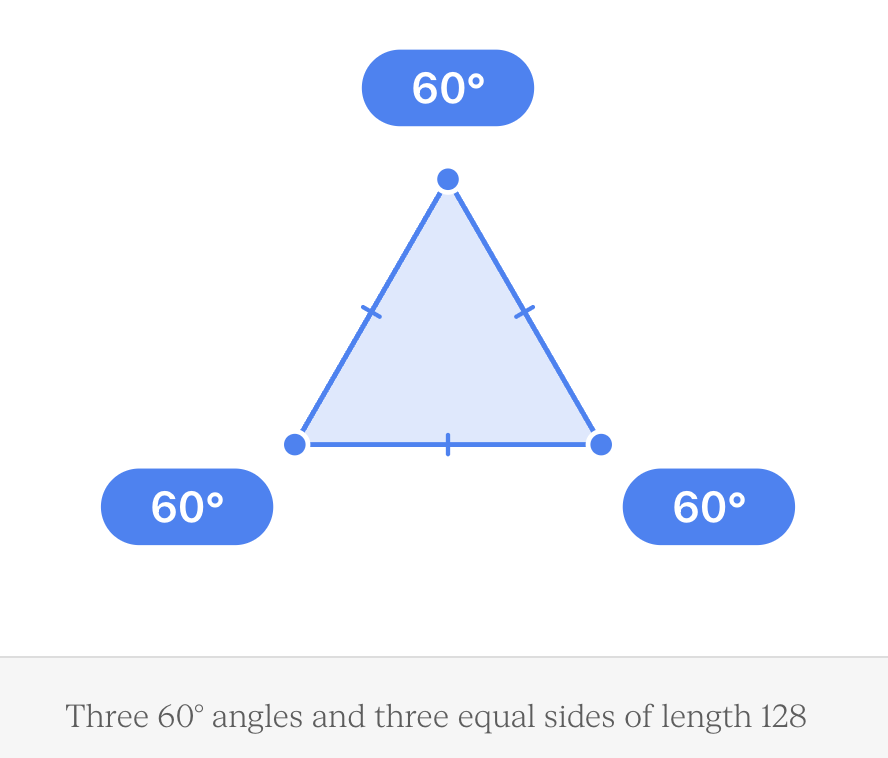
An equilateral triangle has:
3 equal sides
Because all three sides are equal, all three interior angles are also equal.
The angles in every triangle add to:
180°
Therefore, for an equilateral triangle:
180° ÷ 3 = 60°
Each interior angle is:
60°
So an equilateral triangle has:
3 equal sides
and:
3 angles of 60°
Properties of Equilateral Triangles
An equilateral triangle:
- Has three equal sides.
- Has three equal angles.
- Has three 60° angles.
- Is always an acute triangle.
- Has three lines of symmetry.
- Is a regular polygon.
Because all its sides and angles are equal, an equilateral triangle is the only regular triangle.
Isosceles Triangles
An isosceles triangle has at least two equal sides.
The angles opposite those equal sides are also equal.


For example, suppose a triangle has side lengths:
7 cm, 7 cm, and 10 cm
Two sides are equal.
Therefore, it is an:
isosceles triangle
Base Angles of an Isosceles Triangle
An important property of isosceles triangles is:
Equal sides are opposite equal angles.
Suppose the top angle of an isosceles triangle is:
40°
The other two angles must be equal.
The total remaining angle is:
180° − 40° = 140°
Divide equally:
140° ÷ 2 = 70°
Therefore, the angles are:
40°, 70°, 70°
Working Backward with Isosceles Triangles
Suppose an isosceles triangle has two equal angles measuring:
55°
Find the third angle.
55° + 55° = 110°
Therefore:
180° − 110° = 70°
The third angle is:
70°
Scalene Triangles
A scalene triangle has:
3 different side lengths
Because no sides are equal, its three angles are also different.
For example, a triangle with sides:
5 cm, 7 cm, and 9 cm
is scalene.


A scalene triangle:
- Has no equal sides.
- Has no equal angles.
- Can be acute.
- Can be right.
- Can be obtuse.
Comparing Triangles by Side Length
| Triangle | Side Properties | Angle Properties |
|---|---|---|
| Equilateral | 3 equal sides | 3 equal angles |
| Isosceles | At least 2 equal sides | At least 2 equal angles |
| Scalene | 3 different sides | 3 different angles |
Classifying Triangles by Angles
Triangles can also be classified according to their largest angle.
The three main classifications are:
- Acute.
- Right.
- Obtuse.
Acute Triangles
An acute triangle has:
3 acute angles
This means every angle is:
less than 90°
For example:
50°, 60°, 70°
All three angles are less than 90°.
Therefore, the triangle is:
acute
An equilateral triangle is always acute because all its angles are:
60°
Right Triangles
A right triangle contains exactly one:
90° angle
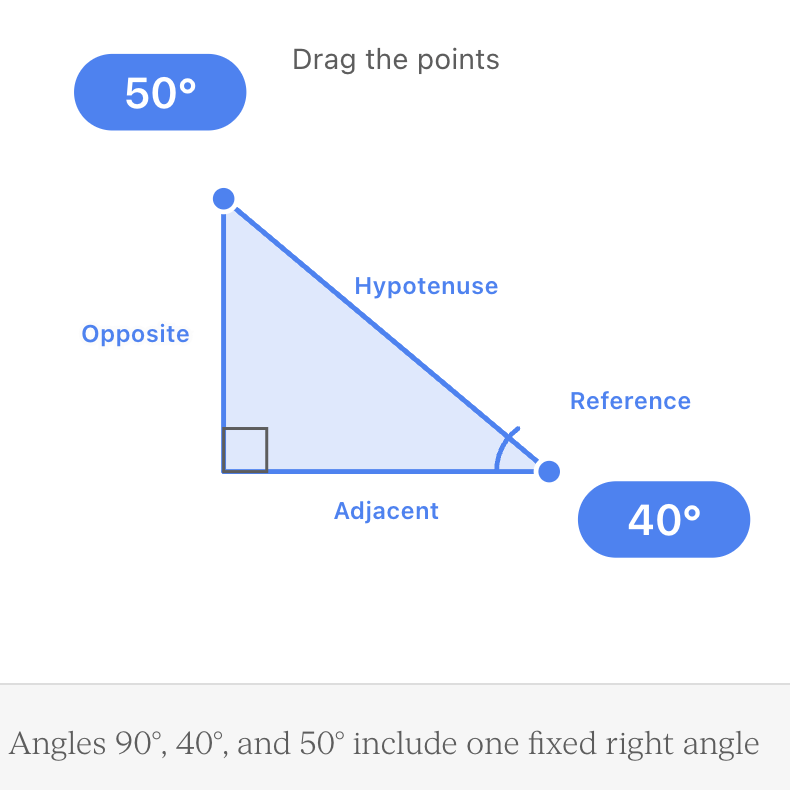
The other two angles must both be acute.
Since all three angles total 180°:
the two acute angles in a right triangle add to 90°
For example:
90° + 35° + 55° = 180°
Parts of a Right Triangle
The side opposite the 90° angle is called the:
hypotenuse
The hypotenuse is always the longest side of a right triangle.
The other two sides are often called the:
legs
Right triangles are extremely important in:
- Construction.
- Engineering.
- Navigation.
- Trigonometry.
- Measurement.
Obtuse Triangles
An obtuse triangle contains exactly one angle greater than:
90°
but less than:
180°
For example:
110°, 40°, 30°
Since one angle is:
110°
the triangle is:
obtuse


Why a Triangle Cannot Have Two Obtuse Angles
Suppose a triangle had two angles greater than 90°.
Even if both were only:
91°
their sum would already be:
182°
But all three angles in a triangle must add to:
180°
Therefore, a triangle can have at most one obtuse angle.
Why a Triangle Cannot Have Two Right Angles
Two right angles would add to:
90° + 90° = 180°
There would be no angle remaining for the third vertex.
Therefore, a triangle can have only one right angle.
Triangle Angle Sum
One of the most important properties of triangles is:
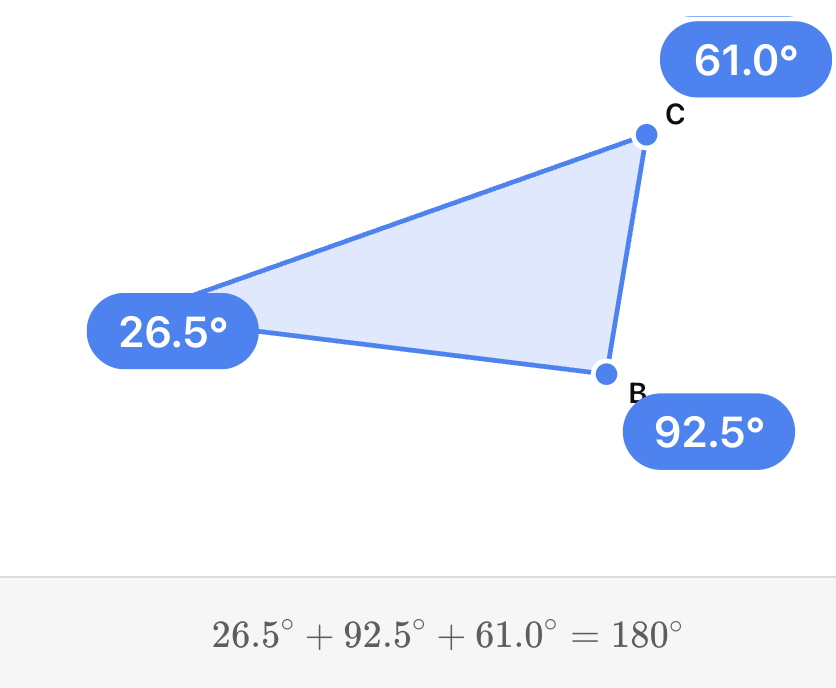
This rule applies to:
- Equilateral triangles.
- Isosceles triangles.
- Scalene triangles.
- Acute triangles.
- Right triangles.
- Obtuse triangles.
It applies to every triangle.
Finding a Missing Angle
Suppose a triangle has angles:
45°, 65°, and x
Since the angles total 180°:
45° + 65° + x = 180°
Add:
110° + x = 180°
Therefore:
x = 70°
Another Missing-Angle Example
A triangle contains:
90°, 32°, and x
Calculate:
90° + 32° = 122°
Then:
x = 180° − 122°
x = 58°
The triangle has angles:
90°, 32°, 58°
Because it contains a 90° angle, it is a:
right triangle
Two Ways to Classify the Same Triangle
A triangle should often be classified using both its sides and its angles.
For example:
Triangle A
Sides:
5 cm, 5 cm, 6 cm
Angles:
approximately 53°, 53°, 74°
Classification:
isosceles acute triangle
Triangle B
Sides:
3 cm, 4 cm, 5 cm
Angles include:
90°
All sides are different.
Classification:
scalene right triangle
Triangle C
Angles:
100°, 40°, 40°
Two angles are equal, so the opposite sides are equal.
Classification:
isosceles obtuse triangle
Possible Triangle Combinations
Not every combination is possible.
| By Sides | Acute | Right | Obtuse |
|---|---|---|---|
| Equilateral | Yes | No | No |
| Isosceles | Yes | Yes | Yes |
| Scalene | Yes | Yes | Yes |
An equilateral triangle can only be acute because every angle equals:
60°
Equal Sides and Equal Angles
There is an important relationship between sides and angles.
Equal sides are opposite equal angles.
Similarly:
Equal angles are opposite equal sides.
This allows us to use information about sides to determine information about angles and vice versa.
Longer Sides and Larger Angles
There is another important relationship:
The largest angle is opposite the longest side.
Similarly:
The smallest angle is opposite the shortest side.


For example, if a triangle has sides:
5 cm, 7 cm, 10 cm
the largest angle must be opposite the:
10 cm side
Triangle Inequality
Not every set of three lengths can form a triangle.
For three lengths to form a triangle:
the sum of any two sides must be greater than the third side
Consider:
4 cm, 5 cm, 7 cm
Check:
4 + 5 > 7
4 + 7 > 5
5 + 7 > 4
All conditions are satisfied.
Therefore, these lengths can form a triangle.
When a Triangle Cannot Form
Consider:
2 cm, 3 cm, 6 cm
Check the two shortest sides:
2 + 3 = 5
But:
5 < 6
The two shorter sides cannot reach each other to close the triangle.
Therefore:
2 cm, 3 cm, and 6 cm cannot form a triangle.
What If the Sum Is Exactly Equal?
Consider:
3 cm, 4 cm, 7 cm
Here:
3 + 4 = 7
These lengths would form a straight line rather than a triangle.
Therefore, the sum must be:
greater than
the third side, not equal to it.
Right Triangles and the Pythagorean Theorem
Right triangles have another special property.
For a right triangle:
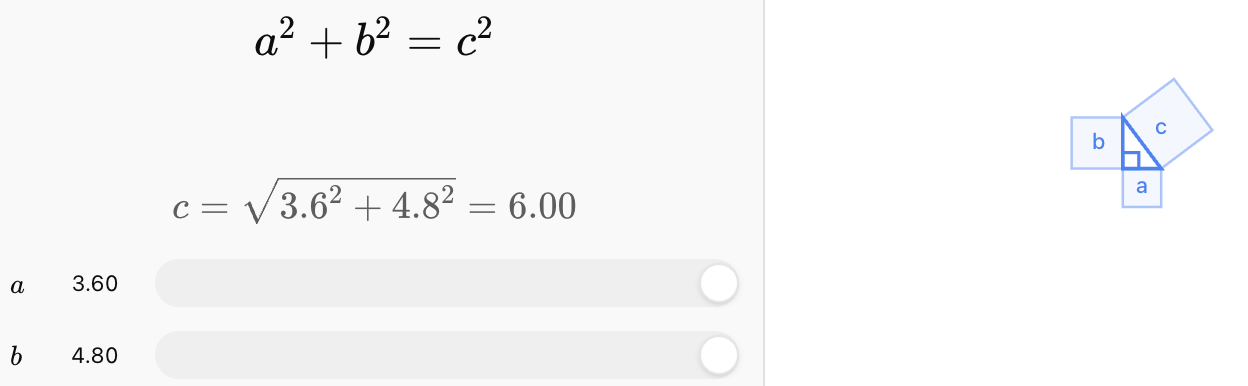
where:
a and b are the shorter sides
and:
c is the hypotenuse
Example
A triangle has sides:
3 cm, 4 cm, 5 cm
Check:
3² + 4² = 9 + 16
= 25
and:
5² = 25
Therefore, the triangle is a:
right triangle
Using Side Lengths to Classify Angles
The Pythagorean relationship can also help classify a triangle when all three side lengths are known.
Let:
c = longest side
Compare:
a² + b²
with:
c²
If:
a² + b² = c²
the triangle is:
right
If:
a² + b² > c²
the triangle is:
acute
If:
a² + b² < c²
the triangle is:
obtuse
Example: Classifying from Side Lengths
Consider:
5 cm, 6 cm, 7 cm
Longest side:
c = 7
Calculate:
5² + 6² = 25 + 36 = 61
and:
7² = 49
Since:
61 > 49
the triangle is:
acute
Since all three sides are different, it is also:
scalene
Complete classification:
scalene acute triangle
Example: Obtuse Triangle
Consider sides:
4 cm, 5 cm, 7 cm
Calculate:
4² + 5² = 16 + 25 = 41
and:
7² = 49
Since:
41 < 49
the triangle is:
obtuse
Since all sides are different:
scalene obtuse triangle
Perimeter of a Triangle
The perimeter is the total distance around the triangle.
For sides:
a, b, and c
the perimeter is:
P = a + b + c
Example
A triangle has sides:
7 cm, 8 cm, and 10 cm
Therefore:
P = 7 + 8 + 10
P = 25 cm
Area of a Triangle
The area of a triangle is calculated using its base and perpendicular height:
A = ½ × b × h
Suppose:
base = 12 cm
height = 7 cm
Then:
A = ½ × 12 × 7
A = 42 cm²
The height must be perpendicular to the chosen base.
Real-World Triangles
Triangles are extremely common in structures because they can form strong, rigid frameworks.


Triangles are used in:
- Roof trusses.
- Bridges.
- Towers.
- Cranes.
- Bicycle frames.
- Road signs.
- Surveying.
- Architecture.
Why Triangles Are Useful in Structures
A rectangle can change shape if its corners are pushed unless it is reinforced.
A triangle is much more resistant to changing shape when its side lengths remain fixed.
Engineers therefore use triangular frameworks to help create strong structures.
A rectangular frame can often be strengthened by adding a diagonal brace, which divides it into:
two triangles
Solving Geometric Problems with Triangle Properties
When solving a triangle problem, first determine what information is given.
Ask:
- Are side lengths given?
- Are angles given?
- Are any sides marked equal?
- Is there a right-angle symbol?
- Is a missing angle required?
- Is a missing side required?
- Do I need to classify the triangle?
Then choose the appropriate property.
Worked Problem: Isosceles Triangle
An isosceles triangle has one angle measuring:
100°
The other two angles are equal.
Calculate:
180° − 100° = 80°
Divide:
80° ÷ 2 = 40°
Therefore, the angles are:
100°, 40°, 40°
Classification:
isosceles obtuse
Worked Problem: Right Isosceles Triangle
A triangle has:
- One 90° angle.
- Two equal sides.
Because it is isosceles, the remaining two angles are equal.
Their total is:
180° − 90° = 90°
Therefore:
90° ÷ 2 = 45°
The angles are:
45°, 45°, 90°
This is an:
isosceles right triangle
Worked Problem: Missing Angle
A triangle has angles:
x, 2x, and 3x
Since:
x + 2x + 3x = 180°
Combine:
6x = 180°
Therefore:
x = 30°
The angles are:
30°, 60°, 90°
So the triangle is:
right
Since all angles are different, all sides are different.
Therefore, its full classification is:
scalene right triangle
A Reliable Classification Strategy
When classifying a triangle:
Look at the sides
3 equal → equilateral
2 equal → isosceles
No equal sides → scalene
Look at the angles
All less than 90° → acute
One exactly 90° → right
One greater than 90° → obtuse
Then combine the classifications when appropriate.
For example:
isosceles acute
isosceles right
scalene obtuse
Common Mistakes
Classifying Only by Appearance
Do not assume a triangle is isosceles simply because it looks symmetrical.
Use the measurements or markings provided.
Forgetting That Triangles Can Have Two Classifications
Isosceles describes the sides.
Obtuse describes the angles.
A triangle can therefore be both:
isosceles and obtuse
Calling a Triangle with a 90° Angle Acute
An acute triangle must have:
three angles less than 90°
If one angle is exactly 90°, it is a:
right triangle
Calling a 90° Angle Obtuse
An obtuse angle must be:
greater than 90°
Exactly 90° is a:
right angle
Forgetting the Triangle Angle Sum
Every triangle has:
180°
of interior angles.
Use this fact whenever one angle is missing.
Assuming Equal Sides Are Beside Equal Angles
Remember:
Equal sides are opposite equal angles.
Using the Wrong Side as the Hypotenuse
The hypotenuse is always:
- Opposite the 90° angle.
- The longest side of a right triangle.
Forgetting the Triangle Inequality
Three positive lengths do not automatically form a triangle.
The sum of any two sides must be greater than the third.
Forgetting to Square the Sides
When using the Pythagorean relationship, compare:
a² + b²
with:
c²
not:
a + b
with:
c
Check Your Understanding
1. What three basic features does every triangle have?
2. Name the three classifications of triangles based on side length.
3. Name the three classifications based on angles.
4. Describe an equilateral triangle.
5. What is the measure of each angle in an equilateral triangle?
6. Describe an isosceles triangle.
7. Describe a scalene triangle.
8. Describe an acute triangle.
9. Describe a right triangle.
10. Describe an obtuse triangle.
11. Classify a triangle with sides 6 cm, 6 cm, and 9 cm according to its sides.
12. Classify a triangle with sides 5 cm, 7 cm, and 8 cm according to its sides.
13. Classify a triangle with angles 60°, 60°, and 60°.
14. Classify a triangle with angles 90°, 35°, and 55° according to its angles.
15. Classify a triangle with angles 110°, 40°, and 30°.
16. A triangle has angles 45°, 65°, and x. Find x.
17. An isosceles triangle has a top angle of 40°. Find the other two angles.
18. An isosceles triangle has two equal angles of 65°. Find the third angle.
19. A right triangle has one acute angle of 28°. Find the other acute angle.
20. Explain why a triangle cannot contain two right angles.
21. Explain why a triangle cannot contain two obtuse angles.
22. Can an equilateral triangle be obtuse? Explain.
23. Can an isosceles triangle be right? If so, what would its angles be?
24. Can a scalene triangle be right? Give an example.
25. Which side of a triangle is opposite its largest angle?
26. Can side lengths 3 cm, 4 cm, and 8 cm form a triangle? Explain.
27. Can side lengths 5 cm, 6 cm, and 8 cm form a triangle? Explain.
28. Determine whether a triangle with sides 3 cm, 4 cm, and 5 cm is a right triangle.
29. A triangle has sides 4 cm, 5 cm, and 7 cm. Determine whether it is acute, right, or obtuse.
30. A triangle has angles x, 2x, and 3x. Find all three angles and classify the triangle.
Key Terms
- Triangle – polygon with three sides, three vertices, and three interior angles.
- Equilateral triangle – triangle with three equal sides and three equal angles.
- Isosceles triangle – triangle with at least two equal sides.
- Scalene triangle – triangle with three different side lengths.
- Acute triangle – triangle with three acute angles.
- Right triangle – triangle containing one 90° angle.
- Obtuse triangle – triangle containing one angle greater than 90°.
- Hypotenuse – longest side of a right triangle, opposite the 90° angle.
- Legs – the two shorter sides forming the right angle of a right triangle.
- Vertex – point where two sides meet.
- Interior angle – angle formed inside the triangle at a vertex.
- Triangle inequality – rule stating that the sum of any two side lengths must be greater than the third.
- Perimeter – total distance around a triangle.
- Base – side chosen as the reference when calculating area.
- Perpendicular height – shortest distance from the base to the opposite vertex measured at 90°.
Key Takeaways
- Every triangle has 3 sides, 3 vertices, and 3 interior angles.
- Triangles can be classified by both sides and angles.
- Equilateral triangles have three equal sides and three 60° angles.
- Isosceles triangles have at least two equal sides and corresponding equal angles.
- Scalene triangles have three different sides and three different angles.
- Acute triangles have three angles less than 90°.
- Right triangles contain exactly one 90° angle.
- Obtuse triangles contain exactly one angle greater than 90°.
- The interior angles of every triangle add to 180°.
- Equal sides are opposite equal angles.
- The longest side is opposite the largest angle.
- The shortest side is opposite the smallest angle.
- The hypotenuse is the longest side of a right triangle.
- Three lengths form a triangle only when the sum of any two is greater than the third.
- Equilateral triangles are always acute.
- Isosceles and scalene triangles can be acute, right, or obtuse.
- Triangle properties can be used to calculate missing sides and angles and solve practical geometric problems.
A useful classification check is:
Sides: equilateral, isosceles, or scalene
Angles: acute, right, or obtuse