Understanding Fractions
4. Improper Fractions and Mixed Numbers
Learning outcomes
- I can identify improper fractions and mixed numbers.
- I can convert improper fractions to mixed numbers.
- I can convert mixed numbers to improper fractions.
- I can represent mixed numbers using visual models.
- I can solve problems involving improper fractions and mixed numbers.


What Are Proper and Improper Fractions?
Fractions can represent quantities that are less than one whole, equal to one whole, or greater than one whole.
Consider:
3/4
The numerator is smaller than the denominator.
This means we have 3 pieces out of the 4 pieces needed to make one whole.
This is called a proper fraction.
Now consider:
7/4
The numerator is larger than the denominator.
Four fourths make one whole, so seven fourths represents more than one whole.
This is called an improper fraction.
Proper Fractions
A proper fraction has a numerator that is smaller than its denominator.
Examples:
2/5
3/8
7/10
All of these fractions have values between 0 and 1.


For example:
3/4 < 1
because we need four fourths to make one whole.
Improper Fractions
An improper fraction has a numerator that is equal to or greater than its denominator.
Examples:
5/4
8/5
11/6
9/9


Improper fractions usually represent a quantity of one whole or more.
For example:
5/4
means five pieces when four pieces make one whole.
Four fourths make one whole:
4/4 = 1
with another:
1/4
remaining.
Therefore:
5/4 = 1 1/4
What Is a Mixed Number?
A mixed number contains:
- a whole number
- a proper fraction
For example:
2 3/5
means:
2 wholes + 3/5 of another whole


Mixed numbers are another way to represent quantities greater than one.
For example:
7/4
and:
1 3/4
represent exactly the same quantity.
Improper Fractions and Mixed Numbers Represent the Same Values
An improper fraction and a mixed number can describe the same point on a number line.
For example:
9/4 = 2 1/4
Why?
Two complete wholes contain:
4/4 + 4/4 = 8/4
There is another:
1/4
remaining.
Therefore:
9/4 = 8/4 + 1/4 = 2 1/4


Visualizing Improper Fractions
Suppose we have:
7/3
Each whole requires three thirds:
3/3 = 1
We can group the seven thirds:
3/3 + 3/3 + 1/3
The first three thirds make one whole.
The next three thirds make another whole.
One third remains.
Therefore:
7/3 = 2 1/3

Interactive Mixed-Number Model
This model shows how pieces in an improper fraction can be regrouped into complete wholes, with any remaining pieces becoming the fractional part of a mixed number.
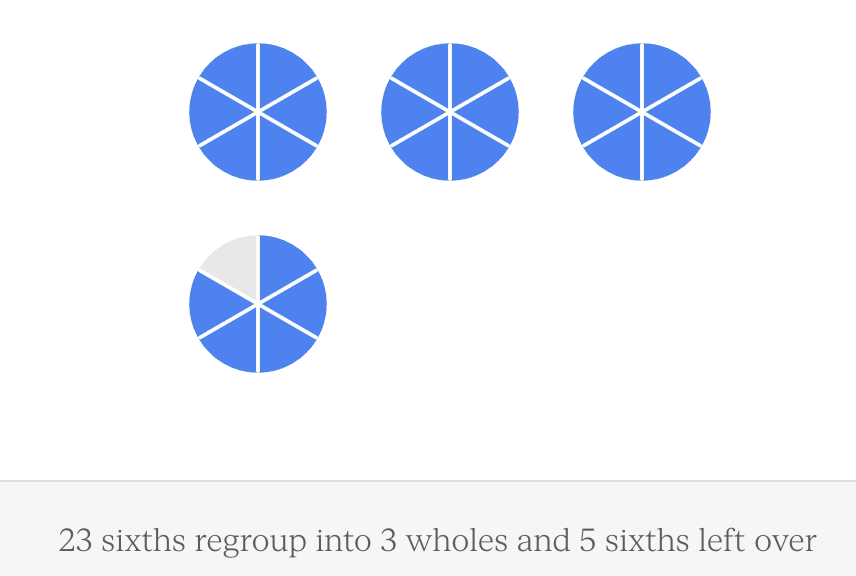
The important idea is that the value does not change. We are simply regrouping the same fractional pieces into wholes and a remainder.
Converting Improper Fractions to Mixed Numbers
To convert an improper fraction into a mixed number, use division.
Consider:
11/4
This means:
11 ÷ 4
Calculate:
11 ÷ 4 = 2 remainder 3
The quotient becomes the whole number:
2
The remainder becomes the numerator:
3
The denominator stays the same:
4
Therefore:
11/4 = 2 3/4
The Conversion Rule
To convert an improper fraction to a mixed number:
Step 1: Divide the numerator by the denominator.
Step 2: The quotient becomes the whole number.
Step 3: The remainder becomes the new numerator.
Step 4: Keep the original denominator.
For:
17/5
calculate:
17 ÷ 5 = 3 remainder 2
Therefore:
17/5 = 3 2/5


Worked Example 1
Convert:
13/4
to a mixed number.
Divide:
13 ÷ 4 = 3 remainder 1
Therefore:
13/4 = 3 1/4
Check:
Three wholes contain:
12/4
plus another:
1/4
gives:
13/4
Worked Example 2
Convert:
22/6
to a mixed number.
Divide:
22 ÷ 6 = 3 remainder 4
Therefore:
22/6 = 3 4/6
But the fraction can be simplified:
4/6 = 2/3
So the final answer is:
22/6 = 3 2/3
Always check whether the fractional part can be simplified.
When There Is No Remainder
Sometimes an improper fraction represents an exact whole number.
Consider:
12/4
Calculate:
12 ÷ 4 = 3
There is no remainder.
Therefore:
12/4 = 3


Similarly:
10/5 = 2
18/6 = 3
20/4 = 5
An improper fraction does not always produce a mixed number. Sometimes it produces a whole number.
Converting Mixed Numbers to Improper Fractions
We can also reverse the process.
Suppose we have:
2 3/4
Each whole contains four fourths.
Two wholes therefore contain:
2 × 4 = 8 fourths
Then add the remaining three fourths:
8 + 3 = 11
Therefore:
2 3/4 = 11/4


The Mixed Number Conversion Rule
To convert a mixed number into an improper fraction:
Step 1: Multiply the whole number by the denominator.
Step 2: Add the numerator.
Step 3: Place the result over the original denominator.
For:
3 2/5
multiply:
3 × 5 = 15
Add:
15 + 2 = 17
Keep the denominator:
5
Therefore:
3 2/5 = 17/5
A useful pattern is:
Multiply → Add → Keep the denominator
Why the Method Works
Consider:
4 3/5
Each whole contains five fifths.
Four wholes contain:
4 × 5 = 20 fifths
There are another three fifths:
20 + 3 = 23
Therefore:
4 3/5 = 23/5
The calculation is simply counting how many fifth-sized pieces exist altogether.
Worked Example 3
Convert:
5 2/3
to an improper fraction.
Multiply:
5 × 3 = 15
Add the numerator:
15 + 2 = 17
Keep the denominator:
3
Therefore:
5 2/3 = 17/3
Worked Example 4
Convert:
7 5/8
to an improper fraction.
Multiply:
7 × 8 = 56
Add:
56 + 5 = 61
Keep the denominator:
8
Therefore:
7 5/8 = 61/8
Using Fraction Bars
Fraction bars can show how mixed numbers and improper fractions are connected.
Suppose we have:
1 3/4


One whole contains:
4/4
Add:
3/4
Therefore:
4/4 + 3/4 = 7/4
So:
1 3/4 = 7/4
Using Fraction Circles
Fraction circles are another useful visual model.
Imagine:
2 1/3
This can be shown using:
- two completely shaded circles
- one-third of another circle

Each complete circle contains:
3/3
Two circles contain:
6/3
Add another:
1/3
Therefore:
2 1/3 = 7/3
Mixed Numbers on a Number Line
Mixed numbers can also be located on a number line.
Consider:
2 1/2
This number lies halfway between:
2 and 3


The equivalent improper fraction is:
5/2
Both:
2 1/2
and:
5/2
occupy exactly the same point on the number line.
Comparing Improper Fractions and Mixed Numbers
Sometimes numbers are written in different forms.
For example, compare:
7/4 and 1 2/3
It may be easier to convert them into the same type.
Convert:
7/4 = 1 3/4
Now compare:
1 3/4 and 1 2/3
Both have one whole.
Compare:
3/4 and 2/3
Use twelfths:
3/4 = 9/12
2/3 = 8/12
Therefore:
1 3/4 > 1 2/3
So:
7/4 > 1 2/3
Ordering Mixed Numbers
Mixed numbers can be ordered just like other numbers.
Consider:
1 3/4, 2 1/4, 1 1/2
First compare the whole-number parts.
Both:
1 3/4
and:
1 1/2
are between 1 and 2.
But:
2 1/4
is greater than 2.
Now compare:
3/4 and 1/2
Since:
3/4 > 1/2
the order from least to greatest is:
1 1/2 < 1 3/4 < 2 1/4
Adding Improper Fractions
Improper fractions behave just like other fractions.
Consider:
5/4 + 2/4
The denominators are the same.
Add:
7/4
Convert:
7 ÷ 4 = 1 remainder 3
Therefore:
7/4 = 1 3/4
So:
5/4 + 2/4 = 1 3/4
Adding Mixed Numbers
Suppose:
1 1/4 + 2 2/4
Add the whole numbers:
1 + 2 = 3
Add the fractions:
1/4 + 2/4 = 3/4
Therefore:
1 1/4 + 2 2/4 = 3 3/4
If the fractional parts have different denominators, a common denominator will be needed.
When the Fractional Part Creates Another Whole
Consider:
1 3/4 + 2 2/4
Add the whole numbers:
1 + 2 = 3
Add the fractions:
3/4 + 2/4 = 5/4
But:
5/4 = 1 1/4
Therefore:
3 + 1 1/4
gives:
4 1/4


This process is called regrouping.
Real-World Example: Pizza
Three friends have eaten a total of:
9/8 pizzas
How many whole pizzas and what fraction of another pizza have they eaten?


Convert:
9 ÷ 8 = 1 remainder 1
Therefore:
9/8 = 1 1/8
The friends have eaten:
1 1/8 pizzas
Real-World Example: Distance
A runner travels:
11/4 km
Express the distance as a mixed number.
Calculate:
11 ÷ 4 = 2 remainder 3
Therefore:
11/4 km = 2 3/4 km
This form can be easier to understand because it clearly shows that the runner traveled more than 2 km but less than 3 km.
Real-World Example: Cooking
A recipe requires:
2 1/2 cups of flour
How many half-cups of flour is this?


Convert:
2 1/2
into an improper fraction.
Multiply:
2 × 2 = 4
Add:
4 + 1 = 5
Therefore:
2 1/2 = 5/2
So the recipe requires:
5 half-cups of flour.
Real-World Example: Construction
A piece of wood measures:
3 3/4 m
Express this measurement as an improper fraction.
Multiply:
3 × 4 = 12
Add:
12 + 3 = 15
Therefore:
3 3/4 = 15/4
So the length can be expressed as:
15/4 m


Checking a Conversion
A good way to check your work is to convert the answer back into its original form.
Suppose:
14/5 = 2 4/5
Check by converting:
2 4/5
back to an improper fraction.
Multiply:
2 × 5 = 10
Add:
10 + 4 = 14
Therefore:
2 4/5 = 14/5
The conversion is correct.
Estimating Improper Fractions
You can often estimate an improper fraction by comparing its numerator with multiples of its denominator.
Consider:
17/5
We know:
15/5 = 3
and:
20/5 = 4
Therefore:
17/5
must be between 3 and 4.
Convert:
17 ÷ 5 = 3 remainder 2
So:
17/5 = 3 2/5
This matches our estimate.
Common Mistakes
Mistake 1: Thinking every fraction must be less than one
Fractions can represent quantities greater than one.
For example:
7/4 > 1
Mistake 2: Changing the denominator when converting
For:
11/4
the mixed number is:
2 3/4
The denominator remains 4.
Mistake 3: Forgetting the remainder
For:
17/5
17 ÷ 5 = 3 remainder 2
The answer is:
3 2/5
not simply 3.
Mistake 4: Adding instead of multiplying first
To convert:
3 2/5
do not calculate:
3 + 5 + 2.
Instead:
3 × 5 + 2
= 17
Therefore:
3 2/5 = 17/5
Mistake 5: Forgetting to simplify
For example:
14/6
becomes:
2 2/6
but:
2/6 = 1/3
So the simplified answer is:
2 1/3
A Strategy for Improper Fraction → Mixed Number
For:
numerator / denominator
- Divide the numerator by the denominator.
- Write the quotient as the whole number.
- Write the remainder as the numerator.
- Keep the original denominator.
- Simplify if necessary.
Example:
19/6
19 ÷ 6 = 3 remainder 1
Therefore:
19/6 = 3 1/6
A Strategy for Mixed Number → Improper Fraction
For:
whole number + fraction
- Multiply the whole number by the denominator.
- Add the numerator.
- Keep the denominator.
Example:
4 2/7
Multiply:
4 × 7 = 28
Add:
28 + 2 = 30
Therefore:
4 2/7 = 30/7
A useful memory aid is:
Multiply → Add → Keep
Did You Know?
Improper fractions are often more useful than mixed numbers when performing calculations, while mixed numbers can sometimes be easier to interpret in everyday situations.


For example:
2 3/4 cups
is easy to picture when following a recipe.
But:
11/4
may be easier to use when performing fraction calculations.
Being able to move between the two forms allows us to choose the most useful representation for a particular problem.
Key Terms
Proper fraction: A fraction whose numerator is smaller than its denominator.
Improper fraction: A fraction whose numerator is equal to or greater than its denominator.
Mixed number: A number consisting of a whole number and a proper fraction.
Whole number: A number such as 0, 1, 2, 3, or 4 with no fractional part.
Numerator: The top number of a fraction.
Denominator: The bottom number of a fraction.
Remainder: The amount left after division when a number does not divide evenly.
Equivalent: Having the same mathematical value.
Regroup: To reorganize a quantity into different but equivalent groups.
Key Rules
To convert an improper fraction to a mixed number:
Divide numerator ÷ denominator
Then:
Quotient = whole number
Remainder = new numerator
Denominator stays the same
For example:
17/4 = 4 1/4
To convert a mixed number to an improper fraction:
New numerator = (whole number × denominator) + numerator
The denominator stays the same.
For example:
3 2/5 = (3 × 5 + 2)/5 = 17/5
Key Takeaways
- A proper fraction has a numerator smaller than its denominator.
- An improper fraction has a numerator equal to or greater than its denominator.
- Improper fractions can represent quantities greater than one whole.
- A mixed number contains a whole number and a proper fraction.
- Improper fractions and mixed numbers can represent exactly the same value.
- To convert an improper fraction to a mixed number, divide the numerator by the denominator.
- The quotient becomes the whole number and the remainder becomes the new numerator.
- The denominator remains unchanged.
- To convert a mixed number to an improper fraction, multiply the whole number by the denominator, add the numerator, and keep the denominator.
- Visual models can show how fractional pieces regroup into complete wholes.
- Improper fractions and mixed numbers occupy the same positions on a number line when they are equivalent.
- Some improper fractions convert exactly into whole numbers.
- Fractional parts should be simplified when possible.
- Mixed numbers are common in measurement, cooking, construction, distance, and many other real-world situations.
- Being able to convert between mixed numbers and improper fractions makes later fraction calculations much easier.