Understanding Fractions
1. What Are Fractions?
Learning outcomes
- I can define a fraction as a part of a whole or a part of a set.
- I can identify the numerator and denominator of a fraction.
- I can represent fractions using diagrams, models, and number lines.
- I can explain the meaning of common fractions in real-life situations.
- I can recognize fractions greater than, less than, or equal to one.
Understanding Fractions
Fractions are one of the most useful ideas in mathematics. They help us describe parts of objects, groups, distances, time, and many other real-world situations.
What is a Fraction?
A fraction represents part of a whole or part of a set.
A fraction has two numbers:
\( \frac{numerator}{denominator} \)
For example:
\( \frac{3}{4} \)
- Numerator (3): tells how many parts are being considered.
- Denominator (4): tells how many equal parts make up the whole.
Think of it this way:
Numerator = How many you have.
Denominator = How many make the whole.
Part of a Whole
When one object is divided into equal parts, each part is a fraction of the whole.
Example:
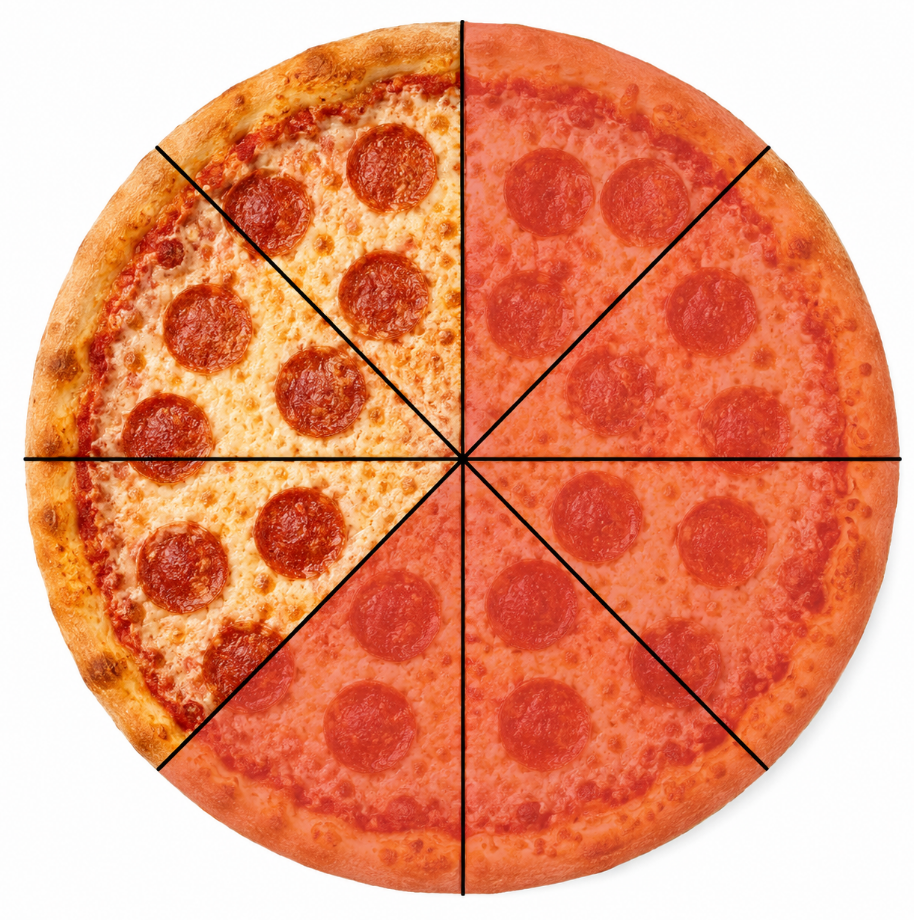
A pizza is cut into 8 equal slices.
- Eating 1 slice means you ate 1/8.
- Eating 4 slices means you ate 4/8, which is also 1/2.
- Eating 8 slices means you ate the whole pizza (8/8 = 1).
Part of a Set
Fractions can also describe part of a group of objects.
Example:
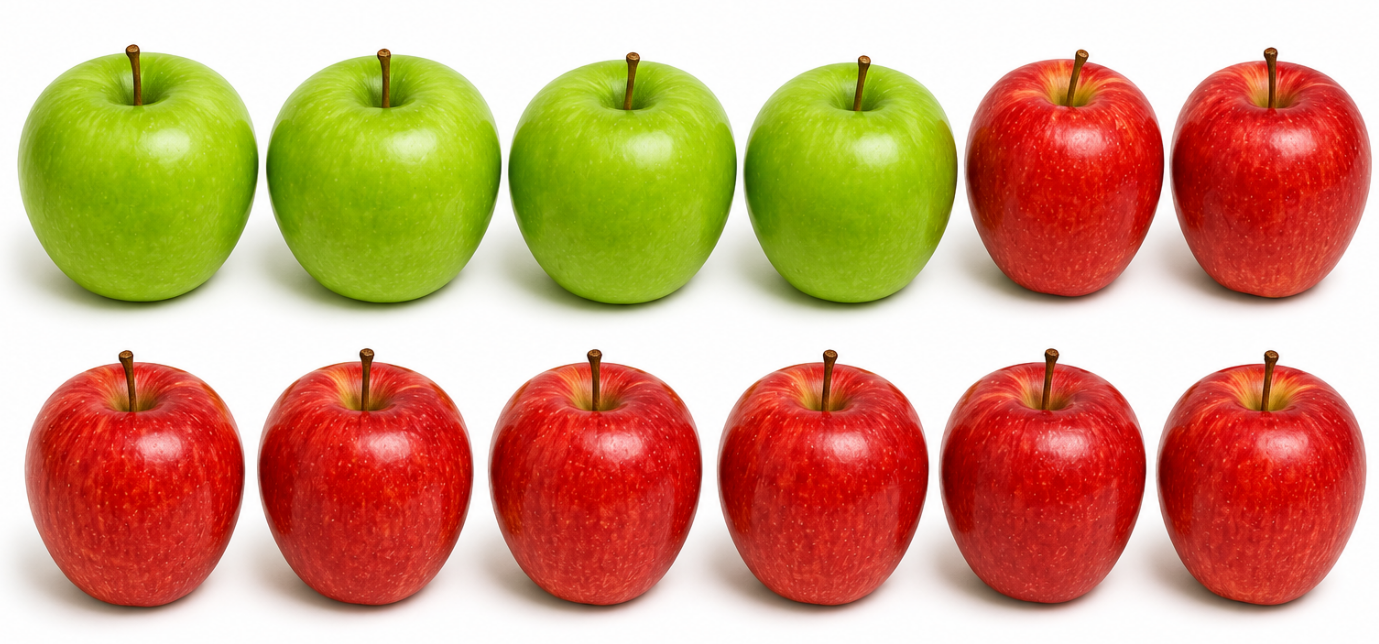
There are 10 apples.
If 4 are green, then:
\( \frac{4}{10} \)
of the apples are green.
The denominator is the total number of objects, and the numerator is the number you are describing.
Numerator and Denominator
Every fraction has two important parts.
Example:
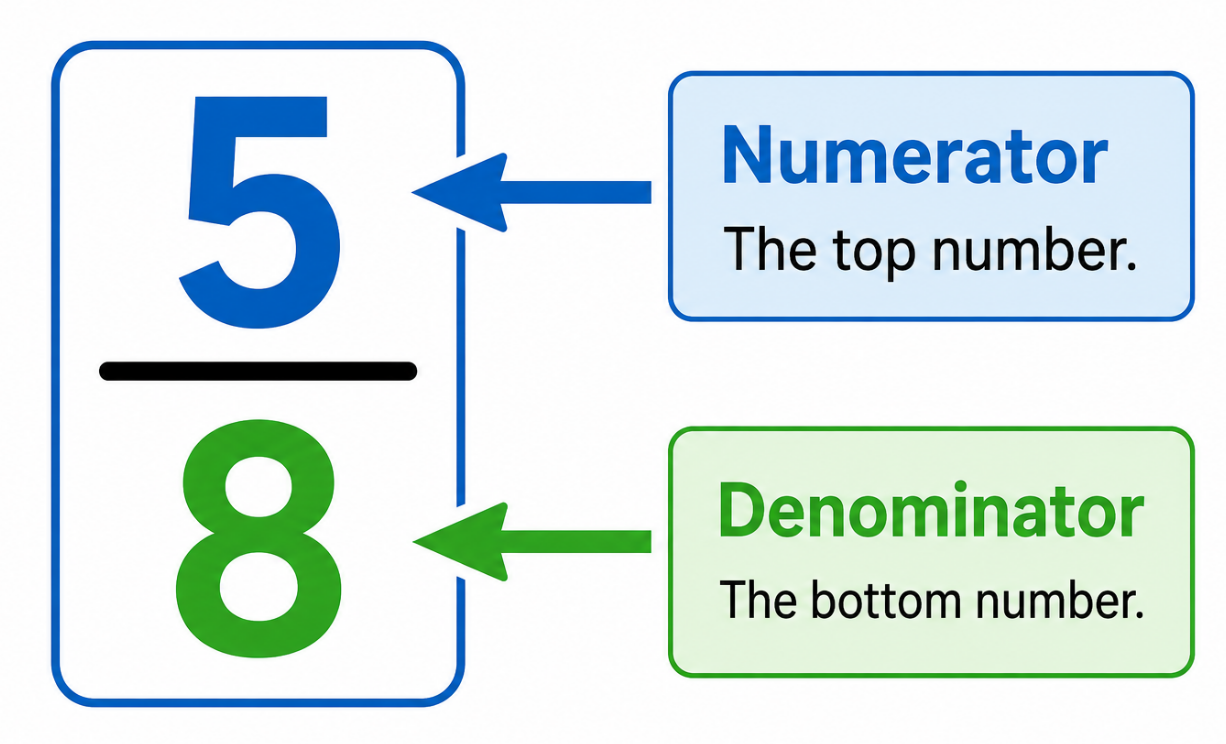
\( \frac{5}{8} \)
- 5 = numerator
- 8 = denominator
| Part | Meaning |
|---|---|
| Numerator | Number of parts chosen |
| Denominator | Total equal parts in the whole |
The denominator must represent equal-sized parts.
For example:
- Dividing a chocolate bar into 6 equal pieces creates sixths.
- Dividing it into unequal pieces does not create sixths.
Representing Fractions
Fractions can be shown in many different ways.
1. Fraction Circles
Shade part of a circle.
Example:
- Half the circle shaded = 1/2
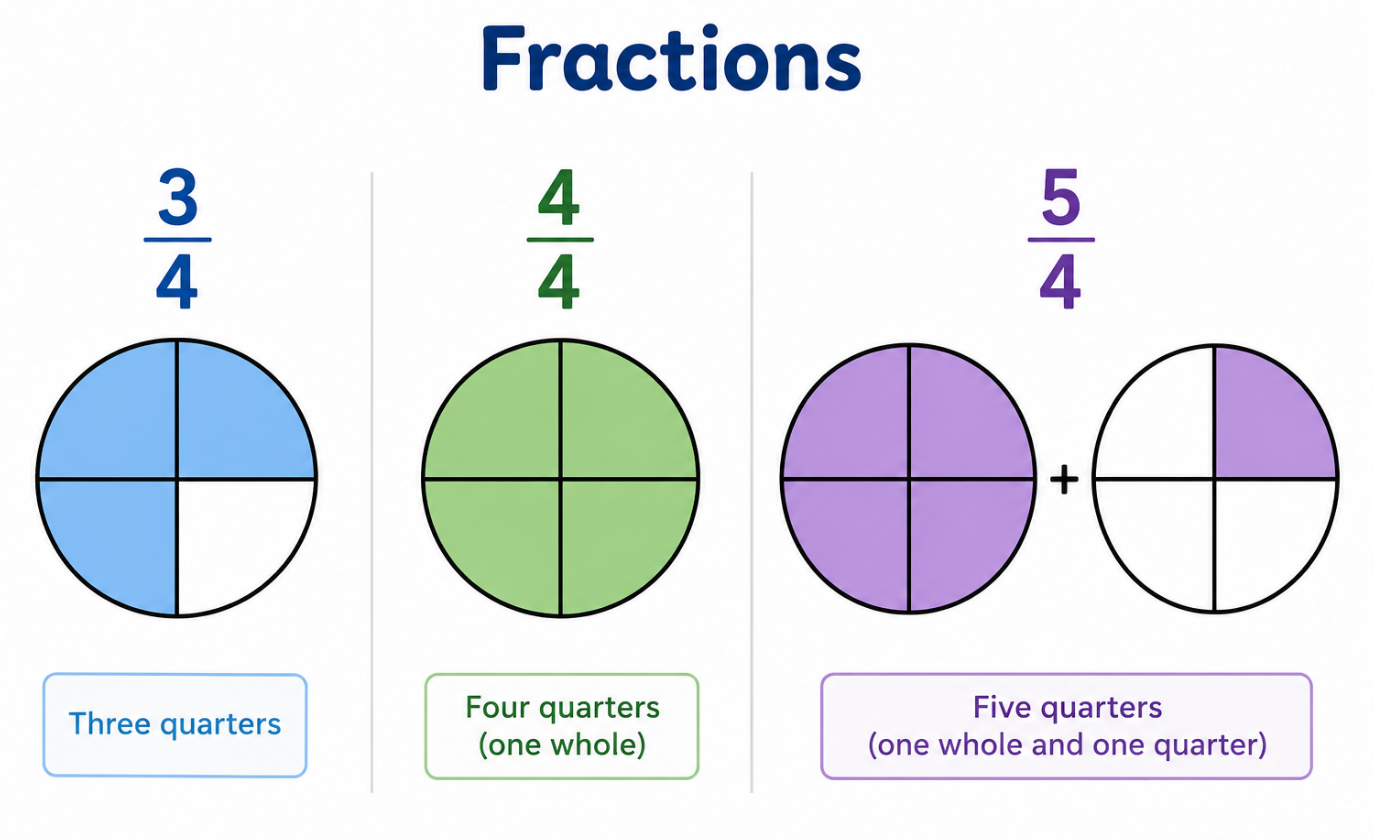
- Three quarters shaded = 3/4
2. Fraction Bars
Bars divided into equal sections.
Example:
■■■■□□□□
4/8
3. Sets of Objects
Example:
⭐⭐⭐⭐☆☆☆☆
4 out of 8 stars are filled.
\( \frac{4}{8} \)
4. Number Lines
Fractions also represent numbers between whole numbers.
Example:
0 ----|----|----|---- 1
     1/4  2/4  3/4
Fractions have exact positions on a number line.
Fractions in Everyday Life
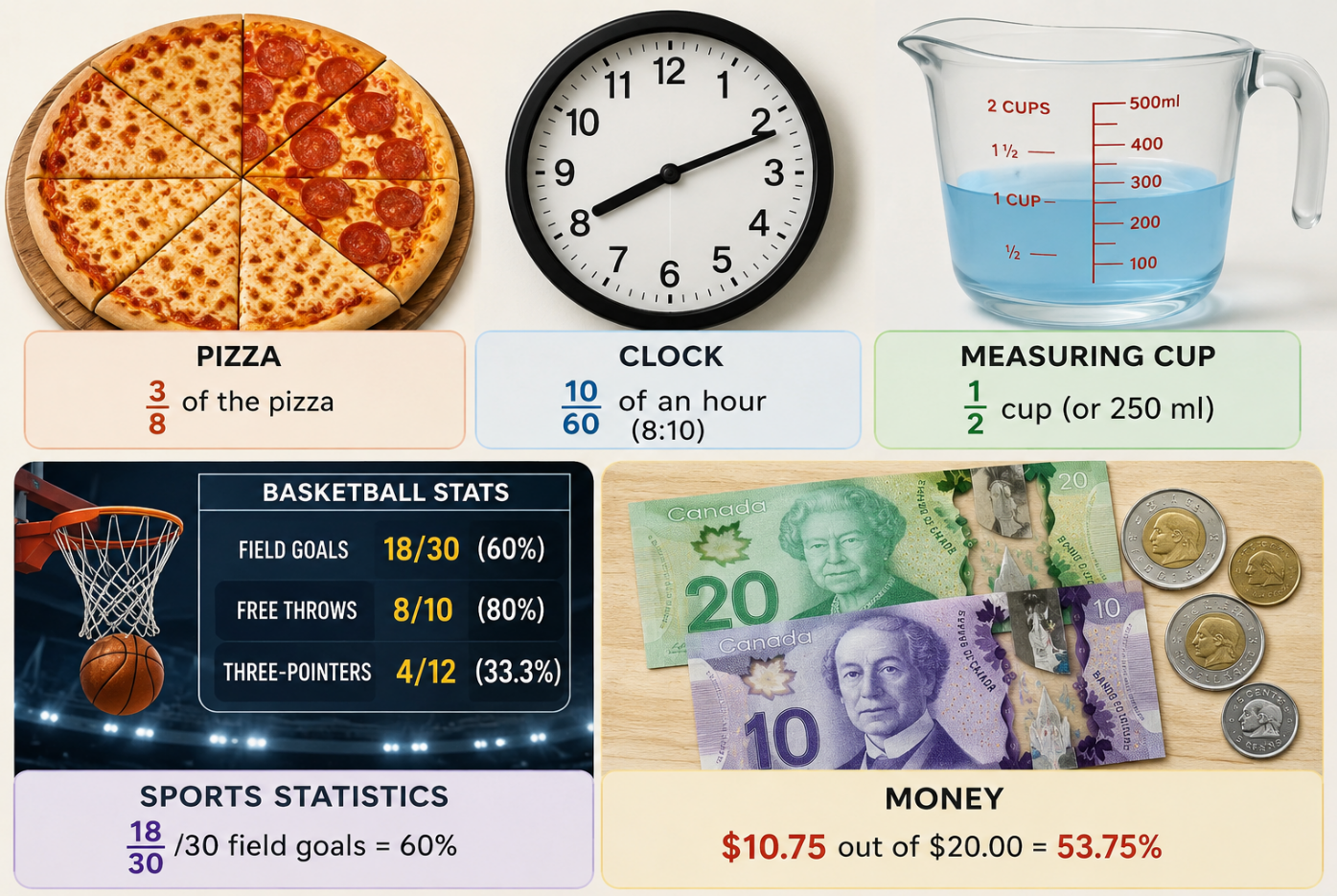
Fractions appear everywhere.
Food
- Half a sandwich
- Quarter of a pizza
- Three quarters of a chocolate bar
Time
- Half an hour = 30 minutes
- Quarter of an hour = 15 minutes
Money
- Spending half your allowance
- Saving one quarter of your money
Sports
A basketball player makes:
8 out of 10 shots.
\( \frac{8}{10} \)
Fractions Compared with One
Fractions can be less than one, equal to one, or greater than one.
Less Than One
The numerator is smaller than the denominator.
Examples:
\( \frac{1}{4}, \frac{2}{5}, \frac{7}{8} \)
These represent only part of a whole.
Equal to One
The numerator equals the denominator.
Examples:
\( \frac{5}{5} = 1 \
\( \frac{9}{9} = 1
This represents one complete whole.
Greater Than One
The numerator is larger than the denominator.
Examples:
\( \frac{5}{4} \)
\( \frac{7}{3} \)
These represent more than one whole.
For example:
\( \frac{5}{4} = 1 \frac{1}{4} \)
This means one whole plus one extra quarter.
Key Vocabulary
| Word | Meaning |
|---|---|
| Fraction | A number representing part of a whole or part of a set |
| Numerator | The top number showing how many parts are considered |
| Denominator | The bottom number showing the total equal parts |
| Whole | One complete object or complete set |
| Equal Parts | Parts that are exactly the same size |
| Number Line | A line used to show the position of numbers |
| Part of a Set | A fraction describing some objects in a group |
Summary
- A fraction represents part of a whole or part of a set.
- The numerator tells how many parts are being considered.
- The denominator tells how many equal parts make the whole.
- Fractions can be shown using circles, bars, sets of objects, and number lines.
- Fractions are used every day in cooking, sports, shopping, time, and measurement.
- Fractions may be less than one, equal to one, or greater than one depending on the relationship between the numerator and denominator.