Buoyancy and Archimedes' Principle
3. Floating Objects
Learning outcomes
- I can explain the conditions required for an object to float.
- I can compare floating, sinking, and neutral buoyancy.
- I can describe how weight and buoyant force interact.
- I can predict how changes in density affect floating behaviour.
- I can apply floating principles to practical examples.
Why does a piece of wood float while a stone sinks? How can an enormous steel ship remain on the surface of the ocean? Why can a submarine deliberately sink, rise, or remain suspended underwater?
The answer depends on two closely connected ideas:
the forces acting on the object and the density of the object compared with the fluid.
Understanding floating therefore brings together several concepts we have already studied: density, fluid pressure, buoyant force, and Archimedes' Principle.


What Does It Mean to Float?
An object floats when it remains supported by a fluid rather than sinking through it.
For an object floating at rest, two important vertical forces act on it:
- weight acts downward
- buoyant force acts upward
For the object to remain at rest:
Buoyant force = Weight
The forces are balanced, so the net vertical force is zero.
        ↑
  Buoyant force
        │
     [object]
        │
      Weight
        ↓
This is the basic condition for an object floating at rest.
Weight and Buoyant Force
The weight of an object is caused by gravity.
W = mg
where:
- W = weight (N)
- m = mass (kg)
- g = gravitational field strength (N/kg)
The buoyant force is the upward force exerted by the surrounding fluid.
According to Archimedes' Principle:
Buoyant force = weight of displaced fluid
Therefore, whether an object rises, sinks, or remains balanced depends on the relationship between these forces.


Three Possible Situations
There are three main behaviours to consider:
- sinking
- rising or floating
- neutral buoyancy
The balance between weight and buoyant force determines which occurs.
1. Sinking
Suppose an object is completely underwater and:
Weight > Buoyant force
There is a net downward force.
Therefore, the object accelerates downward.
       ↑
  Buoyant force
      [●]
      ↓↓↓
     Weight
A stone dropped into water is a familiar example.
The stone experiences buoyant force, but that force is not large enough to balance its weight.
Weight > Buoyant force → object sinks
2. Rising and Floating
Suppose an object is completely underwater and:
Buoyant force > Weight
There is a net upward force.
The object accelerates upward.
      ↑↑↑
  Buoyant force
      [●]
       ↓
     Weight
When the object reaches the surface, part of it may emerge from the water.
As it rises out of the water, the submerged volume decreases.
Therefore:
less water displaced → smaller buoyant force
Eventually:
Buoyant force = Weight
The object then floats at the surface.
3. Neutral Buoyancy
An object has neutral buoyancy when it is completely submerged and:
Buoyant force = Weight
The forces are balanced.
       ↑↑
  Buoyant force
      [●]
       ↓↓
     Weight
The object neither accelerates upward nor downward.
It can remain suspended within the fluid.
This is different from ordinary floating because the object can remain completely underwater.


Divers, submarines, and many aquatic organisms make use of neutral buoyancy.
Explore Floating, Sinking, and Neutral Buoyancy
The relationship between object density, fluid density and displaced fluid can be explored directly:
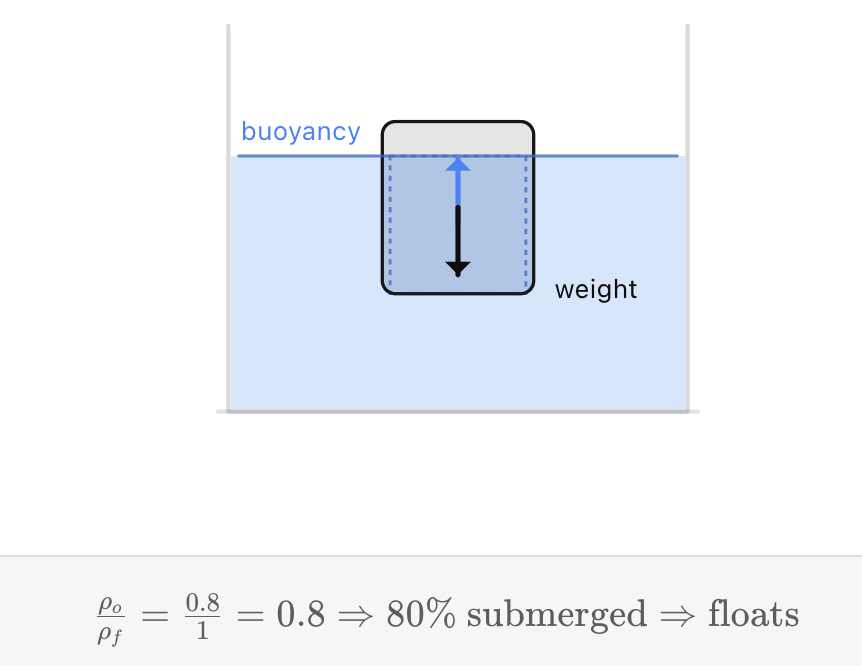
The key pattern is that the behaviour of an object depends on its density relative to the density of the surrounding fluid.
Density and Floating
Density gives us another useful way to predict floating behaviour.
Remember:
Density = mass ÷ volume
For an object placed in a fluid, compare:
density of object
with:
density of fluid
For many simple situations:
| Density Comparison | Behaviour |
|---|---|
| ρobject > ρfluid | Sinks |
| ρobject < ρfluid | Rises and can float |
| ρobject = ρfluid | Neutral buoyancy |
This gives us a powerful prediction rule.
Why Does Density Determine Floating?
Suppose two objects have exactly the same volume.
One has a mass of 2 kg.
The other has a mass of 8 kg.
When completely submerged in the same water, both displace the same volume of water.
Therefore, both experience the same buoyant force.
But the 8 kg object has much greater weight.
So density matters because it connects an object's mass and volume.
A high-density object has a large mass—and therefore large weight—for its volume.
A low-density object has less mass for the same volume.
Example: Wood and Steel
Consider equal-sized blocks of wood and solid steel.


They have the same volume.
When completely submerged, they would displace the same amount of water and therefore experience the same buoyant force.
However:
steel has much greater mass → greater weight
The wood rises and floats.
The solid steel sinks.
This can be understood through density:
ρwood < ρwater
while:
ρsteel > ρwater
Floating Objects Are Only Partly Submerged
An important difference exists between a floating object and a completely submerged object.
A floating object usually has only part of its volume underwater.
Why?
As the object enters the water, it begins to displace water.
The farther it sinks:
more water displaced → greater buoyant force
Eventually:
Buoyant force = Weight
At this point, the object stops sinking.


The amount below the surface depends on the object's density compared with the fluid.
How Much of an Object Is Submerged?
For a floating object:
Weight of object = Weight of displaced fluid
This leads to a useful relationship:
Fraction submerged = density of object ÷ density of fluid
For example, suppose an object has density:
600 kg/m³
and floats in freshwater with density:
1000 kg/m³
Then:
Fraction submerged = 600 ÷ 1000
Fraction submerged = 0.60
So approximately:
60% of the object is underwater
and:
40% is above the water
Worked Example 1: Fraction Submerged
A wooden block has a density of:
750 kg/m³
It floats in freshwater:
ρwater = 1000 kg/m³
Calculate the percentage of the block that is submerged.
Use:
Fraction submerged = ρobject ÷ ρfluid
Substitute:
750 ÷ 1000 = 0.75
Convert to a percentage:
0.75 × 100 = 75%
Answer
Approximately 75% of the block is submerged.
About 25% remains above the surface.
Denser Floating Objects Sit Lower
Suppose three objects all float in water.
Their densities are:
- Object A = 300 kg/m³
- Object B = 600 kg/m³
- Object C = 900 kg/m³
Water has density:
1000 kg/m³
All three objects are less dense than water, so all can float.
But Object C is closest to the density of water.
It must displace more water to support its greater weight.
Therefore, it sits lowest in the water.
Object A sits highest.
So:
greater object density → greater fraction submerged
provided the object is still less dense than the fluid.
Why Does Ice Float?
Ice is less dense than liquid water.
The density of ordinary ice is approximately:
920 kg/m³
while freshwater is approximately:
1000 kg/m³.
Therefore:
ρice < ρwater
and ice floats.


Using the fraction-submerged relationship:
920 ÷ 1000 = 0.92
So roughly 92% of an iceberg's volume is underwater, with only about 8% above the surface.
This is the origin of the expression "the tip of the iceberg."
Why Do Steel Ships Float?
This seems like a contradiction.
Steel is much denser than water.
So why can a ship made largely from steel float?


A ship is not a solid piece of steel.
Its hull contains enormous air-filled spaces.
The important quantity is the average density of the entire ship, including:
- steel
- cargo
- fuel
- equipment
- passengers
- enclosed air
The ship has a very large volume relative to its total mass.
Its overall average density can therefore be less than the density of water.
As the ship settles into the water, it displaces more water until:
Weight of displaced water = Weight of ship
Then:
Buoyant force = Weight
and the ship floats.
Loading a Ship
Suppose cargo is loaded onto a ship.
The ship's mass increases.
Therefore:
Weight increases
To remain floating:
Buoyant force must also increase
How can the ship increase its buoyant force?
It sinks slightly deeper.


As the ship moves deeper:
more water is displaced → buoyant force increases
Eventually:
new buoyant force = new weight
and the ship reaches a new equilibrium.
This is why heavily loaded ships sit lower in the water.
The Plimsoll Line
Ships cannot safely continue taking on cargo indefinitely.
If too much cargo is loaded, the ship can sit dangerously low in the water.
Commercial ships therefore use load lines, commonly associated with the Plimsoll mark, to indicate safe loading limits under different water and seasonal conditions.


These markings help ensure that enough of the hull remains above water to maintain a safe freeboard.
This is a practical application of density, displacement, and buoyancy.
Freshwater vs Saltwater
Saltwater is denser than freshwater.
Consider the same ship floating first in freshwater and then in seawater.
The ship's weight remains the same.
Therefore, it requires the same buoyant force.
But because seawater is denser:
a smaller volume of seawater provides the required buoyant force
Therefore, the ship floats slightly higher in seawater.


In freshwater, the ship must sink slightly deeper to displace enough water.
Worked Example 2: Floating in Different Fluids
An object has a density of:
800 kg/m³
In freshwater
ρfluid = 1000 kg/m³
Fraction submerged:
800 ÷ 1000 = 0.80
So:
80% submerged
In a denser liquid
Suppose:
ρfluid = 1200 kg/m³
Fraction submerged:
800 ÷ 1200 ≈ 0.67
So:
about 67% submerged
The object floats higher in the denser fluid.
Why Is It Easier to Float in Saltwater?
The human body has an average density relatively close to that of water.
Saltwater is denser than freshwater.
For the same submerged volume:
denser fluid → greater buoyant force
Therefore, a person generally needs to displace less saltwater to balance their weight.


This is why floating can feel noticeably easier in very salty water.
Submarines: Controlling Floating and Sinking
A submarine must do something more complicated than a ship.
It needs to:
- float at the surface
- descend
- remain underwater
- rise again
Submarines accomplish this partly by controlling their overall mass and buoyancy using ballast tanks.


To Dive
Water enters the ballast tanks.
Mass increases.
Weight increases.
The submarine's average density increases.
If:
ρsubmarine > ρwater
the submarine tends to descend.
To Rise
Compressed air forces water out of the ballast tanks.
Mass decreases.
Average density decreases.
The submarine can rise.
To Maintain Depth
The submarine can adjust its buoyancy so that:
Buoyant force ≈ Weight
This produces approximately neutral buoyancy.
Fish and Swim Bladders
Many bony fish use a gas-filled organ called a swim bladder to help regulate buoyancy.


Changing the amount of gas in the swim bladder changes the fish's volume and overall density.
A larger gas-filled volume can reduce average density and increase displacement.
This helps the fish maintain depth without constantly swimming upward or downward.
Scuba Divers and Neutral Buoyancy
Scuba divers also control their buoyancy.
A diver can use a buoyancy control device (BCD) that contains adjustable amounts of air.


Adding air increases the diver-system's volume and can increase buoyancy.
Releasing air reduces buoyancy.
Divers try to achieve neutral buoyancy when they want to remain at approximately the same depth.
This allows them to move efficiently without constantly swimming upward or downward.
Hot-Air Balloons Also Float
Floating is not limited to liquids.
Air is a fluid.
A hot-air balloon displaces surrounding air and therefore experiences a buoyant force.


Heating the air inside the balloon reduces its density compared with the surrounding cooler air.
If the total average density of the balloon system becomes low enough, the buoyant force can exceed its weight.
The balloon rises.
When the upward and downward forces balance, it can maintain approximately constant altitude.
Floating Does Not Mean "No Weight"
A floating object still has weight.
For example, a cargo ship may weigh millions of newtons.
Gravity continues pulling downward.
The ship remains at the surface because water produces an equally large upward buoyant force.
Therefore:
Floating does not mean weight disappears.
It means:
Buoyant force balances weight.
Floating Does Not Require the Object's Material to Be Less Dense
Another important distinction is between:
density of the material
and
average density of the whole object
A steel ship contains steel that is denser than water.
But the entire ship includes large air-filled spaces.
Therefore, its overall average density can be low enough for it to float.
The same principle applies to:
- hollow metal boats
- pontoons
- floating platforms
- life jackets
- some fishing floats
Shape and enclosed air can change an object's average density without changing the density of the solid material itself.
Life Jackets
A life jacket contains low-density material such as foam or air-filled chambers.


Adding a life jacket increases the total volume of the person-jacket system without adding much mass.
Therefore:
average density decreases
and the system can displace more water for relatively little additional weight.
This increases the available buoyant force and helps keep the wearer at the surface.
Changing Shape Can Change Floating Behaviour
Consider a lump of modelling clay.
If rolled into a compact ball, it may sink.
But if the same clay is shaped into a wide hollow boat, it may float.


The mass has not changed.
But the hollow shape occupies a much greater volume.
This allows the object to displace more water before becoming fully submerged.
Its overall average density is reduced.
This demonstrates an important engineering idea:
Floating depends not only on what an object is made from, but also on its shape and overall density.
Worked Example 3: Predicting Behaviour
Three objects are completely submerged in freshwater.
Freshwater density:
1000 kg/m³
Object A
Density = 700 kg/m³
Because:
700 < 1000
Object A experiences a net tendency to rise.
It can eventually float at the surface.
Object B
Density = 1000 kg/m³
Because:
1000 = 1000
Object B can have neutral buoyancy.
Object C
Density = 1400 kg/m³
Because:
1400 > 1000
Object C sinks.
So:
lower density → rise
equal density → neutral buoyancy
higher density → sink
Worked Example 4: Forces
An underwater object has:
Weight = 80 N
Buoyant force = 50 N
Calculate the net force.
Take downward as the direction of the larger force:
Net force = 80 − 50
Net force = 30 N downward
Therefore, the object accelerates downward.
It sinks.
Worked Example 5: A Rising Object
An object has:
Weight = 35 N
Buoyant force = 50 N
Calculate the net force.
Net force = 50 − 35
Net force = 15 N upward
Therefore, the object accelerates upward.
When it reaches the surface, part of the object may emerge from the water.
This reduces the displaced volume until the buoyant force eventually balances its weight.
A Useful Decision Process
When predicting floating behaviour, ask:
Step 1: Is the object completely submerged?
If yes, compare either:
- weight and buoyant force, or
- object density and fluid density
Step 2: Compare the forces
Fᵦ > W → rises
Fᵦ < W → sinks
Fᵦ = W → balanced
Step 3: Compare densities
For a simple fully submerged object:
ρobject < ρfluid → rises
ρobject > ρfluid → sinks
ρobject = ρfluid → neutral buoyancy
Step 4: If it floats at the surface
Remember:
Buoyant force = Weight
and only enough of the object remains submerged to displace the required amount of fluid.
Common Mistakes
Mistake 1: Saying floating means buoyant force is greater than weight
If an object is floating at rest:
Buoyant force = Weight
If buoyant force were greater, the object would accelerate upward.
Mistake 2: Saying sinking objects do not experience buoyant force
Sinking objects still experience buoyant force.
They sink because:
Weight > Buoyant force
Mistake 3: Thinking all objects less dense than water remain completely underwater
An object less dense than water generally rises until part of it leaves the water.
It then displaces less water until:
Buoyant force = Weight
Mistake 4: Saying steel cannot float
A solid piece of steel normally sinks, but a hollow steel ship can float because its overall average density can be less than that of water.
Mistake 5: Thinking a heavier floating object must sink
A heavy object can float if it displaces enough fluid.
Ships are extremely heavy, but their large hulls allow them to displace enormous quantities of water.
Mistake 6: Confusing neutral buoyancy with floating at the surface
Both situations involve balanced forces, but they are not exactly the same.
A floating object is normally partly submerged at the surface.
A neutrally buoyant object can remain completely submerged within the fluid.
Mistake 7: Thinking a ship floats at the same height in every liquid
The density of the fluid matters.
A ship floats higher in denser water and lower in less-dense water.
Mistake 8: Thinking changing shape cannot affect floating
Changing shape can change the volume of water an object can displace and its overall average density.
This is why the same material can sometimes sink as a compact object but float when shaped into a hollow vessel.
Check Your Understanding
1. Recall
What two major vertical forces act on an object floating at rest?
2. Forces
A floating object has a weight of 120 N.
What is the buoyant force acting on it?
Explain how you know.
3. Compare
Complete the following:
a. Weight > buoyant force: __________
b. Weight < buoyant force: __________
c. Weight = buoyant force while completely submerged: __________
4. Density
Predict what happens when each object is completely submerged in freshwater with density 1000 kg/m³.
a. Object A: 600 kg/m³
b. Object B: 1000 kg/m³
c. Object C: 1500 kg/m³
5. Fraction Submerged
A wooden block has density:
400 kg/m³
It floats in freshwater.
Approximately what percentage of the block is underwater?
6. Apply
Explain why a cargo ship sits lower in the water after additional containers are loaded onto it.
7. Compare Fluids
A boat travels from a freshwater river into denser seawater.
Will it float higher, lower, or at the same level?
Explain using density, displacement, and buoyant force.
8. Challenge
A solid lump of metal sinks when placed in water.
A boat made from the same mass of metal floats.
Explain how this is possible even though the density of the metal itself has not changed.
Key Terms
- Floating – remaining supported by a fluid without sinking
- Sinking – moving downward through a fluid because the downward forces are greater
- Buoyant force – upward force exerted by a fluid
- Weight – gravitational force acting on an object
- Neutral buoyancy – condition in which buoyant force balances weight while an object remains submerged
- Average density – total mass divided by total volume of an object or system
- Displacement – fluid pushed aside by an object
- Equilibrium – condition in which forces are balanced and net force is zero
- Ballast tank – tank used to adjust the mass and buoyancy of a submarine
- Swim bladder – gas-filled organ used by many fish to regulate buoyancy
- Freeboard – vertical distance between the waterline and the upper part of a ship's hull
- Load line – marking indicating safe loading limits on a ship
Key Takeaways
- An object floating at rest has buoyant force equal to its weight.
- If weight is greater than buoyant force, an object accelerates downward.
- If buoyant force is greater than weight, an object accelerates upward.
- Neutral buoyancy occurs when weight and buoyant force are equal while an object is submerged.
- An object less dense than its surrounding fluid tends to rise.
- An object denser than its surrounding fluid tends to sink.
- An object with the same average density as the surrounding fluid can have neutral buoyancy.
- Floating objects displace enough fluid for the weight of displaced fluid to equal their own weight.
- Denser floating objects sit lower in a fluid.
- Objects float higher in denser fluids such as saltwater.
- Ships float because their hollow structure gives them a relatively low overall average density and allows them to displace large amounts of water.
- Submarines, divers, fish, life jackets, ships, and hot-air balloons all apply the principles of density and buoyancy in practical ways.