Buoyancy and Archimedes' Principle
2. Archimedes' Principle
Learning outcomes
- I can state Archimedes' Principle.
- I can explain the relationship between displaced fluid and buoyant force.
- I can calculate buoyant force using displaced fluid data.
- I can apply Archimedes' Principle to real-world situations.
- I can explain how Archimedes' discovery changed our understanding of floating.
Why can a steel ship float? Why does an object seem lighter underwater? How can we predict whether an object will float or sink?
More than 2,000 years ago, the Greek mathematician and scientist Archimedes described the relationship between an object, the fluid it displaces, and the upward buoyant force acting on it.
His principle remains fundamental to the design of ships, submarines, floating platforms, hydrometers, and many other technologies.


What Is Archimedes' Principle?
Archimedes' Principle states that an object partly or completely immersed in a fluid experiences a buoyant force equal to the weight of the fluid it displaces.
In simpler words:
Buoyant force = weight of displaced fluid
This gives us a powerful way to determine the buoyant force on an object.
Instead of measuring the forces acting on every surface of the object, we can determine how much fluid it displaces.
What Does "Displaced Fluid" Mean?
When an object is placed into a fluid, the object occupies space that was previously occupied by the fluid.
The fluid that has been pushed out of this space is called the displaced fluid.


Imagine placing a rock into a container filled completely to the top with water.
Some water spills out.
The volume of water pushed aside corresponds to the volume of the part of the rock that is underwater.
If the rock is completely submerged:
Volume of displaced water = Volume of rock
If only part of an object is underwater:
Volume of displaced water = Volume of submerged part
This distinction becomes especially important when studying floating objects.
From Displaced Fluid to Buoyant Force
Archimedes' Principle tells us:
Buoyant force = weight of displaced fluid
Weight is calculated using:
W = mg
Therefore:
Buoyant force = mass of displaced fluid × gravitational field strength
or:
Fᵦ = mfluid × g
where:
- Fᵦ = buoyant force (N)
- mfluid = mass of displaced fluid (kg)
- g = gravitational field strength (N/kg)
This gives us our first useful method for calculating buoyant force.
Worked Example 1: Using the Mass of Displaced Water
An object displaces 3.0 kg of water.
Calculate the buoyant force.
Use:
g = 10 N/kg
According to Archimedes' Principle:
Fᵦ = weight of displaced water
So:
Fᵦ = mg
Fᵦ = 3.0 × 10
Fᵦ = 30 N
Answer
The buoyant force is:
30 N upward
Notice that we did not need to know the mass of the object.
We needed the mass of the displaced fluid.
Using Volume and Density
Sometimes we are given the volume of displaced fluid rather than its mass.
Remember the density equation:
ρ = m/V
Rearranging:
m = ρV
The weight of the displaced fluid is therefore:
W = ρVg
Since buoyant force equals the weight of displaced fluid:
Fᵦ = ρVg
where:
- Fᵦ = buoyant force (N)
- ρ = density of the fluid (kg/m³)
- V = volume of displaced fluid (m³)
- g = gravitational field strength (N/kg)
This equation connects several of the ideas we have studied:
density + displacement + gravity → buoyant force
Worked Example 2: Using Displaced Volume
A completely submerged object displaces:
0.004 m³ of freshwater
Calculate the buoyant force.
Use:
ρwater = 1000 kg/m³
g = 10 N/kg
Start with:
Fᵦ = ρVg
Substitute:
Fᵦ = 1000 × 0.004 × 10
First:
1000 × 0.004 = 4 kg
So the object displaces 4 kg of water.
Then:
Fᵦ = 4 × 10
Fᵦ = 40 N
Answer
The buoyant force is:
40 N upward
Why Does This Principle Work?
Archimedes' Principle is closely connected to fluid pressure.
Recall:
Pressure increases with depth.
Imagine a block completely submerged in water.


The bottom of the block is deeper than the top.
Therefore:
Pressure at bottom > Pressure at top
The water produces:
- a downward force on the top
- an upward force on the bottom
- sideways forces that largely balance
Because the upward force is greater than the downward force, there is a net upward force.
That force is the buoyant force.
Archimedes' Principle gives us a convenient way to calculate that force without calculating all the individual pressure forces.
More Displaced Fluid Means More Buoyant Force
Consider two completely submerged objects in the same water.
Object A displaces:
1 kg of water
Object B displaces:
4 kg of water
Object A experiences:
Fᵦ = 1 × 10 = 10 N
Object B experiences:
Fᵦ = 4 × 10 = 40 N
Therefore:
more displaced fluid → greater buoyant force
For the same fluid and gravitational field:
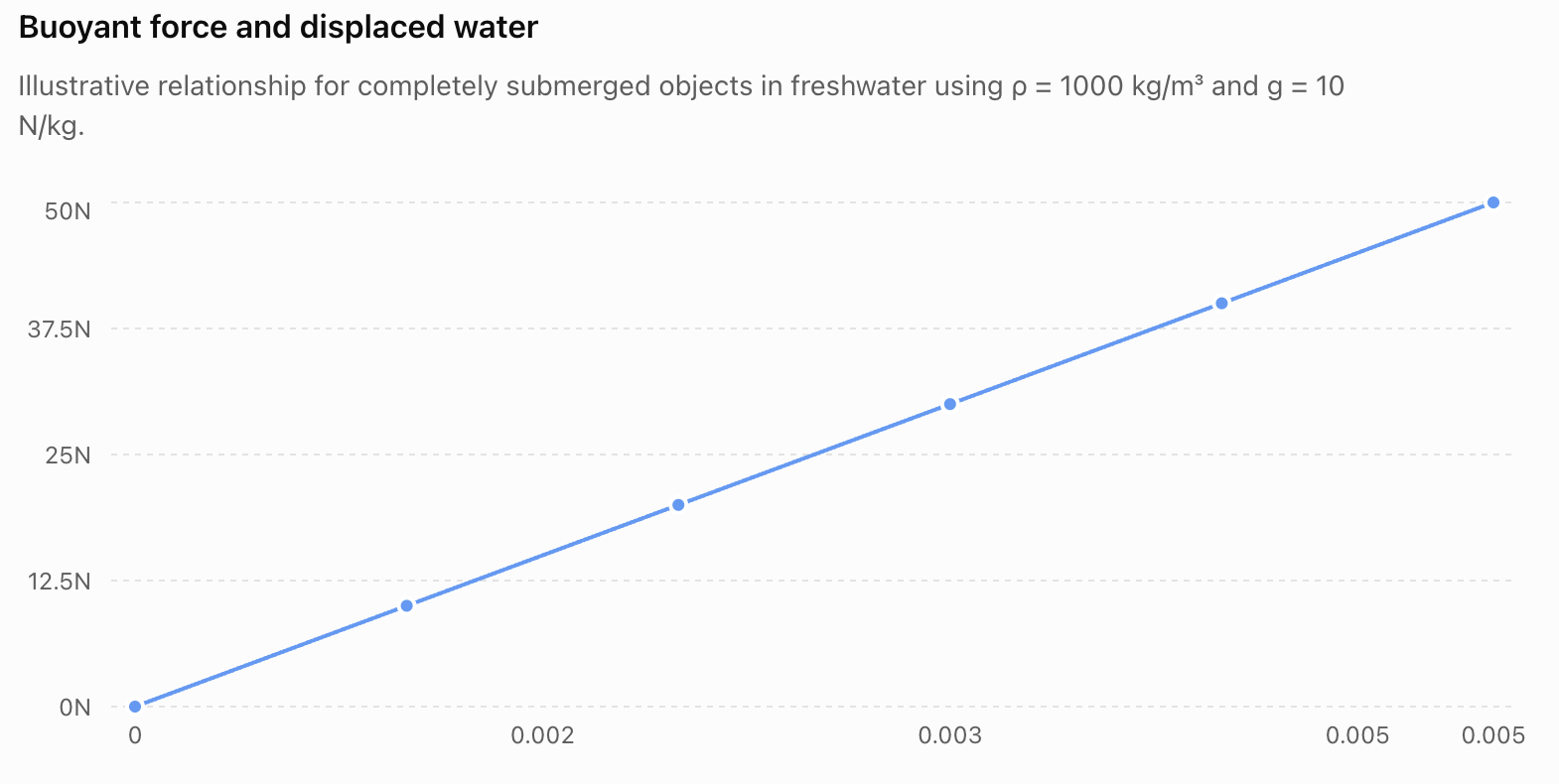
Buoyant force ∝ displaced volume
Comparing Displaced Volume and Buoyant Force
Consider completely submerged objects in freshwater.
Using ρ = 1000 kg/m³ and g = 10 N/kg: