Ethics and Future Biotechnology
2. Cloning
Learning outcomes
- I can explain the process of cloning.
- I can distinguish between reproductive and therapeutic cloning.
- I can describe potential applications of cloning technology.
- I can evaluate ethical concerns associated with cloning.
- I can assess the scientific limitations of cloning.
Introduction
Imagine being able to produce a new plant with exactly the same genetic characteristics as its parent, create genetically identical laboratory animals for medical research, or produce specialized cells that could potentially repair damaged human tissues.
These possibilities are connected to cloning, an important area of modern biotechnology.
Cloning is the process of producing genetically identical or nearly identical copies of biological material, such as DNA, cells, or entire organisms.
Although cloning is often associated with science fiction, it already occurs naturally and has many practical applications in agriculture, medicine, and scientific research.
Cloning also raises important scientific and ethical questions. Just because scientists can produce genetically similar organisms does not necessarily mean that every application is safe, practical, or ethically acceptable.
What Is Cloning?
A clone is a cell, organism, or piece of genetic material that has essentially the same genetic information as its source.
Cloning may occur naturally or through artificial techniques.
Natural cloning
Cloning occurs naturally when organisms reproduce without combining genetic material from two parents.
Examples include:
-
Bacteria: Many bacteria reproduce through binary fission, producing genetically very similar daughter cells.
-
Plants: Strawberry plants produce runners that develop into genetically identical plants.
-
Identical twins: Identical twins develop when an early embryo separates into two developing embryos.
Natural clones are not always perfectly identical. Mutations can arise during cell division, producing small genetic differences.
Artificial cloning
Artificial cloning involves scientific techniques used to produce copies of DNA, cells, or organisms.
There are three major types:
|
Type |
What is copied? |
Example |
|---|---|---|
|
Gene cloning |
A DNA sequence |
Producing copies of a gene for research |
|
Reproductive cloning |
An entire organism |
Dolly the sheep |
|
Therapeutic cloning |
Cells for research or potential treatment |
Producing patient-matched stem cells |
How Does Cloning Work?
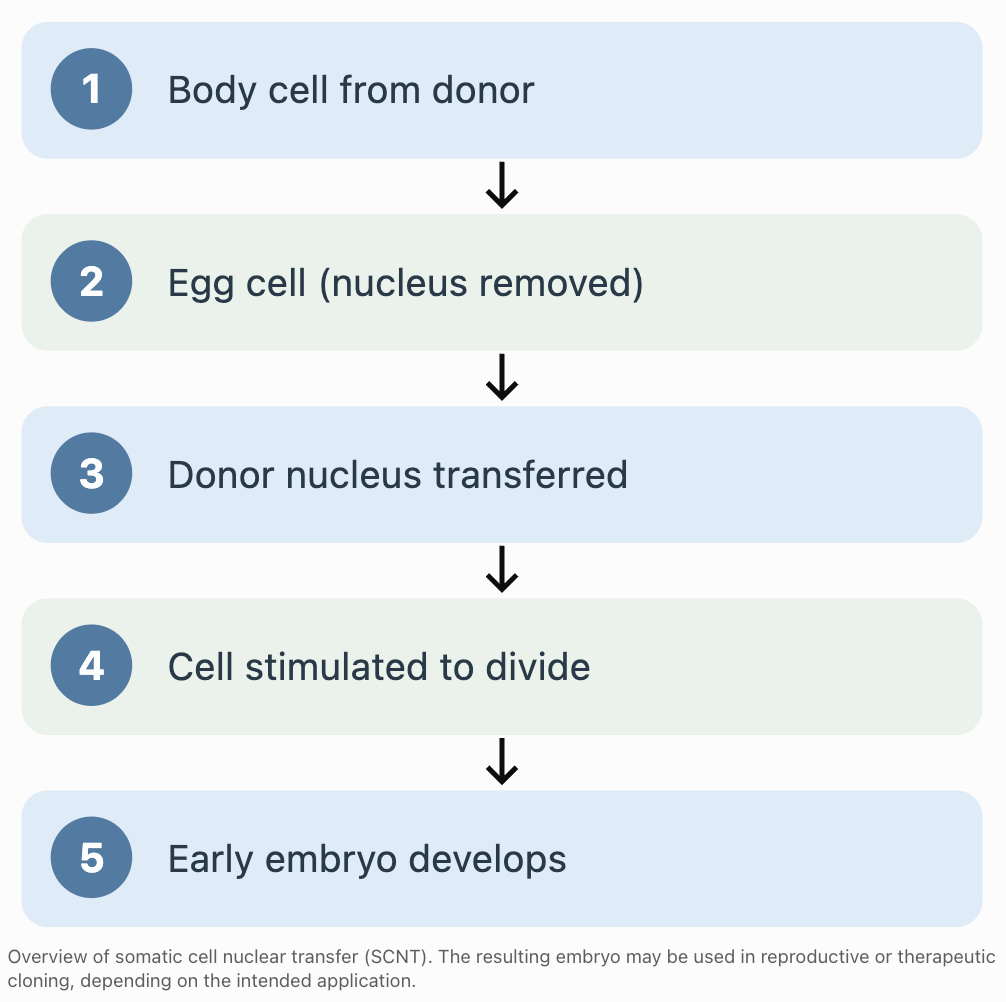
One of the most important techniques used in animal cloning is somatic cell nuclear transfer (SCNT).
A somatic cell is an ordinary body cell, such as a skin cell. Most somatic cells contain a complete set of nuclear genetic information.
In SCNT, scientists transfer the nucleus of a somatic cell into an egg cell whose nucleus has been removed.
Steps in somatic cell nuclear transfer
-
Collect a somatic cell. A body cell is obtained from the animal to be cloned.
-
Collect an egg cell. An unfertilized egg cell is obtained from a female animal.
-
Remove the egg nucleus. The egg's nuclear genetic material is removed.
-
Transfer the donor nucleus. The nucleus from the somatic cell is introduced into the enucleated egg.
-
Stimulate cell division. Electrical or chemical stimulation encourages the reconstructed cell to begin dividing.
-
Allow early embryo development. If successful, the cell develops into an early-stage embryo.
At this point, the procedure can follow different pathways depending on whether the purpose is reproductive or therapeutic cloning.
Important: The embryo's nuclear DNA comes primarily from the somatic cell donor. However, mitochondrial DNA generally comes from the egg donor. Therefore, the resulting organism is not necessarily genetically identical in every respect.
Reproductive Cloning
Reproductive cloning aims to produce an entire living organism with essentially the same nuclear genetic information as the donor.
Following SCNT, the early embryo is transferred into the uterus of a surrogate female, where it may implant and develop.
If development is successful, a cloned offspring is born.
Dolly the sheep
One of the most famous examples of reproductive cloning is Dolly the sheep.
Dolly was born in Scotland in 1996 and became famous because she was the first mammal successfully cloned from an adult somatic cell.
Scientists used a nucleus from an adult sheep's mammary gland cell and transferred it into an egg cell whose nucleus had been removed.
The resulting embryo was implanted into a surrogate sheep.
Dolly demonstrated that the nucleus of a specialized adult cell could be reprogrammed to support the development of an entire organism.
However, the experiment was inefficient. Researchers reconstructed 277 embryos, and only one resulted in Dolly's birth.
Applications of reproductive cloning
Reproductive cloning has several potential applications:
-
Producing animals with valuable agricultural characteristics.
-
Replicating genetically valuable research animals.
-
Preserving particular breeding lines.
-
Supporting some conservation breeding programs.
-
Studying embryonic development and genetic regulation.
Cloning is not a reliable method for restoring extinct species. Even when preserved genetic material is available, suitable egg cells, surrogate animals, and appropriate developmental conditions may be unavailable.
Therapeutic Cloning
Therapeutic cloning aims to produce cells that can be studied or potentially used to repair damaged tissues, rather than producing a new organism.
Therapeutic cloning may also use SCNT.
However, instead of implanting the embryo into a surrogate uterus, scientists allow it to develop to the blastocyst stage and derive embryonic stem cells from its inner cell mass.
These cells may then be grown in laboratory cultures.
Why are stem cells important?
Stem cells have two important characteristics:
-
Self-renewal: They can divide to produce additional stem cells.
-
Differentiation: They can develop into specialized cell types.
Embryonic stem cells are pluripotent, meaning they can develop into essentially all major body cell types.
Potential applications include:
-
Producing nerve cells for research into spinal cord injuries.
-
Studying insulin-producing cells for diabetes research.
-
Investigating heart muscle repair after heart attacks.
-
Testing medicines on cells with particular genetic characteristics.
-
Studying how specialized cells develop.
Most of these therapeutic-cloning applications remain experimental. Producing stem cells does not automatically mean that a safe, effective medical treatment is available.
Reproductive vs. therapeutic cloning
|
Feature |
Reproductive cloning |
Therapeutic cloning |
|---|---|---|
|
Main purpose |
Produce a new organism |
Produce cells for research or potential treatment |
|
SCNT used? |
Often |
Often |
|
Embryo implanted? |
Yes |
No |
|
Intended result |
Birth of an organism |
Stem-cell lines |
|
Main concern |
Animal welfare and developmental abnormalities |
Embryo use and cell safety |
Therapeutic cloning and iPSCs
Another important biotechnology is the production of induced pluripotent stem cells (iPSCs).
Scientists can reprogram specialized adult cells into a pluripotent-like state by introducing or activating particular factors.
Unlike therapeutic cloning through SCNT, iPSC production does not require creating an embryo.
This makes iPSCs an important alternative for some research and potential regenerative medicine applications.
However, iPSCs also have limitations, including risks of abnormal cell behavior and incomplete reprogramming.
Applications of Cloning Technology
Agriculture
Cloning can help reproduce animals with desirable characteristics, including:
-
High milk production.
-
Desirable meat characteristics.
-
Valuable breeding traits.
-
Disease resistance, where genetically determined.
Plant cloning through tissue culture can also produce large numbers of plants with desirable characteristics.
For example, tissue culture is used commercially to propagate bananas, orchids, and other valuable plants.
Medical research
Genetically similar animals or cell lines can help scientists investigate diseases under more controlled conditions.
Cloning can also support the production of cell cultures for studying gene function, drug responses, and development.
Conservation
Cloning has been investigated as a way to help preserve genetic material from rare or endangered animals.
For example, scientists have cloned black-footed ferrets using preserved cells.
However, cloning cannot replace habitat protection, effective breeding programs, or the preservation of genetic diversity.
Biotechnology
Gene cloning allows scientists to produce multiple copies of a selected DNA sequence.
This is useful in:
-
Genetic research.
-
Recombinant protein production.
-
DNA sequencing.
-
Developing genetically engineered organisms.
Gene cloning differs from reproductive cloning because it copies DNA rather than producing a complete organism.
Ethical Concerns Associated with Cloning
Cloning raises questions about the responsibilities of scientists, governments, and society.
Ethical decisions often involve weighing potential benefits against possible harms.
Animal welfare
Reproductive cloning can involve unsuccessful pregnancies, developmental abnormalities, and health complications.
Surrogate mothers and cloned offspring may experience suffering.
Ethical question: Is producing genetically valuable animals justified when the procedure may cause significant animal suffering?
Human reproductive cloning
Human reproductive cloning raises serious safety, social, and ethical concerns.
These include:
-
Risks to embryos, pregnant individuals, and offspring.
-
Questions about autonomy and informed consent.
-
Concerns about identity and family relationships.
-
Possible exploitation of individuals providing eggs or reproductive services.
There is no verified case of a human being successfully born through reproductive cloning.
Embryo use
Therapeutic cloning using SCNT involves creating an early embryo from which stem cells may be derived.
This raises questions about the moral status of embryos.
Different ethical and religious traditions assign different levels of moral significance to early human embryos.
Genetic diversity
Widespread use of genetically similar organisms may reduce genetic diversity within a population.
Lower genetic diversity can make populations more vulnerable to diseases or environmental changes.
Access and fairness
Cloning technologies can be expensive.
If their benefits are available only to wealthy individuals, companies, or countries, they may increase existing inequalities.
Evaluating ethical arguments
Consider the following example.
A company proposes cloning a valuable dairy cow to reproduce its desirable characteristics.
Arguments supporting the proposal:
-
It may improve agricultural productivity.
-
It could preserve valuable genetic traits.
-
It may support research into animal breeding.
Arguments opposing the proposal:
-
The procedure may cause animal suffering.
-
Success rates may be low.
-
Repeated cloning may reduce genetic diversity if used excessively.
-
Financial resources might be better invested in conventional breeding.
A balanced ethical evaluation considers the scientific evidence, potential benefits, risks, alternatives, and welfare of the organisms involved.
Scientific Limitations of Cloning
Although cloning technology has advanced considerably, it still faces major scientific challenges.
Low success rates
Many reconstructed embryos fail to develop normally.
Some fail before implantation, while others are lost during pregnancy.
Success rates vary considerably depending on the species, technique, and laboratory conditions.
Developmental abnormalities
Cloned animals may experience:
-
Abnormal placental development.
-
Excessive fetal growth.
-
Organ abnormalities.
-
Pregnancy complications.
-
Problems after birth.
These problems are not inevitable, but their possibility is an important limitation.
Epigenetic reprogramming
Cells contain chemical modifications that help regulate gene expression.
These modifications are known as epigenetic marks.
During normal development, many epigenetic patterns are reset.
In SCNT, the transferred adult nucleus must be reprogrammed to support embryonic development.
If this reprogramming is incomplete, gene expression may be abnormal.
This is one of the major biological reasons cloning can fail.
Genetic identity does not guarantee identical characteristics
Two organisms with essentially the same nuclear DNA may develop differently.
This is because characteristics are influenced by:
-
Environmental conditions.
-
Nutrition.
-
Epigenetic changes.
-
Random developmental events.
-
Mitochondrial differences.
For example, a cloned animal may have the same nuclear genetic information as its donor but different behavior, body size, or coat markings.
Cost and technical complexity
Cloning requires specialized equipment, trained scientists, egg cells, and suitable laboratory conditions.
Animal reproductive cloning may also require surrogate mothers and extensive veterinary care.
These requirements make cloning expensive and difficult to scale.
Limits of therapeutic cloning
Therapeutic cloning also faces scientific challenges.
Stem cells must be directed into appropriate specialized cell types, remain genetically stable, and function safely after transplantation.
There may be risks of unwanted cell growth, including tumor formation.
Even patient-matched cells are not guaranteed to avoid every immune response.
Worked Examples
Example 1: Identifying the type of cloning
A scientist transfers the nucleus of an adult sheep's skin cell into an egg whose nucleus has been removed. The resulting embryo is implanted into a surrogate sheep.
Question: What type of cloning is being attempted?
Answer: Reproductive cloning.
Explanation: The purpose is to produce an entire living animal rather than obtain stem cells for research.
Example 2: Calculating cloning success rate
A research laboratory reconstructs 240 embryos. Six result in live births.
Calculate the live-birth success rate.
Solution:
Success rate = (Number of live births ÷ Number of reconstructed embryos) × 100%
Success rate = (6 ÷ 240) × 100%
Success rate = 2.5%
Answer: The live-birth success rate is 2.5%.
This means that 97.5% of the reconstructed embryos did not result in live births. It does not mean that all failed at the same stage.
Example 3: Evaluating a scientific claim
A student says:
"Cloned animals must look and behave exactly like their donors because they have identical DNA."
Is the statement correct?
Answer: No.
Although cloned animals have essentially the same nuclear genetic information as their donors, environmental influences, epigenetic regulation, and developmental variation can produce differences.
Common Mistakes
|
Mistake |
Correct understanding |
|---|---|
|
Cloning always involves producing an entire organism. |
Cloning can involve DNA, cells, or organisms. |
|
Cloned organisms are identical in every way. |
Genetic similarity does not guarantee identical appearance or behavior. |
|
Reproductive and therapeutic cloning have the same purpose. |
Reproductive cloning aims to produce an organism; therapeutic cloning aims to obtain cells. |
|
Cloning always succeeds. |
Many cloning attempts fail, and success varies by species and technique. |
|
Therapeutic cloning is already a routine cure for major diseases. |
Most therapeutic-cloning applications remain experimental. |
|
Cloning increases genetic diversity. |
Repeated copying of existing genotypes does not introduce new genetic diversity. |
|
Dolly was the first animal ever cloned. |
Dolly was the first mammal cloned from an adult somatic cell. |
Key Terms
-
Clone: A genetically identical or nearly identical copy of biological material.
-
Cloning: The production of copies of DNA, cells, or organisms.
-
Somatic cell: A body cell other than a reproductive cell.
-
Somatic cell nuclear transfer (SCNT): Transfer of a body-cell nucleus into an egg cell whose nucleus has been removed.
-
Enucleated egg: An egg cell from which the nucleus has been removed.
-
Reproductive cloning: Cloning intended to produce a living organism.
-
Therapeutic cloning: Cloning intended to obtain cells for research or potential medical treatment.
-
Stem cell: A cell capable of self-renewal and differentiation.
-
Pluripotent: Capable of producing essentially all major body cell types.
-
Differentiation: Development of specialized cell characteristics.
-
Induced pluripotent stem cell (iPSC): A specialized cell reprogrammed into a pluripotent-like state.
-
Epigenetics: Study of changes in gene activity that do not require changes in the DNA sequence.
-
Surrogate mother: Female that carries a pregnancy involving an embryo produced from another source.
-
Genetic diversity: Variation in genetic information within a population.
-
Bioethics: Study of ethical questions arising from biology, medicine, and biotechnology.
Key Takeaways
-
Cloning produces genetically identical or nearly identical biological material.
-
Natural cloning occurs in bacteria, plants, and identical twins.
-
Somatic cell nuclear transfer involves transferring a body-cell nucleus into an egg whose nucleus has been removed.
-
Reproductive cloning aims to produce an entire organism.
-
Therapeutic cloning aims to obtain cells for research or potential treatment.
-
Cloning has applications in agriculture, medicine, conservation, and biotechnology.
-
Ethical concerns include animal welfare, embryo use, human safety, genetic diversity, and fairness.
-
Scientific limitations include low success rates, developmental abnormalities, epigenetic reprogramming, and high costs.
-
Cloned organisms may differ in appearance and behavior despite having essentially identical nuclear DNA.
-
Cloning is a powerful technology, but its applications require careful scientific and ethical evaluation.
Check Your Understanding
Question 1
What is cloning?
Answer: Cloning is the process of producing genetically identical or nearly identical copies of DNA, cells, or organisms.
Question 2
Explain the purpose of somatic cell nuclear transfer.
Answer: SCNT transfers the nucleus of a body cell into an egg whose nucleus has been removed. The reconstructed cell can then be stimulated to divide and potentially develop into an embryo.
Question 3
What is the main difference between reproductive and therapeutic cloning?
Answer: Reproductive cloning aims to produce an entire living organism. Therapeutic cloning aims to obtain cells for research or potential medical treatment.
Question 4
Why was Dolly the sheep scientifically important?
Answer: Dolly demonstrated that the nucleus of a specialized adult cell could be reprogrammed to support the development of an entire mammal.
Question 5
Give two possible applications of cloning technology.
Answer: Cloning can reproduce valuable agricultural animals and produce cells for medical research. Other applications include plant propagation, genetic research, and conservation.
Question 6
Why might two cloned animals develop different characteristics?
Answer: Environmental influences, epigenetic differences, mitochondrial DNA, and random developmental events can affect their characteristics.
Question 7
Explain one ethical concern associated with reproductive cloning.
Answer: Animal welfare is a major concern because reproductive cloning may involve failed pregnancies, developmental abnormalities, and suffering among surrogate mothers or cloned offspring.
Question 8
Why is epigenetic reprogramming important in cloning?
Answer: The transferred nucleus must be reprogrammed so that its genes function appropriately during embryonic development. Incomplete reprogramming can cause abnormal development or cloning failure.
Question 9
A laboratory reconstructs 500 embryos, and 15 result in live births. Calculate the success rate.
Solution:
Success rate = (15 ÷ 500) × 100%
Success rate = 3%
Answer: 3%.
Question 10
A scientist claims that cloning endangered animals will automatically prevent extinction. Evaluate this statement.
Answer: The statement is incorrect. Cloning may help preserve valuable genetic material, but it does not solve habitat loss, disease, reduced genetic diversity, or other threats. Conservation requires a combination of approaches, including habitat protection and sustainable breeding programs.
Final Reflection
Cloning illustrates an important principle of biotechnology: scientific capability and ethical responsibility must develop together.
The ability to copy genetic material, produce organisms, or generate specialized cells creates valuable opportunities, but every application must be evaluated in terms of safety, effectiveness, environmental consequences, and ethical acceptability.