Biotechnology in Agriculture and Industry
3. Fermentation Technologies
Learning outcomes
- I can explain the process of fermentation.
- I can identify products made using fermentation.
- I can describe the role of microorganisms in fermentation.
- I can explain industrial applications of fermentation technology.
- I can evaluate the importance of fermentation in biotechnology.
Fermentation is one of humanity's oldest forms of biotechnology. Long before people understood microorganisms, they were using them to make bread, cheese, yogurt, fermented vegetables, and beverages.
Today, fermentation is much more than a traditional food-making process. Scientists and engineers grow microorganisms and other cells under carefully controlled conditions to manufacture products ranging from enzymes and food ingredients to medicines, biofuels, and industrial chemicals.
The central idea is simple:
living cells + suitable nutrients + controlled conditions → useful products


What Is Fermentation?
The word fermentation can be used in two related ways.
In cellular biology, fermentation is a metabolic process that allows cells to regenerate NAD⁺ so that glycolysis can continue when oxygen-dependent respiration is unavailable.
In biotechnology, fermentation is often used more broadly to describe the controlled cultivation of microorganisms or cells to produce useful substances.
This distinction is important because an industrial "fermentation" process does not always have to be anaerobic.
Industrial fermentation may involve:
- bacteria
- yeast
- fungi
- cultured animal cells
- cultured plant cells
The organisms or cells are grown under conditions designed to maximize production of a desired product.
Microorganisms as Tiny Factories
Microorganisms need resources to grow and reproduce.
These can include:
- a carbon source such as glucose
- nitrogen
- minerals
- water
- appropriate temperature
- suitable pH
Microorganisms use these materials in their metabolism.
During this metabolism, they may produce substances that humans find useful.
A useful model is:
nutrients
↓
microorganism
↓
metabolism
↓
useful product
The microorganism acts almost like a microscopic chemical factory.


Cellular Fermentation
Cells normally obtain energy from glucose.
The first stage is glycolysis, which occurs in the cytoplasm.
During glycolysis:
glucose → pyruvate
A small amount of ATP is produced.
If oxygen-dependent respiration cannot continue, some cells use fermentation pathways to regenerate NAD⁺.
Two important pathways are:
- alcoholic fermentation
- lactic acid fermentation
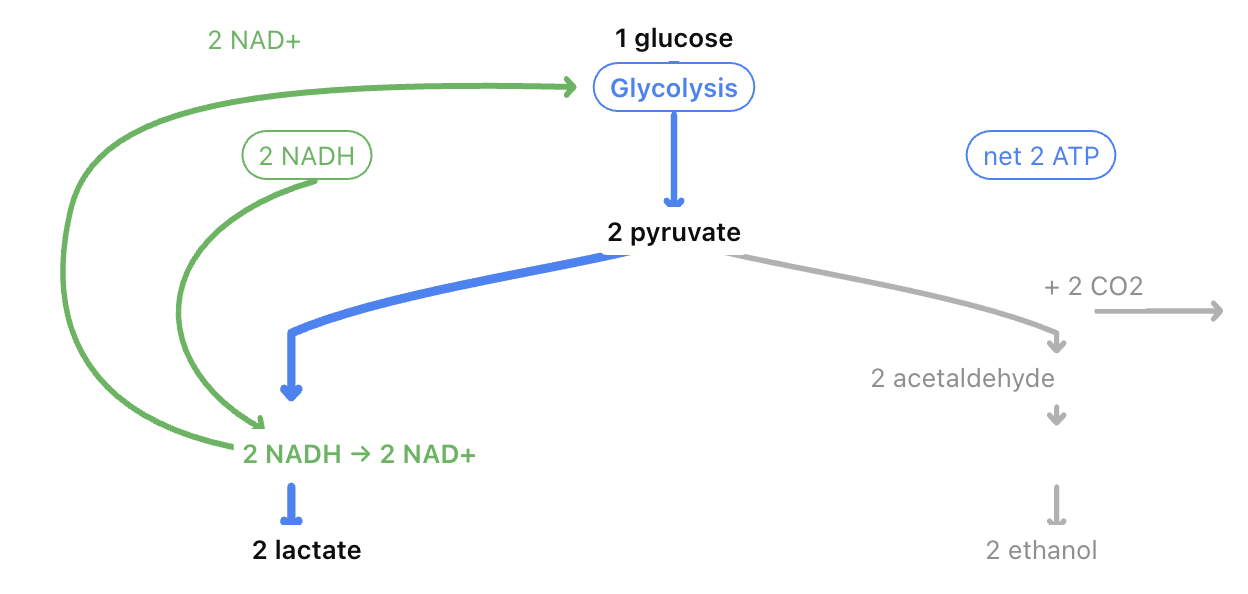
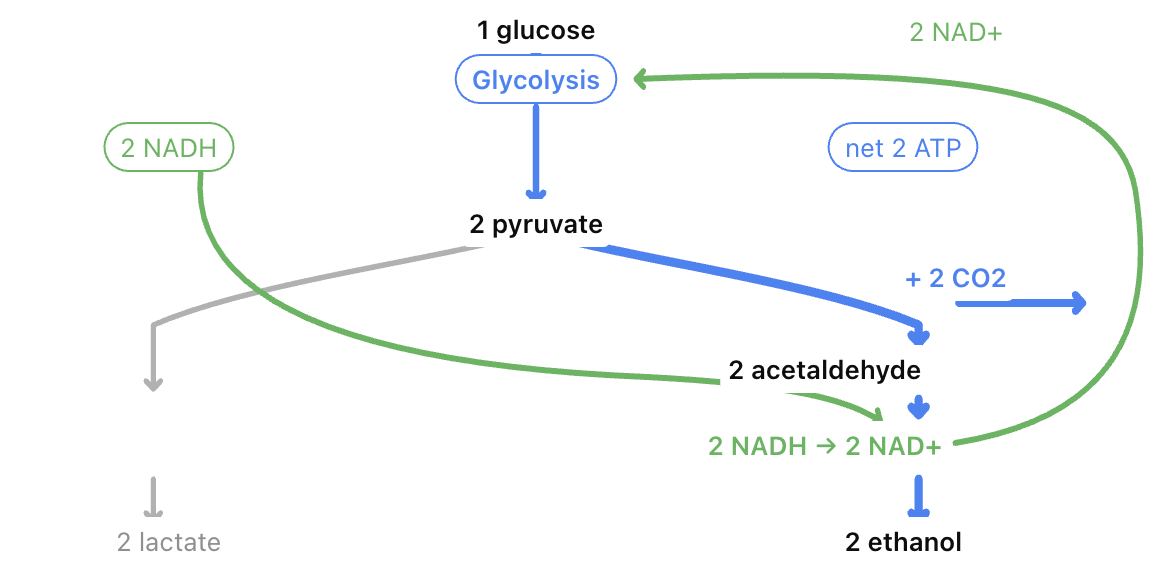
The regeneration of NAD⁺ is important because glycolysis requires NAD⁺.
Without it, glycolysis would eventually stop.
Alcoholic Fermentation
Yeast can carry out alcoholic fermentation.
A simplified overall representation is:
glucose → ethanol + carbon dioxide + energy
The ATP associated with this process is produced during glycolysis.
Yeast fermentation is extremely important in:
- bread making
- brewing
- wine production
- bioethanol production


Yeast
Yeasts are single-celled fungi.
One of the most widely used species is Saccharomyces cerevisiae.
This species has been used extensively in:
- baking
- brewing
- winemaking
- biotechnology research
Yeast is useful because it:
- grows relatively quickly
- can use sugars as an energy source
- is relatively easy to culture
- produces useful fermentation products
Fermentation in Bread
Bread provides an everyday example of biotechnology.
Yeast is mixed into dough containing carbohydrates.
The yeast metabolizes available sugars.
During fermentation:
sugar → carbon dioxide + ethanol
The important product for bread making is carbon dioxide.


Carbon dioxide becomes trapped in the dough.
The gas forms bubbles, causing the dough to:
- expand
- rise
- develop a lighter texture
During baking, much of the ethanol and water evaporates, gases expand, and the structure of the bread becomes fixed.
Why Does Bread Dough Rise Faster When Warm?
Microorganisms contain enzymes.
Like other enzymes, yeast enzymes are affected by temperature.
At low temperatures:
enzyme activity is relatively slow
As temperature increases toward a suitable range:
metabolic reactions become faster
However, if the temperature becomes too high:
proteins can lose function and yeast cells can be damaged or killed
Therefore:
Warmer does not always mean better.
There is an optimum range for yeast activity.
Lactic Acid Fermentation
Some microorganisms use pathways that produce lactate.
A simplified representation is:
glucose → lactate + energy
Again, the ATP comes from glycolysis, while fermentation regenerates NAD⁺.
Lactic acid bacteria are particularly important in food biotechnology.
They are used in products such as:
- yogurt
- some cheeses
- fermented vegetables
- other cultured foods
Yogurt Production
Yogurt is produced using particular bacteria that ferment sugars in milk.


A simplified process is:
milk
↓
starter bacteria added
↓
bacteria metabolize lactose
↓
organic acids accumulate
↓
pH decreases
↓
milk proteins change
↓
yogurt texture and flavour develop
The microorganisms therefore change both the chemistry and physical properties of the food.
Starter Cultures
A starter culture contains selected microorganisms used to begin a fermentation.
Instead of relying on random microorganisms from the environment, producers introduce organisms with known characteristics.
Starter cultures help provide:
- predictable fermentation
- consistent flavour
- consistent texture
- appropriate acid production
- improved control over the process
This is an important difference between traditional uncontrolled fermentation and modern industrial production.
Cheese Production
Microorganisms also play important roles in cheese making.
Different microorganisms contribute to:
- acid production
- flavour
- aroma
- texture
- ripening


Different combinations of:
- microorganisms
- temperature
- moisture
- salt
- time
help produce the enormous variety of cheeses found around the world.
Fermented Vegetables
Vegetables can also be fermented by microorganisms.
Examples include:
- sauerkraut
- kimchi
- some pickles
Lactic acid bacteria convert available sugars into organic acids.
As acidity increases, conditions become less favourable for many spoilage microorganisms.
Fermentation therefore contributes to both:
flavour
and
food preservation.
Fermentation and Food Preservation
Before refrigeration, fermentation provided an important method of preserving food.
Microorganisms involved in fermentation can change conditions by producing:
- acids
- alcohol
- other antimicrobial compounds
These changes can make the environment unsuitable for some competing microorganisms.
Fermentation may therefore:
fresh food → microbial activity → chemical changes → longer usable storage
However, fermentation does not mean that any food left at room temperature automatically becomes safe.
Controlled organisms and appropriate conditions are essential.
Industrial Fermentation
Traditional fermentation can occur in a bowl, jar, barrel, or dough.
Industrial biotechnology requires much greater control.
Large-scale processes commonly use vessels called fermenters or bioreactors.

A bioreactor provides a controlled environment in which cells can grow and produce a desired substance.
The Bioreactor
A bioreactor is a vessel designed to maintain suitable conditions for biological processes.
Depending on the process, engineers may control:
- temperature
- pH
- nutrient concentration
- oxygen supply
- stirring
- pressure
- foam
- microorganism concentration
Sensors continuously monitor conditions.
Control systems can then make adjustments.
A modern bioreactor is therefore much more sophisticated than simply placing microorganisms into a tank.
Temperature Control
Microorganisms depend on enzyme-controlled reactions.
Temperature affects the rates of these reactions.
If temperature is:
too low → metabolism slows
optimal → efficient growth and production
too high → enzymes and cells may be damaged
Microorganisms also produce heat as they metabolize nutrients.
Large industrial fermenters may therefore require cooling systems.
pH Control
Microorganisms usually grow best within particular pH ranges.
Fermentation itself can change pH.
For example, microorganisms producing organic acids can make the culture increasingly acidic.
Sensors measure pH.
If necessary, substances can be added to keep conditions within an appropriate range.
This creates a feedback system:
pH measured → control system responds → pH adjusted
Oxygen Supply
Some industrial microorganisms require oxygen.
Others operate under low-oxygen or anaerobic conditions.
When oxygen is needed, sterile air can be pumped into the fermenter.


Oxygen supply can become challenging in large fermenters because oxygen must move:
air → liquid → microorganism
Engineers therefore use:
- aeration
- mixing
- carefully designed impellers
to improve oxygen transfer.
Stirring and Mixing
Industrial fermenters often contain impellers that rotate and mix the contents.
Mixing helps distribute:
- microorganisms
- nutrients
- oxygen
- heat
Without adequate mixing, different parts of a large tank could develop different conditions.
One region might have plenty of glucose while another has very little.
Industrial biotechnology therefore requires both biology and engineering.
Sterility
One major challenge in industrial fermentation is contamination.
Imagine a company wants to grow Microorganism A.
If Microorganism B enters the fermenter, it might:
- consume nutrients
- produce unwanted chemicals
- reduce yield
- destroy the product
- create safety problems
Equipment, air supplies, nutrients, and transfer systems may therefore need careful sterilization or contamination control.


A single contamination event in a large industrial batch can be extremely expensive.
Batch Fermentation
In batch fermentation, microorganisms and nutrients are placed into a vessel and allowed to react for a period of time.
A simplified process is:
fermenter prepared
↓
nutrients added
↓
microorganisms added
↓
fermentation occurs
↓
product collected
↓
fermenter cleaned
↓
next batch begins
Batch systems are relatively straightforward and widely used.
Continuous Fermentation
In continuous fermentation, fresh nutrients are continuously supplied while culture material and products are continuously removed.
A simplified model is:
fresh nutrients → bioreactor → product/culture removed
Advantages may include:
- continuous production
- high productivity
- reduced downtime
However, continuous systems can be more difficult to control.
A contamination event can also persist through the production system.
Fed-Batch Fermentation
Another important method is fed-batch fermentation.
The process begins with microorganisms and some nutrients.
Additional nutrients are then added gradually.
Why not add everything at the beginning?
Very high nutrient concentrations can sometimes:
- inhibit cells
- change metabolism
- produce unwanted by-products
Controlled feeding can help maintain favourable conditions.
Fed-batch processing is widely used in industrial biotechnology.
Industrial Production Process
Industrial fermentation usually involves more than the fermentation itself.
A complete production chain may look like:
microorganism selected
↓
starter culture prepared
↓
bioreactor sterilized
↓
nutrients added
↓
culture introduced
↓
conditions controlled
↓
product produced
↓
product separated
↓
product purified
↓
quality tested
↓
packaged
The stages after fermentation are called downstream processing.
Downstream Processing
The desired product may be mixed with:
- microorganisms
- water
- nutrients
- waste products
- other molecules
Therefore, the product must often be separated and purified.
Possible techniques include:
- filtration
- centrifugation
- precipitation
- chromatography
- crystallization
For some biotechnology products, purification can be one of the most expensive parts of production.
Fermentation and Medicines
Microorganisms can manufacture medically important substances.
One famous example is antibiotic production.
Certain microorganisms naturally produce substances that inhibit competing microorganisms.


These compounds can be produced industrially using controlled fermentation.
The product must then be:
- extracted
- purified
- tested
- formulated into medicine
Penicillin
Penicillin was originally discovered from a fungus belonging to the genus Penicillium.
Industrial production eventually required scientists and engineers to develop methods for growing large quantities of the fungus under controlled conditions.
The process illustrates the relationship between:
microbiology + chemistry + engineering + medicine
A naturally produced microbial molecule became a major pharmaceutical product through fermentation technology.
Recombinant Proteins
Genetic engineering can be combined with fermentation.
Scientists can insert a human gene into microorganisms.
The modified microorganisms can then produce the corresponding human protein.
A major example is human insulin.


A simplified process is:
human insulin gene identified
↓
gene introduced into production cells
↓
engineered cells cultured
↓
protein produced
↓
protein harvested
↓
purification
↓
quality testing
This connects genetic engineering directly with industrial fermentation.
Enzyme Production
Microorganisms are also used to manufacture enzymes.
Industrial enzymes may be used in:
- food processing
- detergents
- textiles
- paper production
- pharmaceuticals
- biotechnology laboratories
Examples include:
- amylases
- proteases
- lipases
- lactase
Microorganisms are useful because they can often produce enzymes rapidly and at large scale.
Example: Lactase
Lactase breaks lactose into simpler sugars.
It can be produced using microorganisms and used to manufacture lactose-reduced or lactose-free dairy products.
The process demonstrates an important biotechnology chain:
microorganism
↓
enzyme production
↓
enzyme purified
↓
enzyme added during food processing
↓
lactose broken down
The microorganism itself does not necessarily need to be present in the final food.
Organic Acids
Fermentation can manufacture useful organic acids.
One important example is citric acid.
Although citric acid occurs naturally in citrus fruits, much commercial citric acid is produced using microbial fermentation.


Citric acid is widely used in:
- foods
- beverages
- pharmaceuticals
- cleaning products
This demonstrates that industrial fermentation can sometimes be more practical than extracting a substance directly from natural sources.
Bioethanol
Yeast fermentation can also produce ethanol for use as a fuel.
Sugar-rich materials can be fermented:
sugar → ethanol + carbon dioxide
The ethanol is then separated and purified.
Bioethanol can be produced from materials such as:
- sugar cane
- sugar beet
- maize-derived sugars
- other plant biomass after suitable processing
Biofuels and Sustainability
Biofuels are sometimes described as renewable because the starting biomass can be regrown.
However, environmental evaluation should consider the entire production system.
Questions include:
- How much land is required?
- How much water is used?
- What fertilizers are needed?
- How much energy is required for processing?
- Does production compete with food crops?
- What are the total greenhouse gas emissions?
Therefore:
biological origin ≠ automatically environmentally sustainable
Precision Fermentation
Modern biotechnology increasingly uses precision fermentation.
In precision fermentation, microorganisms can be genetically engineered to manufacture particular molecules.
Examples can include:
- proteins
- enzymes
- flavour compounds
- food ingredients
- pharmaceutical molecules
The process combines:
genetic engineering
microbial fermentation
industrial bioprocessing
The microorganism is programmed to act as a biological production system.
Scaling Up
A process that works in a laboratory flask does not automatically work equally well in a 100,000-litre industrial vessel.
This is called the scale-up problem.


As fermenters become larger, engineers must consider:
- mixing
- heat transfer
- oxygen transfer
- pressure
- contamination
- sensor placement
For example, the centre of a huge fermenter may experience different conditions from regions near the walls.
Scale-up therefore requires extensive engineering.
Optimizing Fermentation
Suppose scientists want microorganisms to produce as much Product X as possible.
They could investigate:
- temperature
- pH
- glucose concentration
- oxygen concentration
- nutrient supply
- mixing rate
- fermentation time
This is an example of optimization.
The goal is not necessarily to produce the largest number of microorganisms.
The goal may instead be to maximize:
desired product per unit time or cost
Growth and Product Formation
Microbial populations typically pass through several stages.
Lag Phase
Cells adapt to their environment.
Exponential Phase
Cells divide rapidly.
Stationary Phase
Population growth slows as nutrients become limited and wastes accumulate.
Death Phase
The number of living cells declines.
Some useful products are produced mainly during rapid growth.
Others may be produced most strongly when growth slows.
Therefore, industries must know when to harvest their product.
Fermentation and the Circular Economy
Fermentation technologies can sometimes use biological waste materials as raw materials.
Possible feedstocks include:
- agricultural residues
- food-processing waste
- plant biomass
Microorganisms may convert these materials into:
- fuels
- chemicals
- enzymes
- food ingredients
This supports the idea of a circular economy, where waste from one process becomes a resource for another.
Why Is Fermentation Important in Biotechnology?
Fermentation has several major advantages.
Rapid Reproduction
Microorganisms can grow quickly.
Large-Scale Production
Bioreactors can produce large quantities of material.
Controlled Conditions
Temperature, pH, nutrients, and oxygen can be optimized.
Wide Range of Products
Microorganisms can produce foods, enzymes, medicines, fuels, and chemicals.
Genetic Engineering
Microorganisms can be engineered to produce molecules they would not normally make.
Renewable Feedstocks
Some processes can use plant-based or waste-derived materials.
Limitations of Industrial Fermentation
Fermentation technology also has challenges.
Contamination
Unwanted microorganisms can destroy a batch.
Energy Use
Heating, cooling, stirring, aeration, purification, and sterilization require energy.
Downstream Processing
Separating and purifying products can be difficult and expensive.
Waste
Fermentation can generate:
- unused biomass
- wastewater
- metabolic waste
Scale-Up
Processes may behave differently in industrial equipment than in laboratory experiments.
Cost
Bioreactors, sensors, sterile systems, and skilled staff can be expensive.
Worked Example 1: Bread
A student prepares two identical bread mixtures.
Mixture A: kept at 10°C
Mixture B: kept at 30°C
After one hour, Mixture B has risen much more.
Explain why.
Answer
At 30°C, the yeast enzymes generally function more rapidly than at 10°C.
The yeast therefore metabolizes sugar faster and produces carbon dioxide more quickly.
The carbon dioxide becomes trapped in the dough, causing it to rise.
However, increasing temperature indefinitely would not continue increasing the rate because excessive heat damages the yeast.
Worked Example 2: Yogurt
During yogurt production, the pH decreases.
Why?
Answer
Bacteria metabolize sugars in the milk and produce organic acids.
As acid accumulates:
pH decreases
The changing pH affects milk proteins and contributes to yogurt's:
- texture
- flavour
- preservation
Worked Example 3: Industrial Fermenter
A company notices that microorganisms near the top of a fermenter grow well, but cells deeper in the vessel grow poorly.
The microorganisms require oxygen.
Suggest one possible cause and solution.
Answer
Possible cause: insufficient oxygen transfer or mixing.
Possible solution: increase appropriate aeration or improve mixing.
The goal is to distribute oxygen throughout the culture more effectively.
Worked Example 4: Production Rate
A fermenter produces 2,400 kg of Product X during a 48-hour fermentation.
Average production rate:
production rate = amount produced ÷ time
= 2,400 kg ÷ 48 h
= 50 kg/h
If optimization increases production to 3,000 kg in the same time:
3,000 ÷ 48 = 62.5 kg/h
Increase in production rate:
62.5 − 50 = 12.5 kg/h
Worked Example 5: Evaluating a New Process
A company develops a fermentation process that produces a chemical from agricultural waste.
Compared with conventional production, it:
- uses less fossil-fuel feedstock
- produces less hazardous waste
- requires substantial electricity for aeration
- costs 15% more
- uses renewable agricultural waste
Is the fermentation process automatically more sustainable?
Answer
No.
The evidence is promising, but a complete evaluation should consider:
- source of electricity
- total energy use
- greenhouse gas emissions
- transportation
- waste production
- resource use
- economic cost
A full life-cycle assessment would provide stronger evidence.
Common Mistakes
Mistake 1: "Fermentation only makes alcohol."
Fermentation technologies produce many substances, including:
- foods
- organic acids
- enzymes
- medicines
- fuels
Mistake 2: "Fermentation always requires yeast."
Many bacteria and fungi are also used.
Mistake 3: "All fermentation happens without oxygen."
Cellular fermentation pathways are associated with conditions where oxygen-dependent respiration is unavailable, but industrial biotechnology uses the term fermentation more broadly. Many industrial fermentation processes are aerobic.
Mistake 4: "Microorganisms are always harmful."
Many microorganisms are harmless or beneficial and are extremely important in biotechnology.
Mistake 5: "Fermentation itself produces large amounts of ATP."
In cellular fermentation, the ATP associated with the pathway is produced during glycolysis. Fermentation primarily regenerates NAD⁺.
Mistake 6: "Higher temperature always makes fermentation faster."
Only within an appropriate range.
Excessive temperatures can damage enzymes and kill microorganisms.
Mistake 7: "A fermenter is simply a large container."
Industrial fermenters contain systems for monitoring and controlling biological conditions.
Mistake 8: "The microorganism is always the final product."
Often the microorganism produces another substance that is harvested and purified.
Mistake 9: "If a microorganism produces a medicine, the medicine can immediately be used."
The product usually requires extensive separation, purification, and quality testing.
Mistake 10: "Biological production is automatically sustainable."
The entire process—including energy, materials, land use, waste, and purification—must be evaluated.
Check Your Understanding
1. Fermentation
Explain fermentation in your own words.
Why is fermentation important to microorganisms under conditions where oxygen-dependent respiration cannot continue?
2. Products
Identify six products or product types that can be produced using fermentation technology.
For each, identify the microorganism or type of microorganism involved where possible.
3. Bread
Explain how yeast causes bread dough to rise.
Include:
- glucose
- fermentation
- carbon dioxide
- gas bubbles
4. Yogurt
Explain how microorganisms change milk into yogurt.
Why does the pH decrease?
5. Industrial Fermenters
Identify five conditions that may need to be controlled inside an industrial fermenter.
Explain why each is important.
6. Sterility
Why is contamination a major problem in industrial fermentation?
Suggest two ways contamination could enter a fermenter.
7. Genetic Engineering
Explain how genetic engineering and fermentation can be combined to manufacture a human protein such as insulin.
8. Scale-Up
Why might a fermentation process that works well in a 1-L laboratory flask not work equally well in a 100,000-L industrial fermenter?
9. Sustainability
Give two potential environmental advantages and two possible environmental disadvantages of industrial fermentation.
10. Challenge
A biotechnology company develops a genetically engineered bacterium that converts agricultural waste into a useful industrial chemical.
Laboratory results show:
- high product yield
- rapid bacterial growth
- agricultural waste can be used as the carbon source
- large amounts of oxygen are required
- the product requires extensive purification
- industrial-scale production has not yet been tested
Evaluate the potential of this technology.
Include:
Potential benefits
Technical challenges
Environmental considerations
Evidence still required
Key Terms
- Fermentation – metabolic process that regenerates NAD⁺ without oxygen-dependent respiration; also used industrially for controlled cultivation of microorganisms or cells
- Microorganism – microscopic organism such as a bacterium or yeast
- Yeast – single-celled fungus widely used in fermentation
- Alcoholic fermentation – pathway producing ethanol and carbon dioxide while regenerating NAD⁺
- Lactic acid fermentation – pathway producing lactate while regenerating NAD⁺
- Glycolysis – pathway that breaks glucose into pyruvate and produces a small amount of ATP
- Starter culture – selected microorganisms used to begin a fermentation
- Bioreactor – controlled vessel used for biological production
- Fermenter – bioreactor used for fermentation processes
- Aeration – supplying air or oxygen to a culture
- Impeller – rotating device used to mix material inside a bioreactor
- Sterility – absence of unwanted living microorganisms
- Contamination – unwanted microorganisms entering a culture
- Batch fermentation – production system in which a batch is grown and harvested
- Continuous fermentation – system in which nutrients are continuously supplied and material continuously removed
- Fed-batch fermentation – process in which nutrients are gradually added during cultivation
- Downstream processing – recovery and purification of a biological product after production
- Bioethanol – ethanol produced from biological materials
- Precision fermentation – use of selected or engineered microorganisms to produce specific molecules
- Scale-up – increasing a biological process from laboratory to industrial production
- Optimization – adjusting conditions to improve production
- Feedstock – raw material supplied to a biological or industrial process
- Cryopreservation – preservation at very low temperatures, often used to maintain production strains
- Life-cycle assessment – evaluation of environmental impacts across the stages of a product's life
Key Takeaways
- Fermentation is one of the oldest and most important forms of biotechnology.
- Microorganisms act as microscopic factories that convert nutrients into useful products.
- In cellular biology, fermentation regenerates NAD⁺, allowing glycolysis to continue when oxygen-dependent respiration is unavailable.
- Yeast performs alcoholic fermentation and is important in bread, beverage, and bioethanol production.
- Lactic acid bacteria are used to manufacture products such as yogurt, cheese, and fermented vegetables.
- Fermentation can preserve foods by changing environmental conditions such as pH.
- Industrial biotechnology uses fermenters or bioreactors to grow microorganisms under controlled conditions.
- Important variables include temperature, pH, nutrients, oxygen, mixing, and contamination control.
- Fermentation can be operated using batch, fed-batch, or continuous systems.
- The desired product often requires substantial downstream processing before it can be used.
- Industrial fermentation can produce antibiotics, enzymes, organic acids, recombinant proteins, food ingredients, chemicals, and biofuels.
- Genetic engineering can turn microorganisms into biological factories for products such as human insulin.
- Precision fermentation combines genetic engineering with controlled microbial production.
- Scaling fermentation from a laboratory flask to a large industrial bioreactor creates challenges involving oxygen transfer, mixing, heat removal, and contamination.
- Fermentation technologies can potentially use renewable or waste-derived feedstocks, but biological production is not automatically sustainable.
- The importance of fermentation lies in its ability to combine microbiology, genetics, chemistry, and engineering to manufacture useful products efficiently and at large scale.