Microorganisms in Industry and Biotechnology
1. Fermentation
Learning outcomes
- I can define fermentation.
- I can explain how microorganisms carry out fermentation.
- I can identify products made through fermentation.
- I can compare aerobic and anaerobic processes.
- I can explain the importance of fermentation in industry.


What Is Fermentation?
Fermentation is a process that allows cells to continue releasing energy from glucose when oxygen is unavailable or limited.
During fermentation, glucose is first partially broken down through:
glycolysis.
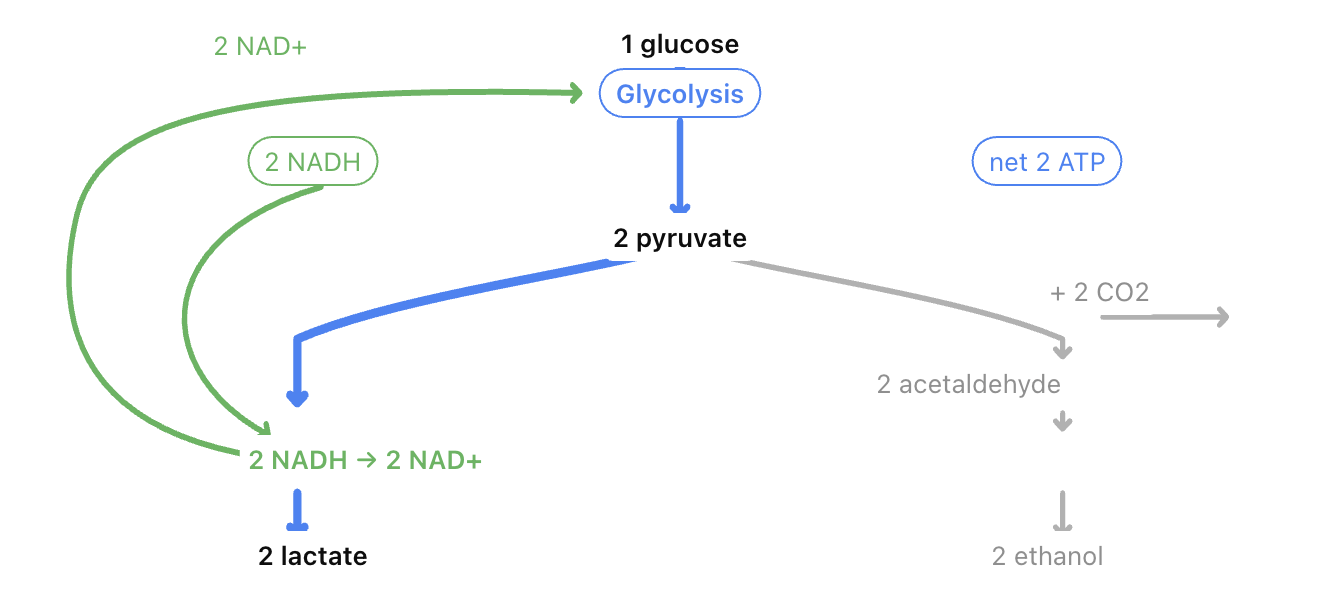
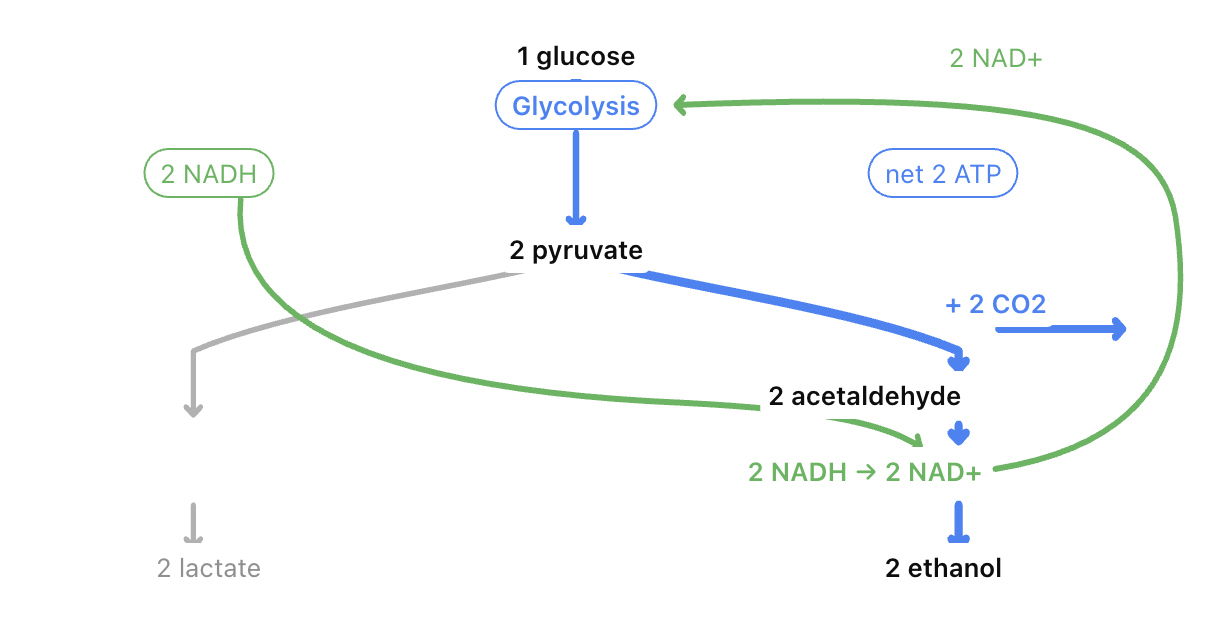
Glycolysis produces a small amount of ATP and molecules that carry high-energy electrons.
Fermentation then regenerates molecules needed for glycolysis to continue.
The overall process releases much less usable energy from glucose than:
aerobic respiration.
Why Do Cells Need Energy?
Living cells require energy for processes such as:
- growth
- movement
- active transport
- reproduction
- protein synthesis
- repair
Cells obtain usable energy through molecules of:
ATP (adenosine triphosphate).
Glucose is an important fuel that cells can break down to produce ATP.
Aerobic Respiration
When oxygen is available, many organisms use:
aerobic respiration.
A simplified word equation is:
glucose + oxygen → carbon dioxide + water + energy
Aerobic respiration releases a relatively large amount of energy from each glucose molecule.
Most stages occur in the:
mitochondria of eukaryotic cells.
What Happens Without Oxygen?
If oxygen is unavailable, aerobic respiration cannot continue normally.
However, some cells and microorganisms can continue producing a small amount of ATP through:
glycolysis followed by fermentation.
This is particularly important for:
- yeast
- certain bacteria
- muscle cells under some conditions
Glycolysis
Fermentation begins with:
glycolysis.
During glycolysis:
glucose → 2 pyruvate
A small amount of ATP is produced.
The net gain is:
2 ATP per glucose molecule.
Glycolysis occurs in the:
cytoplasm.
It does not directly require oxygen.
The Role of NAD+
Glycolysis also requires a molecule called:
NAD+.
During glycolysis, NAD+ accepts electrons and hydrogen and becomes:
NADH.
For glycolysis to continue, cells need to regenerate:
NAD+.
This is one of the main purposes of fermentation.
The Key Purpose of Fermentation
Fermentation allows:
NADH → NAD+
The regenerated NAD+ can return to glycolysis.
This means glycolysis can continue producing a small amount of:
ATP
even when oxygen is unavailable.
Two Important Types of Fermentation
Two commonly studied types are:
alcoholic fermentation
and
lactic acid fermentation.
Different organisms use different fermentation pathways.
Alcoholic Fermentation
Alcoholic fermentation is commonly carried out by:
yeast.
After glycolysis, pyruvate is converted into:
ethanol and carbon dioxide.
A simplified overall word equation is:
glucose → ethanol + carbon dioxide + energy
Only a small amount of ATP is produced, and that ATP comes from glycolysis.


Yeast
Yeast is a type of single-celled fungus.
Yeast can use sugars as an energy source.
Under suitable conditions with limited oxygen, yeast carries out alcoholic fermentation.
Important products include:
- ethanol
- carbon dioxide
Humans have used yeast fermentation for thousands of years.
Fermentation in Bread Making
Yeast is added to bread dough.
The yeast uses sugars and produces:
carbon dioxide.
The carbon dioxide becomes trapped in the dough as bubbles.
This causes the dough to:
rise.
During baking, the structure of the bread becomes fixed.
Why Does Bread Have Holes?
The holes visible inside bread are related to gas bubbles produced during:
fermentation.
Yeast produces carbon dioxide.
The dough traps some of this gas.
Therefore:
yeast fermentation → CO₂ production → gas bubbles → dough rises


Fermentation in Brewing
Yeast fermentation is also used to produce alcoholic beverages such as:
- beer
- wine
- cider
Yeast converts sugars into:
ethanol and carbon dioxide.
Different microorganisms, raw materials, temperatures, and fermentation conditions influence the final product.
Fermentation in Wine Production
Grapes contain sugars.
Yeast uses these sugars during fermentation.
The simplified process is:
grape sugars → yeast fermentation → ethanol + carbon dioxide
Other chemical reactions contribute to the:
flavor and aroma of the final product.
Fermentation in Beer Production
Beer production begins with materials containing carbohydrates, commonly malted grains.
These provide sugars that yeast can ferment.
The yeast produces:
ethanol + carbon dioxide.
The brewing process carefully controls:
- yeast strain
- temperature
- sugar concentration
- fermentation time
These variables influence the final product.
Lactic Acid Fermentation
Another important pathway is:
lactic acid fermentation.
In this process, pyruvate is converted to:
lactate.
This regenerates NAD+, allowing glycolysis to continue.
A simplified representation is:
glucose → lactate + energy
Again, the small ATP yield comes from:
glycolysis.


Lactic Acid Bacteria
Certain bacteria carry out lactic acid fermentation.
These microorganisms are extremely important in food production.
They can convert sugars into:
lactic acid.
The increasing acidity changes:
- taste
- texture
- microbial growth
- preservation characteristics
Yogurt Production
Yogurt is produced using:
lactic acid bacteria.
The bacteria ferment lactose, a sugar found in milk.
They produce:
lactic acid.
The increasing acidity causes milk proteins to change structure.
This contributes to yogurt's:
- thick texture
- acidic taste
- characteristic flavor


Cheese Production
Microorganisms also play important roles in:
cheese making.
Lactic acid bacteria ferment sugars in milk.
The resulting changes in acidity help create conditions needed for cheese formation.
Different cheeses use different:
- microorganisms
- temperatures
- aging conditions
- processing methods
These produce different textures and flavors.
Fermented Vegetables
Lactic acid fermentation can be used to produce foods such as:
- sauerkraut
- kimchi
- some pickles
Naturally occurring or deliberately added microorganisms convert sugars in the vegetables into:
lactic acid.
The acidic environment helps inhibit many unwanted microorganisms.
Fermentation and Food Preservation
Before refrigeration, fermentation was an important method of:
food preservation.
Fermentation can change environmental conditions so that some spoilage organisms and pathogens find it more difficult to grow.
For example, fermentation may:
- lower pH
- produce ethanol
- alter nutrient availability
- produce antimicrobial compounds
Fermentation can therefore help extend the useful life of certain foods.
Fermentation in Human Muscles
Human muscle cells can also produce lactate when energy demand is high and oxygen-dependent metabolism cannot supply ATP rapidly enough.
Glycolysis can continue because NAD+ is regenerated.
This allows rapid but limited ATP production.
The process is particularly important during:
intense exercise.
Does Lactic Acid Cause Muscle Soreness?
A common misconception is that lactate remaining in muscles causes soreness for several days after exercise.
This is incorrect.
Lactate levels generally fall relatively quickly after exercise.
Delayed muscle soreness is mainly associated with microscopic muscle damage and the body's subsequent:
inflammatory and repair responses.
Aerobic vs Anaerobic Processes
Aerobic and fermentation pathways both begin with:
glucose.
However, they differ significantly.
Aerobic respiration
Requires oxygen:
Yes
Energy released:
Large amount
Breakdown of glucose:
More complete
Major end products:
carbon dioxide and water
Fermentation
Does not require oxygen:
Yes — it can proceed without oxygen
Energy released:
Small amount
Breakdown of glucose:
Incomplete
Possible products:
lactate
or
ethanol + carbon dioxide
Energy Yield
Aerobic respiration extracts much more energy from glucose than fermentation.
Fermentation depends on glycolysis, which provides a net:
2 ATP per glucose.
Aerobic respiration can produce many more ATP molecules from the same glucose molecule.
Therefore:
aerobic respiration is much more energy-efficient.
Why Is Fermentation Less Efficient?
During fermentation, glucose is not completely broken down.
Products such as:
ethanol or lactate
still contain considerable chemical energy.
In aerobic respiration, glucose is broken down much more completely.
More of its stored chemical energy can therefore be transferred to:
ATP.
Comparing the Locations
Glycolysis and fermentation
Occur in the:
cytoplasm
Most later stages of aerobic respiration in eukaryotes
Occur in the:
mitochondria
This means cells can carry out fermentation without relying on mitochondrial oxygen-dependent pathways.
Fermentation Conditions
Industrial fermentation requires carefully controlled conditions.
Important variables may include:
- temperature
- pH
- nutrient concentration
- oxygen availability
- microorganism strain
- fermentation time
- contamination
Changing these conditions can affect:
microbial growth and product yield.
Temperature
Microorganisms depend on enzymes.
At low temperatures:
enzyme activity and microbial metabolism may be slower.
As temperature rises toward an optimum:
reaction rates generally increase.
If the temperature becomes too high:
enzymes can lose function and microorganisms may die.
Industrial fermentation therefore requires careful temperature control.
pH
Microorganisms usually grow best within particular:
pH ranges.
Fermentation itself may change the pH.
For example, lactic acid bacteria produce acids that cause the environment to become:
more acidic.
Industrial systems may monitor or control pH to maintain suitable conditions.
Nutrients
Microorganisms require nutrients for:
- energy
- growth
- reproduction
- producing desired substances
Industrial fermentation therefore requires an appropriate:
growth medium.
This may contain:
- sugars
- minerals
- nitrogen sources
- vitamins
- other nutrients
Oxygen
Different industrial processes require different oxygen conditions.
Some microorganisms require oxygen for particular stages of growth.
Other processes are designed to maintain:
low-oxygen or anaerobic conditions.
Therefore, oxygen levels may need to be carefully monitored and controlled.
What Is a Fermenter?
A fermenter, also called a bioreactor, is a vessel in which microorganisms or cells are grown under controlled conditions.
Industrial fermenters can be used to manufacture large quantities of useful:
products.


Parts of an Industrial Fermenter
A fermenter may include systems for controlling:
- temperature
- pH
- oxygen
- nutrient supply
- mixing
- foam
- contamination
Sensors continually measure important conditions.
This allows operators or automated systems to maintain an environment suitable for the microorganisms.
Stirring
Large fermenters often contain:
stirrers or impellers.
Mixing helps distribute:
- nutrients
- microorganisms
- heat
- gases
Without mixing, different regions of the fermenter could develop very different:
conditions.
Temperature Control
Microbial metabolism produces:
heat.
If this heat accumulates, the temperature could become unsuitable.
Industrial fermenters therefore often use:
cooling systems.
These maintain temperatures close to the optimum for the microorganism and process.
Preventing Contamination
Industrial fermentation often uses carefully selected microorganisms.
If unwanted microorganisms enter the fermenter, they may:
- compete for nutrients
- reduce product yield
- produce unwanted chemicals
- spoil the product
- create safety problems
Equipment and growth media may therefore be:
sterilized.
Aseptic Conditions
Aseptic techniques are procedures designed to prevent unwanted microbial contamination.
Examples include:
- sterilizing equipment
- sterilizing growth media
- filtering incoming air
- maintaining sealed systems
- carefully controlling sampling
Contamination control is essential in many industrial fermentation processes.
Fermentation in Biotechnology
Industrial fermentation is not limited to food and beverages.
Microorganisms and cultured cells can also be used to manufacture:
- enzymes
- organic acids
- vitamins
- medicines
- biofuels
- food ingredients
This makes fermentation an important part of:
biotechnology.


Producing Enzymes
Microorganisms can be grown in fermenters to produce industrial:
enzymes.
These enzymes may be used in:
- food production
- detergents
- textile processing
- biotechnology
- medicine
Microbial production allows large quantities of enzymes to be manufactured efficiently.
Producing Medicines
Microorganisms can also be used to manufacture certain:
medicines.
For example, genetically engineered microorganisms can produce useful proteins.
A famous example is:
human insulin.
The microorganism is given genetic instructions for producing the desired protein and is then grown under controlled conditions.
Fermentation and Insulin
Scientists can insert the human insulin gene into microorganisms such as bacteria or yeast.
These genetically modified organisms can then produce insulin-related proteins while growing in industrial culture systems.
The product is collected and purified.
This combines:
genetic engineering + industrial biotechnology.
Antibiotic Production
Some antibiotics are produced naturally by:
microorganisms.
Industrial cultivation can be used to produce these substances in large quantities.
For example, species of the fungus Penicillium produce:
penicillin-related compounds.
The product must then be extracted and purified.
Organic Acids
Microorganisms are used industrially to produce organic acids.
Examples include:
- lactic acid
- citric acid
- acetic acid
These chemicals have applications in:
- food
- pharmaceuticals
- manufacturing
- biotechnology
Biofuels
Fermentation can also contribute to production of:
biofuels.
For example, yeast can ferment sugars obtained from plant material to produce:
ethanol.
The ethanol can be processed and used as a fuel or blended with other fuels.
Fermentation and Sustainability
Industrial fermentation may provide ways to produce materials using:
renewable biological resources.
Potential advantages can include:
- renewable raw materials
- relatively mild reaction conditions
- highly specific biological reactions
- production of complex molecules
However, sustainability depends on the entire production system, including:
- energy use
- land use
- water use
- raw materials
- waste production
Batch Fermentation
In batch fermentation, microorganisms and nutrients are placed into a fermenter.
The process runs for a particular period.
The product is then:
collected.
The fermenter can then be cleaned and prepared for another batch.
Continuous Fermentation
In continuous fermentation, fresh nutrients are continually supplied while some culture and product are continually removed.
This can allow production to continue for:
long periods.
However, maintaining stable conditions and preventing contamination can be challenging.
Why Industry Uses Microorganisms
Microorganisms are useful in industry because they can:
- reproduce rapidly
- use relatively inexpensive nutrients
- produce useful chemicals
- grow in controlled vessels
- be genetically modified
- operate under relatively mild conditions
They function like microscopic:
biological factories.
Traditional and Modern Fermentation
Humans used fermentation long before microorganisms were understood.
Traditional products include:
- bread
- yogurt
- cheese
- fermented vegetables
- alcoholic beverages
Modern biotechnology extends microbial production to:
- medicines
- enzymes
- industrial chemicals
- fuels
- specialized food ingredients
Worked Example 1
Yeast is placed in a sugar solution with limited oxygen.
What process can occur?
Alcoholic fermentation.
The yeast converts sugars into products including:
ethanol and carbon dioxide.
Worked Example 2
Why does bread dough rise?
Yeast ferments sugars and produces:
carbon dioxide.
The gas becomes trapped inside the dough.
Worked Example 3
Milk becomes acidic during yogurt production.
Why?
Lactic acid bacteria convert sugars into:
lactic acid.
The acid lowers the pH.
Worked Example 4
A student says fermentation produces as much ATP as aerobic respiration.
Is the student correct?
No.
Fermentation depends on glycolysis for ATP production and provides only a small ATP yield compared with aerobic respiration.
Worked Example 5
A fermenter becomes too hot.
Why might production decrease?
High temperatures may reduce enzyme function or kill the:
microorganisms.
This can decrease product yield.
Worked Example 6
An unwanted bacterium enters an industrial fermenter.
Why is this a problem?
The contaminating bacterium may:
- consume nutrients
- compete with the desired microorganism
- produce unwanted substances
- contaminate the final product
This is why industrial fermenters require strict:
contamination control.
Worked Example 7
A yeast culture produces ethanol from plant sugars.
What industrial application does this represent?
Production of:
bioethanol.
This is an example of using fermentation for biofuel production.
Worked Example 8
Why is NAD+ important during fermentation?
NAD+ is needed for:
glycolysis.
Fermentation regenerates NAD+ from NADH so glycolysis can continue producing ATP.
Comparing Aerobic Respiration and Fermentation
Oxygen
Aerobic respiration:
requires oxygen
Fermentation:
does not require oxygen
ATP yield
Aerobic respiration:
high
Fermentation:
low
Glucose breakdown
Aerobic respiration:
more complete
Fermentation:
incomplete
Main location in eukaryotic cells
Aerobic respiration:
glycolysis in cytoplasm; later stages mainly in mitochondria
Fermentation:
cytoplasm
Typical products
Aerobic respiration:
carbon dioxide + water
Alcoholic fermentation:
ethanol + carbon dioxide
Lactic acid fermentation:
lactate
Common Mistake: Fermentation Produces No Energy
Fermentation is associated with a small amount of ATP production because it allows:
glycolysis to continue.
The net ATP produced through glycolysis is:
2 ATP per glucose.
Common Mistake: Fermentation Produces ATP Directly
The fermentation reactions after glycolysis mainly regenerate:
NAD+.
The ATP associated with fermentation is actually produced during:
glycolysis.
Common Mistake: All Fermentation Produces Alcohol
Only certain fermentation pathways produce:
ethanol.
Lactic acid fermentation produces:
lactate.
Different microorganisms can produce many different fermentation products.
Common Mistake: Fermentation Is Only Used for Alcohol
Fermentation is important in:
- bread
- yogurt
- cheese
- fermented vegetables
- medicines
- enzymes
- chemicals
- biofuels
Its industrial importance extends far beyond alcoholic beverages.
Common Mistake: Fermentation and Aerobic Respiration Are Equally Efficient
Aerobic respiration releases much more usable energy from each glucose molecule.
Fermentation is useful because it allows ATP production through glycolysis to continue when:
oxygen-dependent respiration is unavailable or insufficient.
Common Mistake: Fermentation Always Requires Microorganisms
Many industrial and food fermentation processes use microorganisms.
However, some animal cells can also carry out:
lactic acid fermentation.
Human muscle cells are an example.
Check Your Understanding
1. Define fermentation.
2. What molecule is usually broken down during fermentation?
3. What process occurs before fermentation?
4. Where does glycolysis occur?
5. What is the net ATP gain from glycolysis?
6. What happens to glucose during glycolysis?
7. Why must NAD+ be regenerated?
8. Explain the role of fermentation in regenerating NAD+.
9. Name two major types of fermentation.
10. What organism commonly carries out alcoholic fermentation?
11. Name the two major products of alcoholic fermentation.
12. Explain why bread dough rises.
13. How is yeast fermentation used in brewing?
14. What is produced during lactic acid fermentation?
15. Name a food produced using lactic acid bacteria.
16. Explain how bacteria help produce yogurt.
17. How can fermentation help preserve food?
18. Compare the oxygen requirements of aerobic respiration and fermentation.
19. Which process produces more ATP per glucose: fermentation or aerobic respiration?
20. Explain why fermentation releases less usable energy from glucose.
21. Compare the products of aerobic respiration and alcoholic fermentation.
22. What is a fermenter?
23. Why must temperature be controlled in an industrial fermenter?
24. Why must pH be monitored during fermentation?
25. Why are nutrients added to fermenters?
26. Why is mixing important in large fermenters?
27. Why must contamination be prevented?
28. What is meant by aseptic technique?
29. Give three foods produced using fermentation.
30. Give three non-food products that can be produced using industrial biotechnology.
31. How can microorganisms be used to manufacture insulin?
32. How can fermentation contribute to biofuel production?
33. Why are microorganisms useful for industrial production?
34. Explain the difference between batch and continuous fermentation.
35. How does fermentation differ from aerobic respiration?
36. Explain why fermentation can continue without oxygen.
37. A fermenter suddenly reaches a temperature far above the microorganism's optimum. Predict what may happen.
38. A yogurt culture becomes increasingly acidic. Explain why.
39. Explain why fermentation is important to both traditional food production and modern biotechnology.
40. Evaluate the importance of fermentation in industry by giving at least three applications and explaining why microorganisms are useful for each.
Key Terms
- Fermentation: Process that regenerates NAD+ so glycolysis can continue when oxygen-dependent respiration cannot proceed normally.
- Glycolysis: Breakdown of glucose into pyruvate, producing a small amount of ATP.
- ATP: Molecule used by cells to transfer usable energy.
- NAD+: Electron carrier required during glycolysis.
- NADH: Reduced form of NAD+ produced during glycolysis.
- Aerobic respiration: Energy-releasing process that uses oxygen and breaks down glucose more completely.
- Anaerobic: Occurring without oxygen.
- Alcoholic fermentation: Fermentation pathway producing ethanol and carbon dioxide.
- Lactic acid fermentation: Fermentation pathway producing lactate.
- Yeast: Single-celled fungus commonly used in alcoholic fermentation.
- Lactic acid bacteria: Bacteria that produce lactic acid during fermentation.
- Fermenter: Vessel used to grow microorganisms or cells under controlled conditions.
- Bioreactor: Controlled vessel used for biological production processes.
- Aseptic technique: Procedures used to prevent unwanted microbial contamination.
- Culture medium: Nutrient-containing material used to grow microorganisms.
- Batch fermentation: Production system in which a fermentation process runs as a defined batch.
- Continuous fermentation: Production system in which nutrients are continuously supplied and culture or product is continuously removed.
- Biofuel: Fuel produced from biological material.
- Biotechnology: Use of organisms, cells, or biological processes to produce useful products.
Key Takeaways
- Fermentation allows glycolysis to continue when oxygen-dependent respiration cannot proceed normally.
- Glycolysis breaks glucose into pyruvate and produces a net 2 ATP per glucose.
- Fermentation regenerates NAD+, which is required for glycolysis.
- Fermentation itself does not provide the large ATP yield associated with aerobic respiration.
- Alcoholic fermentation produces ethanol and carbon dioxide.
- Yeast commonly carries out alcoholic fermentation.
- Carbon dioxide produced by yeast causes bread dough to rise.
- Lactic acid fermentation produces lactate.
- Lactic acid bacteria are important in yogurt, cheese, and fermented vegetable production.
- Fermentation can help preserve foods by changing environmental conditions such as pH.
- Aerobic respiration requires oxygen and releases much more usable energy from glucose.
- Fermentation can proceed without oxygen but produces a much smaller ATP yield.
- Industrial fermentation uses microorganisms as biological production systems.
- Fermenters allow temperature, pH, nutrients, gases, and other conditions to be controlled.
- Contamination must be carefully prevented during industrial fermentation.
- Microorganisms can produce foods, beverages, enzymes, medicines, organic acids, and biofuels.
- Modern biotechnology can combine genetic engineering with industrial microbial production.
- Fermentation has been used by humans for thousands of years and remains important in modern industry.
- Understanding fermentation connects cellular respiration, microbiology, food science, biotechnology, and industrial chemistry.