Reproduction, Immunity, and Health
1. The Reproductive System
Learning outcomes
- I can identify the major structures of the male and female reproductive systems.
- I can describe the functions of reproductive organs.
- I can explain the roles of sperm and egg cells in reproduction.
- I can describe the process of fertilization.
- I can explain the importance of the reproductive system for the continuation of a species.
Introduction
The ability to reproduce is one of the defining characteristics of living organisms. Reproduction allows parents to produce offspring, ensuring that a species continues from one generation to the next.
In humans, reproduction involves two specialized organ systems:
- The male reproductive system
- The female reproductive system
These systems produce sex cells (gametes), allow fertilization to occur, and support the development of a new individual.
Understanding how these systems work helps us appreciate human development, heredity, health, and the remarkable process by which new life begins.
What Is the Reproductive System?
The reproductive system is the collection of organs that enables organisms to produce offspring.
Its main functions are to:
- Produce reproductive cells (gametes).
- Produce reproductive hormones.
- Enable fertilization.
- Support the growth and development of a baby before birth.
Unlike the circulatory or respiratory systems, the reproductive system is not essential for the survival of an individual, but it is essential for the survival of the human species.
The Male Reproductive System
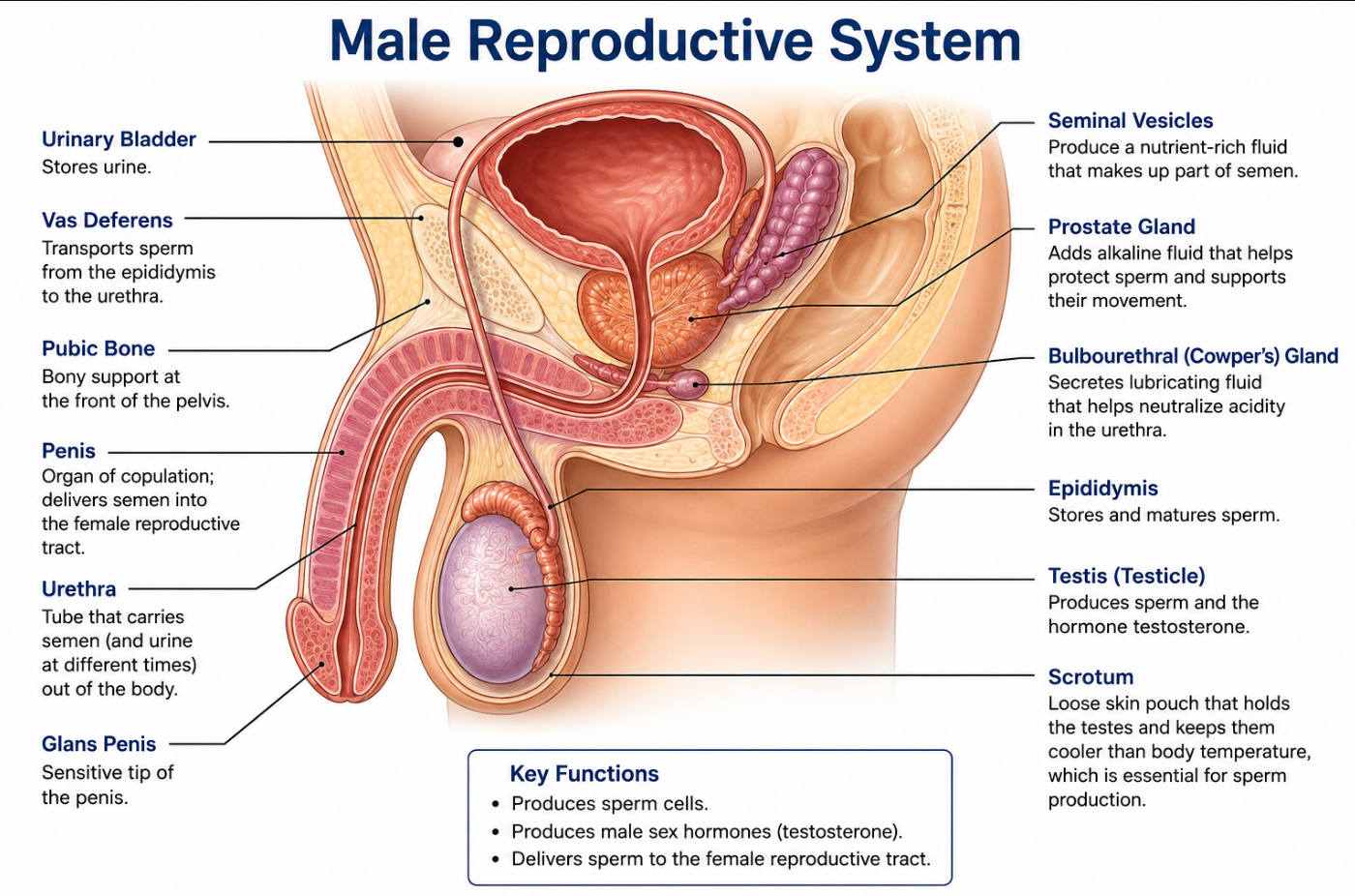
The male reproductive system produces and delivers sperm cells.
Main Structures
| Structure | Function |
|---|---|
| Testes | Produce sperm cells and the hormone testosterone. |
| Scrotum | Holds the testes outside the body to maintain the cooler temperature needed for sperm production. |
| Epididymis | Stores sperm while they mature. |
| Vas Deferens | Carries mature sperm toward the urethra. |
| Seminal Vesicles | Produce nutrient-rich fluid that forms part of semen. |
| Prostate Gland | Adds fluid that helps protect and transport sperm. |
| Urethra | Carries semen out of the body (and urine at different times). |
| Penis | Delivers semen into the female reproductive tract during reproduction. |
How the Male Reproductive System Works
- Sperm are produced continuously in the testes after puberty.
- They mature in the epididymis.
- During ejaculation, sperm mix with fluids from the seminal vesicles and prostate gland to form semen.
- Semen leaves the body through the urethra.
The Female Reproductive System
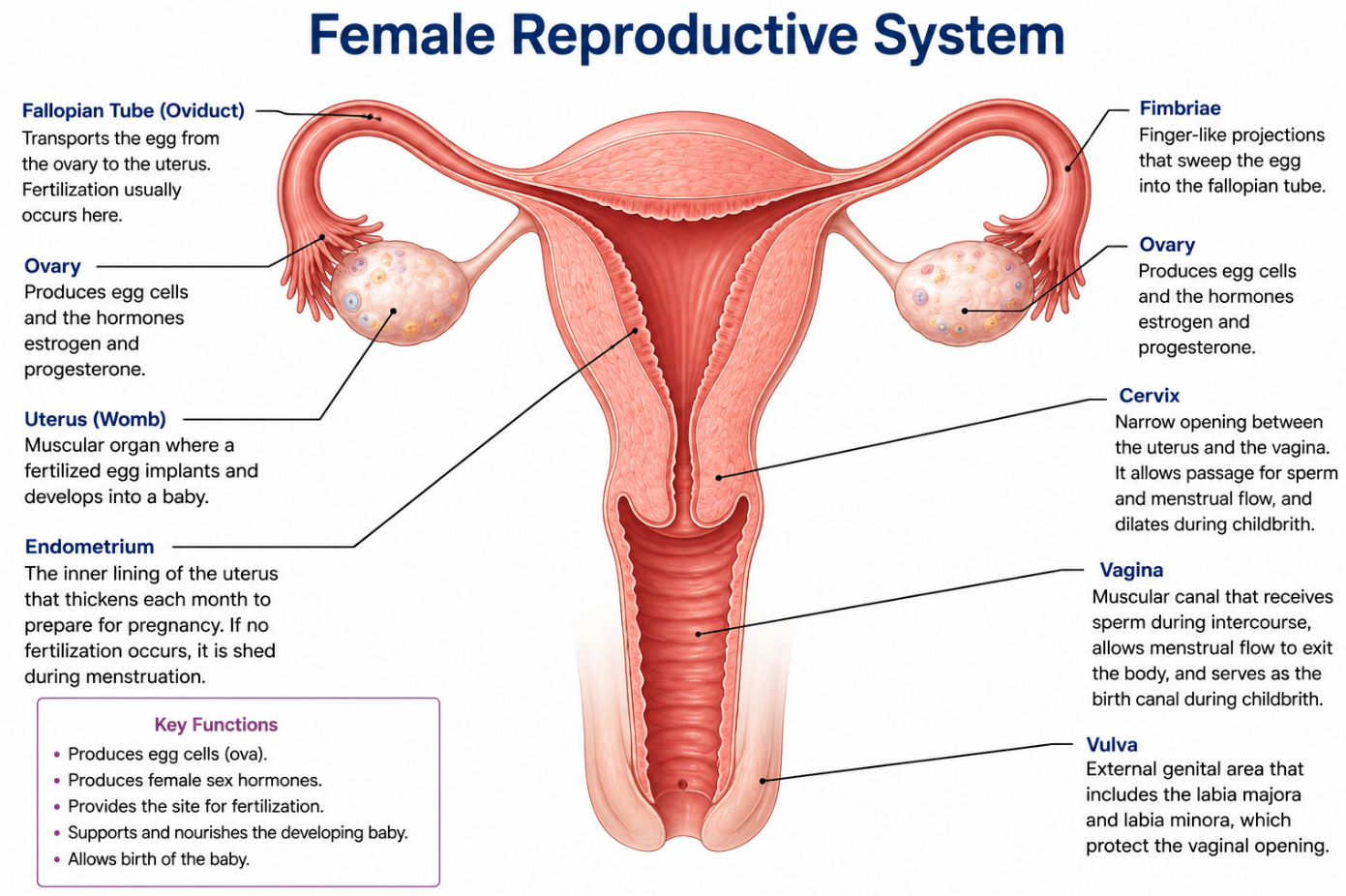
The female reproductive system produces egg cells and provides the environment in which a baby develops.
Main Structures
| Structure | Function |
|---|---|
| Ovaries | Produce egg cells and the hormones estrogen and progesterone. |
| Fallopian Tubes (Oviducts) | Carry the egg to the uterus and are usually where fertilization occurs. |
| Uterus (Womb) | Houses and nourishes the developing embryo and fetus. |
| Endometrium | The inner lining of the uterus that thickens each month to prepare for pregnancy. |
| Cervix | The narrow opening between the uterus and vagina. |
| Vagina | Receives sperm during reproduction and serves as the birth canal during childbirth. |
How the Female Reproductive System Works
- Usually one egg matures and is released from an ovary each month.
- The egg enters a fallopian tube.
- If fertilization occurs, the developing embryo implants in the uterus.
- If fertilization does not occur, the egg and uterine lining are shed during menstruation.
Sperm Cells
Sperm cells are the male reproductive cells.
Each sperm consists of:
- Head – contains the nucleus with genetic material (23 chromosomes).
- Acrosome – contains enzymes that help the sperm penetrate the egg.
- Midpiece – packed with mitochondria that provide energy.
- Tail (flagellum) – propels the sperm through fluid.
Characteristics of sperm:
- Very small
- Highly mobile
- Produced in large numbers
- Carry half of the genetic information needed to produce a new individual
Egg Cells
The egg cell (ovum) is the female reproductive cell.
Characteristics include:
- Much larger than a sperm cell.
- Contains stored nutrients for the early embryo.
- Usually one mature egg is released during each menstrual cycle.
- Contains 23 chromosomes.
Unlike sperm, egg cells do not move by themselves. Tiny hair-like structures called cilia help move the egg through the fallopian tube.


Comparing Sperm and Egg Cells
| Feature | Sperm Cell | Egg Cell |
|---|---|---|
| Produced by | Testes | Ovaries |
| Size | Very small | Large |
| Movement | Swims using a tail | Does not swim |
| Number Produced | Millions each day | Usually one released each month |
| Chromosomes | 23 | 23 |
Fertilization
Fertilization occurs when a sperm cell successfully joins with an egg cell.
In humans, fertilization normally occurs in a fallopian tube.
Steps in Fertilization
- Millions of sperm enter the female reproductive tract.
- One sperm reaches the egg.
- The sperm penetrates the egg's outer layer.
- The nuclei of the sperm and egg fuse.
- A zygote containing 46 chromosomes is formed.
The zygote contains half of its genetic information from each parent.
From Zygote to Embryo
After fertilization:
- The zygote divides repeatedly by mitosis.
- It travels along the fallopian tube.
- It reaches the uterus after several days.
- It attaches to the uterine lining in a process called implantation.
- It continues developing into an embryo, and later a fetus.
The uterus protects and nourishes the developing baby throughout pregnancy.


Reproductive Hormones
Several hormones control the reproductive system.
| Hormone | Function |
|---|---|
| Testosterone | Stimulates sperm production and male secondary sexual characteristics. |
| Estrogen | Regulates the menstrual cycle and female secondary sexual characteristics. |
| Progesterone | Maintains the uterine lining during pregnancy. |
These hormones become especially important during puberty, when the reproductive organs mature.


Why Is the Reproductive System Important?
The reproductive system is essential because it:
- Produces offspring.
- Passes genetic information to the next generation.
- Maintains populations.
- Ensures the continuation of the human species.
Without reproduction, every species would eventually become extinct.
Real-World Applications


Knowledge of the reproductive system is important in:
- Medicine
- Reproductive health
- Pregnancy and prenatal care
- Fertility treatments
- Genetics
- Human development
- Family planning
Understanding reproductive biology helps people make informed decisions about their health and wellbeing.
Worked Examples
Example 1
Which organ produces sperm cells?
Answer:
The testes.
Example 2
Where are egg cells produced?
Answer:
The ovaries.
Example 3
Where does fertilization usually occur?
Answer:
In a fallopian tube (oviduct).
Example 4
What is formed when a sperm cell fuses with an egg cell?
Answer:
A zygote.
Example 5
Why is the reproductive system important?
Answer:
Because it allows organisms to produce offspring and pass genetic information from one generation to the next, ensuring the continuation of the species.
Did You Know?
Although millions of sperm may begin the journey toward an egg during fertilization, only one sperm normally fertilizes the egg. Once fertilization occurs, the egg's outer membrane changes almost immediately to prevent any additional sperm from entering.
Key Terms
| Term | Definition |
|---|---|
| Reproductive System | The group of organs responsible for producing offspring. |
| Gamete | A reproductive (sex) cell such as a sperm or egg. |
| Sperm Cell | The male reproductive cell. |
| Egg Cell (Ovum) | The female reproductive cell. |
| Fertilization | The fusion of a sperm and an egg to form a zygote. |
| Zygote | The first cell formed after fertilization. |
| Embryo | The early stage of development after implantation. |
| Testes | Male organs that produce sperm and testosterone. |
| Ovaries | Female organs that produce egg cells, estrogen, and progesterone. |
| Uterus | The organ where a fertilized egg develops during pregnancy. |
Key Takeaways
- The male and female reproductive systems have different structures but work together during reproduction.
- The testes produce sperm cells, while the ovaries produce egg cells.
- Fertilization usually occurs in a fallopian tube, forming a zygote with 46 chromosomes.
- The developing embryo implants in the uterus, where it grows throughout pregnancy.
- Reproductive hormones regulate the development and function of the reproductive organs.
- The reproductive system ensures the continuation of the human species by producing offspring and passing genetic information to the next generation.