Natural Selection and Adaptation

5. Evolution Through Natural Selection

Learning outcomes
  • I can explain how natural selection leads to evolution.
  • I can describe changes in populations over generations.
  • I can explain why evolution occurs in populations rather than individuals.
  • I can interpret examples of evolutionary change.
  • I can connect variation, selection, and evolution.

What Is Evolution?

Evolution is a change in the inherited characteristics of a population over generations.

More specifically, evolution occurs when the frequencies of inherited genetic variants change within a population over time.

Natural selection is one of the major mechanisms that can cause evolution.

The basic sequence is:

Variation → selection pressure → differential reproductive success → inheritance → population change → evolution

https://images.openai.com/static-rsc-4/1c6hqqSYrAHJePJ-jUihfih_Zco7Wq9UzhKD0MPFQdwyOWEICBJyjGCroBfCqKD1xpRxHpz4QJ6IC-MSRgeW_1lYXS_ejwXjvzOdrigQWyeFalqtpQ-RgPzc8zdRdKY_pTbV76xE8kRInpkzS2Hx_73aY_n9_bJnUiCAKA2p_1vvIeVq2oj2gXAHOgzKz5xL?purpose=fullsize
 
https://images.openai.com/static-rsc-4/GDxIL8M6wuy1UOAp2aQm9OCvHVrpo4UEEIa0uCV3NaQeRhaC0ifZw4kqcX4s2txdEAXoTkk0EjGNWXqnA8wHeBHg4FrVx0I0A5B3ZnnE7yFK556c6czRZ8ZvK5JAmN_iLsUE9169J8P-FcmZDp7fEtLnRFtCwgtqIDdMO9WFMBFyxch5TxEzEhnbrB44GkF1?purpose=fullsize
 
https://images.openai.com/static-rsc-4/jsItTVeTVwSG8oGBqYaSPmqnyEq1UZUEcq8XTom3A88mFMF8KWTON-whoxkf8zHIWGlUsOib-bFkQmryAQHP2xCpU9D8Qk1JDSl7vXgib2Fa7VHhdLXuNWzQD8tJlRLU1xiqPw0s8J875qx0lVZylUaYEdtehJqQELXUu-iEVujzeiH_Icwg11p3zYPe9yiH?purpose=fullsize
 
6

Evolution does not mean that individual organisms transform into more advanced forms. It describes changes occurring in populations across generations.


Connecting Natural Selection and Evolution

Natural selection and evolution are closely related, but they are not exactly the same thing.

Natural selection is a process.

Evolution is population-level change across generations.

Natural selection can cause evolution when individuals with certain inherited characteristics reproduce more successfully than others.

Over many generations, the genetic variants associated with those characteristics may become more common.


The Basic Process

Consider a population containing inherited variation.

Some individuals have characteristics that provide an advantage under current environmental conditions.

The process can be described as:

1. Variation exists

Individuals within the population differ.

2. Some variation is inherited

Genetic differences can be passed from parents to offspring.

3. Selection pressures act

Environmental conditions affect survival and reproduction.

4. Reproductive success differs

Some individuals produce more surviving offspring than others.

5. Characteristics are inherited

Offspring inherit genetic variants from their parents.

6. The population changes

Advantageous variants become more common over generations.

That population-level change is evolution.


Variation Is the Starting Point

Natural selection requires variation.

Individuals may vary in:

  • Size.
  • Coloration.
  • Speed.
  • Disease resistance.
  • Beak shape.
  • Body structure.
  • Temperature tolerance.
  • Feeding ability.
  • Behavior.
https://images.openai.com/static-rsc-4/aVcj6quNAlRisB6z3b79-okO9wPbj5x0TomFL-Ho6yPFjqnOF38ODAuwAm7GhSrJrAnN5m8uWXo_4bXNu6bEkhTVoa29z5A0ttt7vKuEhbra8MMoBd5TOpbWetAVR3f6DnJPMTdBVTcyULCOFr6gmlTp8MZzejaPTSiddCdIei15zzQs-Yf_cC2-tlPGO9fC?purpose=fullsize
 
https://images.openai.com/static-rsc-4/RhrILQPybah2dKlY7V1Q5igFuZ85H8dX7HRjZHAWEbmPjznkm4X_dki6iur-1SgSqnYz6RetTCP6nD0JXXVykFNVDuJ4czlR8PCD6Azfk0iBFUDEJKETycirouDzztQTaBSU1UbpgJHaxvA1RBRn6sx2KEuClwplcX-kmz4PEBQ7WHIexEkSHkHf1f8hNYEN?purpose=fullsize
 
https://images.openai.com/static-rsc-4/pkhqNiX7CJ2-VsGWs83U4U45cTx2xXnhhJiFl05k5iRn78fqpab8PFXP2H4ooDPdCYEZXhMi2fyZdwlxBBac-uKY1FvXKPIodrLBgFuhFAY6EKh0nDqoGrghvBZuzF4-9twdz-qMP1cwYHRs8HElMafDAR_DhKliRveLt4fIw_sAdmqn1Mm_aNCLqHMS_XHF?purpose=fullsize
 
6

Without variation, individuals would respond similarly to selection pressures and natural selection would have little variation on which to act.


Heritable Variation

Not every difference between individuals contributes to evolution.

For natural selection to produce evolutionary change, the relevant variation must have a heritable component.

Heritable characteristics can be passed genetically from parents to offspring.

For example, genetic variation might influence:

  • Fur color.
  • Beak shape.
  • Disease resistance.
  • Body size.
  • Enzyme function.

If a characteristic is entirely caused by an individual's environment and cannot be inherited, natural selection cannot directly cause that acquired characteristic to spread genetically through a population.


Sources of Genetic Variation

Genetic variation arises through processes including:

  • Mutation.
  • Sexual reproduction.
  • Meiosis.
  • Genetic recombination.
  • Random fertilization.

A mutation is a change in DNA.

Mutations can introduce new genetic variants into populations.

Sexual reproduction reshuffles existing genetic variation, producing genetically different offspring.

Variation therefore provides the raw material on which natural selection can act.


Selection Pressures

A selection pressure is an environmental factor that influences reproductive success.

Examples include:

  • Predators.
  • Competition.
  • Disease.
  • Parasites.
  • Temperature.
  • Drought.
  • Food availability.
  • Water availability.
  • Antibiotics.
  • Pesticides.
  • Competition for mates.

Selection pressures determine which inherited characteristics provide advantages under particular conditions.


Differential Reproductive Success

Natural selection depends on differences in reproductive success.

Suppose two individuals survive equally long.

One produces ten surviving offspring.

The other produces none.

From an evolutionary perspective, the first individual contributes more of its genes to the next generation.

Therefore, natural selection is not simply about survival.

The key idea is:

Which individuals successfully pass their genes to future generations?


Evolution Occurs in Populations

An individual organism does not evolve through natural selection during its lifetime.

Instead:

Individuals have characteristics.

Individuals survive and reproduce.

Populations evolve.

Imagine a beetle population containing brown and green beetles.

A single green beetle does not gradually become brown because brown coloration would be useful.

Instead, if brown beetles reproduce more successfully, brown coloration may become increasingly common in later generations.

https://images.openai.com/static-rsc-4/RNAhOXAQl6vaChr72JducNbYukcyKn57wFwK8Ik3h_-m46UdgxUedbhOY-P-gkB1NKYmpgqfG0VRdnln4ARrOhMLFBJq0hjf9Tu7yP7BPkCVgrkmVJ_7jV1hQCpjlm02AlAh8zyvvK7jYrjZn8ZRv4nWR8iQrzb4EEQI5fOEnS8MoVAdwy_1iZeZwGDAuiZt?purpose=fullsize
 
https://images.openai.com/static-rsc-4/aVcj6quNAlRisB6z3b79-okO9wPbj5x0TomFL-Ho6yPFjqnOF38ODAuwAm7GhSrJrAnN5m8uWXo_4bXNu6bEkhTVoa29z5A0ttt7vKuEhbra8MMoBd5TOpbWetAVR3f6DnJPMTdBVTcyULCOFr6gmlTp8MZzejaPTSiddCdIei15zzQs-Yf_cC2-tlPGO9fC?purpose=fullsize
 
https://images.openai.com/static-rsc-4/ZUN-Mb-w4iNm3IG-xWijtJcwYmz0PI9wNavjnGZxWU-JZbwusLykA9CW0EzFa_hGrRjc9dIjGZE8UCiCz5rebwpQyy2qJq7eltlJhSLbUxVUy-fv0-5qGuLZCqp2y9Xb2ctbNbnmM937vMN-1hoZ_e1ExIve_gSCvo0djYpm56wu8gHjPnbCNlrsqDdtVbTF?purpose=fullsize
 
4

Evolution is therefore a change in the population, not a transformation of individual organisms.


Evolution Across Generations

Imagine a population containing an advantageous inherited genetic variant.

At first, the variant may be uncommon.

If individuals carrying it consistently reproduce more successfully, its frequency may increase.

For example:

Generation 1: advantageous variant is uncommon.

Generation 10: advantageous variant is more common.

Generation 50: advantageous variant may be very common.

The following visualization shows this simplified process. It models how a beneficial inherited variant can increase across generations when it provides a reproductive advantage.
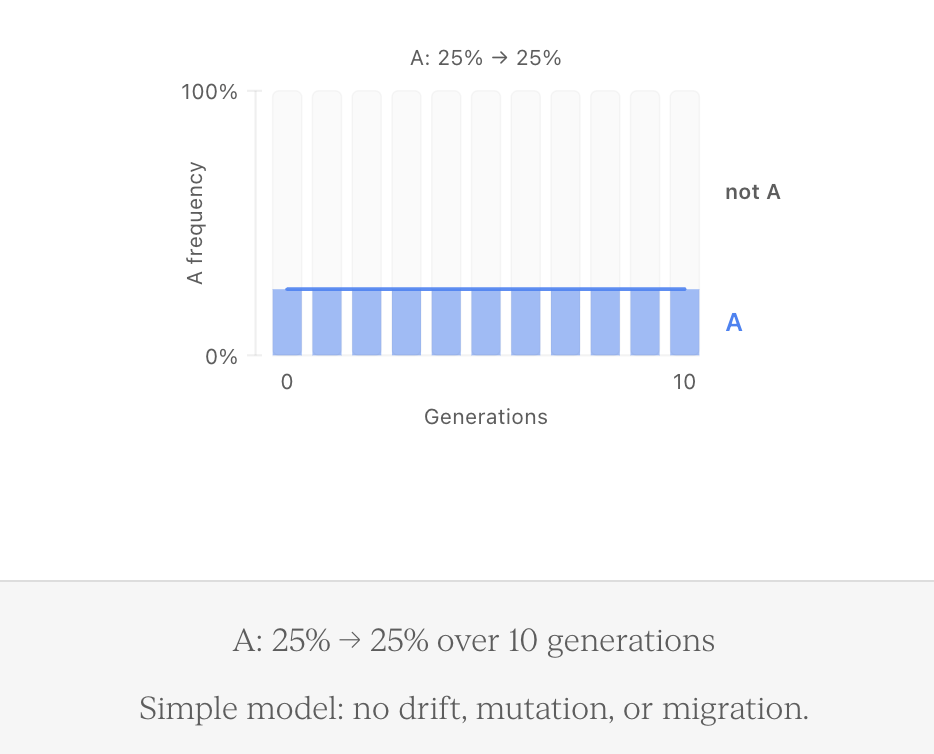
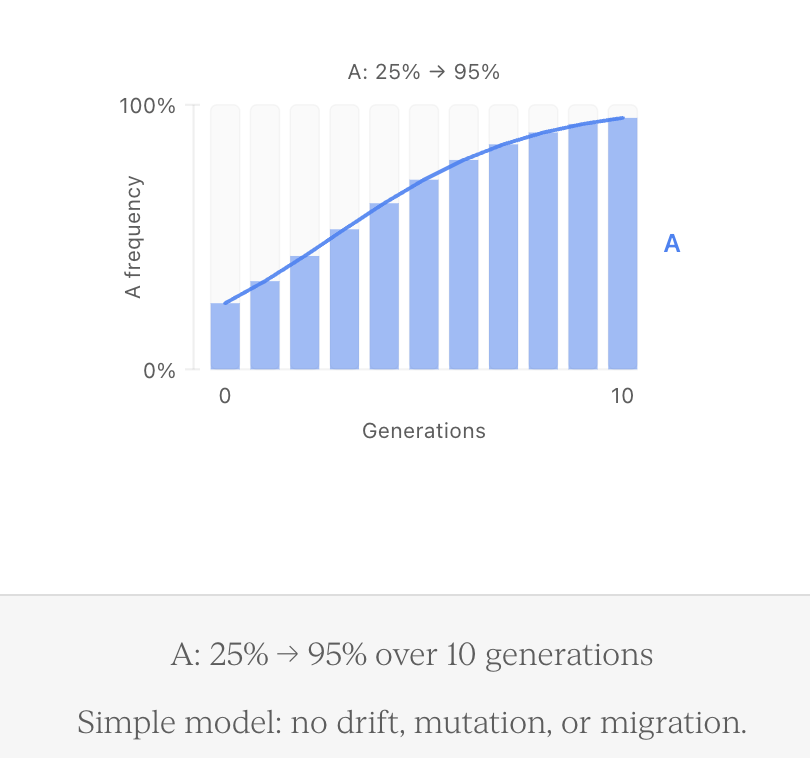
Real populations are more complicated because mutation, migration, chance events, changing environments, and other processes can also affect genetic variation.


Alleles and Evolution

An allele is a version of a gene.

Suppose a gene has two alleles:

  • Allele A.
  • Allele a.

If environmental conditions favor individuals carrying allele A, those individuals may reproduce more successfully.

Over generations:

Frequency of A increases

while

frequency of a may decrease.

A change in allele frequencies within a population is one way evolution can be measured.


Worked Example: Camouflage

Imagine a population of insects living on dark tree bark.

The insects vary genetically in coloration.

Some are:

  • Dark brown.
  • Light brown.

Birds hunt the insects visually.

Dark insects are harder to see.

The sequence is:

Variation

Dark and light insects exist.

Selection pressure

Birds prey on the insects.

Advantage

Dark insects are better camouflaged.

Differential reproductive success

More dark insects survive and reproduce.

Inheritance

Their offspring inherit genes influencing dark coloration.

Population change

Dark coloration becomes more common.

Evolution

The inherited characteristics of the population have changed across generations.


Natural Selection Does Not Create the Variation Because It Is Needed

A common misunderstanding is:

"The environment caused the organisms to develop the trait they needed."

This is incorrect.

Instead:

Variation already exists or arises through mutation.

Then:

The environment influences which variants reproduce more successfully.

For example, antibiotics do not cause bacteria to develop resistance because bacteria need it.

Resistant variants may already exist before antibiotic treatment.


Worked Example: Antibiotic Resistance

A bacterial population contains millions of bacteria.

Most are susceptible to an antibiotic, but some carry genetic variants providing resistance.

The antibiotic is applied.

Before treatment

→ resistant bacteria are uncommon.

Antibiotic applied

→ susceptible bacteria die.

Resistant bacteria survive

→ they reproduce.

Later generations

→ resistant bacteria form a larger proportion of the population.

https://images.openai.com/static-rsc-4/2Q2DeD0jt7Wx8O4vvlmAIFpIuFsbOZlr5OjGH5xltcPnqQgSOd0qTsHS-gRAb2b4DOOUwYxdWpUtdYggUi6rIO0YjuoUKLe0C1sNvN3MDvLESY3mwFp7P2S4nuLHW9gzntXWyq7hbQW4hqCGjpUWxzMAhenR5EtXVLNw3i1R4AyE54NZtlP3jx7ocUj9qe-J?purpose=fullsize
 
https://images.openai.com/static-rsc-4/6ziey4wqGRU_y8Ni4J4quvoUlEMS656W3rOiW1Zjd3bYg4zfp8b-9VyynOfiGvuRoNwteQT9AKFbj5p_ywHAH-H8KDIy5ahk748h0fDfDsdAX7iEmYLFwP56rKlFYYft3xveVInkLwQ_jCWL84pHssiVPDjCw_m3aTtdR2Dnl8mZLGMYURdSyp5RiXuxC-hb?purpose=fullsize
 
https://images.openai.com/static-rsc-4/61WyHsx-K2NH-wCno1gYnCgysD1Hf0_OiUsqtGf3_UhGTtHVxaW0ATJCqd_HGL5trx_6Gtr2OiDE1rTUMhwRpJpLdQpxf1nW_cLTjvAwkhyN_x7D-cp164GofX5TxDGt7utrDxvZ8dcipY5tf9iMTEft_UsL_wsQPIFd3kUQDK_qGE-ZCqYQ0Wl1KOltkaqT?purpose=fullsize
 
6

The bacterial population has evolved because its genetic composition has changed.


Evolution Can Occur Rapidly

Evolution is sometimes imagined as an extremely slow process.

Major evolutionary changes often take very long periods, but measurable evolutionary change can sometimes occur rapidly.

This is particularly likely in organisms that have:

  • Short generation times.
  • Large populations.
  • High reproductive rates.

Bacteria can reproduce very quickly, so many generations can occur within a relatively short period.

This allows natural selection to produce observable changes rapidly.


Worked Example: Pesticide Resistance

Consider an insect population exposed to a pesticide.

Initially:

  • Most insects are susceptible.
  • A small number carry resistance variants.

After spraying:

Susceptible insects die

→ resistant insects survive

→ resistant insects reproduce

→ resistance becomes increasingly common.

After repeated exposure, the population may contain a much greater proportion of resistant insects.

The population has evolved.


Darwin's Finches

Finches from the Galápagos Islands are a famous example used to understand natural selection and evolution.

Finches show variation in beak characteristics.

Different beak forms are useful for different foods.

https://images.openai.com/static-rsc-4/bxLFG8MvW-p3mcCBdPbmhkDl42wNn96BewQSMSzpV1MSU2WxueVnuYENpek7sOW5iQkrtLAEtjHFeEOtI6BFyasbrqVZf0dcUfcmAnebNj0ZVURhU5s3GjLYJcYPKhht6guEUuVZPmOSsHz1BNCDerz99omjDBe9uQ_r5hCBnIXIm7Ks7pxNAdjYFTl3BMX6?purpose=fullsize
 
https://images.openai.com/static-rsc-4/tvzuGC_s4X5gUEoBDVCoBfOQ_qsK-3IIZVN4kxY-GS8qrJPspO6eME0JAv_i2QE001ipNy3EtvJ4_5gZp6dHHgW4Hy5DWRjscB_6CfF52vdoyo2tOQ8E4BsUJtKTcDEbAzkEVg_hpVmKhGiLWlNbg5EA8l5yqjt-qEfV7nYzfEWrE6-ur_EsXxECKtoEct3K?purpose=fullsize
 
https://images.openai.com/static-rsc-4/33lcZs3hDgTiwQqaeiafU2KhOqfknPqUJqGZE8xfxu47dS8wB5gNUBnB-yRHOb8DDR-VftrkhxngSWJXT9hWseVk1r_wCao0udFkWfx2-1xgrED7MF4d70d9mK3ULSjEUYg_STd9MTjiIA2HbWQFfHXGeCOCrsENP_0y9PWjZb-QjEsClJTbBUa-4g0RrI3Z?purpose=fullsize
 
5

Environmental changes can alter food availability.

If hard seeds become more common, birds with beaks better suited to opening hard seeds may obtain more food.

If beak characteristics are heritable:

Environmental change

→ different food availability

→ selection favors particular beak characteristics

→ differential reproduction

→ population changes over generations.


Worked Example: Finch Population During a Drought

Suppose a population contains birds with different beak depths.

A drought occurs.

Small, soft seeds become scarce.

Large, hard seeds remain.

Birds with deeper, stronger beaks can open these seeds more effectively.

The sequence is:

Variation in beak depth

→ drought changes available food

→ stronger beaks provide an advantage

→ these birds obtain more food

→ greater survival and reproduction

→ offspring inherit characteristics influencing beak depth

→ average beak depth in the population may increase over generations.

This is evolution through natural selection.


Peppered Moths

Peppered moths are another well-known example of evolutionary change.

Moths vary in coloration.

Different colors can provide different levels of camouflage depending on the background.

https://images.openai.com/static-rsc-4/Cvr530Dswz8WvX3BMofdtbHFkxYZeO104lU1ns-OPMcAuV9OUnxagRhhEwe1Nc1vO5a68KFysTPU5fajkvYM8DOkcQnabWwR5SVbDYjgLjR6hp5SUNFVN4SHCoEgI7U-sFtAc4P_gwvcMLe-fBdxeyMfq7ZRaVzVE4mSYlNFO0eUkoNzuZvIkBz3k2kvqM_l?purpose=fullsize
 
https://images.openai.com/static-rsc-4/_4T-lTuuB00d5jvHn_SJgHDEKy27gpl0YFnodPR6UQerwY6rBPB7e3dxTDye4KGtY1Nls7JFR8_UmUrUK5Vk3Jq7bwYuwRqZFRYcOS-Aj0fhzoep1EMRr_0nnOZs3wLtDRC6uAouLj6zR4ibqIJqCN1IBnY02zzmYpJn9dbTYGhUEtsNwv0DiM33nZkxsNKF?purpose=fullsize
 
https://images.openai.com/static-rsc-4/7L-NfA43B29dLsJqe1pZN6rd--kvhtST8XJDZ4gZOuVdVGWjj1F8P6nHbC7q4YXByk7s3Tdjh1YPchMyvW35wYlO6A_PDjOzm0HRxZ_JJYE0XJJdHwQMzouMf4gYGhx-hF4ddmPEjFArZbTqic_4syGkRS1NJtr3GMMdtSxpsk5DdqORqnqhFZ4Yc5rWo1f9?purpose=fullsize
 
5

When environmental conditions change, the coloration providing the best camouflage may also change.

Predation can then alter the relative reproductive success of different color variants.

Over generations, the frequencies of those variants can change.


Environmental Change Can Change Evolutionary Direction

A characteristic is not permanently advantageous.

Suppose thick fur provides an advantage during a cold period.

If the environment becomes warmer:

Cold conditions

→ thick fur advantageous.

Later:

Warm conditions

→ thinner fur may become advantageous.

Selection pressures can therefore change direction.

Evolution depends on the relationship between a population and its current environment.


Evolution Does Not Have a Goal

Evolution does not work toward perfection.

Natural selection has:

  • No plan.
  • No intended outcome.
  • No predetermined direction.

It simply results from differences in reproductive success among inherited variants under particular conditions.

If environmental conditions change, the characteristics favored by natural selection may also change.


Evolution Does Not Always Produce "Better" Organisms

The word better is misleading in evolution.

A characteristic may be advantageous in one environment but disadvantageous in another.

For example:

Thick fur may improve survival in the Arctic.

The same thick fur could create problems in a hot desert.

Evolution therefore produces populations that may become better suited to particular conditions, rather than universally superior organisms.


Adaptation Through Evolution

An adaptation is an inherited characteristic that increases reproductive success in a particular environment.

Adaptations can become common through natural selection.

For example:

Inherited variation in fur thickness

→ cold environment

→ thicker-furred animals reproduce more successfully

→ genes contributing to thicker fur increase in frequency

→ population becomes increasingly adapted to cold conditions.

Adaptation is therefore a population-level evolutionary outcome.


Structural Evolutionary Changes

Natural selection can influence structural characteristics such as:

  • Beak shape.
  • Body size.
  • Fur thickness.
  • Coloration.
  • Limb structure.
  • Root depth.
  • Leaf shape.

These physical characteristics may become more or less common over generations.


Physiological Evolutionary Changes

Natural selection can also influence physiological characteristics.

Examples include:

  • Disease resistance.
  • Antibiotic resistance.
  • Temperature tolerance.
  • Water conservation.
  • Salt tolerance.
  • Toxin resistance.

Evolution therefore involves much more than visible physical changes.


Behavioral Characteristics Can Also Evolve

Some behavioral tendencies have inherited components.

Natural selection can influence behaviors related to:

  • Feeding.
  • Predator avoidance.
  • Migration.
  • Courtship.
  • Reproduction.
  • Territorial behavior.

If inherited differences in behavior affect reproductive success, those behavioral tendencies can evolve.


Natural Selection Can Maintain Variation

Natural selection does not always cause one characteristic to completely replace another.

Different conditions may favor different characteristics.

For example:

  • Dark coloration may be advantageous in one habitat.
  • Light coloration may be advantageous in another.

If environments vary across a species' range, several variants may remain in the population.


Evolution Is Not Always Caused by Natural Selection

Natural selection is an important mechanism of evolution, but it is not the only one.

Population genetics can also change because of:

  • Mutation.
  • Migration and gene flow.
  • Genetic drift.
  • Sexual selection.

Therefore:

Natural selection can cause evolution, but not all evolutionary change results from natural selection.


Genetic Drift

Genetic drift is evolutionary change caused by chance.

Imagine a storm randomly kills many individuals in a small population.

The survivors may not be the best adapted.

They may simply have survived by chance.

If the survivors reproduce, allele frequencies can change.

Genetic drift is especially important in small populations.

This differs from natural selection because the changes are not caused by consistent differences in reproductive success associated with particular advantageous traits.


Gene Flow

Gene flow occurs when individuals or their gametes move between populations and introduce genetic variants.

For example:

Population A

→ individuals migrate to Population B

→ they reproduce

→ their alleles enter Population B.

Gene flow can therefore change allele frequencies without natural selection being responsible for the initial change.


Mutation and Evolution

Mutations introduce new genetic variation.

A mutation can be:

  • Advantageous.
  • Neutral.
  • Disadvantageous.

Whether a mutation is advantageous depends on environmental conditions.

Natural selection can then affect how common that mutation becomes.

Mutation therefore provides new variation, while natural selection can change the frequency of that variation.


Evolutionary Change Can Be Measured

Scientists can study evolution by measuring changes in populations over time.

Evidence might include changes in:

  • Allele frequencies.
  • Average body size.
  • Beak dimensions.
  • Resistance to antibiotics.
  • Resistance to pesticides.
  • Coloration.
  • Timing of reproduction.

Scientists compare populations across generations to determine whether inherited characteristics are changing.


Interpreting Evolutionary Data

Imagine researchers measure the average beak depth of a bird population.

Before a drought:

Average beak depth = 8.5 mm

After several generations:

Average beak depth = 9.4 mm

This alone does not prove natural selection caused the change.

Scientists would also investigate:

  • Whether beak depth is heritable.
  • Whether food availability changed.
  • Whether beak depth affected survival or reproduction.
  • Whether migration affected the population.
  • Whether the difference is statistically meaningful.

Good evolutionary explanations require evidence, not simply an observed difference.


Natural Selection and Speciation

Natural selection can eventually contribute to the formation of new species.

Suppose one population becomes divided by a geographic barrier.

Examples include:

  • Mountains.
  • Rivers.
  • Islands.
  • Glaciers.

The separated populations may experience different selection pressures.

https://images.openai.com/static-rsc-4/IeWA0BoBxpvARGXqx3gbFOHcQfbCv3GpFlVKLISsdUJVyyPv35rD77FYJzDgCjsMtkoEtglqVuG7zMZh4HQFabPTxIL93TA2SVZ9MvVEiGuToKX8ceFgi5IvlehqM1TPEXU6_cCjLjXyeE2Y27qQ2JIcHNu88G7FTYnaTjh8qlye9MnAepXcCyXJVFSRZ0_g?purpose=fullsize
 
https://images.openai.com/static-rsc-4/EA1zj62MDGUo1EpnsSaDbR_JoEcDimUgp_lL3sICVcluL6Sg3hVfHbMnfIsLdBvAq14CYIppATdnE_OMuJ93pKAS_98yAZgbxhMjJJAyfEtELcLa_3ybGHob6B5Sdnea18oNFyPY3UC9tdTJSoicbLAuKS7l1UoNlZljQUj20Kae1jyD_KSO0OwPybCr6N55?purpose=fullsize
 
https://images.openai.com/static-rsc-4/tAtKSxqI8riNibP-LlY8x0QW4aCCvHnseUruqsaYU3VEcdrYkwTcKlvO2RFXXw0LBLnzqZEK9TavZpzVo7Oho9cfo1cmG3dWGdz_zqX1x1Zu8doaDOebJxMaWpx_I7U4UUMv00HYAFNpepEjGU8ytF9GTJJPjH0KXw_JUssGWx2FoTXpqy63uPk7OTLx70iN?purpose=fullsize
 
6

Over many generations:

Isolation

→ different environments

→ different selection pressures

→ different evolutionary changes

→ increasing genetic differences.

Eventually, the populations may become sufficiently different that they can no longer successfully interbreed.

This is speciation.


Worked Example: Island Populations

Imagine birds from one population reach two different islands.

Island A contains mainly hard seeds.

Island B contains mainly insects.

On Island A, strong seed-crushing beaks may provide an advantage.

On Island B, narrow insect-catching beaks may provide an advantage.

Over many generations:

Different selection pressures

→ different reproductive advantages

→ different inherited characteristics become common

→ populations become increasingly different.

If reproductive isolation eventually develops, they may become separate species.


Evolution Produces Branching Patterns

Evolution is not a ladder in which one species becomes progressively "higher."

Instead, evolution produces branching patterns.

Populations split and change in different directions.

This creates the diversity of organisms seen today.

Different modern species can share a common ancestor without one modern species having evolved directly from the other.


Common Ancestry

If two species share a common ancestor, their populations diverged from an ancestral population in the past.

Over generations, processes including natural selection, mutation, genetic drift, and isolation can cause them to become increasingly different.

Similarities between species can therefore provide evidence of common ancestry.


Fossil Evidence

Fossils provide evidence that organisms have changed through Earth's history.

https://images.openai.com/static-rsc-4/i2jrL0VrD-yQIW2f7mZKtRpb1mElZkDHqP3S7RWfiqSkWLEqP1Ck7QufW-2l7oChn-0IlT46UPPXPvbPke-L_WSdAy0yYM88I9KgGpRciyOPa6f-rTjvrvYrIQKSlEuX3wl9UMuEIoYV_VC3nSkHOt32X-RA-CA_ngBCdPM0XXa912hPGzLf3Z2i_WzaYpkE?purpose=fullsize
 
https://images.openai.com/static-rsc-4/Q87Ld0dsyaaY4ZzcB-g_OggqKCGdQLt1K1siqhR1nlWXAiB0TAmhJBm9dHbUXW97Lg2nRH65198paHBq74LMUxDYa9WcUlpx-x6D0h0N1Ja0SFeltk5DSXXiF0W8s662QPKRQqadbJcON74ZkAax7Lt62TACk0cpEecozjnHyWtZdq_JVT3yj7Ow-Rktsc98?purpose=fullsize
 
https://images.openai.com/static-rsc-4/sQUbd_ytwPgdeD3-9Ny8SRHq9Six23_101I_Yi1-ksuaYgDYJsdmg3qbRJSr-pX9-ZO-ish2USKgsEN2pvhsk5q7m3V0yhXeejpSWbNwKZemw2ncmuM9NNXpMGjNTOMH76J1YU2XIIaSVf0liqkZeU7hMapoxiMdJ1QFu9capgxScOZrQkyJ752UeWH8wWKy?purpose=fullsize
 
6

The fossil record shows:

  • Species that no longer exist.
  • Changes in groups over time.
  • Organisms with combinations of characteristics that help scientists understand evolutionary relationships.

Fossils are one important source of evidence for evolution.


DNA Evidence

Modern genetics provides powerful evidence for evolution.

Organisms share many genes.

Closely related species generally have more similar DNA sequences than more distantly related species.

Scientists can compare DNA to investigate:

  • Evolutionary relationships.
  • Common ancestry.
  • Population differences.
  • Genetic changes over time.

Evolution can therefore be studied at the molecular level as well as through visible characteristics.


Evolution and Extinction

Evolution does not guarantee survival.

If environmental conditions change rapidly, a population may not possess suitable genetic variation.

If individuals cannot:

  • Adapt through evolutionary change quickly enough.
  • Move to suitable habitat.
  • Survive through behavioral flexibility.

the population may decline.

A species may eventually become extinct.


A Complete Natural Selection Explanation

When explaining evolution through natural selection, use the following structure:

Variation

Individuals differ in inherited characteristics.

Selection pressure

Environmental conditions favor some characteristics over others.

Differential reproductive success

Individuals possessing advantageous characteristics produce more surviving offspring.

Inheritance

Those characteristics are passed to offspring.

Generational change

The advantageous genetic variants become more common.

Evolution

The inherited characteristics of the population change over generations.

This structure works for many evolutionary examples.


Worked Example: Fur Color

Imagine a population of mice containing light and dark individuals.

A volcanic eruption covers the ground with dark rock.

Variation

The population contains inherited differences in fur color.

Selection pressure

Predators hunt the mice visually.

Advantage

Dark mice are better camouflaged against the dark rock.

Reproductive success

Dark mice are more likely to survive and reproduce.

Inheritance

Their offspring inherit genes influencing dark coloration.

Population change

Dark coloration becomes more common.

Evolution

The inherited characteristics of the mouse population have changed across generations.


Worked Example: Disease Resistance

Imagine a disease enters an animal population.

Some individuals possess inherited resistance.

Variation

Resistance differs among individuals.

Selection pressure

The disease affects susceptible animals more severely.

Advantage

Resistant individuals are more likely to survive and remain healthy enough to reproduce.

Reproduction

Resistant individuals contribute more offspring.

Inheritance

Resistance-associated alleles are passed to offspring.

Evolution

Resistance becomes more common in the population over generations.


Predicting Evolutionary Change

To predict how a population might evolve, ask:

What has changed in the environment?

Identify the selection pressure.

What inherited variation exists?

Identify potentially relevant differences.

Which variants provide an advantage?

Determine which individuals may reproduce more successfully.

Can the characteristic be inherited?

Without inheritance, natural selection cannot directly increase its genetic frequency.

What will happen across generations?

Predict how the population's genetic composition may change.


Common Mistakes

Saying Individuals Evolve

Individuals do not evolve through natural selection. Populations evolve across generations.

Saying Organisms Change Because They Need To

Need does not create useful inherited characteristics.

Forgetting Variation

Natural selection requires differences among individuals.

Forgetting Inheritance

Only heritable variation can produce genetic evolutionary change through natural selection.

Thinking Survival Alone Is Enough

Reproductive success determines contribution to future generations.

Thinking Natural Selection and Evolution Mean Exactly the Same Thing

Natural selection is a mechanism that can cause evolution.

Evolution is population-level genetic change across generations.

Assuming All Evolution Is Caused by Natural Selection

Mutation, gene flow, genetic drift, and other processes can also change populations.

Thinking Evolution Has a Goal

Evolution does not work toward perfection or a predetermined outcome.

Thinking "Fittest" Means Strongest

Evolutionary fitness refers to reproductive success under particular environmental conditions.

Assuming Every Observed Change Is Evolution

A change must involve inherited population characteristics across generations to represent biological evolution.


Check Your Understanding

1. Define evolution.

2. Explain the relationship between natural selection and evolution.

3. Why is variation necessary for natural selection?

4. Why must variation be heritable for natural selection to cause evolutionary change?

5. What is differential reproductive success?

6. Explain why populations evolve but individuals do not.

7. What happens to an advantageous allele when individuals carrying it consistently reproduce more successfully?

8. Explain how predation could cause evolutionary change in a prey population.

9. Explain how antibiotic resistance demonstrates evolution through natural selection.

10. Why is it incorrect to say that antibiotics cause bacteria to become resistant because they need resistance?

11. Explain how a drought could cause evolutionary changes in a bird population.

12. Why might a characteristic that was once advantageous later become disadvantageous?

13. Explain the difference between mutation and natural selection.

14. What is genetic drift?

15. How does genetic drift differ from natural selection?

16. What is gene flow?

17. Explain how natural selection can contribute to adaptation.

18. Explain how geographic isolation and different selection pressures can contribute to speciation.

19. A population of insects contains green and brown individuals. Their habitat changes from green vegetation to mostly brown vegetation. Predict how the population might evolve if birds hunt the insects visually.

20. Explain the complete connection between variation → selection → reproductive success → inheritance → population change → evolution.


Key Terms

  • Evolution – change in inherited characteristics or allele frequencies within a population across generations.
  • Natural selection – process in which inherited characteristics affecting reproductive success become more or less common.
  • Variation – differences between individuals within a population.
  • Heritable variation – genetic differences that can be passed between generations.
  • Allele – alternative version of a gene.
  • Allele frequency – proportion of a particular allele within a population.
  • Mutation – change in DNA that can introduce new genetic variation.
  • Selection pressure – environmental factor affecting reproductive success.
  • Differential reproductive success – differences among individuals in the number of surviving offspring they contribute to future generations.
  • Fitness – reproductive success in a particular environment.
  • Adaptation – inherited characteristic increasing reproductive success in a particular environment.
  • Genetic drift – change in allele frequencies caused by chance.
  • Gene flow – movement of alleles between populations.
  • Speciation – evolutionary process through which new species arise.
  • Common ancestor – ancestral population from which two or more evolutionary lineages descended.
  • Extinction – permanent disappearance of a species.

Key Takeaways

  • Evolution is change in the inherited characteristics of populations over generations.
  • Natural selection is one mechanism that can cause evolution.
  • Natural selection requires variation among individuals.
  • The variation must have a heritable component to produce genetic evolutionary change.
  • Selection pressures affect which individuals reproduce most successfully.
  • Individuals with advantageous inherited characteristics may contribute more offspring to future generations.
  • As a result, advantageous genetic variants can become more common.
  • Individuals do not evolve; populations evolve.
  • Evolution can be observed as changes in allele frequencies or inherited characteristics across generations.
  • Antibiotic and pesticide resistance provide clear examples of evolution through natural selection.
  • Environmental changes can alter which characteristics are advantageous.
  • Evolution does not have a predetermined goal.
  • Natural selection does not create useful variation because organisms need it.
  • Mutation provides new genetic variation.
  • Gene flow and genetic drift can also cause evolutionary change.
  • Adaptations can develop when natural selection causes advantageous inherited characteristics to become more common.
  • Different selection pressures can cause separated populations to evolve differently.
  • Over long periods, evolutionary divergence can contribute to speciation.
  • Evolution does not guarantee that a population will survive environmental change.
  • The central connection is: variation → selection pressure → differential reproductive success → inheritance → population change → evolution.