Natural Selection and Adaptation

1. The Theory of Natural Selection

Learning outcomes
  • I can describe Darwin's theory of natural selection.
  • I can explain the role of variation in natural selection.
  • I can describe how advantageous traits become more common.
  • I can explain how populations change over time.
  • I can apply natural selection to simple examples.

What Is Natural Selection?

Natural selection is a process that causes populations to change over generations because individuals with certain inherited characteristics are more likely to survive and reproduce in a particular environment.

The theory of natural selection is strongly associated with Charles Darwin, who developed the idea during the 19th century. Alfred Russel Wallace independently developed a similar explanation.

Natural selection helps explain:

  • How populations become adapted to their environments.
  • Why populations change over time.
  • How biodiversity can arise.
  • How new species can eventually evolve.
https://images.openai.com/static-rsc-4/dg9_crumffmCaf89gG3S3SPzfHoHuIWjNtZ6GSMSCFtU6iFE3U-X0bYSiQThra-0bGT3eJ0h6Il7RFG4qPwAivKshnz-g-B5cbzhLf0mRWTdRmVBynjE5aRknwHtGQkS9lqnqEpvg7lxEs_9WYo9AhtcZhjLRtUQcLz_1duOPRyz2gl5PwxcpTJpoWsmcr8w?purpose=fullsize
 
https://images.openai.com/static-rsc-4/Ps6NSfKcCy_HjztvsoGCHUEKjkOE3ZZBNmIq_oKGUukuLHsgAjmDQXYMV9Y0nAIKtOc6g9DV_WgUNDwwXFjAheHAHYKPB9IZ0oSQ-BGGkfjH2u-3LvZQx-dUaC6QwNdwwrcrZwS_f2SuQzrY0nADjvoJHd5FfeIsFeHNhPqf_EqYB81rXwicfsUrzuaA4jGT?purpose=fullsize
 
https://images.openai.com/static-rsc-4/aVcj6quNAlRisB6z3b79-okO9wPbj5x0TomFL-Ho6yPFjqnOF38ODAuwAm7GhSrJrAnN5m8uWXo_4bXNu6bEkhTVoa29z5A0ttt7vKuEhbra8MMoBd5TOpbWetAVR3f6DnJPMTdBVTcyULCOFr6gmlTp8MZzejaPTSiddCdIei15zzQs-Yf_cC2-tlPGO9fC?purpose=fullsize
 
6

Natural selection does not mean that individual organisms deliberately change because they need to. Instead, individuals already differ, and some inherited differences affect reproductive success.


Darwin and the Development of the Theory

During the voyage of HMS Beagle from 1831 to 1836, Darwin observed organisms in many parts of the world.

His observations helped him recognize that:

  • Species show considerable variation.
  • Related organisms can differ between environments.
  • Organisms appear adapted to their surroundings.
  • Fossils show that organisms living in the past were different from organisms alive today.

His observations of organisms from the Galápagos Islands became particularly well known.

https://images.openai.com/static-rsc-4/3vSQ35uDFcoiGu-F1vkzXuwUS6uS0dXdn0yXAL62e1MWYaAqlJRbDry-n_CbY10bKbcxlPPNzOp-tlO1BaqV0MFPdf2_9DXUtJbeuxCM6aL71FRQjoNUd2u0yUCZM2lpb5DRCJ3Ae8UITtve7HOP_TM1IOhwWDTIuxfTJlwBH8msTtU-gBSwP3RAKYhYIrmW?purpose=fullsize
 
https://images.openai.com/static-rsc-4/Es1_TkHZ_i58bTUsGH2LNoqkFPjv5Tx3l083U0sBGkSmpkoX0--13PpOAwOyEqDKBCw3X9Ce8jO6zU5JBgkcqVxXzToed6h2LUTlNZBreSLEgfU4T99U8gRSLxeKIwxqSufG4Nle8RSLq9lwYBhLt2dxQQfvJ7k-AURPHHSmkh9QL4RwROKmAVWjg9nCGmqR?purpose=fullsize
 
https://images.openai.com/static-rsc-4/-zT1u5wR7R6iMHMreAgYCWOr6BvDzYDwAGhb2bulz4NxkO7pV95Zl2kuAEwcgeBXBABsCU1Bxy8FjJH-SvOaD1sbaPTMNoAAv461tKg1bqvWTeekXh2ROMwAE7zTD0OdlT9tP7a3K0OkuojmgHZDvRGVoJHR99p86303Zfm2B0udtIjpqQdZnjmVGH9u649A?purpose=fullsize
 

Darwin eventually proposed that natural selection could explain how these differences developed over many generations.


The Main Ideas of Natural Selection

Natural selection can be understood through several connected ideas:

Variation

→ inheritance

→ competition and environmental pressures

→ differences in survival and reproduction

→ advantageous inherited traits become more common

→ population changes over generations

Each part of this process is important.


Variation Within Populations

Individuals within a population are not identical.

They may vary in:

  • Size.
  • Color.
  • Speed.
  • Disease resistance.
  • Beak shape.
  • Body shape.
  • Behavior.
  • Ability to tolerate temperature.
  • Ability to obtain food.
https://images.openai.com/static-rsc-4/KZuhqQcZk6q3qVAjZjbpqSWL0d80kHb15U51vP9DbvoTzGX0NyfZqlfgcv2DbwGXmg4ZX_sGtJhr-jOHX38vst2SlqVrJgff4o_N0-oR-ajvEw6mU57g197vHlmivoi1RUSIq44UmW5XKqplkBBXhyFh1u5LBwBRPU85MPaIpjKMIfzEdvtjqB1_hFkyVkYZ?purpose=fullsize
 
https://images.openai.com/static-rsc-4/Td6CnZoe4U-Num2_BpMwsDaIcVcN4W0mJL7v8laKZcnuUk8s3tqbgILM-tlv3hyQsUsX6puGeBZVpQll0zvT4Q8pnrNJ2e99Xqo4t9Foqq1Nu5H2K8cEIIZmvecncrmnAGoTqtlTXY0KxVgbFxShsypFBQ7aW5YpEQRRUkcjtKAzshYdS-9r5T7I1dmSs1A6?purpose=fullsize
 
https://images.openai.com/static-rsc-4/xHkI4LlAotcQLkHXJZ6VOPbzEDk-nS9idKaSylbfR1jUk4wKHa1FdHhlLacErsOIsP0xl1aw0DtorLZiR79rb_C3nJ8IUfYUeV2pQ6cZKEU6pwdeZvxOxi3Nl3iHZ1HstlJEzgBM1fV_UJ4_qnDs30XM15y_LtAn5MwTW0m-dvP3i2aS48nP5IPkIf5QBJmY?purpose=fullsize
 
6

Some variation is caused by genetic differences.

Other variation can be caused by environmental conditions.

Natural selection depends particularly on heritable variation — differences that can be passed from parents to offspring.


Where Does Genetic Variation Come From?

Genetic variation can arise through processes including:

  • Mutation.
  • Sexual reproduction.
  • Recombination during meiosis.
  • Random fertilization.

A mutation is a change in DNA.

Mutations can produce new genetic variants.

Mutations occur without regard to whether they would be useful to an organism.

Most importantly:

The environment does not create a useful mutation because an organism needs it.

Variation exists first. Natural selection then acts on that variation.


Environmental Variation

Not every difference between organisms is inherited.

For example, a plant may grow poorly because it receives little water.

This does not necessarily mean its offspring will inherit genes for being small.

Natural selection can only cause evolutionary change when differences affecting reproductive success have a heritable component.


Overproduction of Offspring

Many organisms produce more offspring than can survive and reproduce.

For example:

  • Fish may produce thousands of eggs.
  • Plants may produce thousands of seeds.
  • Insects may produce hundreds of offspring.

Yet populations usually do not increase without limit.

Many offspring:

  • Are eaten.
  • Fail to find food.
  • Die from disease.
  • Experience unsuitable environmental conditions.
  • Fail to reproduce.

This creates competition and other forms of selection pressure.


Selection Pressures

A selection pressure is an environmental factor that affects survival or reproductive success.

Examples include:

  • Predators.
  • Disease.
  • Competition.
  • Temperature.
  • Drought.
  • Food availability.
  • Salinity.
  • Chemicals such as antibiotics.

Different environments create different selection pressures.

A characteristic that is advantageous in one environment may not be advantageous in another.


Differential Survival and Reproduction

Suppose a population contains individuals with different inherited characteristics.

Some individuals may possess a characteristic that gives them an advantage in their environment.

They may:

  • Survive more successfully.
  • Obtain more food.
  • Escape predators.
  • Resist disease.
  • Attract more mates.
  • Produce more surviving offspring.

The most important idea is reproductive success.

Natural selection favors traits that result in individuals contributing more offspring to future generations.


Fitness

In evolutionary biology, fitness refers to an organism's reproductive success in a particular environment.

It does not simply mean:

  • Strongest.
  • Fastest.
  • Biggest.
  • Healthiest.

An organism with high evolutionary fitness successfully passes its genes to future generations.

A smaller animal that produces many surviving offspring could therefore have greater evolutionary fitness than a stronger animal that produces none.


Advantageous Traits Become More Common

Imagine a population of insects containing two inherited color variations:

  • Green insects.
  • Brown insects.

Suppose the insects live on brown tree bark.

Birds can easily see the green insects, while brown insects are better camouflaged.

The sequence might be:

Variation exists

→ brown and green insects occur

→ birds catch more visible green insects

→ more brown insects survive

→ brown insects reproduce more successfully

→ their offspring inherit genes associated with brown coloration

→ brown coloration becomes more common over many generations.

https://images.openai.com/static-rsc-4/4j8pqdC2AfepnRZure4PJalcIyLy4pVqKTmXaX6E5iEjOHZVNeDhUYX3j8HgS5we9YnVsuIqhzVZF-G7GFN2aKaPd82479Jip1Bo8I0QGBY8_mohzDjqvlVU_a91imO5HS8JKZKoQ2sdMb2KroOPuDjszWpefXfRg5DBKAHYXq-6HfHk8XRW-IXbpmsGgxYJ?purpose=fullsize
 
https://images.openai.com/static-rsc-4/RNAhOXAQl6vaChr72JducNbYukcyKn57wFwK8Ik3h_-m46UdgxUedbhOY-P-gkB1NKYmpgqfG0VRdnln4ARrOhMLFBJq0hjf9Tu7yP7BPkCVgrkmVJ_7jV1hQCpjlm02AlAh8zyvvK7jYrjZn8ZRv4nWR8iQrzb4EEQI5fOEnS8MoVAdwy_1iZeZwGDAuiZt?purpose=fullsize
 
https://images.openai.com/static-rsc-4/J4IDK_rvt-iNS1c-vPhjhmdMFMkWL-UROn2Bl6S_M6Xsb3K5ZKCjqANpFt8z4t6hXjFhUfsTU2UKDxghRRL4nVXAULjkLEnLxldiSdyWzuv4zQ_giWvTflRK2Ar_vQuWH0OV4udyLuD_h0ZWP-XHaH-njCX-9jGNPOZUyOKSunMDid7_gdA5jRSpOvz4gLY7?purpose=fullsize
 
5

The insects did not change color because they wanted to hide.

The population already contained variation.


Populations Evolve, Not Individuals

This distinction is extremely important.

An individual organism does not evolve during its lifetime through natural selection.

Instead:

Individuals are selected

but

populations evolve.

Evolution occurs when inherited characteristics become more or less common in a population over generations.
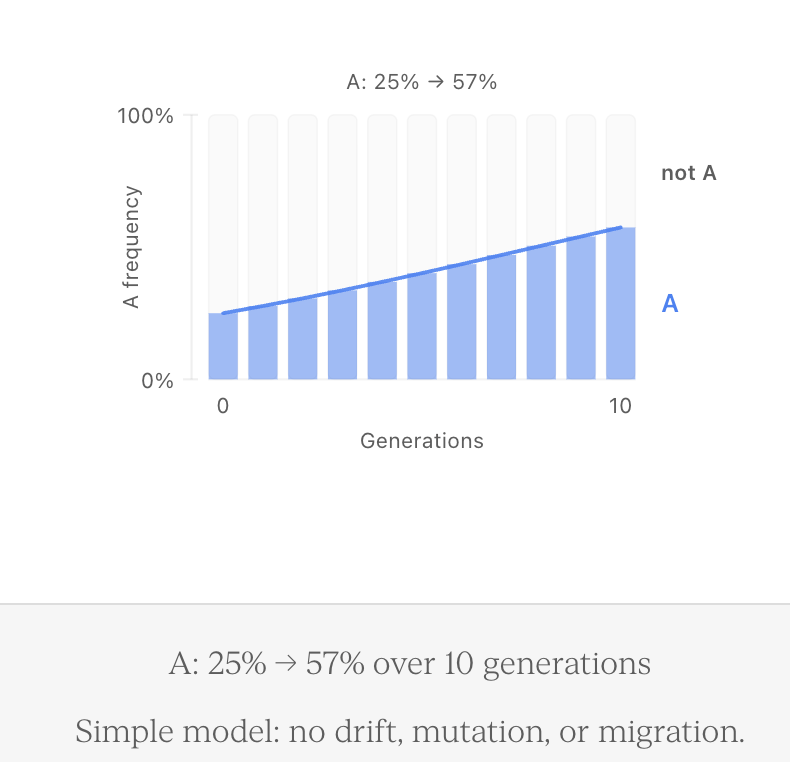
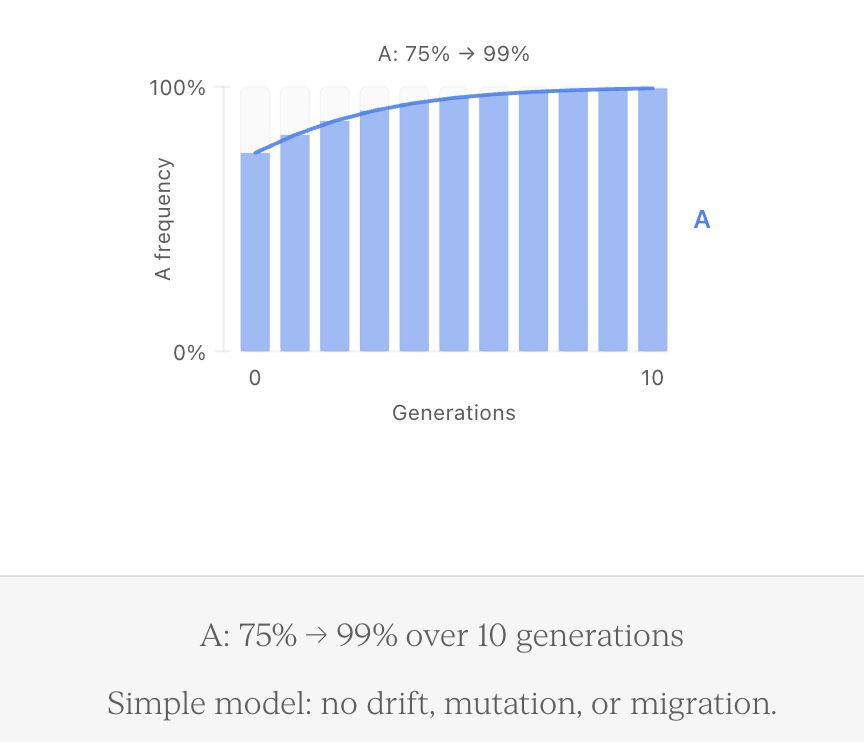
The visualization illustrates a simplified situation in which a beneficial inherited variant becomes increasingly common over generations.


Adaptations

An adaptation is an inherited characteristic that increases reproductive success in a particular environment.

Adaptations can be:

Structural

Physical features of an organism.

Examples:

  • Thick fur.
  • Camouflage.
  • Sharp claws.
  • Different beak shapes.

Behavioral

Inherited behaviors that improve survival or reproduction.

Examples can include:

  • Courtship behaviors.
  • Defensive behaviors.
  • Some migration behaviors.

Physiological

Internal biological processes.

Examples:

  • Venom production.
  • Water conservation.
  • Tolerance to unusual temperatures.
https://images.openai.com/static-rsc-4/jtfX-sm_DKSmmTUxnxlsyj1Kgb_Nn5Sqs1VJ3r14afqfw_Ojl5Y2shzMENlbEPZW_xt8gk1hDPejktM9hWNteY58n02UckjT74-mY17kDPVHP4Uje6ux-AWYwf0pnx_B0OHFAowOeYnIFbEf6qw4RBdRxUGZNK2FJ2ip89mnCYfHOedlZfAmjxEoc0phDA0w?purpose=fullsize
 
https://images.openai.com/static-rsc-4/qWLBaRiuK0NLqWOOe8Mwuf2PqxGl2wxPIWajDY902vvBxwlJt-0YKJ9SijZdJmpAzcRqWiACpALkGG5glltreEksT-2Wu9uBCQij6H0gtsGmQlfOhyKwiiVvqCThjA9WTbq3AEAvtP50-yFMd-ClEazRwB2L6GANNA2cnPCnVPGCsBIW09IgfaH0GCbL7zgF?purpose=fullsize
 
https://images.openai.com/static-rsc-4/P7NDduMx2qcW7V14-mXan9teuPMq5ZWDMO9Ds6RGtqrI85CiYBmG5_I-Zl_JXUBN9uEMirqNvlecXEdMSLPcPyJpdGT0cxzuqxsXVw09W3LerZQq4-VMkYmDd_8am3asa-XxJveUAMFigs21-T-ze8NklhZO3lJFjAXRE5pOMQlEjjTU5hO7-btVXOc74cAs?purpose=fullsize
 
5

Adaptations arise through natural selection acting across many generations.


Adaptation Is Environment-Specific

There is no universally "best" trait.

Whether a trait is advantageous depends on the environment.

For example, thick fur can be advantageous in a cold environment because it reduces heat loss.

In a very hot environment, thick fur might create disadvantages.

Therefore:

Fitness depends on environmental conditions.

If the environment changes, the characteristics favored by natural selection may also change.


Example: Darwin's Finches

The Galápagos Islands contain finches with different beak shapes.

Different beaks are suited to different food sources.

Some birds have:

  • Strong, deep beaks suitable for crushing hard seeds.
  • Narrower beaks suited to different foods.
  • Longer beaks useful for accessing particular food sources.
https://images.openai.com/static-rsc-4/fpjvtwZvFMwnZQna8GE8u2E3b-yQZvbwAzQ5XebzjU2xjjynFRAtCN3ygdnROE02HKeyXEOGk25wX08Grl6dJ1hZ3abQJFj2Dbh1Ot6XPXaL6IWjwyT-Ul2Bkmd5kCywROrCrLX0MOr0Wyob-Ma8uhuNxrFkSMmB3NeTNoUHfGj4Mz3-inxw-3DsYppix5j3?purpose=fullsize
 
https://images.openai.com/static-rsc-4/h5sGReV1pNC4YgpEBh4zZMhm2PXPBix-SFG1Bb0uxQle3ql_zFcBnRs84u5EspZL9pIBpJjcsoX8F4E6XytL4BXmGMDcpSSzd2nYBYH74uIBQ3uESBwqqQ5v6MAw8-MYtBUMZd6RszRQS4TNYjdfS1C42kTP6ep4O_adnxXUK3TrBELc6Wzog9d6BBdxsqdw?purpose=fullsize
 
https://images.openai.com/static-rsc-4/CyiXWXYLJgnlx3gM5mJSjzc0q7jkfFCODOqOFcjpw7QAS_yiOR22XCxxzJtXo_NNHL_FBp2zgWEN_6m4bgFJeBtDrHgFkS28O_wsaQPUY4i48rCPwIPhOb4dX_Y458ungPugsgZZm_v6iLCnJBnP0jHBR2WN7tvIrchEH9KmV3oHzcC_7-yPsSUM07KhSPeO?purpose=fullsize
 
5

If environmental conditions favor hard seeds, birds with stronger beaks may obtain food more successfully.

If beak characteristics are inherited:

Variation in beak shape

→ differences in feeding success

→ differences in survival and reproduction

→ advantageous beak characteristics become more common.


Worked Example: A Drought and Finch Beaks

Imagine a finch population contains birds with different beak sizes.

A severe drought occurs.

Small, soft seeds become scarce, while larger, harder seeds remain available.

Birds with larger, stronger beaks may be better able to eat the remaining seeds.

These birds may therefore:

  • Obtain more food.
  • Survive at higher rates.
  • Produce more offspring.

If beak size is heritable, the next generations may contain a greater proportion of birds with genes associated with larger beaks.

The drought did not cause individual birds to grow genetically larger beaks.

Instead, the drought changed which existing variations were advantageous.


Example: Peppered Moths

Peppered moths provide a classic example used to illustrate natural selection.

Moths vary in coloration.

In environments where tree surfaces were relatively light, lighter moths could be less visible to predators.

During periods of heavy industrial pollution, some surfaces became darker.

Darker moths could then have a camouflage advantage in affected environments.

https://images.openai.com/static-rsc-4/2HYG_JrneqAVZUbQVKgI1uf2cCaDa_Dj1JqKT5czNJREA-d0_2GTxy-bR_vKFnNMRAUTomwO5jztY3-dv7Pd57v2URM24ysSuLK35TefE_tLYfw67Xlr3PoOgy5TosAkN39qoJgV12Lf3-BgfsHqcNJCKPS0EzeJChUJ8Q65QkFPp075zk1KXPzvYWs69OH0?purpose=fullsize
 
https://images.openai.com/static-rsc-4/Hx7mb-Dwu_UaQwA4URamSmvSNXK7qAuWf-A5khojJhR8SC_yS0jvzRa_JnkWGcmsB449p0adiyKzSsrw-qTJsqqAG8HPanziZcnw4EPe-6aVWw1rjtyQDhjBhSMXLqFCNfxU4EV6sLqKoa33V7AeSfNNtZrb-2OKSBL2BnUt92AbbH7xFAIkEpz527D63QYd?purpose=fullsize
 
https://images.openai.com/static-rsc-4/-KgNxOZwfzG8Gmar_SNtLc6WCiTuvv0xfrNHkgYAbKUQwV6z20nUOdHleBUaNkFmeOKi-gC1O0L5uxu6j2zsAVIrrPkYPl25hMas28TTDjYHCYYivKliu_r4rlLULCVVkf24n2w245MaTdsV8nvA5LUu_1jcIGHzO5_fBEd2xAEX31cI3bmR6Gh5IkV6-arr?purpose=fullsize
 
5

As environmental conditions changed, the relative advantage of different inherited colors also changed.

This demonstrates an important principle:

Natural selection depends on the environment.


Example: Antibiotic Resistance

Natural selection can occur rapidly in microorganisms.

Consider a population of bacteria.

Before exposure to an antibiotic, genetic variation may mean that a small number are resistant.

When the antibiotic is used:

Antibiotic applied

→ susceptible bacteria die

→ resistant bacteria survive

→ resistant bacteria reproduce

→ resistance becomes more common in the population.

https://images.openai.com/static-rsc-4/0H8oaM8_n8pEj_GnHSd9IQpYfkWMEU3PJAbL1AnCgwL8vdrIopcw-BnEqLsOMbrbKf2-Wq55FDJaSVD-8KbD_QpNblsA8oINufKvg1WLAxRCX432mhregPoZ3hquljSkI02snVbjDKDdrIiJctdCDJ4sI1rnAXnwYKbBBWbDpG7RIPr22O0uGhzYD6hwsIZO?purpose=fullsize
 
https://images.openai.com/static-rsc-4/DNUwZ_EkOaEBi0ivv86HywU9UPXKKJ91R5bEXkg7RSZj803GUddo6_EGLbW43Bzckar8Q2N5jQqU-a6JUn9SmTMsOvwpuDIQr1nJ2Rr-wnAT1LQWe9pEQBzPun9oBTblIHh8-HDY4_zcE2gL39hHhe4LMAt2mZ9jWSutM4HBY1lzB_ZB8EDadh4gyHDUpwPT?purpose=fullsize
 
https://images.openai.com/static-rsc-4/ip2AF-PLVzj2TOwPqD8A1_rEA-WglxhXNw8RbYaGRXb4FFSosByfVUBzYb9lKCZR6RG3XQTcWNBqQnOjP18oYT9AoOtw6hxg1CoXHb9d_6x0OX6x-gmnA6aD9DlZpzDpaOh_dcBwJXpilxLDWmSFaSaF5B4zIF3iA3g9r6vkKqhHB9ClA9FHcz8jA20DRyLr?purpose=fullsize
 
5

The antibiotic does not cause bacteria to become resistant because they "try" to survive.

Instead, it creates a selection pressure favoring resistant variants.


Why Antibiotic Resistance Matters

Bacteria reproduce quickly.

This means many generations can occur in a short time.

Natural selection can therefore cause resistant strains to increase rapidly.

Unnecessary or inappropriate antibiotic use can increase selection favoring resistant bacteria.

This is an important example of evolution occurring in populations today.


Example: Insecticide Resistance

A similar process can occur in insects exposed to pesticides.

Suppose a few insects carry inherited resistance.

Pesticide applied

→ susceptible insects die

→ resistant insects survive

→ survivors reproduce

→ resistance becomes more common.

After repeated pesticide use, the pesticide may become less effective.

Again, the chemical acts as a selection pressure.


Natural Selection Over Many Generations

Natural selection is usually easiest to understand by following a population through time.

Generation 1

There is variation.

Environmental Pressure

Some variations provide an advantage.

Survival and Reproduction

Individuals possessing advantageous inherited characteristics produce more offspring.

Generation 2

Those characteristics are more common.

Continued Selection

The process continues.

After many generations, the population may look significantly different from the original population.


Natural Selection Does Not Have a Goal

Natural selection does not plan for the future.

It does not produce organisms because a particular trait will someday be useful.

Instead, selection acts on inherited variation under current environmental conditions.

This means evolution has no predetermined direction.

A trait becomes common when it contributes to greater reproductive success in the conditions experienced by the population.


"Survival of the Fittest"

The phrase "survival of the fittest" is often misunderstood.

It does not mean:

The strongest organisms always survive.

Evolutionary fitness refers to reproductive success.

A better interpretation is:

Individuals with inherited traits that improve reproductive success in a particular environment tend to contribute more genes to future generations.

Survival matters mainly because an organism generally needs to survive long enough to reproduce.


Competition

Competition occurs when organisms require the same limited resources.

They may compete for:

  • Food.
  • Water.
  • Territory.
  • Nesting sites.
  • Light.
  • Nutrients.
  • Mates.

Competition can contribute to natural selection when inherited differences affect an organism's ability to obtain these resources and reproduce.


Predation

Predators can also act as selection pressures.

Suppose prey vary in speed.

If speed has an inherited component:

Faster prey escape more frequently

→ survive more often

→ reproduce more successfully

→ genes contributing to greater speed may become more common.

At the same time, prey can exert selection pressure on predators.

Evolutionary relationships can therefore influence both populations.


Changing Environments

Environmental conditions do not remain constant.

They can change because of:

  • Climate change.
  • New predators.
  • New diseases.
  • Habitat changes.
  • Competition.
  • Human activities.

When conditions change, previously advantageous characteristics may become less useful.

Different traits may then be favored.


Worked Example: Fur Thickness

Imagine a population of mammals varies naturally in fur thickness.

In a cold climate:

Thicker fur

→ reduced heat loss

→ improved survival

→ potentially greater reproductive success.

If the climate becomes much warmer, the advantage may decrease.

Individuals with thinner fur might then have greater reproductive success.

Natural selection therefore responds to environmental conditions rather than producing permanently "perfect" organisms.


Natural Selection and Evolution

Evolution is change in the inherited characteristics of populations over generations.

Natural selection is one important mechanism of evolution.

A simplified relationship is:

Genetic variation

→ selection pressure

→ differential reproductive success

→ change in inherited characteristics

→ population evolves

Over many generations, these changes can produce substantial differences.


Natural Selection and Speciation

If populations of the same species become separated, they may experience different environmental conditions.

For example:

Original population

→ populations become geographically separated

→ different environments create different selection pressures

→ different traits become advantageous

→ populations become increasingly different.

Over long periods, genetic differences may accumulate until the populations can no longer successfully interbreed.

This can contribute to the formation of new species, called speciation.

https://images.openai.com/static-rsc-4/EA1zj62MDGUo1EpnsSaDbR_JoEcDimUgp_lL3sICVcluL6Sg3hVfHbMnfIsLdBvAq14CYIppATdnE_OMuJ93pKAS_98yAZgbxhMjJJAyfEtELcLa_3ybGHob6B5Sdnea18oNFyPY3UC9tdTJSoicbLAuKS7l1UoNlZljQUj20Kae1jyD_KSO0OwPybCr6N55?purpose=fullsize
 
https://images.openai.com/static-rsc-4/dcbPoYOkVzHN1W7R6o9HalZnxtXBiG4GUPK7xBMz5n7qBc8u4bAkw-eGzuUc31MJQaq57ZSioOEeVPYKluzowKJFantr55bgx-zB-wKB3VvYZ4Zoqfmec8BqSndgzfsAq04Q26IuVly_S8UBTJZercOxTYINjWZieEOrmj1D_8771RkFtx1__a78L5TKdalM?purpose=fullsize
 
https://images.openai.com/static-rsc-4/MB6yxw5zrbZyQgLA3ATcIgnyy2c7w7riQvbsC9T93vcBenc1J5F-7AyZaFAF9aCo_V1oO2ZEszGWdRFb4r5Kgy7JTJkl2UbbO7TOTIBhTIDms0h-3qKeGDyiN-VzQZlhp-9lwkvy8KhepNVFa0FAbcJv9VL_qwtg-f4zSBCsEo_GA7J5p7xJgB4ZM0QbsdTO?purpose=fullsize
 
5

Natural selection can therefore contribute not only to adaptation but also to biodiversity.


Natural Selection Does Not Produce Perfect Organisms

Natural selection works with the genetic variation already available.

Adaptations can also involve trade-offs.

For example:

A large body might help an animal defend itself.

But a large body may also:

  • Require more food.
  • Require more energy.
  • Reduce agility.

Natural selection therefore does not create perfect organisms.

It favors characteristics that result in greater reproductive success under particular circumstances.


Applying Natural Selection to a New Example

Suppose a population of rabbits contains variation in fur color.

Some rabbits are:

  • Light brown.
  • Dark brown.

The environment becomes darker following a change in vegetation.

Predators find light rabbits more easily.

To explain what might happen using natural selection:

1. Variation

The rabbit population already contains inherited variation in fur color.

2. Selection pressure

Predation creates a selection pressure.

3. Advantage

Dark rabbits are better camouflaged.

4. Differential survival

More dark rabbits survive.

5. Reproduction

Surviving dark rabbits reproduce and pass inherited characteristics to offspring.

6. Population change

After many generations, dark fur becomes more common.

This six-step structure can be used to explain many natural-selection examples.


A Useful Natural Selection Framework

When solving a natural-selection question, identify:

Variation

What differences already exist?

Inheritance

Which differences can be passed to offspring?

Selection pressure

What environmental factor affects survival or reproduction?

Advantage

Which variation provides an advantage?

Reproduction

Which individuals produce more surviving offspring?

Population change

Which inherited characteristic becomes more common over generations?

This framework is especially useful for unfamiliar examples.


Common Mistakes

Saying Organisms Change Because They Need To

Incorrect:

"Giraffes developed long necks because they needed to reach leaves."

Better:

Giraffes varied in neck length. If longer-necked individuals obtained more food and reproduced more successfully, inherited characteristics associated with longer necks could become more common over generations.

Saying Individuals Evolve

Individuals do not evolve through natural selection.

Populations evolve over generations.

Forgetting Variation

Natural selection requires variation within the population.

Forgetting Inheritance

A characteristic cannot become more common through natural selection unless the relevant variation has a heritable component.

Assuming "Fittest" Means Strongest

Fitness means reproductive success in a particular environment.

Saying the Environment Creates Useful Mutations

Mutations do not appear because organisms need them.

The environment selects among existing and newly arising variation.

Assuming Every Trait Is an Adaptation

Some characteristics may have little effect on reproductive success or may result from other evolutionary processes.

Thinking Evolution Has a Goal

Natural selection does not plan ahead or work toward a predetermined "perfect" organism.


Check Your Understanding

1. Define natural selection.

2. Why is variation necessary for natural selection?

3. What is meant by heritable variation?

4. Give three examples of selection pressures.

5. Explain what evolutionary fitness means.

6. Why is "survival of the strongest" an inaccurate description of natural selection?

7. Explain why populations evolve but individuals do not.

8. How can an advantageous inherited trait become more common over generations?

9. Explain how camouflage could evolve through natural selection.

10. Why can the same characteristic be advantageous in one environment but disadvantageous in another?

11. Explain how a drought could cause average beak size in a bird population to change over several generations.

12. Explain how antibiotic resistance develops through natural selection.

13. Why is it incorrect to say that antibiotics cause bacteria to develop resistance because they need it?

14. Explain how insecticide resistance can become more common in an insect population.

15. What happens to natural selection when environmental conditions change?

16. Distinguish between an inherited adaptation and a characteristic acquired during an individual's lifetime.

17. Explain how natural selection can cause a population to become better adapted to its environment.

18. Describe how natural selection can contribute to speciation.

19. A population of insects contains green and brown individuals. After a drought, vegetation becomes mostly brown. Birds hunt the insects visually. Predict how the population might change and explain your answer using natural selection.

20. A population of mammals contains individuals with different amounts of body fat. The climate becomes much colder. Apply the six-step natural-selection framework to predict how the population might change.


Key Terms

  • Natural selection – process in which inherited characteristics affecting reproductive success become more or less common over generations.
  • Variation – differences between individuals within a population.
  • Heritable variation – differences that have a genetic component and can be passed between generations.
  • Mutation – change in DNA that can introduce new genetic variation.
  • Selection pressure – environmental factor affecting survival or reproductive success.
  • Fitness – reproductive success of an organism in a particular environment.
  • Adaptation – inherited characteristic that increases reproductive success in a particular environment.
  • Evolution – change in inherited characteristics of populations over generations.
  • Population – group of organisms of the same species living in the same area.
  • Differential reproductive success – differences among individuals in their contribution of offspring to future generations.
  • Competition – interaction occurring when organisms require the same limited resource.
  • Predation – interaction in which one organism captures and consumes another.
  • Antibiotic resistance – inherited ability of bacteria to survive exposure to an antibiotic that would normally inhibit or kill them.
  • Speciation – evolutionary process through which new species arise.

Key Takeaways

  • Darwin's theory of natural selection explains how populations can become adapted to their environments over generations.
  • Natural selection begins with variation within a population.
  • Only variation with a heritable component can directly contribute to evolutionary change through natural selection.
  • Mutations and sexual reproduction contribute to genetic variation.
  • Organisms generally produce more offspring than can survive and reproduce.
  • Environmental factors create selection pressures.
  • Individuals with advantageous inherited characteristics may have greater reproductive success.
  • These individuals contribute more of their genes to future generations.
  • As a result, advantageous inherited characteristics can become more common.
  • Individuals do not evolve; populations evolve over generations.
  • Evolutionary fitness means reproductive success, not simply strength or physical fitness.
  • Whether a trait is advantageous depends on the environment.
  • Natural selection does not produce traits because organisms "need" them.
  • Natural selection has no predetermined goal.
  • Antibiotic and pesticide resistance provide observable examples of natural selection.
  • Environmental change can alter which characteristics are favored.
  • Over long periods, natural selection can contribute to adaptation, evolutionary change, and the formation of new species.
  • A useful way to explain natural selection is: variation → inheritance → selection pressure → advantage → differential reproduction → population change.