Applications of Electrochemistry and Bioelectricity

3. Corrosion and Cathodic Protection

Learning outcomes
  • I can explain corrosion as an electrochemical process.
  • I can identify factors that contribute to corrosion.
  • I can describe how cathodic protection prevents corrosion.
  • I can compare different corrosion-prevention methods.
  • I can evaluate the importance of corrosion control in engineering.

https://images.openai.com/static-rsc-4/AeG5ikG01aBf8SW3Cx8uED1NsNJi4iLbtxgR3RsHuw0f9dlRrzxHI2sA3RQgCciiSsfzw-deE4Qh2W32iv1Y1jUvjcqtQHee4V1KUU8FUJtm5xHfjX1VK3jbdsHdNU8daS-NhUgTBSsGrgzyKnvoT3ffk4lCnqkpwzy2RBOZXdObdSUCovTv3w9pOwK_EFHr?purpose=fullsize
 
https://images.openai.com/static-rsc-4/Iwc0mqCM09lRztP2nc36TzijC8KCYQq7NveG6mZl3dvfRr5EDhqCJObb7EyFeRyFXo0MAfW-yceJ1sGICrkLL50tX7T54lANge-sTDsdhunSBRkDO-5SId118eNhs8i8aVhox_A-3s1cYHOffDIZtRahz322iBl8VoWHNzHcngKRxZrLhkaH06KjvMVjxq0y?purpose=fullsize
 
https://images.openai.com/static-rsc-4/JsVa4v91GzHXJtkAEwccb85vRHsnIDiHMbiFtQA8zfGQc_5LBvp5rWfHme5fWqTwBqGzWJn4xjUii_F8zIia-HF3tw6KAMZc_jJIq_p7pPFzcj2WrhJ_0T_yQCyJ7MG3Pio_RujwMNXeDCNYi3aJBGCOVK_SLshVkkxHjB1gDJXVTAfFZ2sv0SR2U7e4DS-l?purpose=fullsize
 
5

What Is Corrosion?

Corrosion is the gradual deterioration of a material through chemical or electrochemical reactions with its environment.

For metals, corrosion usually involves the metal being:

oxidized.

Metal atoms lose electrons and form positive ions:

M → Mⁿ⁺ + ne⁻

A familiar example is the corrosion of:

iron.

The corrosion products formed on iron are commonly called:

rust.


Corrosion Is an Electrochemical Process

Corrosion is not simply a metal "wearing away."

It involves:

oxidation and reduction reactions.

Different regions of a metal surface can behave like tiny:

anodes and cathodes.

Electrons move through the metal, while ions move through moisture or another electrolyte.

This creates a small:

electrochemical cell.


What Is Needed for Iron to Rust?

Rusting generally requires:

oxygen

and:

water.

Water on the metal surface acts as part of the:

electrolyte.

Dissolved ions in the water can increase its conductivity and often make corrosion:

faster.

https://images.openai.com/static-rsc-4/MHaKU37YMcyP-fHGTWoPVgDsD369PmlCvfATixOpZrxvMd4pa3DUlgxAPESFnWDX6XM96Xm-EANtSHf1xEQwOQaKISRRHCeQcTPhxm4vUAfUBF66m2PIt3yuzIHgqKa5MsEZnmz_hGVcQaeZ783Zns9WeoDQc6HnabWF4mnpZS-kmDQhj7Sygu2zschZcZ_j?purpose=fullsize
 
https://images.openai.com/static-rsc-4/QtAMQBztgSSgTlT2bpn4ULi5ePX7McKUqR4XqssYtFdwu_ithpyikeuDWijIXIKLgabfXRRxkfKpknXNWTSdyOLlgDiAnrDND0Um80MJFT8pRvNYFVu21QnLBQ4oFGij3z9eFAdF5xyh9kyO0v3XHx_t1TJzFTALjn4ncGsaoNeZ9d-vK2ErnfoY9oufyd7c?purpose=fullsize
 
https://images.openai.com/static-rsc-4/XNZt3Wq17XcAViLg71cOvFNm-c9OapFvLtGEwX1riNhRAigsJGH3-O7Bcp9EmOL_B0KIKFIrKEirmwuHXf26n5PEbn5b_0pI4MCw0HJ-H-WR69lHkkQY63u_qL7opOtaL6rr7CVc-mL7pGSGe_EUCsKLNxyPXOdFyiZl1PDmwt6T_J57PIcnLyB77XbZiChq?purpose=fullsize
 
5

The Anodic Reaction

At anodic regions of an iron surface, iron atoms lose electrons:

Fe → Fe²⁺ + 2e⁻

This is:

oxidation.

The iron is being converted into ions.

Therefore the metal is gradually:

lost from the structure.


Where Do the Electrons Go?

The electrons produced at the anodic region travel through the:

metal.

They move to a cathodic region where a:

reduction reaction

occurs.

In aerated neutral water, dissolved oxygen can be reduced:

O₂ + 2H₂O + 4e⁻ → 4OH⁻

Therefore:

Anode → oxidation of iron

Cathode → reduction of oxygen


Formation of Rust

The Fe²⁺ ions produced by oxidation can undergo further reactions with oxygen, water, and hydroxide ions.

A series of reactions eventually forms hydrated iron(III) oxides and related compounds that we collectively call:

rust.

Rust is often represented approximately as:

Fe₂O₃·xH₂O

The exact composition of rust can vary.


Why Rusting Can Continue

Some metal oxide layers form dense, protective barriers.

Rust on ordinary iron and steel is generally:

porous and poorly protective.

Water and oxygen can continue reaching the underlying metal.

Therefore corrosion can continue:

beneath the rust layer.

https://images.openai.com/static-rsc-4/yE9qaRNv26xpC48_bUJMtdoWxf7_tOurvvUEnLkQOQPWdf5Ywh6Be0CAVq2h2gXxebiohUKevyO6BvIY9tHYN5N-DCjzlS0fOoLxzxT7kcX31wsoOQZPUwx22guIZ1kSBVskV-txZ4Sj-OcGOgItq_Im_-FoBhs4V3qDF32REjf164Tu4pBNCLIQLuNAN3Os?purpose=fullsize
 
https://images.openai.com/static-rsc-4/0_cSYrXAWp-AuJBZnb_ot9GdBLzK8ZS3czTq0zEJ-mD9OYZslZxX4IFA9-0S_u2joHx5_WiJZTQR_Ed0297LYx95o-o722WigNvGZ26gYIqZpo3QwtieB7dpA4mnyJTe3tPaMpWEit5c4ARZI1H5S1aleLE7GKC_9SMdiOl8pc-yLXi9kGFfS-W2BHv_Kn_i?purpose=fullsize
 
https://images.openai.com/static-rsc-4/3iwq58UGoWbdVWCkmKgwLWuNUk5a9kW2N5ZLdkXyFr7uKRXhwK3cKPp5vrIHBgQeAXJWLlDpe0fOwoqpM3kPveJ6b-xBNkA9Oqok2jIvr1eXaM_RL1ihRffWfC5rfc_Jb4gRLoCEsjPxEW3EQ9brqId1rkgUguhSms7BA4SU_bf6XNyx14NG344OkS5mxoGy?purpose=fullsize
 
5

Factors That Affect Corrosion

The rate of corrosion depends on environmental and material conditions.

Important factors include:

  • water
  • oxygen
  • dissolved salts
  • acidity
  • temperature
  • contact with other metals
  • surface damage
  • pollutants
  • properties of the metal

Some environments are therefore much more corrosive than:

others.


Water and Moisture

Water allows ions to move and helps create an:

electrolyte.

Metal structures exposed to persistent moisture are generally at greater risk of corrosion than similar structures kept:

dry.

This is why moisture control is an important corrosion-prevention strategy.


Oxygen

Oxygen participates in the cathodic reaction during common forms of iron corrosion.

More importantly, differences in oxygen concentration across a metal surface can establish different anodic and cathodic regions.

This can lead to:

localized corrosion.


Salt and Corrosion

Salt water usually accelerates corrosion because dissolved ions make the water a better:

electrolyte.

This allows charge to move more readily through the solution.

For this reason, corrosion is a major concern for:

  • ships
  • offshore platforms
  • coastal bridges
  • marine pipelines
  • vehicles exposed to road salt
https://images.openai.com/static-rsc-4/24HvYXbXp5BYdg0H-JoOg-vKVyCislsWGfrkzaxRVl6WpkguNXzPMk-e0smhQCbMOCFPH7tzt4oUpq5QLU3kchzrf4IDU77efted27OIF70sKwSeu6Aj4aco024tlDnRI85tK0iuv6XjiouVo8l_SqXIdJmhevhg7YOmWWSUSPJs7EzOJQuWMe4_i8rPA1uS?purpose=fullsize
 
https://images.openai.com/static-rsc-4/r9CQWIQSiuyZIvAwiX45xa0CxarL7kyPJ8kuR-a-3QWDK9IqssB-bgVUj7xDYTq3f9aQ42DfDd8djMz4IlJavlN0Ras99KqVOrLgDr7ljqVdLAl0c1SbDD4RlRyg-mmc4IbYhzZBSAlcMEbK_TIaFY8-JIKKDFKOcUlCTe6DuuIRFLGC09j7TdyRGIfo56r8?purpose=fullsize
 
https://images.openai.com/static-rsc-4/sY1MQLOZq_A2rGmC5ICJBAB7sa1L6eUEm9MKqn9PFLqzFZKRp0uR79hru1yil2grCarguuEiiXNY7d3EmGZl7WeX-I9l-MX0ks6wlBfwOdW2cpnrYuCGY2N_uXmvRvY1ao2lRkFKUb-Dy-gJEMmLWel73tQWkKa9hTKP3beORC6lMXtKitOeY9Ltr7LOrTW_?purpose=fullsize
 
5

Acidity

Acidic conditions can accelerate corrosion of many metals.

Hydrogen ions can participate in reduction reactions such as:

2H⁺ + 2e⁻ → H₂

Acids may also dissolve protective oxide layers.

Therefore industrial equipment exposed to acidic chemicals often requires:

special corrosion protection.


Temperature

Higher temperatures often increase the rates of:

chemical and electrochemical reactions.

However, real corrosion systems can be complex because temperature can also affect:

  • oxygen solubility
  • protective films
  • electrolyte properties
  • reaction mechanisms

Therefore temperature effects depend on the:

specific system.


Contact Between Different Metals

When two different metals are electrically connected in the presence of an electrolyte, they can form a:

galvanic couple.

One metal may become the anode and corrode more rapidly.

The other becomes the:

cathode.

This process is called:

galvanic corrosion.

https://images.openai.com/static-rsc-4/ZpAA7mYOhe-rc_uqgRz0g9zT1vnVtx_8yASW3PPRnfhLbTRRCitiq_8TWFRKpvLfAoCtmve6bqWFolfIpHLZ9jwy1emFMd2lB-vXCvjk6OgF2mlYAvHfRW6TOLhPXOpDkPdjOX0x8FYwSvyDNF7DuowZ85cX_1fRKzuWfNgAp4QMM9TOyW-f5G0avtKJVXG5?purpose=fullsize
 
https://images.openai.com/static-rsc-4/14WBmoeG4GJG6q8shL3bpHQ4oqeptF-hlJDQfQ_SswEXsyB08TXMCtUSBspdSzq4c2rB0C7K5fSTQdL6e4slRkd4lMNXZptgrp11wQFVpyvdoxHK3K3WqdjaxNXyTxmvtFFOnpMi0vKKgEnswwxs0Xi5f-qX6htQWlGxAA_VTHW6yET8AGPCwDJ0XCIQJZb8?purpose=fullsize
 
https://images.openai.com/static-rsc-4/gSuO4-4Gy9a8PPDn_bAEudJ-Ii1KHaACb0L1JuKr8Z_wC6wWVDKHK0PM80XsOBqTtqYHuD2GawQo7zjHjry5stPmiPsNq2_JYKSiADotPvLNl-AEG_v-ZNww9ooYcis-Jz-F7i2p5wGoYjCt32kfNkc5oRGCqehKjWEj_2vodLuJe5xITjudva8c3DOqndM1?purpose=fullsize
 
6

Galvanic Corrosion

Suppose two different metals are connected and exposed to salt water.

The more easily oxidized metal tends to act as the:

anode.

At that metal:

M → Mⁿ⁺ + ne⁻

The more noble metal acts as the:

cathode.

This can greatly increase corrosion of the anodic metal.


Surface Damage

A protective coating may work well until it becomes:

scratched or damaged.

If the underlying metal becomes exposed, corrosion may begin at the damaged area.

This is particularly important when the coating metal and underlying metal form a:

galvanic couple.


Preventing Corrosion

Engineers can control corrosion using several approaches.

These include:

  • painting
  • polymer coatings
  • oiling and greasing
  • electroplating
  • galvanizing
  • alloying
  • corrosion inhibitors
  • sacrificial-anode protection
  • impressed-current cathodic protection

The best method depends on the:

application and environment.


Barrier Protection

The simplest strategy is to prevent the metal from contacting:

water and oxygen.

Barrier methods include:

  • paint
  • plastic coatings
  • grease
  • oil

The barrier separates the metal from its:

environment.


Painting

Paint can provide an effective protective barrier.

It is widely used on:

  • bridges
  • vehicles
  • buildings
  • ships
  • industrial equipment

Advantages include relatively low cost and ease of:

application.

However, paint can:

  • crack
  • peel
  • scratch
  • degrade over time

Therefore painted structures require:

inspection and maintenance.


Oiling and Greasing

Oil and grease can prevent water and oxygen from reaching metal surfaces.

They are particularly useful for:

  • moving machine parts
  • tools
  • chains
  • mechanical components

However, the coating may need to be:

regularly renewed.


Electroplating

Electroplating uses electrolysis to deposit a thin metal layer onto another:

material.

A suitable coating can improve:

  • corrosion resistance
  • appearance
  • hardness
  • wear resistance

Nickel and other metals can be used for corrosion-resistant surface coatings.

The effectiveness depends on the coating remaining sufficiently:

intact.


Galvanizing

Galvanizing involves coating iron or steel with:

zinc.

A major advantage is that zinc provides more than just a physical barrier.

Zinc is more readily oxidized than iron.

Therefore zinc can provide:

sacrificial protection.

https://images.openai.com/static-rsc-4/CJdeOM5Hr5HKfZVoVeD6G30CvcEe4COJUcm-reqs333NE6Ikq28NbFwmGHo5kq64dBLPQObnfvYuUxG9EtOwWvMft8jqNl4qKqHa2FRZi61_Cn4oq8JytVmQG3QvNf9Z-ka_Bddo9t5KX_38oTQmp8c4yW39Xyj3ZasmxaFzh9S2nV3D0YuURihUmlOdU9hE?purpose=fullsize
 
https://images.openai.com/static-rsc-4/HtXiQU0TM4h9wrTrvNZsn6zc4yKTlsxqlWV554OL0qarV3dhfAmPNfi5B_ONIxzrY0uQex_hLWNrWaFgeDzR_OJav33qZA7gKWHJ-LReKrPlt_b1q-X1Z3HWkNsAyzbKNOHPwdLLoLdJ8JAZ31VNHhyuq_uTio8vNkHn7QT7E7DxXivpyHm0MVTuLgid6QYU?purpose=fullsize
 
https://images.openai.com/static-rsc-4/Z7ixxNrISGnxDy0H8gH_H-L5wKugg98YNyZ-GSE7Lrg_4Ms8Flni7iZ0eIbF4wZEKanekAy8TwdTtraLrIy-u62Wf9bMsqKjrFp1Z1cjVIh-KAwmQT8KICWZ4o0z0qN2PABIlBWJbOhGQH9f8JrM-COV5f_T_gAqQVy7KcY5tVuQr5t-_j3-XdKh2rOZSCb6?purpose=fullsize
 
5

Why Zinc Protects Iron

Zinc can oxidize:

Zn → Zn²⁺ + 2e⁻

Because zinc oxidizes preferentially, it can protect nearby iron from oxidation.

This means galvanized steel may remain protected even when a small part of the coating is:

scratched.

This is different from a coating that acts only as a:

barrier.


Cathodic Protection

Another important corrosion-control technique is:

cathodic protection.

The basic idea is simple:

Make the metal structure we want to protect behave as the:

cathode.

If the structure remains cathodic, its metal atoms are prevented from undergoing the anodic oxidation reaction responsible for:

corrosion.

There are two major approaches:

sacrificial-anode protection

and:

impressed-current cathodic protection.


Sacrificial-Anode Protection

A more reactive metal is electrically connected to the structure being protected.

Common sacrificial-anode materials include:

  • magnesium
  • zinc
  • aluminum alloys

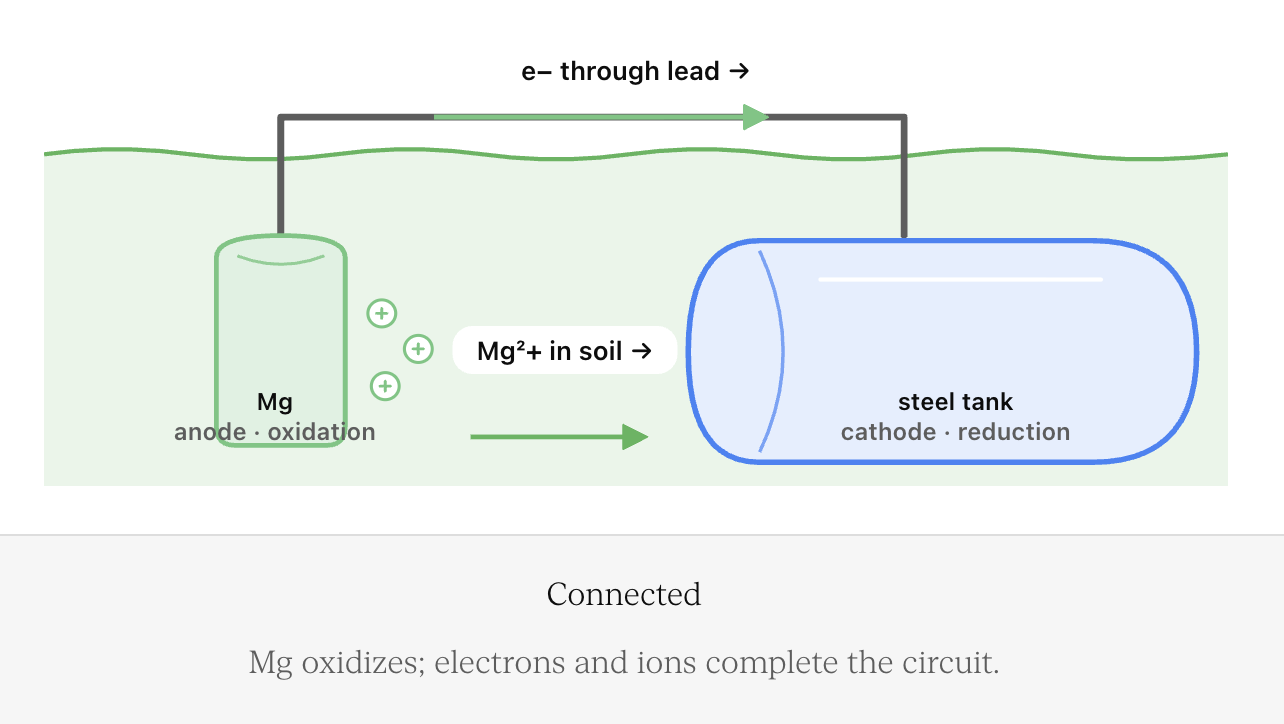
The attached metal becomes the:

anode.

It oxidizes instead of the protected structure.

For example:

Mg → Mg²⁺ + 2e⁻
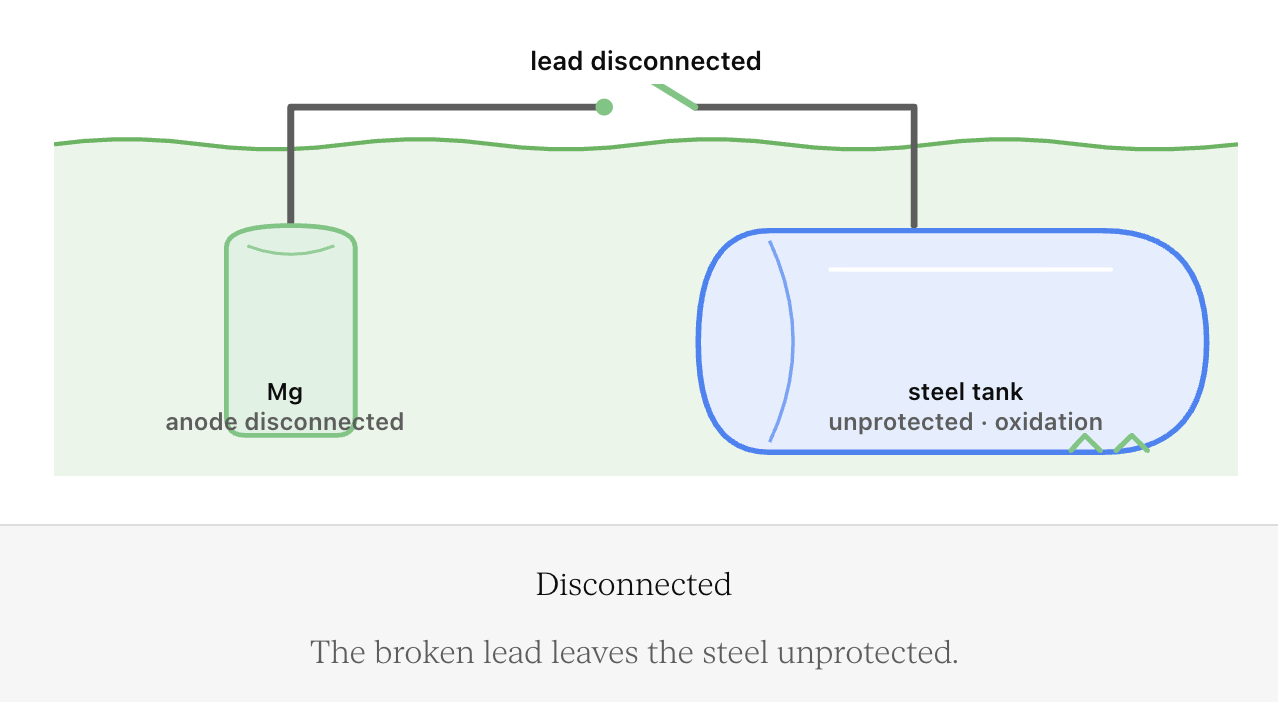
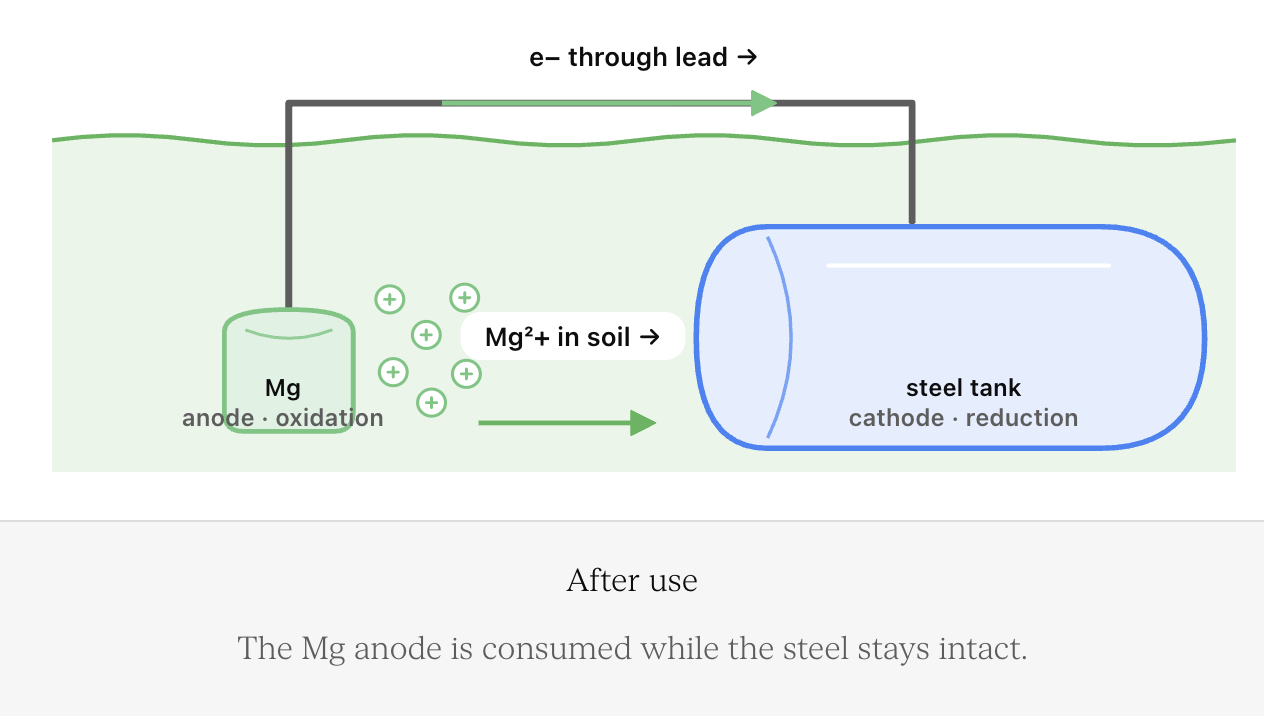
The interactive model shows the key idea: the sacrificial metal is oxidized while the steel structure is maintained as the cathode.


Why Is It Called a Sacrificial Anode?

The anode is deliberately allowed to:

corrode.

It is sacrificed to protect the more valuable structure.

Over time, the sacrificial anode becomes smaller and eventually needs to be:

replaced.

This is much easier and cheaper than replacing an entire ship, pipeline, or storage tank.


Electron Flow in Sacrificial Protection

Consider magnesium connected to steel.

Magnesium oxidizes:

Mg → Mg²⁺ + 2e⁻

The released electrons travel through the metallic connection toward the:

steel.

The steel receives electrons and is maintained as a:

cathodic surface.

This suppresses oxidation of iron:

Fe → Fe²⁺ + 2e⁻

and therefore reduces corrosion.


Where Is Sacrificial Protection Used?

Sacrificial anodes can protect:

  • ship hulls
  • boat engines
  • underground tanks
  • water heaters
  • pipelines
  • offshore structures
  • marine equipment

The sacrificial metal is selected according to the structure and:

environment.

https://images.openai.com/static-rsc-4/QLv6jgF1HqrrfcAO0XnKmRPxVRogfyjj09JueGub_Y8M2YT1Oz3wz7xko9GYd4hjkNgWPxjnklBJrkleVshkT875BI78FbfenxYgkfX1XUnf91bJoFNoNBc1MuenOaycRp5h63cv9T-GxvtCINrlWDjFDp7TtsNLM3UGohk742XSfupVKKdKwpEoISTmrecP?purpose=fullsize
 
https://images.openai.com/static-rsc-4/fYXFyxGdS2piVjqLG1GeFGyZ0lXPuYKvY7CaSjov-Zp27O6qSmJvkisRHbThKH1VrDABM3Z3wKb7qhCLBT7h836SsoZo1DEPcp6Lh_J88vYNgIiwqoanj7Ura3FaoCq5un2p2k_M7JQdn3zQ3r8emyBb8kWwbm-PRphx02iS28BX6iPObEMzZEqMB1lHgmxg?purpose=fullsize
 
https://images.openai.com/static-rsc-4/peMszkI6ZhNMPxAvoAaDW00pP-cf_pzt16H3X_JS1QRAcS_8QFVw8OcGX3vIVHB9hWRPQCiyNWBqDPlSHHFR1oArocyLVqePnzpQr_gWJIvPBZYh_ezx8hOZUFhHg2951AoUgMc7y4HTsCOBJ5-WfHjRbjR1nSawncNiq2bSWn-f0MzLOollEvFWoCUrOCmZ?purpose=fullsize
 
7

Sacrificial Anodes on Ships

A ship's steel hull spends long periods in:

seawater.

Seawater is a good electrolyte because it contains many dissolved ions.

Pieces of suitable sacrificial metal can be attached to the hull.

These anodes corrode preferentially, helping protect the:

steel hull.


Sacrificial Anodes in Water Heaters

Many water heaters contain a sacrificial:

anode rod.

The rod is often made from magnesium, aluminum-based material, or another suitable alloy.

The rod corrodes preferentially and helps protect the steel tank.

Eventually the rod may need to be:

replaced.


Impressed-Current Cathodic Protection

Large structures may use another system called:

impressed-current cathodic protection, or ICCP.

Instead of relying only on the natural potential difference between metals, an external DC power source supplies electrons to the structure.

The structure is maintained as the:

cathode.

Separate anodes are installed in the surrounding electrolyte.


Where Is Impressed-Current Protection Used?

ICCP can be used for large structures such as:

  • long pipelines
  • large storage tanks
  • ship hulls
  • offshore structures
  • buried steel infrastructure

It is particularly useful when a large amount of metal must be:

protected.

https://images.openai.com/static-rsc-4/S61spvMc31lpqdnTJZpl34eq7ComQrzhIUM4wDWyvwIEnG_DY6R1sv3dbwAcQhm1APRVGEOyw7mi_I9_iGYyPAmlau4TkMo80ZRkq7tKoaW10H7fy62UzUkcDAI3DpBIOacUJBMw1J5um5n_BnuBHImxmecx__NQya_fXlcx9KF4HWhIY9ZMKAG_l0xn-0r_?purpose=fullsize
 
https://images.openai.com/static-rsc-4/0fR_905vitZULFUEE6LAtzRFQPMKe2Zh_k_5UyUGWQj1EqIY5MvVH1w5s6K3511kA6JQ5EghdLvaCsDqXLJnRE4_uXPbiHEUO7apW1gI66ah1EOuV-IH8xjS0dfqNQ0p8fcKNt5ZD4OD3ReTI-xSDvZA0K_HyRzqa_6Jl3KaQnECwZlla6DKDwz8oWei_mwV?purpose=fullsize
 
https://images.openai.com/static-rsc-4/FH_4kkTj9abdAm_xT5C22ASDSUcAQeufg215DxtZqd1QZlEodEg3UNZa_mJcqpuQTX2ifmexq8ADdvtXaD6-rMpwt01E01VW3Pj3ZfxY_9FYc7K6MhjY9Wwva0W1Jm_3MTBVYsKEI5rpkrm_L2CXeJ_KCGbaSQktTGTvmVUy1YmI-4Z0FI9qW9PG2OpbTJRd?purpose=fullsize
 
6

Sacrificial vs Impressed-Current Protection

Feature Sacrificial Anode Impressed Current
Energy source Natural potential difference External DC supply
Anode Reactive sacrificial metal Usually durable specialized anode
Maintenance Anodes replaced as consumed Electrical system monitored
Complexity Relatively simple More complex
Typical use Smaller/local systems Large structures and pipelines
Control Limited Can be adjusted

Neither method is universally best.

The appropriate system depends on:

size, environment, cost, and engineering requirements.


Coatings and Cathodic Protection Together

Engineering systems often use more than one corrosion-control method.

For example, a buried pipeline may have:

a protective coating + cathodic protection.

The coating reduces the amount of metal exposed to the environment.

Cathodic protection protects areas where the coating has:

defects or damage.

Combining methods can provide much better protection than relying on only:

one system.


Stainless Steel and Alloying

Another strategy is to change the:

material itself.

Stainless steels contain chromium.

Chromium helps form a thin, adherent, protective oxide layer on the surface.

This layer is called a:

passive film.

It greatly reduces further corrosion under many conditions.

https://images.openai.com/static-rsc-4/Olym8HtI5EgbpKFvxY1fBpmq5bXZV69rM95mpo0MQwTm0iTa_xg3MWlnUQGU0OND66zWnPqYLpfen2oIBd4PAisEQSWF3z6CKO1lcXvNoPGNAgaVQuPcX9IGO2_6F6-bO25LQVSyrkeQUZjSln924SMRjSShM4JV_JaaOQC4ADL446mP7dAlOhhyhgtzGcRd?purpose=fullsize
 
https://images.openai.com/static-rsc-4/w1Fr_jXHvjCy7n1OHtY4ukcJcN1KVXNUBZrzPweMkBbQ5mhIkSvb7zlyLKWy5iCFSt7quR5Lb5UE4JzpGUQv-G87RNT_00oRcy5CpTaUpH8pw1BsJPa0xdvJPHXdvQlFbaHzqgQ16Ol-YPaZKuTXIEVhedKYsYd8wdviIYzlobrRGU3CX6EhtaRhF9QBUwkm?purpose=fullsize
 
https://images.openai.com/static-rsc-4/5q5xGMS0RlTSGyjIQbF3ptk2vlFznXeu2-7UPegG45mHR7ZDHXovVreMJnylUcWVMMLMm44oYA-m1rHoJ4-a5fqtQt9TbVsGfqpoEie9oQjtBegJFuW7JL4r4kyNtTNjljgLDXnf7LK3eygsAricnetaPSEPUCU8xCjv4R0aWkLGiBrkvExLm_d9_eWze62_?purpose=fullsize
 
4

Passivation

Passivation occurs when a metal forms a thin surface layer that slows further reaction.

Metals that can show useful passivation include:

  • aluminum
  • chromium
  • stainless steel
  • titanium

Unlike porous rust, a good passive layer can strongly limit contact between the underlying metal and:

the environment.


Aluminum and Corrosion

Aluminum is reactive, but it often appears highly corrosion resistant.

This is because aluminum rapidly develops a thin layer of:

aluminum oxide.

The oxide layer adheres strongly to the surface and helps prevent further:

oxidation.

This demonstrates that a reactive metal is not necessarily a metal that corrodes rapidly under all:

conditions.


Corrosion Inhibitors

A corrosion inhibitor is a chemical added in relatively small amounts to an environment to reduce:

corrosion rate.

Inhibitors may work by:

  • forming protective surface films
  • slowing oxidation
  • slowing reduction reactions
  • changing solution chemistry

They can be used in systems such as:

  • cooling systems
  • boilers
  • industrial equipment
  • closed water systems

Comparing Corrosion-Prevention Methods

Different methods solve different problems.

Method How It Works Main Advantage Limitation
Paint Blocks environment Simple and inexpensive Damage exposes metal
Oil/grease Blocks water and oxygen Good for moving parts Must be reapplied
Electroplating Adds protective metal surface Improves several properties Coating can be damaged
Galvanizing Zinc coating + sacrificial action Protects steel even at small scratches Zinc is gradually consumed
Alloying Changes material composition Protection throughout material Often more expensive
Sacrificial anode More reactive metal oxidizes Simple electrochemical protection Anode must be replaced
Impressed current External supply keeps structure cathodic Effective for large structures Requires equipment and monitoring
Inhibitors Slow corrosion reactions Useful in fluid systems Requires chemical control

Why Corrosion Control Matters

Corrosion is much more than an appearance problem.

It can weaken:

structures and equipment.

If enough material is lost, a component can eventually:

fail.

This makes corrosion control important for:

  • safety
  • reliability
  • economics
  • environmental protection
  • infrastructure lifetime

Bridges

Steel bridges are exposed to:

  • rain
  • humidity
  • oxygen
  • pollutants
  • sometimes road salt

Corrosion can reduce the thickness and strength of steel components.

Engineers therefore use:

  • protective coatings
  • corrosion-resistant materials
  • drainage
  • inspections
  • maintenance
https://images.openai.com/static-rsc-4/KHRXpMOc0I30dooiFfugUE7_IPSB0eUKqElDhZR0GJXMZUtZvy0HNF4FvuU6-09sbldbAr1MVXKKMbvCPxg92bxD6KOwGAVFvcGMCrycVo7LdH3kQ3VDAhqDQ8XjNkpLwbBscSCGEWanNmGc9UefXd3ssAfozWG54Nje6_s3u19Gd7xorLKb57E0BoYA97jc?purpose=fullsize
 
https://images.openai.com/static-rsc-4/j-92U63xPYPErBpL__TduGr7-J4XR7tuMtWs8WQU0Aq09CBl4gZrElfR95GK3f86EumEl19XYJamRuG9Or_gBk6jIc1OONIjdrUMcuAe9ycnUdJnpoGGvjUA-U2-90Gg-OABi5wP89WbVHs0btvkeobLz5bydmvKmLpAE-NkBcB2Ni4ulVL3oDl0hKCaXMBt?purpose=fullsize
 
https://images.openai.com/static-rsc-4/XldcOzHh-0IEPapRREvUoC_VkPAWcw4u0xW_mG0Nlk0_Ys4lkRUYLITCaYA9fRffGj-lAU6foy_PIvEMevpEEOJs89X_ZtbtkqpJKicUgukQA9WFLOmT9zO10bVTX2PRFH7VwBrg8vI_IrPb7BDaHZugUSsUpvj5YhgYF69JUoiUOnEY8iVyVUHJY8ypClZb?purpose=fullsize
 
7

Pipelines

Pipelines may be buried underground or exposed to water and soil.

These environments can create conditions for:

electrochemical corrosion.

Pipeline protection commonly combines:

coatings and cathodic protection.

Regular monitoring allows engineers to determine whether the protection system is:

working correctly.


Ships and Offshore Structures

Marine environments are particularly challenging because seawater is an effective:

electrolyte.

Ships and offshore structures may use combinations of:

  • protective coatings
  • sacrificial anodes
  • impressed-current systems
  • corrosion-resistant materials

Without corrosion control, their service lives could be significantly:

reduced.


Storage Tanks

Corrosion in storage tanks can potentially lead to:

leaks.

Depending on what the tank contains, this could cause:

  • loss of product
  • contamination
  • environmental damage
  • fire hazards
  • expensive repairs

Corrosion prevention is therefore an important part of:

engineering risk management.


Reinforced Concrete

Concrete structures often contain:

steel reinforcement bars.

Normally, the concrete environment helps protect the steel.

However, chloride ions or other environmental changes can damage the protective conditions.

The steel may then corrode.

Rust products occupy more volume than the original iron, which can create pressure and cause:

cracking and spalling of concrete.

https://images.openai.com/static-rsc-4/X92JXHNNxA0refRy7ek2p_e8N2vue561ax3bwu3opDCCNsigOe5Tzo1j196ZeL827eYZq9ybs3uu4rsryiSO9J_0Tiu4cqP7YcG3vjweY4Az470mzl-5gfU2w9X3UFwMZiNIq8D4_JgVW73BTjUDv-_KlyNb5lJIaKG4vT7nsMKlJSiBRjMCbuY33nAMaEEn?purpose=fullsize
 
https://images.openai.com/static-rsc-4/JezhVnC-OZFeZ8nZq2f8japprj0VUiyTeuNbKUGDgyC04s2Y6PKTo_u2l50nIQ28eBGvox4IVN3O24J2y9xql32ouWzenVdsHwru0FnM4rSDqXBXXUc0knEw0XxU-LpvdoCUpRYkX4ExN0KwN6zggMgmYuqxiA1TSGqSE7D3aZTH61NhSpxRkFG8rPxY1Z1z?purpose=fullsize
 
https://images.openai.com/static-rsc-4/6RcuwlsYTn5uJr5RU-AgV2RYNKPlO01ghzULvp-70ciuRmACnCHFbzIFYZwGk4qKalf3KJ3BK9JLc-g1D2pKPkBsxTpRd_IXOoP0KV_NPPyRVmxuiK_QRPOzQUwhblLpxnu211xi_aa39S5BadwwFmMECjwWd4CMfnihLt5VwMBX1r6bCEQBdjpVkbKDCDRA?purpose=fullsize
 
7

Economic Importance of Corrosion Control

Replacing damaged infrastructure can be extremely:

expensive.

Corrosion control can extend the useful life of:

  • bridges
  • pipelines
  • vehicles
  • buildings
  • ships
  • industrial equipment

Preventive maintenance can therefore reduce:

long-term costs.


Safety Importance

Corrosion can reduce the strength of a component without immediately being:

obvious.

Serious corrosion can contribute to failures involving:

  • pressure vessels
  • pipelines
  • structural supports
  • transportation equipment

Engineers therefore inspect critical systems and monitor corrosion as part of:

safe operation.


Environmental Importance

Corrosion can cause leaks from:

  • pipelines
  • storage tanks
  • industrial equipment

A leak can release chemicals, fuels, or other substances into the:

environment.

Preventing corrosion therefore helps prevent some forms of:

pollution.


Choosing a Corrosion-Control Method

Engineers must consider several factors.

These include:

  • type of metal
  • environment
  • expected lifetime
  • structure size
  • accessibility
  • maintenance requirements
  • safety consequences
  • cost
  • possibility of coating damage
  • availability of electrical power

The best solution may combine:

several methods.


Worked Example 1

Iron is exposed to moist air.

Write the oxidation half-equation.

Fe → Fe²⁺ + 2e⁻

Iron loses electrons.

Therefore iron is:

oxidized.


Worked Example 2

Where does corrosion occur in an electrochemical corrosion cell?

Metal loss occurs primarily at:

anodic regions.

This is where metal atoms lose electrons and enter the electrolyte as:

ions.


Worked Example 3

Why does salt water often increase corrosion?

Salt water contains mobile ions.

These increase the electrical conductivity of the electrolyte, allowing electrochemical corrosion reactions to proceed more readily.


Worked Example 4

A steel pipeline is connected to blocks of magnesium.

Which metal is the sacrificial anode?

Magnesium.

Magnesium oxidizes:

Mg → Mg²⁺ + 2e⁻

The steel is maintained as the:

cathode.


Worked Example 5

Why must magnesium anodes eventually be replaced?

Magnesium atoms are continuously oxidized and leave the anode as:

Mg²⁺ ions.

The magnesium block therefore gradually:

loses mass.


Worked Example 6

Why can galvanizing protect scratched steel?

Zinc is more readily oxidized than iron.

If electrical contact remains, nearby zinc can act sacrificially:

Zn → Zn²⁺ + 2e⁻

This helps suppress oxidation of the exposed:

iron.


Worked Example 7

Why might paint alone be insufficient for a buried pipeline?

Paint or another coating can develop:

defects or damage.

Exposed steel could then corrode.

Combining the coating with cathodic protection provides protection at some exposed areas.


Worked Example 8

Why is stainless steel corrosion resistant?

Chromium in stainless steel promotes formation of a thin, adherent:

passive oxide layer.

This layer reduces further reaction between the metal and its:

environment.


Worked Example 9

Why might impressed-current protection be selected for a long pipeline?

A long pipeline has a large surface area and may require substantial, controllable protection.

An impressed-current system allows engineers to adjust the protective:

current.


Worked Example 10

A ship uses sacrificial zinc anodes.

After several years the zinc blocks are much smaller.

Is the system failing?

Not necessarily.

The loss of zinc is evidence that the sacrificial anodes have been:

oxidized as intended.

They must be inspected and replaced before they become too depleted to provide adequate protection.


Common Mistake: Rust Is the Same as Corrosion

Corrosion is the broader process of material deterioration.

Rust refers specifically to corrosion products associated with:

iron and steel.

Other metals corrode but do not:

rust.


Common Mistake: Corrosion Is Not a Redox Reaction

Corrosion involves:

oxidation and reduction.

Metal oxidation occurs at anodic regions, while another species is reduced at cathodic regions.

Therefore corrosion is fundamentally:

electrochemical.


Common Mistake: The Cathode Corrodes

Metal dissolution occurs at the:

anode.

Cathodic protection works precisely because the valuable structure is maintained as the:

cathode.


Common Mistake: Sacrificial Anodes Stop Reacting

Sacrificial anodes protect a structure because they:

do react.

They are deliberately oxidized.

Their consumption is part of the:

protection mechanism.


Common Mistake: Paint and Cathodic Protection Work the Same Way

They use different mechanisms.

Paint provides:

barrier protection.

Cathodic protection controls:

electrochemical reactions.

They can therefore be particularly effective when:

used together.


Common Mistake: Stainless Steel Cannot Corrode

Stainless steel is highly corrosion resistant under many conditions, but it is not:

completely immune.

Its passive layer can break down in certain environments, particularly under some chloride-rich conditions.


Check Your Understanding

  1. Define corrosion.
  2. Why is corrosion considered an electrochemical process?
  3. What happens to metal atoms during corrosion?
  4. What two substances are normally required for iron to rust?
  5. Write the oxidation half-equation for iron.
  6. Where does oxidation occur in a corrosion cell?
  7. Where does reduction occur?
  8. How do electrons move during corrosion?
  9. How do ions move during corrosion?
  10. Write a possible oxygen-reduction half-equation in neutral water.
  11. What is rust?
  12. Why does rust not usually provide effective protection to iron?
  13. Explain how water contributes to corrosion.
  14. Explain how oxygen contributes to corrosion.
  15. Why does salt water often increase corrosion?
  16. How can acidic conditions affect corrosion?
  17. What is galvanic corrosion?
  18. Why can contact between different metals accelerate corrosion?
  19. What is barrier protection?
  20. Give three examples of barrier protection.
  21. Explain how painting prevents corrosion.
  22. State one limitation of paint.
  23. Explain how oil or grease prevents corrosion.
  24. What is galvanizing?
  25. Why is zinc used to protect steel?
  26. Write the oxidation half-equation for zinc.
  27. Why can galvanized steel remain protected after a small scratch?
  28. Define cathodic protection.
  29. Why does making a structure the cathode reduce its corrosion?
  30. What is a sacrificial anode?
  31. Name three metals or metal systems commonly used as sacrificial anodes.
  32. Write the oxidation half-equation for magnesium.
  33. Describe how magnesium can protect steel.
  34. Why must sacrificial anodes be replaced?
  35. Give three applications of sacrificial-anode protection.
  36. What is impressed-current cathodic protection?
  37. How does it differ from sacrificial-anode protection?
  38. Why might impressed current be suitable for a long pipeline?
  39. Why are coatings and cathodic protection often used together?
  40. What is passivation?
  41. Why is stainless steel corrosion resistant?
  42. Why does aluminum often resist corrosion despite being reactive?
  43. What is a corrosion inhibitor?
  44. Compare painting and galvanizing.
  45. Compare galvanizing and sacrificial-anode cathodic protection.
  46. Compare sacrificial-anode and impressed-current systems.
  47. Explain why corrosion control is important for bridges.
  48. Explain why corrosion control is important for pipelines.
  49. Explain one environmental consequence of uncontrolled corrosion.
  50. Evaluate which corrosion-control methods might be appropriate for a steel structure exposed to seawater.

Key Terms

Corrosion: Gradual deterioration of a material through chemical or electrochemical reactions with its environment.

Rust: Mixture of hydrated iron oxides and related corrosion products formed when iron or steel corrodes.

Anode: Region where oxidation occurs.

Cathode: Region where reduction occurs.

Oxidation: Loss of electrons.

Reduction: Gain of electrons.

Electrolyte: Medium containing mobile ions that can carry electrical charge.

Galvanic corrosion: Corrosion caused or accelerated when dissimilar metals are electrically connected in an electrolyte.

Barrier protection: Prevention of corrosion by physically separating a metal from its environment.

Galvanizing: Coating iron or steel with zinc for corrosion protection.

Cathodic protection: Corrosion-control method in which the structure being protected is maintained as a cathode.

Sacrificial anode: More reactive metal deliberately oxidized to protect another metal.

Impressed-current cathodic protection: Cathodic protection using an external electrical power source.

Passivation: Formation of a protective surface layer that slows further corrosion.

Corrosion inhibitor: Chemical used to reduce the rate of corrosion.


Key Takeaways

  • Corrosion is fundamentally an electrochemical redox process.
  • During metal corrosion, oxidation occurs at anodic regions.
  • For iron, the anodic reaction can be written as Fe → Fe²⁺ + 2e⁻.
  • Water and oxygen are important in ordinary rusting.
  • Salt often accelerates corrosion by increasing the conductivity of the electrolyte.
  • Contact between different metals can cause galvanic corrosion.
  • Barrier coatings protect metals by separating them from the environment.
  • Galvanizing protects steel using both a zinc barrier and sacrificial action.
  • Cathodic protection prevents corrosion by making the valuable structure behave as the cathode.
  • Sacrificial anodes made from suitable reactive metals corrode instead of the protected structure.
  • Impressed-current systems use an external electrical supply and are useful for large structures.
  • Passivation allows metals such as stainless steel and aluminum to resist corrosion under many conditions.
  • Engineers often combine coatings and cathodic protection for improved reliability.
  • Corrosion control is critical for safety, infrastructure lifetime, environmental protection, and economic efficiency.
  • Effective corrosion management requires selecting a protection system appropriate to the material, environment, cost, and engineering risk.