pH and Indicators
5. Measuring pH
Learning outcomes
- I can measure pH using indicator paper.
- I can measure pH using a pH meter.
- I can record and interpret pH data.
- I can compare the accuracy of different pH measurement methods.
- I can evaluate sources of error in pH measurements.


Why Do We Measure pH?
pH describes how acidic or alkaline an aqueous solution is.
At about room temperature:
- pH below 7 → acidic
- pH 7 → neutral
- pH above 7 → alkaline
Measuring pH is important in:
- chemistry laboratories
- environmental monitoring
- agriculture
- food production
- water treatment
- swimming pools
- manufacturing
- biological research
Different methods provide different levels of accuracy and precision.
The pH Scale
The familiar classroom pH scale usually ranges from approximately 0 to 14.
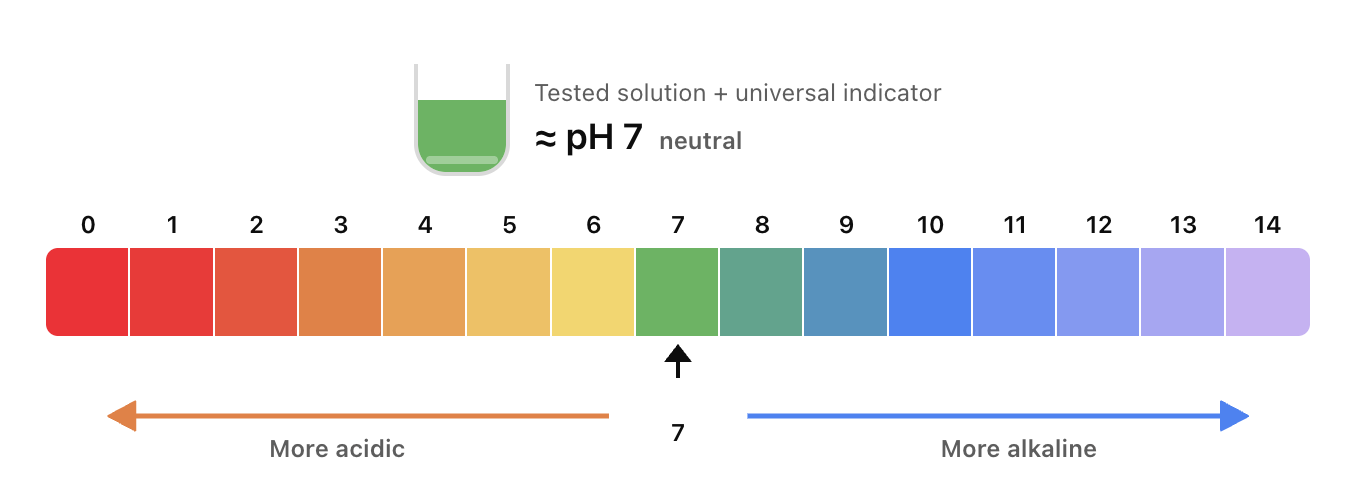
Lower pH values indicate greater acidity.
Higher pH values indicate greater alkalinity.
The scale is logarithmic, so a difference of one pH unit corresponds to approximately a tenfold difference in hydrogen ion concentration.
Methods for Measuring pH
Three common methods are:
- indicator paper
- universal indicator solution
- electronic pH meter


Each method has advantages and limitations.
The best method depends on:
- required precision
- available equipment
- sample type
- number of samples
- purpose of the investigation
Indicator Paper
Indicator paper contains chemical indicators that change colour depending on pH.
Common forms include:
- litmus paper
- universal indicator paper
- pH test strips
Universal pH paper is particularly useful because its colour can be compared with a reference chart to estimate pH.


Measuring pH with Indicator Paper
A general procedure is:
- Place a small sample of the solution in a clean container.
- Obtain a fresh piece of indicator paper.
- Apply the sample to the paper using the method specified for that paper.
- Allow the colour to develop.
- Compare the colour with the manufacturer's reference chart.
- Record the estimated pH.
- Classify the solution as acidic, neutral, or alkaline.
Avoid putting used indicator paper into stock solutions because this could cause contamination.
Reading Indicator Paper
Suppose indicator paper turns orange.
The colour chart might indicate approximately:
pH 3–4
The correct result should therefore be recorded as an estimate.
For example:
Estimated pH = 4
or, if the match is uncertain:
Estimated pH ≈ 3–4
Do not report unnecessary decimal places from indicator paper.
Why Indicator Paper Is Approximate
The result depends on a person's ability to compare colours.
Two students might see the same strip slightly differently.


Possible problems include:
- colours between two chart values
- poor lighting
- faded indicator paper
- coloured samples
- subjective colour judgement
Indicator paper therefore usually provides lower precision than a properly calibrated pH meter.
Advantages of Indicator Paper
Indicator paper is:
- inexpensive
- fast
- portable
- simple to use
- useful for many samples
- suitable for approximate measurements
It is particularly useful when the scientific question is:
"Approximately what is the pH?"
rather than:
"What is the pH to two decimal places?"
Limitations of Indicator Paper
Indicator paper:
- gives approximate results
- depends on visual colour matching
- may be difficult to use with coloured solutions
- may be affected by lighting
- has limited resolution
- may deteriorate if stored incorrectly
Therefore, it may not be appropriate when high precision is required.
Universal Indicator Solution
Universal indicator solution works in a similar way.
A small amount is added to the test solution.
The resulting colour is compared with a pH chart.


It is excellent for showing large pH differences visually.
However, like indicator paper, it normally provides only an approximate measurement.
The pH Meter
A pH meter is an electronic instrument used to measure pH.
It normally consists of:
- an electronic meter
- a pH electrode or probe
- a display


The probe produces an electrical response related to hydrogen ion activity in the solution.
The meter converts this response into a pH reading.
Measuring pH with a pH Meter
A typical procedure is:
- Check that the meter has been calibrated appropriately.
- Rinse the electrode with suitable water, commonly deionized or distilled water.
- Gently remove excess rinse water according to the probe instructions.
- Place the probe into the sample.
- Ensure the sensitive part of the probe is properly immersed.
- Wait for the reading to stabilize.
- Record the pH.
- Remove and rinse the probe before testing another sample.
- Store the electrode according to the manufacturer's instructions.


Correct technique is essential for reliable measurements.
Why Must the Probe Be Rinsed?
Suppose you measure an acidic solution and then immediately place the probe into pure water without rinsing it.
A small amount of acid may remain on the probe.
This could contaminate the water sample.
The recorded pH may therefore be too low.
Rinsing between samples reduces cross-contamination.
Calibration
A pH meter must be calibrated to produce reliable measurements.
Calibration compares the instrument with solutions of accurately known pH called buffer solutions.


Common calibration buffers include values near:
- pH 4
- pH 7
- pH 10
The exact calibration procedure depends on the instrument.
Why Calibration Matters
Electronic instruments can gradually develop measurement errors.
A meter might display:
pH 6.8
when a known pH 7 buffer should read approximately:
7.0
Calibration allows the instrument to correct its response using known standards.
Without appropriate calibration, a digital display may appear precise while still being inaccurate.
Accuracy and Precision
These terms have different meanings.
Accuracy describes how close a measurement is to the accepted or true value.
Precision describes how closely repeated measurements agree with one another.
For example:
Accepted value = 7.00
Measurements:
7.01, 7.00, 7.02
These results are both precise and accurate.
Precise but Inaccurate
Imagine a poorly calibrated pH meter gives:
6.52
6.51
6.52
for a buffer whose accepted pH is 7.00.
The measurements are close to each other.
Therefore, they are:
precise
But they are not close to the accepted value.
Therefore, they are:
inaccurate


This is why precision alone does not guarantee good data.
Resolution
Resolution is the smallest change an instrument can display or detect.
Suppose one pH meter displays:
6.4
and another displays:
6.42
The second instrument has greater displayed resolution.
However, more decimal places do not automatically mean greater accuracy.
A poorly calibrated meter can display many digits and still give the wrong result.
Comparing Measurement Methods
Consider a solution whose actual pH is close to 5.4.
Indicator paper might suggest:
pH ≈ 5
A calibrated pH meter might give:
pH = 5.38
Both measurements can be useful.
The better method depends on the scientific question.
If you only need to classify the solution as acidic:
indicator paper may be sufficient.
If you need to detect a small pH change:
a calibrated pH meter is more appropriate.
Recording pH Data
Good scientific records should be:
- clear
- organized
- appropriately precise
- labelled
- complete
A useful table might contain:
| Sample | Indicator colour | Indicator pH | pH meter Trial 1 | Trial 2 | Trial 3 | Mean pH |
|---|---|---|---|---|---|---|
| A | Yellow | ≈5 | 5.24 | 5.29 | 5.26 | 5.26 |
| B | Green | ≈7 | 7.03 | 7.01 | 7.02 | 7.02 |
| C | Blue | ≈9 | 9.18 | 9.21 | 9.19 | 9.19 |
This allows the two measurement methods to be compared directly.
Calculating a Mean pH
Suppose repeated measurements are:
6.42
6.38
6.40
Mean:
(6.42 + 6.38 + 6.40) ÷ 3
= 6.40
Repeated measurements help identify random variation and improve confidence in the result.
Identifying Anomalous Results
Suppose measurements are:
6.42
6.39
8.71
6.41
The value 8.71 is very different from the others.
It may be an anomalous result.
Possible explanations include:
- contamination
- recording error
- probe not rinsed
- instrument instability
- incorrect sample
- equipment malfunction
The measurement should be investigated rather than simply deleted without explanation.
Repeating Measurements
Repeated measurements can improve the reliability of an investigation.
Instead of recording one value:
pH = 6.3
take several readings.
For example:
6.31
6.35
6.32
The results can then be compared and an appropriate mean calculated.
Repeats also make unusual results easier to identify.
Random Error
Random errors cause measurements to vary unpredictably.
Examples in pH investigations can include:
- small fluctuations in meter readings
- slight differences in colour judgement
- small temperature variations
- small differences between samples
Repeating measurements can help reduce the effect of random error when estimating a mean.
Systematic Error
A systematic error shifts measurements consistently in the same direction.
For example, an incorrectly calibrated pH meter might consistently read:
0.4 pH units too low
Repeating the measurement does not remove this problem.
You might obtain:
5.61
5.62
5.60
5.61
These values are very consistent, but they can all still be wrong.
Correct calibration is required.
Source of Error: Poor Calibration
If the pH meter is incorrectly calibrated, measurements may be systematically too high or too low.
Improvement:
calibrate the meter using appropriate standard buffer solutions before measurement.
Source of Error: Cross-Contamination
If the electrode is moved directly from one sample to another, some of the first sample can be transferred.


Improvement:
rinse the probe appropriately between measurements.
Source of Error: Poor Colour Matching
Indicator paper depends on visual judgement.
Two colours may look very similar.
Improvement:
- use good lighting
- compare against a white background
- use the correct colour chart
- have more than one observer compare the colour
- use a pH meter if greater precision is required
Source of Error: Coloured Samples
Suppose a dark red drink is tested with universal indicator.
The original colour of the drink may interfere with the indicator colour.
This makes visual measurement unreliable.
Improvement:
use an appropriate pH meter if the sample is suitable for probe measurement.
Source of Error: Temperature
pH measurements can be affected by temperature.
Temperature can influence:
- chemical equilibria
- electrode response
- the pH of the sample itself


For careful experiments:
- measure samples at controlled temperatures
- record temperature when relevant
- use appropriate temperature compensation where available
Neutral pH and Temperature
A common classroom statement is:
neutral = pH 7
This is approximately true at 25°C.
More precisely, neutrality occurs when:
[H⁺] = [OH⁻]
The pH corresponding to neutrality changes somewhat with temperature.
For most introductory classroom investigations at room temperature, pH 7 is an appropriate approximation.
Source of Error: Dirty Glassware
Suppose a beaker previously contained sodium hydroxide.
If it is not properly cleaned, a small amount may remain.
An acidic sample placed into the beaker could partially react with the remaining alkali.
The measured pH would then be incorrect.
Improvement:
use appropriately cleaned glassware.
Source of Error: Waiting Too Little Time
A pH meter reading may fluctuate when the electrode first enters a sample.
For example:
6.71 → 6.54 → 6.47 → 6.46
Recording the first value would give a poor measurement.
Improvement:
allow the reading to stabilize before recording it.
Source of Error: Poor Electrode Storage
Many pH electrodes require specific storage conditions.
Allowing an electrode to dry out or storing it incorrectly can reduce its performance.
Always follow the manufacturer's instructions for:
- cleaning
- storage
- calibration
- maintenance
Evaluating Indicator Paper
Suppose indicator paper gives:
pH ≈ 6
A pH meter gives:
pH = 5.63
Does this mean the indicator paper was "wrong"?
Not necessarily.
Indicator paper has limited resolution and provides an estimate.
A reading around pH 6 may be reasonable given the method.
The methods should be evaluated according to what they are capable of measuring.
Evaluating a pH Meter
A digital pH meter might display:
7.426
This does not automatically mean the actual pH is known accurately to three decimal places.
Before trusting the result, ask:
- Was the meter calibrated?
- What is its stated accuracy?
- Was the probe clean?
- Was temperature controlled?
- Was the reading stable?
- Were measurements repeated?
A digital display can give a false impression of certainty.
Reliability
Reliability describes whether a measurement or investigation produces consistent results.
Reliability can often be improved by:
- repeating measurements
- using consistent procedures
- controlling variables
- identifying anomalous results
A reliable measurement is not automatically accurate.
A badly calibrated meter may give highly consistent but inaccurate readings.
Validity
An investigation is valid when its method actually measures or tests what it is intended to measure.
For example, if the goal is to compare the pH of several clear solutions, universal indicator may provide useful approximate results.
If the goal is to detect a pH change from:
6.42 to 6.55
indicator paper would probably not be suitable.
A higher-resolution, properly calibrated pH meter would be more valid for that purpose.
Comparing pH Measurement Methods
Litmus paper
Information:
acidic or alkaline classification
Advantages:
- fast
- inexpensive
- simple
Limitations:
- does not give useful numerical pH
Universal indicator paper
Information:
approximate pH
Advantages:
- inexpensive
- portable
- quick
- easy to compare many samples
Limitations:
- subjective colour matching
- limited precision
Universal indicator solution
Information:
approximate pH
Advantages:
- excellent visual demonstration
- broad colour range
Limitations:
- changes the sample
- coloured samples can interfere
- limited precision
pH meter
Information:
numerical pH
Advantages:
- greater precision
- useful for detecting small changes
- avoids visual colour matching
Limitations:
- requires calibration
- requires maintenance
- can be contaminated
- more expensive
- improper technique can produce misleading results
Example 1: Choosing a Method
A student wants to determine whether rainwater is acidic, neutral, or alkaline.
Indicator paper may be sufficient for a rough classification.
If the student wants to compare:
pH 5.4
with:
pH 5.7
a calibrated pH meter would be more appropriate.
The required precision determines the method.
Example 2: Evaluating Data
A student measures a solution three times:
Trial 1 = 4.21
Trial 2 = 4.19
Trial 3 = 4.20
These results are very close together.
Therefore, they show:
good precision
Can we conclude they are accurate?
Not from these measurements alone.
We would need information about calibration or comparison with a known standard.
Example 3: Comparing Methods
Indicator paper:
pH ≈ 8
pH meter:
pH = 8.27
These results are consistent with each other.
The indicator paper provides a reasonable estimate.
The pH meter provides greater resolution and, if properly calibrated and used, can provide a more precise measurement.
Example 4: Finding an Error
A student tests:
lemon juice → pH 2.4
water → pH 3.1
baking soda solution → pH 8.3
The water result seems unexpected.
Possible explanations include:
- contaminated glassware
- contaminated probe
- incorrect sample
- poor calibration
- acidic water source
- recording error
The correct scientific response is to investigate and repeat the measurement, not simply replace it with pH 7.
Planning a pH Investigation
Suppose you want to compare the pH of five different liquids.
A strong experimental method would be:
- Label five clean containers.
- Add equal or sufficient volumes of each sample.
- Test each with indicator paper.
- Record the colour and estimated pH.
- Calibrate the pH meter.
- Rinse the probe.
- Measure the first sample.
- Wait for the reading to stabilize.
- Record the result.
- Rinse the probe.
- Repeat for the remaining samples.
- Repeat measurements where appropriate.
- Calculate means if useful.
- Compare the two measurement methods.
- Identify sources of uncertainty and error.


Recording Appropriate Precision
Suppose indicator paper has colour blocks corresponding to whole-number pH values.
Reporting:
pH = 5.000
would be inappropriate.
A better result is:
pH ≈ 5
Suppose a calibrated meter designed for the investigation gives:
5.37
Then reporting:
pH = 5.37
may be appropriate, depending on the instrument's actual accuracy and resolution.
Measurements should never imply greater certainty than the method provides.
Improving a pH Investigation
Weak method:
"Test everything and write down the pH."
Improved method:
- calibrate the meter
- use clean equipment
- rinse between samples
- control temperature where relevant
- use the same procedure for every sample
- allow readings to stabilize
- repeat measurements
- record appropriate precision
- identify anomalous results
- compare methods
This produces more defensible scientific evidence.
Laboratory Safety
The main hazard in a pH investigation is often the solution being tested, rather than the measuring equipment.


Safe practice includes:
- wear appropriate eye protection
- follow laboratory instructions
- use small quantities
- avoid skin and eye contact
- never taste laboratory chemicals
- keep samples labelled
- clean spills correctly
- handle glass electrodes carefully
- wash hands after practical work
Extreme pH values may indicate corrosive solutions, but pH alone does not identify every possible hazard.
Common Mistakes
Mistake 1: Treating indicator paper as an exact measurement
Indicator paper normally gives an estimate.
Mistake 2: Assuming more decimal places mean greater accuracy
A digital instrument can display a precise-looking but inaccurate result.
Mistake 3: Not calibrating the pH meter
Poor calibration can create systematic error.
Mistake 4: Not rinsing the probe
This can cause cross-contamination.
Mistake 5: Recording the reading immediately
Wait for the measurement to stabilize.
Mistake 6: Confusing accuracy and precision
Accuracy = closeness to the accepted value.
Precision = agreement between repeated measurements.
Mistake 7: Ignoring anomalous results
Investigate unusual results and repeat measurements where appropriate.
Mistake 8: Assuming pH 7 is always exactly neutral
Neutrality depends somewhat on temperature.
Mistake 9: Using indicator paper with a strongly coloured sample without considering interference
The sample colour may make interpretation unreliable.
Mistake 10: Assuming a calibrated instrument cannot make mistakes
Technique, contamination, temperature, electrode condition, and other factors can still affect measurements.
Did You Know?
Modern pH measurement developed from discoveries about electrochemistry and the behaviour of special glass membranes.


Today, pH sensors are used continuously in industrial systems.
They can monitor:
- drinking water
- wastewater
- chemical manufacturing
- food production
- fermentation
- environmental systems
In these situations, pH is not measured simply to complete an experiment. It may be part of a control system that automatically adjusts an industrial process.
Key Terms
- pH: Measure related to hydrogen ion activity in a solution.
- Indicator paper: Paper containing chemical indicators used to estimate pH.
- Universal indicator: Mixture of indicators that produces different colours across a broad pH range.
- pH meter: Electronic instrument used to measure pH.
- Electrode: Sensor that responds electrically to chemical conditions in a solution.
- Calibration: Comparison and adjustment of an instrument using known standards.
- Buffer solution: Solution with a stable, known pH used for purposes such as calibration.
- Accuracy: Closeness of a measurement to the accepted or true value.
- Precision: Closeness of repeated measurements to one another.
- Resolution: Smallest change an instrument can display or detect.
- Reliability: Consistency of measurements or results.
- Random error: Unpredictable variation between measurements.
- Systematic error: Consistent bias that shifts measurements in a particular direction.
- Anomalous result: Measurement that differs substantially from the expected pattern or other measurements.
- Cross-contamination: Transfer of material from one sample into another.
Measurement Method Guide
Need only acid/alkali classification?
→ Litmus may be sufficient.
Need approximate pH?
→ Universal indicator paper.
Need a quick visual demonstration?
→ Universal indicator solution.
Need greater precision?
→ Calibrated pH meter.
Need to detect small pH changes?
→ Calibrated pH meter.
Testing a strongly coloured solution?
→ Consider a pH meter because colour indicators may be difficult to interpret.
Key Takeaways
- pH can be measured using indicator paper or electronic instruments.
- Indicator paper changes colour according to pH.
- The colour is compared with a reference chart to estimate pH.
- Indicator paper is inexpensive, rapid, and useful for approximate measurements.
- Colour matching limits the precision of indicator paper.
- A pH meter provides a numerical measurement.
- pH meters must be calibrated correctly.
- Buffer solutions of known pH are used for calibration.
- The probe should be rinsed appropriately between samples to reduce contamination.
- Meter readings should be allowed to stabilize before being recorded.
- Repeated measurements can help assess precision and identify anomalous results.
- Accuracy and precision are different concepts.
- More decimal places do not automatically mean greater accuracy.
- Random errors cause unpredictable variation.
- Systematic errors consistently shift measurements.
- Temperature, contamination, calibration, electrode condition, sample colour, and technique can affect pH measurements.
- Measurements should be recorded with precision appropriate to the method.
- Indicator paper and pH meters should be selected according to the needs of the investigation.
- A useful measurement process is:
select method → calibrate if required → measure carefully → record data → repeat → interpret → compare methods → identify errors → evaluate reliability and accuracy.