Rates of Reaction
5. Catalysts and Reaction Rates
Learning outcomes
- I can explain how catalysts increase reaction rates.
- I can describe the effect of catalysts on activation energy.
- I can identify industrial and biological catalysts.
- I can compare catalyzed and uncatalyzed reactions.
- I can explain why catalysts are important in industry.
What Is a Catalyst?
A catalyst is a substance that increases the rate of a chemical reaction without being consumed overall by the reaction.
A catalyst may participate in steps of the reaction, but it is regenerated before the reaction is complete.
This means a relatively small amount of catalyst can often help convert a much larger amount of reactant into product.
Catalysts work mainly by providing:
an alternative reaction pathway with a lower activation energy.

The catalyzed pathway has the lower energy barrier.
Catalysts and Reaction Rate
Remember from collision theory:
For particles to react, collisions must have enough energy to overcome the activation energy, Eₐ.
Without a catalyst, the activation-energy barrier may be relatively high.
Only a small proportion of particle collisions may have sufficient energy.
When a catalyst is added:
activation energy decreases
so:
a larger proportion of collisions can be successful
and therefore:
reaction rate increases.
This gives the chain:
catalyst
→ alternative reaction pathway
→ lower activation energy
→ more successful collisions per second
→ faster reaction
What Is Activation Energy?
Activation energy, Eₐ, is the minimum energy barrier associated with a reaction pathway.
Reactant particles must overcome this barrier before products can form.
Imagine the reaction pathway as a hill.
Without a catalyst:
large hill
With a catalyst:
smaller hill
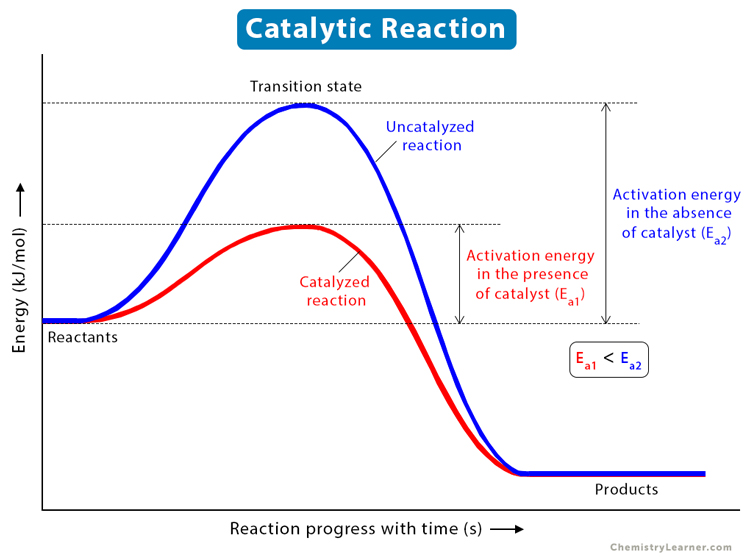
The catalyst does not push particles over the original hill.
Instead, it provides a different route with a lower hill.
Comparing Catalyzed and Uncatalyzed Reactions
Consider the same chemical reaction under identical conditions.
Uncatalyzed reaction
- higher activation energy
- smaller fraction of collisions can overcome Eₐ
- fewer successful collisions per second
- slower reaction
Catalyzed reaction
- lower activation energy
- larger fraction of collisions can overcome Eₐ
- more successful collisions per second
- faster reaction
The important point is:
the starting reactants and final products remain the same.
The catalyst changes the pathway, not the overall reaction.
What Does a Catalyst Change?
A catalyst changes:
- reaction mechanism or pathway
- activation energy
- reaction rate
- time required to reach equilibrium
A catalyst does not change:
- the energy of the reactants
- the energy of the products
- the overall enthalpy change, ΔH
- the equilibrium constant
- the equilibrium position
Catalyst and ΔH
Look again at an energy-profile diagram.
The catalyzed and uncatalyzed curves begin at the same reactant energy.
They finish at the same product energy.
Therefore:
ΔH remains unchanged.
Only the height of the activation-energy barrier changes.
So:
Catalyst affects Eₐ, not ΔH.
Worked Example: Activation Energy
Suppose an uncatalyzed reaction has:
Eₐ = 150 kJ mol⁻¹
After adding a catalyst:
Eₐ = 85 kJ mol⁻¹
The decrease in activation energy is:
150 − 85 = 65 kJ mol⁻¹
The catalyst has provided a pathway whose activation-energy barrier is:
65 kJ mol⁻¹ lower.
If:
ΔH = −40 kJ mol⁻¹
before adding the catalyst, then after adding it:
ΔH is still −40 kJ mol⁻¹.
The catalyst changes the reaction rate, not the overall energy change.
Why Does Lower Activation Energy Increase Rate?
Particles in a reaction mixture have a range of kinetic energies.
At any temperature, some particles have:
- low energy
- medium energy
- high energy
Suppose the original Eₐ is very high.
Only a small fraction of particles can overcome it.
If a catalyst lowers Eₐ, many more particles now possess enough energy to follow the reaction pathway.
Therefore:
more collisions become successful.
This explains why the reaction becomes faster even though the temperature has not changed.
A Catalyst Does Not Give Particles More Energy
This is a common misconception.
A catalyst does not:
- increase temperature
- increase average kinetic energy
- make particles move faster
Instead, it:
reduces the amount of energy required for a successful pathway.
That distinction is very important.
Temperature vs Catalyst
Both increasing temperature and adding a catalyst can increase reaction rate.
However, they work differently.
Higher temperature
Particles gain greater average kinetic energy.
A larger fraction can overcome the existing Eₐ.
Catalyst
The particle-energy distribution remains essentially unchanged at the same temperature.
Instead:
Eₐ is lowered.
Therefore a larger fraction of the existing particle population can react.
Alternative Reaction Pathways
The catalyzed pathway may involve different intermediate steps from the uncatalyzed reaction.
For example, an uncatalyzed reaction might occur as:
A + B → AB
through one difficult step.
A catalyst might provide a mechanism such as:
A + catalyst → intermediate
intermediate + B → AB + catalyst
The catalyst appears during the mechanism but is regenerated at the end.
Overall:
A + B → AB
The catalyst does not appear in the final overall equation because it has not been consumed.
Why Is a Catalyst Not Used Up?
A catalyst can participate chemically during the reaction.
This sometimes causes confusion.
It may:
- temporarily bond to a reactant
- form an intermediate
- change oxidation state
- provide a reaction surface
But by the end of the catalytic cycle, the original catalyst is regenerated.
A simplified catalytic cycle is:
C + A → AC
AC + B → AB + C
C is used in the first step but recreated in the second.
Therefore:
C is not consumed overall.
Catalysts Can Eventually Become Less Effective
Although catalysts are regenerated chemically, real catalysts do not necessarily work forever.
They can become less effective because of:
- contamination
- catalyst poisoning
- physical damage
- surface blockage
- sintering at high temperatures
So "not consumed" does not mean:
"a catalyst lasts forever under all conditions."
Types of Catalysts
Two important types are:
heterogeneous catalysts
and:
homogeneous catalysts
Biological catalysts called enzymes are also extremely important.
Heterogeneous Catalysts
A heterogeneous catalyst is in a different physical phase from the reactants.
A common example is:
solid catalyst + gaseous reactants
Many industrial catalysts work this way.
The reaction takes place on the catalyst's surface.
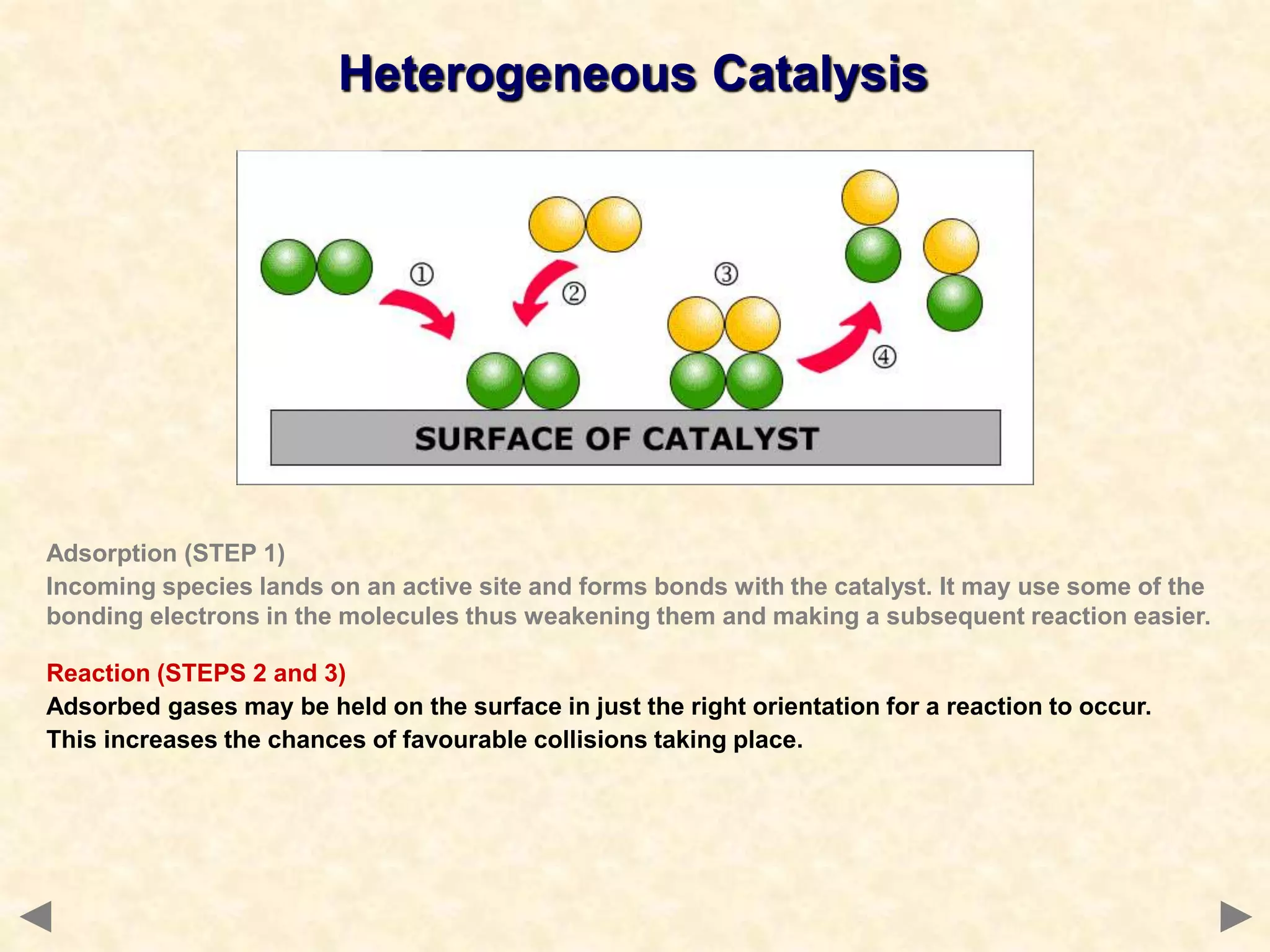
Reactant particles first attach to the catalyst surface.
This process is called:
adsorption
The catalyst can then:
- hold particles close together
- weaken existing bonds
- orient reactants favourably
- provide a lower-energy reaction pathway
The products eventually leave the surface, called desorption.
Surface Catalysis
A simplified heterogeneous catalytic process can be described as:
- reactants move toward the catalyst
- reactants adsorb onto active sites
- bonds in the reactants may weaken
- atoms rearrange
- new bonds form
- products desorb
- catalyst surface is available again

The solid catalyst itself remains available for further reactions.
Active Sites
The most important regions of many heterogeneous catalysts are called active sites.
An active site is a location on the catalyst surface where reactant particles can:
- adsorb
- become activated
- react
- form products
Increasing the available catalyst surface area can expose more active sites.
That is why industrial catalysts are often designed with:
very large surface areas.
Homogeneous Catalysts
A homogeneous catalyst is in the same phase as the reactants.
For example:
catalyst dissolved in the same solution as the reactants
The catalyst may react temporarily to form an intermediate.
That intermediate then reacts further, regenerating the catalyst.
A simplified mechanism might be:
A + C → AC
AC + B → products + C
where:
C = catalyst
Overall:
A + B → products
The catalyst has created a different mechanism with a lower activation-energy pathway.
Biological Catalysts: Enzymes
Living organisms depend on thousands of chemical reactions.
Many of these reactions would occur far too slowly under normal biological conditions without catalysts.
The catalysts used by living organisms are called:
enzymes
Most enzymes are proteins.
Examples include:
- amylase
- catalase
- lipase
- protease
- lactase
- DNA polymerase
Enzymes allow important biological reactions to occur rapidly at relatively mild temperatures.
How Enzymes Work
An enzyme usually contains a region called an:
active site
A reactant molecule, called the substrate, interacts with this active site.
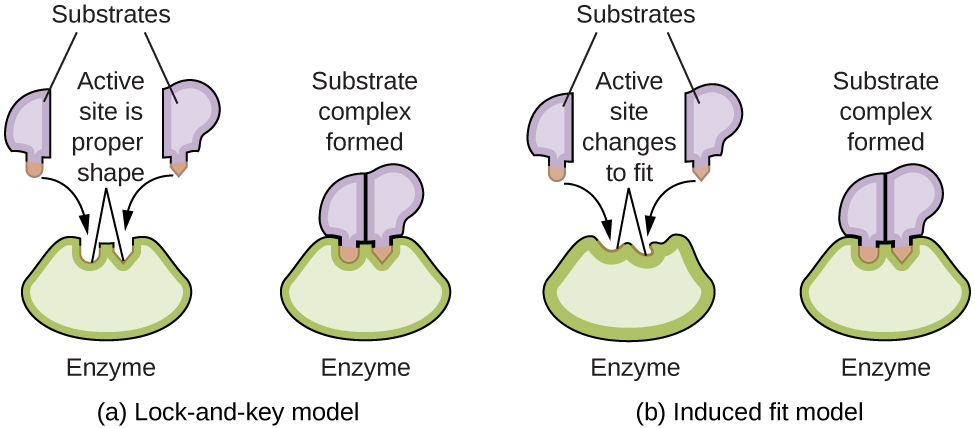
The enzyme helps create a lower-energy pathway for the reaction.
The products then leave the enzyme.
The enzyme can be used again.
The Induced-Fit Model
Modern descriptions of enzyme action often use the induced-fit model.
The active site is not completely rigid.
When a substrate approaches, interactions between the enzyme and substrate can cause a slight change in the enzyme's shape.

This can help:
- position substrates correctly
- strain particular bonds
- stabilize the transition state
- lower activation energy
The result is a much faster reaction.
Enzymes Are Specific
Enzymes often show a high degree of specificity.
This means a particular enzyme may catalyze:
- one specific reaction
- one type of substrate
- a small group of closely related reactions
The shape and chemical environment of the active site help determine which substrates can interact effectively with the enzyme.
Example: Catalase
Catalase is an enzyme found in many living cells.
It helps decompose hydrogen peroxide.
Hydrogen peroxide can be harmful to cells, so it is useful to remove it rapidly.
The reaction is:
2H₂O₂ → 2H₂O + O₂
Catalase dramatically increases the rate of this reaction.
Oxygen gas produced by the reaction can often be observed as bubbles or foam.
Enzyme Catalysis in the Human Body
Enzymes are essential because the human body operates at approximately:
37°C
Many important reactions would be extremely slow at this temperature without enzymes.
For example:
Amylase
Catalyzes the breakdown of starch.
Proteases
Catalyze the breakdown of proteins.
Lipases
Catalyze reactions involving fats.
Lactase
Catalyzes the breakdown of lactose.
Carbonic anhydrase
Rapidly catalyzes reactions involving carbon dioxide and water that are important in maintaining acid-base balance.
Catalysts in Industry
Catalysts are used extensively in chemical manufacturing.
Without catalysts, many industrial reactions would be:
- too slow
- too energy-intensive
- too expensive
- impractical at useful production rates
Industrial catalysts help manufacturers produce chemicals efficiently while controlling energy use and operating costs.
Industrial Example 1: The Haber Process
The Haber process produces ammonia.
Ammonia is extremely important because it is used to make nitrogen fertilizers and many other chemicals.
The reaction is:
N₂(g) + 3H₂(g) ⇌ 2NH₃(g)
An iron-based catalyst is used.
The iron catalyst increases the rate of both forward and reverse reactions, allowing equilibrium to be reached more quickly. It does not change the equilibrium position.
The Haber Catalyst
Nitrogen molecules contain an extremely strong:
N≡N triple bond
This contributes to the difficulty of reacting nitrogen.
On the iron catalyst surface:
- nitrogen and hydrogen can adsorb
- bonds can be weakened
- particles are held in favourable positions
- ammonia can form through a lower-energy sequence of steps
The catalyst therefore helps the reaction proceed at an industrially useful rate.
Haber Process Flow
A simplified Haber plant contains:
- nitrogen and hydrogen supply
- compression system
- catalytic reactor
- cooling system
- ammonia separation
- recycling of unreacted gases
The reactor contains a solid iron-based catalyst.
Unreacted nitrogen and hydrogen can be recycled through the process rather than discarded.
Why the Catalyst Matters in the Haber Process
Without a catalyst, nitrogen and hydrogen react too slowly under practical industrial conditions.
Increasing the temperature could increase the rate, but high temperatures:
- require more energy
- increase operating costs
- can affect the equilibrium yield of reversible exothermic reactions
The catalyst allows an acceptable reaction rate without relying entirely on even more extreme operating conditions.
This is a major economic advantage.
Industrial Example 2: The Contact Process
Sulfuric acid is one of the world's most important industrial chemicals.
During the Contact process, sulfur dioxide is oxidized to sulfur trioxide:
2SO₂(g) + O₂(g) ⇌ 2SO₃(g)
A commonly used catalyst is:
vanadium(V) oxide, V₂O₅
The catalyst helps the reaction occur at a sufficiently rapid rate at practical operating temperatures.
Why Sulfuric Acid Production Matters
Sulfuric acid is used in:
- fertilizer manufacture
- metal processing
- detergents
- chemical production
- petroleum processing
- batteries
Large-scale manufacture therefore requires a process that is:
fast, efficient and economical.
Catalysts are central to achieving this.
Industrial Example 3: Catalytic Converters
Cars with internal-combustion engines can produce pollutants such as:
- carbon monoxide, CO
- nitrogen oxides, NOₓ
- unburned hydrocarbons
A catalytic converter contains catalysts that help convert these pollutants into less harmful substances.
Common catalytic metals include:
- platinum, Pt
- palladium, Pd
- rhodium, Rh
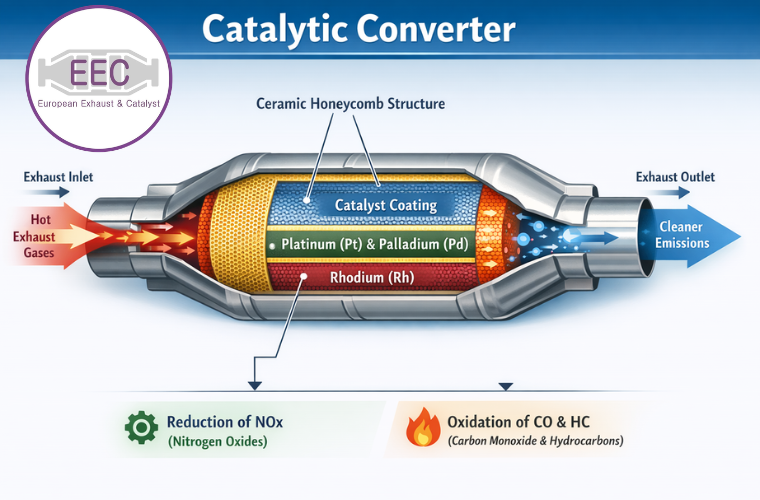
The metals are spread over a large surface area inside a honeycomb structure.
Why Use a Honeycomb Structure?
A catalyst works at its surface.
Therefore a catalytic converter is designed to provide a very large surface while remaining compact.
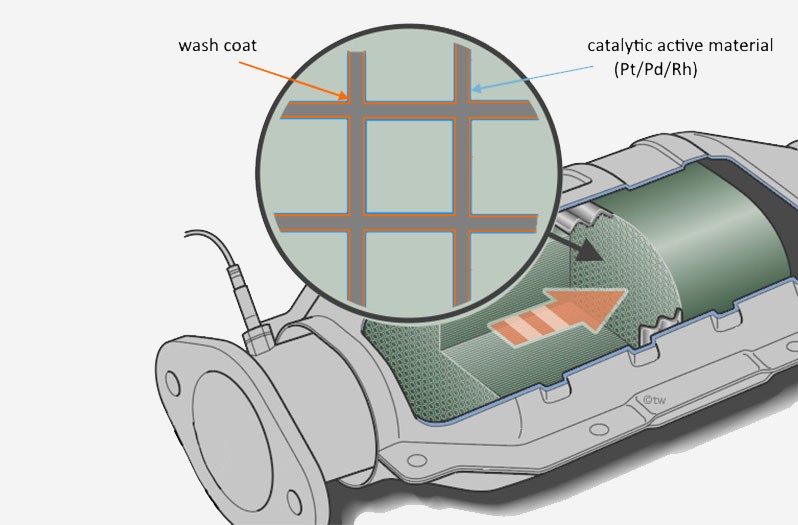
The honeycomb contains many narrow channels.
The channels are coated with catalytic material.
As hot exhaust gases pass through them, pollutant molecules contact the catalyst surface and react more rapidly.
Reactions in a Catalytic Converter
Different reactions can occur inside the converter.
For example, carbon monoxide may be oxidized:
2CO + O₂ → 2CO₂
Unburned hydrocarbons can be oxidized to form mainly:
CO₂ + H₂O
Nitrogen oxides can be reduced to form:
N₂
The catalyst increases the rate at which these transformations occur as the exhaust passes through the vehicle's exhaust system.
Industrial Hydrogenation
Catalysts are also used for hydrogenation reactions.
For example, hydrogen can be added across carbon-carbon double bonds.
Nickel and some other transition metals can act as catalysts for hydrogenation.
The reactant molecules adsorb onto the catalyst surface, where their bonds can interact more easily.
This creates an alternative reaction mechanism with lower activation energy.
Hydrogenation is used in:
- chemical manufacturing
- petrochemicals
- synthesis of organic compounds
Why Are Transition Metals Often Good Catalysts?
Many industrial catalysts involve transition metals such as:
- iron
- nickel
- platinum
- palladium
- rhodium
Transition metals are often effective because their surfaces can interact with reactant molecules.
They may:
- adsorb reactants
- weaken bonds
- stabilize intermediates
- allow different reaction pathways
- support changes in oxidation state
Different metals are suitable for different reactions.
There is no single universal catalyst.
Catalyzed vs Uncatalyzed Reaction Graph
Imagine measuring product formation with time.
An uncatalyzed reaction might produce this pattern:
slow rise → long time to plateau
The same reaction with a catalyst might show:
steeper rise → plateau reached sooner
If the starting amounts are otherwise the same, both may reach the same final amount of product.
The catalyst changes:
how quickly the final state is reached
not necessarily:
how much product can ultimately exist.
Catalysts and Equilibrium
For a reversible reaction:
A ⇌ B
a catalyst speeds up:
A → B
and:
B → A
It lowers the activation-energy barriers for the forward and reverse processes.
Therefore equilibrium is reached:
more quickly
but the catalyst does not shift the equilibrium toward either side.
This is important in industrial chemistry.
A Catalyst Does Not Increase Equilibrium Yield
Suppose a reversible reaction eventually reaches:
60% products
without a catalyst.
Adding a catalyst does not automatically change this to:
80% products
The system may still reach approximately the same equilibrium composition.
It simply gets there faster.
Therefore:
catalyst changes rate, not equilibrium position.
Why Are Catalysts Economically Important?
Industrial reactions often involve enormous quantities of chemicals.
Even a small improvement in reaction rate can have a major economic effect.
A faster process can mean:
- more product produced per hour
- smaller reactors for a given production rate
- shorter processing times
- more efficient use of equipment
This can reduce the cost of manufacturing.
Catalysts Can Reduce Energy Requirements
Many reactions could theoretically be accelerated by increasing temperature.
But heating industrial reactors requires large amounts of energy.
A catalyst can allow a useful reaction rate at a lower temperature than might otherwise be required.
This can mean:
less fuel
lower electricity demand
lower operating cost
and potentially:
lower greenhouse-gas emissions.
Catalysts and Pressure
Some industrial reactions involve gases at high pressure.
Building and operating high-pressure equipment can be expensive.
It requires:
- strong reaction vessels
- powerful compressors
- more energy
- extensive safety systems
A catalyst does not necessarily remove the need for pressure, but by increasing reaction rate it can help make a practical set of operating conditions possible.
Catalysts and Green Chemistry
Catalysts are important in green chemistry, which aims to reduce the environmental impact of chemical production.
Effective catalysts may allow:
- lower reaction temperatures
- lower energy consumption
- fewer unwanted side reactions
- less waste
- better product selectivity
- reduced use of raw materials
Catalysts can therefore improve both:
economic efficiency
and:
environmental performance.
Selectivity
Some catalysts do more than increase reaction rate.
They can favour one reaction pathway over another.
This property is called:
selectivity
Suppose reactant A could produce:
product B
or:
product C
A suitable catalyst might strongly favour the pathway to B.
This is valuable because industrial manufacturers often want one specific product and want to minimize unwanted by-products.
Biological Catalysts in Industry
Enzymes are also used commercially.
Because they can work under relatively mild conditions, enzymes can reduce the need for extreme temperatures or harsh chemicals.
Industrial enzyme applications include:
- food processing
- detergents
- brewing
- cheese production
- biotechnology
- pharmaceuticals
- biofuel production
The specificity of enzymes can also help reduce unwanted side reactions.
Enzymes in Detergents
Some laundry detergents contain enzymes such as:
proteases
which help break down protein stains,
lipases
which help break down fats,
and:
amylases
which help break down starches.
These biological catalysts allow stain-removal reactions to occur more rapidly under washing conditions.
Enzymes in Food Production
Enzymes are widely used in food processing.
For example:
lactase
can be used to break lactose into simpler sugars when producing lactose-reduced or lactose-free products.
Enzymes can also be used in:
- baking
- brewing
- cheese production
- fruit-juice processing
Their specificity makes them particularly useful catalysts.
Enzyme Activity Depends on Conditions
Unlike many simple industrial catalysts, enzymes are complex biological molecules.
Their catalytic activity depends strongly on conditions such as:
- temperature
- pH
- substrate concentration
Very high temperatures can disrupt an enzyme's three-dimensional structure.
This is called:
denaturation
The active site may change shape, reducing catalytic activity.
So although enzymes are catalysts, they require suitable operating conditions.
Catalyst Poisoning
Catalysts may lose activity if unwanted substances bind strongly to their active sites.
This is called:
catalyst poisoning
If the active sites become blocked:
- reactants cannot adsorb effectively
- fewer catalytic reactions occur
- reaction rate decreases
Industrial feed gases may therefore need to be purified before they reach expensive catalysts.
Catalyst Surface Area
Because heterogeneous catalysis occurs on the surface, a larger catalyst surface area can provide:
more active sites
Industrial catalysts are often:
- finely divided
- porous
- coated onto high-surface-area supports
- arranged in honeycomb structures
This allows a relatively small mass of catalytic material to interact with a large flow of reactants.
Worked Example 1: Energy Profile
An uncatalyzed reaction has:
Reactant energy = 70 kJ mol⁻¹
Peak energy = 210 kJ mol⁻¹
Product energy = 30 kJ mol⁻¹
Uncatalyzed activation energy:
Eₐ = 210 − 70
= 140 kJ mol⁻¹
A catalyst provides a pathway with a peak of:
135 kJ mol⁻¹
Catalyzed activation energy:
Eₐ = 135 − 70
= 65 kJ mol⁻¹
The enthalpy change remains:
ΔH = 30 − 70
= −40 kJ mol⁻¹
So:
- Eₐ decreases from 140 to 65 kJ mol⁻¹
- reaction rate increases
- ΔH remains −40 kJ mol⁻¹
Worked Example 2: Comparing Rates
Experiment A contains no catalyst.
It takes:
120 s
to produce 50 cm³ of gas.
Experiment B contains a catalyst.
It takes:
35 s
to produce 50 cm³ of gas.
Experiment B is faster.
Why?
The catalyst provides a lower-activation-energy pathway, so more collisions can successfully produce products each second.
Worked Example 3: Same Final Product
Two reactions are followed until completion.
Without catalyst:
100 cm³ product gas after 180 s
With catalyst:
100 cm³ product gas after 50 s
The catalyst has increased:
reaction rate
but has not increased:
the final volume of product
The same amount was produced in less time.
Worked Example 4: Industrial Choice
A manufacturer can operate a reaction at:
700°C without a catalyst
or:
450°C with a catalyst
while achieving a useful production rate.
Why might the catalyst be preferred?
Possible advantages include:
- lower energy consumption
- lower fuel costs
- reduced thermal stress on equipment
- potentially improved safety
- potentially lower emissions associated with energy use
This helps explain the enormous economic importance of catalysts.
Comparing Industrial and Biological Catalysts
| Feature | Industrial Catalyst | Biological Catalyst |
|---|---|---|
| Example | Iron | Catalase |
| Typical setting | Chemical reactor | Living cell |
| Main role | Increase reaction rate | Increase reaction rate |
| Effect on Eₐ | Lowers Eₐ through alternative pathway | Lowers Eₐ through alternative pathway |
| Consumed overall? | No | No |
| Specificity | Varies | Often very high |
| Conditions | May tolerate high T/P | Usually works in narrower biological conditions |
The basic chemical principle is the same:
both provide lower-energy pathways.
Industrial Catalyst Examples
| Process | Catalyst | Purpose |
|---|---|---|
| Haber process | Iron-based catalyst | Ammonia production |
| Contact process | Vanadium(V) oxide | Sulfuric acid production |
| Catalytic converter | Pt, Pd, Rh | Reduces vehicle exhaust pollutants |
| Hydrogenation | Often Ni, Pt or Pd | Adds hydrogen to unsaturated compounds |
These examples demonstrate how widespread catalysis is in modern technology.
Biological Catalyst Examples
| Enzyme | Catalyzed Process |
|---|---|
| Amylase | Starch breakdown |
| Catalase | Hydrogen peroxide decomposition |
| Lipase | Fat breakdown |
| Protease | Protein breakdown |
| Lactase | Lactose breakdown |
| DNA polymerase | DNA synthesis |
Without enzyme catalysis, many life processes would occur far too slowly to sustain normal biological activity.
Common Misconception: Catalysts Increase Particle Energy
Incorrect.
A catalyst does not normally increase the kinetic energy of the particles.
It lowers the energy requirement for a successful reaction pathway.
Common Misconception: Catalysts Increase ΔH
Incorrect.
The reactant and product energies remain unchanged.
Therefore:
ΔH is unchanged.
Common Misconception: Catalysts Are Never Involved in Reactions
Incorrect.
A catalyst may participate in individual reaction steps.
The key is that it is:
regenerated overall.
Common Misconception: Catalysts Produce More Product
Not necessarily.
A catalyst mainly changes:
how quickly the reaction proceeds.
For a reversible reaction at equilibrium, it does not change the equilibrium position.
For a reaction going essentially to completion, it can help the system reach completion faster.
Common Misconception: Catalysts Work by Increasing Collision Frequency
This is incomplete.
The central effect is:
lower activation energy through an alternative pathway.
At the same temperature, this causes a larger fraction of particle collisions to be capable of reaction.
Common Misconception: All Catalysts Work the Same Way
Different catalysts use different mechanisms.
Some:
- adsorb reactants onto surfaces
- form temporary intermediates
- transfer electrons
- transfer protons
- position molecules in favourable orientations
- stabilize transition states
What they share is that they provide a more favourable pathway for the reaction.
Why Are Catalysts So Important?
Modern society depends heavily on catalysis.
Catalysts are involved in producing:
- fertilizers
- fuels
- plastics
- medicines
- food products
- detergents
- acids
- industrial chemicals
They are also involved in:
- pollution control
- petroleum refining
- biological metabolism
- biotechnology
A huge fraction of industrial chemistry relies on catalytic processes.
Did You Know?
A catalyst may completely change the route that reactants take to become products without changing either the starting point or the finishing point.
Think of climbing a mountain.
The uncatalyzed reaction takes a route over a high peak.
The catalyzed reaction finds a lower mountain pass.
Both routes begin and end in the same places.
But one route requires a much smaller energy barrier.
That is the central idea of catalysis.
Evaluating a Catalyst
When choosing an industrial catalyst, chemists may consider:
Activity
How much does it increase reaction rate?
Selectivity
Does it produce the desired product instead of unwanted products?
Stability
Can it survive industrial temperatures and pressures?
Lifetime
How long does it remain active?
Cost
Some catalysts contain expensive metals such as platinum.
Availability
Can sufficient quantities be obtained?
Environmental impact
Does using the catalyst reduce energy use or waste?
The fastest catalyst is not automatically the best industrial choice.
A Strong Catalyst Explanation
Suppose the question asks:
Explain why adding a catalyst increases reaction rate.
A weak answer:
"It makes the reaction faster."
A stronger answer:
"The catalyst provides an alternative reaction pathway with a lower activation energy. At the same temperature, a greater fraction of particle collisions has sufficient energy to react. Therefore, more successful collisions occur per second and the reaction rate increases."
This explanation connects:
catalyst
→ activation energy
→ successful collisions
→ reaction rate
Key Terms
Catalyst – A substance that increases reaction rate without being consumed overall.
Catalysis – The process by which a catalyst increases reaction rate.
Activation energy, Eₐ – The minimum energy barrier associated with a reaction pathway.
Alternative pathway – A different reaction mechanism with a different activation-energy barrier.
Heterogeneous catalyst – A catalyst in a different physical phase from the reactants.
Homogeneous catalyst – A catalyst in the same phase as the reactants.
Enzyme – A biological catalyst.
Active site – Region where reactants or substrates interact with a catalyst or enzyme.
Adsorption – Attachment of particles to a surface.
Desorption – Release of particles from a surface.
Substrate – A reactant upon which an enzyme acts.
Selectivity – Ability of a catalyst to favour a particular reaction or product.
Catalyst poisoning – Loss of catalytic activity caused by substances blocking or interfering with active sites.
Key Takeaways
- A catalyst increases reaction rate without being consumed overall.
- Catalysts provide an alternative reaction pathway.
- The catalyzed pathway has a lower activation energy.
- Lower Eₐ means a larger fraction of collisions can result in reaction.
- Therefore, more successful collisions occur per second.
- Catalysts do not increase the average kinetic energy of reactant particles.
- Catalysts do not change the energy of the reactants or products.
- Catalysts therefore do not change ΔH.
- Catalysts speed both forward and reverse reactions.
- Catalysts allow equilibrium to be reached faster but do not change the equilibrium position.
- Heterogeneous catalysts work at surfaces and active sites.
- Homogeneous catalysts operate in the same phase as the reactants.
- Enzymes are biological catalysts.
- Catalase, amylase, lipase and protease are examples of enzymes.
- Iron-based catalysts are used in the Haber process.
- Vanadium(V) oxide is used in the Contact process.
- Platinum, palladium and rhodium are used in vehicle catalytic converters.
- Catalysts can reduce industrial energy requirements.
- They can lower operating costs and reduce waste.
- Catalysts can also improve product selectivity.
- Industrial catalysts are chosen based on activity, selectivity, stability, cost and environmental impact.
- The essential relationship is:
Catalyst → lower Eₐ pathway → more successful collisions → faster reaction.