Rates of Reaction
3. Collision Theory
Learning outcomes
- I can explain collision theory.
- I can describe the conditions required for successful collisions.
- I can explain the relationship between collisions and reaction rate.
- I can relate activation energy to collision theory.
- I can use collision theory to explain experimental observations.
What Is Collision Theory?
Collision theory explains chemical reactions by considering what happens when reactant particles collide.
For a chemical reaction to occur, reactant particles must first come into contact with one another.
However:
not every collision produces a reaction.
A successful reaction normally requires the particles to:
- collide
- collide with sufficient energy
- collide with a suitable orientation
A collision that produces products is called a successful collision or effective collision.
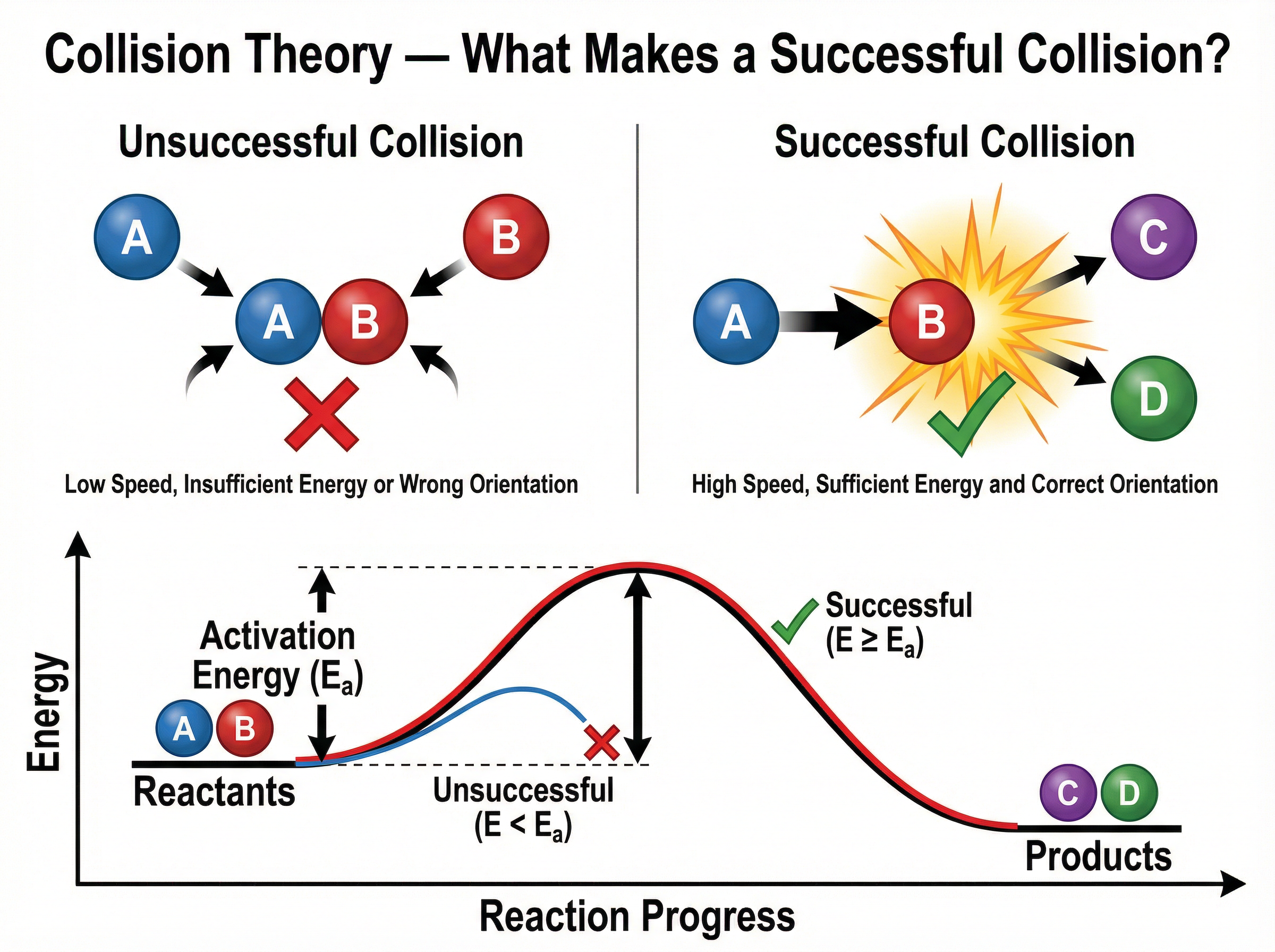
The central idea of collision theory is:
More successful collisions per second → faster reaction
Particles Are Constantly Moving
Particles in gases and liquids are constantly moving.
As they move, they collide with:
- other reactant particles
- solvent particles
- the walls of their container
Many of these collisions do not cause any chemical change.
The particles simply collide and move apart again.
A chemical reaction occurs only when a collision satisfies the conditions necessary for atoms and bonds to rearrange.
Successful and Unsuccessful Collisions
Consider a simple reaction:
A + B → AB
Particles A and B may collide many times before a reaction occurs.
Unsuccessful collision
The particles collide but:
- have insufficient energy, or
- approach in an unsuitable orientation
They separate unchanged.
Successful collision
The particles collide:
- with enough energy
- in a suitable orientation
Bonds can rearrange and product AB forms.
An important distinction is therefore:
collision ≠ successful collision
Condition 1: Particles Must Collide
The first requirement is that reactant particles actually encounter one another.
If two particles never meet:
they cannot react with each other.
This explains why factors that increase collision frequency often increase reaction rate.
Examples include:
- increasing concentration
- increasing pressure of gases
- increasing the exposed surface area of a solid
These changes create more opportunities for reactant particles to collide.
Condition 2: Sufficient Energy
Particles also need enough energy when they collide.
The minimum energy barrier associated with a reaction is called the:
activation energy
Symbol:
Eₐ
If particles collide with energy below the activation-energy requirement:
no reaction occurs
If they collide with enough energy and have an appropriate orientation:
a reaction may occur
The vertical Eₐ line shows the energy threshold that reacting particles must overcome.
What Happens During a Successful Collision?
During a successful collision:
- atoms move very close together
- electron distributions change
- existing bonds may stretch and weaken
- some bonds may break
- atoms rearrange
- new bonds may form
The collision briefly takes the system toward a high-energy arrangement called the transition state.
If the particles do not have enough energy to reach this state, they separate without reacting.
Activation Energy as an Energy Barrier
Activation energy can be visualised using a reaction profile.
Reactants begin at one energy level.
The reaction pathway rises to a maximum before falling toward the products.
The energy difference between the reactants and the top of the barrier is:
Eₐ
A large activation-energy barrier means that, at the same temperature, relatively few collisions may have enough energy to react.
A smaller barrier allows a larger proportion of collisions to be successful.
Activation Energy Is Not the Same as ΔH
Do not confuse:
Activation energy, Eₐ
with:
Enthalpy change, ΔH
Activation energy tells us about the energy barrier that must be overcome.
ΔH tells us about the overall energy difference between reactants and products.
A reaction can therefore be:
- exothermic with a large Eₐ
- exothermic with a small Eₐ
- endothermic with a large Eₐ
- endothermic with a small Eₐ
This is why knowing whether a reaction is exothermic does not automatically tell us whether it will be fast.
Why Can an Exothermic Reaction Need a Spark?
Consider combustion.
A fuel may react strongly with oxygen and release a large amount of energy.
Yet the fuel does not necessarily ignite immediately at room temperature.
An initial flame or spark provides energy that allows some particles to overcome the activation-energy barrier.
Once the reaction begins, the energy released can help sustain further reactions.
Therefore:
exothermic does not mean zero activation energy.
Condition 3: Correct Orientation
Sufficient energy alone may not be enough.
For many molecular reactions, particles must also collide in a suitable orientation.
Imagine:
A–B + C → A + B–C
Particle C may need to approach the B end of A–B.
If C strikes near A instead, the required bonds may not rearrange.
Even though the collision occurred, it may be unsuccessful.
Orientation is especially important when reacting molecules have complicated shapes or particular reactive regions.
Reaction Rate and Successful Collisions
Reaction rate depends primarily on how frequently successful collisions occur.
Imagine two reactions.
Reaction A:
100 successful collisions each second
Reaction B:
600 successful collisions each second
All other things being comparable:
Reaction B will proceed more rapidly.
Therefore:
Higher frequency of successful collisions → higher reaction rate
This idea connects microscopic particle behaviour with the macroscopic reaction rates we measure in experiments.
Collision Frequency
Collision frequency describes how often particles collide.
Suppose:
1000 collisions occur each second
and:
10 are successful.
Now imagine conditions change so that:
5000 collisions occur each second
while the same fraction remains successful.
There will now be many more successful collisions per second.
The reaction rate will increase.
Collision Theory and Concentration
Increasing the concentration of a solution means:
more reactant particles occupy the same volume.
The particles are therefore more likely to encounter each other.
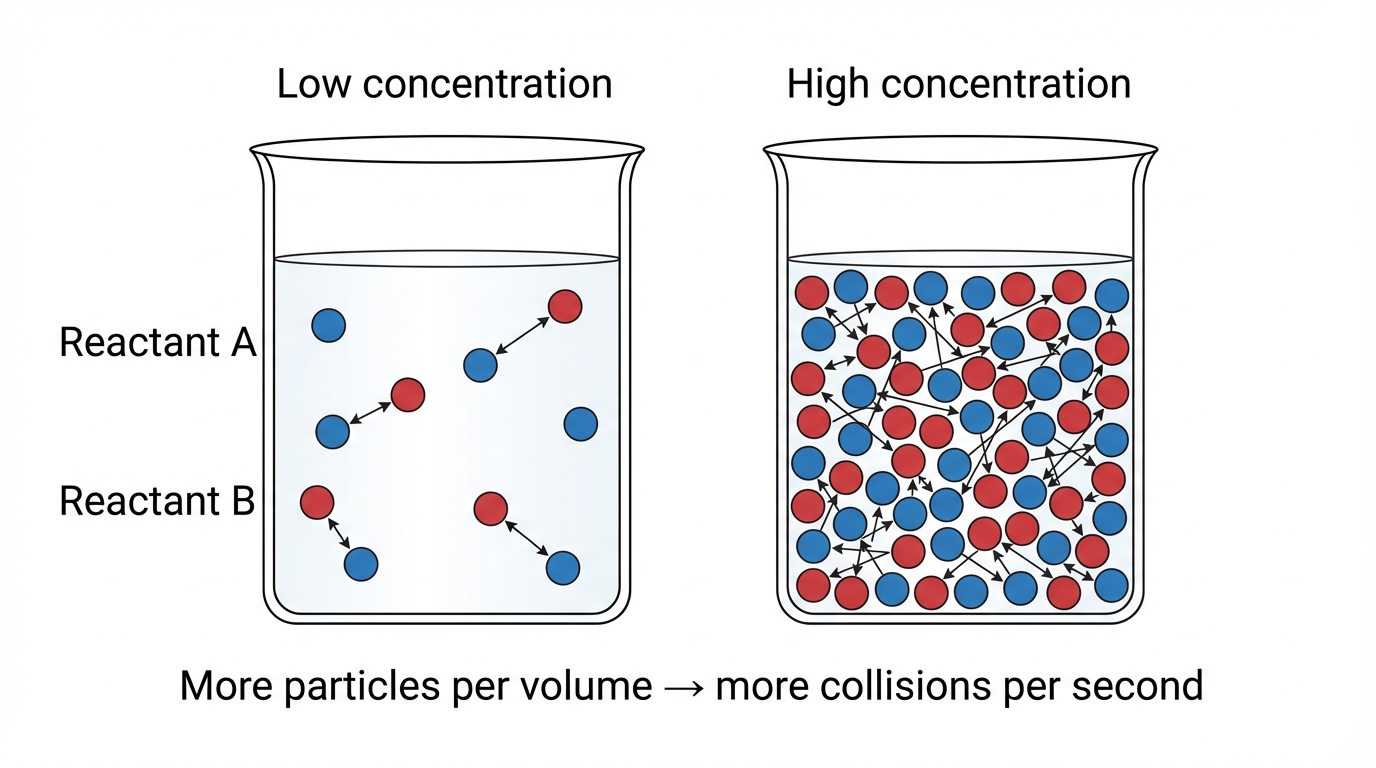
Therefore:
higher concentration
→ more particles per unit volume
→ more frequent collisions
→ more successful collisions per second
→ higher reaction rate
Increasing concentration increases collision frequency; it does not normally increase the kinetic energy of each particle.
Example: Magnesium and Hydrochloric Acid
Consider:
Mg + 2HCl → MgCl₂ + H₂
Suppose magnesium is reacted with:
0.5 mol dm⁻³ HCl
and then with:
2.0 mol dm⁻³ HCl
The more concentrated acid contains more reacting particles per unit volume.
Therefore:
collision frequency at the magnesium surface increases
and the reaction is faster.
What Would We Observe?
If hydrogen gas were collected:
The higher-concentration experiment would normally show:
- more rapid bubbling
- faster gas production
- a steeper graph
- a shorter time to reach the plateau
If the same amount of limiting reactant is used, both experiments may still eventually produce the same final amount of gas.
This is an important distinction:
higher concentration can change the rate without changing the final yield.
Concentration and Reaction Graphs
A faster reaction produces a steeper initial curve.
A slower reaction produces a shallower curve.

If both curves reach the same plateau:
the same final amount of product formed
but one reaction reached that amount faster.
The gradient gives information about the reaction rate.
Collision Theory and Gas Pressure
Pressure is particularly important for reactions involving gases.
Increasing the pressure of a gas usually means forcing the same number of particles into a smaller volume.
The particles become closer together.
Therefore:
collision frequency increases.
This leads to:
more successful collisions per second
and therefore:
a faster reaction.
Low Pressure vs High Pressure
Imagine two containers containing the same number of reacting gas particles.
Low pressure
Particles are spread throughout a larger volume.
They collide relatively infrequently.
High pressure
Particles occupy a smaller volume.
They encounter each other more frequently.
Therefore:
higher pressure → faster reaction
for many gas-phase reactions.
Collision Theory and Temperature
Temperature has an especially important effect on reaction rate.
Increasing temperature increases the average kinetic energy of the particles.
The particles move faster.
This produces two effects:
- collisions generally become more frequent
- a larger fraction of collisions has enough energy to overcome Eₐ
The second effect is particularly important.
At higher temperature, more collisions have sufficient energy to become successful.
Temperature and Particle Energy
Particles at the same temperature do not all have exactly the same kinetic energy.
Some have relatively low energies.
Some have intermediate energies.
A smaller number have very high energies.
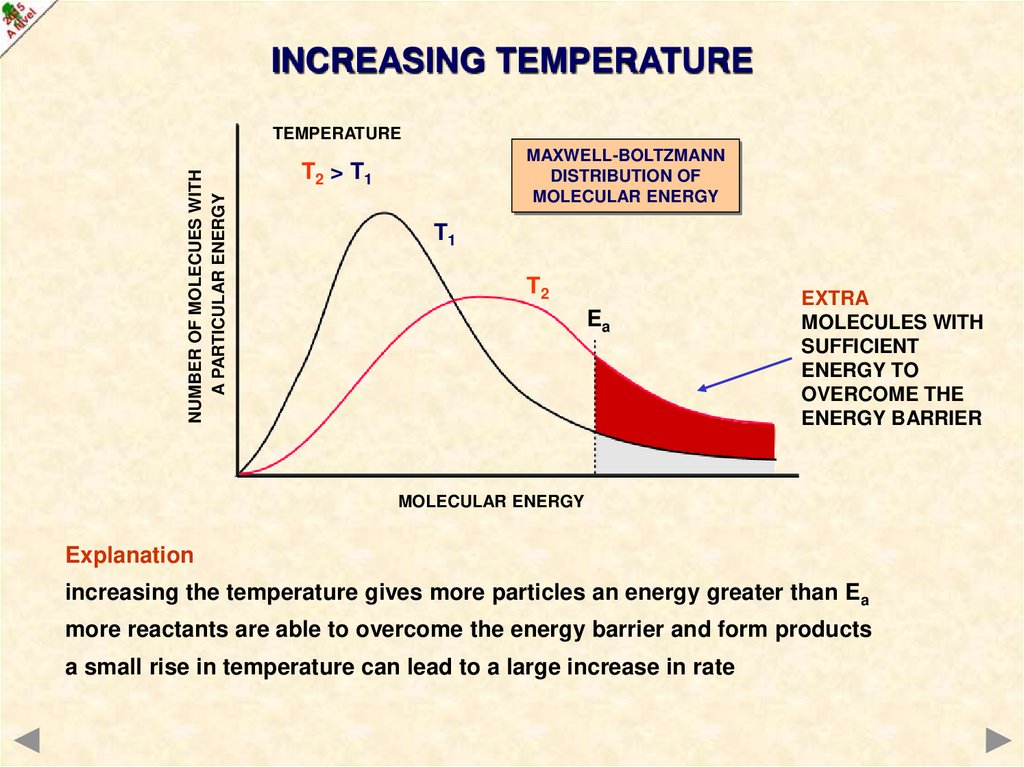
The distribution can be represented using a Maxwell–Boltzmann distribution.
The area to the right of the activation-energy line represents particles with sufficient energy to overcome the activation-energy barrier.
When temperature increases:
a greater fraction of particles lies beyond Eₐ.
Therefore:
more collisions can be successful.
Why Temperature Has Such a Strong Effect
Suppose at a lower temperature only:
5%
of collisions have enough energy to overcome Eₐ.
After increasing temperature, perhaps:
15%
have sufficient energy.
The particles have not merely begun colliding a little faster.
The fraction of collisions capable of reacting has increased considerably.
That is why temperature can have such a strong effect on reaction rate.
Temperature Does Not Normally Lower Activation Energy
A common mistake is to say:
"Heating lowers the activation energy."
It does not.
Increasing temperature gives the particles greater average kinetic energy.
The activation-energy barrier remains essentially unchanged for the same reaction pathway.
So:
Higher temperature → more particles exceed Eₐ
rather than:
Higher temperature → lower Eₐ
Example: Temperature Experiment
Suppose the disappearing-cross reaction takes:
20°C → 80 s
40°C → 38 s
60°C → 18 s
The shorter time indicates a faster reaction.
Collision theory explains this because, at higher temperature:
- particles move faster
- collision frequency increases
- more importantly, more collisions have energy ≥ Eₐ
Therefore there are more successful collisions per second.
Collision Theory and Surface Area
Surface area matters when one reactant is a solid.
Only particles at the exposed surface of the solid can collide directly with particles from the other reactant.
Consider the same mass of solid as:
- one large lump
- several smaller chips
- a fine powder
The powder has the greatest total surface area.
Therefore:
smaller particle size
→ greater surface area
→ more exposed particles
→ more collisions per second
→ faster reaction
Why Does Crushing a Solid Help?
Imagine a large cube of calcium carbonate.
Many calcium carbonate particles are trapped inside the solid.
The acid cannot collide directly with them.
If the cube is crushed into many smaller pieces, new surfaces are exposed.
Particles that were previously inside the solid can now come into contact with acid.
This greatly increases the number of possible collisions.
Example: Calcium Carbonate and Acid
Consider:
CaCO₃ + 2HCl → CaCl₂ + H₂O + CO₂
Experiment A:
5 g large marble chips
Experiment B:
5 g powdered calcium carbonate
Same temperature, concentration and acid volume.
The powder should react faster.
Why?
The powder has a larger surface area, exposing more calcium carbonate particles to collisions with acid particles. Therefore, more successful collisions occur per second.
What Would the Graph Show?
If the same amount of limiting reactant is used, both experiments may eventually produce the same volume of carbon dioxide.
But the powder would:
- have a steeper initial gradient
- reach the plateau earlier
The large chips would:
- have a shallower gradient
- take longer to reach the plateau
The total product may be the same even though the rates are different.
Collision Theory and Catalysts
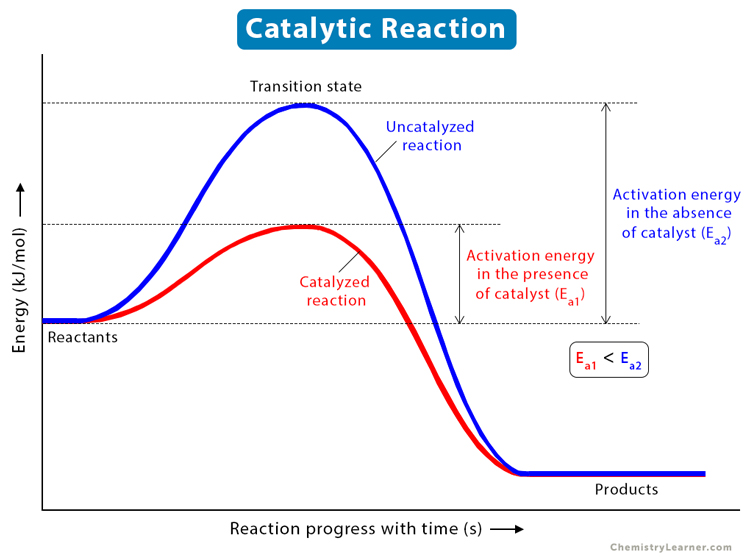
A catalyst increases reaction rate by providing an alternative reaction pathway with a lower activation energy.
Without a catalyst:
higher Eₐ
With a catalyst:
lower Eₐ
At the same temperature, lowering Eₐ means that a larger fraction of particles can overcome the energy barrier.
Therefore:
more collisions are successful
and:
reaction rate increases.
A catalyst changes the pathway, not the overall ΔH of the reaction.
A Catalyst Does Not Give Particles More Energy
This distinction is very important.
A catalyst does not:
- heat the particles
- increase their average kinetic energy
- make them move faster
Instead, it:
reduces the activation-energy requirement.
Suppose particles have collision energies of:
40, 60, 80, 100 and 120 kJ mol⁻¹.
Without catalyst:
Eₐ = 110 kJ mol⁻¹
Only the 120 kJ mol⁻¹ collision has sufficient energy.
With catalyst:
Eₐ = 70 kJ mol⁻¹
Now the:
80, 100 and 120 kJ mol⁻¹
collisions all exceed the barrier.
Many more collisions can therefore succeed.
Catalyst and Maxwell–Boltzmann Distribution
Adding a catalyst does not change the energy distribution of the particles if temperature remains constant.
Instead, the activation-energy threshold effectively moves to a lower energy.
So a larger portion of the existing particle distribution can react.
This gives another way to see why a catalyst increases reaction rate.
Comparing the Main Factors
| Factor | What changes? | Collision-theory explanation |
|---|---|---|
| Higher concentration | More particles per volume | More frequent collisions |
| Higher gas pressure | Particles closer together | More frequent collisions |
| Higher temperature | Greater kinetic energy | More collisions exceed Eₐ |
| Greater surface area | More particles exposed | More collisions at solid surface |
| Catalyst | Lower activation-energy pathway | Larger fraction of collisions succeeds |
Each factor increases rate, but not for exactly the same reason.
Using Collision Theory to Explain Experimental Results
Collision theory becomes most useful when we use it to explain observations.
For example:
Observation: Higher acid concentration makes a reaction faster.
Good explanation:
Increasing concentration puts more reactant particles in the same volume. This increases collision frequency, causing more successful collisions per second and therefore increasing reaction rate.
Example: Increasing Temperature
Observation: A reaction occurs much faster at 50°C than at 20°C.
Good explanation:
At higher temperature the particles have greater average kinetic energy. They move faster, and a larger fraction of collisions has energy equal to or greater than the activation energy. Therefore more successful collisions occur per second and the reaction rate increases.
Example: Crushing a Solid
Observation: Powdered calcium carbonate reacts faster than large marble chips.
Good explanation:
Powdered calcium carbonate has a larger surface area. More calcium carbonate particles are exposed to acid particles, increasing the collision frequency at the solid surface. More successful collisions occur per second, so the reaction is faster.
Example: Increasing Pressure
Observation: A gas-phase reaction speeds up when pressure increases.
Good explanation:
Increasing pressure places the gas particles closer together in a smaller volume. The particles collide more frequently, producing more successful collisions per second and increasing reaction rate.
Example: Adding a Catalyst
Observation: A reaction finishes sooner when a catalyst is added.
Good explanation:
The catalyst provides an alternative reaction pathway with a lower activation energy. A larger proportion of collisions therefore has enough energy to react. More collisions are successful each second, increasing reaction rate.
Explaining Why Reactions Slow Down
Reaction-rate graphs often begin steeply and gradually become flatter.
Why?
At the start:
reactant concentrations are relatively high
so:
collisions occur frequently
As reactants are consumed:
there are fewer reactant particles available
so:
collision frequency falls
Therefore:
successful collisions occur less frequently
and the reaction slows.
Eventually, a limiting reactant may be used up and the measured rate becomes zero.
Connecting Collision Theory to a Reaction Graph
Imagine gas is being produced.
At the beginning:
steep gradient
→ many successful collisions per second
Later:
shallower gradient
→ fewer successful collisions per second
At the plateau:
gradient = 0
→ no further measurable product formation
This connects the particle model directly to experimental observations.
Same Plateau, Different Rates
Suppose two experiments both produce:
60 cm³ gas
Experiment A reaches 60 cm³ after:
25 s
Experiment B reaches 60 cm³ after:
70 s
Experiment A experienced more successful collisions per unit time.
However, both eventually produced the same amount of gas.
Therefore:
successful-collision frequency determines rate
while:
amount of limiting reactant helps determine total product.
Different Plateau Heights
Now suppose:
Reaction A produces:
40 cm³
Reaction B produces:
80 cm³
The different final amounts cannot be explained simply by saying that B reacted faster.
The experiments probably involved different amounts of limiting reactant.
Collision theory is mainly used to explain:
how rapidly products form
rather than:
the maximum amount of product that can form.
Correct Collision-Theory Language
When explaining observations, avoid vague statements such as:
"The particles get more reactive."
"There are more reactions."
"The particles hit harder."
Instead, use precise scientific language:
collision frequency
kinetic energy
activation energy
successful collisions
particles per unit volume
surface area
These terms make explanations much stronger.
A Useful Explanation Pattern
For concentration:
Increase concentration
→ more particles per unit volume
→ more frequent collisions
→ more successful collisions per second
→ faster reaction
For surface area:
Increase surface area
→ more exposed solid particles
→ more collisions at the surface
→ more successful collisions per second
→ faster reaction
For temperature:
Increase temperature
→ higher average kinetic energy
→ more particles have E ≥ Eₐ
→ more successful collisions per second
→ faster reaction
For catalyst:
Add catalyst
→ lower activation energy pathway
→ larger fraction of collisions can overcome Eₐ
→ more successful collisions per second
→ faster reaction
Temperature vs Concentration
These two factors are commonly confused.
Increasing concentration
Main effect:
more frequent collisions
It does not normally increase individual particle kinetic energy.
Increasing temperature
Main effects:
particles have greater kinetic energy
and:
a larger fraction exceeds Eₐ
So temperature and concentration both increase reaction rate, but they do so in different ways.
Surface Area vs Temperature
Crushing a solid:
does not give its particles more kinetic energy.
It exposes more particles to collisions.
Heating:
does not increase the solid's surface area.
It increases particle kinetic energy.
Again, both may increase reaction rate, but through different mechanisms.
Catalyst vs Temperature
This is another important comparison.
Increasing temperature
Changes the energy distribution of the particles.
Adding a catalyst
Changes the reaction pathway and lowers Eₐ.
Both lead to more successful collisions, but by different mechanisms.
Everyday Example: Refrigerating Food
Many chemical and biochemical reactions are involved in food spoilage.
In a refrigerator:
temperature is lower
Particles have lower average kinetic energy.
A smaller fraction of collisions has enough energy to overcome activation barriers.
Therefore many spoilage reactions occur more slowly.
This helps food remain usable for longer.
Everyday Example: Cooking Food
Heating increases the kinetic energy of particles.
More collisions have sufficient energy to overcome activation barriers.
Chemical reactions involved in cooking therefore occur much faster at high temperatures than at room temperature.
This is why temperature control is such an important part of cooking.
Everyday Example: Fire
Wood can remain surrounded by oxygen for a very long time without burning.
The particles are colliding, but most collisions do not overcome the activation-energy barrier.
A match or spark supplies energy.
Once enough initial reactions begin, the combustion process releases energy that helps maintain further successful collisions.
Collision theory therefore helps explain why:
fuel + oxygen does not necessarily mean immediate combustion.
Orientation and Complex Molecules
Orientation becomes increasingly important when molecules become more complicated.
Simple ions may be able to react whenever they encounter each other appropriately.
Large molecules may contain only a small reactive region.
If two large molecules collide in the wrong orientation:
their reactive sites may never meet.
Therefore the collision remains unsuccessful even if substantial kinetic energy is present.
Enzymes and Orientation
Biological enzymes provide an interesting extension of collision theory.
An enzyme's active site can hold reactant molecules in favourable positions.
This can make productive interactions more likely.

Enzymes also lower activation-energy barriers, which is why they can dramatically increase biological reaction rates.
Experimental Evidence and Collision Theory
Imagine an experiment gives these reaction times:
| Condition | Reaction Time |
|---|---|
| Low concentration | 90 s |
| High concentration | 42 s |
| Low temperature | 110 s |
| High temperature | 35 s |
| Large chunks | 95 s |
| Powder | 28 s |
Collision theory helps explain each result.
Higher concentration:
more collisions
Higher temperature:
more energetic collisions
Powder:
more surface collisions
The observed changes provide evidence consistent with the collision model.
Evaluating an Explanation
Suppose a student writes:
"Powder reacts faster because there is more of it."
This is incorrect if the same mass was used.
A better explanation is:
"The powder has a greater surface area, so more reactant particles are exposed. This increases collision frequency with the other reactant, resulting in more successful collisions per second."
The amount of substance did not necessarily change.
The available surface changed.
Another Common Error
Statement:
"A catalyst increases the number of collisions."
This misses the main mechanism.
A better explanation is:
"A catalyst provides an alternative reaction pathway with lower activation energy, so a larger proportion of collisions can be successful."
Another Common Error
Statement:
"Heating lowers activation energy."
Incorrect.
A better explanation is:
"Heating increases the kinetic energy of the particles, so a greater proportion of collisions has sufficient energy to overcome the unchanged activation-energy barrier."
Another Common Error
Statement:
"Every collision above Eₐ creates products."
Not necessarily.
For many reactions, particles must also collide with an appropriate orientation.
A more complete statement is:
A successful collision requires sufficient energy and, where relevant, suitable orientation.
Did You Know?
In many reaction mixtures, particles may undergo an enormous number of collisions every second.
Yet the reaction may still be slow.
The reason is that only a small fraction of those collisions may satisfy all the requirements for reaction.
Some collisions have:
too little energy
Others have:
the wrong orientation
Only successful collisions contribute to chemical change.
This is why successful collisions per unit time is the key concept in collision theory.
Key Terms
Collision theory – A model that explains reaction rates using collisions between reacting particles.
Collision – An encounter between two or more particles.
Successful collision – A collision that results in a chemical reaction.
Unsuccessful collision – A collision in which products do not form.
Activation energy, Eₐ – The minimum energy barrier that must be overcome for a reaction pathway to proceed.
Kinetic energy – Energy possessed by a particle because of its motion.
Orientation – The way reacting particles are positioned relative to one another during a collision.
Collision frequency – The number of collisions occurring per unit time.
Surface area – The exposed area of a solid available for collisions.
Catalyst – A substance that increases reaction rate by providing an alternative pathway with lower activation energy and is regenerated overall.
Transition state – A temporary high-energy arrangement along a reaction pathway.
Key Takeaways
- Collision theory explains reaction rate in terms of particle collisions.
- Reactant particles must collide before they can react.
- Not every collision produces a reaction.
- A successful collision requires sufficient energy.
- The required energy is related to the activation energy, Eₐ.
- Many reactions also require suitable particle orientation.
- Reaction rate depends on the number of successful collisions per unit time.
- Higher concentration produces more frequent collisions.
- Higher gas pressure produces more frequent collisions.
- Greater solid surface area exposes more particles for collisions.
- Higher temperature increases average kinetic energy.
- At higher temperature, a larger fraction of collisions can overcome Eₐ.
- Heating does not normally lower activation energy.
- Catalysts provide an alternative pathway with a lower activation energy.
- Catalysts do not simply give particles more kinetic energy.
- Reactions often slow down as reactants are consumed because collision frequency decreases.
- Collision theory can explain experimental observations involving concentration, pressure, temperature, surface area and catalysts.
- A strong collision-theory explanation should connect:
change in conditions → change in particle behaviour → change in successful collisions → change in reaction rate.