Solutions and Concentration
1. Solutes and Solvents
Learning outcomes
- I can distinguish between solutes, solvents, and solutions.
- I can describe how solutions are formed.
- I can identify the solute and solvent in common solutions.
- I can explain the difference between concentrated and dilute solutions.
- I can relate particle models to the formation of solutions.
Solutes and Solvents
A solution is a homogeneous mixture formed when one substance dissolves in another.
Every solution contains at least two components:
- a solute — the substance being dissolved
- a solvent — the substance that dissolves the solute
For example, when salt dissolves in water:
salt = solute
water = solvent
salt water = solution
The solute particles become distributed throughout the solvent, producing a mixture that appears uniform.


What Is a Solute?
A solute is the substance that is dissolved in a solution.
For example, imagine adding a spoonful of sugar to a glass of water.
After stirring, the sugar appears to disappear.
The sugar has not actually disappeared. Its particles have become dispersed among the water particles.
In this example:
sugar = solute
A solution can contain more than one solute.
For example, seawater contains many dissolved substances, including different salts.
What Is a Solvent?
A solvent is the substance that dissolves the solute.
In sugar water:
water = solvent
In salt water:
water = solvent
The solvent is commonly the component present in the greater amount, although identifying the solvent is fundamentally about its role in the solution.
Water is an especially important solvent because many substances dissolve in it.
What Is a Solution?
A solution is the homogeneous mixture produced when a solute dissolves in a solvent.
Examples include:
- salt water
- sugar water
- vinegar
- carbonated water
- air
- some metal alloys
A solution is homogeneous, meaning its composition is uniform throughout at the scale we normally observe.
If you take samples from different parts of a properly mixed salt solution, each should have approximately the same concentration.
Solute + Solvent → Solution
A simple way to remember the relationship is:
solute + solvent → solution
For example:
salt + water → salt solution
or:
sugar + water → sugar solution
Dissolving usually does not mean that a new substance has been produced.
The particles of the solute are dispersed among the particles of the solvent.
What Happens When a Substance Dissolves?
Consider a crystal of salt placed in water.
At first:
- salt particles are together in the crystal
- water molecules surround the crystal
As dissolution occurs:
- particles separate from the crystal
- water molecules surround the separated particles
- the dissolved particles spread throughout the water
Eventually, the particles are distributed throughout the solution.
This particle-level process can be explored here:
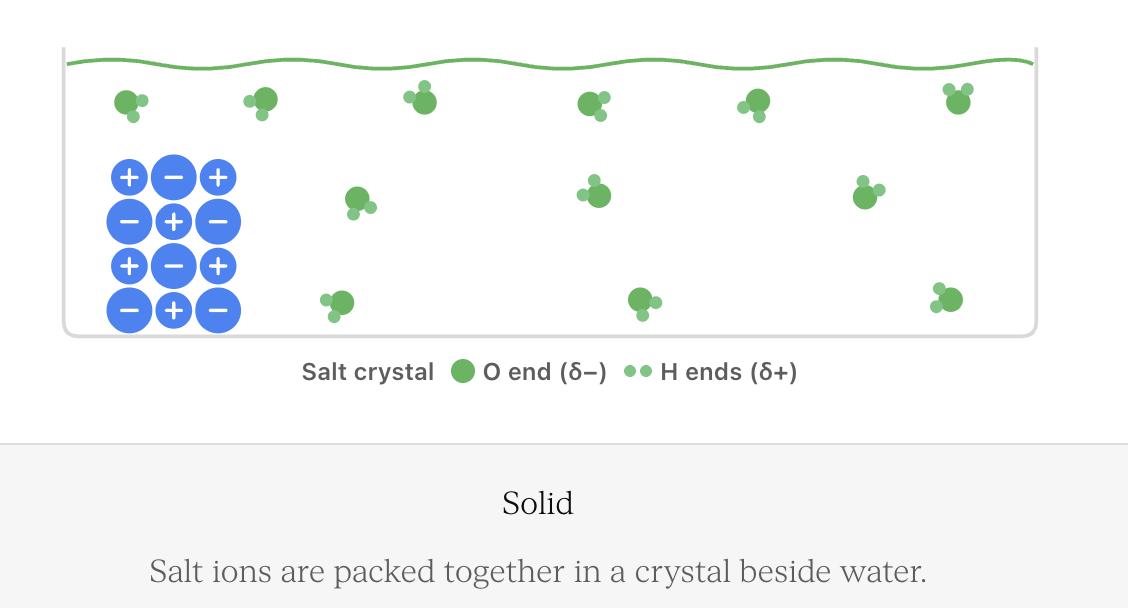
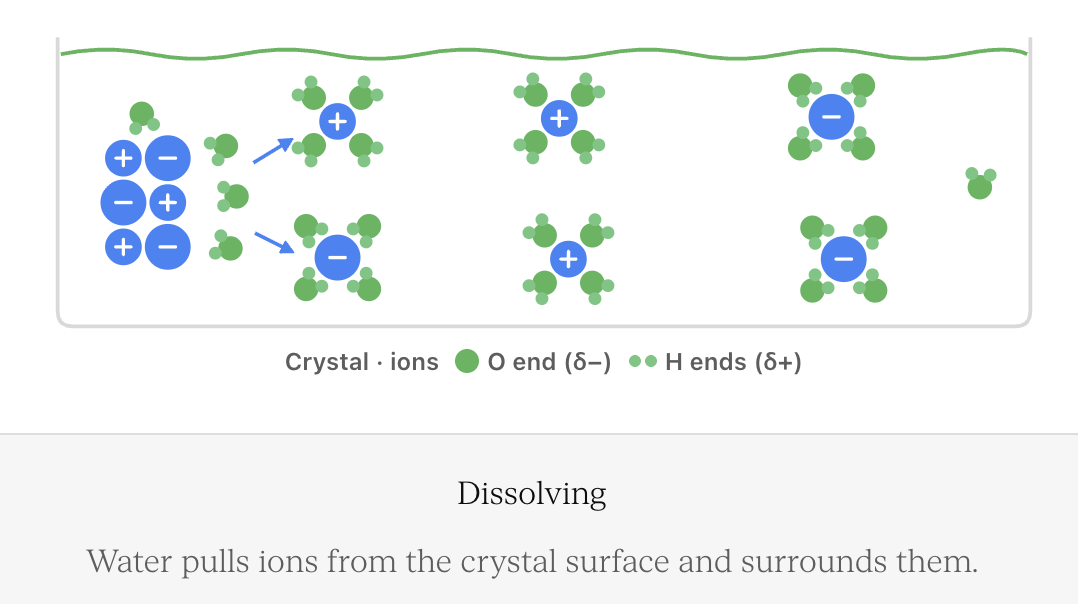
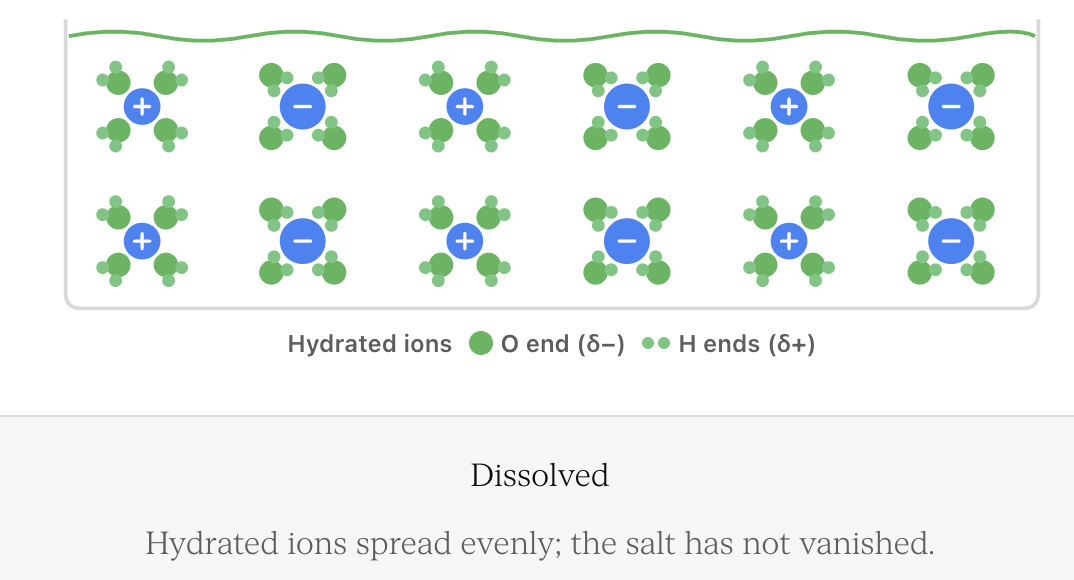
The salt may no longer be visible, but it is still present.
Dissolving Sugar
Sugar also dissolves in water, but there is an important difference at the particle level.
When sugar dissolves, individual sugar molecules separate from the crystal and become surrounded by water molecules.
The sugar molecules remain sugar molecules.
They simply become dispersed throughout the solvent.


Dissolving Is Not the Same as Melting
These processes are often confused.
Dissolving
A substance becomes dispersed within a solvent.
Example:
sugar + water → sugar solution
Melting
A solid changes into a liquid because energy is transferred to it.
Example:
solid ice → liquid water
When sugar disappears into water, the sugar has dissolved, not melted.
Dissolving Is Usually Not a Chemical Reaction
When salt or sugar dissolves in water, we usually describe this as a physical process rather than the formation of an entirely new substance.
The components can often be separated again.
For example, if water evaporates from salt water, solid salt remains.
This shows that the salt was still present in the solution.
Identifying Solutes and Solvents
Ask two questions:
What substance is being dissolved?
That is the solute.
What substance is doing the dissolving?
That is the solvent.
For example:
| Solution | Solute | Solvent |
|---|---|---|
| Salt water | Salt | Water |
| Sugar water | Sugar | Water |
| Copper sulfate solution | Copper sulfate | Water |
| Carbonated water | Carbon dioxide | Water |
| Vinegar | Acetic acid and other dissolved substances | Mainly water |
Water as a Solvent
Water is one of the most important solvents in chemistry and biology.
Many substances can dissolve in water, including:
- salts
- sugars
- acids
- bases
- gases
Solutions in which water is the solvent are called aqueous solutions.
For example:
aqueous sodium chloride
means sodium chloride dissolved in water.
The symbol:
(aq)
is commonly used in chemical equations to indicate that a substance is dissolved in water.
For example:
NaCl(aq)
means sodium chloride in aqueous solution.
Not Everything Dissolves in Water
Water can dissolve many substances, but not everything.
For example:
- salt dissolves readily
- sugar dissolves readily
- oil does not mix well with water
- sand does not significantly dissolve in water
A substance that can dissolve in a particular solvent is described as soluble.
A substance that does not dissolve to an appreciable extent is described as insoluble.
Solubility depends on both the solute and the solvent.


Solutions Do Not Have to Be Liquids
We often think of solutions as liquids, but solutions can exist in other states.
Gas Solutions
Air is a mixture of gases.
Nitrogen is the major component, with oxygen, argon, carbon dioxide, and other gases mixed throughout.
Solid Solutions
Some alloys can be considered solid solutions.
For example, brass contains mainly:
- copper
- zinc
Gas Dissolved in Liquid
Carbonated drinks contain:
carbon dioxide dissolved in water
This demonstrates that a solute does not have to be a solid.
Concentrated Solutions
A concentrated solution contains a relatively large amount of solute compared with the amount of solvent or solution.
Imagine two glasses containing the same amount of water.
Glass A contains:
1 spoonful of sugar
Glass B contains:
5 spoonfuls of sugar
Glass B is more concentrated.
It contains more dissolved sugar relative to the amount of solution.
Dilute Solutions
A dilute solution contains a relatively small amount of solute compared with the amount of solvent or solution.
For example:
A glass containing:
1 g salt in 200 mL water
is generally more dilute than one containing:
20 g salt in 200 mL water.
The terms concentrated and dilute describe relative amounts. They do not by themselves give an exact numerical concentration.
Concentrated Does Not Mean Saturated
These terms have different meanings.
A solution can be concentrated without being saturated.
Concentrated means there is a relatively large amount of solute.
Saturated means the solution contains approximately the maximum amount of dissolved solute possible under the given conditions.
A concentrated solution might still be capable of dissolving more solute.
Diluting a Solution
A solution can often be made more dilute by adding additional solvent.
Suppose we have:
10 g salt in 100 mL water
If we add more water without adding more salt, the salt becomes distributed through a larger amount of solvent.
The solution becomes more dilute.
The amount of salt has not changed.
Only its concentration has decreased.
Concentrating a Solution
A solution can become more concentrated if:
- more solute is added and dissolves
- some solvent is removed
For example, if water evaporates from salt water, the amount of water decreases while the salt remains.
The solution becomes more concentrated.
If enough water evaporates, salt may eventually begin to crystallize.
Particle Model of a Dilute Solution
Imagine a container containing water molecules and only a few dissolved solute particles.
The solute particles are:
- separated
- surrounded by solvent particles
- distributed throughout the liquid
Because relatively few solute particles are present, the solution is dilute.
At the particle level:
few solute particles relative to solvent particles = dilute
Particle Model of a Concentrated Solution
Now imagine the same volume containing many more dissolved solute particles.
There are more solute particles between the solvent particles.
At the particle level:
many solute particles relative to solvent particles = concentrated
The important difference is the relative amount of solute, not necessarily the total volume of solution.
Comparing Two Solutions
Suppose:
Solution A
5 g sugar in 100 mL water
Solution B
20 g sugar in 100 mL water
Solution B contains four times as much sugar in approximately the same amount of solvent.
Therefore:
Solution B is more concentrated.
Now consider:
Solution C
20 g sugar in 500 mL water
Even though C contains the same total amount of sugar as B, that sugar is distributed through much more water.
Therefore, Solution C is more dilute than Solution B.
Everyday Solutions
Solutions are everywhere.


Salt Water
Solute:
salt
Solvent:
water
Sugar Water
Solute:
sugar
Solvent:
water
Vinegar
Vinegar contains acetic acid dissolved mainly in water.
Carbonated Water
Solute:
carbon dioxide
Solvent:
water
Sports Drinks
Sports drinks may contain several solutes, including:
- sugars
- sodium compounds
- potassium compounds
- flavouring substances
The solvent is mainly water.
Solutions in the Human Body
Many important biological processes occur in solutions.
Blood plasma contains water along with dissolved substances such as:
- ions
- glucose
- hormones
- gases
- waste products
Cells also contain aqueous solutions.
Dissolved substances can be transported through organisms because they are dispersed in water.
Solutions in Plants
Plants depend on solutions as well.
Water taken up by roots contains dissolved mineral ions.
These substances can be transported through the plant.
Sugars and other substances are also transported in aqueous mixtures.
The ability of substances to dissolve in water is therefore essential to plant function.
Solutions in the Environment
Natural water contains many dissolved substances.
Ocean water contains dissolved salts.
River water may contain:
- mineral ions
- dissolved gases
- nutrients
- pollutants
Groundwater can dissolve minerals as it moves through soil and rock.
Understanding solutions is therefore important in environmental science and water treatment.
Solutes Can Affect Properties
Adding a solute can change the properties of a solvent.
For example, dissolved substances can affect:
- freezing point
- boiling point
- electrical conductivity
- density
Salt water behaves differently from pure water because of the dissolved ions.
This is why the properties of a solution depend on both the solvent and the substances dissolved within it.
Solutions and Electrical Conductivity
Some solutions conduct electricity because they contain mobile ions.
For example, when sodium chloride dissolves in water, charged particles become dispersed throughout the solution.
These mobile ions allow electrical charge to move through the liquid.
Sugar solution behaves differently because dissolved sugar remains as neutral molecules rather than producing ions.
This difference becomes important when studying electrolytes and conductivity.
Solute Particles Have Not Vanished
A common misconception is that a solute disappears when it dissolves.
Suppose:
5 g salt
is added to water and dissolves completely.
The salt is still present.
If the water is evaporated, the salt can be recovered.
The solute particles have simply become too small and widely dispersed to see individually.
Mass Is Conserved During Dissolving
Suppose:
100 g water
is mixed with:
10 g salt
If nothing escapes, the total mass is:
100 g + 10 g = 110 g
After the salt dissolves, the solution still has a mass of approximately:
110 g
Dissolving does not destroy matter.
Worked Example: Identifying Components
A student mixes:
15 g sugar
with:
200 mL water
The sugar completely dissolves.
What is the solute?
Sugar
What is the solvent?
Water
What is the solution?
Sugar solution
What happened to the sugar?
The sugar molecules became dispersed throughout the water.
Worked Example: Comparing Concentration
Solution A contains:
5 g salt in 100 mL water
Solution B contains:
15 g salt in 100 mL water
Which is more concentrated?
Both contain the same amount of water, but B contains more solute.
Therefore:
Solution B is more concentrated.
Worked Example: Same Solute, Different Volumes
Solution A:
10 g sugar in 100 mL water
Solution B:
10 g sugar in 500 mL water
Both contain the same amount of solute.
However, Solution B contains much more solvent.
Therefore:
Solution A is more concentrated.
Worked Example: Dilution
A student has a concentrated salt solution.
They add:
200 mL water
without adding any additional salt.
What happens?
The amount of solute remains the same.
The amount of solvent increases.
Therefore:
the solution becomes more dilute.
Separating a Solute from a Solution
Because dissolving does not necessarily produce a new substance, components of some solutions can be separated physically.
For example, salt can be recovered from salt water by evaporating the water.
As the water leaves:
- the solution becomes more concentrated
- eventually crystals may begin to form
- solid salt can remain after the water is removed


Solutions vs. Suspensions
Not every mixture involving a liquid is a solution.
Consider sand mixed with water.
The sand:
- does not dissolve
- remains as visible particles
- may eventually settle
This is different from a true solution.
In a salt solution:
- the dissolved particles are extremely small
- the mixture remains uniform
- the salt does not simply settle to the bottom
Solutions vs. Colloids
Some mixtures have particles larger than those in true solutions but smaller than those in ordinary suspensions.
These are called colloids.
Examples can include:
- milk
- fog
- some gels
Solutions, colloids, and suspensions behave differently because of the size and behaviour of the particles they contain.
Why Some Substances Dissolve
Dissolving depends on interactions between:
- solute particles
- solvent particles
For dissolution to occur, solvent particles must interact strongly enough with the solute particles to separate and disperse them.
This helps explain why:
- salt dissolves in water
- sugar dissolves in water
- oil does not mix well with water
Different substances have different chemical structures and therefore interact differently.
Temperature and Dissolving
Temperature can affect how much of a substance can dissolve.
For many solid solutes, increasing temperature allows more solute to dissolve in a given amount of water.
For example, hot water can often dissolve more sugar than cold water.
However, this pattern does not apply in exactly the same way to every substance.
Temperature can also affect how quickly dissolution occurs.
These are two different ideas:
solubility = how much can dissolve
rate of dissolving = how quickly it dissolves
Stirring and Particle Size
Stirring can help a solute dissolve more quickly because fresh solvent is continually brought into contact with the solute.
Breaking a solid into smaller pieces can also increase the rate of dissolving because more surface area is exposed to the solvent.
However, stirring and crushing do not necessarily increase the final maximum amount that can dissolve under the same conditions.
They mainly affect the rate of dissolution.
Common Mistakes
Saying the Solute Disappears
The solute remains present.
Its particles become dispersed throughout the solvent.
Confusing Solute and Solvent
Remember:
solute = dissolved
solvent = does the dissolving
Assuming Solutes Must Be Solids
Solutes can be:
- solids
- liquids
- gases
Carbon dioxide dissolved in water is an example of a gas solute.
Assuming Solutions Must Be Liquids
Gas and solid solutions also exist.
Air and some alloys are examples.
Confusing Dissolving with Melting
Melting is a change of state.
Dissolving involves mixing a solute with a solvent at the particle level.
Thinking Concentrated Means a Large Volume
A large container does not automatically contain a concentrated solution.
Concentration depends on the relative amount of solute.
Thinking Darker Colour Always Means More Concentrated
For some coloured solutions, darker colour can indicate greater concentration under comparable conditions.
But colour alone is not a universal measure of concentration.
Confusing Concentrated with Saturated
A concentrated solution contains a relatively large amount of solute.
A saturated solution contains approximately the maximum amount that can dissolve under the given conditions.
Thinking Dilution Removes Solute
Adding solvent does not remove solute.
It spreads the existing solute through a greater amount of solution.
Key Terms
Solute — A substance that is dissolved in a solvent.
Solvent — The substance that dissolves the solute.
Solution — A homogeneous mixture containing one or more solutes dispersed throughout a solvent.
Dissolve — To become dispersed at the particle level throughout a solvent.
Dissolution — The process by which a solute dissolves in a solvent.
Homogeneous mixture — A mixture with a uniform composition throughout.
Aqueous solution — A solution in which water is the solvent.
Soluble — Able to dissolve to a significant extent in a particular solvent.
Insoluble — Unable to dissolve to a significant extent in a particular solvent.
Concentrated solution — A solution containing a relatively large amount of solute.
Dilute solution — A solution containing a relatively small amount of solute.
Concentration — A measure of how much solute is present in a given amount of solution or solvent.
Saturated solution — A solution containing approximately the maximum amount of dissolved solute possible under particular conditions.
Particle model — A model describing matter as being made of tiny particles whose arrangement and interactions help explain observable properties.
Suspension — A heterogeneous mixture containing particles that do not dissolve and may settle over time.
Colloid — A mixture containing dispersed particles intermediate in size between those of a solution and a typical suspension.
Key Takeaways
- A solution contains a solute and a solvent.
- The solute is the substance being dissolved.
- The solvent is the substance doing the dissolving.
- A solution is a homogeneous mixture.
- Water is an important solvent in chemistry, biology, and environmental science.
- A solution with water as the solvent is called an aqueous solution.
- Solutes can be solids, liquids, or gases.
- Solutions can also exist as liquids, gases, or solids.
- When a substance dissolves, its particles do not disappear.
- Solute particles become dispersed among solvent particles.
- Dissolving is different from melting.
- Dissolving usually does not mean a new substance has formed.
- A concentrated solution contains relatively more solute.
- A dilute solution contains relatively less solute.
- Adding solvent usually makes a solution more dilute.
- Adding dissolved solute usually makes a solution more concentrated.
- Removing solvent can also increase concentration.
- Concentrated and saturated do not mean the same thing.
- Particle models help explain why dissolved substances remain present even when they cannot be seen.
- The total mass is conserved when a solute dissolves in a solvent, provided nothing enters or leaves the system.
The central relationship is:
SOLUTE + SOLVENT → SOLUTION
Check Your Understanding
1. Define a solute.
2. Define a solvent.
3. Define a solution.
4. In salt water, identify the solute and solvent.
5. In sugar water, identify the solute and solvent.
6. Explain what happens to sugar particles when sugar dissolves in water.
7. Why is it incorrect to say that dissolved salt has disappeared?
8. Explain why a solution is described as homogeneous.
9. What does the term aqueous solution mean?
10. What does NaCl(aq) tell us about sodium chloride?
Concentrated and Dilute Solutions
11. Explain the difference between a concentrated and dilute solution.
12. Solution A contains 5 g sugar in 100 mL water. Solution B contains 20 g sugar in 100 mL water. Which is more concentrated? Explain.
13. Solution A contains 10 g salt in 100 mL water. Solution B contains 10 g salt in 500 mL water. Which is more concentrated? Explain.
14. What happens to concentration when additional solvent is added but no additional solute is added?
15. What happens to the concentration of salt water as some of the water evaporates?
16. Explain why a concentrated solution is not necessarily saturated.
Particle Model
17. Describe the arrangement of solute particles in a solution.
18. Compare the particle model of a dilute solution with that of a concentrated solution.
19. Explain why dissolved particles do not settle to the bottom of a true solution.
20. A student says, "The sugar is gone because I can't see it." Use the particle model to explain why this statement is incorrect.
Applying the Ideas
21. Identify the solute and solvent in carbonated water.
22. Give an example showing that a solute does not have to be a solid.
23. Give an example showing that a solution does not have to be a liquid.
24. Explain the difference between dissolving and melting.
25. Explain why sand mixed with water is not a true solution.
26. Describe one method that could be used to recover salt from salt water.
27. If 10 g salt are added to 100 g water and completely dissolve, what should the approximate total mass of the solution be? Explain.
28. Explain why stirring can make a solid dissolve faster.
29. Explain why crushing a solid solute into smaller pieces can increase its rate of dissolving.
30. Distinguish between solubility and rate of dissolving.
Analysis and Reasoning
31. Two clear solutions look identical. Can you conclude that they have the same concentration? Explain.
32. A student adds water to orange squash and notices that its flavour becomes weaker. Explain this using the idea of dilution.
33. A salt solution is left in an open container for several days and some water evaporates. Predict what happens to its concentration.
34. If enough water evaporates from the solution in Question 33, what might eventually happen to the dissolved salt?
35. Explain why dissolved substances are important for transporting materials in living organisms.
36. Explain why water's ability to act as a solvent is important in rivers and oceans.
37. A student adds 5 g of sugar to water and another student adds 15 g to the same volume of water. Assuming all the sugar dissolves, compare the two solutions.
38. A student adds 20 g salt to a small amount of water, but some solid salt remains at the bottom even after stirring. What might this suggest?
39. Explain how a particle model helps us understand what happens when a solute dissolves.
40. Describe, using the terms solute, solvent, solution, dissolve, concentrated, dilute, and particles, what happens when sugar is added to water and then more water is added to the resulting mixture.