Mass Relationships in Reactions
3. Excess Reactants
Learning outcomes
- I can explain the concept of an excess reactant.
- I can identify excess reactants in chemical reactions.
- I can calculate the amount of reactant remaining after a reaction.
- I can relate excess reactants to limiting reactants.
- I can solve problems involving leftover reactants.
Excess Reactants
In many chemical reactions, the reactants are not mixed in exactly the proportions required by the balanced chemical equation.
One reactant is used up first. This is the limiting reactant.
Another reactant may be present in a larger amount than is needed. This is the excess reactant.
When the reaction stops:
- the limiting reactant has been consumed
- some of the excess reactant remains
- the amount of product is determined by the limiting reactant
An excess reactant is therefore a reactant that is present in more than the stoichiometric amount required.


A Simple Example
Consider the reaction:
2H₂ + O₂ → 2H₂O
The equation requires:
2 mol H₂ for every 1 mol O₂
Suppose we begin with:
6 mol H₂
and:
2 mol O₂
Two moles of O₂ require:
4 mol H₂
But we have:
6 mol H₂
Therefore:
- O₂ is the limiting reactant
- H₂ is the excess reactant
The reaction consumes:
4 mol H₂
from the original:
6 mol H₂
Therefore:
6 − 4 = 2 mol H₂
remain after the reaction.
So:
excess H₂ remaining = 2 mol
This relationship between limiting and excess reactants can be explored visually here:
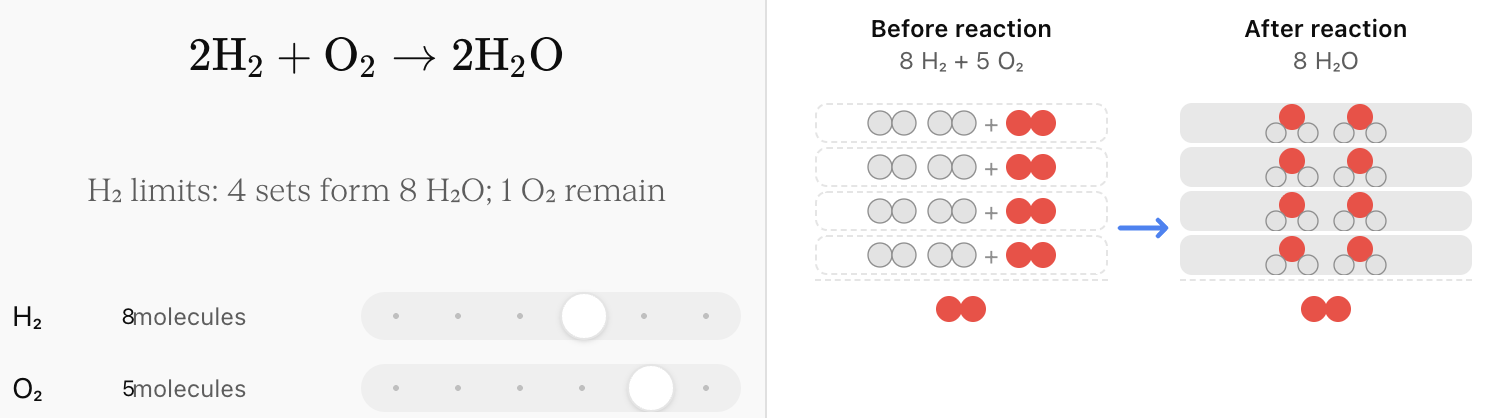
Limiting Reactant vs. Excess Reactant
These two concepts are closely connected.
Limiting Reactant
The reactant that:
- is completely consumed first
- stops the reaction when it runs out
- determines the maximum amount of product
Excess Reactant
The reactant that:
- is supplied in more than the required amount
- is not completely consumed
- remains after the reaction stops
If one reactant is limiting, another reactant is usually in excess.
Why Does an Excess Reactant Remain?
Chemical reactions occur according to specific particle ratios.
Consider:
N₂ + 3H₂ → 2NH₃
Every:
1 mol N₂
requires:
3 mol H₂
Suppose we have:
2 mol N₂
and:
9 mol H₂
The 2 mol N₂ require:
6 mol H₂
But:
9 mol H₂
are available.
Only 6 mol H₂ can react because all the nitrogen is then gone.
Therefore:
9 − 6 = 3 mol H₂
remain.
Hydrogen is the excess reactant.
The Basic Excess Reactant Calculation
The central calculation is:
amount remaining = amount initially present − amount consumed
The difficult part is usually determining the amount consumed.
To find it:
- Identify the limiting reactant.
- Use the limiting reactant and the mole ratio to determine how much excess reactant reacts.
- Subtract that amount from the initial amount.
A Useful Roadmap
For excess-reactant problems:
BALANCE THE EQUATION
↓
CONVERT REACTANTS TO MOLES
↓
IDENTIFY THE LIMITING REACTANT
↓
CALCULATE EXCESS REACTANT CONSUMED
↓
INITIAL EXCESS − CONSUMED EXCESS
↓
EXCESS REACTANT REMAINING
This is closely related to limiting-reactant calculations, but the final goal is different.
Worked Example: Hydrogen and Oxygen
Consider:
2H₂ + O₂ → 2H₂O
Suppose:
10 mol H₂
and:
3 mol O₂
are available.
Identify the limiting reactant
Three moles of O₂ require:
3 × 2 = 6 mol H₂
We have:
10 mol H₂
Therefore:
O₂ is limiting
and:
H₂ is in excess
Determine how much H₂ reacts
From the equation:
1 mol O₂ requires 2 mol H₂
Therefore:
3 mol O₂ require 6 mol H₂
Calculate the amount remaining
Initial H₂:
10 mol
Consumed:
6 mol
Remaining:
10 − 6 = 4 mol
Answer
4 mol H₂ remain after the reaction.
Calculate the Product Too
Using the same reaction:
2H₂ + O₂ → 2H₂O
and:
10 mol H₂ + 3 mol O₂
we determined that O₂ is limiting.
The ratio is:
1 mol O₂ : 2 mol H₂O
Therefore:
3 mol O₂ → 6 mol H₂O
At the end:
- H₂O formed = 6 mol
- O₂ remaining = 0 mol
- H₂ remaining = 4 mol
This gives us a complete picture of the reaction.
Worked Example: Ammonia
Consider:
N₂ + 3H₂ → 2NH₃
Suppose:
5 mol N₂
and:
12 mol H₂
are available.
Identify the limiting reactant
Five moles N₂ would require:
15 mol H₂
But only:
12 mol H₂
are available.
Therefore:
H₂ is limiting
and:
N₂ is in excess
Calculate N₂ consumed
Ratio:
3 mol H₂ : 1 mol N₂
Therefore:
12 mol H₂ × (1 mol N₂ / 3 mol H₂)
= 4 mol N₂
Calculate N₂ remaining
Initial:
5 mol N₂
Consumed:
4 mol N₂
Remaining:
5 − 4 = 1 mol N₂
Answer
1 mol N₂ remains in excess.
Worked Example: Another Ammonia Problem
Suppose:
4 mol N₂
and:
9 mol H₂
are available.
Equation:
N₂ + 3H₂ → 2NH₃
Nine moles H₂ require:
9 × (1/3) = 3 mol N₂
We have:
4 mol N₂
Therefore:
H₂ is limiting
and:
N₂ is in excess
N₂ remaining:
4 − 3 = 1 mol N₂
Product:
9 mol H₂ × (2 mol NH₃ / 3 mol H₂)
= 6 mol NH₃
At the end:
- H₂ = 0 mol
- N₂ = 1 mol
- NH₃ = 6 mol
When Masses Are Given
Excess-reactant problems often provide masses rather than moles.
Because balanced equations describe mole ratios, first convert the reactants to moles.
The pathway becomes:
grams → moles → identify limiting/excess reactants → calculate excess consumed → calculate excess remaining


Worked Example: Magnesium and Oxygen
Consider:
2Mg + O₂ → 2MgO
Suppose:
36.45 g Mg
react with:
16.0 g O₂
Use:
M(Mg) = 24.3 g/mol
M(O₂) = 32.0 g/mol
Convert magnesium to moles
36.45 ÷ 24.3 = 1.50 mol Mg
Convert oxygen to moles
16.0 ÷ 32.0 = 0.500 mol O₂
Identify the limiting reactant
The equation requires:
2 mol Mg : 1 mol O₂
Therefore:
0.500 mol O₂
requires:
1.00 mol Mg
We have:
1.50 mol Mg
Therefore:
O₂ is limiting
and:
Mg is in excess
Calculate the Excess Magnesium Remaining
Initial Mg:
1.50 mol
Mg consumed:
1.00 mol
Therefore:
1.50 − 1.00 = 0.50 mol Mg
Convert to mass:
m = nM
m = 0.50 × 24.3
= 12.15 g
Answer
12.15 g Mg remain after the reaction.
Check the Entire Reaction
The limiting O₂ produces MgO.
From:
2Mg + O₂ → 2MgO
0.500 mol O₂ → 1.00 mol MgO
Use:
M(MgO) = 40.3 g/mol
Therefore:
40.3 g MgO
are produced.
Initial mass:
36.45 + 16.0 = 52.45 g
Final mass:
40.3 + 12.15 = 52.45 g
Therefore:
initial mass = final mass
The leftover excess reactant must be included when checking conservation of mass.
Why the Excess Reactant Cannot Keep Reacting
Suppose magnesium remains after all the oxygen has been consumed.
You might ask:
Why doesn't the remaining magnesium continue reacting?
Because the reaction requires oxygen.
Once there are no O₂ molecules left, the remaining Mg atoms have nothing to react with.
The reaction stops even though magnesium is still present.
Adding more oxygen would allow the reaction to continue.
Worked Example: Iron and Oxygen
Consider:
4Fe + 3O₂ → 2Fe₂O₃
Suppose:
112 g Fe
react with:
64 g O₂
Use:
M(Fe) = 56 g/mol
M(O₂) = 32 g/mol
Convert to moles
Fe:
112 ÷ 56 = 2.00 mol
O₂:
64 ÷ 32 = 2.00 mol
Equal numbers of moles do not mean equal stoichiometric quantities.
The equation requires:
4 mol Fe : 3 mol O₂
Identify the Excess Reactant
Two moles Fe require:
2 × (3/4) = 1.50 mol O₂
But:
2.00 mol O₂
are available.
Therefore:
Fe is limiting
and:
O₂ is in excess
Calculate Oxygen Remaining
Initial O₂:
2.00 mol
Consumed:
1.50 mol
Remaining:
2.00 − 1.50 = 0.50 mol O₂
Convert to mass:
0.50 × 32 = 16 g
Answer
16 g O₂ remain.
Check the Product
Two moles Fe produce:
1 mol Fe₂O₃
Use:
M(Fe₂O₃) = 160 g/mol
Product:
160 g Fe₂O₃
Initial mass:
112 + 64 = 176 g
Final mass:
160 + 16 = 176 g
Again:
mass is conserved
Worked Example: Aluminum and Chlorine
Consider:
2Al + 3Cl₂ → 2AlCl₃
Suppose:
54.0 g Al
react with:
142 g Cl₂
Use:
M(Al) = 27.0 g/mol
M(Cl₂) = 71.0 g/mol
Convert to moles
Al:
54.0 ÷ 27.0 = 2.00 mol Al
Cl₂:
142 ÷ 71.0 = 2.00 mol Cl₂
Required ratio:
2 mol Al : 3 mol Cl₂
Two moles Cl₂ require:
2 × (2/3) = 1.33 mol Al
We have:
2.00 mol Al
Therefore:
Cl₂ is limiting
and:
Al is in excess
Calculate Aluminum Remaining
Al consumed:
2.00 mol Cl₂ × (2 mol Al / 3 mol Cl₂)
= 1.33 mol Al
Initial Al:
2.00 mol
Remaining:
2.00 − 1.33 = 0.67 mol Al
Convert to mass:
0.67 × 27.0 ≈ 18.0 g Al
Answer
Approximately:
18.0 g Al remain.
Using Product Amount to Find Excess Consumed
Sometimes you already know how much product formed.
Consider:
2H₂ + O₂ → 2H₂O
Suppose the reaction produces:
8 mol H₂O
How much O₂ was consumed?
Ratio:
1 mol O₂ : 2 mol H₂O
Therefore:
8 mol H₂O × (1 mol O₂ / 2 mol H₂O)
= 4 mol O₂
If initially there were:
6 mol O₂
then:
6 − 4 = 2 mol O₂
remain.
This is another way to calculate leftover reactant.
Calculating Percent Excess
In more advanced stoichiometry, chemists may describe how much extra reactant has been supplied using percent excess.
First determine how much reactant is actually required.
Then:
excess amount = actual amount − required amount
and:
percent excess = (excess amount / required amount) × 100%
Worked Example: Percent Excess
Suppose a reaction requires:
20 g of reactant B
but:
25 g
are supplied.
Excess:
25 − 20 = 5 g
Percent excess:
(5 / 20) × 100% = 25%
Therefore:
B was supplied at 25% excess.
This does not mean that 25% of the original amount necessarily remains in every situation; it describes the extra amount relative to the stoichiometric requirement.
Why Use an Excess Reactant?
Using an excess reactant may sound wasteful, but it can be useful.
An excess reactant may help:
- ensure the limiting reactant reacts completely
- increase conversion of an expensive reactant
- improve production efficiency
- drive some reactions toward greater product formation
- compensate for practical losses
- maintain desired reaction conditions
The choice of which substance to use in excess can be economically important.


Excess Reactants in Industry
Suppose reactant A is very expensive and reactant B is inexpensive.
A manufacturer may deliberately use excess B.
This helps ensure that as much of A as possible reacts.
Afterward, unused B may sometimes be:
- separated
- purified
- recycled
- returned to the reactor
This can reduce both costs and waste.
Excess Oxygen in Combustion
Combustion provides a familiar example.
For complete methane combustion:
CH₄ + 2O₂ → CO₂ + 2H₂O
The stoichiometric ratio requires:
1 mol CH₄ : 2 mol O₂
In practical combustion systems, oxygen may be supplied in excess to help ensure more complete combustion of the fuel.
Insufficient oxygen can contribute to incomplete combustion and the formation of products such as carbon monoxide.
Worked Combustion Example
Suppose:
2 mol CH₄
react with:
6 mol O₂
Equation:
CH₄ + 2O₂ → CO₂ + 2H₂O
Two moles CH₄ require:
4 mol O₂
Available:
6 mol O₂
Therefore:
CH₄ is limiting
and:
O₂ is in excess
O₂ remaining:
6 − 4 = 2 mol O₂
Products:
2 mol CO₂
and:
4 mol H₂O
When There Is No Excess Reactant
Not every reaction mixture has an excess reactant.
For:
2H₂ + O₂ → 2H₂O
suppose:
4 mol H₂
and:
2 mol O₂
are available.
The ratio is exactly:
2 : 1
Both reactants are completely consumed.
Therefore:
H₂ remaining = 0
O₂ remaining = 0
The reactants were present in stoichiometric proportions.
Excess Reactants and Conservation of Mass
Excess reactants are especially important when accounting for mass.
Suppose:
70 g
of reactants are initially present.
After the reaction:
12 g
of an excess reactant remain.
If there is only one product:
product mass = 70 − 12
= 58 g
The excess reactant remains part of the system.
It cannot simply be ignored.
A Complete Mass Balance
Suppose a reaction begins with:
25 g A
and:
40 g B
Total initial mass:
65 g
Suppose A is limiting and:
15 g B
remain afterward.
Mass consumed:
25 g A + 25 g B = 50 g
If there is one product:
product mass = 50 g
Final mass:
50 g product + 15 g B = 65 g
Therefore:
initial mass = final mass
Practical Laboratory Example
Imagine mixing two solutions to form a precipitate.
If one dissolved reactant is supplied in excess:
- all of the limiting reactant may be consumed
- the solid product forms
- some excess reactant remains dissolved in the solution
The excess reactant has not disappeared simply because it cannot be seen.
It may remain as dissolved ions in the solution.
This is important when interpreting laboratory results.


Choosing Which Reactant Should Be in Excess
Chemists may consider several factors:
- cost
- availability
- safety
- toxicity
- ease of separation
- environmental impact
- ability to recycle unused material
- desired reaction efficiency
For example, it may make sense to use an inexpensive and easily removed substance in excess rather than an expensive or hazardous one.
A Full Problem-Solving Example
Consider:
2Na + Cl₂ → 2NaCl
Suppose:
69 g Na
react with:
71 g Cl₂
Use:
M(Na) = 23 g/mol
M(Cl₂) = 71 g/mol
M(NaCl) = 58.5 g/mol
Convert to moles
Na:
69 ÷ 23 = 3 mol Na
Cl₂:
71 ÷ 71 = 1 mol Cl₂
Determine the limiting reactant
One mole Cl₂ requires:
2 mol Na
We have:
3 mol Na
Therefore:
Cl₂ is limiting
and:
Na is in excess
Calculate Na consumed
1 mol Cl₂ × (2 mol Na / 1 mol Cl₂)
= 2 mol Na
Calculate Na remaining
Initial:
3 mol Na
Consumed:
2 mol Na
Remaining:
1 mol Na
Mass remaining:
1 × 23 = 23 g Na
Calculate product
One mole Cl₂ produces:
2 mol NaCl
Mass:
2 × 58.5 = 117 g NaCl
Check mass conservation
Initial:
69 + 71 = 140 g
Final:
117 + 23 = 140 g
Everything is accounted for.
Common Mistakes
Confusing Excess with Limiting
The limiting reactant runs out.
The excess reactant remains.
Assuming the Larger Mass Is Excess
A substance is not excess simply because more grams are present.
Molar masses and stoichiometric ratios must be considered.
Assuming the Larger Number of Moles Is Excess
The balanced equation may require different mole quantities.
For:
N₂ + 3H₂ → 2NH₃
having more H₂ moles than N₂ does not automatically mean H₂ is in excess.
Three times as much H₂ is required.
Subtracting the Limiting Reactant from the Excess Reactant
Do not calculate:
initial excess − limiting amount
unless the mole ratio happens to be 1 : 1.
First use the balanced equation to determine the amount of excess reactant consumed.
Subtracting Different Units
Do not calculate something such as:
10 g − 0.2 mol
Both quantities must be expressed in compatible units.
Forgetting to Convert Back to Grams
If the question asks for the mass remaining, convert leftover moles to mass.
Using Initial Excess to Calculate Product
The product is controlled by the limiting reactant, not by the total amount of excess reactant supplied.
Forgetting Leftover Material in Mass Conservation
If excess reactant remains, it must be included in the final mass.
Rounding Too Early
Keep additional digits during intermediate calculations and round at the end.
Key Terms
Excess reactant — A reactant present in more than the stoichiometric amount required.
Limiting reactant — The reactant consumed first, which determines the maximum amount of product.
Leftover reactant — The portion of an excess reactant remaining after the reaction stops.
Excess consumed — The amount of excess reactant that participates in the reaction.
Excess remaining — The amount of excess reactant left after the limiting reactant has been consumed.
Stoichiometric ratio — The quantitative relationship between substances given by a balanced equation.
Stoichiometric proportions — Reactants present in exactly the required mole ratio.
Mole ratio — A relationship between quantities of substances based on balanced-equation coefficients.
Percent excess — The amount supplied beyond the stoichiometric requirement, expressed as a percentage of the required amount.
Theoretical yield — The maximum amount of product predicted from the limiting reactant.
Mass balance — Accounting for all mass entering, leaving, reacting, and remaining in a chemical system.
Conservation of mass — The principle that total mass remains constant during an ordinary chemical reaction.
Key Takeaways
- An excess reactant is present in more than the amount required by the balanced equation.
- The excess reactant is not completely consumed.
- The limiting reactant runs out first.
- The limiting reactant determines how much product forms.
- The excess reactant determines how much material may remain afterward.
- Limiting and excess reactants must be identified using stoichiometric ratios.
- Neither mass nor number of moles alone reliably identifies the excess reactant.
- When masses are given, convert them to moles before comparing reactants.
- To find leftover reactant:
amount remaining = amount initially present − amount consumed
- Use the limiting reactant to calculate how much of the excess reactant is consumed.
- If the question asks for leftover mass, convert the remaining moles back to grams.
- Sometimes reactants are present in exact stoichiometric proportions and neither remains in excess.
- Excess reactants may be deliberately used in laboratories and industrial processes.
- Excess reactants can help ensure that a more valuable reactant is consumed as completely as possible.
- Unused excess material may sometimes be recovered and recycled.
- Leftover reactant must be included when checking conservation of mass.
The main pathway is:
BALANCE → CONVERT TO MOLES → IDENTIFY LIMITING REACTANT → IDENTIFY EXCESS REACTANT → CALCULATE EXCESS CONSUMED → SUBTRACT → FIND EXCESS REMAINING
Check Your Understanding
Use:
2H₂ + O₂ → 2H₂O
1. If 8 mol H₂ react with 3 mol O₂, identify the excess reactant.
2. How many moles of the excess reactant are consumed?
3. How many moles of the excess reactant remain?
4. How many moles of H₂O form?
5. If 6 mol H₂ react with 3 mol O₂, is either reactant in excess? Explain.
Use:
N₂ + 3H₂ → 2NH₃
6. If 4 mol N₂ react with 9 mol H₂, identify the excess reactant.
7. Calculate the amount of N₂ consumed.
8. Calculate the amount of N₂ remaining.
9. Calculate the amount of NH₃ produced.
10. If 3 mol N₂ react with 12 mol H₂, calculate the amount of excess reactant remaining.
Mass Problems
Use:
2Mg + O₂ → 2MgO
with:
M(Mg) = 24.3 g/mol
M(O₂) = 32.0 g/mol
M(MgO) = 40.3 g/mol
11. If 48.6 g Mg react with 16.0 g O₂, identify the excess reactant.
12. Calculate the mass of excess reactant consumed.
13. Calculate the mass of excess reactant remaining.
14. Calculate the mass of MgO formed.
15. Show that the initial and final masses are equal.
Use:
4Fe + 3O₂ → 2Fe₂O₃
with:
M(Fe) = 56 g/mol
M(O₂) = 32 g/mol
M(Fe₂O₃) = 160 g/mol
16. If 112 g Fe react with 96 g O₂, identify the excess reactant.
17. Calculate the amount of excess reactant consumed.
18. Calculate the mass of excess reactant remaining.
19. Calculate the mass of Fe₂O₃ produced.
20. Check your answer using conservation of mass.
Challenge Problems
Use:
2Al + 3Cl₂ → 2AlCl₃
with:
M(Al) = 27.0 g/mol
M(Cl₂) = 71.0 g/mol
M(AlCl₃) = 133.5 g/mol
21. If 81.0 g Al react with 213 g Cl₂, determine whether either reactant is in excess.
22. If 81.0 g Al react with 142 g Cl₂, identify the excess reactant.
23. Calculate the mass of excess reactant remaining in Question 22.
24. Calculate the mass of AlCl₃ produced.
25. Demonstrate that mass is conserved.
Use:
CH₄ + 2O₂ → CO₂ + 2H₂O
with:
M(CH₄) = 16 g/mol
M(O₂) = 32 g/mol
26. If 32 g CH₄ react with 160 g O₂, identify the excess reactant.
27. Calculate the mass of excess reactant consumed.
28. Calculate the mass of excess reactant remaining.
29. Calculate the moles of CO₂ and H₂O produced.
30. Explain why the reaction stops even though one reactant remains.
Reasoning and Application
31. Define an excess reactant in your own words.
32. Explain the relationship between limiting and excess reactants.
33. Why can't the reactant with the larger mass automatically be identified as excess?
34. Why must the balanced equation be used when calculating leftover reactant?
35. A reaction begins with 80 g of total reactants and leaves 12 g of excess reactant. If only one product forms, calculate the mass of product.
36. Explain how Question 35 demonstrates conservation of mass.
37. A reaction requires 40 g of reactant B, but 50 g are supplied. Calculate the mass supplied in excess.
38. Calculate the percent excess in Question 37.
39. Explain why an industrial process might deliberately use one reactant in excess.
40. Describe the complete procedure for determining the mass of an excess reactant remaining when the initial masses of two reactants are known.