Periodic Trends

3. Reactivity Trends

Learning outcomes
  • I can describe how reactivity changes within major groups of the periodic table.
  • I can explain why Group 1 metals become more reactive down the group.
  • I can explain why Group 17 halogens become less reactive down the group.
  • I can relate reactivity trends to electron arrangements and ion formation.
  • I can use periodic trends to predict the relative reactivity of unfamiliar elements.

https://images.openai.com/static-rsc-4/TtTOKCNxaoZv2yHOaAx9FYt2_6nglNE2ht0u4-zlR_PxXB7v1-KxQk1EjHt42Bup7VawcVsbb1OFfzVcuGcvaI4rp-yLoHYVGofDw54O-WPPDWh0eO6wRlM07CrVluoF9mv_nRy7KU9WvVAihj7PipXwg39yuMgLww2eFm9AI8u6LMSv1D2XCuI-hwukv-fg?purpose=fullsize
 
https://images.openai.com/static-rsc-4/In305u_bR5fX0VunHdnUAEPazC2X1WH981UuoHIwvYGX7CRtKsrNNGveJbt3-YFm3ItKgbfkoMSaKmCPOic03f3Xu8Mb-NVEM4-MIeP_zYH7ufiyQaW2G1AKVFIzITIID8LodWcKefmMEOKzziR5_S5bgxuESc0BhO-4FrUcT9avAzUJUOThMPcf_qALQ4Gn?purpose=fullsize
 
https://images.openai.com/static-rsc-4/mBSesxQgDVEPUWIndZ3r_aegxqC3-GZKTNBABdWr6xlmGYT_eE0ITaCLLke4-R0lCC06LtEsfkvGXWMtCxxDMHNtYuoPG4f_RczYHlS0CtdYCZBATrdkxFzgCopQ-cBPPXz6Pfagy2FSVmsqb4Ou8Wz4VLZSP2tzdKcqJyjsYV3CIEcrV2GXM_e2c7BZcMXZ?purpose=fullsize
 
4

What Is Reactivity?

Reactivity describes how readily a substance undergoes a chemical reaction.

Some elements react extremely easily, while others are much less reactive.

An element's reactivity is strongly connected to its electron arrangement, especially the electrons in its outer shell.

Atoms tend to react in ways that produce a more stable electron arrangement. For many main-group elements, this means gaining, losing, or sharing electrons to obtain a full outer shell.

The periodic table helps us predict these behaviours because elements in the same group have similar outer-shell electron arrangements.


Groups and Reactivity

A group is a vertical column of the periodic table.

Elements in the same group have similar chemical properties because they have the same number of valence electrons.

https://images.openai.com/static-rsc-4/gJcHiyEUFr4Oyb92IKPqnEw0aMJMI9dktAb8m2KT-wq_HUABpFC4fxJs5rpX9_N4AVvGEKvdb5Sm3xoV5d2RQuyfyXcHEx11rIsoEGdODq_SC2NLZtZOqg0ldC4w-TTFkCxmJcdxzhdiMZ8pLYCq0D9CXxbaebmJ_gKnx5YnmbHA3NpVHF_aY7KmRsHxCSNT?purpose=fullsize
 
https://images.openai.com/static-rsc-4/thBLCQCKsyaV8aawBKg7yxs2P5D2raSkc_ZHwj_u1-6caRzn8XTaNCOR8irkbu9PVuMMEZaToS-m05GD0s65IVQAhTOiBd7PEtGE5X3HQqeRiTOCcP-6Yay1gEdMJNMlS5vUEAAIwRlFU3O1UCbqMeDTmvpcjT6WKJ9pVYkEB5VQSqivGFe-TYE-TVUizp-j?purpose=fullsize
 
https://images.openai.com/static-rsc-4/FSZbaRiguezD43xDo3DG20sxtNWThB27Wx9WoNKH4EXo73NevBG-6HA-w_cBM9LUzwU7Qn4yJC8iJscpOcYRfN6bRIapo3OcxZIooVvg9pz9XgO6NW_rZitOCDZtP79--H1d7ULGTJEf8zkKRtn_cTGNbuHDuK07mcOKUOhvT2hO3A-uC19RmDPIK8ShoLAl?purpose=fullsize
 
6

Two groups show particularly clear reactivity trends:

Group 1 – Alkali metals

Reactivity increases down the group.

Group 17 – Halogens

Reactivity decreases down the group.

These trends appear opposite because Group 1 and Group 17 elements react in different ways.


Group 1: The Alkali Metals

Group 1 contains the alkali metals.

Important examples include:

  • lithium (Li)
  • sodium (Na)
  • potassium (K)
  • rubidium (Rb)
  • caesium (Cs)
https://images.openai.com/static-rsc-4/6GtgpcrOWPNNBr11IayEicHZm82laL0WJcM8LSCKDNpSb04klSN1mwgZhUHbFG2WqpQlMyuphH24DY_aUDFDTxWt0e0Mu250QJjYFMuGKvsAfoONUoX6Ay7Y2bzWhvRorCuIQN1_gpa7Au29acsOKuWV7J7EGRQKwlooJzdxZr9T2vSizZhe5TjJRCf-rqrh?purpose=fullsize
 
https://images.openai.com/static-rsc-4/a52UyG4CQPTrKa0xH_qwoLzInjSNmGQA058syQEKYmh6g2HVChQzRH_aHFUWEvPeBisayNUhrviWMHtn1NaYDNS2OHeTHhfDJfd98P6OCt3WxGlgcpxSsTNF9EmAFz29gqM7IUsdYv4wtZgPWLds9ZIJmNBwI409PCQsUidVcuTDaNH9lEJBGHk1Aihlzzjb?purpose=fullsize
 
https://images.openai.com/static-rsc-4/D6VvvZynlprbEYlp31GyjGPGYV3NxDcr-kEDysYo2LFs837-3QW5uquiI5M1v8Q9uxD0YQgNMbpbun3JipcBG2PdoHP-sU4lxMTRsGbrYD9DUvSZBcIm7W48fpAiU9zZ3suA1IKMcP_XiSGQtW2TBgE5_g-ZlqR41PXrfliiM_zep7iSfafMvCbxvOa7UMk8?purpose=fullsize
 
5

All Group 1 elements have one electron in their outer shell.

For example:

Lithium: 2,1

Sodium: 2,8,1

Potassium: 2,8,8,1

This similarity explains why these elements undergo similar types of chemical reactions.


Group 1 Elements Lose an Electron

Group 1 atoms become stable by losing their single outer electron.

For example:

Na → Na⁺ + e⁻

A sodium atom loses one electron and forms a:

Na⁺ ion

Similarly:

Li → Li⁺ + e⁻

K → K⁺ + e⁻

Therefore, Group 1 metals usually form ions with a:

+1 charge

https://images.openai.com/static-rsc-4/KZeigxaq4_AvziUuE5dBn_ye4BTZUdwT885UJhKJG29pjjMW6rFu7AXNLVowKSi7ke1kOoZizPUP1EB3j9NXGFj5l8Du0ZWgV5JYfOfLGuDq19-U2dGEmsmo1b7GRFpcUj6y-iiYNClbFoGbj_zLQVZYUo0v5RcxbyICX2fv8TgnP9y1epPIBXFjpuWwgCMx?purpose=fullsize
 
https://images.openai.com/static-rsc-4/gcmLk7zqP8YIPGRQPmM2gWYz1ouidK_ppRtHWKTidkJiJtj4ZY-fCpideDTIOz83HrVIQKzqZtgw_m5IzVNXSIkHD9SeAaSx-KE3O67eWaqCYARE4frx4zumWjAslUYFwzzfxO4lvbTBkHRqH5ULcd7k9wwPbsrJdQQWqu1HMYdd0xSSAatgEwV8BXZwthqO?purpose=fullsize
 
https://images.openai.com/static-rsc-4/0dzWhFR7dl1nD2p2EvWMecZxGskCv3QqKo8FQtkLihurW_ZlLynEBAPwVqA4_-Ez322q-tPqSVL17x3i2gAvAZLF7MGdFVScpl4YA3PEiq_b0xj2j7juN-uxTYpSaRBQHpr3tRyPlSPeZNepm5zo9qdZjQ0HBLhz6Nk0sNNqwPzBeTKHZnS_7gqXAQaSoM05?purpose=fullsize
 
4

The easier this electron is to remove, the more reactive the metal is.


Reactivity Increases Down Group 1

The trend in Group 1 is:

Li < Na < K < Rb < Cs

Reactivity increases as we move down the group.

Lithium is less reactive than sodium.

Sodium is less reactive than potassium.

Potassium is less reactive than rubidium.

The trend continues down the group.

https://images.openai.com/static-rsc-4/VcekFRqs2R3qeRCqt-G7qLpmvUNGg8_CtN1tBFNf4aX9mkqW4PQdm5VjhavqBmDB2_Van0kLIPA0wJYH-EtdNnLhCiugI_ajWWUeQFsFPE4QTSz4nFiG3TbsrQpFFSJdkb54p22NJjPXlqXCLNvay_rNKKGeyzoT1rGR8BYFhDoRyFyv01JEPfSgdQiG1k7r?purpose=fullsize
 
https://images.openai.com/static-rsc-4/gcmLk7zqP8YIPGRQPmM2gWYz1ouidK_ppRtHWKTidkJiJtj4ZY-fCpideDTIOz83HrVIQKzqZtgw_m5IzVNXSIkHD9SeAaSx-KE3O67eWaqCYARE4frx4zumWjAslUYFwzzfxO4lvbTBkHRqH5ULcd7k9wwPbsrJdQQWqu1HMYdd0xSSAatgEwV8BXZwthqO?purpose=fullsize
 
https://images.openai.com/static-rsc-4/pf8AymW9Td_JqVjVR9JBnHUj3aKGVItgPFvrZzd9x5kUt_sSe2pw_T1a_j5DxtPg9dRvYgMcWEIM-SBEsP44KwuLok6qY29sQ5SUO0qMtKdMlBbP5tbv9GucYX2aG-ECrLjPT6NfMVJmA7sGALWA1U8ZdVeQO8uv-KEjkI9_Chz249GjSN4P_XUIBKYzy6zv?purpose=fullsize
 
5

But why?

The answer comes from atomic structure.


More Electron Shells Down Group 1

As we move down Group 1, atoms contain more occupied electron shells.

Lithium: 2,1

Sodium: 2,8,1

Potassium: 2,8,8,1

The outer electron therefore becomes progressively farther from the nucleus.

https://images.openai.com/static-rsc-4/z5LHKsvUQ77IMXMbdBX4Kz7brTlxkoGDnPF7Hv4T_1UaB38elnVB-exzAf3mGg98tNTcCxVvY8mDvsRYdzIepAX8swQVkxIKrAgx0NU_Ti1UidsY7avCtzmPA5KqlvB25X_X2__RKGMAKXTi0hN7wGlJW7yRlw0DbP3z2uRxJVtM2XzKJQ__uRjvlC4kf-jC?purpose=fullsize
 
https://images.openai.com/static-rsc-4/JhAW8kXRU2IN3_N489gWFisOjnThaHxx8NSl8QyuISJhKCrLaUR95SkwQZns97HTaySypPTBE9SHg1755dFWTrAVp56SmYKQIrD3yWZMCpJs9u7I5ebTN6x3VFfGdAkl_bAhw9OCIoh77FjmXjjXbRZSbRUO3yzjkuWE-kaVk82yHCfrJyWG9bhuecODElKX?purpose=fullsize
 
https://images.openai.com/static-rsc-4/r9KyZc_3EeN11Z0W_-rAkKiBsJIXZx-Oh9miRpIbnxr59ywfzgBKQjtLBoZhatLvUGkz4lD0gx3mBLvTPBSnMGpwwoRlt2YnYp9SHEzM-qTA5N0AWgYRA1v5TJRiyvCC1-xzb3k3UtXzkCnWe3Y5C31c5hp88Zk0aT3cUvV3ZikWsKhfd7nIWNQypBskIwo_?purpose=fullsize
 
4

This greater distance is one reason the outer electron becomes easier to remove.


Nuclear Attraction

The nucleus contains positively charged protons.

Electrons have negative charge.

Therefore, the nucleus attracts electrons through electrostatic attraction.

The closer an electron is to the nucleus, the stronger this attraction tends to be.

As we move down Group 1:

  • the number of electron shells increases
  • the atomic radius increases
  • the outer electron becomes farther from the nucleus

Therefore, the attraction between the nucleus and the outer electron becomes less effective.


Electron Shielding

Distance is not the only factor.

Inner electrons also produce an effect called shielding.

https://images.openai.com/static-rsc-4/fH6I2PduMkPTsO21UUOyb-zV4G6eZ5104gpbhgkAbGKa_TKHcpr2yASOYN-FZfGmeHlOTYf8KyogAjwSz24s__p_aLAaGPA5WVUWvXnVEvsH1ph-i-dvXVxQdehYUJjOWHcrgPSJcb9z-XgwFA2MT-gIgj5V8OHiZdYM8dkotHbRzls5UGxeytve5VFbHGgW?purpose=fullsize
 
https://images.openai.com/static-rsc-4/cZxS_efMjLUfwmEjJnfyvItJIqi8E2o_b0xYQ06JAqYKgwLUFBij0CrOQZZGP1rU6V51Od3MWxKtFVTjrCfc7bGANMEHQTaKSWG7xMv9aEeuWfx_ApomdECBWGP3LBeJpt9PIGpcAmK9K77P0Mfvkp9AD5MzLlpZExLeUPrx3xa606C7kmkDujVKCClBhRPU?purpose=fullsize
 
https://images.openai.com/static-rsc-4/w7ZYAGRUGLdFVSmrxrIP6CQt6jnYGvPiC6jdFF8VLXoNlNTx8VKO9on66YXHUthDA3QYGH_8icp6W6y9DJgilS9qJ_03LpY3mxH2rKuWRPTGC50nx4rPm-LAtVIusYKunMJStxjMBiPPDFWVObZVFrsf15FIFF6Zvs69K22zMxwF2FKL3hkc0nckTLVh1ASx?purpose=fullsize
 
5

Inner electron shells lie between the nucleus and the outer electron.

These inner electrons reduce the effective attraction experienced by the outer electron.

As we move down Group 1:

more shells → more shielding

Therefore, the outer electron becomes easier to remove.


The Complete Explanation for Group 1

Moving down Group 1:

More electron shells

↓

Greater atomic radius

↓

More electron shielding

↓

Weaker effective attraction between the nucleus and the outer electron

↓

Outer electron is easier to remove

↓

Positive ion forms more easily

↓

Reactivity increases

This chain of reasoning is the key explanation for the Group 1 trend.


Periodic Trends Behind the Pattern

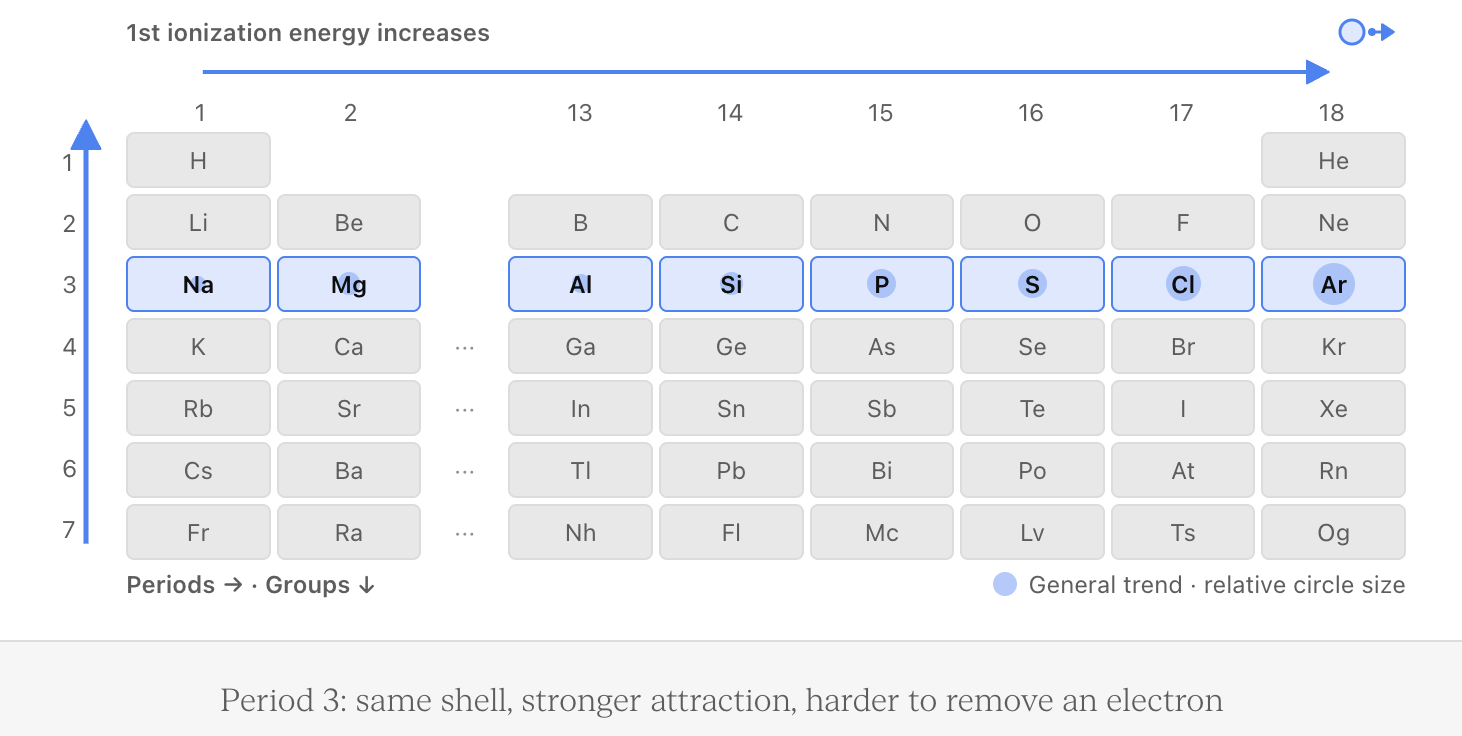
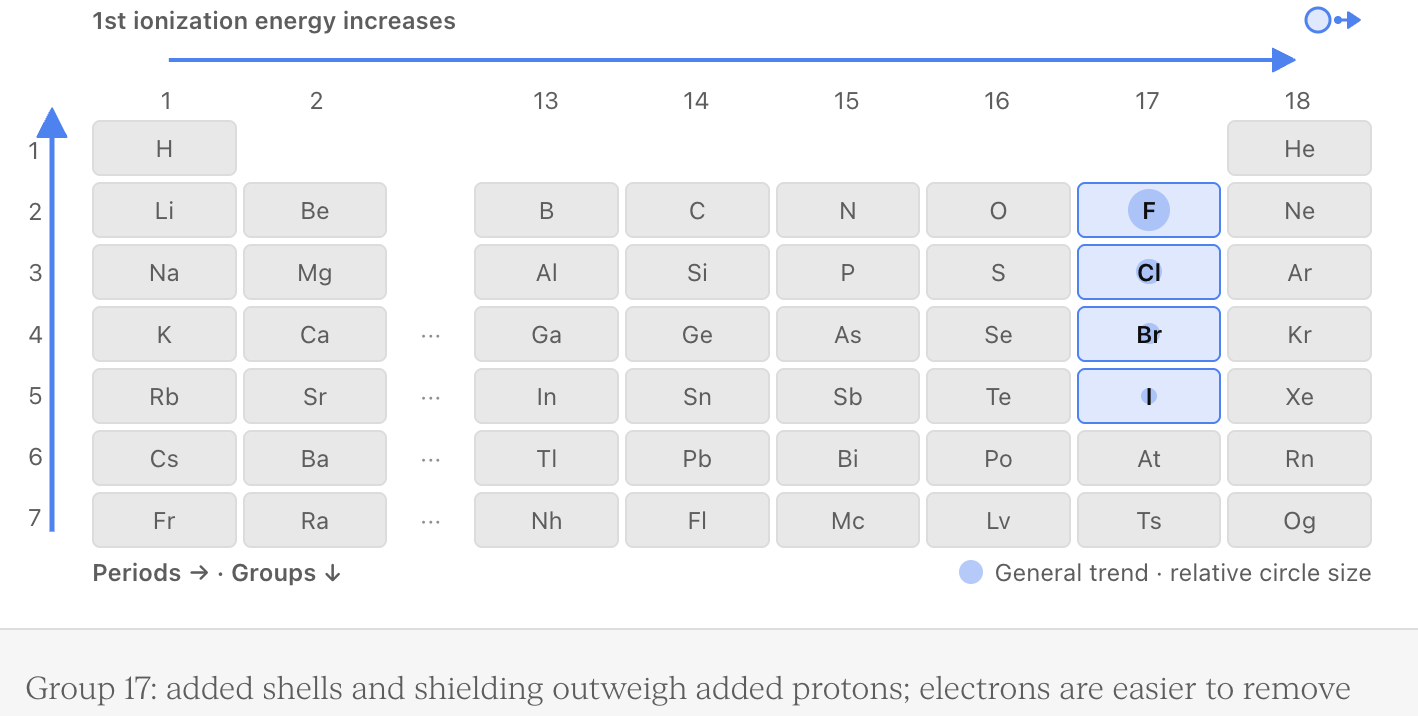
Atomic radius and first ionization energy help explain why Group 1 metals become more reactive down the group.

Atomic radius generally increases down a group, while first ionization energy generally decreases down a group.

First ionization energy is the energy needed to remove the first electron from a gaseous atom.

A lower first ionization energy means the outer electron can be removed more easily.

For Group 1 metals, easier electron loss generally means greater reactivity.


Group 1 and Water

One way to observe the increasing reactivity of Group 1 metals is through their reactions with water.

The general reaction is:

alkali metal + water → metal hydroxide + hydrogen

For sodium:

2Na + 2H₂O → 2NaOH + H₂

https://images.openai.com/static-rsc-4/_RNcvYbbg53v6g2QAiXcmM88-lHVn3GMAWp74XSg2Aw2Ch6m8mo_Qb50n6P1kwXgKXUyuOvyZJUugUDqAxwm6u3C3LU7nCS3y_OX7_VBqOxPXGyFozluym3MQd9VGBgxMNJOCRF1HUGlkb5N0vx118rrLCkDfqhcs39SW6ww2VR-qJt2vdORjA7j9X8obW6I?purpose=fullsize
 
https://images.openai.com/static-rsc-4/pqZ6xsgPPITq_WkN6oF5-8OY1sunhUZfDR7ytkfJAKlWLIbSuqIXJb8fzEdR17ZGvTms3ereEMnBCBamHlhmeL8IQqmk9MjMrODregO7bhKe9Rp1dRSMN1NSWZwK1aD-WLILywhUmQct0Ia2bTRcldMm_mhRPxx51467tTq0JEIflAgrfNFITQUz9NNrB7Ul?purpose=fullsize
 
https://images.openai.com/static-rsc-4/GE8mRahjh1MteYyRLzXHfLXXJ6FtiCnvDsMLDNu2UBB3qzM2-T67t0y3l9UKPbJ9zOJhn0WW_62c31Jf3uuoI2X-b0ENYv1w-jO2d5hV-3ZfxUJhxGqCzY_gQtwkmi5vrf0faDv5D9W01zCTX3Yg1MO9dH8P705Jvnh7YGLZRgVWKbV-ltvV7UdFAcU1nbk7?purpose=fullsize
 
5

Lithium reacts relatively gently.

Sodium reacts more vigorously.

Potassium reacts even more vigorously.

This provides observable evidence that:

reactivity increases down Group 1.


Predicting Group 1 Reactivity

Suppose you are asked:

Which is more reactive: sodium or rubidium?

Locate them in Group 1.

Rubidium is below sodium.

Since Group 1 reactivity increases down the group:

rubidium is more reactive than sodium.

You do not need to memorize every possible pair of elements. You can use the periodic trend.


Group 17: The Halogens

Group 17 contains the halogens.

Important examples include:

  • fluorine (F)
  • chlorine (Cl)
  • bromine (Br)
  • iodine (I)
https://images.openai.com/static-rsc-4/noMvAHDiMywCwYpQjeEvzPbVR6_XI05PJJA-6U8UoD_HKEwQqBfIgIjDMFHDUzqyHbbmQQRjAilzi2lgQCJoPBj-g1bRPhm0AUChOBz6K5pt7ZNXYrpnh96bGpkASXHPUEehRjf1mHN0K6WYbWFNAHZvjuhJ5onSwmQXKiIvdQKni2lVIAXxPot4o_cigyzB?purpose=fullsize
 
https://images.openai.com/static-rsc-4/maKJe1JAq8ui_Lk86z4unYc0BwRZq1Wnt-2KQPlx1zJyB1GQaWzNc152ckqnDrj7SRREqPRhUdf2QzCCWmOg_-tg5nNapp2aHToytZcOFOh4q-CJTaDJqe-_VC9nenpm1yDaDzGJ-4PT5EHoNsxvYaY23Yl_dqMfhfCSH9wyND9Z4OzCjO1aXMkkayIWZbPH?purpose=fullsize
 
https://images.openai.com/static-rsc-4/C3FK5vQvUuVcppF1MwRoJUygyOvv_agt22g9F0xQOpKbzEU4VWVvMbpW54G7o9gwyfScfBrrIr9yN9rltpWpBDitwFdBVwvTBUdolM9GsiJl_aYLS7XfutB4CaDpWjlyXob3enMoS4An6dBO_GwOSWDyjN2JaTf-p7rIbg0VLhL_tEDBIMzjx9ZQ0UoEoDlf?purpose=fullsize
 
5

All Group 17 elements have:

7 valence electrons

For example:

Fluorine: 2,7

Chlorine: 2,8,7

Because they already have seven outer electrons, halogens tend to gain one electron.


Group 17 Elements Gain an Electron

A halogen atom needs one additional electron to complete its outer shell.

For example:

Cl + e⁻ → Cl⁻

Chlorine gains one electron and forms a chloride ion.

Similarly:

F + e⁻ → F⁻

Br + e⁻ → Br⁻

Therefore, Group 17 elements commonly form ions with a:

−1 charge

https://images.openai.com/static-rsc-4/hBBc6c6bX7g2B2FwCsEvRJw2tyg54ZzC_wzw3PmsHVbdqtDzDZ-1UVyHq8bjuPfj_Y8iepuL8SebBWGgQn3FOgNBSxE9g008TV0N9pqWEVW4rIBHEakMF1TRYnbXdy3B4j8yJRs1vY7AyJBKvlFp99J7xQhT8Vha-r386IpaTJo1EYiVApuxze2hBFZr4L0h?purpose=fullsize
 
https://images.openai.com/static-rsc-4/jdXtqDPcNedCHs6udx2wAHR94kNWNg9yrRT5QfesL8m38VtomGMnWVTjY778C_0Sx_QVXo03cL-hmRG9OPr-g8p8h0O1kiQftm7Q5cJDZv_sYlwItx6kQC5GwuGfgxkGcw2nuRcll0NAeAQjV-Dkj7Tcm1myG7Yd2fJTUkBa0kblzqUUk6S4UkxEYtET7tgn?purpose=fullsize
 
https://images.openai.com/static-rsc-4/fg4TeD6vanbPsFdqECggXdvEI05BqFjZTdLIX7pp7Zvl3TwjzrCeqYZLX1rXujbnCVJeRfia5lKMMWuYFDeoCGlN8AkiBU21vmaqG-bSOGq2cs2jhWMtyph1Eg_lS0hyDNKLG_GmNry9jPOry7srUW8S8nTVB9n-2_7yjA19m7iEF3GPFTheKSfr3Zub__pN?purpose=fullsize
 
5

For halogens, reactivity depends strongly on how easily an atom can attract and gain an electron.


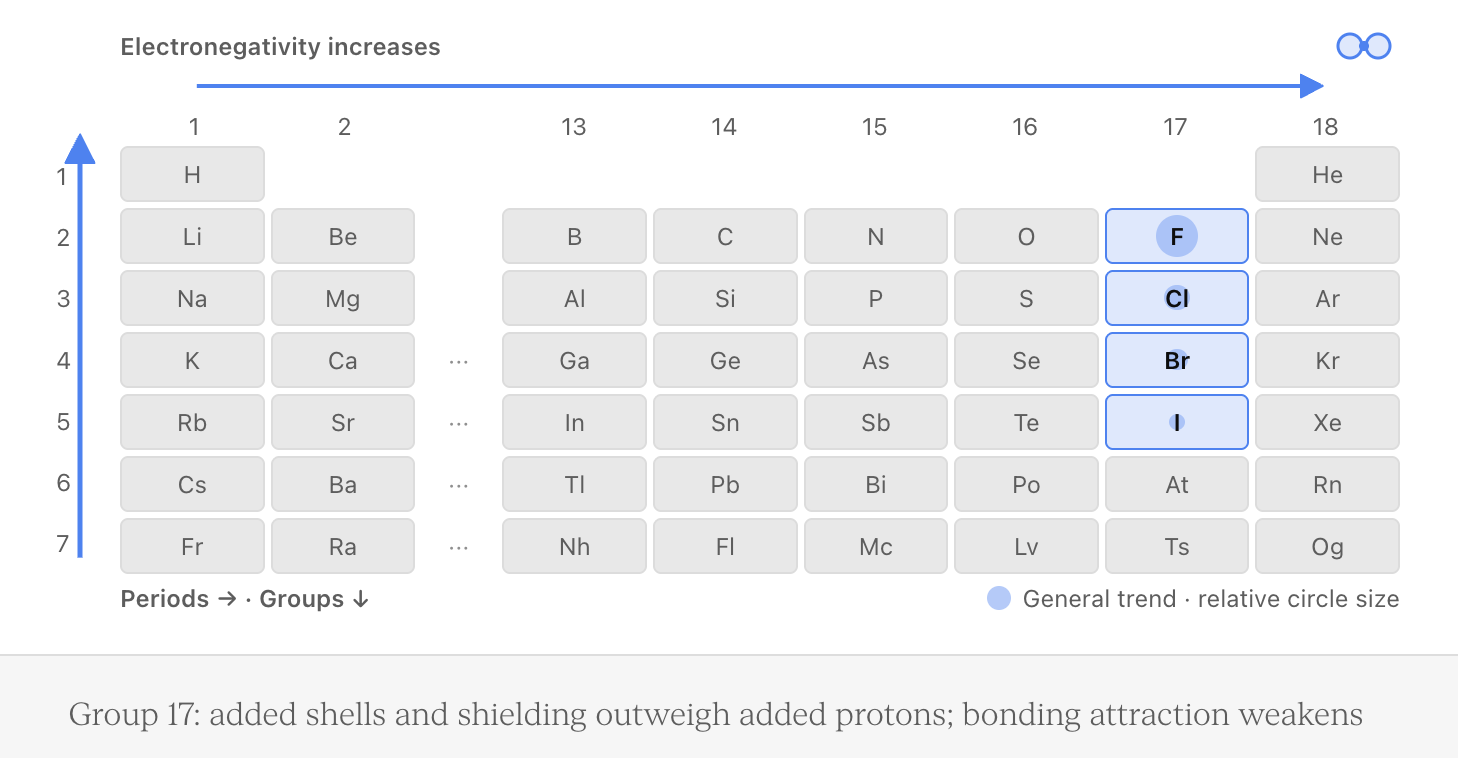
Reactivity Decreases Down Group 17

The Group 17 trend is:

F > Cl > Br > I

Reactivity decreases down the group.

Fluorine is more reactive than chlorine.

Chlorine is more reactive than bromine.

Bromine is more reactive than iodine.

https://images.openai.com/static-rsc-4/In305u_bR5fX0VunHdnUAEPazC2X1WH981UuoHIwvYGX7CRtKsrNNGveJbt3-YFm3ItKgbfkoMSaKmCPOic03f3Xu8Mb-NVEM4-MIeP_zYH7ufiyQaW2G1AKVFIzITIID8LodWcKefmMEOKzziR5_S5bgxuESc0BhO-4FrUcT9avAzUJUOThMPcf_qALQ4Gn?purpose=fullsize
 
https://images.openai.com/static-rsc-4/GfF30h6Uxy_9k1NM0lUA-5EzrUrLadooJNbVzmJfMPP-Zhmsjgz6SfUFjA3f6NlOnsotKIiRynkqLAPEw7T_-uQbjmHh4fEu0MKELjb8UyxKwouVvruuN6Cls5Z8QAYpKp-ipdddt-vfR1cyA2LW4sBH-x4XVHRaBy0dICONC20bb3hnJl7-BxsIaBwmYyhq?purpose=fullsize
 
https://images.openai.com/static-rsc-4/gNp5EJZKWOg_ppIkjEbozJe_vrkDiGq1Wf8pr5Qc8cdPFk5XkpazcSByVQ_8nEnYZO50Vb0tY0dCrR23rShreOv-NKI8CmY3YZYj585XJLeyMSsY4Q5mqPWawRpyNPoUgfmONE7RJc5z3brj60Em-W20TztPMYx3wxg1dsdbrRqToVUNkItxQJ8Uq8U_Xq7-?purpose=fullsize
 
5

This trend is the opposite of Group 1.

Again, atomic structure explains why.


More Electron Shells Down Group 17

Moving down Group 17, atoms gain additional electron shells.

Fluorine: 2,7

Chlorine: 2,8,7

The atoms farther down the group have even more occupied shells.

https://images.openai.com/static-rsc-4/agDn_zAT-ram0izdRW7cRgEvCugBq8AQGEV9fVw_9cJ-tR2-JGD1AIPARf7CdU_2TC8MPfZsZz68JZPjb610bqpavyC_HM71RzB2wtHGF5X7OCvOhu_-SSW4VZ3fMAwD-d8xT_rfaUa0FVZg5mvPPUSbJ2_10C0QigvbbD6rNsQgnEbtzIeQVqE6geKTTT8F?purpose=fullsize
 
https://images.openai.com/static-rsc-4/H5lqQM-56zHqoNT_UV4tMT-0vquKXbWN8jjGTiD5H6ceKrJpImB1sFT8vGSVnZnj6zbFtgPfr3x_ZZ6hqKzmFHVHVCNLM3DnqMO2-lhGABhDQrDkqCVCovUzWrZ9z04tKf5KYIu3Cx6N62sT0zfDQwdiepH6C2vXd9DVJ1esm0xAXvAQDSEMXvqxgbo_oPrj?purpose=fullsize
 
https://images.openai.com/static-rsc-4/1ngSCn6HrOXRo3rJ6XfE7peOtlVDcHcAFdXFmm4UQJ_rYRq_qGnDeX96Lj05G0vimOwo_f3jU-wELoMZXqzB_sSZ9BaadGU0gqwnSrbe3zAogtkKd4NzildIY-vOh8XvE177twv5luuXhoOxg9fbrvoSK0PCgTeFKBDlHtZSsyDBcGDEWzddWkueHHnnnpzy?purpose=fullsize
 
5

As the number of shells increases:

  • atomic radius increases
  • shielding increases
  • the outer region of the atom becomes farther from the nucleus

This affects the atom's ability to attract an incoming electron.


Why Group 17 Becomes Less Reactive

A halogen reacts by gaining an electron.

The incoming electron is attracted toward the positive nucleus.

Near the top of Group 17, this attraction is relatively strong.

Farther down the group:

  • there are more electron shells
  • the incoming electron is farther from the nucleus
  • there is greater shielding from inner electrons
  • the effective attraction for the incoming electron is weaker

Therefore, gaining an electron becomes less favourable.

As a result:

reactivity decreases down Group 17.


The Complete Explanation for Group 17

Moving down Group 17:

More electron shells

↓

Greater atomic radius

↓

More electron shielding

↓

Weaker effective attraction between the nucleus and an incoming electron

↓

Electron is gained less readily

↓

Negative ion forms less readily

↓

Reactivity decreases

This explains why fluorine is more reactive than chlorine, and chlorine is more reactive than bromine.


Group 1 and Group 17 Compared

The two groups show opposite trends because they react differently.

Group 1

Atoms tend to lose one electron.

Moving down the group makes that electron easier to remove.

Therefore:

reactivity increases down Group 1.

Group 17

Atoms tend to gain one electron.

Moving down the group makes attracting an incoming electron less effective.

Therefore:

reactivity decreases down Group 17.

https://images.openai.com/static-rsc-4/9sADoC3gWZKppDi-1QdRAJd2qqTiIBqYNyW2zyXJS5ACbFs-IrX-NMN4mwTI07ZAewy5GZHf3PwtuhvH1JgKpyVuc7xRufTQU-bkHaXeqDyJrNF2bO6MOJujJIPz1hHL7294Wox2t4YYtxd_wOQzzVG8dxCSTQ_01QSI4KhTECYhSYqpeceBmHF6eIm4epvz?purpose=fullsize
 
https://images.openai.com/static-rsc-4/TtTOKCNxaoZv2yHOaAx9FYt2_6nglNE2ht0u4-zlR_PxXB7v1-KxQk1EjHt42Bup7VawcVsbb1OFfzVcuGcvaI4rp-yLoHYVGofDw54O-WPPDWh0eO6wRlM07CrVluoF9mv_nRy7KU9WvVAihj7PipXwg39yuMgLww2eFm9AI8u6LMSv1D2XCuI-hwukv-fg?purpose=fullsize
 
https://images.openai.com/static-rsc-4/NRrJY56YBYdr74ZQrDiJMrr5e4N0GiiulmPG9qGmhLTqS_Zqwu5-wXWlqzCv_ybEUN514Rl3xCspNLx5kWOnXL40w_NEEr2CDHwzHHrM1MpPqCm78cSP3upb3V4vZC0aApl3fNzUy5305aO7BbyMMYXx4raSULoDtvWMTUqgI8qz5H7jKAm-zV-s6L0zs--L?purpose=fullsize
 

Electron Arrangements Explain the Difference

Consider sodium and chlorine.

Sodium:

2,8,1

Chlorine:

2,8,7

Sodium becomes stable by losing one electron:

Na → Na⁺ + e⁻

Chlorine becomes stable by gaining one electron:

Cl + e⁻ → Cl⁻

https://images.openai.com/static-rsc-4/eadH-JuuELwHLnpnZVh-31mtEBMeOGcRFjY0_qXo01ix_WHr0GtBiuASEba4S915CzvLQB4qsHp3TeT2IOg0LWkRUbm9lr4x3gmL0Y2vsEyKc0ZPsKq3g8wEadKQjWQK5I99T2MWMyWA_nJLW8qkqar6nmrHxnNdBQUBiDHSumRZ65Bkfp3xEfwMg_yNDXKB?purpose=fullsize
 
https://images.openai.com/static-rsc-4/_ja19GiDG0tfLyKt-rPxRGV8UY6-oZtKbhV3gcgSP2WQVtehOBBV45rSZSy228Gld-sDVrhhwWy3uUcJqT4F9NxTEbovGJyYmihTxsJlxGIoa27pJYlHMco4TbX_wBH7RJerZK3a5CU9RYgwNLHEiaL9Fg8mEl4cMoEnBSsv3s1H4hq66FhK78RysZY2Fep2?purpose=fullsize
 
https://images.openai.com/static-rsc-4/smvywfgR5q7Jubg6t4Nxa11Zpc4BaKOxKzw1N7sRogsvWVrRR27HLWJb35pEqwEfBNPNH5xb1FAjTuLU-AG0jxepXRaRRCvwYHbIXsm9IQ4yme3zfxCWFH4oD1GfSIBULQykFjjUqT5FKR1VMC1T6Zru5ngAB5tQEVlJJzHNqhsT_-okksw0Ix3NTGTlrP1v?purpose=fullsize
 
5

The resulting ions have opposite charges:

Na⁺

and:

Cl⁻

These ions attract each other and form an ionic compound such as sodium chloride.


Reactivity and Ion Formation

The reactivity of an element is closely related to how easily it can undergo the electron change required during a reaction.

For Group 1:

M → M⁺ + e⁻

The easier this electron loss becomes, the more reactive the metal tends to be.

For Group 17:

X + e⁻ → X⁻

The more effectively the atom attracts and gains the electron, the more reactive the halogen tends to be.

This connects periodic trends, electron arrangement, ion formation, and chemical reactivity.


Halogen Displacement Reactions

The reactivity trend in Group 17 can be demonstrated using displacement reactions.

A more reactive halogen can displace a less reactive halogen from a compound.

For example:

Cl₂ + 2KBr → 2KCl + Br₂

Chlorine displaces bromine because chlorine is more reactive than bromine.

https://images.openai.com/static-rsc-4/1Y3eOqwRRL5IA3hjzshRZC9YrrrSCTqj1VqhWZyBao6igLa8jexlZoariommZF7yZq_TwoEaG4RdGw-CBnAR2vmpyDrALT_eH8BxWD8YxxbPdAlBCbwld9kaglECxO5ELi9dLRXIVyhh4zFboXWnQyPgQ5mRrQUnj81LbOZg-rNVvj9vQcns_hw2shQ2yt85?purpose=fullsize
 
https://images.openai.com/static-rsc-4/FDCH3dBC9OWbsWjwxThcofLzMlPzCku8eja51XLnfz1-9maNgDpjW57n30m8pa8qi3GC0m6_oSkwWwAghcZj-6P-vhOHoE8ILFrOJjmIk5U_Xc08RdHhbvdT5ttfMTOoSq_8S1aeblZKGUiJ_xFXs_DSvu-KzBBSG1bZ1q8wL9MI3wOCrVAm-ZzUXls_jlC0?purpose=fullsize
 
https://images.openai.com/static-rsc-4/NY8cCCGrESd1Ryg8WSCHdNG9xxizGFu9uHGFvhPYjXliEVhZ3Hu_2lSD6tVAbtxW3IBpX78nrO9m0H0GUkuaaI7umt3gxwIVuOOjFPAHV3D8PzeUdbBbG2LVrAPam1ifKecEQWCiZbfP_8UT6AK7j-WB9tqDZCTYv-16-qUxmo-dRPSVLhs82RiWWloc6o9c?purpose=fullsize
 
5

However, bromine cannot displace chlorine from a chloride compound because bromine is less reactive.


Predicting Halogen Displacement

Consider:

chlorine + potassium iodide

Chlorine is above iodine in Group 17.

Therefore, chlorine is more reactive.

Chlorine can displace iodine:

Cl₂ + 2KI → 2KCl + I₂

Now consider:

iodine + potassium chloride

Iodine is below chlorine.

It is less reactive.

Therefore:

no displacement reaction occurs.


Using Position to Predict Reactivity

The periodic table allows us to predict the behaviour of elements even if we have never studied them directly.

Suppose an unfamiliar element is located below potassium in Group 1.

We can predict that it:

  • has one valence electron
  • tends to lose one electron
  • forms a +1 ion
  • has more electron shells than potassium
  • has greater shielding
  • loses its outer electron more easily
  • is likely to be more reactive than potassium

This is the power of periodic trends.


Predicting an Unfamiliar Halogen

Suppose an unfamiliar halogen is located below bromine in Group 17.

We can predict that it:

  • has seven valence electrons
  • tends to gain one electron
  • forms a −1 ion
  • has more occupied electron shells than bromine
  • experiences greater shielding
  • attracts an incoming electron less effectively
  • is likely to be less reactive than bromine

The prediction comes from the element's position in the periodic table, not from memorizing its individual behaviour.


Worked Example 1

Which is more reactive?

Lithium or potassium?

Both are Group 1 metals.

Potassium is farther down the group.

Group 1 reactivity increases down the group.

Therefore:

potassium is more reactive than lithium.

Explanation:

Potassium has more occupied electron shells, so its outer electron is farther from the nucleus and more shielded. The outer electron is therefore easier to remove.


Worked Example 2

Which is more reactive?

Chlorine or iodine?

Both are Group 17 halogens.

Chlorine is higher in the group.

Group 17 reactivity decreases down the group.

Therefore:

chlorine is more reactive than iodine.

Explanation:

Chlorine has fewer electron shells and less shielding, so its nucleus can attract an incoming electron more effectively.


Worked Example 3

An unknown element, X, is located below sodium in Group 1.

Predict whether X will be more or less reactive than sodium.

Since X is farther down Group 1:

X should be more reactive than sodium.

We can also predict that X forms:

X⁺ ions

because Group 1 elements lose one electron.


Worked Example 4

An unknown element, Y, is located above bromine in Group 17.

Predict its reactivity relative to bromine.

Group 17 reactivity decreases down the group.

Because Y is above bromine:

Y should be more reactive than bromine.

We can also predict that Y forms:

Y⁻ ions

because Group 17 atoms gain one electron.


Reactivity and Atomic Radius

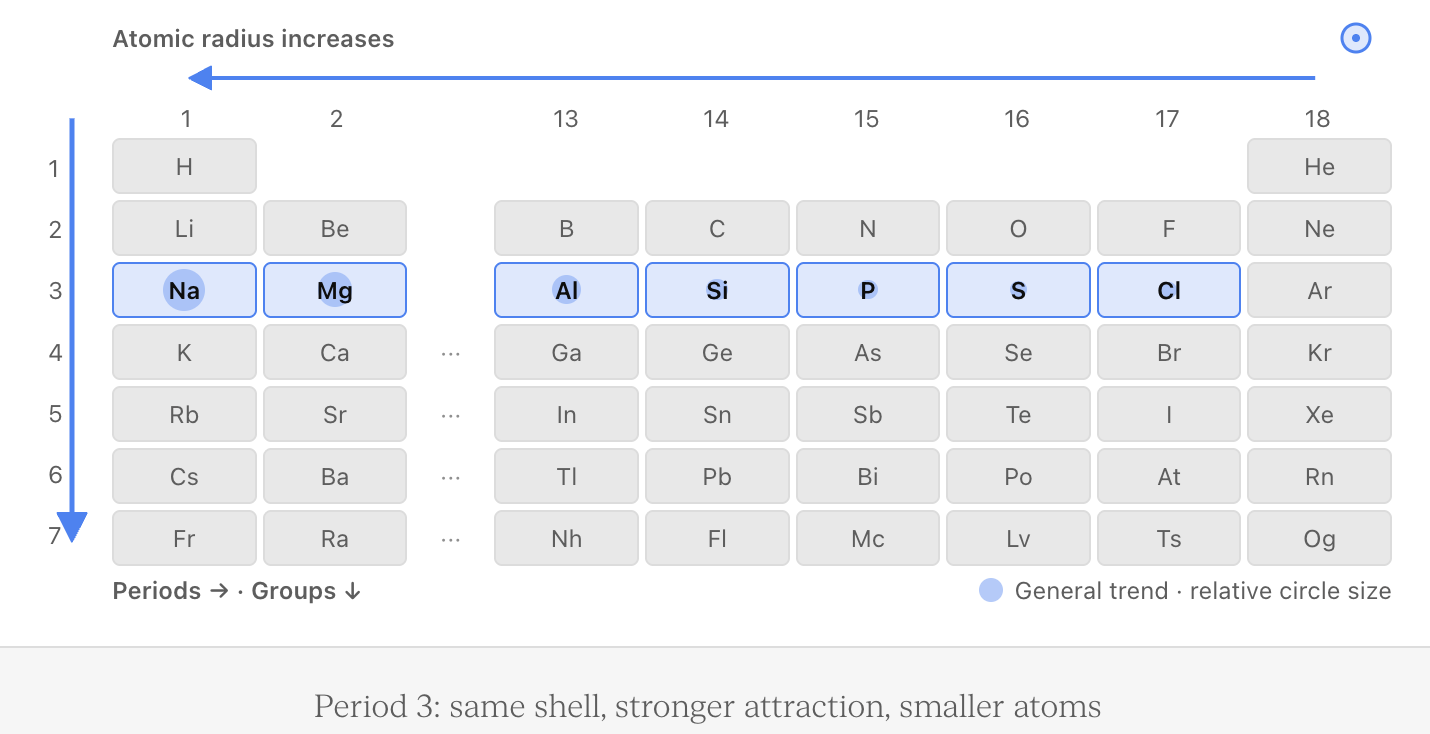
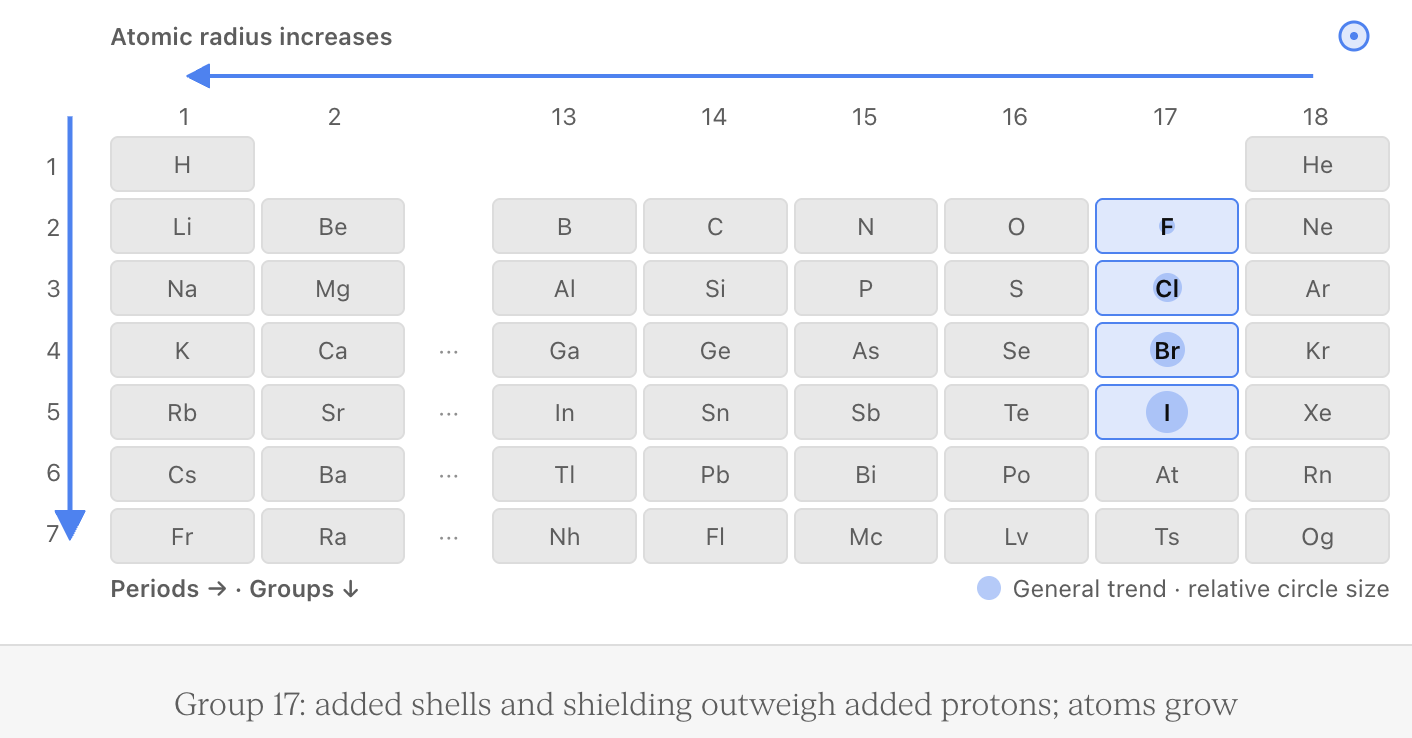
Atomic radius generally increases down a group.

https://images.openai.com/static-rsc-4/AJpDzmTnoC9KwOYN0SKhwIDQ0GOVobOlRE4uMAS2O98oszZnznCA__9BJRdnV2LZ_ySLyuurYNlnwjzinO3lAEGiKtQB9oxPhVBvZXZXbMlmDBAXORiIsKrnKIPOQOpjl_-v0RM45OOCQmXQW62UoIkKEXPS25jfg67_lAcld_S-_FlzazXm9al9rjYINHEk?purpose=fullsize
 
https://images.openai.com/static-rsc-4/IUG0d071FniGpU3z0dtmJNTkhXluG6c6ov2A2GCH0aHyX5B3ZWRPHdj2ICFt6fcnjXcO1zlF-XWnLb77wcBE-upJLh3uibR29Gs_uIq2vvm4gc7f2-B6n4_86wO1AFLyGRahlGO7JDO7dwMdHsOMYZkjT1EHmQuYGcvAwKq4QP30HVGuMEHsk3RoWJmrqvhS?purpose=fullsize
 
https://images.openai.com/static-rsc-4/gAhlk4e6yJxVtz60AO1-8s7pvpmJG89uCG15D3K444t6lsmWUqxR9nIJZVIs16frweGm5TXf272M9u8x8Yz-Kype2Kk3gmzEz4tS_-2jqseQhDGTiWdj_bPdRtNRD7A5ITyq8kPmDTuPAEdRn045KHTLOUgevs7guit-T8288cXUwoGy4MfpS_s1uD7ASzxb?purpose=fullsize
 

This increase in atomic size affects Group 1 and Group 17 differently.

For Group 1, greater radius makes the outer electron easier to lose.

For Group 17, greater radius makes an incoming electron harder to attract strongly.

Therefore, the same structural change helps produce opposite reactivity trends.


Reactivity and Shielding

Shielding increases as additional electron shells are added.

Think of the inner electrons as partially reducing the influence of the nucleus on electrons farther away.

https://images.openai.com/static-rsc-4/AigGjttiT-_NLNt9hNCDqp0CntdvXb-mb6rzpoupPXW3px0s8nn7zb-VqP8uiXXMEu6Hj4IcK8Wp76VRUkAzLsEi5_iwXzHz_0ZEQC5ACLrnK9z1LTwAjS6G-v9n6NMVEJdjQ-hq4_3yeNGFNSBgmNn7q3ViYMRJhreZwyS_gHErFMaYOrCyAEhKCSrRg6mq?purpose=fullsize
 
https://images.openai.com/static-rsc-4/b4aH3JctYLac3Zd9MHs8sFXlM9u3ih2eWseQKvTuvLuQMNVhTCbTSHSqeMRrHBes2EUk6Pn9Q80XF2AenxLsSCjwCgMLfLOmqxBwe_mSuTJiTA-YsHbQU-pxVpd0UXQ6AyCV-4N8AofKSUh-FJcojVZwmg7tP3D0fx6C-crUxXRvONYr1KihmOHxSPzF176m?purpose=fullsize
 
https://images.openai.com/static-rsc-4/KVf9X2w52z4mbubR9q9R1PZM5fMV_ciXAYuO_4ezf1JW1uGvf4MMLn19cpAIgF6DNwIt1CtF70Zb211d8-RVtawSkN48N68QiiZ8ipPWrJ8MHqG2eqLP8vN1sBlQRU_d-KNmfXHfVdRGLbneaNyFIfcsV4uA8pX0Nd43KxREF8sHkni0jxUX1lCB5J5k_kMr?purpose=fullsize
 
5

Down either Group 1 or Group 17:

number of shells increases

and:

shielding increases

But the effect on reactivity depends on whether the atom needs to lose or gain an electron.


Why Proton Number Alone Does Not Explain the Trend

Atoms farther down a group contain more protons.

You might therefore expect their nuclei always to attract electrons more strongly.

However, they also contain:

  • more electron shells
  • greater atomic radius
  • more inner electrons
  • greater shielding

These factors reduce the effective nuclear attraction experienced by outer or incoming electrons.

Therefore, reactivity cannot be predicted simply by counting protons.

We must consider the entire electron arrangement.


Metals and Non-Metals Behave Differently

Group 1 elements are metals.

Their reactions commonly involve:

electron loss

Group 17 elements are non-metals.

Their reactions commonly involve:

electron gain

https://images.openai.com/static-rsc-4/BcOBtO1cDTJP4wpN87jNhjEzB0jt5s-bf-JYhIzhfkv53Pv4Ca5piJ0jl-x9cIxq95MVZHEzyfObRjZxlmbjB_DXbGnJKKwqBFo7VG_CE3i57YLZCB5VSgvBYKoa4e5H6vOHzGHfA_p63-5nfM02VpvXFYuWpoMoTCmCjE9PUFcLS5fSRXjYdTdGSuRpDCMt?purpose=fullsize
 
https://images.openai.com/static-rsc-4/8-MHWSvYaWTYOJu2SESwveTABSGBWZCg84Fpht8Wl2Gsdb-AZ-R-oeiTlEutn9iLMd1B2DxXcs7DWaiq7Ig0kWEVQ_cGvN4YI3pgLXaVtp6O0drI3JdAtjjk9xdnTaGCXvibgr2EpVrM4iFVzh52Gu_a257LSiiBjhC3weBBCvv2coqCVvV7nAMIgnyHFU-J?purpose=fullsize
 
https://images.openai.com/static-rsc-4/jHPU8UesckjzI9x_JCYOc083Dptm5L6DAf6KRcP509X02EqygCgv65EfQ-w9kWMvKA2Wx71TCgDe-RC-3pD9FmsApc0xfcHFYPCdYTL9qrq7GIXoIk-PulEZh0Fu9WwBNpgh0SnK3_824tAt_Xo7WzcGthBcBSXOzqRBDrROVh8EL3wHjd3Hw_Qi94vRBODR?purpose=fullsize
 
5

This is one of the most important patterns in introductory chemistry:

metals tend to form positive ions

while:

non-metals tend to form negative ions


Group 18: A Useful Comparison

Group 18 contains the noble gases.

These elements already have full outer electron shells.

https://images.openai.com/static-rsc-4/yOHCcHE7uF3srAormLzKfsAXlatu2PLU9qYwI7AG2t_ObZDVbRN50JFzmUxffHYTcYXHheBY-65j6p_RQ-kHBEsy10iDA8CPJ77PbCVOYkl2pCoQbSZxN_zbW0hwW_gf3xIGPSmVbAou0BQ6vScps4-1MJOujPF9rHm2c3kcZo-qWJbTxFZGueo45R-4EZPQ?purpose=fullsize
 
https://images.openai.com/static-rsc-4/yfMAuE9duLjVS7SwFdep1OcUbD6OYnpFNADlI1aV78dtqcXqSEO241-z1HvJ8TjjBJzJWNahlplMhZzMAOXIFuGB0Sg0ceRr4vAHjxXcxAmQLLSVa3LscYjzALxP2kUMVpEdBM26i61ljQoTrjmVeg9967FyZrBFRtWk4EgEtnWrZ5qytkUdpjItIEQLltjv?purpose=fullsize
 
https://images.openai.com/static-rsc-4/VGuLrrDmzZKI7crqfggiAJZ1vwSxwu5iyyshxUpkhpumGKzsWylCk8_eNUEmBjVN3t9EVx16VrcVNCY-eqHZXsssL9cFHVHrc5pDf0QA13BYPnJ0u0jUHpvQFjB6I9GhULKOfaidlrOJ3hEpPjWT1IjYsfZyrwkTma_QNuhIc19kVg--IaKkpf1qN6rXpUpu?purpose=fullsize
 
5

Because their electron arrangements are already very stable, noble gases are generally much less reactive than Group 1 metals or Group 17 halogens.

This comparison reinforces the connection between:

electron arrangement and chemical reactivity.


Observing Patterns in the Periodic Table

The periodic table is more than a list of elements.

It is a predictive model.

Once you understand the patterns, you can predict properties of unfamiliar elements.

For reactivity:

Group 1

Top → less reactive

Bottom → more reactive

Group 17

Top → more reactive

Bottom → less reactive

https://images.openai.com/static-rsc-4/TtTOKCNxaoZv2yHOaAx9FYt2_6nglNE2ht0u4-zlR_PxXB7v1-KxQk1EjHt42Bup7VawcVsbb1OFfzVcuGcvaI4rp-yLoHYVGofDw54O-WPPDWh0eO6wRlM07CrVluoF9mv_nRy7KU9WvVAihj7PipXwg39yuMgLww2eFm9AI8u6LMSv1D2XCuI-hwukv-fg?purpose=fullsize
 
https://images.openai.com/static-rsc-4/In305u_bR5fX0VunHdnUAEPazC2X1WH981UuoHIwvYGX7CRtKsrNNGveJbt3-YFm3ItKgbfkoMSaKmCPOic03f3Xu8Mb-NVEM4-MIeP_zYH7ufiyQaW2G1AKVFIzITIID8LodWcKefmMEOKzziR5_S5bgxuESc0BhO-4FrUcT9avAzUJUOThMPcf_qALQ4Gn?purpose=fullsize
 
https://images.openai.com/static-rsc-4/9sADoC3gWZKppDi-1QdRAJd2qqTiIBqYNyW2zyXJS5ACbFs-IrX-NMN4mwTI07ZAewy5GZHf3PwtuhvH1JgKpyVuc7xRufTQU-bkHaXeqDyJrNF2bO6MOJujJIPz1hHL7294Wox2t4YYtxd_wOQzzVG8dxCSTQ_01QSI4KhTECYhSYqpeceBmHF6eIm4epvz?purpose=fullsize
 

A Useful Reasoning Strategy

When asked to predict reactivity, do not rely only on memorized lists.

Ask:

1. Which group is the element in?

2. How many valence electrons does it have?

3. Does it tend to lose or gain electrons?

4. Is the element higher or lower in the group?

5. How do atomic radius and shielding change?

6. Does that make electron loss or gain easier or harder?

7. What does this tell me about reactivity?

This method allows you to explain the trend rather than simply state it.


Common Mistakes

Mistake 1: Saying all groups become more reactive down the periodic table

This is not true.

Group 1 becomes more reactive down the group.

Group 17 becomes less reactive down the group.


Mistake 2: Explaining Group 1 using electron gain

Group 1 metals react mainly by losing one electron, not gaining one.


Mistake 3: Explaining Group 17 using electron loss

Group 17 halogens react mainly by gaining one electron.


Mistake 4: Saying shielding decreases down a group

Shielding generally increases because more occupied electron shells are present.


Mistake 5: Saying the nucleus becomes weaker

The nucleus does not simply become "weaker."

In fact, atoms lower in a group contain more protons.

A better explanation is that increased distance and shielding reduce the effective attraction experienced by the relevant electron.


Mistake 6: Memorizing the trend without explaining it

A strong explanation connects:

electron shells → shielding and distance → electron loss/gain → ion formation → reactivity


Did You Know?

Some of the most reactive elements in the periodic table are found near its outer edges.

Group 1 metals readily lose electrons, while Group 17 halogens readily gain electrons.

https://images.openai.com/static-rsc-4/In305u_bR5fX0VunHdnUAEPazC2X1WH981UuoHIwvYGX7CRtKsrNNGveJbt3-YFm3ItKgbfkoMSaKmCPOic03f3Xu8Mb-NVEM4-MIeP_zYH7ufiyQaW2G1AKVFIzITIID8LodWcKefmMEOKzziR5_S5bgxuESc0BhO-4FrUcT9avAzUJUOThMPcf_qALQ4Gn?purpose=fullsize
 
https://images.openai.com/static-rsc-4/TtTOKCNxaoZv2yHOaAx9FYt2_6nglNE2ht0u4-zlR_PxXB7v1-KxQk1EjHt42Bup7VawcVsbb1OFfzVcuGcvaI4rp-yLoHYVGofDw54O-WPPDWh0eO6wRlM07CrVluoF9mv_nRy7KU9WvVAihj7PipXwg39yuMgLww2eFm9AI8u6LMSv1D2XCuI-hwukv-fg?purpose=fullsize
 
https://images.openai.com/static-rsc-4/fXNiTg38Grddq-ZgCwlFdbFvfmMf8zt8AVlEVDp4sJZ-8tjAG1PFFPdK9As3ibKbNRq0l8YwPqzryUqXRo7zIaZxoB_Dr2KFaid31teEyMXA_PAaTbFSUNILkKOUBnSCTiDVfXnaJbN1c8iRL26MSNyAh1CMAdrVofAwVlwtxAFjkBGd8VrKJyvGmp99BKPz?purpose=fullsize
 

When elements from these groups react together, electron transfer can produce stable ionic compounds.

For example:

2Na + Cl₂ → 2NaCl

Sodium loses electrons and chlorine gains them, producing sodium chloride.


Key Terms

Reactivity: How readily a substance undergoes a chemical reaction.

Valence electron: An electron in the outermost occupied shell of an atom.

Group: A vertical column of the periodic table.

Alkali metal: A Group 1 metal.

Halogen: A Group 17 non-metal.

Ion: A charged particle formed when an atom gains or loses electrons.

Cation: A positively charged ion.

Anion: A negatively charged ion.

Atomic radius: A measure of the size of an atom.

Shielding: The reduction in effective nuclear attraction caused by inner electrons.

Ionization energy: The energy required to remove an electron from an atom.

Displacement reaction: A reaction in which a more reactive element replaces a less reactive element in a compound.


Key Patterns

Group 1

One valence electron.

Forms +1 ions.

Reactivity:

increases down the group

because the outer electron becomes easier to remove.

Li < Na < K < Rb < Cs


Group 17

Seven valence electrons.

Forms −1 ions.

Reactivity:

decreases down the group

because attracting an incoming electron becomes less effective.

F > Cl > Br > I


Key Takeaways

  • Chemical reactivity is strongly connected to electron arrangement.
  • Elements in the same group have similar chemical behaviour because they have the same number of valence electrons.
  • Group 1 metals have one valence electron and tend to lose it to form +1 ions.
  • Group 1 reactivity increases down the group.
  • Down Group 1, atomic radius and shielding increase.
  • This reduces the effective attraction holding the outer electron, making it easier to remove.
  • Easier electron loss means greater Group 1 reactivity.
  • Group 17 halogens have seven valence electrons and tend to gain one electron to form −1 ions.
  • Group 17 reactivity decreases down the group.
  • Down Group 17, atomic radius and shielding increase.
  • This reduces the effective attraction between the nucleus and an incoming electron.
  • Less effective electron gain means lower Group 17 reactivity.
  • Group 1 and Group 17 have opposite trends because Group 1 reacts mainly by losing electrons, while Group 17 reacts mainly by gaining electrons.
  • Halogen displacement reactions provide evidence for the Group 17 reactivity trend.
  • Position in the periodic table can be used to predict the relative reactivity of unfamiliar elements.
  • Understanding electron arrangements, atomic radius, shielding, and ion formation allows us to explain periodic reactivity trends rather than simply memorize them.