Energy in Systems

2. Friction and Energy Losses

Learning outcomes
  • I can explain how friction affects the motion of objects and systems.
  • I can describe how energy is dissipated through friction and air resistance.
  • I can identify useful and wasted energy transfers in real-world situations.
  • I can analyze the impact of friction on the efficiency of machines and transportation systems.
  • I can suggest methods for reducing unwanted energy losses.

Friction and Energy Losses

Friction is a force that opposes relative motion, or the tendency for relative motion, between surfaces in contact.

Friction plays an important role in almost every mechanical system. Sometimes friction is useful: it allows us to walk, grip objects, brake vehicles, and transfer forces between tyres and roads. In other situations, friction is unwanted because it reduces motion and causes mechanical energy to be transferred into thermal energy.

Examples of friction include:

  • tyres interacting with a road
  • brake pads rubbing against a brake disc
  • gears contacting one another
  • bearings rotating inside machines
  • shoes gripping the ground
  • an object sliding across a table
  • moving parts inside an engine
https://images.openai.com/static-rsc-4/m9eJP62DDepLoCox9B8buDY7Iqa38tsLF0Wyt-Q57gicUOBCpOTyIFrzKJcDQ7xiBTojn48oDT6HbNQUOVjzajKTyDASZwZtgglPEaQ4AtW1pj6k8eAbKa_NfSAaw7xmPIcz5TSkpuzqQkk2ePDIydCOV3MKMjO0Rc7KMn8b2cC1TMGiEFL-2lh6sgdirKaI?purpose=fullsize
 
https://images.openai.com/static-rsc-4/93u0K137g4WINfFsiO_H6Kn3HxdnX2A6rg-Q8mUrliUiPJym13EkcAMzB_xK9kCxorKWkiTY2n8kaQvjf2u0g6pdwJ3jQ41nXpjziFLLSIRoRxHyVyJMVeMaJlFvEO37_EZrn0lDdfXM9crZUgCe7owwSJyAQxh65zee69KCmCXamSlY2YDevP_rQuMW2_L6?purpose=fullsize
 
https://images.openai.com/static-rsc-4/VENDtd_QkN9FtISGk9igLip4ikHzEW6PJTK5gxAU_P5hpN39QKKSm3ypNZnUjuJ6k0DE2FuAfX6bcMwR1i7thzF9mPacOdSSRhhJs0Sv7Fxz7TOx1fP2fAeZ-vGH8wH98mirsup7ItB8TYVRB6tzYTUGozB19sSd1XlSEzkm75VUUNLTMXlsdE_oSgbvc13O?purpose=fullsize
 
4

How Friction Affects Motion

Friction acts in a direction that opposes relative motion between surfaces.

Imagine pushing a box across a floor.

Your applied force acts forward.

Friction acts in the opposite direction.

If:

applied force > friction

there is a resultant force forward and the box accelerates.

If:

applied force = friction

the resultant force is zero. If the box is already moving, it continues at constant velocity.

If the applied force is removed, friction produces a resultant force opposite the motion, causing the box to slow down.

Eventually, the box stops.


Friction and Newton's Laws

Friction does not automatically mean that an object must slow down.

Consider a car traveling at constant velocity.

The engine provides a forward driving force.

Friction, rolling resistance, and air resistance act against the motion.

If:

driving force = total resistive force

then:

resultant force = 0 N

According to Newton's First Law, the car continues at constant velocity.

To accelerate:

driving force > resistive forces

To slow down:

resistive forces > driving force


Friction and Energy

Friction affects both forces and energy transfers.

When surfaces move against one another, mechanical energy is often transferred into thermal energy.

For example, rub your hands together quickly.

Your hands become warmer.

The kinetic energy associated with the movement has been transferred partly into thermal energy.

The energy has not disappeared.

It has been dissipated.


Energy Dissipation

Energy dissipation occurs when energy is transferred into less useful forms and spreads into the surroundings.

Friction commonly causes:

mechanical energy → thermal energy

Other unwanted transfers may include:

mechanical energy → sound

and:

mechanical energy → vibration

Once thermal energy has spread throughout the surroundings, it is usually difficult to recover and use for mechanical work.


Conservation of Energy

Friction does not violate conservation of energy.

Suppose a moving object initially has:

500 J kinetic energy

Friction causes it to stop.

The final kinetic energy is:

0 J

It might appear that 500 J has disappeared.

It has not.

Instead:

500 J kinetic energy → approximately 500 J thermal energy in the object and surroundings

Total energy is still conserved.


Worked Example: Sliding Object

A box initially has:

800 J

of kinetic energy.

After sliding across a rough floor, it has:

250 J

of kinetic energy.

Energy dissipated:

800 − 250 = 550 J

Approximately:

550 J

has been transferred into other forms, mainly thermal energy.


Work Done Against Friction

When an object moves against friction, work is done against the frictional force.

Recall:

W = Fd

where:

  • W = work done
  • F = force
  • d = distance moved in the direction of the force

For a constant frictional force, the magnitude of the energy dissipated can be calculated using:

energy dissipated = friction force × distance


Worked Example: Friction

A box experiences a frictional force of:

40 N

while moving:

5 m

across a floor.

Energy dissipated:

E = Fd

E = 40 × 5

E = 200 J

Approximately 200 J of mechanical energy is transferred into thermal energy.


Worked Example: Longer Distance

A machine component experiences a frictional force of:

25 N

and moves:

20 m

Energy dissipated:

E = Fd

E = 25 × 20

E = 500 J

If the same frictional force acts over twice the distance, twice as much energy is dissipated.


Friction and Mechanical Energy

Mechanical energy includes:

  • kinetic energy
  • gravitational potential energy
  • elastic potential energy

Without dissipative forces, these energy stores can transform into one another while total mechanical energy remains constant.

With friction:

mechanical energy decreases

because some of it is transferred into thermal energy and other forms.

However:

total energy remains conserved

This distinction is extremely important.


Example: Object Sliding Down a Ramp

Suppose an object begins with:

1000 J gravitational potential energy

At the bottom of a rough ramp it has:

750 J kinetic energy

The remaining:

1000 − 750 = 250 J

has been dissipated.

Energy transfer:

1000 J gravitational potential

becomes:

750 J kinetic + 250 J thermal/sound

The system still contains the full 1000 J of energy.


Friction and Efficiency

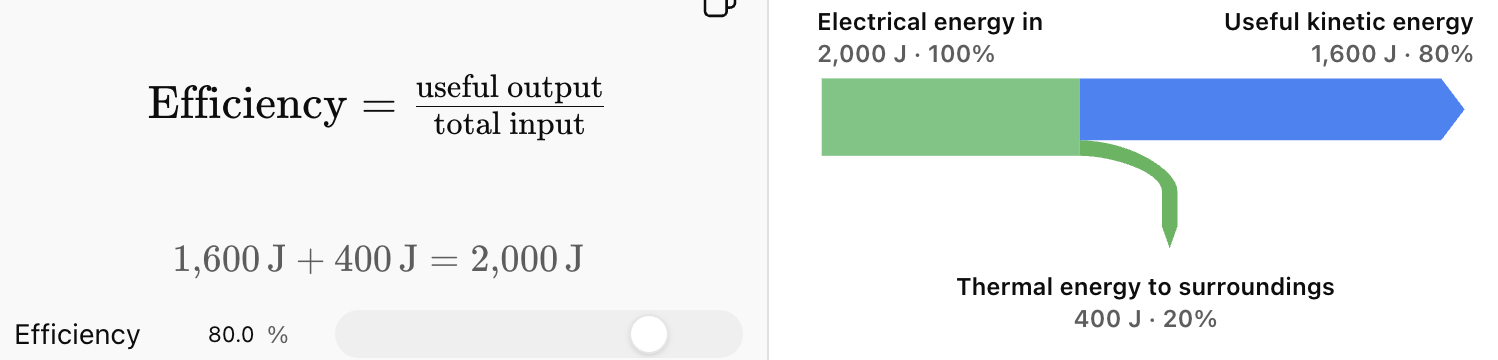
Friction often reduces the efficiency of machines because some of the input energy is transferred into unwanted thermal energy.

Suppose a motor receives:

2000 J

of electrical energy.

It provides:

1600 J

of useful mechanical energy.

The remaining:

400 J

is transferred mainly through:

  • friction
  • electrical resistance
  • sound
  • vibration

Efficiency:

efficiency = useful output / total input × 100

efficiency = 1600/2000 × 100

efficiency = 80%

The more energy dissipated through unwanted processes, the lower the efficiency.
Useful Friction

Friction is not always an unwanted energy loss.

Without friction, many everyday activities would be impossible.

Useful friction allows:

  • shoes to grip the ground
  • tyres to grip roads
  • brakes to stop vehicles
  • pencils to write
  • screws and nails to remain in place
  • objects to be held
  • belts to transfer motion between machine components

The goal in engineering is therefore usually not to eliminate all friction.

Instead, engineers try to:

increase friction where it is useful

and:

reduce friction where it causes unwanted energy transfers.


Walking

Walking depends on friction between your shoes and the ground.

Your foot pushes backward against the ground.

The ground provides a forward frictional force on your foot.

Without sufficient friction, your foot slips.

This is why:

  • shoes have textured soles
  • sports shoes use specialized materials
  • hiking boots have deep tread patterns

Friction is essential for controlled movement.


Tyres and Roads

Vehicles depend on friction between tyres and the road.

This friction allows vehicles to:

  • accelerate
  • turn
  • brake
  • climb hills

Tyre tread helps maintain effective contact, especially when water is present.

Too little friction can cause a vehicle to slide.

However, some resistive effects associated with tyre deformation and road contact also contribute to energy losses.

https://images.openai.com/static-rsc-4/ULiuw-f5ieP2bqr2ikHlLfsCP-VQTgDQTbBQKyIqXj5jvyffP9GUDytv06dv2OwrmY89mRk4EBwKaypuPTFeSO4lUEOjoYygw-I42kdfcz0BkCwOo3ZeiEXj9serYxzAUvLeq6fOS216zK5CU8ply99t9By8BCbf2hLHZNUxLsJSYmsnhcHF3-H4H9-8RfOz?purpose=fullsize
 
https://images.openai.com/static-rsc-4/LgcGbd5aF_a1dzf3pORzniOlyguJfEdg0L0Uby1iF0ZO2MGXzqAONOTWJnwcaY1JZmjNpFvjW2BXFcTcLrc3uQDyxNHrqy2GIdfUOHJ4PfxGx98IvB2f8H3G80WBBa1B9_YU2Gtv4EaREpZ3eDmLAAe73-WCYVKeeptupIbX63i8-hT0g2LqZzW5tO6dIRMb?purpose=fullsize
 
https://images.openai.com/static-rsc-4/OEGBm1fr08sw9Xw1yFnpZ7wktOd1Es0enYiYQdOQnol-j2HfufAzXEOayIF60lgXCInyRr0olWHVMK4E-UfkUc-yLjkpZJVeKFkDkYQ2CG-UxdbjN9C-oSoKlRopMiwUIXeubAQk4ZMliDjYe3qN4GaWgAT_uVZmz1PvfLVmfmU8dxPBWrrbw8tgZnHU4Gry?purpose=fullsize
 
4

Braking

Brakes deliberately use friction.

When brake pads press against a disc:

kinetic energy → thermal energy

The vehicle slows because its kinetic energy decreases.

The brakes become hot because energy has been transferred into thermal energy.

In this situation, friction is useful because stopping the vehicle is the intended result.


Worked Example: Braking

A car initially has:

300,000 J

of kinetic energy.

It brakes until it stops.

Ignoring other energy transfers, approximately:

300,000 J

must be transferred into other forms.

Much of this becomes thermal energy in:

  • brakes
  • tyres
  • road
  • surrounding air

Energy has not disappeared.

It has changed form and spread into the surroundings.


Regenerative Braking

Some electric and hybrid vehicles can recover part of the vehicle's kinetic energy.

During regenerative braking, the electric motor operates as a generator.

Energy transformation:

kinetic energy → electrical energy → stored chemical energy

Some energy is still dissipated, so the process is not 100% efficient.

However, regenerative braking can recover energy that would otherwise largely become thermal energy in conventional friction brakes.


Friction in Machines

Machines often contain many moving components.

Examples include:

  • shafts
  • gears
  • bearings
  • pistons
  • chains
  • belts
  • wheels

Contact between moving parts can produce friction.

This causes:

  • unwanted heating
  • energy dissipation
  • component wear
  • reduced efficiency
  • increased energy consumption
https://images.openai.com/static-rsc-4/TrWisz4U_NK8b1RzN3Q7Hu3pKCLBMiJKyy58p-0hQMGp7_rsaH4vAGDSGB-TCr7gHvRhePzha7u9E3v9HiBPiTKxs2RIhgsroKokbcIwpPMBcMYOTD2stvt-wOiE3ROIGnwTePDIBmIFXeMabr9rDFU6Po70SBiwoAIRLGVyQjFGHfzO64fGP4UOYixx4Zut?purpose=fullsize
 
https://images.openai.com/static-rsc-4/DMoMAtKijKiQwAHpBf2UrY-b7EzEmI9yz1E27eJs9ZMEKeJnUrJ2rf8GHqLcifuLfvjBv8amE5bHZe4AYs2bjiAkU6-bMq5oKKzmyW42c0NEIVahKoFK8BMEsSptknKkN5srBQkASg5xPM9W9rBF5j0mVtrjkbdK6trhFQdgqKaADow8XtmFIAYFvaM73Y2X?purpose=fullsize
 
https://images.openai.com/static-rsc-4/gdEu2srx71pY0hBpBRJRiQY31Z5IFFZGf9hFlbdby6-_kbWdaHTBEHIfi9XgDKhi7bMKn4aZlQ_syKL_DuxpMXASjJxQYV2lb1PSD3IsNEca_qkP8VklVpAEM5gIF9aUO9CAwgjAEkuEWzpsO4ELNh9rcy5IFyph-bGfZNxcuyUXsDmuekn1OXFg1_ZFS1bc?purpose=fullsize
 
5

Friction and Wear

Friction can gradually remove material from surfaces.

This is called wear.

Wear can:

  • change the shape of components
  • increase gaps between parts
  • increase vibration
  • reduce efficiency
  • eventually cause component failure

Machines therefore require maintenance.

This may include:

  • lubrication
  • cleaning
  • adjustment
  • replacing worn components

Lubrication

One of the most common ways to reduce unwanted friction is lubrication.

Lubricants include:

  • oils
  • greases
  • specialized synthetic fluids

A lubricant forms a layer between surfaces, reducing direct contact.

This can:

  • reduce friction
  • reduce heating
  • reduce wear
  • increase efficiency
  • extend machine lifetime

However, some friction still remains.


Bearings

Bearings are designed to reduce friction between moving components.

Instead of surfaces sliding directly against each other, bearings may allow rolling motion.

Examples include:

  • ball bearings
  • roller bearings

Rolling friction is often much smaller than sliding friction.

Bearings are widely used in:

  • bicycles
  • cars
  • electric motors
  • turbines
  • industrial machinery

Rolling Instead of Sliding

Consider moving a heavy object across the ground.

Dragging it causes substantial sliding friction.

Placing rollers underneath can make movement much easier.

This is one reason wheels are such an important technological development.

Wheels allow much of the interaction to involve rolling rather than sliding.


Air Resistance

Objects moving through air experience air resistance, also called drag.

Air resistance acts opposite the direction of motion.

Examples include:

  • cars
  • cyclists
  • trains
  • aircraft
  • falling objects
  • projectiles

Energy is transferred from the moving object to the surrounding air.

Some of this energy eventually becomes thermal energy and turbulent motion.

https://images.openai.com/static-rsc-4/TAvryV1gje2hVWkV0y5EMWvKN4VTzkUjUdPee7VGOXcYn3wNtgndDLHIiWTPdDXHEkc0m-0m_7Ye_tXRnIMIxK_Oiie5VgFxzaVDGIkKIWQZhFVZ2M-B4wcI43hcff4RaJYdKJBJbSFogu3iKxe0uy4JZjSW6I9_HULascp3Qi9kyt1EKGRH-TemRRsNtBrA?purpose=fullsize
 
https://images.openai.com/static-rsc-4/sT6DepGOwwI_xTgE3A2VtK5RdGmCTo2AxUuDackR3-IQv9bcMsXN9zdmaREbxQ2JKEE2ON_kFbiVdD-XWgwQRcwp2duBCCpb3RPKjcYHyP5o4T4iRBPgEQpSEWGcltXfBeQwfJveEg2BS84w48QavnDxRGPY0XBaK-708_RKSDKEKzP-zlLIJdkhDCEiVK6v?purpose=fullsize
 
https://images.openai.com/static-rsc-4/zYVBVxxBP0yc_05xc8mEBXem3Lx4m3vGmdCGFvz2nbIRhJBKbPfDWLyE7-oXCh6z6iP0J3UkjLIgEpKIFIGH2zLltXlGWVREm5XMsDbuDV7bR4TbbFnHURwVHKt8r9o1H4JVTNCSt4BYyVwC3iRZZxUktlliWJqrLPdDxW4OFx6XQCHSEtGRvp9iL0uvQ2xl?purpose=fullsize
 
8

Air Resistance and Speed

Air resistance generally increases as an object's speed increases.

At high speeds, air resistance can become a major energy loss.

This is especially important for:

  • highway vehicles
  • high-speed trains
  • racing bicycles
  • aircraft

A faster vehicle must often use significantly more power to overcome drag.

This is one reason aerodynamic design is so important.


Streamlining

Streamlining means designing an object so air or water can flow around it with less resistance.

Examples include:

  • aerodynamic cars
  • aircraft
  • high-speed trains
  • racing bicycles
  • streamlined helmets

Reducing drag means less energy is needed to maintain a particular speed.

This can improve efficiency.


Worked Example: Work Against Drag

A vehicle experiences an average resistive force of:

600 N

while traveling:

1000 m

Energy transferred against the resistance:

E = Fd

E = 600 × 1000

E = 600,000 J

or:

600 kJ

The engine must supply at least this amount of energy simply to overcome the resistive force over that distance.


Power Needed to Overcome Resistance

Recall:

P = Fv

If a vehicle moves at constant velocity, the engine's driving force balances the resistive forces.

Suppose:

Resistive force = 500 N

Speed = 20 m/s

Power needed just to overcome resistance:

P = Fv

P = 500 × 20

P = 10,000 W

or:

10 kW

This power is continuously being transferred into the surroundings.


Worked Example: Higher Speed

Suppose a vehicle experiences:

800 N

of total resistance while moving at:

30 m/s

Power required:

P = Fv

P = 800 × 30

P = 24,000 W

P = 24 kW

The engine must provide 24 kW merely to balance the resistance and maintain constant speed under these simplified conditions.


Transportation Efficiency

Transportation systems experience several sources of energy dissipation.

These may include:

  • air resistance
  • rolling resistance
  • friction in bearings
  • friction in gears
  • tyre deformation
  • engine losses
  • electrical resistance
  • braking

Reducing these losses can reduce the energy required to move people and goods.


Reducing Energy Losses in Cars

Engineers can reduce unwanted energy transfers by using:

  • aerodynamic body shapes
  • properly inflated tyres
  • efficient bearings
  • low-friction lubricants
  • efficient transmissions
  • lightweight materials
  • regenerative braking
  • efficient electric motors

Each improvement may reduce the amount of input energy required for a journey.


Tyre Pressure

Tyres deform as they roll.

This deformation causes energy to be transferred into thermal energy.

If tyre pressure is too low, deformation can increase.

This can increase rolling resistance.

Proper tyre pressure can therefore:

  • reduce energy losses
  • improve fuel economy or driving range
  • reduce unnecessary tyre heating
  • improve tyre performance

Bicycles

Bicycles provide a useful example of energy losses.

A cyclist must provide energy to overcome:

  • air resistance
  • rolling resistance
  • bearing friction
  • chain and gear friction

At higher speeds, aerodynamic drag can become particularly important.

Engineers and athletes therefore use:

  • streamlined riding positions
  • aerodynamic helmets
  • narrow profiles
  • efficient bearings
  • lubricated chains
  • appropriate tyre pressures

to reduce unwanted losses.


Aircraft

Aircraft must overcome drag while moving through the atmosphere.

The engines must continuously provide energy to balance drag during steady flight.

Aircraft designers reduce drag through:

  • streamlined fuselages
  • carefully shaped wings
  • smooth surfaces
  • optimized aircraft geometry

Reducing drag can reduce fuel consumption and increase range.


Thermal Energy in Machines

If a machine becomes warm while operating, this often indicates that some input energy is being transferred into thermal energy.

Examples include:

  • warm electric motors
  • hot engines
  • heated bearings
  • warm bicycle brakes
  • hot tyres

Not all heating is caused by mechanical friction. Electrical resistance and other processes can also produce heating.

However, unwanted heating often indicates energy that is not reaching the desired output.


Sound and Vibration

Energy can also be dissipated through:

  • sound
  • vibration

A noisy, vibrating machine may be transferring more energy into unwanted forms.

Engineers may reduce these transfers using:

  • better alignment
  • balanced rotating components
  • damping materials
  • improved bearings
  • stronger structural support

Reducing vibration can also reduce wear and improve machine lifespan.


Useful and Wasted Transfers

Whether an energy transfer is useful depends on the purpose of the system.

Consider friction.

Car Brakes

Thermal energy produced by friction is part of the intended process of slowing the vehicle.

Friction is useful.

Car Engine Bearings

Thermal energy caused by friction is unwanted.

Friction reduces efficiency.

Shoes

Friction provides grip.

Useful.

Skiing

Excessive friction between skis and snow can slow the skier.

Often unwanted.

The same physical process can therefore be useful in one situation and unwanted in another.


Comparing Two Machines

Machine A receives:

1000 J

and provides:

700 J

of useful output.

Energy dissipated:

300 J

Efficiency:

70%

Machine B receives:

1000 J

and provides:

900 J

of useful output.

Energy dissipated:

100 J

Efficiency:

90%

Machine B dissipates less energy and is more efficient.


Worked Example: Machine with Friction

A machine uses an input force of:

300 N

over:

4 m

Input work:

Win = Fd

Win = 300 × 4

Win = 1200 J

The machine provides:

900 J

of useful output work.

Energy dissipated:

1200 − 900 = 300 J

Efficiency:

efficiency = 900/1200 × 100

efficiency = 75%


Reducing Friction Does Not Always Mean Eliminating It

Suppose engineers completely eliminated friction between car tyres and the road.

The result would not be an extremely efficient car.

The car would be unable to:

  • accelerate properly
  • steer
  • brake effectively

This illustrates an important engineering principle:

friction should be controlled, not simply eliminated.

Useful friction should be maintained while unwanted friction is reduced.


Methods for Reducing Unwanted Energy Losses

Lubrication

Reduces direct contact between moving surfaces.

Bearings

Replace much sliding friction with lower rolling friction.

Streamlining

Reduces air or fluid resistance.

Smooth Surfaces

Can reduce friction and turbulence in appropriate systems.

Proper Alignment

Prevents unnecessary rubbing and vibration.

Proper Tyre Pressure

Reduces unwanted tyre deformation and rolling resistance.

Lightweight Design

Can reduce some energy requirements in transportation.

Regenerative Braking

Recovers part of a vehicle's kinetic energy instead of dissipating all of it thermally.

Regular Maintenance

Keeps machines operating close to their intended performance.


Engineering Trade-Offs

Reducing friction can sometimes create other problems.

For example:

  • extremely smooth tyres may provide poor grip
  • very thin lubricants may not protect surfaces adequately
  • lightweight components may be less durable
  • aerodynamic designs may reduce cargo or passenger space

Engineers therefore balance:

  • efficiency
  • safety
  • cost
  • durability
  • performance
  • reliability

The goal is not simply to minimize friction at all costs.


Friction, Efficiency, and Sustainability

Reducing unnecessary energy losses can have environmental benefits.

If a transportation system requires less energy:

  • less fuel may be consumed
  • battery range may increase
  • energy costs may decrease
  • emissions associated with energy production may decrease
  • components may last longer

Small improvements in efficiency can become significant when applied to millions of vehicles or machines.


Multi-Step Example

A vehicle experiences an average total resistive force of:

700 N

while traveling:

5 km

Convert distance:

5 km = 5000 m

Energy dissipated:

E = Fd

E = 700 × 5000

E = 3,500,000 J

E = 3.5 MJ

Suppose the vehicle travels at:

25 m/s

Power needed to overcome this resistance:

P = Fv

P = 700 × 25

P = 17,500 W

P = 17.5 kW

This means the vehicle must continuously provide 17.5 kW just to overcome these resistive forces while maintaining that speed under the stated conditions.


Common Mistakes

Saying Friction Destroys Energy

Friction does not destroy energy.

It transfers energy, usually into thermal energy.


Saying Energy Is "Lost"

Energy is conserved.

When we talk about an energy loss, we usually mean energy has been transferred into a form that is less useful for the intended purpose.


Assuming Friction Is Always Bad

Friction is essential for:

  • walking
  • braking
  • gripping
  • steering
  • many machines

Only unwanted friction should generally be reduced.


Assuming an Object Must Slow Down if Friction Acts

If another force balances friction, an object can move at constant velocity.


Confusing Friction with Air Resistance

Both are resistive forces, but ordinary surface friction involves interacting surfaces in contact.

Air resistance results from movement through air.


Forgetting Distance in Energy Calculations

The energy dissipated by a constant frictional force depends on both force and distance:

E = Fd


Confusing Energy and Power

Energy dissipated is measured in:

joules (J)

Power dissipated is measured in:

watts (W)

Power tells us how quickly energy is being transferred.


Assuming Reducing Friction Always Improves a System

Some friction is necessary for safe and effective operation.

For example, reducing tyre-road friction too much would make a vehicle dangerous.


Check Your Understanding

  1. Define friction.
  2. In what direction does friction act relative to relative motion?
  3. Explain how friction can cause an object to slow down.
  4. Explain what happens when the driving force on a car equals the total resistive force.
  5. Describe what happens to mechanical energy when friction acts.
  6. Why is it incorrect to say friction destroys energy?
  7. A sliding object loses 300 J of kinetic energy. Where has this energy gone?
  8. A frictional force of 50 N acts over 6 m. Calculate the energy dissipated.
  9. A frictional force of 120 N acts over 20 m. Calculate the energy dissipated.
  10. Explain the difference between mechanical energy loss and total energy loss.
  11. Give three examples in which friction is useful.
  12. Give three examples in which friction causes unwanted energy transfers.
  13. Explain how friction reduces machine efficiency.
  14. A machine receives 1500 J and provides 1200 J of useful output. Calculate its efficiency.
  15. Calculate the energy dissipated in Question 14.
  16. Explain how lubrication can improve machine efficiency.
  17. Why can bearings reduce energy losses?
  18. Explain why rolling an object is often easier than sliding it.
  19. Define air resistance.
  20. Explain why aerodynamic design can improve transportation efficiency.
  21. A vehicle experiences a resistive force of 500 N over 2 km. Calculate the energy transferred against resistance.
  22. A car experiences 600 N of resistance while moving at 20 m/s. Calculate the power required to balance the resistance.
  23. Explain why high-speed transportation can require large amounts of power to overcome air resistance.
  24. Describe how regenerative braking differs from conventional friction braking.
  25. Explain why correct tyre pressure can improve vehicle efficiency.
  26. Why might reducing tyre-road friction too much be dangerous?
  27. Identify two ways sound and vibration can reduce machine efficiency.
  28. Suggest four methods engineers can use to reduce unwanted energy losses.
  29. Explain why a machine becoming hot can be evidence of energy dissipation.
  30. Explain the statement: "The engineering goal is usually to control friction, not eliminate it."

Key Terms

Friction — Force that opposes relative motion or the tendency for relative motion between surfaces.

Resistive force — Force acting against motion.

Air resistance — Resistive force acting on an object moving through air.

Drag — Resistive force caused by motion through a fluid such as air or water.

Energy dissipation — Transfer and spreading of energy into less useful forms.

Thermal energy — Energy associated with the internal motion and interactions of particles.

Mechanical energy — Energy associated with motion and position, including kinetic and potential energy.

Kinetic energy — Energy associated with motion.

Useful energy transfer — Energy transfer that contributes to the intended purpose of a system.

Wasted energy transfer — Energy transfer that does not contribute to the intended purpose.

Efficiency — Fraction of input energy or power transferred into useful output.

Lubrication — Use of a material between surfaces to reduce unwanted friction and wear.

Lubricant — Substance used to reduce friction between moving surfaces.

Bearing — Component designed to reduce friction and support relative motion.

Rolling resistance — Resistance associated with rolling objects, often involving deformation of wheels, tyres, or surfaces.

Streamlining — Designing an object to reduce resistance as it moves through a fluid.

Aerodynamic drag — Air resistance acting on an object moving through the atmosphere.

Regenerative braking — Braking system that recovers some kinetic energy and transfers it into stored energy.

Wear — Gradual removal or deformation of material caused by repeated interactions between surfaces.


Key Takeaways

  • Friction is a force that opposes relative motion between interacting surfaces.
  • Friction affects both the motion of objects and the way energy is transferred.
  • Friction often transfers mechanical energy into thermal energy.
  • Energy dissipated by friction is not destroyed.
  • Total energy is always conserved.
  • A decrease in mechanical energy does not mean total energy has disappeared.
  • For constant friction, the magnitude of energy dissipated can be calculated using E = Fd.
  • Friction can reduce the efficiency of machines by transferring energy into unwanted forms.
  • Friction can also be useful for walking, gripping, braking, steering, and transmitting forces.
  • Whether friction is useful or unwanted depends on the purpose of the system.
  • Air resistance is another important source of energy dissipation.
  • At high speeds, aerodynamic drag can require substantial power to overcome.
  • Streamlining can reduce drag and improve transportation efficiency.
  • Lubrication reduces unwanted friction between moving surfaces.
  • Bearings can reduce friction by replacing sliding interactions with rolling motion.
  • Correct maintenance can reduce friction, vibration, wear, and unnecessary energy losses.
  • Regenerative braking can recover some kinetic energy that would otherwise be dissipated.
  • Sound, vibration, deformation, electrical resistance, and heating can also reduce system efficiency.
  • Reducing unwanted energy losses can lower energy consumption and operating costs.
  • Engineers must balance efficiency with safety, reliability, durability, and performance.

The central energy idea is:

friction does not destroy energy — it transfers mechanical energy into other forms, usually thermal energy.

The central engineering idea is:

keep friction where it is useful and reduce it where it wastes energy.