Mechanical Energy
1. Kinetic Energy
Learning outcomes
- I can define kinetic energy as the energy associated with motion.
- I can explain how an object's mass and speed affect its kinetic energy.
- I can recall and use the equation\( E_k = \frac{1}{2}mv^2 \) .
- I can calculate the kinetic energy of moving objects in a variety of situations.
- I can analyze how changes in speed affect kinetic energy and explain why kinetic energy increases rapidly with velocity.
Kinetic Energy
Kinetic energy is the energy an object has because it is moving.
Any moving object has kinetic energy, including:
- a rolling ball
- a moving car
- a running person
- a flying aircraft
- flowing water
- a falling object
- a moving planet
An object that is stationary has zero kinetic energy relative to the chosen reference frame.
The amount of kinetic energy depends on two important quantities:
- the object's mass
- the object's speed


The Kinetic Energy Equation
The equation for translational kinetic energy is:
Eₖ = 0.5mv²
or equivalently:
Eₖ = ½mv²
where:
- Eₖ = kinetic energy in joules (J)
- m = mass in kilograms (kg)
- v = speed in metres per second (m/s)
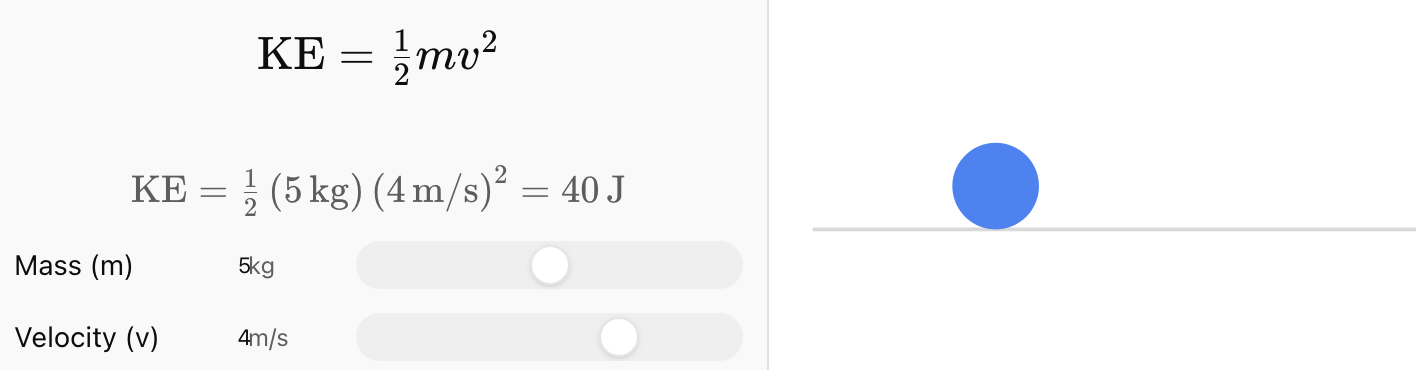
The equation shows that kinetic energy is directly proportional to mass but proportional to the square of speed.
That difference is extremely important.
Units of Kinetic Energy
The SI unit of energy is the joule (J).
From the equation:
Eₖ = 0.5mv²
the units are:
kg × (m/s)²
which becomes:
kg·m²/s²
This combination of units is defined as one joule:
1 J = 1 kg·m²/s²
Larger quantities of energy may be expressed in:
- kilojoules (kJ)
- megajoules (MJ)
Remember:
1 kJ = 1000 J
1 MJ = 1,000,000 J
Calculating Kinetic Energy
The basic procedure is:
Identify mass → identify speed → square the speed → multiply by mass → multiply by 0.5
For example, consider a 4 kg object moving at 3 m/s.
Eₖ = 0.5mv²
Substitute:
Eₖ = 0.5 × 4 × 3²
Square the speed:
Eₖ = 0.5 × 4 × 9
Therefore:
Eₖ = 18 J
The object has 18 J of kinetic energy.
Worked Example: Moving Bicycle
A bicycle and rider have a combined mass of 80 kg and travel at 5 m/s.
Calculate their kinetic energy.
Eₖ = 0.5mv²
Eₖ = 0.5 × 80 × 5²
Eₖ = 0.5 × 80 × 25
Eₖ = 1000 J
The bicycle and rider have 1000 J, or 1.0 kJ, of kinetic energy.


Worked Example: Moving Car
A car has a mass of 1200 kg and travels at 20 m/s.
Eₖ = 0.5mv²
Eₖ = 0.5 × 1200 × 20²
Eₖ = 0.5 × 1200 × 400
Eₖ = 240,000 J
Therefore:
Eₖ = 240 kJ
This large amount of energy must be transferred somewhere when the car stops.
How Mass Affects Kinetic Energy
Consider two objects moving at the same speed.
Object A
Mass = 2 kg
Speed = 5 m/s
Eₖ = 0.5 × 2 × 5² = 25 J
Object B
Mass = 4 kg
Speed = 5 m/s
Eₖ = 0.5 × 4 × 5² = 50 J
Doubling the mass has doubled the kinetic energy.
Therefore:
mass × 2 → kinetic energy × 2
If speed remains constant, kinetic energy is directly proportional to mass.
Comparing Mass and Kinetic Energy
If speed remains constant:
| Mass | Kinetic Energy |
|---|---|
| m | Eₖ |
| 2m | 2Eₖ |
| 3m | 3Eₖ |
| 4m | 4Eₖ |
This relationship is linear.
If mass increases by 50%, kinetic energy also increases by 50%, provided speed does not change.
How Speed Affects Kinetic Energy
Speed has a much stronger effect because speed is squared.
Consider a 2 kg object.
At 2 m/s
Eₖ = 0.5 × 2 × 2² = 4 J
At 4 m/s
Eₖ = 0.5 × 2 × 4² = 16 J
The speed doubled:
2 m/s → 4 m/s
but the kinetic energy increased from:
4 J → 16 J
Therefore:
speed × 2 → kinetic energy × 4
Why Speed Has Such a Large Effect
The reason is the v² term.
If speed doubles:
(2v)² = 4v²
Therefore:
kinetic energy × 4
If speed triples:
(3v)² = 9v²
Therefore:
kinetic energy × 9
If speed quadruples:
(4v)² = 16v²
Therefore:
kinetic energy × 16
This is one of the most important relationships to understand about kinetic energy.
Speed and Kinetic Energy
For the same object:
| Speed | Relative Kinetic Energy |
|---|---|
| v | Eₖ |
| 2v | 4Eₖ |
| 3v | 9Eₖ |
| 4v | 16Eₖ |
| 5v | 25Eₖ |
Kinetic energy therefore does not increase linearly with speed.
It increases with the square of speed.
Worked Example: Doubling Speed
A 1000 kg car travels at 10 m/s.
Initial kinetic energy:
Eₖ = 0.5 × 1000 × 10²
Eₖ = 50,000 J
Now the car travels at 20 m/s.
Eₖ = 0.5 × 1000 × 20²
Eₖ = 200,000 J
The speed doubled, but:
50,000 J → 200,000 J
The kinetic energy became four times greater.
Worked Example: Tripling Speed
A ball has 20 J of kinetic energy while moving at speed v.
What happens if its speed becomes 3v?
Because:
Eₖ ∝ v²
then:
new Eₖ = 3² × 20
new Eₖ = 9 × 20
new Eₖ = 180 J
There is no need to know the ball's mass for this comparison.
Why This Matters for Vehicles
The squared relationship between speed and kinetic energy has important consequences for transportation.
A faster vehicle has much more kinetic energy that must be transferred when it stops.
For the same vehicle:
50 km/h → Eₖ
100 km/h → 4Eₖ
The speed has doubled, so the kinetic energy has quadrupled.
This is one reason increasing speed can greatly increase the energy involved in a collision.


Kinetic Energy and Braking
When a vehicle brakes, its kinetic energy must be transferred.
Much of the energy is ultimately transferred as thermal energy to:
- brakes
- tires
- road
- surrounding air
If a vehicle has more kinetic energy, more energy must be transferred before it can stop.
Because kinetic energy depends on v², speed has a particularly important effect.
Kinetic Energy in Collisions
During a collision, kinetic energy may be transferred into:
- deformation
- thermal energy
- sound
- motion of other objects
For example, during a car crash, energy may be transferred into bending and crushing the vehicle's structure.
Modern vehicles use crumple zones partly to manage this energy transfer over a greater distance and time.
Kinetic Energy and Falling Objects
A falling object gains speed as gravitational potential energy is transferred into kinetic energy.
Ignoring air resistance:
gravitational potential energy → kinetic energy
As the object falls:
- gravitational potential energy decreases
- speed increases
- kinetic energy increases
Just before reaching the ground, much of the original gravitational potential energy may have been transferred into kinetic energy.


Example: Falling Object
Suppose a 2 kg object reaches a speed of 10 m/s while falling.
Eₖ = 0.5 × 2 × 10²
Eₖ = 100 J
The object has 100 J of kinetic energy.
If air resistance is negligible, this energy came from a decrease in gravitational potential energy.
Kinetic Energy and Roller Coasters
Roller coasters demonstrate the transfer between gravitational potential energy and kinetic energy.
At the top of a hill:
- height is large
- gravitational potential energy is large
- speed may be relatively low
As the coaster travels downhill:
gravitational potential energy → kinetic energy
Near the bottom:
- height is lower
- speed is greater
- kinetic energy is greater
Friction and air resistance transfer some energy to the surroundings.
Kinetic Energy Is a Scalar
Kinetic energy is a scalar quantity.
This means it has:
- magnitude
- no direction
Velocity has direction, but kinetic energy does not.
Consider two identical cars:
Car A: 20 m/s east
Car B: 20 m/s west
Both have the same mass and the same speed.
Therefore, they have the same kinetic energy.
The direction of motion does not change kinetic energy.
Why Squaring Velocity Removes Direction
Suppose:
v = +5 m/s
Then:
v² = (+5)² = 25
If:
v = −5 m/s
Then:
v² = (−5)² = 25
Both produce the same kinetic energy.
Therefore, kinetic energy cannot be negative.
Can Kinetic Energy Be Zero?
Yes.
If:
v = 0
then:
Eₖ = 0.5m(0)²
so:
Eₖ = 0 J
A stationary object has zero translational kinetic energy relative to the chosen reference frame.
Reference Frames
Whether an object is moving depends on the reference frame.
Imagine sitting in a train moving at constant speed.
Relative to the train:
you are stationary
Relative to the ground:
you are moving
Therefore, your calculated kinetic energy depends on the reference frame used to measure your speed.
In most introductory problems, the reference frame is Earth's surface.
Rearranging the Kinetic Energy Equation
Sometimes kinetic energy is known and mass or speed must be calculated.
Starting with:
Eₖ = 0.5mv²
Finding Mass
Multiply both sides by 2:
2Eₖ = mv²
Divide by v²:
m = 2Eₖ/v²
Worked Example: Finding Mass
An object has:
Kinetic energy = 400 J
Speed = 10 m/s
Find its mass.
m = 2Eₖ/v²
m = (2 × 400)/10²
m = 800/100
m = 8 kg
Finding Speed
Starting with:
Eₖ = 0.5mv²
Multiply by 2:
2Eₖ = mv²
Divide by m:
v² = 2Eₖ/m
Take the square root:
v = √(2Eₖ/m)
Worked Example: Finding Speed
A 5 kg object has 360 J of kinetic energy.
v = √(2Eₖ/m)
v = √((2 × 360)/5)
v = √144
v = 12 m/s
Unit Conversions
Mass must normally be expressed in kilograms.
If mass is given in grams:
1000 g = 1 kg
Therefore:
mass in kg = mass in g ÷ 1000
For example:
500 g = 0.500 kg
Worked Example: Mass in Grams
A 200 g ball travels at 15 m/s.
First convert mass:
200 g = 0.200 kg
Then:
Eₖ = 0.5 × 0.200 × 15²
Eₖ = 0.1 × 225
Eₖ = 22.5 J
The ball has 22.5 J of kinetic energy.
Converting km/h to m/s
Vehicle speeds are often given in km/h, while kinetic-energy calculations normally use m/s.
To convert:
m/s = km/h ÷ 3.6
For example:
72 km/h ÷ 3.6 = 20 m/s
Worked Example: Car Speed in km/h
A 1500 kg car travels at 72 km/h.
First:
72 ÷ 3.6 = 20 m/s
Then:
Eₖ = 0.5 × 1500 × 20²
Eₖ = 300,000 J
or:
Eₖ = 300 kJ
Comparing Two Objects
Consider:
Object A
Mass = 4 kg
Speed = 6 m/s
Eₖ = 0.5 × 4 × 6² = 72 J
Object B
Mass = 2 kg
Speed = 10 m/s
Eₖ = 0.5 × 2 × 10² = 100 J
Object A has more mass, but Object B has more kinetic energy.
This demonstrates that speed can have a very strong influence because it is squared.
Percentage Changes
Suppose speed increases by 20%.
The new speed is:
1.2v
Because kinetic energy depends on speed squared:
new Eₖ = (1.2)²Eₖ
new Eₖ = 1.44Eₖ
Therefore, a 20% increase in speed produces a 44% increase in kinetic energy, assuming mass remains constant.
Another Percentage Example
Suppose speed decreases by 50%.
New speed:
0.5v
New kinetic energy:
(0.5)²Eₖ = 0.25Eₖ
The object now has only 25% of its original kinetic energy.
Therefore, reducing speed by half reduces kinetic energy by 75%.
Graph of Kinetic Energy and Mass
If speed is constant:
Eₖ ∝ m
A graph of kinetic energy against mass is therefore a straight line through the origin.
Double the mass:
double the kinetic energy.
Graph of Kinetic Energy and Speed
If mass is constant:
Eₖ ∝ v²
A graph of kinetic energy against speed is therefore curved, not a straight line.
At higher speeds, relatively small increases in speed can produce large increases in kinetic energy.
This graphical relationship is important when analyzing motion and transportation.
Energy Transfers
Kinetic energy is one part of a larger energy system.
Examples include:
Falling Object
gravitational potential → kinetic
Car Accelerating
chemical energy → kinetic + thermal
Electric Vehicle Accelerating
electrical energy → kinetic + thermal
Braking
kinetic → thermal
Collision
kinetic → deformation + thermal + sound + other kinetic energy
Energy is transferred between stores rather than simply disappearing.
Real-World Connection: Sports
Kinetic energy is important in many sports.
Consider a moving ball.
A faster ball has much more kinetic energy because:
Eₖ ∝ v²
Increasing the speed of a:
- football
- tennis ball
- baseball
- hockey puck
can greatly increase its kinetic energy.
Mass also matters, which is why objects of different masses moving at the same speed can carry different amounts of kinetic energy.


Real-World Connection: Spacecraft
Spacecraft can travel at extremely high speeds.
Even relatively small objects can therefore possess enormous kinetic energies.
This is particularly important for objects in orbit.
Because kinetic energy depends on speed squared, even small pieces of space debris moving at orbital speeds can carry enough kinetic energy to damage spacecraft.
Real-World Connection: Wind Energy
Moving air has kinetic energy.
Wind turbines capture some of this energy and convert it into electrical energy.
Faster-moving air carries much more energy than slower-moving air.
This is one reason wind speed is extremely important when determining suitable locations for wind turbines.
Common Mistakes
Forgetting to Square the Speed
Incorrect:
Eₖ = 0.5mv
Correct:
Eₖ = 0.5mv²
Squaring the Mass
Incorrect:
Eₖ = 0.5m²v
Only the speed is squared.
Assuming Doubling Speed Doubles Kinetic Energy
Incorrect:
speed × 2 → Eₖ × 2
Correct:
speed × 2 → Eₖ × 4
Forgetting to Convert Grams to Kilograms
Use kilograms in standard SI calculations.
750 g = 0.750 kg
not:
750 kg
Forgetting to Convert km/h to m/s
For standard calculations:
m/s = km/h ÷ 3.6
Giving the Answer in Newtons
Kinetic energy is measured in joules, not newtons.
Newtons measure force.
Thinking Direction Changes Kinetic Energy
Kinetic energy depends on speed, not direction.
Two identical objects moving at equal speeds in opposite directions have equal kinetic energies.
Thinking a Negative Velocity Produces Negative Kinetic Energy
Velocity may be negative depending on direction, but:
v² is always positive
so kinetic energy cannot be negative.
Check Your Understanding
- Define kinetic energy.
- State the equation for kinetic energy.
- What unit is used for kinetic energy?
- Calculate the kinetic energy of a 5 kg object moving at 4 m/s.
- Calculate the kinetic energy of a 1000 kg car moving at 15 m/s.
- A 500 g ball travels at 8 m/s. Calculate its kinetic energy.
- Explain how doubling an object's mass affects its kinetic energy if speed remains constant.
- Explain how doubling speed affects kinetic energy.
- What happens to kinetic energy if speed triples?
- An object has 50 J of kinetic energy. Its speed doubles without changing its mass. What is its new kinetic energy?
- An object has 80 J of kinetic energy. Its speed is halved. What is its new kinetic energy?
- Why does speed have a greater effect on kinetic energy than mass?
- A 1500 kg car travels at 25 m/s. Calculate its kinetic energy.
- Convert 90 km/h to m/s.
- A 1200 kg vehicle travels at 90 km/h. Calculate its kinetic energy.
- An object has 900 J of kinetic energy and moves at 15 m/s. Calculate its mass.
- A 10 kg object has 500 J of kinetic energy. Calculate its speed.
- Two identical balls move at 10 m/s east and 10 m/s west. Compare their kinetic energies.
- Explain why higher vehicle speeds can make collisions more severe.
- Explain the energy transfers that occur when a moving car brakes to a stop.
Key Terms
Kinetic energy — Energy associated with the motion of an object.
Energy — Capacity of a system to cause change or transfer energy.
Joule (J) — SI unit of energy.
Mass — Measure of the amount of matter in an object, measured in kilograms.
Speed — Distance traveled per unit time.
Velocity — Speed in a particular direction.
Scalar quantity — Quantity with magnitude but no direction.
Reference frame — Coordinate system or viewpoint relative to which motion is measured.
Energy transfer — Movement of energy from one store or system to another.
Translational kinetic energy — Kinetic energy associated with an object's overall motion from one position to another.
Direct proportionality — Relationship in which multiplying one quantity by a factor multiplies another by the same factor.
Squared relationship — Relationship in which one quantity depends on the square of another.
Key Takeaways
- Kinetic energy is the energy associated with motion.
- A stationary object has zero translational kinetic energy relative to the chosen reference frame.
- Kinetic energy depends on both mass and speed.
- The kinetic energy equation is Eₖ = 0.5mv².
- Kinetic energy is measured in joules (J).
- Doubling mass doubles kinetic energy if speed remains constant.
- Tripling mass triples kinetic energy if speed remains constant.
- Kinetic energy is therefore directly proportional to mass.
- Speed has a much stronger effect because it is squared.
- Doubling speed produces four times the kinetic energy.
- Tripling speed produces nine times the kinetic energy.
- Quadrupling speed produces sixteen times the kinetic energy.
- A 20% increase in speed produces a 44% increase in kinetic energy.
- Halving speed leaves an object with only one-quarter of its original kinetic energy.
- Kinetic energy is a scalar and therefore has no direction.
- Objects traveling in opposite directions can have identical kinetic energies.
- Vehicle speed strongly affects the amount of energy that must be transferred during braking or a collision.
- Kinetic energy can be transferred into thermal energy, sound, deformation, gravitational potential energy, or the motion of other objects.
- Mass should normally be converted to kilograms and speed to metres per second before using the equation.
- When solving problems, always check that the final answer includes the correct unit.
The central relationship to remember is:
Eₖ = 0.5mv²
and especially:
mass × 2 → kinetic energy × 2
but
speed × 2 → kinetic energy × 4
That squared relationship is why speed has such a powerful effect on kinetic energy.