Resonance and Sound Waves
2. Waves on Strings
Learning outcomes
- I can describe how standing waves form on vibrating strings fixed at both ends.
- I can identify the fundamental frequency and higher harmonics produced by vibrating strings.
- I can explain how tension, length, and mass per unit length affect wave speed and frequency on a string.
- I can calculate relationships between wavelength, frequency, and wave speed for standing waves on strings.
- I can relate standing waves on strings to the operation of musical instruments such as guitars, violins, and pianos.
When a string is stretched tightly between two fixed points and disturbed, waves travel along the string and reflect back from the ends. Under the right conditions, these reflected waves interfere with incoming waves to produce standing waves. In a vibrating string, the ends of the string are always fixed, so they form nodes where no motion occurs. Between the nodes, regions of maximum vibration called antinodes are produced.
The simplest standing wave pattern on a string is called the fundamental frequency or first harmonic. In this mode, the string contains one antinode at its center and nodes at both ends. The wavelength of the first harmonic is twice the length of the string:
where
L is the length of the string. The frequency of this vibration determines the basic pitch heard from the instrument.
Strings can also vibrate in more complex patterns called harmonics or overtones. In the second harmonic, the string contains two antinodes and an additional node at the center. In the third harmonic, three antinodes are present, and so on. Each harmonic has a shorter wavelength and a higher frequency than the previous one. The harmonic frequencies are simple multiples of the fundamental frequency:
where
fn is the harmonic frequency,
n is the harmonic number, and
f1 is the fundamental frequency.
The speed of waves traveling on a string depends strongly on the tension in the string and the string’s mass per unit length. A tighter string generally produces faster wave speeds and therefore higher frequencies. Heavier strings vibrate more slowly and produce lower pitches. The wave speed on a stretched string is given by:
where
v is the wave speed,
T is the tension in the string, and
μ is the mass per unit length.
The basic wave relationship also applies to vibrating strings:
v=fλ
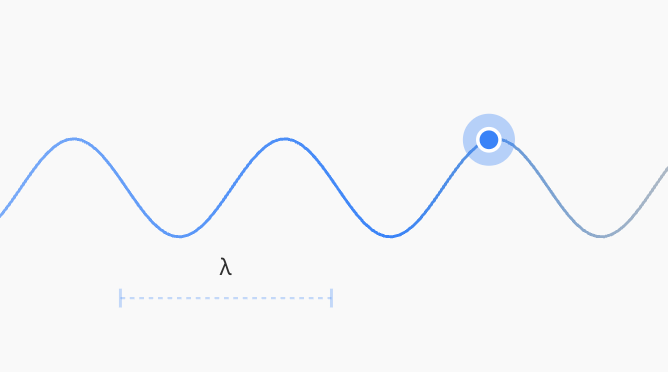
This equation connects wave speed, frequency, and wavelength. Since the allowed wavelengths on a string are fixed by the length of the string, changing the tension or mass of the string changes the frequencies that can be produced.
Musical instruments such as guitars, violins, pianos, and harps all rely on vibrating strings to produce sound. Musicians change pitch by adjusting string length, tension, or thickness. Pressing a guitar string against a fret shortens the vibrating length and increases the frequency. Tightening a tuning peg increases tension and raises the pitch. Thicker strings vibrate more slowly and produce deeper notes.
The harmonics produced by vibrating strings are also responsible for the unique sound quality, or timbre, of musical instruments. Although two instruments may play the same fundamental frequency, the relative strengths of their harmonics differ, giving each instrument its distinctive tone. Understanding vibrating strings and standing waves is therefore essential in both physics and music.