Cell Division and Reproduction
4. Meiosis
Learning outcomes
-
I can describe the purpose of meiosis.
- I can explain how meiosis produces gametes.
- I can compare chromosome numbers before and after meiosis.
- I can explain how meiosis contributes to genetic variation.
- I can describe the importance of meiosis in sexual reproduction.


What Is Meiosis?
Meiosis is a specialized type of cell division used to produce cells for:
sexual reproduction.
In animals, meiosis produces reproductive cells called:
gametes.
Examples of gametes include:
sperm cells
and:
egg cells.
The most important result of meiosis is that it reduces the chromosome number by:
half.
A diploid cell containing two sets of chromosomes produces haploid cells containing:
one set of chromosomes.
The Main Purpose of Meiosis
Meiosis has two major purposes:
1. Reduce chromosome number
Gametes must contain half the chromosome number of ordinary body cells.
2. Produce genetic variation
The gametes produced by meiosis are genetically different from one another.
Both are essential to:
sexual reproduction.
The Basic Pattern
Meiosis begins with:
one diploid cell.
DNA is copied once.
The cell then undergoes:
two divisions.
These are called:
Meiosis I
and:
Meiosis II.
The typical result is:
One diploid cell → four haploid cells
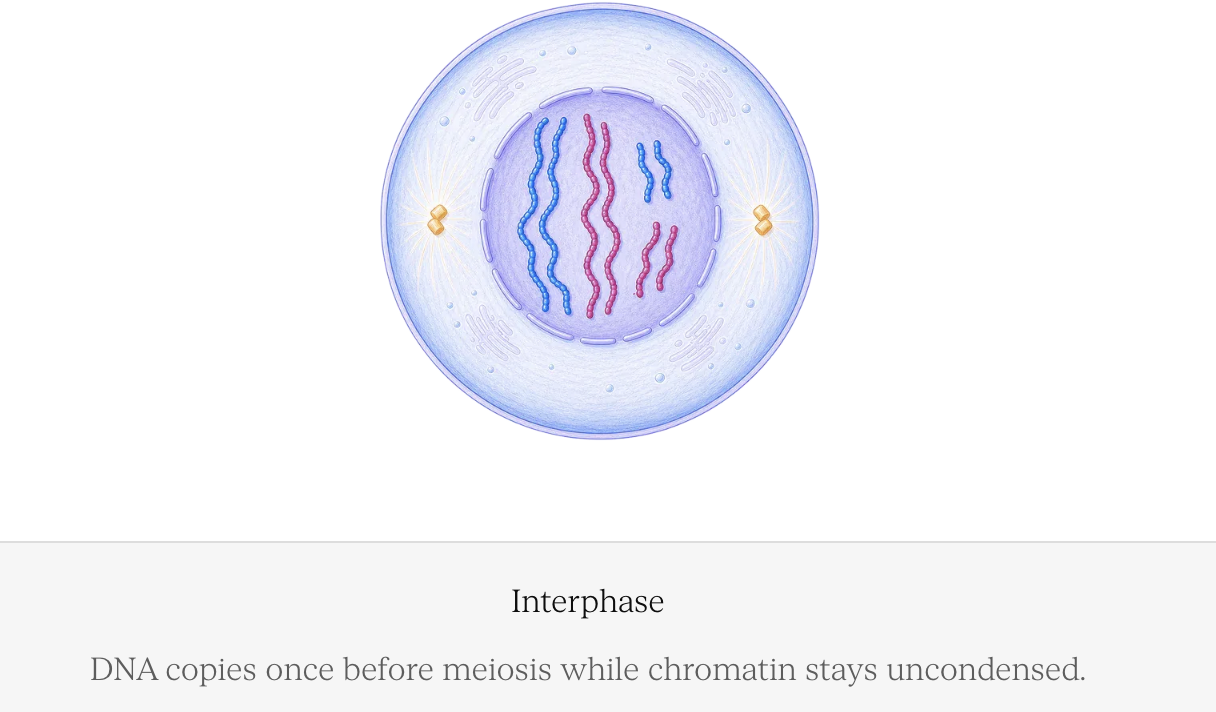
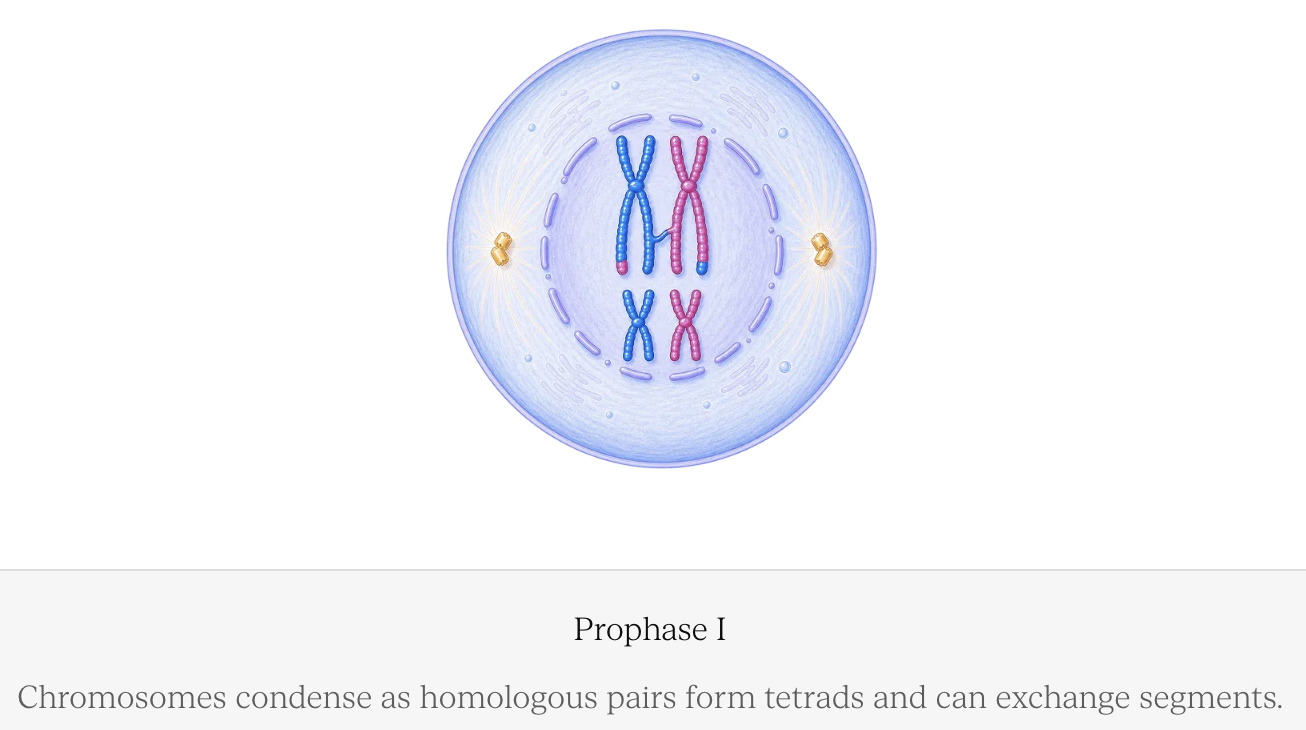
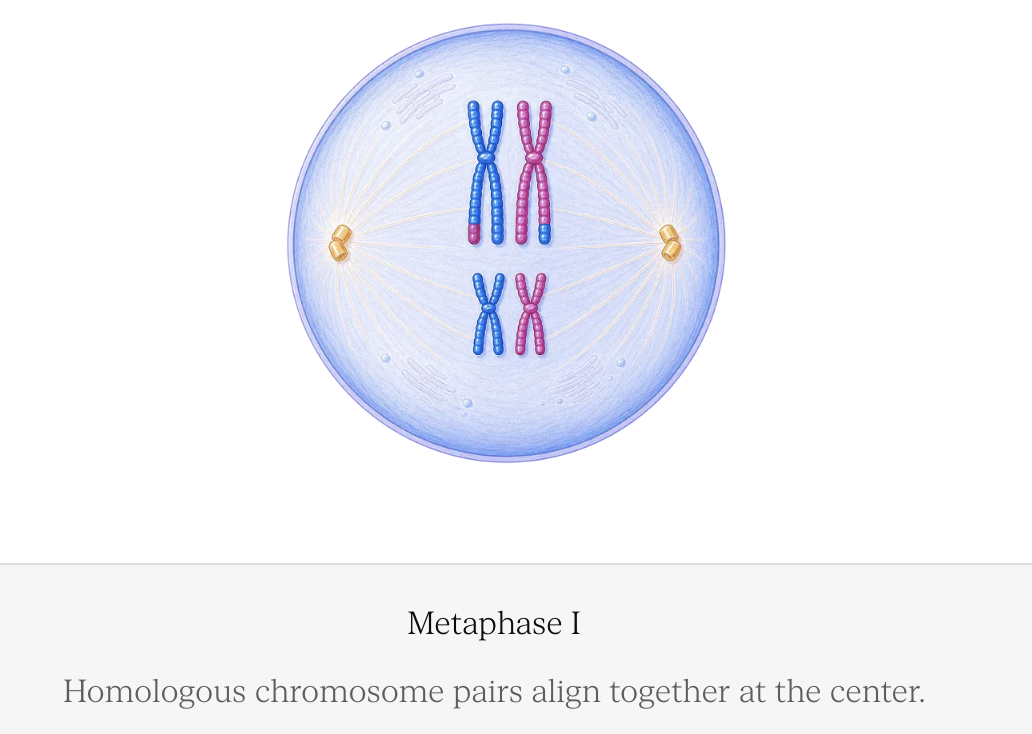
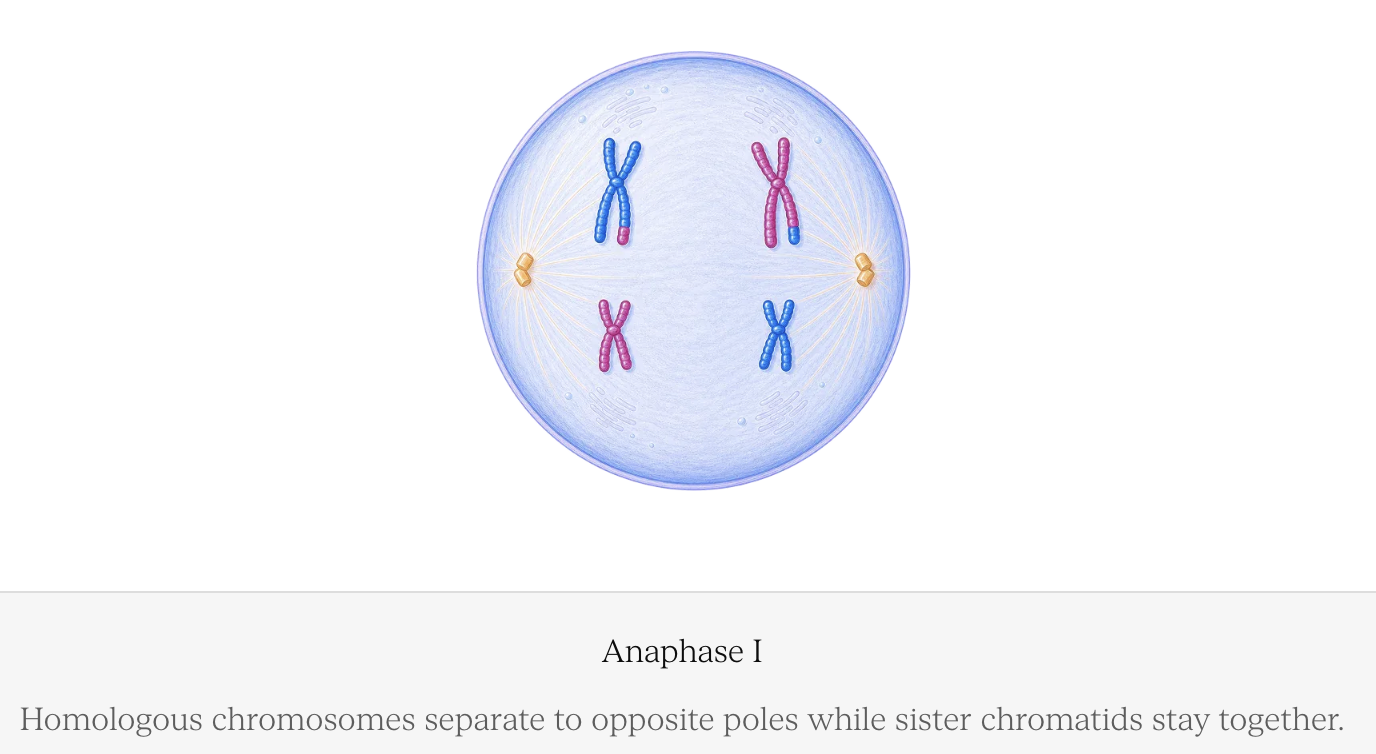
Here is an interactive visualization of the complete process:
Diploid and Haploid Cells
To understand meiosis, we need to understand:
diploid and haploid.
A diploid cell contains two sets of chromosomes.
We represent this as:
2n.
A haploid cell contains one set of chromosomes.
We represent this as:
n.
Therefore, meiosis changes:
2n → n
The chromosome number is:
halved.
Human Chromosome Numbers
Most human body cells contain:
46 chromosomes.
These chromosomes are arranged in:
23 pairs.
Therefore, human body cells are:
diploid.
We can write:
2n = 46
Human gametes contain:
23 chromosomes.
Therefore:
n = 23.
Before and After Meiosis
For humans:
Starting cell: 46 chromosomes
↓
Meiosis
↓
Gametes: 23 chromosomes each
The chromosome number has been reduced from:
46 to 23.
This reduction is essential for:
sexual reproduction.
Why Must Chromosome Number Be Halved?
During fertilization:
one sperm cell joins with one egg cell.
Each human gamete contains:
23 chromosomes.
Therefore:
23 + 23 = 46
The normal diploid chromosome number is:
restored.
What If Meiosis Did Not Halve Chromosome Number?
Imagine that sperm and egg cells each contained:
46 chromosomes.
During fertilization:
46 + 46 = 92
The offspring would have:
92 chromosomes.
If this continued, chromosome number would double with every:
generation.
Meiosis prevents this by producing:
haploid gametes.
Chromosome Pairs
Diploid cells contain chromosomes in:
homologous pairs.
A homologous pair contains chromosomes with the same types of genes at corresponding:
locations.
In humans, one chromosome of each homologous pair was originally inherited from the biological:
mother.
The other was inherited from the biological:
father.
The chromosomes are similar but are not necessarily genetically:
identical.
Homologous Chromosomes
Homologous chromosomes carry genes for the same general:
characteristics.
However, they may carry different versions of those genes.
Different versions of a gene are called:
alleles.
For example, one homologous chromosome might carry one allele while its partner carries:
another allele.
This becomes important when meiosis creates:
genetic variation.


DNA Is Replicated Before Meiosis
Before meiosis begins, the cell goes through:
interphase.
During the S phase of interphase, DNA is:
replicated.
Each chromosome is copied.
The duplicated chromosome consists of two:
sister chromatids.
The sister chromatids are joined at the:
centromere.
An Important Rule
DNA is replicated:
once.
The cell then divides:
twice.
This is a key feature of meiosis.
We can summarize it as:
One DNA replication → two cell divisions
The two divisions are:
Meiosis I and Meiosis II.
Meiosis I
The first division is called:
Meiosis I.
Its major purpose is to separate:
homologous chromosomes.
This is the division in which chromosome number is:
reduced.
A diploid cell becomes cells that have one chromosome from each homologous:
pair.
For this reason, Meiosis I is sometimes called the:
reduction division.
Prophase I
During Prophase I, chromosomes condense and homologous chromosomes pair:
together.
This pairing is an important difference between meiosis and:
mitosis.
Homologous chromosomes can exchange sections of DNA in a process called:
crossing over.
Crossing over creates new combinations of:
alleles.


Crossing Over
During crossing over, homologous chromosomes lie close together.
Sections of DNA can be exchanged between:
non-sister chromatids.
After the exchange, chromosomes contain combinations of genetic information that differ from those originally inherited from either:
parent.
This process is also called:
genetic recombination.
Why Crossing Over Matters
Imagine two homologous chromosomes carrying different:
alleles.
Before crossing over, each chromosome has its original combination of:
alleles.
After crossing over, sections have been exchanged.
This produces:
new combinations of alleles.
As a result, the gametes produced later can be genetically different from:
one another.
Metaphase I
During Metaphase I, homologous chromosome pairs line up near the:
middle of the cell.
The orientation of each pair is:
random.
For example, the chromosome originally inherited from the mother could face either:
side of the cell.
The same is true for the chromosome originally inherited from the father.
This random arrangement contributes to:
genetic variation.


Independent Assortment
The random orientation and separation of homologous chromosome pairs produces different combinations of chromosomes in:
gametes.
This is called:
independent assortment.
For humans, independent assortment alone can produce more than:
8 million possible chromosome combinations.
That is before considering:
crossing over.
Anaphase I
During Anaphase I, homologous chromosomes are pulled toward:
opposite poles of the cell.
Importantly:
sister chromatids remain together.
This is very different from mitosis.
In mitosis, sister chromatids separate during:
anaphase.
In Meiosis I, it is the:
homologous chromosomes
that separate.
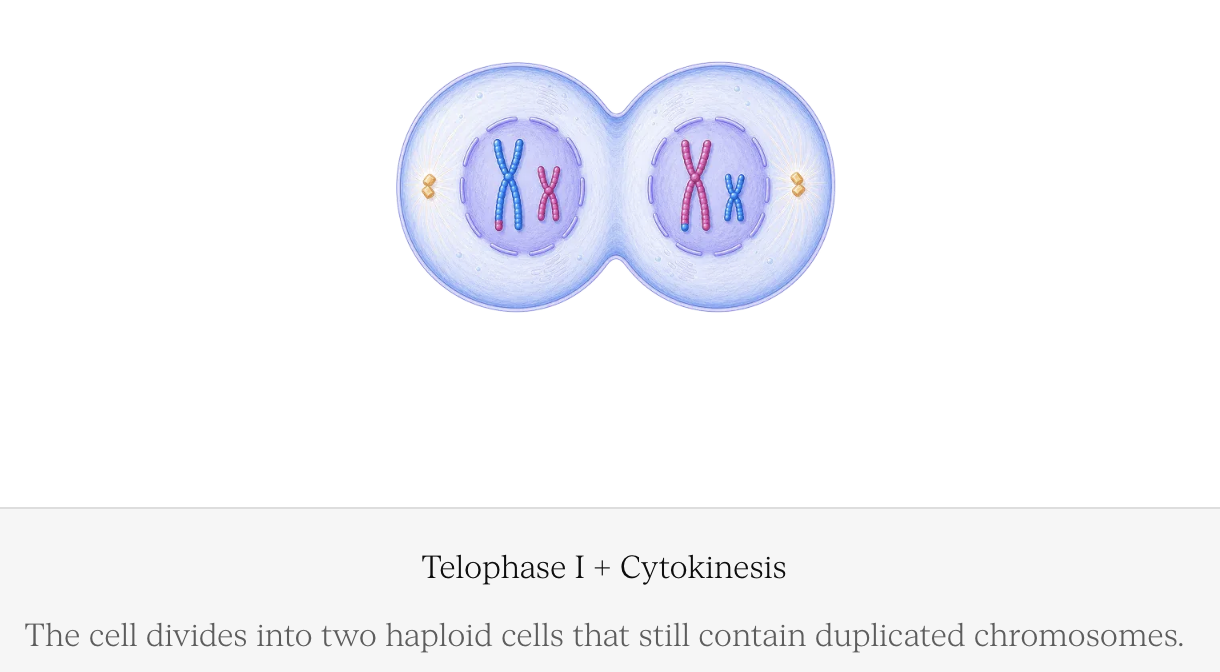
Telophase I and Cytokinesis
By the end of Meiosis I, the homologous chromosomes have been:
separated.
The cell usually divides through:
cytokinesis.
The result is:
two haploid cells.
However, each chromosome still consists of:
two sister chromatids.
Therefore, another division is required.
After Meiosis I
We now have:
two cells.
Each cell contains:
one chromosome from each homologous pair.
The cells are therefore:
haploid.
But the chromosomes are still:
duplicated.
This leads to:
Meiosis II.
Meiosis II
Meiosis II resembles:
mitosis.
Its main purpose is to separate:
sister chromatids.
Importantly, there is no second round of DNA replication between:
Meiosis I and Meiosis II.
The DNA has already been copied.
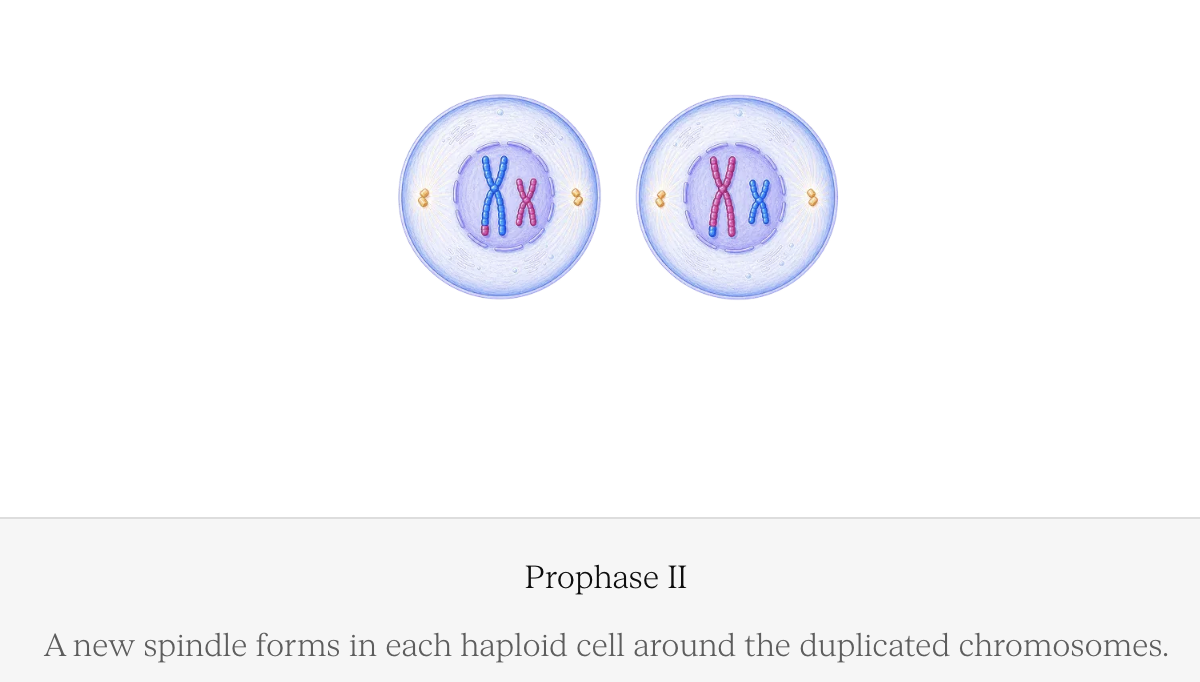
Prophase II
During Prophase II:
- chromosomes condense if necessary
- spindle structures form
- nuclear envelopes, if present, break down
Each cell contains a:
haploid chromosome set.
Each chromosome still consists of:
two sister chromatids.
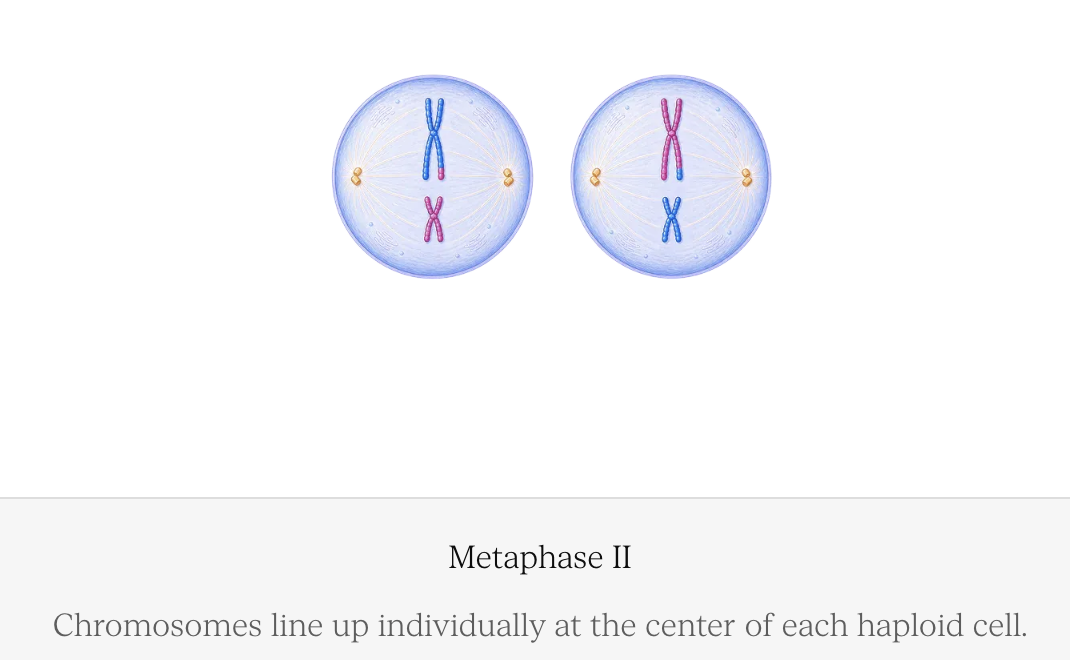
Metaphase II
During Metaphase II, chromosomes line up individually near the:
middle of each cell.
Unlike Metaphase I, homologous pairs are no longer lined up:
together.
The chromosomes are positioned so that sister chromatids can be separated during:
Anaphase II.


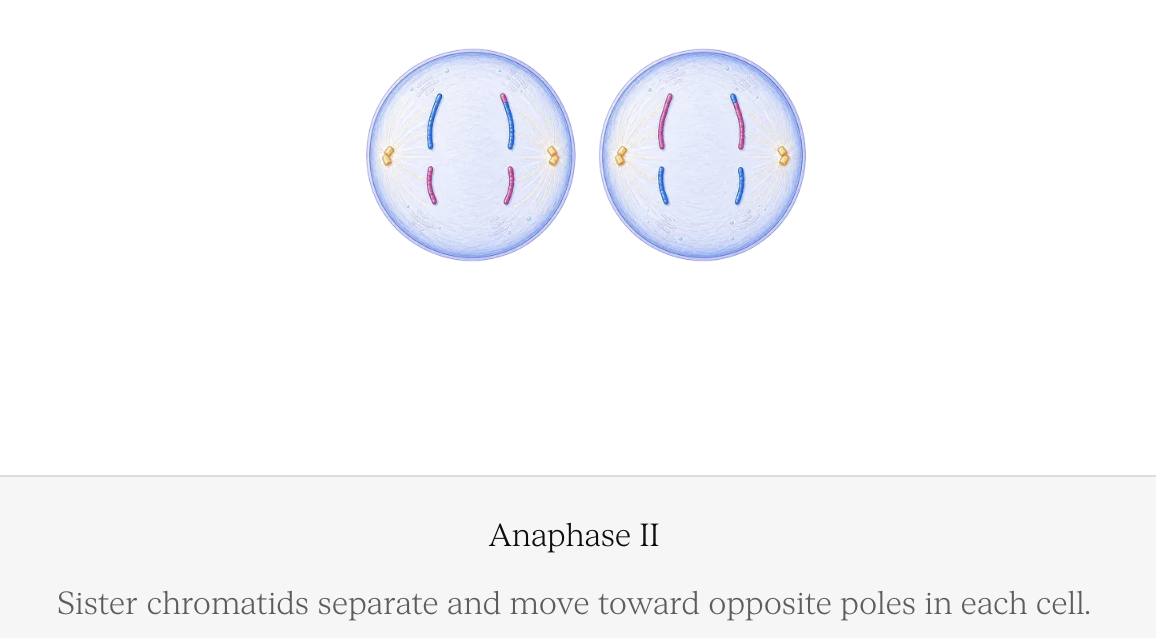
Anaphase II
During Anaphase II, sister chromatids:
separate.
They move toward opposite ends of:
each cell.
Once separated, each chromatid is considered an individual:
chromosome.
This is similar to what happens during:
anaphase of mitosis.
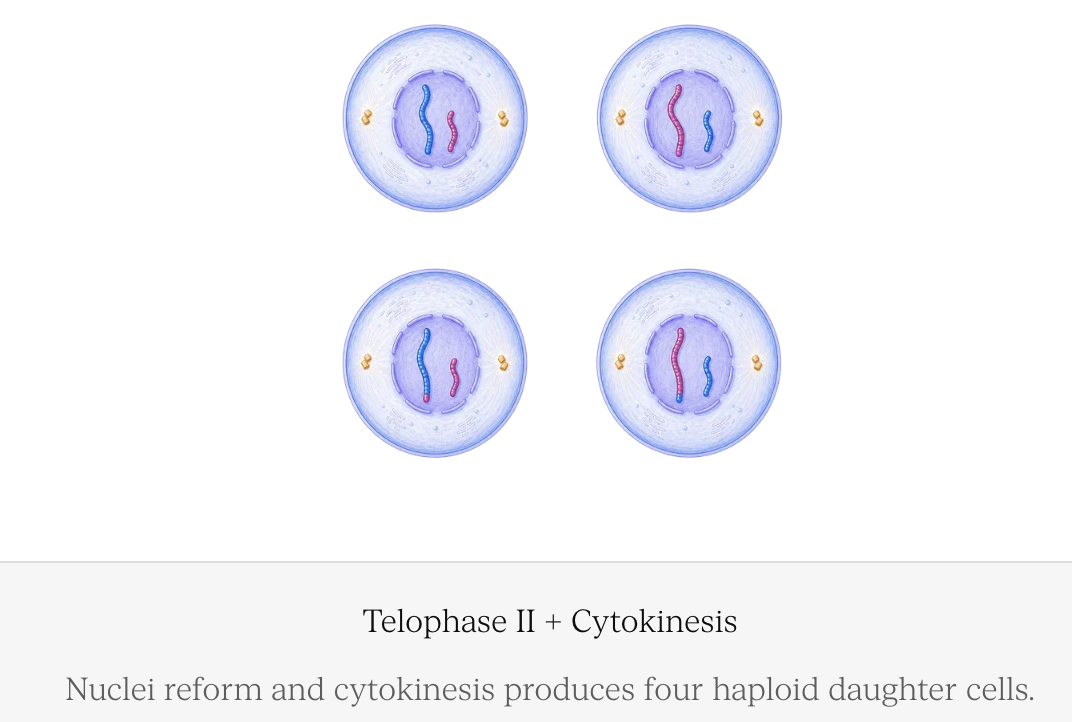
Telophase II and Cytokinesis
During Telophase II, chromosomes reach opposite ends of the cells.
New nuclei may form.
Cytokinesis then divides the:
cells.
The typical result is:
four haploid cells.
These cells are genetically:
different from one another.
The Complete Sequence
The overall process can be summarized as:
Diploid parent cell
↓
DNA replication
↓
Meiosis I
Homologous chromosomes separate
↓
Two haploid cells
↓
Meiosis II
Sister chromatids separate
↓
Four haploid cells
What Happens to Chromosome Number?
Suppose a species has:
2n = 8.
The starting cell contains:
8 chromosomes.
After meiosis, each resulting cell contains:
4 chromosomes.
Therefore:
2n = 8 → n = 4
The chromosome number has been:
halved.
Another Example
Suppose a species has:
30 chromosomes
in its body cells.
Its gametes should contain:
15 chromosomes.
Why?
Because:
30 ÷ 2 = 15
At fertilization:
15 + 15 = 30
The diploid chromosome number is:
restored.
Meiosis Produces Gametes
In animals, meiosis is used to produce:
gametes.
Male gametes are:
sperm cells.
Female gametes are:
egg cells.
These cells contain half the chromosome number of ordinary:
body cells.
Sperm Production
In males, meiosis occurs during:
sperm production.
A diploid germ cell eventually undergoes meiosis to produce haploid:
cells.
These cells develop into:
sperm.
Each sperm contains one set of:
chromosomes.
Egg Production
In females, meiosis contributes to the production of:
egg cells.
The process is somewhat different from sperm production.
Cell division is unequal, so typically only one large functional egg is produced from a meiotic sequence, while smaller cells called:
polar bodies
are also formed.
The functional egg is:
haploid.
Meiosis in Plants
Plants also use meiosis as part of:
sexual reproduction.
However, plant life cycles are somewhat more complex.
In flowering plants, meiosis produces haploid:
spores,
which then divide and develop into structures that ultimately produce the:
gametes.
Therefore, it is more accurate to say that meiosis produces gametes directly in animals but contributes to gamete production in plants.


How Meiosis Creates Genetic Variation
Meiosis does more than simply reduce chromosome number.
It also produces:
genetically different cells.
Two major processes are especially important:
crossing over
and:
independent assortment.
Together, they create many possible genetic combinations.
Source of Variation 1: Crossing Over
During Prophase I, homologous chromosomes can exchange:
DNA segments.
This creates chromosomes with new combinations of:
alleles.
Therefore, chromosomes passed into gametes may differ from the chromosomes originally inherited by the:
parent.
Source of Variation 2: Independent Assortment
During Metaphase I, homologous chromosome pairs arrange themselves:
randomly.
When the chromosomes separate, each cell receives a different combination of:
maternal and paternal chromosomes.
This produces additional:
genetic variation.
Meiosis Plus Random Fertilization
Meiosis produces many genetically different:
gametes.
Sexual reproduction creates even more variation because fertilization is also:
random.
Any one sperm may potentially combine with any one:
egg.
Therefore:
Meiosis creates varied gametes
and:
random fertilization combines them in new ways.
Why Genetic Variation Matters
Genetic variation means that individuals in a population have different combinations of:
alleles.
This variation is important because environments can:
change.
Individuals may differ in their ability to survive challenges such as:
- disease
- drought
- temperature change
- predators
- competition
- changing food supplies
Genetic variation provides the raw material upon which:
natural selection can act.
Meiosis and Sexual Reproduction
Meiosis and fertilization work together.
Meiosis:
halves chromosome number.
Fertilization:
restores chromosome number.
We can represent the cycle as:
Diploid adult (2n)
↓
Meiosis
↓
Haploid gametes
↓
Fertilization
↓
Diploid zygote (2n)
↓
Mitosis and development
↓
Diploid adult (2n)
This cycle keeps chromosome number stable from:
generation to generation.
Why Meiosis Is Essential
Without meiosis, sexual reproduction would create a major chromosome-number:
problem.
Gametes would contain the full diploid chromosome number.
Fertilization would then double chromosome number every:
generation.
Meiosis solves this problem by reducing chromosome number:
before fertilization.
Meiosis vs Mitosis
Mitosis and meiosis are both forms of cell division, but their purposes and outcomes are very:
different.
| Feature | Mitosis | Meiosis |
|---|---|---|
| Main purpose | Growth and repair | Sexual reproduction |
| DNA replication | Once | Once |
| Number of divisions | One | Two |
| Typical cells produced | Two | Four |
| Chromosome number | Maintained | Halved |
| Genetic similarity | Usually identical | Genetically different |
| Homologous pairing | No | Yes, in Prophase I |
| Crossing over | Normally no | Yes |
| Human starting number | 46 | 46 |
| Human final number | 46 | 23 |
Mitosis Maintains Chromosome Number
In mitosis:
2n → 2n + 2n
For humans:
46 → 46 + 46
Each daughter cell maintains the:
diploid chromosome number.
Meiosis Halves Chromosome Number
In meiosis:
2n → n + n + n + n
For humans:
46 → 23 + 23 + 23 + 23
The cells produced are:
haploid.
Mitosis Produces Similarity
Mitosis normally produces cells with essentially the same genetic information as the:
parent cell.
This is useful for:
growth and repair.
If you are replacing damaged skin cells, you generally want new skin cells containing the same genetic instructions as:
existing skin cells.
Meiosis Produces Variation
Meiosis deliberately reshuffles genetic information through:
crossing over and independent assortment.
The resulting cells are genetically:
different.
This is useful for sexual reproduction because it increases:
genetic diversity.
A Crucial Difference: Meiosis I
The biggest difference between mitosis and meiosis occurs during:
Meiosis I.
In Meiosis I:
homologous chromosomes pair and then separate.
In mitosis:
homologous chromosomes do not pair in this way.
Instead, sister chromatids are separated during the single:
division.
A Useful Comparison
Think of a diploid cell as having chromosome pairs:
A/a, B/b, C/c
Mitosis makes cells that retain:
A/a, B/b, C/c
Meiosis separates homologous chromosomes so each gamete receives only:
one member of each pair.
A gamete might receive:
A, b, C
while another might receive:
a, B, c.
Different combinations create:
variation.
Counting Chromosomes vs Chromatids
Chromosome counting during meiosis can sometimes be:
confusing.
After DNA replication, each chromosome consists of:
two chromatids.
However, it is still counted as:
one chromosome
as long as the sister chromatids remain connected at the centromere.
Therefore, DNA replication doubles the amount of DNA but does not immediately double the:
chromosome number.
Human Example
Before DNA replication:
46 chromosomes
After DNA replication:
46 duplicated chromosomes
and:
92 chromatids.
After Meiosis I:
each cell has:
23 duplicated chromosomes.
After Meiosis II:
each cell has:
23 unduplicated chromosomes.
This distinction is important when analyzing:
meiosis diagrams.
Errors During Meiosis
Meiosis is highly controlled, but errors can sometimes:
occur.
One example is:
nondisjunction.
Nondisjunction occurs when chromosomes fail to separate:
correctly.
This can produce gametes containing too many or too few:
chromosomes.
Nondisjunction
Nondisjunction can occur during:
Meiosis I
or:
Meiosis II.
If such a gamete participates in fertilization, the resulting zygote may have an abnormal:
chromosome number.
This demonstrates why accurate chromosome separation during meiosis is:
important.
Example: Down Syndrome
One well-known example involving chromosome number is:
Down syndrome.
Most cases result from the presence of an extra copy of:
chromosome 21.
This is called:
trisomy 21.
It usually results from a chromosome-separation error during the formation of a:
gamete.
Meiosis and Evolution
Meiosis contributes to genetic diversity within:
populations.
Because offspring inherit different combinations of alleles, individuals differ in their:
characteristics.
Natural selection can act on inherited variation.
Over many generations, this can contribute to:
evolutionary change.
Meiosis Does Not Create Needed Traits
Meiosis does not intentionally create traits that an organism:
needs.
Instead, meiosis creates:
genetic variation.
Environmental conditions then influence which inherited characteristics are associated with greater survival and:
reproductive success.
Variation occurs first.
Selection acts:
afterward.
Worked Example: Human Chromosome Number
A human germ cell begins meiosis with:
46 chromosomes.
How many chromosomes should each final cell contain?
Meiosis halves chromosome number.
Therefore:
46 ÷ 2 = 23
Each final haploid cell contains:
23 chromosomes.
Worked Example: Another Species
A species has:
2n = 24.
How many chromosomes will its gametes contain?
24 ÷ 2 = 12
Therefore:
n = 12.
At fertilization:
12 + 12 = 24.
Worked Example: Identifying Meiosis I
A diagram shows homologous chromosomes moving toward opposite poles while sister chromatids remain attached.
Which stage is occurring?
This happens during:
Anaphase I.
The key evidence is that:
homologous chromosomes are separating.
Worked Example: Identifying Meiosis II
A diagram shows sister chromatids separating in two haploid cells.
This occurs during:
Anaphase II.
Meiosis II separates:
sister chromatids.
Worked Example: Genetic Variation
Two gametes produced by the same individual contain different combinations of chromosomes.
What process helps explain this?
One important explanation is:
independent assortment.
If chromosomes also contain exchanged DNA sections, another explanation is:
crossing over.
Both occur as part of:
meiosis.
Why Four Cells?
Meiosis involves:
two divisions.
Starting with one cell:
After Meiosis I:
1 → 2 cells
After Meiosis II:
2 → 4 cells
Therefore, the typical final result is:
four haploid cells.
In egg formation, however, unequal division means only one usually develops into a large functional:
egg cell.
Common Mistake: Meiosis Is Used for Growth
Growth and tissue repair mainly use:
mitosis.
Meiosis is associated with:
sexual reproduction.
Its main role is producing haploid reproductive cells or cells that lead to:
gametes.
Common Mistake: Meiosis Produces Identical Cells
Meiosis normally produces genetically:
different cells.
Variation is generated through processes including:
crossing over and independent assortment.
Mitosis, by contrast, normally produces genetically:
similar daughter cells.
Common Mistake: DNA Is Copied Twice
Meiosis contains:
two divisions,
but DNA is normally replicated only:
once.
There is no complete round of DNA replication between:
Meiosis I and Meiosis II.
Common Mistake: Sister Chromatids Separate in Meiosis I
During Meiosis I:
homologous chromosomes separate.
During Meiosis II:
sister chromatids separate.
Remember:
Meiosis I → homologues
Meiosis II → sister chromatids
Common Mistake: Fertilization Is Part of Meiosis
Meiosis produces:
haploid reproductive cells.
Fertilization occurs afterward when two gametes:
fuse.
They are separate but closely connected parts of:
sexual reproduction.
Common Mistake: Meiosis Creates New Alleles
Meiosis mainly produces new:
combinations of alleles.
New alleles ultimately arise through:
mutation.
Crossing over and independent assortment reshuffle existing genetic:
variation.
Check Your Understanding
1. Define meiosis.
2. State the two major purposes of meiosis.
3. What type of cells does meiosis produce in animals?
4. Define diploid.
5. Define haploid.
6. What does 2n represent?
7. What does n represent?
8. How many chromosomes are found in most human body cells?
9. How many chromosomes are found in a human gamete?
10. Why must gametes contain half the normal chromosome number?
11. How many times is DNA replicated before meiosis?
12. How many cell divisions occur during meiosis?
13. What separates during Meiosis I?
14. What separates during Meiosis II?
15. What is a homologous chromosome pair?
16. What happens during Prophase I?
17. Define crossing over.
18. Explain how crossing over increases genetic variation.
19. What happens during Metaphase I?
20. Explain independent assortment.
21. How does independent assortment increase genetic variation?
22. How many cells are typically produced at the end of meiosis?
23. Are the cells produced by meiosis diploid or haploid?
24. A species has 36 chromosomes in its body cells. How many chromosomes should its gametes contain?
25. Compare chromosome number before and after meiosis.
26. Give three differences between mitosis and meiosis.
27. Explain how meiosis and fertilization work together to maintain chromosome number.
28. Why are gametes produced by meiosis genetically different?
29. What is nondisjunction?
30. Explain why meiosis is essential for sexual reproduction.
Key Terms
- Meiosis: Specialized cell division that reduces chromosome number and contributes to genetic variation.
- Gamete: Haploid reproductive cell.
- Diploid: Having two sets of chromosomes.
- Haploid: Having one set of chromosomes.
- Chromosome: DNA-containing structure carrying genes.
- Homologous chromosomes: Chromosome pair carrying the same types of genes at corresponding locations.
- Sister chromatids: Copies of a chromosome produced during DNA replication.
- Centromere: Chromosomal region joining sister chromatids.
- Meiosis I: First meiotic division in which homologous chromosomes separate.
- Meiosis II: Second meiotic division in which sister chromatids separate.
- Prophase I: Stage in which homologous chromosomes pair and crossing over can occur.
- Crossing over: Exchange of DNA between non-sister chromatids of homologous chromosomes.
- Genetic recombination: Production of new combinations of genetic material.
- Independent assortment: Random distribution of homologous chromosomes into cells during meiosis.
- Genetic variation: Genetic differences among individuals.
- Fertilization: Fusion of haploid gametes.
- Zygote: Diploid cell produced by fertilization.
- Nondisjunction: Failure of chromosomes to separate correctly during cell division.
- Trisomy: Presence of three copies of a particular chromosome.
- Mutation: Change in DNA that can produce new genetic variants.
Key Takeaways
- Meiosis is essential for sexual reproduction.
- Its two major purposes are to halve chromosome number and produce genetic variation.
- Meiosis begins with a diploid cell.
- DNA is replicated once before meiosis.
- Meiosis contains two cell divisions.
- Meiosis I separates homologous chromosomes.
- Meiosis II separates sister chromatids.
- One diploid cell typically produces four haploid cells.
- Diploid cells contain two chromosome sets and are represented as 2n.
- Haploid cells contain one chromosome set and are represented as n.
- In humans, most body cells contain 46 chromosomes.
- Human gametes contain 23 chromosomes.
- Meiosis reduces chromosome number from 46 to 23 in humans.
- Fertilization combines two haploid gametes and restores the diploid number.
- This prevents chromosome number from doubling every generation.
- Homologous chromosomes carry the same types of genes but may contain different alleles.
- Homologous chromosomes pair during Prophase I.
- Crossing over exchanges DNA between homologous chromosomes.
- Crossing over produces new combinations of alleles.
- Independent assortment creates different combinations of maternal and paternal chromosomes in gametes.
- Meiosis therefore produces genetically different reproductive cells.
- Random fertilization creates even more genetic variation.
- Genetic variation provides material for natural selection and evolution.
- Mitosis maintains chromosome number; meiosis halves it.
- Mitosis normally produces two genetically similar cells; meiosis typically produces four genetically different haploid cells.
- DNA is copied once even though meiosis involves two divisions.
- Chromosome number and DNA amount are not the same thing.
- Errors in chromosome separation during meiosis are called nondisjunction.
- Accurate meiosis is important for maintaining the correct chromosome number.
- In animals, meiosis directly produces cells that develop as gametes; in plants, meiosis produces spores that ultimately give rise to gametes.
- The central relationship is: diploid organism → meiosis → haploid reproductive cells → fertilization → diploid zygote.