Cell Division and Reproduction
3. Mitosis
Learning outcomes
-
I can describe the purpose of mitosis.
- I can identify the major stages of mitosis.
- I can explain how mitosis produces genetically identical cells.
- I can describe the role of mitosis in growth and repair.
- I can explain the importance of maintaining chromosome number during mitosis.


What Is Mitosis?
Mitosis is a type of nuclear division that produces two nuclei containing the same chromosome number and, normally, the same genetic information as the original nucleus.
It is essential for:
- growth
- repair of damaged tissues
- replacement of worn-out cells
- asexual reproduction in some organisms
Mitosis allows organisms to make new cells while maintaining their:
genetic information.
A simple summary is:
One parent cell → DNA copied → chromosomes separated → two genetically identical daughter cells
Why Do Cells Divide?
Multicellular organisms begin life as:
a single cell.
For example, a human begins as a fertilized egg called a:
zygote.
The zygote divides repeatedly.
One cell becomes:
2 → 4 → 8 → 16 → 32 → many more cells
Eventually, these cells form the tissues and organs of the:
body.
Mitosis makes this growth possible.
The Cell Cycle
Mitosis is actually one part of a larger process called the:
cell cycle.
The cell cycle includes:
Interphase → Mitosis → Cytokinesis
During interphase, the cell grows, carries out its normal functions, and prepares for division.
Most importantly, before mitosis begins:
the DNA is replicated.
This ensures that each new cell can receive a complete set of:
genetic information.
Important: DNA Replication Happens Before Mitosis
A common misconception is that DNA is copied during:
mitosis.
DNA replication actually occurs during the S phase of interphase, before mitosis begins.
Each chromosome is copied to form two identical:
sister chromatids.
The sister chromatids remain joined at a region called the:
centromere.


Chromosomes During Mitosis
DNA in a non-dividing cell is generally spread out as:
chromatin.
As the cell prepares to divide, the DNA becomes tightly coiled into visible:
chromosomes.
After DNA replication, each chromosome consists of:
two sister chromatids.
The sister chromatids contain essentially identical copies of the chromosome's:
DNA.
During mitosis, these chromatids are separated so that each new nucleus receives:
one copy.
The Major Stages of Mitosis
The major stages are:
Prophase
Metaphase
Anaphase
Telophase
These are commonly remembered as:
PMAT
After mitosis, cytokinesis divides the rest of the cell.
The complete sequence can therefore be represented as:
Interphase → Prophase → Metaphase → Anaphase → Telophase → Cytokinesis
Here is an interactive view of the process:
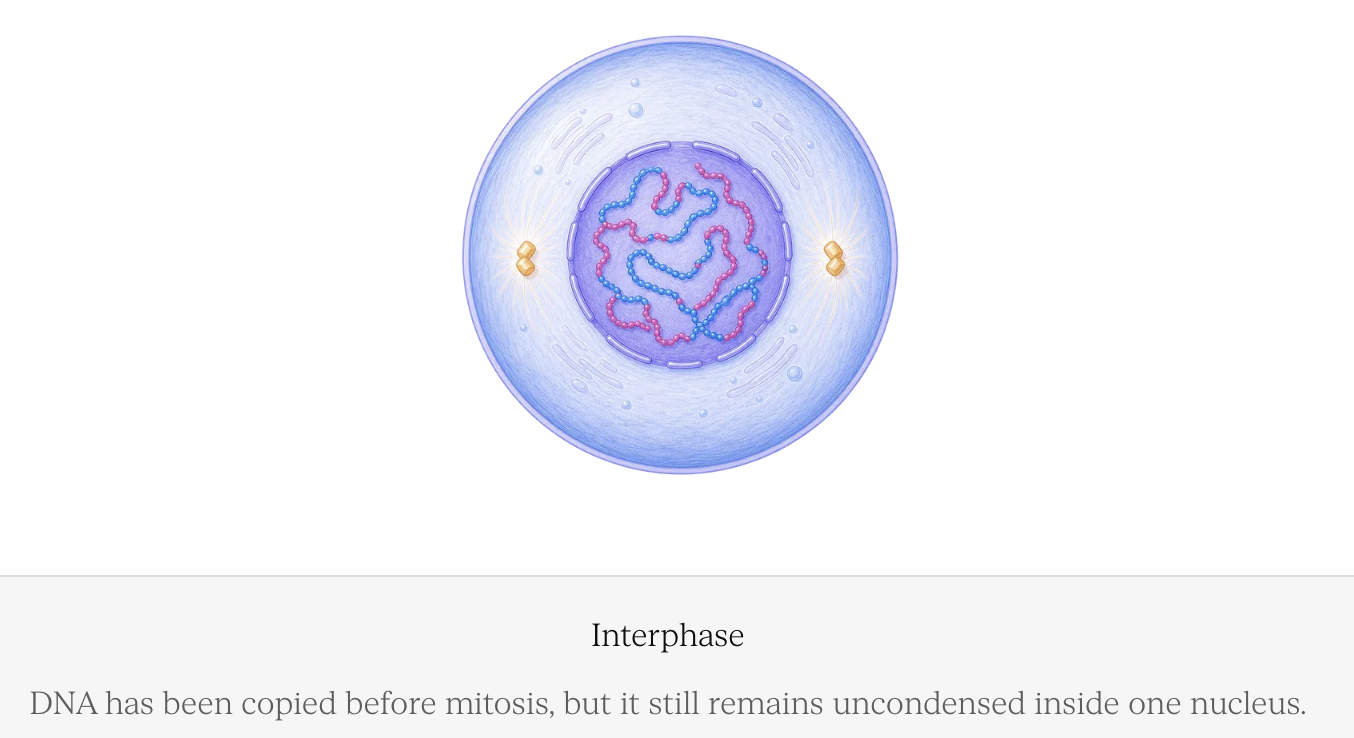
Interphase: Preparation
Interphase is not technically a stage of mitosis, but it is essential preparation for:
cell division.
During interphase:
- the cell grows
- normal cell activities occur
- organelles may be produced
- DNA is replicated
- the cell prepares for division
At the end of DNA replication, each chromosome has been:
copied.
The cell is now prepared to distribute the genetic material between:
two daughter cells.
Prophase
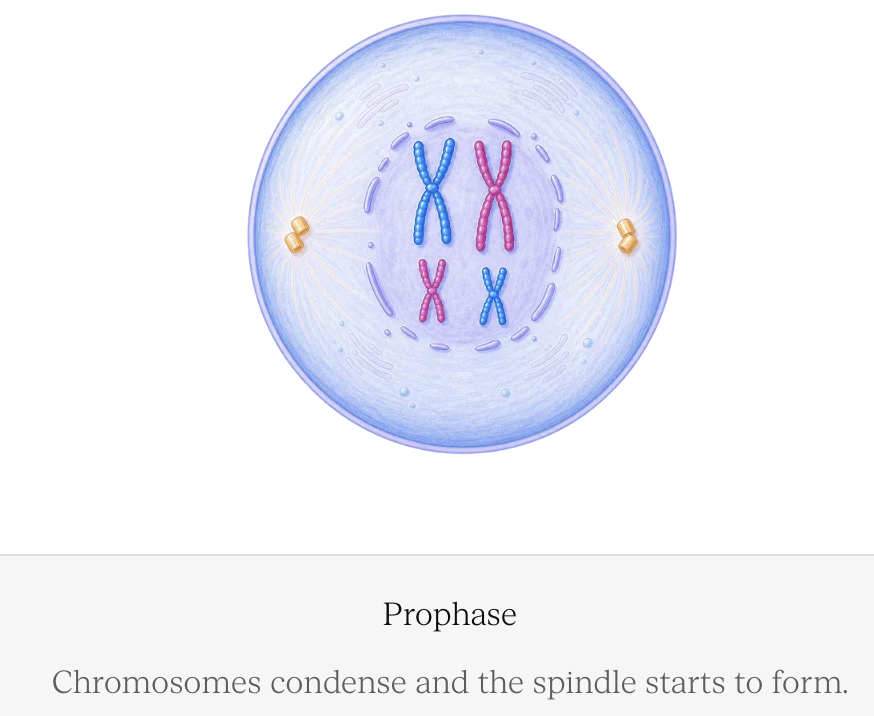
During prophase, the cell begins preparing the chromosomes for:
separation.
Several important changes occur:
- chromosomes condense and become visible
- each chromosome consists of two sister chromatids
- the nucleolus disappears
- the nuclear envelope breaks down
- spindle structures begin to form
The condensed chromosomes can now be moved more easily within the:
cell.


Why Do Chromosomes Condense?
A cell contains extremely long molecules of:
DNA.
If the DNA remained loosely arranged while the cell divided, it would be difficult to move and separate accurately.
Condensing the DNA into chromosomes helps the cell:
organize and move its genetic material.
Think of it like carefully packing long cables before:
moving them.
Metaphase
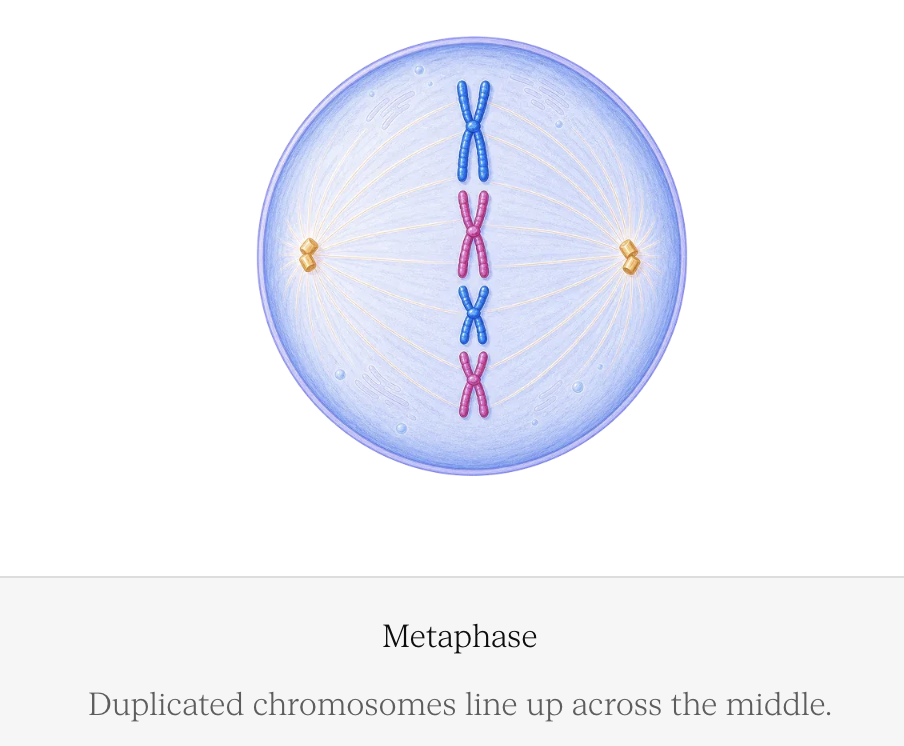
During metaphase, chromosomes move toward the:
middle of the cell.
They line up along an imaginary central region often called the:
metaphase plate.
Spindle fibres are attached to chromosome structures called:
kinetochores, located at the centromere region.
The arrangement helps ensure that sister chromatids can be separated to:
opposite sides of the cell.


Why Is Metaphase Important?
Imagine chromosomes were separated without first being correctly attached and:
organized.
One daughter cell might receive too many chromosomes while another might receive:
too few.
The metaphase arrangement and cell-cycle checkpoints help ensure chromosomes are properly connected to the spindle before:
separation occurs.
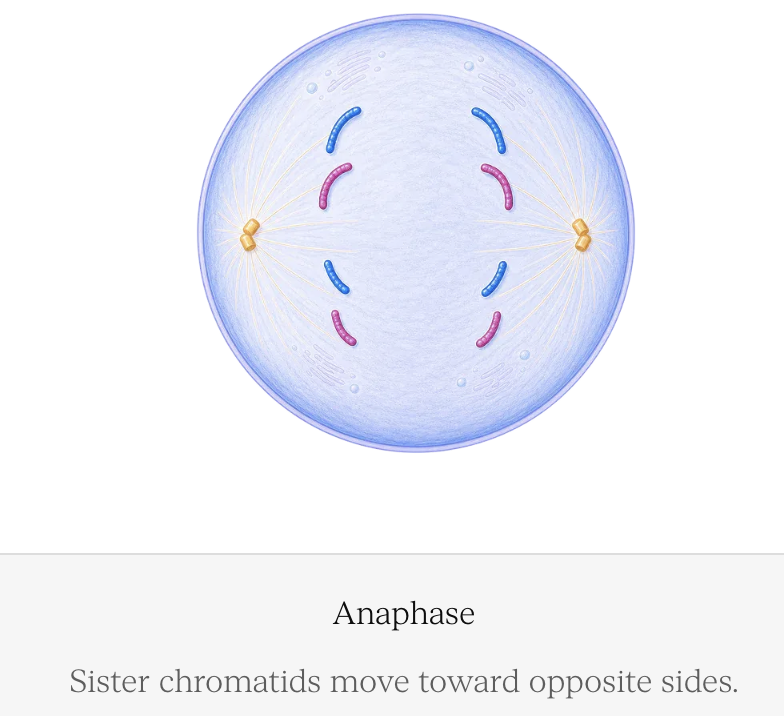
Anaphase
During anaphase, the sister chromatids:
separate.
The connection between the sister chromatids is released.
The separated chromatids are moved toward:
opposite poles of the cell.
Once separated, each chromatid is considered an individual:
chromosome.


Why Is Anaphase So Important?
Anaphase is the stage in which the copied genetic material is physically:
separated.
One complete set moves toward:
one side of the cell.
The other complete set moves toward:
the opposite side.
This is essential for producing two nuclei with the same:
chromosome number.
Telophase
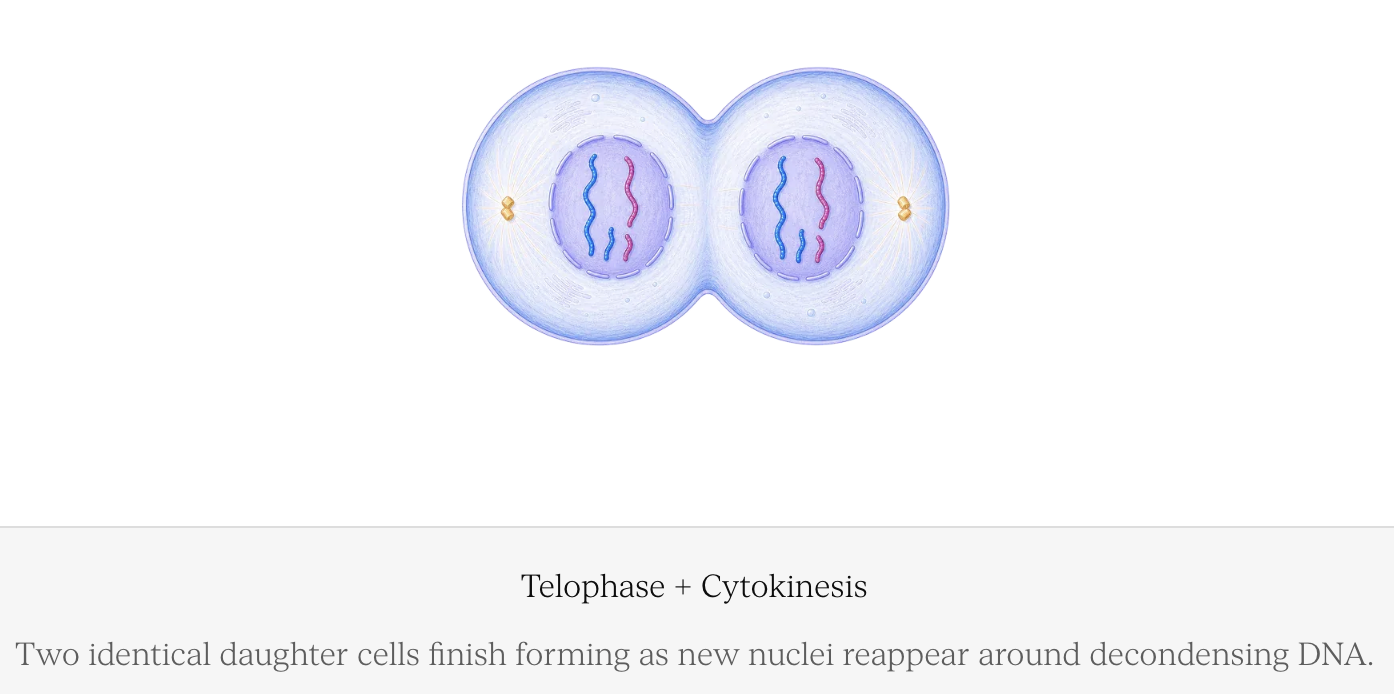
During telophase, the separated chromosomes have reached opposite ends of the:
cell.
Several changes occur:
- chromosomes begin to uncoil
- new nuclear envelopes form
- spindle structures disappear
- nucleoli reappear
- two nuclei are formed
The cell now contains:
two genetically equivalent nuclei.


Cytokinesis
After nuclear division, the cell itself usually divides through:
cytokinesis.
Cytokinesis divides the:
cytoplasm.
The result is:
two daughter cells.
Each daughter cell normally contains:
- one nucleus
- a complete chromosome set
- essentially the same genetic information
- the same chromosome number as the original parent cell
Cytokinesis in Animal Cells
In animal cells, the cell membrane begins to pinch inward.
This forms a:
cleavage furrow.
The membrane continues moving inward until the cytoplasm separates into:
two cells.


Cytokinesis in Plant Cells
Plant cells cannot simply pinch inward because they have a rigid:
cell wall.
Instead, a structure called a:
cell plate
forms between the two new nuclei.
The cell plate develops into new membranes and a new cell wall separating the:
daughter cells.


The Whole Process
The sequence can be summarized as:
Interphase
DNA is copied.
↓
Prophase
Chromosomes condense and the spindle forms.
↓
Metaphase
Chromosomes line up near the middle of the cell.
↓
Anaphase
Sister chromatids separate.
↓
Telophase
Two nuclei form.
↓
Cytokinesis
The cytoplasm divides.
↓
Two daughter cells
Remember PMAT
A useful memory aid for the stages of mitosis is:
P – Prophase
M – Metaphase
A – Anaphase
T – Telophase
One simple mnemonic is:
Please Make Another Two
The important thing is not only remembering the order, but understanding what happens to the:
chromosomes.
Following One Chromosome
Suppose a cell contains a particular chromosome.
Before DNA replication:
one chromosome
After DNA replication:
one duplicated chromosome consisting of two sister chromatids
During metaphase:
the duplicated chromosome lines up
During anaphase:
the sister chromatids separate
After mitosis:
each daughter nucleus receives one copy
This is how genetic information is distributed:
accurately.
Why Are Daughter Cells Genetically Identical?
Before mitosis, DNA is:
replicated.
Each chromosome produces an essentially identical:
copy.
During mitosis, the copies are carefully separated.
One copy goes into:
each daughter nucleus.
Therefore, under normal circumstances:
Parent cell → two genetically identical daughter cells
Are Daughter Cells Always Perfectly Identical?
Mitosis is designed to produce genetically identical:
daughter cells.
However, DNA replication is not absolutely perfect.
Occasionally, changes called:
mutations
can occur.
Therefore, cells produced by mitosis are normally genetically identical, but mutations can introduce:
differences.
Maintaining Chromosome Number
One of the most important features of mitosis is that chromosome number is:
maintained.
If a parent cell contains:
2n chromosomes
each daughter cell also contains:
2n chromosomes.
Mitosis can therefore be represented as:
2n → 2n + 2n
The daughter cells have the same chromosome number as the:
parent cell.
Human Example
Most human body cells contain:
46 chromosomes.
Before mitosis, the DNA is replicated.
The copied chromosomes are then separated.
The result is:
Parent cell: 46 chromosomes
↓
Mitosis
↓
Daughter cell 1: 46 chromosomes
Daughter cell 2: 46 chromosomes
The chromosome number remains:
46.
A Common Chromosome-Counting Problem
After DNA replication, a human cell still has:
46 chromosomes,
but each chromosome consists of two sister chromatids.
Therefore, it contains:
46 duplicated chromosomes
and:
92 chromatids.
After the chromatids separate and cell division is complete, each daughter cell contains:
46 chromosomes.
This distinction between chromosomes and chromatids is:
important.
Why Must Chromosome Number Be Maintained?
Body cells need a complete set of genetic instructions to function:
properly.
If chromosome number changed every time a cell divided, tissues would quickly contain cells with incorrect amounts of:
genetic information.
Mitosis ensures that new body cells normally receive the same chromosome number as:
existing body cells.
Mitosis and Growth
Growth in multicellular organisms occurs largely by increasing the:
number of cells.
A baby grows into an adult because cells repeatedly undergo:
mitosis.
The body does not simply make each original cell enormously larger.
Instead, it produces:
more cells.


Mitosis and Development
After fertilization, the zygote begins dividing through:
mitosis.
Repeated mitosis produces increasing numbers of:
cells.
These cells eventually become specialized through a process called:
differentiation.
Different cell types then form:
- tissues
- organs
- organ systems
Mitosis therefore plays a central role in:
development.
Mitosis and Repair
Body tissues can become damaged by:
- cuts
- burns
- physical injury
- normal wear
- environmental damage
Damaged or lost cells may need to be:
replaced.
Nearby cells can divide by mitosis to produce:
new cells.
This contributes to tissue:
repair and healing.


Example: Healing a Cut
Suppose you cut your skin.
Some cells near the wound are:
damaged or destroyed.
Cells surrounding the wound divide by:
mitosis.
The new cells help replace those that were:
lost.
Over time, the tissue closes and:
repairs itself.
Mitosis and Cell Replacement
Even when you are not injured, cells are constantly being:
lost and replaced.
For example, cells in the lining of the digestive system experience significant:
wear.
Skin cells are also continually:
shed.
Mitosis produces replacement cells that help maintain:
healthy tissues.
Different Cells Divide at Different Rates
Not every cell in the body divides at the:
same rate.
Some cells divide frequently.
Others divide rarely.
The rate depends on the tissue and its:
function.
For example, tissues exposed to frequent wear often require more regular:
cell replacement.
Mitosis and Asexual Reproduction
Mitosis can also contribute to:
asexual reproduction.
In many single-celled eukaryotes, cell division can produce a new:
organism.
Plants can also use mitosis during:
vegetative propagation.
For example, new strawberry plants growing from runners require repeated:
mitotic cell divisions.
Mitosis and Clones
Because mitosis produces genetically similar cells, asexual reproduction based on mitosis can produce:
clones.
A clone has essentially the same genetic information as the organism from which it:
originated.
This explains why vegetative propagation can preserve desirable plant:
characteristics.
Mitosis vs Meiosis
Mitosis and meiosis are both forms of:
cell division.
However, they serve very different purposes.
| Feature | Mitosis | Meiosis |
|---|---|---|
| Main purpose | Growth and repair | Gamete production |
| Number of divisions | One | Two |
| Daughter cells | Two | Usually four |
| Chromosome number | Maintained | Halved |
| Genetic similarity | Usually identical | Genetically varied |
| Human example | 46 → 46 | 46 → 23 |
Mitosis maintains chromosome number.
Meiosis:
reduces chromosome number.
Why Mitosis and Meiosis Must Be Different
Body cells need the normal:
diploid chromosome number.
Therefore, mitosis maintains:
2n → 2n.
Gametes need half the normal chromosome number so that fertilization does not double chromosome number every:
generation.
Therefore, meiosis produces:
2n → n.
The two processes have different biological:
purposes.
Cell-Cycle Control
Cells do not normally divide whenever they:
want.
The cell cycle contains regulatory systems called:
checkpoints.
These help determine whether the cell is ready to proceed through:
division.
For example, cells can check whether DNA has been correctly replicated and whether chromosomes are properly attached to the spindle.
This regulation helps maintain:
genetic stability.
What Happens When Cell Division Is Not Controlled?
If mutations affect genes that regulate the cell cycle, cells may begin dividing:
uncontrollably.
A mass of abnormal cells may form a:
tumour.
Some tumours remain localized, while others may become:
cancerous.
Cancer therefore involves problems with the normal control of:
cell division.


Mitosis Under a Microscope
Scientists can observe mitosis particularly clearly in tissues where cells divide:
rapidly.
A common example is an:
onion root tip.
Root tips contain regions of actively dividing cells because roots are:
growing.
Different cells in a microscope image may therefore show different stages of:
mitosis.


Identifying Mitosis from Images
When looking at microscope images, focus on the position and appearance of the:
chromosomes.
Prophase: chromosomes become condensed and visible.
Metaphase: chromosomes are lined up near the centre.
Anaphase: chromatids are separating toward opposite sides.
Telophase: two groups of chromosomes are at opposite ends and new nuclei are forming.
Recognizing these patterns is more useful than simply memorizing:
stage names.
Worked Example: Identifying a Stage
A cell has chromosomes arranged across the middle of the cell.
Which stage is it?
Chromosomes align near the centre during:
metaphase.
Therefore, the cell is in:
metaphase.
Worked Example: Identifying Anaphase
A microscope image shows two groups of chromosomes moving away from one another toward opposite ends of the cell.
This indicates:
anaphase.
The key evidence is that the:
sister chromatids have separated.
Worked Example: Chromosome Number
A species has:
18 chromosomes
in each body cell.
A body cell divides through mitosis.
How many chromosomes will each daughter cell contain?
Mitosis maintains chromosome number.
Therefore:
Parent cell = 18 chromosomes
Daughter cell 1 = 18 chromosomes
Daughter cell 2 = 18 chromosomes
Worked Example: Growth
A single cell divides through mitosis.
After one division:
2 cells
After two rounds:
4 cells
After three rounds:
8 cells
After four rounds:
16 cells
If every cell continues dividing, cell number can increase:
rapidly.
This demonstrates how repeated mitosis contributes to:
growth.
Mitosis in Everyday Life
Mitosis is occurring throughout your body as you:
live and grow.
It contributes to:
- growth during childhood
- replacement of skin cells
- renewal of some blood-forming cells
- maintenance of the digestive lining
- healing of wounds
- growth of hair-producing tissues
Without mitosis, multicellular organisms could not effectively:
grow, maintain, or repair their bodies.
Common Mistake: Mitosis Produces Four Cells
Mitosis normally produces:
two daughter cells.
Meiosis typically produces:
four haploid cells.
Remember:
Mitosis → 2
Meiosis → usually 4
Common Mistake: Mitosis Halves Chromosome Number
Mitosis does:
not halve chromosome number.
If the parent cell contains:
2n
the daughter cells normally contain:
2n.
Meiosis is the process that reduces chromosome number from:
2n to n.
Common Mistake: DNA Is Copied During Mitosis
DNA replication occurs:
before mitosis,
during the S phase of:
interphase.
Mitosis then separates the copied chromosomes between:
two nuclei.
Common Mistake: Interphase Is a Stage of Mitosis
Interphase is part of the:
cell cycle.
It occurs before mitosis.
The major stages of mitosis itself are:
prophase, metaphase, anaphase, and telophase.
Common Mistake: Cytokinesis and Mitosis Are Exactly the Same
Mitosis refers specifically to division of the:
nucleus.
Cytokinesis refers to division of the:
cytoplasm and cell.
The two processes usually occur closely together, but they are:
not identical.
Check Your Understanding
1. Define mitosis.
2. State four important purposes of mitosis.
3. Name the four major stages of mitosis in order.
4. What happens during interphase before mitosis?
5. When is DNA replicated?
6. What are sister chromatids?
7. What connects sister chromatids?
8. Describe what happens during prophase.
9. Why do chromosomes condense during prophase?
10. Describe what happens during metaphase.
11. Why is chromosome alignment important?
12. Describe what happens during anaphase.
13. What happens to sister chromatids during anaphase?
14. Describe what happens during telophase.
15. What is cytokinesis?
16. How does cytokinesis differ between animal and plant cells?
17. Explain why daughter cells produced by mitosis are normally genetically identical.
18. Explain why DNA must be replicated before mitosis.
19. A human body cell contains 46 chromosomes. How many chromosomes will each daughter cell normally contain?
20. A plant cell contains 24 chromosomes. How many chromosomes will each daughter cell contain after mitosis?
21. Explain how mitosis contributes to growth.
22. Explain how mitosis contributes to tissue repair.
23. Give two examples of tissues that require regular cell replacement.
24. Explain how mitosis can contribute to asexual reproduction.
25. Why is maintaining chromosome number important?
26. Compare chromosome number in mitosis and meiosis.
27. Explain the difference between mitosis and cytokinesis.
28. Why are onion root tips useful for observing mitosis?
29. What can happen when control of cell division is disrupted?
30. Explain why mitosis is essential for multicellular organisms.
Key Terms
- Mitosis: Nuclear division producing two genetically equivalent nuclei with the same chromosome number as the original nucleus.
- Cell cycle: Sequence of growth, DNA replication and cell division experienced by a cell.
- Interphase: Period when a cell grows, performs normal functions and replicates its DNA before division.
- DNA replication: Process of copying DNA.
- Chromosome: DNA-containing structure carrying genetic information.
- Chromatin: Less-condensed form of DNA and associated proteins in the nucleus.
- Sister chromatids: Essentially identical copies of a chromosome produced during DNA replication.
- Centromere: Chromosomal region joining sister chromatids and associated with kinetochore formation.
- Spindle: Cellular structure involved in moving chromosomes during cell division.
- Prophase: Stage when chromosomes condense and the mitotic spindle begins forming.
- Metaphase: Stage when chromosomes align near the middle of the cell.
- Anaphase: Stage when sister chromatids separate and move toward opposite poles.
- Telophase: Stage when new nuclei form around the separated chromosome sets.
- Cytokinesis: Division of the cytoplasm into daughter cells.
- Cleavage furrow: Indentation that forms as an animal cell undergoes cytokinesis.
- Cell plate: Structure that develops between daughter cells during plant cytokinesis.
- Daughter cell: Cell produced by cell division.
- Diploid: Having two sets of chromosomes.
- Mutation: Change in DNA sequence.
- Differentiation: Process through which cells become specialized.
- Cell-cycle checkpoint: Regulatory mechanism controlling progression through the cell cycle.
- Tumour: Abnormal mass of cells resulting from excessive cell division.
Key Takeaways
- Mitosis produces two genetically equivalent daughter nuclei.
- Mitosis is important for growth, repair, replacement, and some forms of asexual reproduction.
- DNA is replicated before mitosis during interphase.
- A replicated chromosome contains two sister chromatids.
- The major stages of mitosis are prophase, metaphase, anaphase, and telophase.
- PMAT is a useful way to remember their order.
- During prophase, chromosomes condense and the spindle develops.
- During metaphase, chromosomes align near the middle of the cell.
- During anaphase, sister chromatids separate.
- During telophase, new nuclei form.
- Cytokinesis divides the cytoplasm and usually produces two separate cells.
- Animal cells form a cleavage furrow during cytokinesis.
- Plant cells form a cell plate.
- Mitosis maintains the chromosome number.
- A diploid parent cell normally produces diploid daughter cells.
- A human body cell with 46 chromosomes normally produces daughter cells that each have 46 chromosomes.
- Daughter cells are normally genetically identical because DNA is copied and the copies are carefully separated.
- Mutations can occasionally introduce genetic differences.
- Repeated mitosis increases cell number and allows organisms to grow.
- Mitosis replaces damaged and worn-out cells.
- Mitosis contributes to wound healing and tissue maintenance.
- Mitosis can support asexual reproduction and the production of clones.
- Mitosis and meiosis are different: mitosis maintains chromosome number, while meiosis halves it.
- Interphase is part of the cell cycle but is not a stage of mitosis.
- Mitosis divides the nucleus; cytokinesis divides the cytoplasm.
- Proper control of mitosis is essential because uncontrolled cell division can contribute to tumour formation and cancer.
- Accurate chromosome separation allows new cells to receive a complete set of genetic instructions.