Simple Harmonic Motion

5. Energy in Oscillatory Systems

Learning Outcomes
  • I can explain how energy changes during SHM.
  • I can identify positions of maximum kinetic and potential energy.
  • I can describe conservation of mechanical energy in oscillating systems.
  • I can calculate energy in spring and pendulum systems.
  • I can analyze energy transformations occurring during oscillations.

Energy in Oscillatory Systems

An oscillating system continually transfers energy between different energy stores. In an ideal system, the total mechanical energy remains constant even though the amount stored as kinetic or potential energy changes throughout each oscillation.

Two important examples are:

  • A mass attached to a spring
  • A simple pendulum

Understanding these energy transfers helps explain why oscillating objects speed up, slow down, stop momentarily, and reverse direction.

https://images.openai.com/static-rsc-4/ACPe6Ri5pUOxjoAunbpbfCR4jBOy7a7Q57r65uzLef9kTpcXZ15izQY4AUP7qzg4te2wmKS_Y0ynIZg8EJ3LTBHdFiOKPG_EvmBcQHD7CmF_BwmSXxPxIGDsm3MWNz5AubK0mm2kDM5D49LpTkh9MMGSUsln6FsoLxiVvpooAnpRdwzVWotXmkQRiS6ZCxsU?purpose=fullsize
https://images.openai.com/static-rsc-4/xTjVy9wzmhZZNiF7_TwwdwD6swK8R6KToQc1pcj2IWxdck34hGl_fRKwGIlZuRal-P-NnfrB_7pe5HHVyGV71KTSqOtOi4zXVFaLuAo1mXSHDdI1nHitUazZjogOVjlG7eiBfNfH02Bn7jWEiBGnCllozS3sZZyv_hH6isFqx9PBmWMEBWB7JZJ585cS7Ot3?purpose=fullsize
https://images.openai.com/static-rsc-4/a_Es1YSzXGFyMjaqLPn2snA2CWqSU4VGedfPrjIbhYYQvQDvh0a-WOrGkUtMurVU68ge8x-2rGdZx6wgEbbQcg9Tny1Gd3jcXGS-72IT2g0ktcKIK1A-eEsm_vbo2j_Re2earplPTijpM0NC7if7eOKa1NyiGAONOYF1DqqRNp2qFH9mjBHP7OPYW93GCkPc?purpose=fullsize
6

Mechanical Energy in Oscillations

The mechanical energy of an oscillating system is the combination of its kinetic and potential energy.

During ideal oscillation, energy continuously transfers between these stores.
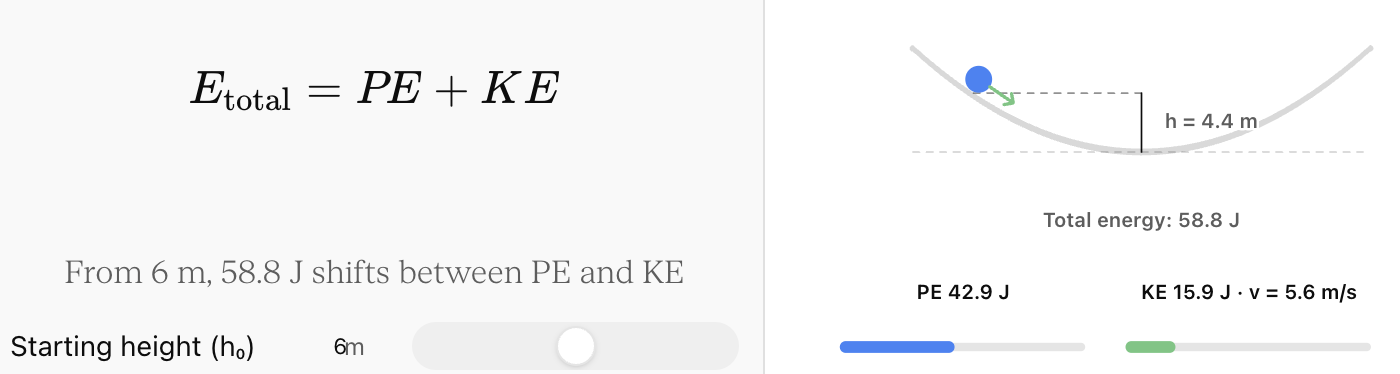
The important idea is:

Potential energy decreases → Kinetic energy increases

and later:

Kinetic energy decreases → Potential energy increases

In an ideal system, no mechanical energy is lost.


Energy and Position

Consider a mass oscillating horizontally on a spring.

There are three particularly important positions:

  • Maximum extension
  • Equilibrium
  • Maximum compression
https://images.openai.com/static-rsc-4/a_Es1YSzXGFyMjaqLPn2snA2CWqSU4VGedfPrjIbhYYQvQDvh0a-WOrGkUtMurVU68ge8x-2rGdZx6wgEbbQcg9Tny1Gd3jcXGS-72IT2g0ktcKIK1A-eEsm_vbo2j_Re2earplPTijpM0NC7if7eOKa1NyiGAONOYF1DqqRNp2qFH9mjBHP7OPYW93GCkPc?purpose=fullsize
https://images.openai.com/static-rsc-4/AFrYETXRGhcoZBhdFgVc-jwnt9DjtucoDWk0-zUnnOpKRmldjinbMKA4yOSA8-k0V5X0jP8W-mgOi2k_eb_Kt2dUgUAGuiqtSA1WDDuaFNQuz9mAETx2EjsfshsAUI5XJKJ3aaD-jpowLYpEFpsX_BO3ZNrcnh9O14sSS573slaEjV6bbUi3rPNSHXF7DPFd?purpose=fullsize
https://images.openai.com/static-rsc-4/m-rAtF9WiMNNInl2q1PGdkVG4DHIDcCiEYL02749O2qii590pJse_2E2mzmNwNtSfnIuFhRmPRWWJrDsUBBVC6XGpif7Uw9-hoUSvN_wkwcK5cSjHxu0H7Ogb8ThQTfZkXCSv0LvY6P6CmzDR9FVuc13QuXDMvYnyAERh_EB3_20iGJeLc140jRxH5vCTu6C?purpose=fullsize
5

The energy distribution is different at each position.


Maximum Extension

At maximum extension:

x = +A

where A is the amplitude.

The mass momentarily stops before changing direction.

Therefore:

v = 0

and:

Kinetic energy = 0

The spring is stretched by its maximum amount.

Therefore:

Elastic potential energy = maximum


Moving Toward Equilibrium

As the spring pulls the mass toward equilibrium:

  • Displacement decreases.
  • Elastic potential energy decreases.
  • Speed increases.
  • Kinetic energy increases.

Energy is transferred from the spring's elastic potential energy store to the mass's kinetic energy store.


At Equilibrium

At equilibrium:

x = 0

The spring is at its equilibrium position.

The mass has its greatest speed.

Therefore:

Kinetic energy = maximum

and, for a horizontal spring measured relative to equilibrium:

Elastic potential energy = minimum

https://images.openai.com/static-rsc-4/a_Es1YSzXGFyMjaqLPn2snA2CWqSU4VGedfPrjIbhYYQvQDvh0a-WOrGkUtMurVU68ge8x-2rGdZx6wgEbbQcg9Tny1Gd3jcXGS-72IT2g0ktcKIK1A-eEsm_vbo2j_Re2earplPTijpM0NC7if7eOKa1NyiGAONOYF1DqqRNp2qFH9mjBHP7OPYW93GCkPc?purpose=fullsize
https://images.openai.com/static-rsc-4/m-rAtF9WiMNNInl2q1PGdkVG4DHIDcCiEYL02749O2qii590pJse_2E2mzmNwNtSfnIuFhRmPRWWJrDsUBBVC6XGpif7Uw9-hoUSvN_wkwcK5cSjHxu0H7Ogb8ThQTfZkXCSv0LvY6P6CmzDR9FVuc13QuXDMvYnyAERh_EB3_20iGJeLc140jRxH5vCTu6C?purpose=fullsize
https://images.openai.com/static-rsc-4/SIEMH519Eost5XkB99869yUGsps-Iq43oTV4DCg2cTEl1Lb6ogzpOysrO8sJxHaaogavJH7G9nVPHMtuX5h4Q1sUZZatVO50akAnicDvljNO40j8uNbahcNfivI502r7r36JOBVyej_BjCUIlUPw1Hrpgy-dSK19JoFO87SYbSgv8d6VILLkKGc2-Ra3gFT7?purpose=fullsize

The mass does not stop at equilibrium because it has kinetic energy.

It continues past equilibrium and begins compressing the spring.


Maximum Compression

As the spring compresses:

  • Speed decreases.
  • Kinetic energy decreases.
  • Elastic potential energy increases.

At maximum compression:

x = −A

and:

v = 0

Therefore:

Kinetic energy = 0

and:

Elastic potential energy = maximum

The mass then reverses direction and the process repeats.


Energy During One Complete Oscillation

Starting at maximum extension:

Maximum extension

Elastic PE = maximum
KE = 0

↓

Moving toward equilibrium

Elastic PE decreases
KE increases

↓

Equilibrium

Elastic PE = minimum
KE = maximum

↓

Moving toward maximum compression

Elastic PE increases
KE decreases

↓

Maximum compression

Elastic PE = maximum
KE = 0

The process then occurs in reverse.

https://images.openai.com/static-rsc-4/rArYf1AAColGj7nW86GSM4qyokEKyd8W8bUW2xAv-naFqxLC4_bJ1Wd7mzFYKTXTRT2llKuG_6ae55mdb8QshWc3n9onLIIsMO7z9sR-GL0c09F2dfasGndByX48x6BIJEsmYson7rZ8H3hcKavazZU8OHEbWE24kJfRkq51OI0HjfELmdJfUP-Bzvmi0VON?purpose=fullsize
https://images.openai.com/static-rsc-4/a_Es1YSzXGFyMjaqLPn2snA2CWqSU4VGedfPrjIbhYYQvQDvh0a-WOrGkUtMurVU68ge8x-2rGdZx6wgEbbQcg9Tny1Gd3jcXGS-72IT2g0ktcKIK1A-eEsm_vbo2j_Re2earplPTijpM0NC7if7eOKa1NyiGAONOYF1DqqRNp2qFH9mjBHP7OPYW93GCkPc?purpose=fullsize
https://images.openai.com/static-rsc-4/m-rAtF9WiMNNInl2q1PGdkVG4DHIDcCiEYL02749O2qii590pJse_2E2mzmNwNtSfnIuFhRmPRWWJrDsUBBVC6XGpif7Uw9-hoUSvN_wkwcK5cSjHxu0H7Ogb8ThQTfZkXCSv0LvY6P6CmzDR9FVuc13QuXDMvYnyAERh_EB3_20iGJeLc140jRxH5vCTu6C?purpose=fullsize
4

Elastic Potential Energy

The energy stored in a stretched or compressed spring is:

Elastic PE = ½kx²

where:

k = spring constant in N/m

x = displacement from equilibrium in m

Elastic potential energy depends on the square of displacement.

This means that both:

x = +A

and:

x = −A

produce the same maximum elastic potential energy.


Worked Example — Energy Stored in a Spring

A spring has:

k = 200 N/m

and is stretched:

x = 0.10 m

Calculate its elastic potential energy.

Elastic PE = ½kx²

Elastic PE = ½(200)(0.10²)

Elastic PE = 100(0.010)

Elastic PE = 1.0 J

Therefore:

Elastic potential energy = 1.0 J


Maximum Energy in a Spring Oscillator

At maximum displacement:

x = A

Therefore, the total mechanical energy of an ideal horizontal spring-mass oscillator is:

Total energy = ½kA²

This energy remains constant throughout the oscillation.

At maximum displacement, it is all elastic potential energy.

At equilibrium, it is all kinetic energy.


Worked Example — Total Mechanical Energy

A spring has:

k = 80 N/m

and the oscillation amplitude is:

A = 0.25 m

Calculate the total mechanical energy.

E = ½kA²

E = ½(80)(0.25²)

E = 40(0.0625)

E = 2.5 J

Therefore:

Total mechanical energy = 2.5 J

At every point in the ideal oscillation, the total mechanical energy remains:

2.5 J


Kinetic Energy

The kinetic energy of the moving mass is:

KE = ½mv²

where:

m = mass in kg

v = velocity in m/s

At equilibrium, speed is maximum.

Therefore:

KE is maximum at equilibrium.

At maximum displacement:

v = 0

so:

KE = 0


Worked Example — Maximum Speed from Energy

A:

0.50 kg

mass oscillates on a spring.

The total mechanical energy is:

4.0 J

At equilibrium, all of this energy is kinetic.

Therefore:

KE = ½mv²

4.0 = ½(0.50)v²

4.0 = 0.25v²

v² = 16

v = 4.0 m/s

Therefore:

Maximum speed = 4.0 m/s


Energy at an Intermediate Position

Between maximum displacement and equilibrium, the system has both:

Elastic potential energy

and:

Kinetic energy

For an ideal horizontal spring:

Total energy = Elastic PE + KE

Therefore:

½kA² = ½kx² + ½mv²

This equation can be used to calculate the speed at any position.

https://images.openai.com/static-rsc-4/a_Es1YSzXGFyMjaqLPn2snA2CWqSU4VGedfPrjIbhYYQvQDvh0a-WOrGkUtMurVU68ge8x-2rGdZx6wgEbbQcg9Tny1Gd3jcXGS-72IT2g0ktcKIK1A-eEsm_vbo2j_Re2earplPTijpM0NC7if7eOKa1NyiGAONOYF1DqqRNp2qFH9mjBHP7OPYW93GCkPc?purpose=fullsize
https://images.openai.com/static-rsc-4/XBwvFnJ8BeSmDuVZ-A0RtSl2Knt2f8T1vpg_4lCQ8E8lVLiC2zmAM_PnJB8p8uQE_vfe4QRx8RXX-vUeMls2WUpXOtRLyulx7UegV792QEgGjv69dTtM2qUVkVXAf-G-0ncZbwXGQtsmlOLVJesiEUYMpgd3HpEF-hEtsZSGlcsY0Q5gwK4AQRxZ8iFLwR1O?purpose=fullsize
https://images.openai.com/static-rsc-4/9m1otbb8w9RxrM9AxCWF_V6afZUdWh7qLKFtDjOmaGOjZtEpxdzIWps4SoN_PLQ3gVPgssHUwJYQjEqkrkR1Lm_QUOk-TpTbRXnBmdmnEjfhXFcrCKRMqPUlEd5y0_5kk3KBH0ccUjPr6IIUdYRnyFfIyTm1qulxBxBihNrUrvufC8-5fteOrMCJWgcEfr3w?purpose=fullsize
5

Worked Example — Energy at a Particular Position

A spring has:

k = 100 N/m

and amplitude:

A = 0.20 m

Calculate the total mechanical energy.

E = ½kA²

E = ½(100)(0.20²)

E = 2.0 J

Now suppose the mass is at:

x = 0.10 m

Elastic potential energy is:

Elastic PE = ½kx²

Elastic PE = ½(100)(0.10²)

Elastic PE = 0.50 J

Therefore:

KE = Total energy − Elastic PE

KE = 2.0 − 0.50

KE = 1.50 J

At this position:

Elastic PE = 0.50 J

KE = 1.50 J

Total = 2.0 J


Energy Graphs for SHM

Energy can also be plotted against displacement.

Elastic potential energy is:

PE = ½kx²

so its graph is a curved parabola.

Kinetic energy is:

KE = Etotal − ½kx²

so it is greatest at:

x = 0

and falls to zero at:

x = ±A

https://images.openai.com/static-rsc-4/lu2yakKJtr_Eu3BhJ8NzK9svQDze54ttGHhfvpj6gPOz8GDJUNQjiWFrZo9PfKtasY0drxgGO4dch7g3Uy63cgMGwZRSpwNo8MhAJIFPRapwpN27PJ630dAn_YThrp1ZkOwdd5jhhETE0hEOirgqQFsSzboXGMsE1EDKX1KTAacOoT21XhRV_KApAR4KidSJ?purpose=fullsize
https://images.openai.com/static-rsc-4/XBwvFnJ8BeSmDuVZ-A0RtSl2Knt2f8T1vpg_4lCQ8E8lVLiC2zmAM_PnJB8p8uQE_vfe4QRx8RXX-vUeMls2WUpXOtRLyulx7UegV792QEgGjv69dTtM2qUVkVXAf-G-0ncZbwXGQtsmlOLVJesiEUYMpgd3HpEF-hEtsZSGlcsY0Q5gwK4AQRxZ8iFLwR1O?purpose=fullsize
https://images.openai.com/static-rsc-4/TMfeRgCOxdnOUpp7LXEuOWGEqkGb-0szIcEzhgc6rtFkTz63FRrtYlYgoFLNAUEMcyntm7aC_dLb4rj3KxTvSG4-m3EC80FgyobZ2rTQ4GEmQaLuyEgUOFexkKTEgf4tPvOZqJVg8MG1PcwflgayLI2nPBk1lXsOlyS1P5TerTXQG_TAoYWQw9HEZPcoOZ5P?purpose=fullsize
5

The total mechanical energy appears as a horizontal line because it remains constant in an ideal system.


An Important Energy Pattern

At:

x = −A

PE = maximum
KE = 0

At:

x = 0

PE = minimum
KE = maximum

At:

x = +A

PE = maximum
KE = 0

Notice that energy depends on x², so the energy distribution is the same at +x and −x.


Where Are KE and PE Equal?

For a spring oscillator:

Total energy = ½kA²

Potential energy at displacement x is:

PE = ½kx²

KE and PE are equal when each contains half the total energy.

Therefore:

½kx² = ¼kA²

This gives:

x² = A²/2

and therefore:

|x| = A/√2

So kinetic and potential energy are equal when the oscillator is approximately:

0.707A

from equilibrium.


Worked Example — Equal Energy Position

Suppose:

A = 0.20 m

Then:

|x| = A/√2

|x| = 0.20/1.414

|x| ≈ 0.141 m

Therefore, kinetic and elastic potential energy are equal at approximately:

x = +0.141 m

and:

x = −0.141 m


Energy in a Pendulum

Energy transformations also occur in a simple pendulum.

The important energy stores are:

  • Gravitational potential energy
  • Kinetic energy
https://images.openai.com/static-rsc-4/KgcBEkAlclFaTM9wZTgJPFUbxzyCFAqKaKYA_O3-7x2BC2qa-_17UkzQBjlbQaiHF-QtivOJkn-te_ArmiBbzzqMXgVcF73gM4gOaKNjG0UcgLJNgtaLigvPDwDjfU-mqFEp4VNFAWZE8eKuAt3o0-qUVGXzR6ZxNeDIE32NTEi-0PWvDaqSeRtqfLzuo8bd?purpose=fullsize
https://images.openai.com/static-rsc-4/xTjVy9wzmhZZNiF7_TwwdwD6swK8R6KToQc1pcj2IWxdck34hGl_fRKwGIlZuRal-P-NnfrB_7pe5HHVyGV71KTSqOtOi4zXVFaLuAo1mXSHDdI1nHitUazZjogOVjlG7eiBfNfH02Bn7jWEiBGnCllozS3sZZyv_hH6isFqx9PBmWMEBWB7JZJ585cS7Ot3?purpose=fullsize
https://images.openai.com/static-rsc-4/Vmt3N4INt4zcbzR4e1896L8GihKJyl5QZGFhaP40GHC_6xGystrabNxvFmHM-xKbqy4qJhgMTr4lLbteomYFDZultH_PShN7myiJvLUlpMUFj683j5xyvZASVASdnBE6G353_nLwy4RG_efyqyd3MAY03nktTl1uAdi1onDk_s8LeJ8hWIdlhNSDHZJbs6sS?purpose=fullsize
4

At the highest points:

GPE = maximum

KE = minimum

At the lowest point:

GPE = minimum

KE = maximum


Pendulum at Maximum Displacement

At either extreme of the swing:

v = 0

Therefore:

KE = 0

The bob is at its greatest height relative to the lowest point.

Therefore:

GPE = maximum

Gravity then accelerates the bob toward equilibrium.


Pendulum Moving Downward

As the bob moves toward its lowest position:

Height decreases

so:

GPE decreases

At the same time:

Speed increases

so:

KE increases

Therefore:

Gravitational PE → Kinetic energy


Pendulum at Equilibrium

At the lowest point:

Speed = maximum

Therefore:

KE = maximum

If the lowest position is chosen as the zero-height reference:

GPE = minimum

The bob continues through equilibrium because of its kinetic energy.

https://images.openai.com/static-rsc-4/xTjVy9wzmhZZNiF7_TwwdwD6swK8R6KToQc1pcj2IWxdck34hGl_fRKwGIlZuRal-P-NnfrB_7pe5HHVyGV71KTSqOtOi4zXVFaLuAo1mXSHDdI1nHitUazZjogOVjlG7eiBfNfH02Bn7jWEiBGnCllozS3sZZyv_hH6isFqx9PBmWMEBWB7JZJ585cS7Ot3?purpose=fullsize
https://images.openai.com/static-rsc-4/9Db8rr8_nbJmdR51ucc3iZScVRF7MTEgpFCzXtwxR9FZ8Nw6frSL_knyHYPeJ6ei-D_vHGpSeb8SrM4JoBZTfftQfpd0NVgahDDad4EK-2HKWAHA6INZo97GbxNnQ7A9v-U3A_kZ4N-4PTQpELBUeNkZZw31n9pZQyXzeKNEVBCr4U_RBqNxN3JgcxfHimGJ?purpose=fullsize
https://images.openai.com/static-rsc-4/E7MaDs6n3e0DCFnBhbpumwNkmrRzY94g4jN33hhvRffMl8Pa4moh-vkgAcW7zsngfHP0X_gbrUOnpfsy-g9w-kDNzMP1wnfSrbf5WWSLnuqzgMQPsK4RQQXoKXl7gAjJbYtrDHPlFxCQJpK6x3VGDb83i1SUHSDcnmYMmKzAmXGghZTN5V2Hsoa_jxdwWyBl?purpose=fullsize
5

Pendulum Moving Upward

As the bob climbs the opposite side:

Speed decreases

so:

KE decreases

At the same time:

Height increases

so:

GPE increases

Therefore:

Kinetic energy → Gravitational PE

At maximum height, the bob momentarily stops and reverses direction.


Gravitational Potential Energy

Near Earth's surface:

GPE = mgh

where:

m = mass in kg

g = gravitational field strength in m/s²

h = height above the chosen reference level in m
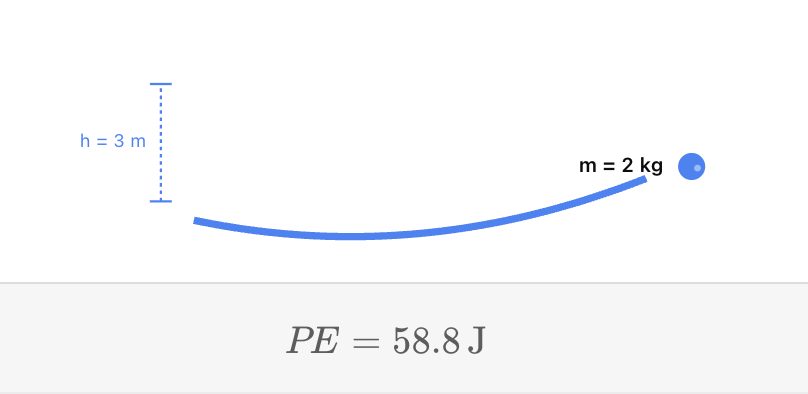
For pendulum problems, the lowest point is often chosen as:

h = 0


Worked Example — Pendulum Energy

A:

0.50 kg

pendulum bob rises:

0.20 m

above its lowest position.

Use:

g = 9.8 m/s²

Calculate its gravitational potential energy.

GPE = mgh

GPE = (0.50)(9.8)(0.20)

GPE = 0.98 J

If the pendulum is released from rest and energy losses are negligible, this becomes its maximum kinetic energy at the lowest point.

Therefore:

Maximum KE = 0.98 J


Finding Pendulum Speed from Energy

At the lowest point:

KE = initial GPE

Therefore:

½mv² = mgh

The mass appears on both sides and cancels.

This gives:

v = √(2gh)

Notice that the speed does not depend on the mass of the bob.


Worked Example — Pendulum Speed

A pendulum bob is released from a position:

0.45 m

above its lowest point.

Calculate its maximum speed.

Use:

g = 9.8 m/s²

v = √(2gh)

v = √(2 × 9.8 × 0.45)

v = √8.82

v ≈ 2.97 m/s

Therefore:

Maximum speed ≈ 3.0 m/s


Spring and Pendulum Energy Compared

Both systems show the same general pattern.

Spring

At extremes:

Elastic PE = maximum

KE = zero

At equilibrium:

Elastic PE = minimum

KE = maximum

Pendulum

At extremes:

Gravitational PE = maximum

KE = zero

At equilibrium:

Gravitational PE = minimum

KE = maximum

https://images.openai.com/static-rsc-4/fbjSJHcgL9n9ajlHMyDoCpGlnWJcUVUs9SwShtE6pBPd7rHW_atixjfvMTvr99MuvWnmiXf311cH7KhbBamPuiqrARJNCRNzl9R3kthBPmQRLiEG9vPSd1JUxcIXw4y8R2hf-_9bdBhtGAJ2X172q9zI1otz2-0vX646qhynhcVFPqovea8n7iaYg0455QVp?purpose=fullsize
https://images.openai.com/static-rsc-4/kKswRs4bZw_b9jynDHGYrsLXDV7i0ICFT1NKWyj7WocwZ8k-VWzfeQ-vbgk76fy7Z9S-nJBCc1bFfBsECLWfpguf7vc0OcHEVMlTxWQBY8_sYPwvAXTQIoVQZDgyzaMwX-fkaIiRRPA349BtcmLiNJZFjryj-xOdcCW-i5EC82BurhJGlrWruqVi-Y9jGCfv?purpose=fullsize
https://images.openai.com/static-rsc-4/HTQ0KGQi778VEz2mJ6JXOmXFTMOQg9OMrf2vJDu4zjA21Yz6EhxHjtEdlxMAYk1-KsqL2Q6A6KIAo3RUjlI6bW33NXAhCAE1fIxp1-Pu4CWcOeIMWRuVXmrMdtednnCEOxD_zyW2fDcCE2xoGfGW5ANA1L7ThBSLSq4VEJrw_iHt3SVxa_3Lmhid_XhZrf4m?purpose=fullsize
5

The type of potential energy differs, but the overall pattern is very similar.


Conservation of Mechanical Energy

In an ideal oscillating system:

Total mechanical energy remains constant.

Energy does not disappear when kinetic energy decreases.

Instead, it is transferred into potential energy.

Similarly, when potential energy decreases, energy is transferred into kinetic energy.

This is an application of the law of conservation of energy.


Ideal vs Real Oscillations

Real oscillators eventually lose amplitude.

A real pendulum gradually stops swinging.

A real spring-mass system gradually stops oscillating.

Does this mean energy has been destroyed?

No.

https://images.openai.com/static-rsc-4/a_1JlF1jlySyUsmR6j0nWRT6uWW2ei1NfGN7NATTtun9vZEFtAu5JxitrgIfD2wMb-SbEDdV_ZDqUHbjmVbs5mh6STU7Zl5BU43zvetVqLJm5lgVnRUesQqfT_U--lBqDECCaceV89poRxoM5-fsciyQwyHc_K4zZjeJm4DUUfryv-Lf5uOv0677JcPGFkOs?purpose=fullsize
https://images.openai.com/static-rsc-4/Zo0WwHpIJVH2tpo_JGr9jXE6UAQP6mrJaz2f2uIYqMhNxfk3cr4wO4HyaChq5VSF_6EBuBCJndgobLftZmXk0_zm9o1ImHNjeh8tnvAGXsNqow7VX-9bCvXqqDctcf7Qrk4Sj0-beelOid7TpOJkOSeJrin4BIk0VeuxV0b66-e8my9PbdHlIRc_qGBzqy4F?purpose=fullsize
https://images.openai.com/static-rsc-4/mC2YiPXy1cIIMupY3rCxBqX-6rmCo6HnenLnfTKAnOz10s-YBsVLSFeSs3H1-odJ3FWyQa4DGHno7RFjVGHZRgEs6GeErn9XOlZpPMebl1_N2Nxcwln_pN7XhXX0svhcV1zaPy5S230OLPSdvRiKptvw1VnDAsq2QwrD4Ppdb8qkLoN_EwqTOmql9xk1C_NT?purpose=fullsize
5

Mechanical energy is transferred to other energy stores.


Energy Dissipation

Energy may be transferred to the surroundings through:

  • Air resistance
  • Friction
  • Heating
  • Sound
  • Internal deformation

As mechanical energy decreases:

Amplitude decreases

This is called:

damping

The total energy of the complete system is still conserved, but the mechanical energy available for oscillation decreases.


Energy and Amplitude

For a spring oscillator:

E = ½kA²

Therefore:

E ∝ A²

This has an important consequence.

If amplitude doubles:

A → 2A

then:

E → 4E

So doubling the amplitude requires four times as much energy.


Worked Example — Changing Amplitude

A spring oscillator has total energy:

3.0 J

at amplitude:

A

If the amplitude is doubled:

New energy = 4 × 3.0

New energy = 12 J

Therefore:

Doubling amplitude quadruples the mechanical energy.


Energy and Time

Kinetic and potential energy also vary periodically with time.

However, there is an important difference between the displacement and energy graphs.

If:

x = A cos(ωt)

then potential energy depends on:

x²

Therefore, the energy repeats twice during each complete displacement cycle.

https://images.openai.com/static-rsc-4/4pUH8uZonXNpxoSXHHu9Bob_msYd4hI6hQjCMClqDLGh4tG8zO6AtkT5rTHmm3bU5HnkjY6Z71VSpLY6WgFzrfRcIynfuO6Ny_z34kNL4Aj-oss_xSNyevdRJl1IfXWV6dtbAS1286AMhZ_1qyIZ15QfZQsGNr_XHjoxRtuhaKsl5lScYCdIQ7MPviDzkAcA?purpose=fullsize
https://images.openai.com/static-rsc-4/t8tSjbmuMOUMTQpNVQIR0R4l9yCfiMG73gtcarH_NaBnW847rsJYtln_W9EmqVQ_wfHrSJO5L-H2GI6XQvOemtMUckgm5sS4ObMfUbMJUzpDbpCLmvUHK7wTVdQS5QvkU4HctTyHPCHByFZaXXzHBC_EqyOuVmkXb6owvxQ9vvcgc3Ea-0oRBeIwQS0VkjPM?purpose=fullsize
https://images.openai.com/static-rsc-4/coO9LSiA7YWPuyerjsbh23hDQ9K97CgOtVXvwucRHzBQjjD6VFu05_jgQtXLhAG054GqlJPUZV1KRZCkLvxIgNdmf_4nRpSWFN7SzO34tW-VYTwMWaZBNkiojvHa_eQKMmCiuv8H_KmslSLI6f8HxiJpjGrakv6ZY3Ikp1acibYok_RbAU24G69aB5ayGGAB?purpose=fullsize
5

This means the energy graphs have a period of:

T/2

even though the oscillator itself has period T.


Analyzing an Oscillator from Energy

Suppose an oscillator is moving away from equilibrium.

As it moves outward:

  • Displacement magnitude increases.
  • Speed decreases.
  • Kinetic energy decreases.
  • Potential energy increases.

Suppose instead it is moving toward equilibrium.

Then:

  • Displacement magnitude decreases.
  • Speed increases.
  • Kinetic energy increases.
  • Potential energy decreases.

This pattern allows us to infer motion from energy changes.


Worked Example — Analyzing Motion

A spring-mass oscillator has:

Total energy = 10 J

At one instant:

Elastic PE = 7 J

Therefore:

KE = 10 − 7

KE = 3 J

A moment later:

Elastic PE = 5 J

The potential energy has decreased.

Therefore, the mass must be moving:

toward equilibrium

Its kinetic energy has increased to:

5 J

and its speed has increased.


Energy Bar Diagrams

Energy transformations can also be represented using energy bar diagrams.

At maximum displacement:

PE ██████████

KE

At an intermediate position:

PE ██████

KE ████

At equilibrium:

PE

KE ██████████

The total height represented by PE + KE remains constant in an ideal system.

These diagrams are useful because they emphasize energy conservation rather than just motion.


Real-World Oscillatory Systems

Oscillatory energy transformations occur in many systems.

Examples include:

  • Playground swings
  • Vehicle suspension
  • Diving boards
  • Trampolines
  • Vibrating guitar strings
  • Pendulum clocks
  • Buildings during earthquakes
  • Mechanical vibration systems
  • Atomic and molecular vibrations
https://images.openai.com/static-rsc-4/LSs53bQvsEXM83mTD8SIQEZrtJeuq_nO6Ksc4hlcAGVXUqx5QeqPCLheISKbG7UtJSZJsW1AS8Eb6uUFyLYowlEH98DKyUGL3qjyZ6L1WBYIMkZb7kxLymPpv6swJhZcrQQEif9gVNZzUq7glj4nX4EhHRL0N4IipTJb4fIehgG32ftAgzmsQmJqdmwhAYmH?purpose=fullsize
https://images.openai.com/static-rsc-4/tN-cqrJqGp1S56g7yKlFxuGQ1Bgncejfk6Fq56Pxe5TUWH8Ts0Iek48JosdbS4b3u0l2Bii_weK6bkUfGqerQa13CCM3r5zcUWVnqCAiSgPPRpMYEWYOA-4GWvtGrQ284ykPGuLiI01yBqnGMW_ApEpuWf9SIvsxg7vSN1UwUXzofwr1O7gbcV63Sp1WDm2z?purpose=fullsize
https://images.openai.com/static-rsc-4/rU0_WXXO3e6sSsm3jyNlIB4yJXOwsYfbDmj9qaA0EzxuOOADu-viCl3jQdAVwkAxy34RtaSScU2U3B0jkExh74-4Xi_h_L6IJAsNbvZkBNZgYTE3LShi-BJj_BiSvSLQk3vO7BtsmXEPBO4A5lw6uqRvKcXVdp-jxYO8eGAghFzZ1i_tzfWfIg2htvxmkrMw?purpose=fullsize
5

The exact energy stores may differ, but the principle of energy conservation remains fundamental.


Shock Absorbers and Energy

Vehicle suspension provides an important example where we want oscillatory mechanical energy to decrease.

Springs allow the suspension to oscillate after the vehicle encounters a bump.

Without damping, the vehicle could continue bouncing.

Shock absorbers transfer mechanical energy mainly into thermal energy.

https://images.openai.com/static-rsc-4/7vkEbpBNdbLeYPgYKpjS7pT_NrKqqHMjWPtOImKl-kivYFzZ5aeykYEVjm4jMH9AB_hPklXowyTUZvx_JyCo7zQnTGHQmyAVoGlpWwtpQVRwO3fMlNMdXiWleFpAi4TRJS8TStwJqoICrvm2wcmNnnQ4iwygG5SfKHsWoBFrJ6FQ7d5Y6FeZL3h0RnXDFyj1?purpose=fullsize
https://images.openai.com/static-rsc-4/lQb3nRBHAxsxMBRSJLllSiRgY_lznqUIU4hmPnXX-6LdFBOul-M4z6lOz9oW9Ad6BGEHg7RZHC79X6VmONkcWT2d9MHmrIEJB7u56c55PzFNQliS0cc2JdwrVwMd-EBkwLyzW2YETQ6V4HFgk5D_NlyJfHHjaxJxYRzHnUj8bR01BFiVDBG7t4U-Oi5Tyt6K?purpose=fullsize
https://images.openai.com/static-rsc-4/I9vJY--MPp7lgpYp2J7plXYbwvsIGpNrOaHjbbBSj_WczfJSUS0oMRF1OfugIZtKyLhZb8JRllWbmhFWm_0L7z4yCV0TNalWeAQSacmJ8FsQ2QPVy5oy8zKrlRyYD-zFKIWfhqn3F7Cnw8AKu_iG_tt1X53jO8nklfvWr8eF-d4xz5wCUDnvKtShfivLX1BI?purpose=fullsize
6

This reduces the amplitude of the oscillations and helps keep the vehicle stable.


Common Mistakes

Mistake: Thinking Energy Disappears at the Turning Points

At maximum displacement:

KE = 0

but potential energy is maximum.

The energy has not disappeared.

Mistake: Thinking Maximum Speed Occurs at Maximum Displacement

At maximum displacement:

v = 0

Maximum speed occurs at equilibrium.

Mistake: Thinking Potential Energy Is Always Zero at Equilibrium

This depends on the chosen reference.

For many SHM calculations, potential energy is defined to be minimum or zero at equilibrium for convenience.

Mistake: Forgetting to Square the Displacement

Spring potential energy is:

½kx²

not:

½kx

Mistake: Using the Full Peak-to-Peak Distance as the Amplitude

Amplitude is the distance:

equilibrium → extreme

not:

extreme → opposite extreme

Mistake: Saying Mechanical Energy Is Conserved in Every Real Oscillator

Mechanical energy is conserved only in an ideal system with negligible dissipative effects.

In real systems, some mechanical energy is transferred into thermal energy, sound, and other stores.

Mistake: Thinking Energy Has the Same Period as Displacement

Because energy depends on displacement squared, the PE and KE patterns repeat every:

T/2


Key Terms

Oscillatory system – system that repeatedly moves around an equilibrium position.

Mechanical energy – energy associated with motion and position.

Kinetic energy – energy associated with motion.

Elastic potential energy – energy stored when an elastic object is stretched or compressed.

Gravitational potential energy – energy associated with position in a gravitational field.

Equilibrium – central position around which oscillation occurs.

Amplitude – maximum displacement from equilibrium.

Turning point – position where the oscillator momentarily stops and reverses direction.

Damping – reduction in oscillation amplitude due to energy transfer to the surroundings.

Conservation of energy – principle that energy cannot be created or destroyed, only transferred or transformed.


Check Your Understanding

1. Where is the kinetic energy of a spring oscillator greatest?

2. Where is its elastic potential energy greatest?

3. What is the kinetic energy at maximum displacement?

4. Explain why a mass does not stop when it reaches equilibrium.

5. A spring has k = 120 N/m and is stretched 0.15 m. Calculate its elastic potential energy.

6. A spring oscillator has k = 200 N/m and amplitude 0.10 m. Calculate its total mechanical energy.

7. The system in Question 6 has 0.40 J of elastic potential energy at one instant. Calculate its kinetic energy.

8. A 0.25 kg mass has 2.0 J of kinetic energy. Calculate its speed.

9. Describe the energy transformations as a spring oscillator moves from maximum extension to equilibrium.

10. Describe the energy transformations as a pendulum moves from its lowest point toward maximum height.

11. A 0.60 kg pendulum bob is raised 0.30 m above its lowest point. Calculate its increase in gravitational potential energy using g = 9.8 m/s².

12. Explain why an ideal pendulum reaches approximately the same height on the opposite side.

13. If the amplitude of a spring oscillator doubles, by what factor does its total energy change?

14. Why does the amplitude of a real oscillator gradually decrease?

15. Explain how conservation of energy applies to a damped oscillator.


Key Takeaways

  • Energy continually changes form during oscillatory motion.
  • In an ideal oscillator, total mechanical energy remains constant.
  • At maximum displacement, potential energy is maximum and kinetic energy is zero.
  • At equilibrium, kinetic energy is maximum and potential energy is minimum.
  • A spring oscillator transfers energy between elastic potential energy and kinetic energy.
  • A pendulum transfers energy between gravitational potential energy and kinetic energy.
  • Spring potential energy is proportional to the square of displacement.
  • Total energy of an ideal spring oscillator depends on the square of its amplitude.
  • Doubling amplitude produces four times the mechanical energy.
  • Energy can be used to calculate an oscillator's speed at different positions.
  • At equal positive and negative displacements, the energy distribution is the same.
  • Kinetic and potential energy are equal at approximately 0.707A from equilibrium in an ideal spring oscillator.
  • Real oscillators experience damping.
  • During damping, mechanical energy is transferred to thermal energy, sound, and other stores.
  • Energy is still conserved when the entire system and surroundings are considered.
  • Energy graphs repeat twice during each complete SHM displacement cycle.

Did You Know?

The energy of an ideal oscillator has an interesting rhythm. During one complete oscillation, the object reaches maximum kinetic energy twice and maximum potential energy twice. This means the kinetic and potential energy patterns repeat at twice the frequency of the displacement. The object might complete 2 oscillations each second, for example, while its energy distribution cycles 4 times each second.