Simple Harmonic Motion
2. Springs and Hooke’s Law
Learning Outcomes
- I can state and apply Hooke’s Law.
- I can calculate restoring forces using spring constants.
- I can interpret force-extension graphs.
- I can explain the relationship between force and displacement in SHM.
- I can analyze oscillations of spring-mass systems.
- Hooke’s Law: .
- Restoring force and its role in SHM.
- Period of a mass-spring system: .
Springs and Hooke’s Law
A spring is an elastic object that can be stretched or compressed. When a spring is displaced from its equilibrium position, it produces a restoring force that acts back toward equilibrium.
This behaviour is described by Hooke’s Law and provides one of the simplest and most important examples of simple harmonic motion (SHM).
Springs are used in:
- Vehicle suspension systems
- Spring balances
- Shock absorbers
- Mechanical clocks
- Mattresses
- Vibration-control systems
- Scientific instruments


Learning Targets
- I can state and apply Hooke’s Law.
- I can calculate restoring forces using spring constants.
- I can interpret force-extension graphs.
- I can explain the relationship between force and displacement in SHM.
- I can analyze oscillations of spring-mass systems.
Elastic Behaviour of Springs
When a force is applied to a spring, the spring changes length.
A pulling force causes the spring to:
extend
A pushing force causes the spring to:
compress
When the applied force is removed, an elastic spring returns to its original length, provided it has not been stretched beyond its elastic limit.


The change in length from the equilibrium position is called the displacement or extension.
Hooke’s Law
For an ideal spring, the restoring force is proportional to its displacement from equilibrium.
F = -kx
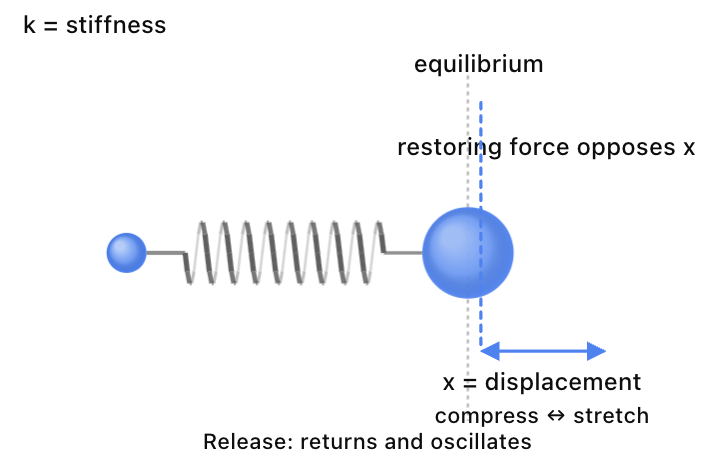
where:
F = restoring force in newtons (N)
k = spring constant in newtons per metre (N/m)
x = displacement from equilibrium in metres (m)
The negative sign tells us that the restoring force acts in the opposite direction to the displacement.
Understanding the Negative Sign
Suppose a spring-mass system is at equilibrium.
If the mass is pulled to the right:
Displacement → right
but:
Restoring force → left
If the mass is pushed to the left:
Displacement → left
but:
Restoring force → right


The spring always attempts to return the mass toward its equilibrium position.
This opposition between force and displacement is fundamental to simple harmonic motion.
The Spring Constant
The spring constant, k, measures the stiffness of a spring.
Its unit is:
N/m
A large spring constant means the spring is relatively:
stiff
A small spring constant means the spring is relatively:
flexible
For example:
Spring A: k = 50 N/m
Spring B: k = 500 N/m
Spring B requires much more force to produce the same extension.
Worked Example — Calculating Restoring Force
A spring has:
k = 200 N/m
It is stretched:
x = 0.05 m
The magnitude of the restoring force is:
F = kx
F = (200)(0.05)
F = 10 N
Therefore, the spring produces a restoring force of:
10 N
directed opposite to the displacement.
Worked Example — Compression
A spring has:
k = 80 N/m
It is compressed by:
0.15 m
The magnitude of the restoring force is:
F = kx
F = (80)(0.15)
F = 12 N
Therefore:
Restoring force = 12 N
The force acts toward the equilibrium position.
Rearranging Hooke’s Law
We can use the magnitude form:
F = kx
to calculate other quantities.
To calculate spring constant:
k = F/x
To calculate displacement:
x = F/k
Always check that displacement is expressed in metres when k is measured in N/m.
Worked Example — Finding the Spring Constant
A force of:
15 N
extends a spring by:
0.060 m
Calculate the spring constant.
k = F/x
k = 15 / 0.060
k = 250 N/m
Therefore:
Spring constant = 250 N/m
Worked Example — Finding Extension
A spring has:
k = 400 N/m
A force of:
20 N
is applied.
Calculate the extension.
x = F/k
x = 20/400
x = 0.050 m
Therefore:
Extension = 0.050 m
or:
5.0 cm
Force-Extension Graphs
Hooke’s Law can be represented using a force-extension graph.
For an ideal spring, force and extension are directly proportional.
Therefore, the graph is a:
straight line through the origin


Doubling the extension requires twice the force.
Tripling the extension requires three times the force.
This proportional relationship applies while the spring obeys Hooke’s Law.
Finding the Spring Constant from a Graph
If the graph has:
Force on the vertical axis
and:
Extension on the horizontal axis
then:
Gradient = change in force / change in extension
Therefore:
Gradient = k
A steeper line represents a spring with a larger spring constant.
Worked Example — Reading a Graph
Suppose a force-extension graph contains the point:
Extension = 0.20 m
Force = 30 N
Calculate the spring constant.
k = F/x
k = 30/0.20
k = 150 N/m
Therefore:
Spring constant = 150 N/m
Comparing Springs Using Graphs
Suppose two springs have straight-line force-extension graphs.
Spring A has a steeper graph than Spring B.
This means:
kA > kB
Therefore:
Spring A is stiffer than Spring B
because a greater force is needed to produce the same extension.


Limit of Proportionality
Real springs do not obey Hooke’s Law indefinitely.
At first:
Force ∝ Extension
The graph is straight.
Eventually, the relationship may stop being proportional.
The point where this begins is called the:
limit of proportionality
Beyond this point, doubling the force no longer necessarily doubles the extension.
Elastic Limit
The elastic limit is the point beyond which an object may not return completely to its original shape when the force is removed.
If a spring is stretched too far, it may become permanently deformed.


For many introductory problems, we assume the spring remains within the region where Hooke’s Law applies.
Springs and Simple Harmonic Motion
Attach a mass to a spring on a low-friction horizontal surface.
At equilibrium, the spring is neither stretched nor compressed.
Pull the mass away from equilibrium and release it.
The mass begins to oscillate back and forth.


This motion can approximate simple harmonic motion.
Force and Displacement in SHM
For a spring:
Restoring force ∝ −displacement
This is the defining condition for simple harmonic motion.
The further the mass moves from equilibrium, the larger the restoring force becomes.
At equilibrium:
x = 0
therefore:
Restoring force = 0
At maximum displacement:
|x| = maximum
therefore:
Restoring force magnitude = maximum
Three Important Positions
Consider a mass oscillating horizontally on a spring.
Maximum Extension
The spring is stretched the most.
Displacement = maximum
Restoring force = maximum toward equilibrium
Speed = 0
Equilibrium Position
The spring passes through its equilibrium position.
Displacement = 0
Spring restoring force = 0
Speed = maximum
Maximum Compression
The spring is compressed the most.
Displacement = maximum in the opposite direction
Restoring force = maximum toward equilibrium
Speed = 0


Acceleration in a Spring-Mass System
Newton’s Second Law tells us:
F = ma
For a spring:
F = −kx
Therefore:
ma = −kx
So:
a = −(k/m)x
This shows that acceleration is proportional to displacement and acts in the opposite direction.
Therefore:
a ∝ −x
This is another way to recognize simple harmonic motion.
Acceleration at Different Positions
At equilibrium:
x = 0
so:
a = 0
At maximum displacement:
|x| = maximum
so:
|a| = maximum
This may initially seem surprising.
The mass moves fastest at equilibrium, even though its acceleration is zero at that instant.
At the ends of the oscillation, its speed is zero but its acceleration is greatest.
Worked Example — Acceleration
A:
0.50 kg
mass is attached to a spring with:
k = 100 N/m
The mass is displaced:
0.10 m
Calculate the magnitude of its acceleration.
First calculate the restoring force:
F = kx
F = (100)(0.10)
F = 10 N
Now:
a = F/m
a = 10/0.50
a = 20 m/s²
Therefore:
Acceleration magnitude = 20 m/s²
directed toward equilibrium.
Oscillation Cycle
Suppose a mass begins at maximum extension.
It then moves:
Maximum extension → equilibrium → maximum compression → equilibrium → maximum extension
This is:
one complete oscillation


The motion then repeats if energy losses are negligible.
Period of a Spring-Mass System
The period, T, is the time required for one complete oscillation.
For an ideal mass-spring system:
T = 2π√(m/k)
where:
T = period in seconds
m = mass in kilograms
k = spring constant in N/m
This equation tells us how the mass and spring stiffness affect the oscillation.
Effect of Mass
From:
T = 2π√(m/k)
increasing the mass increases the period.
Therefore:
Larger mass → Longer period → Slower oscillation
A heavier mass takes longer to complete each oscillation.
Effect of Spring Constant
Increasing k decreases the period.
Therefore:
Stiffer spring → Shorter period → Faster oscillation
A stiff spring produces a stronger restoring force for the same displacement, causing the system to oscillate more rapidly.


Worked Example — Period
A:
0.50 kg
mass is attached to a spring with:
k = 200 N/m
Calculate the period.
T = 2π√(m/k)
Substitute:
T = 2π√(0.50/200)
T = 2π√0.0025
T = 2π(0.05)
T ≈ 0.314 s
Therefore:
Period ≈ 0.31 s
Frequency
The frequency, f, tells us how many complete oscillations occur each second.
Frequency and period are related by:
f = 1/T
For the previous example:
T ≈ 0.314 s
Therefore:
f = 1/0.314
f ≈ 3.18 Hz
The mass completes approximately:
3.18 oscillations per second
Energy in a Spring
A stretched or compressed spring stores elastic potential energy.
For an ideal spring:
Elastic potential energy = ½kx²
At maximum displacement:
- Elastic potential energy is maximum.
- Speed is zero.
- Kinetic energy is minimum.
At equilibrium:
- Elastic potential energy associated with displacement from equilibrium is minimum.
- Speed is maximum.
- Kinetic energy is maximum.


Energy continually transfers between elastic potential energy and kinetic energy.
Energy During One Oscillation
At maximum extension:
Elastic PE = maximum
KE = 0
As the mass approaches equilibrium:
Elastic PE decreases
KE increases
At equilibrium:
KE = maximum
The mass then compresses the spring.
As compression increases:
KE decreases
Elastic PE increases
At maximum compression:
KE = 0
and elastic potential energy is again maximum.
Force-Displacement Graph
For an ideal spring, restoring force and displacement have a linear relationship.
Because the force is opposite to displacement, a graph of restoring force against displacement has a negative gradient.
The gradient is:
−k


This graph directly illustrates the SHM condition:
Restoring force is proportional and opposite to displacement.
Vertical Spring-Mass Systems
A mass can also oscillate vertically on a spring.
When a mass hangs from a vertical spring, gravity stretches the spring until equilibrium is reached.
At equilibrium:
Spring force upward = Weight downward
Therefore:
kx = mg
where x is the equilibrium extension caused by the hanging mass.


If the mass is then displaced from this equilibrium position and released, it can oscillate vertically.
Worked Example — Hanging Mass
A:
2.0 kg
mass hangs from a spring with:
k = 400 N/m
Using:
g = 9.8 m/s²
the weight is:
mg = (2.0)(9.8)
mg = 19.6 N
At equilibrium:
kx = mg
Therefore:
x = mg/k
x = 19.6/400
x = 0.049 m
So the spring extends approximately:
4.9 cm
Real Spring-Mass Systems
Real oscillating systems do not continue forever.
Energy is gradually transferred to the surroundings through:
- Air resistance
- Friction
- Internal heating of the spring
- Sound
As energy is dissipated, the amplitude gradually decreases.
This is called damping.


An ideal SHM model often assumes these energy losses are negligible.
Springs in Vehicle Suspension
Vehicle suspension systems use springs to allow wheels and the vehicle body to respond to bumps in the road.
However, springs alone would cause the vehicle to continue oscillating.
Vehicles therefore also use dampers or shock absorbers.


The spring provides a restoring force.
The damper removes mechanical energy from the oscillation.
Together, they provide a smoother and more controlled ride.
Investigating Hooke’s Law Experimentally
A simple Hooke’s Law investigation can use:
- Clamp stand
- Spring
- Mass hanger
- Slotted masses
- Metre ruler
First measure the spring's original length.
Add masses gradually and record the new length.
Calculate:
Extension = New length − Original length
Calculate the applied force using:
F = mg
Then plot:
Force against extension


A straight-line region through the origin provides evidence that:
F ∝ x
Improving the Experiment
For more reliable results:
- Measure from the same reference point each time.
- Read the ruler at eye level to reduce parallax error.
- Allow the spring to stop moving before measuring.
- Add masses in regular intervals.
- Repeat measurements.
- Avoid exceeding the elastic limit.
- Use a wide range of safe forces.
- Plot a best-fit line rather than joining individual points.
These procedures help improve the quality of the force-extension data.
Common Mistakes
Mistake: Forgetting to Convert Centimetres to Metres
If:
x = 5 cm
then:
x = 0.05 m
when using k in N/m.
Mistake: Ignoring the Direction of Restoring Force
The spring force acts opposite to the displacement.
This is why the full form of Hooke’s Law contains a negative sign.
Mistake: Assuming Hooke’s Law Always Applies
Hooke’s Law applies only while force and extension remain proportional.
Real springs eventually stop behaving linearly.
Mistake: Confusing Stiffness
A larger k means:
stiffer spring
not a more flexible spring.
Mistake: Thinking Speed Is Greatest at Maximum Displacement
At maximum displacement:
speed = 0
The speed is greatest at:
equilibrium
Mistake: Thinking Acceleration Is Greatest at Equilibrium
At equilibrium:
restoring force = 0
therefore:
acceleration = 0
Acceleration magnitude is greatest at maximum displacement.
Key Terms
Spring – elastic object that can be stretched or compressed.
Equilibrium position – position where the net restoring force associated with the oscillation is zero.
Displacement – distance and direction from equilibrium.
Extension – increase in length from the spring's original or reference length.
Restoring force – force directed toward equilibrium.
Spring constant – measure of spring stiffness, measured in N/m.
Hooke’s Law – relationship between spring restoring force and displacement.
Limit of proportionality – point beyond which force and extension are no longer directly proportional.
Elastic limit – point beyond which permanent deformation may occur.
Simple harmonic motion – oscillation in which restoring force or acceleration is proportional and opposite to displacement.
Period – time for one complete oscillation.
Frequency – number of complete oscillations per second.
Amplitude – maximum displacement from equilibrium.
Damping – reduction in oscillation amplitude due to energy dissipation.
Check Your Understanding
1. What does the spring constant tell us about a spring?
2. A spring has k = 150 N/m and is stretched 0.08 m. Calculate the magnitude of the restoring force.
3. A 12 N force extends a spring by 0.040 m. Calculate its spring constant.
4. A spring has k = 500 N/m. Calculate the extension caused by a 25 N force.
5. Explain the meaning of the negative sign in Hooke’s Law.
6. What does the gradient of a force-extension graph represent when force is on the vertical axis?
7. Two springs have force-extension graphs. Spring A has the steeper line. Which spring is stiffer? Explain.
8. What happens when a spring is stretched beyond its elastic limit?
9. Where is the speed of a spring-mass oscillator greatest?
10. Where is its acceleration magnitude greatest?
11. Explain why a spring-mass system can undergo simple harmonic motion.
12. A 0.40 kg mass is attached to a spring with k = 100 N/m. Calculate its period.
13. What happens to the period if the mass is increased?
14. What happens to the period if a stiffer spring is used?
15. Describe the energy transfers that occur as a mass moves from maximum extension through equilibrium.
Key Takeaways
- Springs produce a restoring force when stretched or compressed.
- Hooke’s Law describes the relationship between restoring force and displacement.
- The restoring force acts in the direction opposite to displacement.
- The spring constant k measures the stiffness of a spring.
- A larger spring constant means a stiffer spring.
- Within the proportional region, force and extension are directly proportional.
- A force-extension graph is therefore a straight line through the origin.
- If force is plotted against extension, the gradient gives the spring constant.
- Hooke’s Law does not apply indefinitely to real springs.
- A spring-mass system can approximate simple harmonic motion.
- In SHM, restoring force and acceleration are proportional and opposite to displacement.
- Speed is greatest at equilibrium.
- Restoring force and acceleration magnitude are greatest at maximum displacement.
- Increasing mass increases the period of a spring-mass oscillator.
- Increasing spring stiffness decreases the period.
- Energy transfers between elastic potential and kinetic energy during oscillation.
- Real oscillations gradually lose energy through damping.
Did You Know?
A spring-mass oscillator is one of the most useful models in physics because the same mathematics can describe many systems that do not look like springs at all. Small vibrations of molecules, parts of buildings, vehicle suspension systems, electrical circuits, and even some models of atomic behaviour can display patterns closely related to simple harmonic motion.