Forces in Two Dimensions

3. Inclined Planes

Learning outcomes
  • I can identify forces acting on an object on an incline.
  • I can resolve weight into parallel and perpendicular components.
  • I can calculate net force on an inclined plane.
  • I can analyze motion on slopes with and without friction.
  • I can solve problems involving inclined planes.

https://images.openai.com/static-rsc-4/3nbKB-1zAWfJPhj19p50z8G1WhLRxuXSVmw_H3JhyVcRvdf_yvfdHoaqkYv__jgG1L83NCx6GECZ-OEBRJliHPR40x9IAlcN04asqgKiLwaDYs48fM75wtGZ8WxphTfqiUkUUjZ8Et9HohaDqpXjwKCHSxM79aCBEXEMPyLiuna-p0TurSSJM9hFeYa8rnzS?purpose=fullsize
 
https://images.openai.com/static-rsc-4/IiywTXtBPJkwM_moc626MpmHg239vfy0YNfY2-MAOGNq8EaANBCm89BvL5rwWy2iNld59X_wYLntiQYZNYZiJmVYmSpMmj2bIqaMI8C3SE3HRaoTTm1qtN4wRY2cv3QF3REloyFQRbwOrbv29ksQxXxUZIVpO80LVWh8uZICyIdZEcxKoelh-vSqhjj6OtPR?purpose=fullsize
 
https://images.openai.com/static-rsc-4/t7g8toWvPDk5moCkM6MLJe7Gu6V_ViSe4E0l9wTanLca-cANw7TQBWp4rcmYwrOeTBFkNOIWqKm4VHQbajNhYOge9VS5x_0kUy8weXIg0foSsf6uhYlEZMDc2gXZixN_y0eW0IE3ME-K1kqY2ZJf_3G37hqAPdfU7kzZ-th1iQb0_hNNB1dAHlQt7Tg0MyKo?purpose=fullsize
 
6

What Is an Inclined Plane?

An inclined plane is a flat surface that is tilted at an angle to the horizontal.

Common examples include:

  • ramps
  • hills
  • roads on slopes
  • playground slides
  • loading ramps
  • roofs
  • ski slopes

When an object is placed on an incline, gravity still acts vertically downward. However, part of the gravitational force tends to pull the object down the slope.

This makes inclined planes an important application of force components.


Forces Acting on an Inclined Plane

Consider a box resting on a slope.

Several forces may act on the box:

  • weight (Fg) acting vertically downward
  • normal force (N) acting perpendicular to the surface
  • friction (Ff) acting along the surface when appropriate
  • tension or applied forces if the object is being pulled or pushed
https://images.openai.com/static-rsc-4/Sa7bt14arAcGIEEeHSL-V0kc11EATU7LOCtNoqrohKYuvimhEqA8elhmX8rXO6MnAFDirdDw4swZOaXKSgZ63pcqFSAVQJDaFolufDAKF2jqBctDyRQe0QkqRe0p0P3_sB6OasQVY-til03LiPijl3nevxo1dRuRMyJtRMNQVs3_JSJnFwtbsFqK0Mtn0TYx?purpose=fullsize
 
https://images.openai.com/static-rsc-4/hAK2TErplFQl5YlonU3qMGnux-vWLm2fNCZLPdn2LxWk_aDFcWp5so12KDfrju3Ssq46beir2rGF_UB7_m30xEKqeug3J_iejN8QENV8jpeLpz6x6x6XYwC9fPCqOEOgOSzREz_0ZpPJ5RxeywRck2Nts_BDw931xj7qutdGJoEPv6qaQYsUytLPTBw8YS5v?purpose=fullsize
 
https://images.openai.com/static-rsc-4/Udf42Q9lcPZTIRU_ghLW3yEgtx2QG0guqwKG7lcQ3FU-Ml2IDVgg_QNIUNYAPjwvuGigy8C-nkHdPVy-fpYTH_MWTfhTGoDZ-RXfNdj6m245_tpumuYf7-711zVkq-2uhh6zonVqvYO2moTwUgcKXYi8EhON8NoEJC6_GNgGv5243aotb2C5NWkl1pcTQ60q?purpose=fullsize
 
5

A common mistake is to draw the normal force vertically upward.

On an incline, the normal force is not vertical.

The normal force always acts:

perpendicular to the surface


Choosing Axes on an Incline

For horizontal surfaces, we normally use horizontal and vertical axes.

For inclined planes, a more useful coordinate system is:

x-axis: parallel to the slope

y-axis: perpendicular to the slope

https://images.openai.com/static-rsc-4/7U-nSDJL2KiP8UXTiAyjBHqgGd9Uq3IpX4NmdCMTlX3cPIjOEbWNxiPOurrNOVXVEEYUMIH8MTX5_RI-gR_e2PcBKN8Szi3PiAZBtVUftZBr7lBfdjcutTtyXi98sLI27tljq_I_yjDHjYtFPSi1t1XV5vL0s4Ozd67ea5YT17d89WFOVFnNhZD5_mIGD5-3?purpose=fullsize
 
https://images.openai.com/static-rsc-4/5r7KoAWepPi8_m0oVELTlnUk5ORbIrNXGdtD_YDcM7JeZ29oPUBsAjIyIHlo1NwgXQmSMx3dhwhyh7SyH1j4y5jIT1aUe_LJNSdKXEnwTnhD9byGlsU7Kszukw40q3oBgukUM9BMNAPhJoZKtrPnloTKryjMwed6kl_Sp0go2fZR_Qqk3N_WmPPuZeMgQ3Fk?purpose=fullsize
 
https://images.openai.com/static-rsc-4/7zWHuYF-9jsGxJo9dp4HjZkhdc4HzKTZGWSnFw8oWOSEq_P0EcT6W1ysdJqvJvoOiII_qxUzMj0qf5oAEQ_sX8PWt7c7MIhYgcmxcgL0ZT8fSijMfmSBHIyCj-i6rr7A2Y2oVKKXBlrSi0CKhxC7wPpXLvZairU-PAft1sDWPU5X0CeG2EEzFji8Y_GZk3cJ?purpose=fullsize
 
5

This makes calculations much easier because the normal force and friction already lie along these axes.

Gravity is then the force that must be resolved into components.


Resolving Weight on an Incline

The gravitational force is:

Fg = mg

and always acts vertically downward.

On an incline, we resolve weight into two components:

Fg∥ = component parallel to the slope

Fg⊥ = component perpendicular to the slope

https://images.openai.com/static-rsc-4/t7g8toWvPDk5moCkM6MLJe7Gu6V_ViSe4E0l9wTanLca-cANw7TQBWp4rcmYwrOeTBFkNOIWqKm4VHQbajNhYOge9VS5x_0kUy8weXIg0foSsf6uhYlEZMDc2gXZixN_y0eW0IE3ME-K1kqY2ZJf_3G37hqAPdfU7kzZ-th1iQb0_hNNB1dAHlQt7Tg0MyKo?purpose=fullsize
 
https://images.openai.com/static-rsc-4/2r9AIiaxTSFYa1Th_JrI9ki1Ws0ojMOugoWplnzrsLiImHOitf06zuSRqgTAsGDdjepi28e7YrivqyMjteM5cUMrOo2S0TABNn6-Qy2i-uO4snfen2P_iKRaSbSZq31mZjVBe1fs2bQPBXcPeFhc3I59nsGNp0Mu1z0BwV5Vq7BsVvaU0Mx4HoWKd-wtBDV0?purpose=fullsize
 
https://images.openai.com/static-rsc-4/u1iipXzRSGsjFOaybvTWUWU4tS8b-x_VKaXyZw2K9sAVT2wK-WMt2dBKYChVzQnmIRlPyoFM-As05bF-xJ5HOK3lJYlZtQRORD_FTCNU8Vym-ZHwr_IFIcnPCjYfyTyIS6NN0OR2umAb2pNT-4xNTasw7P8e0FWPvyluC-RUSPM3Ztdw5Zv0wAj8KhjFzhLl?purpose=fullsize
 
5

For a slope at angle θ:

Parallel component:

Fg∥ = mg sin θ

Perpendicular component:

Fg⊥ = mg cos θ

The parallel component pulls the object down the slope.

The perpendicular component pushes the object into the surface.


Why Is It mg sin θ Down the Slope?

The geometry of the force triangle shows that the component parallel to the slope is opposite the angle θ.

Therefore:

sin θ = Fg∥ / mg

Rearranging:

Fg∥ = mg sin θ

The perpendicular component is adjacent to θ:

cos θ = Fg⊥ / mg

Therefore:

Fg⊥ = mg cos θ

https://images.openai.com/static-rsc-4/t7g8toWvPDk5moCkM6MLJe7Gu6V_ViSe4E0l9wTanLca-cANw7TQBWp4rcmYwrOeTBFkNOIWqKm4VHQbajNhYOge9VS5x_0kUy8weXIg0foSsf6uhYlEZMDc2gXZixN_y0eW0IE3ME-K1kqY2ZJf_3G37hqAPdfU7kzZ-th1iQb0_hNNB1dAHlQt7Tg0MyKo?purpose=fullsize
 
https://images.openai.com/static-rsc-4/eU1_M7kzZy04MzEQfRBsOCXyiWKEUS8bRqrbEIvk3mApI8xx_OkWS5qHk_TCsGAU_BBRfLKDSNn0zoiedDu4fhDJvBJITd8D5Xp9W_cZPfAkN3Q-RO5xIlVrgWIazlfVsbtTH11sRG2J-JC3J7jfbCmMjT5kc3w5nw8LDWboBrmPjLJcImmDXlt86W5x0ypA?purpose=fullsize
 
https://images.openai.com/static-rsc-4/CVg8FAn3uKbCPwAraqtSxKHf6hQEkm1ff2ZZip2s1cAj8hZ56rux-T3S_O4tgE-ne_nfiR8QG4NHNEetkq4z7ZRCR2-O6s1vlQ6OtWEd1w8vHLGx7hVtY-DGfyx7-Zz0B2EgPbpc05zqJRyyLyOl1Iwg3GQyLL0h6ZexfXDAkFjlv6XkIvEox8aJoQLVg1Zc?purpose=fullsize
 
4

These two equations are central to solving inclined-plane problems.


The Normal Force on an Incline

If there are no other forces acting perpendicular to the slope and the object does not accelerate away from the surface:

N = Fg⊥

Therefore:

N = mg cos θ

Notice:

N ≠ mg

except when the surface is horizontal.

As the incline becomes steeper, the normal force becomes smaller.

https://images.openai.com/static-rsc-4/OUzVKrQFOIWBn-wc-bYBpUMK0leiiKXNxjG1eOaHxnTFtQTwbcb5og2S0P2x-DpqLj-1VS-4gn-DeTV1vTzN7bZFMcPWV8G6qFCyAjVTOyxCyvUuKDPH1if961NKVxtpgJCh7vOD17uTgT4TusQhsGOKEh8fuEo2fdqTE0_OPRSvi7EhaVnWsA8eJqNtDCdq?purpose=fullsize
 
https://images.openai.com/static-rsc-4/NFoxOCiXUhlnHvAembZxuNwvSHkPm7jQtSSJteDfKIyzEeeD18glylGGou1l-0E4A7G4Hn7YMk8s4nEXQdHDHJqxfLTFHMs-1k5vN1blzLz62-T4350ZJjsCArd-401iceV1D87VjIaEY1t7gKaTZuZF8K82NApuHAieV8OeBDtWWPjmjEIaN3Hg9Iu4YPaB?purpose=fullsize
 
https://images.openai.com/static-rsc-4/hAK2TErplFQl5YlonU3qMGnux-vWLm2fNCZLPdn2LxWk_aDFcWp5so12KDfrju3Ssq46beir2rGF_UB7_m30xEKqeug3J_iejN8QENV8jpeLpz6x6x6XYwC9fPCqOEOgOSzREz_0ZpPJ5RxeywRck2Nts_BDw931xj7qutdGJoEPv6qaQYsUytLPTBw8YS5v?purpose=fullsize
 
7

At:

θ = 0°

cos 0° = 1

so:

N = mg

On a very steep incline, the normal force becomes much smaller.


Worked Example 1: Resolving Weight

A 10 kg box rests on a 30° incline.

Calculate the components of its weight.

First calculate weight:

Fg = mg

Fg = 10 × 9.8

Fg = 98 N

Parallel component:

Fg∥ = mg sin θ

Fg∥ = 98 sin 30°

Fg∥ = 49 N

Perpendicular component:

Fg⊥ = mg cos θ

Fg⊥ = 98 cos 30°

Fg⊥ ≈ 84.9 N

Therefore:

Force down the slope = 49 N

Force into the slope ≈ 84.9 N

If there are no other perpendicular forces:

N ≈ 84.9 N


A Frictionless Inclined Plane

First consider a perfectly smooth incline with no friction.

The forces are:

  • weight
  • normal force

The normal force balances the perpendicular component of weight.

Therefore:

N = mg cos θ

But there is nothing to balance the parallel component:

Fnet = mg sin θ

The object therefore accelerates down the slope.

This relationship is especially clear in the interactive inclined-plane model:

a = gsinθ
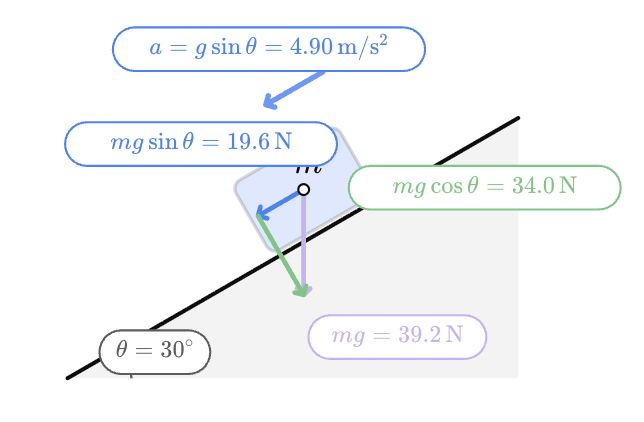
The mass cancels when Newton's Second Law is applied. Therefore, on an ideal frictionless incline, the acceleration depends on the slope angle and gravitational field strength, not on the object's mass.


Worked Example 2: Frictionless Incline

A 5.0 kg block slides down a frictionless 20° incline.

Calculate its acceleration.

Parallel force:

Fnet = mg sin θ

Using:

Fnet = ma

we get:

mg sin θ = ma

Cancel m:

g sin θ = a

Therefore:

a = 9.8 sin 20°

a ≈ 3.35 m/s²

Acceleration ≈ 3.4 m/s² down the slope

Notice that the mass did not affect the final acceleration.


Why Doesn't Mass Affect the Acceleration?

A heavier object has a larger gravitational force.

However, it also has greater inertia.

For a frictionless incline:

F = mg sin θ

and:

F = ma

Therefore:

mg sin θ = ma

The mass appears on both sides and cancels.

So:

a = g sin θ

This is similar to free fall, where objects of different masses experience the same gravitational acceleration when air resistance is ignored.


Inclined Planes with Friction

Real surfaces usually produce friction.

If an object slides down a slope, kinetic friction acts up the slope, opposing the motion.

https://images.openai.com/static-rsc-4/JlvRpzJIgHLQftBBDAJ2pzZoF3B2V60gOBir1AXZfuaQGoU2Bn7XAJzzRVMEltXZRNfv-fObeQR9eEV9hWp44U74vnWab9atUMZ9dJErCRlq0HSl34XmRV1jBYS16VyNgpGtFDxAWBmD96_P5V5m6v4VuZCon99N9z2akVXtI3h453ni4Qbf9eb_0jxiv2Zg?purpose=fullsize
 
https://images.openai.com/static-rsc-4/UiMTVa1T8fZE_5qkRgj8VoX12iQaE3N2qPieeCPwCmlYX901emmWTQ1AkpcGv_Pp2uuZYt8cEtUZYz5a89zXJDup3JK-R1bHWSd0-_WighH-ZCEEY2tcV9Dw-J3tVcjHjDsjME9HKBWkbs--rOLDxa8_w8FAhWf0wbUFfaHFuzBY_y4QaLGHavv2WbokvBNw?purpose=fullsize
 
https://images.openai.com/static-rsc-4/w3TjhEVO4vwEkMWgCbOvFylG6wi11Sf7-Z7WM7RFPhJCyReEAYBE25ogAblxGNHIERyCxUrG-5X14gPYHkIo5Apnplc7-yuSgrM6vN1I54-jRpwS9-ur-zFFdUm4GIkEoIHg0Fmy1Bz7JKvp3J26BZnEsJI3wayfplZ92PayMCrXcFDRvFPOCHPPfoNAw1Wi?purpose=fullsize
 
5

The friction force can be modeled as:

Ff = μN

Since:

N = mg cos θ

then:

Ff = μmg cos θ

The gravitational component down the slope is:

Fg∥ = mg sin θ

Therefore, if the object slides downward:

Fnet = mg sin θ − Ff


Worked Example 3: Incline with Friction

A 10 kg box slides down a 30° slope. The coefficient of kinetic friction is 0.20.

Calculate its acceleration.

First calculate weight:

mg = 10 × 9.8 = 98 N

Parallel component:

Fg∥ = 98 sin 30°

Fg∥ = 49 N

Normal force:

N = 98 cos 30°

N ≈ 84.9 N

Calculate friction:

Ff = μN

Ff = 0.20 × 84.9

Ff ≈ 17.0 N

Now calculate the net force down the slope:

Fnet = 49 − 17

Fnet = 32 N

Use:

Fnet = ma

32 = 10a

a = 3.2 m/s²

The box accelerates at approximately:

3.2 m/s² down the slope


Friction Always Opposes Relative Motion

It is important not to automatically draw friction pointing up the slope.

Friction opposes the relative motion or tendency for relative motion between the surfaces.

If an object is sliding downward:

friction acts upward

If an object is being pulled upward:

friction acts downward

https://images.openai.com/static-rsc-4/d8jPzEVzPZTL15fiarmfjg0lTDwH8BR0bbgo0AlBHHYdzHeHWTS6pjkNW5vhzhZByNonE2t_ZOtZUk0XyWvv7j5CjCDQkvcH5XWZFp0G79SWPCoEMrjr0ERHjR-sIsItK1xGQ9ZeLZndkW9qbrX08vvTDTvsF02YuZDAhpxNWZREBFPCr8rkI2TwmGGJzjoq?purpose=fullsize
 
https://images.openai.com/static-rsc-4/_WeELWbGMxU8FT6x72kBNXOg8V8xwgI7hrKuz0kNPWvjl4L2X9Ht5QomJRrIo-Jm6vti1cpskEZ4C7UaxrhgpexESGIKDyEppGF-L-6sPgiv4l8-dUL-BaZEbyHLKoZbl4_m9AQAffPrzRefKcuM6MfbTZIqSLhJsuWEWvHHv-LiZDz4FJ8NrVWUOrQDkDsR?purpose=fullsize
 
https://images.openai.com/static-rsc-4/yIayFGMD4kNpblRbEA87REW-6ikmB1UP1PI-X8Y5kpEh6pUVC-4Og9eepY0Ms4y1WNx4XOPO6I5GeMg8HjX0NBLMRKLmtUghAOGVBvoP4kbV-6VT3EeWcYhrRRLa8jEZrZC3bRA43HehZpvchuaLhIw_ZI-34nmtZJ-FZoqiiD1GUAPQn68BXFBT-Wue5XbY?purpose=fullsize
 
5

Always determine the direction of motion—or attempted motion—before choosing the direction of friction.


Static Friction on an Incline

An object placed on a slope does not always slide.

Static friction may prevent motion.

The force pulling the object down the slope is:

mg sin θ

Static friction acts up the slope to oppose this tendency.

For equilibrium:

Fstatic = mg sin θ

However, static friction has a maximum value:

Fs(max) = μsN

and:

N = mg cos θ

Therefore:

Fs(max) = μsmg cos θ

The object remains stationary only if the required static friction does not exceed this maximum.


Will the Object Slide?

To determine whether an object will slide:

Calculate the force pulling it down the slope:

Fg∥ = mg sin θ

Then calculate the maximum static friction:

Fs(max) = μsN

If:

mg sin θ ≤ Fs(max)

the object can remain stationary.

If:

mg sin θ > Fs(max)

static friction is insufficient and the object begins to slide.

https://images.openai.com/static-rsc-4/hAK2TErplFQl5YlonU3qMGnux-vWLm2fNCZLPdn2LxWk_aDFcWp5so12KDfrju3Ssq46beir2rGF_UB7_m30xEKqeug3J_iejN8QENV8jpeLpz6x6x6XYwC9fPCqOEOgOSzREz_0ZpPJ5RxeywRck2Nts_BDw931xj7qutdGJoEPv6qaQYsUytLPTBw8YS5v?purpose=fullsize
 
https://images.openai.com/static-rsc-4/Vsziv0p0Zu7r2xLZzOzUAv9hF7DTV7adrFh5lgSgrFtu0HwrN1jF3N3ag4BIQftclpA2XkxiziVAXR2PuM-76rWwVxn6eII-Yk-Iapne_1Bq64fe3ZkNqC1Twvw-0utYFh3cFnd5CR0K5sbWudQPMJpsfmZfQ2Dsd4QZE6jekcukr79VBYrly5wP-MIl6MDY?purpose=fullsize
 
https://images.openai.com/static-rsc-4/aM6lHIR4si5qiCc0_vuf8wH7nUscV4l-N0lBa1MOZKEM-C1MO21YCuUdKpA8y7tmdXOWtWi62Mkq4wOFmKS-Vj0_Zy4BHqqaEnTV2wFJ4PijiOGnZFYMdqMoLnxxmWrQxbC9ry4lB-tnqe6k4jjz3qKYOHGB7xn7_df7DA6IFmqyHN5VBqJ6at0MuC3l40H9?purpose=fullsize
 
5

Worked Example 4: Will It Slide?

A 20 kg box rests on a 25° slope. The coefficient of static friction is 0.50.

First calculate weight:

mg = 20 × 9.8

mg = 196 N

Force down the slope:

Fg∥ = 196 sin 25°

Fg∥ ≈ 82.8 N

Normal force:

N = 196 cos 25°

N ≈ 177.6 N

Maximum static friction:

Fs(max) = μsN

Fs(max) = 0.50 × 177.6

Fs(max) ≈ 88.8 N

Compare:

Required friction = 82.8 N

Maximum available friction = 88.8 N

Since:

82.8 < 88.8

static friction is strong enough to prevent sliding.

The box remains stationary.

The actual static friction is 82.8 N, not 88.8 N.


The Critical Angle

As the angle of a slope increases:

mg sin θ increases

while:

mg cos θ decreases

Therefore:

  • the force pulling the object down the slope increases
  • the normal force decreases
  • the maximum possible friction decreases

Eventually the object may begin to slide.

https://images.openai.com/static-rsc-4/6dpuvnzKYJNSuGJdIZKdxyHyag7XYb-NiZq6RI2w-HBURA5kDk_rg0DP_2v0b2i0wJly34vXMfZqLALjZxeUUPKMyatyVk_xvLgxhYuoxsc6rzo7UwrJZe9JW6U8NTl0awNlIvrnNeoyHd5hDn9wNfSFlFaYeV4jM0HauE5qv2vldxSosTjJPtIUtmF4S9JI?purpose=fullsize
 
https://images.openai.com/static-rsc-4/Dbn-71-MCXWLRnkpobNqnd57yCvFvdAU49pcCbsYTK_CQfZzOCBIb6vGyUqXaWxh50Ik-MhcKPIJjKwxJU6UJ0wgQWyHB4OKY0S2WhiCetXsxlY0zz0SFWMf1h_VaBPaEKwD7lvLcXW_1-e6F68dw246tNr3mJbzPJXH-mewm1B8kPkOCJ2-A9PPRc4u5Hty?purpose=fullsize
 
https://images.openai.com/static-rsc-4/NgZOklogVXrecHhI6E9wRnVqQdNsCj2SzsTupD7nC6vPPxc70TMvID4NUtuZ6JR48G4leLHB5V-QSbOgNC5SmaZ73P86BwaQLKoIJAvDgn8FT2DSMQmEfH4shyqUTp048fF6-dXVvuihj_6Sw8M4B6hCXWeFoHnIgUpmOXDB8Faf4C9-azJw97Xu-hPdXOs8?purpose=fullsize
 
5

At the point where sliding is just about to begin:

mg sin θ = μsmg cos θ

Cancel mg:

sin θ = μs cos θ

Divide by cos θ:

tan θ = μs

Therefore:

μs = tan θcritical

This relationship can be used experimentally to determine the coefficient of static friction.


Pulling an Object Up an Incline

Suppose a rope pulls an object up the slope.

Forces along the slope may include:

  • tension upward
  • gravity component downward
  • friction downward
https://images.openai.com/static-rsc-4/d8jPzEVzPZTL15fiarmfjg0lTDwH8BR0bbgo0AlBHHYdzHeHWTS6pjkNW5vhzhZByNonE2t_ZOtZUk0XyWvv7j5CjCDQkvcH5XWZFp0G79SWPCoEMrjr0ERHjR-sIsItK1xGQ9ZeLZndkW9qbrX08vvTDTvsF02YuZDAhpxNWZREBFPCr8rkI2TwmGGJzjoq?purpose=fullsize
 
https://images.openai.com/static-rsc-4/mnnBQHMfEp_vIDr9vTSCat-22sKrV1TB_VaQCatZExQY1bp2AFErZoxQuaSChsj8J-WzYo4qvOixi-6xDU3ROfaQCfpLZMKJOQ3FPPzk03xxC4MWB8nyz0Mz_SGZgPxcZA4wx6JJPCFISusD-PLYYLNhBbvxR396_Xsy4eB7RKCxIGDzMVfVsajY9mBxSTAF?purpose=fullsize
 
https://images.openai.com/static-rsc-4/AcoF0boti5WnDuNRqN3ZGwJfIPGQG6QrZUI8e9-wWD_l5gOnXz9uTZCmfNsnWM5hK7RXgu6SIbet1kBLjEr2X0m9RT3qO9IRgOR8d4UGI4hJyTBFF8cVaUiUF2WXbNvgeUoiIYhZh6b6EUa7Hwock4258P1sOgBeGdO-_kZZZ2QL_GpRphDgx4i6gDidaktD?purpose=fullsize
 
4

If upward along the slope is positive:

Fnet = T − mg sin θ − Ff

Using Newton's Second Law:

T − mg sin θ − Ff = ma

If the object moves at constant velocity:

a = 0

Therefore:

T = mg sin θ + Ff


Worked Example 5: Pulling a Box Up a Ramp

A 15 kg box is pulled up a 20° ramp at constant velocity. Friction acts with a force of 25 N.

Calculate the required tension.

Because the velocity is constant:

a = 0

Therefore:

Fnet = 0

Calculate the component of weight down the slope:

Fg∥ = mg sin θ

Fg∥ = 15 × 9.8 × sin 20°

Fg∥ ≈ 50.3 N

The tension must balance both gravity and friction:

T = Fg∥ + Ff

T = 50.3 + 25

T ≈ 75.3 N

The required tension is approximately:

75 N


Applied Forces at an Angle to the Incline

Sometimes an applied force is itself at an angle to the slope.

In that case, the applied force must also be resolved into components.

https://images.openai.com/static-rsc-4/_ohJZHHHU_ytnTTUUQYWi-babOpPg00KuINMk096ZA-72MkiURbYbfnDZLQgx203qLjtKbZvPKktDatmEAoL2J1spNDbVnH8TLfp776SJIXrvf95Dow1GyRVLiX_7WMGlvivRU_sWBoVHDfW_z99GvQNWuBSG692cW2nUaEmORHtPS1Pu-odjyaNOcdKucJ8?purpose=fullsize
 
https://images.openai.com/static-rsc-4/CRDdTm2KLnZhLJpluYJ8PQqFq_FO0uu7otQj-rJZ6Pzf3YxUWkyI_7-BU9CFklr095ZIBElTy2HxIm0_rTqvN5ilGvWonqrZBbaEap-0S0s2OP9gt7NSZFS9Ifvq8Et1Q5FFQ5aImWxknzcyVC445oF82EiTVgavTHpJeXt_pbhfK6YV7CR__kSr_RAky9_w?purpose=fullsize
 
https://images.openai.com/static-rsc-4/Zw8a26dTAVYF3UoZNWBTWdTDVfVaay8uJuoacLXOek_8RVFl_heoSRlKpUcIEjiI1oNg_mpxQrf7UyJ2EkYiK3bLwVabtfDheMyhql9MC1yQvysQ4lYU4w6WAN22ZopLazIlJ-IzmPxHxr4q4T-yAiLlc-0qJ9Uz9_Xjoc4ycnAecTj5ZSXJ7Svu-E7bk1JZ?purpose=fullsize
 
5

One component acts parallel to the incline.

The other acts perpendicular to the incline.

The perpendicular component can change the normal force.

Because:

Ff = μN

changing the normal force can also change the friction force.

This is why carefully drawing the free-body diagram is essential.


Net Force on an Inclined Plane

For any inclined-plane problem, identify all forces acting parallel to the slope.

Then calculate:

Fnet,parallel = sum of forces up slope − sum of forces down slope

or choose the opposite sign convention.

The important thing is to remain consistent.

Then use:

Fnet = ma

to calculate acceleration.

For the perpendicular direction, an object that remains in contact with the surface usually has:

aperpendicular = 0

Therefore:

ΣFperpendicular = 0


Inclined Planes and Energy

Inclined planes can also be analyzed using energy.

When an object moves down a slope, its height decreases.

Therefore, its gravitational potential energy decreases.

https://images.openai.com/static-rsc-4/qzZmJ9olezCT1_XnbNPVCd-6tSi8R-nH70-jQG-gRwecZSz_5jC4p7XEto5snlglFJ5giWEuWvgup312y2P9rHIjapjxz9taf5XTIanaNl31CA7XddKTOGCb6Y7zRovsJHB7SLyRiA660g3WxB2jLIV0G_18RfIf3Jbm1T9JnrbF3CXY5uAWiY-lvHJnrcOj?purpose=fullsize
 
https://images.openai.com/static-rsc-4/4O5bqChlkcWT46oWTH7O5s0gvQctfCE5bbupIPmWlZtPZne10cyukumkmXwQ2C4hDN2gOeshbycOg5KqaedGyTSwDFhPWLGDQqf0WfUfXljebq91u4mP-qm1fre98OvVPfPVwk189PLTTdLa_q0y5jMw6q0hm1xEyjGxIsnD54chbwfiaoOR6I9nGibmdgN1?purpose=fullsize
 
https://images.openai.com/static-rsc-4/FWA3sqW9fZnA3nH1-LWny6-xr8e9Tw59CNPIgB3_HFmiuPj25kq1vYqxufB3aJdTjE4neXhiF06zD4hKD4Cvov6_ehHmItng0CcxSkJvjhKLVmUhO9VLMzzCm8vgcxO7Yaxb0Ijh7RmXvjGUs7S6zIaJNCeuGGcTPtdg3ZGZSQ2sppmYmgqXRgvw8-JopZr2?purpose=fullsize
 
6

Without friction:

gravitational potential energy → kinetic energy

With friction:

some energy is also transferred into thermal energy.

This provides another way to analyze motion on ramps and slopes.


Why Use an Inclined Plane?

An inclined plane is one of the simplest machines.

A ramp allows an object to be raised vertically using a smaller force over a longer distance.

https://images.openai.com/static-rsc-4/6igL2eRcXHXAb7mnPW2d4i7L3ErDX3w-kXyWru9u3Nb3lgaF3V-TXYf2Dh2TygxieiTrg78eGKwJ_80JpSP9iBk7C_QhO67cYTBU3D464a4ycHEByhdTeHzQPI38IG8NfeI6ns-PJv0N7pB_z1Ex_QD8bvUjYqQ5eAHhzA9-E9ThZTFATUirUAUaCEptB4LJ?purpose=fullsize
 
https://images.openai.com/static-rsc-4/27tluwIpvPFwYyGMkLQNg_QBMrN6jqskIyVES8PAu1a-YjEcJmhjAVdtIFxamKS-J8fLsrzYOJ8t_cb2WDZfJrLu89wiFNwPMTYbguh24cDOxuwFG85-C1rx7AzX_KS4W_fahsyJecNGUSUIbjbKePc-iMyjDyZHaasMZ1jtAWHNcZCO4h2Xvd0ErPmaqJn8?purpose=fullsize
 
https://images.openai.com/static-rsc-4/fwobkdxaZF0nxrsYJdQRdaOra4Qcfqf9FCHS88JXYPvzJKGwo97bIq2tYMsVYTAtnu-2ppixhs3rTkq5q3NAg_a-Wmvz5ORcK0TN5GBqmTjd8nJG6Bp-kCeRXSHJ0uCNhblnM-e0dVIpxuDMbHQOluCSOP2RtwraCs8NYJmemFOrH74IGsO9x6kebaa2ziSN?purpose=fullsize
 
5

Instead of lifting an object straight upward against its entire weight, it can be pushed or pulled along a slope.

For an ideal frictionless ramp, the force required along the slope is:

F = mg sin θ

A shallow ramp requires a smaller force but a longer distance.

A steep ramp requires a larger force but a shorter distance.


Inclined Roads

Roads through mountainous areas often use gradual slopes and switchbacks instead of traveling directly up steep hills.

https://images.openai.com/static-rsc-4/6wFTRbW-w1OGnlSSHD0K18QUlMCFSxX766b518q1o4yeVURooVuV127MO7Cbc3uDCZGfgKXH2LyvDGMubuuZKVUlt6oij6MblvMvRwn4T4hJ9SP4mNSDMb6npQS5uWq_n1gYf8af6gJu3NvzXpxE20E6K8r_5CfSU-Kpz2LAm4kJr4UDXUB9GR1-Gyj8opBY?purpose=fullsize
 
https://images.openai.com/static-rsc-4/gDfQe1YRLIuNxTl8XiyxPbd78Z1MaoAvFilpWXsBujRYycRddtPd1lCuPLUxkI7HGYFArAkdSAD8Efqs9fe9g12bMQ-WpPzvm1_CVng1hTyBHHJLk-wYHdAOUhGYOL7WTbsLrR4KliLm7xOASrTo11s3gFbYo55LTmMbjpCtcDUu_Sw04RPrHqVzhU73nJMW?purpose=fullsize
 
https://images.openai.com/static-rsc-4/p7G-L_VcMo4fJoX8953jJEmfR4bcM9_iBTXD_Z7Sbl5ialg9eMRdcitQTca5bWJ_jQ6Gq-VIW8GCRJQ85HPhC09EIITa5k6aH9xlVmKRbMJemoAtqnqV7LFeTLIKuzfXVyoTi4sMPnEwvSwxyNjpPdPc4gobH1kuAApyQ_gTsLyiCWPHXzEwFSYXnAWo7WTV?purpose=fullsize
 
6

Reducing the slope angle reduces the component of gravity pulling a vehicle downhill:

Fg∥ = mg sin θ

This makes it easier for vehicles to climb and reduces the forces required from engines and brakes.


Skiing and Snowboarding

Inclined-plane physics is particularly important in skiing and snowboarding.

https://images.openai.com/static-rsc-4/N8DJjCs7T7-dBM0LYgGRcJsg1VQaGuhgC2j3WJQTj5TVJKOZ5rh86sBlL6gKc1qaOFku8ZjooeWjX0yOftqEPKfGGi-So4_AGTJyCE0wTcFhLvRswqQBo41t0O1fKx6RWiSAE_53wgedkiN33-6L6j5xT9vn8dgFQqIVZcprovbwuRTrGayHsuiVRHRcWnPy?purpose=fullsize
 
https://images.openai.com/static-rsc-4/_JnKevTIUs67T2aUamHvqNHBZikKscUR51TvuROTH_R-RNr7DVah-NrsNxBFxBphCPd2G7B3mAJ3EJrGt4HYJYBLtzVgixFUYou8_KU4HfPnUb0UbaVeRWSZtDGOD48HCgZwQP36At-KA255JZxSSQg4_rcE5qBz0ImaCirJqEVZobBq39MMkt6Et61UqiBB?purpose=fullsize
 
https://images.openai.com/static-rsc-4/LtJPTwp82XUjELb81Jw97y8uOo61AZ9x8S_MmXhiMuN5XcsPNlVN5l3xYQo-zA5cP4A9Oeq0PPjqhGGj0SvOfoR0qM2-T_7IMqABuRGgJXLlTy4N2zwrUk7TfwasJXrNHpvQ-CJ4-4ITrb977BFtdT1sjKsStJQaRAPYwOtSI5owXPk_mKN1NPi1YoOEtWOD?purpose=fullsize
 
5

Gravity provides a component down the slope.

Friction and drag oppose the motion.

On a steeper slope:

mg sin θ becomes larger

so the skier can experience a larger downhill force.

At higher speeds, air resistance also becomes increasingly important.


Vehicles on Hills

A parked car on a hill is an example of static equilibrium on an inclined plane.

https://images.openai.com/static-rsc-4/TDXyOzB-qNDeFgz3BrSZ8O_KfJ8RN0J2VpaX1PTU1C40Dw25Z4bawniWZB5JiWcwiLIHQyia8fUmKBW3J38bm-6aC53DkaWp730JP-HwMIUHEE7Jc1ZhT4NrU2RW6xGTeNFFePByw5RsTFNR3Es2wb328xFbUAEaAIyvz3dDIcAqAwl0kLNJ5-uuox3yNOIZ?purpose=fullsize
 
https://images.openai.com/static-rsc-4/CRKCH6dZcLPQh2Qp4ZdvT1H0o1ZrVdx0WZmOa9ELf4O8n_dygs7tqJsamKJOGOGGFcHb-3V0Hwd7mdMRhMpFBLPfsGNXV0_ygGBzVsysFE6MOQzRsfxaKytKrzvSmSkuKrBWWj_JkXVJ0SEtzfaz0QAf1uVtOhP0KF_2Vbkf-Joziv76SpW5tey_n7ak93gK?purpose=fullsize
 
https://images.openai.com/static-rsc-4/weu9O5sCyrCDaVQSoPII_tCLFwOwFICALa-YJlHSUIHokW7TMyrfjgeE1JO_pRxxkWAVHxbhjuRbfFPpjot1uTpY_Sd_bniwXYUN6jUHg91_aI0iYE5h8xol7KYZst5dPEkd0c8KbjvDZaWwB17FD1eSvvi4uMY55wUKfThJo31q0TTtH34mfF-3laKBOu04?purpose=fullsize
 
5

Gravity has a component pulling the car downhill.

Static friction between the tires and road, along with the braking system, prevents the vehicle from moving.

If the available friction becomes insufficient—for example, on ice—the vehicle may begin sliding downhill.


Avalanches and Landslides

Inclined-plane physics also helps explain natural hazards.

https://images.openai.com/static-rsc-4/OiRDyvER675dFP93fiCAaQgrNLKn2t8crNI7FLZ5nqCX4h0rFT3M5_xGZZ_8P7u3TnlKLB8z_Y-qpyUCR1V5Tu5-gv4h8sS7Q6D7jagT6buO7f7S7yjVa-8nBBpWSYQW2DHfXUG9unoEGs8A0SrG_rAEv0YpI5x3hIYO-xgIHGVq8_ndFjnxEVog5VWe5sYw?purpose=fullsize
 
https://images.openai.com/static-rsc-4/hoXdGqGQJ7BmMjMUExpExaQ-0WYT8oS3oFf1r2A3H0sVqIz5kU0dL3Y-6yDuBXOCv_rUtSckd22x0unfhXRHn1bz9IGNKXAb0MyKzWbbyYST75ZeaUu5srAmoKHOXk-Ngb8uSCi5IURDYgDfFix-Pl-rRNSZFPpwBETwHnibg50V-Ksu7DLjmdZrOqKxLEGh?purpose=fullsize
 
https://images.openai.com/static-rsc-4/OKXvMcltwyelA5InDYnVs9iQfM_8PO5Fd4H3pPAlznb5TkrxiryjursWtsNdnl0xwkVzKql5wFXDaXLSs1RIaB2Wxz8njD8ROLWPJBPUDbZwjYMw-OfVdr_hvodF5iCmbheX7BfuZ8GbnrO22lqgzhRrQXF1rKuWZKQoUC63kuDbVKxOaOvZ2EXz2UVGir26?purpose=fullsize
 
4

Material on a slope experiences a gravitational component pulling it downhill.

Friction and other forces resist this motion.

Changes in:

  • slope angle
  • water content
  • snow structure
  • surface conditions
  • friction

can affect whether the material remains stable or begins moving.


Did You Know?

The angle at which loose material naturally forms a stable slope is called the angle of repose.

https://images.openai.com/static-rsc-4/ub3kTgNpOCikYNyrheLUjO2bWdLHud4MfffqxY0lNEZG5-MSQgfLJlI9tsDd83EigMh4psoddTdIrngwRpbPsL6kASiTlnWHdeF4ptIyYoV0qeioD7ZlJTnfPIueHnXo3xvfYPJUsf1O38-ixhD3hN_wDh5elzL1DXqmxmxUI9eFHohywvxU01Z7BXDxSXmz?purpose=fullsize
 
https://images.openai.com/static-rsc-4/hN5_nXvHmQCAmFSSvk1wI7A9bIIkHvuqKVVaL-WkCfldHwYcaXkRFdXvDj6t5RxsYojBEJjDF84pxbSyMPLDKptA2NKmmtkRFdbAVjWw6daR0_gY3O2UEjhJYtcvjs9RzXeHaR1c8DmE3K7l4wMoGqXWykttchkJhfeiiHyvrz2oc5k2uHRIVQ45wQxY4stO?purpose=fullsize
 
https://images.openai.com/static-rsc-4/84Wk2OPFKMBBXPhyDptANOaci_ZY3gslEaT80juhsxqA5fiZS-AdalPWiug4V5e8-ShKgZoC5lcBWqvkwN8TrkmduavMXiuFdue5Q5q8UXChuFJJY2NX2WfDLz2laYV_yn3SK_HTqOTf5c_5VzCMSt2Wy-ROK5FhnBR7ru6VUaasUxGpCObShtRQtFcXjoxm?purpose=fullsize
 
5

Different materials have different angles of repose because their particles interact differently.

Dry sand, gravel, grains, and other granular materials therefore form piles with characteristic slopes.

This concept is important in geology, construction, mining, agriculture, and material storage.


Common Mistakes

Mistake 1: Drawing weight perpendicular to the slope

Weight always acts vertically downward.

Mistake 2: Drawing the normal force vertically upward

The normal force acts perpendicular to the surface.

Mistake 3: Using mg as the force down the slope

Only the parallel component acts down the incline:

mg sin θ

Mistake 4: Assuming N = mg

On a simple incline:

N = mg cos θ

Mistake 5: Automatically drawing friction up the slope

Friction opposes relative motion or attempted relative motion. Its direction depends on the situation.

Mistake 6: Assuming static friction always equals μsN

The equation:

Fs(max) = μsN

gives the maximum static friction. Actual static friction may be smaller.


A Strategy for Solving Inclined-Plane Problems

When solving an inclined-plane problem:

  1. Draw the object and slope.
  2. Draw a free-body diagram.
  3. Draw weight vertically downward.
  4. Draw the normal force perpendicular to the slope.
  5. Identify friction, tension, or applied forces.
  6. Choose axes parallel and perpendicular to the slope.
  7. Resolve weight:

Fg∥ = mg sin θ

Fg⊥ = mg cos θ

  1. Calculate the normal force.
  2. Calculate friction if required.
  3. Find the net force parallel to the slope.
  4. Use Fnet = ma.
  5. Check that the direction and magnitude of the answer make sense.

Key Terms

Inclined plane: A flat surface tilted at an angle to the horizontal.

Parallel component: The component of a force acting along the slope.

Perpendicular component: The component of a force acting at right angles to the slope.

Normal force: The contact force exerted perpendicular to a surface.

Friction: A force opposing relative motion or attempted relative motion between surfaces.

Coefficient of friction: A value describing the frictional interaction between two surfaces.

Angle of repose: The steepest stable angle at which loose material can remain without sliding.

Net force: The vector sum of all forces acting on an object.


Key Equations

Weight:

Fg = mg

Weight parallel to an incline:

Fg∥ = mg sin θ

Weight perpendicular to an incline:

Fg⊥ = mg cos θ

For a simple incline:

N = mg cos θ

Friction:

Ff = μN

Maximum static friction:

Fs(max) = μsN

Newton's Second Law:

Fnet = ma

Frictionless acceleration:

a = g sin θ

Critical angle:

μs = tan θcritical


Key Takeaways

  • An inclined plane is a surface tilted relative to the horizontal.
  • Weight always acts vertically downward, even when an object is on a slope.
  • The normal force acts perpendicular to the inclined surface.
  • It is usually easiest to choose axes parallel and perpendicular to the slope.
  • Weight can be resolved into mg sin θ parallel to the slope and mg cos θ perpendicular to it.
  • The parallel component of gravity pulls an object down the slope.
  • On a simple incline, the perpendicular component determines the normal force.
  • On a frictionless incline, a = g sin θ.
  • The acceleration on an ideal frictionless incline is independent of mass.
  • Friction opposes relative motion or attempted relative motion along the surface.
  • Static friction may prevent an object from sliding.
  • Kinetic friction reduces the net force when an object slides.
  • Steeper slopes produce a larger component of gravity down the incline.
  • Inclined-plane physics helps explain ramps, roads, skiing, vehicles on hills, landslides, and many engineering systems.