Circular Motion
2. Centripetal Force
Learning outcomes
- I can define centripetal force.
- I can identify sources of centripetal force.
- I can explain why centripetal force points toward the center.
- I can calculate centripetal force.
- I can analyze situations involving centripetal force.


What Is Centripetal Force?
When an object moves in a circle, its direction of motion continuously changes.
A change in velocity means that the object is accelerating, even when its speed remains constant.
This acceleration points toward the centre of the circular path and is called centripetal acceleration.
According to Newton's Second Law, acceleration requires a resultant force.
The resultant force directed toward the centre of a circular path is called the centripetal force.
Centripetal force = the net inward force that keeps an object moving along a circular path.
The word centripetal means:
centre-seeking
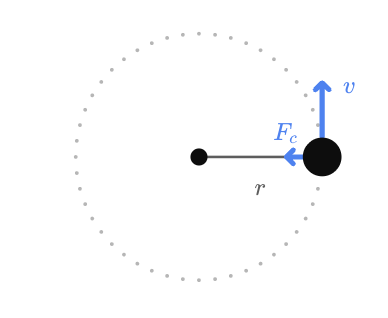
Centripetal Force Points Toward the Centre
In uniform circular motion:
- velocity points tangent to the circle
- acceleration points toward the centre
- resultant force points toward the centre


This relationship follows from Newton's Second Law:
F_net = ma
If acceleration points toward the centre, the net force must also point toward the centre.
Why Does the Object Need an Inward Force?
According to Newton's First Law, an object moving with no resultant force will continue moving in a straight line at constant velocity.
A circular path is not straight.
Therefore, something must continuously change the direction of the object's velocity.
That requires an inward force.
Without the inward force:
the object would leave the circular path and initially travel along a tangent.


The centripetal force does not pull the object "forward" around the circle.
Instead, it continuously redirects the object's velocity.
Centripetal Force Is Not a New Force
This is one of the most important ideas in this topic.
Centripetal force is not a separate type of force.
It is the name given to the net force directed toward the centre.
The actual physical force producing it might be:
- tension
- friction
- gravity
- normal force
- electric force
- a combination of several forces


Therefore, you should not automatically add "centripetal force" as an extra arrow on a free-body diagram.
Instead, identify the real forces and determine which forces combine to produce the inward resultant.
Centripetal Force Equation
The centripetal force required for uniform circular motion depends on:
- mass
- speed
- radius
Explore how each variable changes the required inward force:
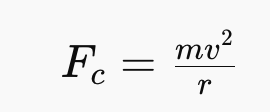
where:
- F_c = centripetal force in newtons (N)
- m = mass in kilograms (kg)
- v = speed in metres per second (m/s)
- r = radius in metres (m)
Where Does the Equation Come From?
Centripetal acceleration is:
a_c = v²/r
Newton's Second Law states:
F = ma
Substituting the centripetal acceleration:
F_c = m(v²/r)
Therefore:
F_c = mv²/r
This shows that centripetal force is simply Newton's Second Law applied to circular motion.
Effect of Mass
From:
F_c = mv²/r
centripetal force is directly proportional to mass.
F_c ∝ m
If mass doubles:
centripetal force doubles
If mass triples:
centripetal force triples
assuming speed and radius remain constant.


A heavier object requires a greater inward force to follow the same circular path at the same speed.
Effect of Speed
Centripetal force depends on the square of speed:
F_c ∝ v²
This has a very important consequence.
If speed doubles:
centripetal force becomes 4 times greater
If speed triples:
centripetal force becomes 9 times greater
If speed quadruples:
centripetal force becomes 16 times greater


This is why speed has such a large effect when vehicles travel around curves.
Effect of Radius
Centripetal force is inversely proportional to radius:
F_c ∝ 1/r
If radius doubles:
centripetal force becomes half as large
If radius triples:
centripetal force becomes one-third as large
assuming mass and speed remain constant.
Therefore:
tight curve → larger required force
wide curve → smaller required force
Example 1: Basic Centripetal Force
A 2 kg object moves at:
6 m/s
around a circular path with radius:
3 m
Calculate the centripetal force.
F_c = mv²/r
F_c = (2)(6²)/3
F_c = (2)(36)/3
F_c = 24 N
Therefore:
F_c = 24 N toward the centre
Always include the direction when describing centripetal force.
Example 2: A Car Turning
A 1000 kg car travels around a curve at:
10 m/s
The radius of the curve is:
50 m
Calculate the required centripetal force.
F_c = mv²/r
F_c = (1000)(10²)/50
F_c = 100 000/50
F_c = 2000 N
The car requires a net force of:
2000 N toward the centre of the curve.
What Provides the Force for the Car?
On a flat road, the horizontal centripetal force is generally provided by:
static friction between the tyres and the road


The tyres interact with the road, allowing the road to exert an inward frictional force on the car.
Therefore:
friction provides the centripetal force.
We should not draw both "friction" and a separate "centripetal force."
In this situation, friction is the force providing the required inward resultant.
What Happens If the Car Goes Faster?
Suppose the same car doubles its speed from:
10 m/s to 20 m/s
Original:
F_c = 2000 N
Because force depends on v²:
new force = 4 × 2000
new force = 8000 N
Doubling speed requires four times the inward force.
This helps explain why excessive speed makes cornering much more demanding.
What Happens If There Is Not Enough Friction?
The required centripetal force might be greater than the friction available between the tyres and road.
If this happens, the car cannot follow the desired circular path.


Instead, the vehicle tends to continue more nearly along its existing direction of motion.
This is particularly important on:
- wet roads
- icy roads
- loose surfaces
- high-speed curves
Example 3: Effect of Speed
A car requires:
3000 N
of centripetal force while travelling around a particular curve.
What force would be required if its speed doubled?
Because:
F_c ∝ v²
doubling speed gives:
F_new = 4F_original
F_new = 4(3000)
F_new = 12 000 N
Example 4: Effect of Radius
An object requires:
600 N
of centripetal force while moving around a circle of radius r.
If the radius doubles while mass and speed remain constant:
F_new = 600/2
F_new = 300 N
A larger-radius curve requires less inward force at the same speed.
Ball on a String
Consider a ball attached to a string and swung in a horizontal circle.
The string pulls inward on the ball.
The force is:
tension


Therefore:
tension provides the centripetal force
in a simplified horizontal circular-motion model.
If the required centripetal force is 15 N, the relevant inward tension component must provide 15 N.
Example 5: Ball on a String
A 0.50 kg ball moves at:
4 m/s
in a horizontal circle of radius:
2 m
Calculate the required centripetal force.
F_c = mv²/r
F_c = (0.50)(4²)/2
F_c = (0.50)(16)/2
F_c = 4 N
Therefore, the required inward force is:
4 N
What Happens If the String Breaks?
Before the string breaks:
- velocity is tangent to the circle
- tension pulls inward
After the string breaks:
- tension disappears
- there is no longer that inward force
- the ball initially moves tangent to the circular path


The ball does not fly directly outward along the radius.
Its inertia carries it along its instantaneous tangential direction.
Satellites and Centripetal Force
A satellite orbiting Earth requires an inward force.
That force is:
gravity


For an ideal circular orbit:
gravitational force = required centripetal force
Gravity continually changes the direction of the satellite's velocity.
The satellite is essentially falling around Earth.
Why Doesn't a Satellite Need a String?
A ball moving in a circle may need tension.
A car may need friction.
A satellite needs neither.
Gravity provides the inward force.
This demonstrates why "centripetal force" is not a specific type of force.
Different situations use different physical forces to produce the same effect:
inward acceleration.
Planets Orbiting the Sun
Planets also require an inward force to follow their curved orbital paths.
That force is:
gravitational attraction between the Sun and the planet


Real planetary orbits are elliptical rather than perfectly circular, but circular motion provides a useful introductory model.
Ferris Wheel
A rider on a Ferris wheel follows a circular path.
The required centripetal force always points toward the centre of the wheel.


At the top:
toward centre = downward
At the bottom:
toward centre = upward
At the side:
toward centre = horizontal
The direction of the required resultant force therefore changes continuously.
Centripetal Force Is a Net Force
This becomes especially important for vertical circular motion.
At the bottom of a Ferris wheel, for example, forces on a rider may include:
- normal force upward
- gravitational force downward
The centripetal force is not an additional third force.
Instead:
net inward force = combination of the real forces
At the bottom, inward is upward, so:
F_c = F_N − F_g
depending on the situation.
At the Top of a Circle
At the top of a vertical circle, inward points downward.
Therefore, forces pointing downward contribute to the centripetal resultant.
For a rider:
gravity may contribute toward the centre.
Depending on the system, normal force or tension may also contribute.
The key question is always:
Which direction is toward the centre?
Then analyze the real forces along that direction.
Example 6: Finding Speed
A 4 kg object experiences a centripetal force of:
100 N
while travelling in a circle of radius:
4 m
Find its speed.
Start with:
F_c = mv²/r
Substitute:
100 = (4)v²/4
100 = v²
v = 10 m/s
Example 7: Finding Radius
A 5 kg object moves at:
6 m/s
and requires a centripetal force of:
45 N
Find the radius.
F_c = mv²/r
Rearrange:
r = mv²/F_c
Substitute:
r = (5)(6²)/45
r = 180/45
r = 4 m
Example 8: Finding Mass
An object moves at:
8 m/s
around a circle of radius:
4 m
The centripetal force is:
32 N
Find its mass.
F_c = mv²/r
Rearrange:
m = F_cr/v²
Substitute:
m = (32)(4)/(8²)
m = 128/64
m = 2 kg
Centripetal Force and Free-Body Diagrams
Free-body diagrams are extremely useful for circular-motion problems.


A good method is:
1. Draw only the real forces.
Examples:
- weight
- normal force
- tension
- friction
2. Locate the centre of the circular path.
3. Determine which forces point toward or away from the centre.
4. Calculate the net inward force.
That net inward force equals:
mv²/r
Example 9: Identify the Centripetal Force
Consider each situation.
Car on a flat circular road
Source:
friction
Satellite orbiting Earth
Source:
gravity
Ball attached to a string
Source:
tension
Object pressed against the inside wall of a rotating drum
Source:
normal force
Planet orbiting the Sun
Source:
gravity
The source changes, but the required direction remains:
toward the centre.
Rotating Drum
Imagine an object inside a rotating cylindrical drum.
The wall pushes on the object.


The normal force from the wall can provide the inward force needed for circular motion.
Therefore:
normal force provides the centripetal force
in the radial direction.
Centrifuges
A laboratory centrifuge rotates samples at high speed.


Because centripetal acceleration depends on:
v²/r
very high speeds can produce very large accelerations.
Centrifuges are used in:
- medicine
- biotechnology
- chemistry
- biological research
to help separate components of mixtures.
Roller-Coaster Loops
A roller-coaster car moving through a loop follows a curved path.


At different points in the loop, different combinations of:
- gravity
- normal force
produce the required inward resultant.
The direction toward the centre changes as the car moves around the loop.
This makes vertical-circle problems especially useful for applying free-body diagrams.
Is There an Outward Centripetal Force?
No.
Centripetal means inward.
The required centripetal force always points toward the centre.
People inside turning vehicles sometimes feel as though they are being pushed outward.
This sensation is related to inertia and the choice of reference frame.
From an inertial reference frame, the physical net force producing the circular motion points inward.
Centrifugal Force
The term centrifugal force is sometimes used when describing motion from a rotating reference frame.
It is an apparent or inertial force introduced in that non-inertial frame.
For most introductory free-body diagrams viewed from an inertial frame:
do not draw centrifugal force as an additional real interaction force.
Instead, identify the real forces that produce the inward resultant.
Example 10: Analyzing a Turning Car
A 1200 kg car travels around a curve of radius:
60 m
at:
15 m/s
Required centripetal force:
F_c = mv²/r
F_c = (1200)(15²)/60
F_c = (1200)(225)/60
F_c = 4500 N
Therefore, the tyres and road must provide a net horizontal inward force of:
4500 N
If the available friction is less than this, the car cannot maintain that circular path at that speed.
Example 11: Same Car, Double Speed
Now the car travels at:
30 m/s
Same mass:
1200 kg
Same radius:
60 m
F_c = (1200)(30²)/60
F_c = (1200)(900)/60
F_c = 18 000 N
At 15 m/s:
4500 N
At 30 m/s:
18 000 N
The speed doubled.
The required centripetal force quadrupled.
Example 12: Wider Curve
The same 1200 kg car travels at 15 m/s, but the curve radius increases from:
60 m to 120 m
F_c = (1200)(15²)/120
F_c = 2250 N
Doubling the radius reduced the required centripetal force by half.
Why Road Curves Are Often Banked
Some high-speed roads and racetracks use banked curves.


On a banked surface, the normal force is tilted.
A component of that normal force can point toward the centre of the curve.
Therefore, the road itself can contribute to the required inward force rather than relying only on friction.
Why Speed Matters So Much
The equation:
F_c = mv²/r
contains v².
This means speed has a stronger effect on centripetal force than mass or radius.
For example:
2× mass → 2× force
2× speed → 4× force
2× radius → ½ force
This relationship is extremely important when analyzing vehicles, rotating machinery, amusement rides, and orbital systems.
Circular Motion in Sports
Centripetal force appears in many sports.


Examples include:
- hammer throwing
- swinging a bat
- swinging a golf club
- cycling around a curved track
- skating around a turn
- rotating gymnastics movements
The object or athlete needs an inward resultant force to maintain a curved path.
Hammer Throw Example
During a hammer throw, the athlete rotates the hammer around their body.
The cable exerts tension on the hammer.
That tension has an inward component that provides the required centripetal force.
As speed increases:
required force increases with v²
Therefore, high-speed rotation can produce very large tension forces.
Circular Motion in Space
Centripetal force is fundamental to orbital motion.

For an ideal circular orbit:
gravity = centripetal force
This relationship can be used to investigate:
- orbital speeds
- orbital radii
- satellite motion
- planetary motion
It connects Newton's laws of motion with Newton's law of universal gravitation.
A Reliable Centripetal Force Strategy
When solving a circular-motion problem:
Step 1: Identify the moving object.
What is following the circular path?
Step 2: Locate the centre.
Which direction is inward?
Step 3: Identify the real forces.
Examples:
- gravity
- friction
- tension
- normal force
Step 4: Determine the net inward force.
This is the centripetal force.
Step 5: Record the variables.
m = mass
v = speed
r = radius
Step 6: Use the centripetal-force relationship.
Relate the net inward force to mass, speed, and radius.
Step 7: Rearrange if necessary.
Solve for force, mass, speed, or radius.
Step 8: Include units.
Force → N
Mass → kg
Speed → m/s
Radius → m
Step 9: Include direction.
Centripetal force points:
toward the centre
Step 10: Check whether your answer is reasonable.
Higher speed should require substantially greater force.
Larger radius should require less force at the same speed.
Worked Problem 1
A 0.25 kg ball moves at 8 m/s around a circle of radius 2 m.
F_c = mv²/r
F_c = (0.25)(8²)/2
F_c = (0.25)(64)/2
F_c = 8 N
Answer:
8 N toward the centre
Worked Problem 2
A 1500 kg vehicle moves at 12 m/s around a curve of radius 80 m.
F_c = mv²/r
F_c = (1500)(12²)/80
F_c = (1500)(144)/80
F_c = 2700 N
Answer:
2700 N toward the centre
Worked Problem 3
A 3 kg object experiences an inward force of 48 N while moving at 8 m/s.
Find the radius.
r = mv²/F_c
r = (3)(8²)/48
r = 192/48
r = 4 m
Worked Problem 4
A 2 kg object moves around a circle of radius 5 m.
The required centripetal force is 40 N.
Find its speed.
F_c = mv²/r
40 = (2)v²/5
Multiply by 5:
200 = 2v²
v² = 100
v = 10 m/s
Worked Problem 5: Predict Before Calculating
Object A and Object B have the same mass and travel around circles with the same radius.
Object B moves three times faster.
How much greater is its centripetal force?
Because:
F_c ∝ v²
3² = 9
Object B requires:
9 times the centripetal force.
No full calculation was necessary.
Common Mistakes
Mistake 1: Drawing centripetal force as an extra force
Centripetal force is the net inward force produced by real forces.
Mistake 2: Pointing centripetal force outward
Centripetal force always points toward the centre.
Mistake 3: Pointing velocity toward the centre
Velocity is tangent to the circular path.
Force and acceleration point inward.
Mistake 4: Forgetting to square velocity
The equation contains:
v²
not v.
Mistake 5: Using diameter instead of radius
The equation requires the radius.
If given diameter:
r = diameter/2
Mistake 6: Assuming every circular-motion problem uses tension
Different forces can provide the centripetal resultant.
Mistake 7: Assuming gravity is an additional centripetal force in an orbit
For a simple circular orbit, gravity itself provides the required centripetal force.
Mistake 8: Adding an outward centrifugal force to every free-body diagram
For analysis from an inertial frame, identify the actual interaction forces instead.
Mistake 9: Thinking constant speed means no force
Constant speed around a circle still involves changing velocity and therefore requires a resultant force.
Did You Know?
One of the most useful features of the centripetal-force equation is how strongly it depends on speed.


A small increase in speed can produce a much larger required inward force.
For example:
10 m/s → force proportional to 100
20 m/s → force proportional to 400
30 m/s → force proportional to 900
This squared relationship explains why high-speed circular motion places large demands on tyres, tracks, cables, rotating machinery, and other structures.
Key Terms
Centripetal force: The net force directed toward the centre of a circular path.
Centripetal: Centre-seeking.
Circular motion: Motion along a circular path.
Centripetal acceleration: Acceleration directed toward the centre of a circular path.
Tangent: A line touching a circle at one point; instantaneous velocity points along the tangent.
Radius: Distance from the centre of the circle to the moving object.
Tension: Pulling force transmitted through a string, rope, or cable.
Friction: Force between surfaces that can provide an inward force when a vehicle turns.
Normal force: Contact force acting perpendicular to a surface.
Gravity: Attractive force between masses; it can provide centripetal force in orbital motion.
Resultant force: The vector sum of all forces acting on an object.
Key Equations
Centripetal acceleration:
a_c = v²/r
Centripetal force:
F_c = mv²/r
Newton's Second Law:
F_net = ma
Useful rearrangements:
m = F_cr/v²
v = √(F_cr/m)
r = mv²/F_c
Key Relationships
If mass increases:
F_c increases proportionally
If speed increases:
F_c increases with v²
If radius increases:
F_c decreases
Therefore:
F_c ∝ m
F_c ∝ v²
F_c ∝ 1/r
Key Takeaways
- Centripetal force is the net inward force required for circular motion.
- Centripetal means centre-seeking.
- Centripetal force always points toward the centre of the circular path.
- Velocity points tangent to the circular path.
- Circular motion requires an inward force because velocity continuously changes direction.
- Without the inward force, an object initially moves tangent to the circle.
- Centripetal force is not a new type of force.
- Tension, friction, gravity, normal force, electric force, or combinations of forces can provide the centripetal resultant.
- On a flat road, friction can provide the inward force for a turning car.
- For a ball on a string, tension can provide the inward force.
- For satellites and planets, gravity provides the inward force.
- Centripetal force follows the relationship F_c = mv²/r.
- Increasing mass increases the required force proportionally.
- Doubling speed quadruples the required force.
- Tripling speed increases the required force by a factor of nine.
- Increasing radius decreases the required force when speed remains constant.
- Free-body diagrams should contain the real physical forces, not an additional "centripetal force" arrow.
- In vertical circular motion, several forces may combine to produce the required inward resultant.
- Centripetal-force concepts apply to vehicles, satellites, planets, centrifuges, amusement rides, rotating machinery, and sports.
- A reliable analysis follows:
locate the centre → identify the real forces → determine the net inward force → relate it to mass, speed, and radius → solve → state the direction toward the centre.