Atomic Energy Levels and Transitions
5. Atomic Transitions
Learning Outcomes
- I can describe how electrons absorb energy.
- I can explain how excited electrons return to lower energy states.
- I can relate electron transitions to emitted photons.
- I can calculate energy changes during transitions.
- I can explain atomic transitions using energy level diagrams.
- Einstein’s explanation of the photoelectric effect
- Work function and threshold frequency
Experimental Evidence for Light’s Particle-Like Behavior: The Photoelectric Effect ⚛️🔆
Einstein’s photoelectric effect experiment provided definitive evidence that light behaves as particles (photons) rather than just waves. Let’s explore the details! 🔍✨
1. The Photoelectric Effect: Einstein’s Explanation 📸
When light of sufficient energy shines on a metal surface, it ejects electrons. This phenomenon is called the photoelectric effect.
📌 Classical Wave Theory Prediction (Incorrect)
- Increasing light intensity should increase energy of ejected electrons.
- Any frequency of light should eventually eject electrons if it’s bright enough.
- There should be a delay before electrons absorb enough energy to be emitted.
📌 Einstein’s Quantum Theory (Correct)
- Light consists of quantized energy packets (photons).
- Each photon has energy given by:
where:
✅
= Planck’s constant (
J·s).
✅
= Frequency of light (Hz).
- Only photons above a threshold frequency () can eject electrons.
- Increasing intensity adds more photons but does not increase individual photon energy.
📌 Key Takeaway: Light is made of particles (photons) carrying quantized energy!
2. Work Function and Threshold Frequency ⚡
🔹 Work Function (
) – Minimum energy needed to eject an electron from a metal.
🔹 Threshold Frequency (
) – Minimum frequency of light required to eject electrons.
- If, no electrons are emitted, no matter how bright the light is!
- If, electrons are ejected instantly with extra kinetic energy.
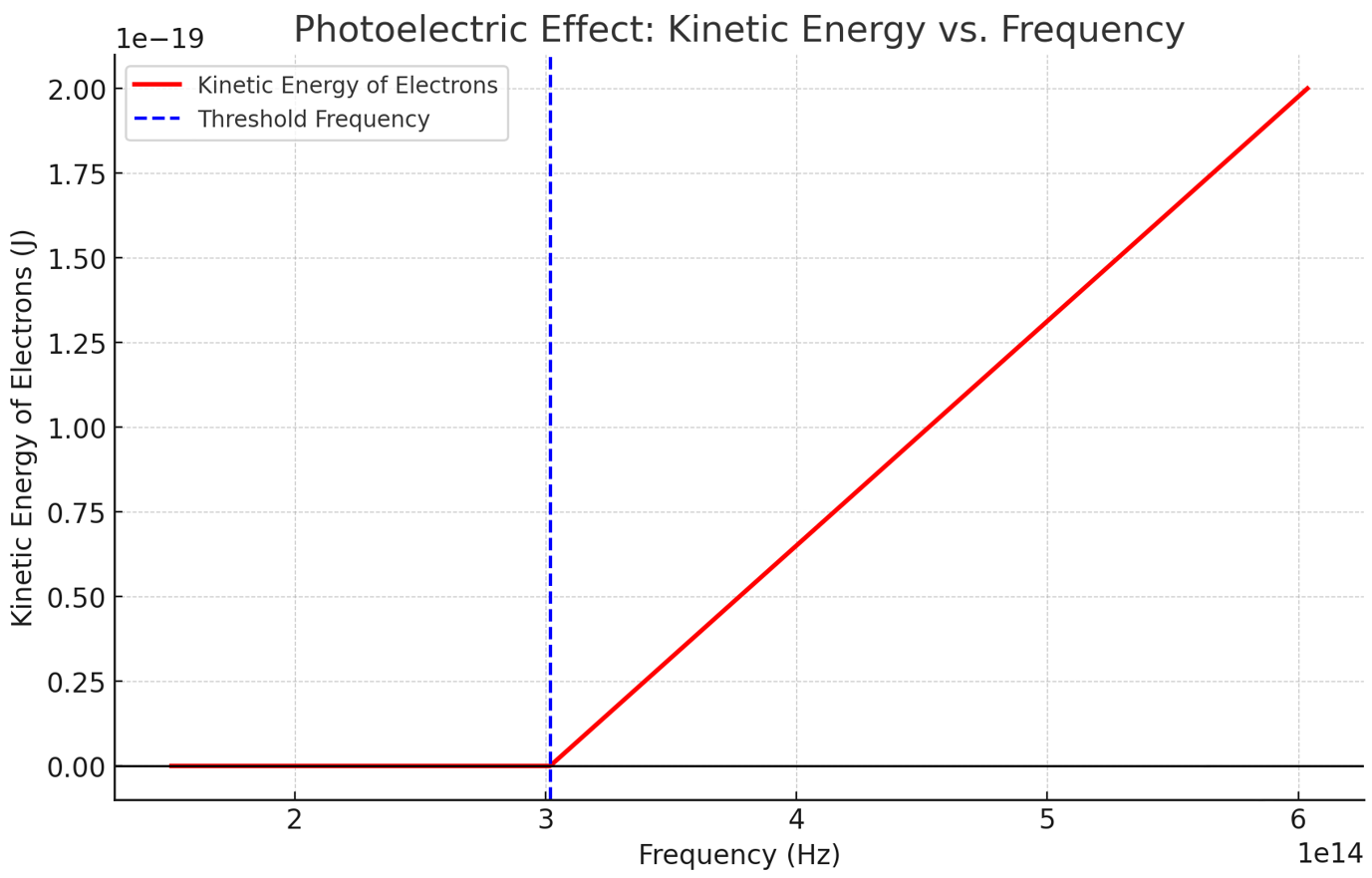
🔹 Kinetic Energy of Ejected Electrons:
📌 Key Insight:
- No electrons below the threshold frequency (blue dashed line in the graph).
- Above threshold, electron kinetic energy increases linearly with frequency.
3. Observational Evidence from the Graph 📊
- Below threshold frequency → No electrons ejected (kinetic energy = 0).
- Above threshold frequency → Electron kinetic energy increases linearly with frequency.
- Higher frequency photons eject faster-moving electrons.
📌 Key Takeaway: Only photon energy matters, not light intensity!
4. Real-World Applications 🌍
✅ Solar Panels ☀️ – Convert photons into electricity via the photoelectric effect.
✅ Photoelectric Sensors 📸 – Used in cameras, motion detectors, and security systems.
✅ X-ray Photoelectron Spectroscopy 🔬 – Determines elemental composition of materials.
✅ Quantum Mechanics & Modern Physics ⚛️ – This experiment helped establish wave-particle duality of light.
📊 Einstein’s work on the photoelectric effect won him the 1921 Nobel Prize in Physics! 🚀✨
Exploring Threshold Frequencies for Different Metals ⚛️🔆
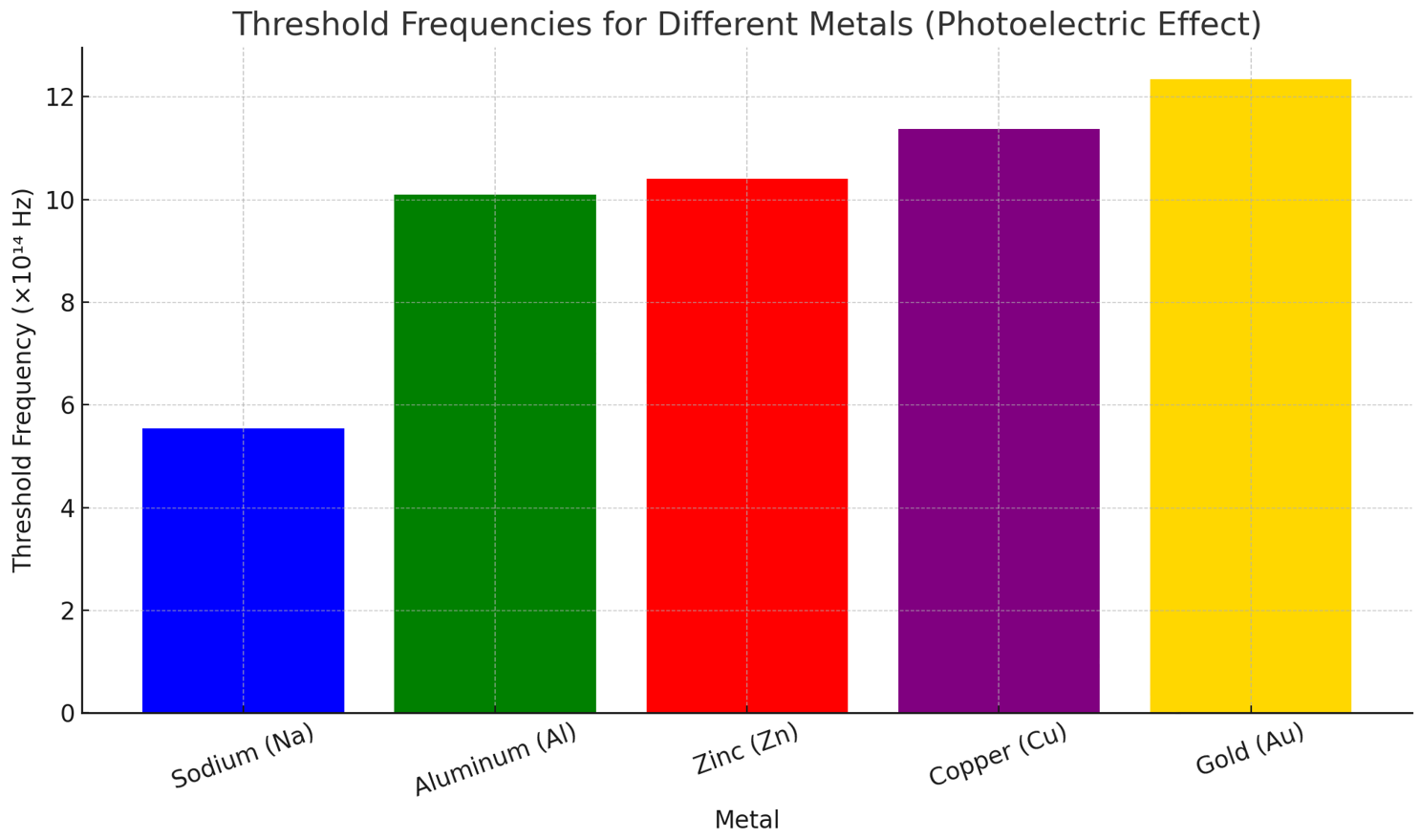
This bar chart compares the threshold frequencies for different metals in the photoelectric effect. Let’s analyze it! 🔍✨
1. What Does This Graph Show? 📊
Each metal has a different work function (
), meaning they require different threshold frequencies (
) to eject electrons.
🔹 Sodium (Na) – Lowest Threshold (Blue Bar)
- Hz
- Easily ejects electrons with visible light.
🔹 Gold (Au) – Highest Threshold (Gold Bar)
- Hz
- Requires ultraviolet (UV) light to eject electrons.
📌 Key Insight:
- Metals with low work functions (e.g., Sodium) eject electrons easily.
- Metals with high work functions (e.g., Gold) require higher-energy photons (UV light).
2. Threshold Frequency & Work Function Relationship 🔢
Using:
we see that metals with higher work functions require higher threshold frequencies.
🔹 Lower work function → Easily ejects electrons under lower-energy light.
🔹 Higher work function → Requires more energetic (shorter-wavelength) light to eject electrons.
📌 Example:
- Sodium (low work function) → Can eject electrons under red or yellow light.
- Gold (high work function) → Needs UV light for photoemission.
3. Real-World Applications 🌍
✅ Solar Panels ☀️ – Use metals with low work functions to efficiently convert sunlight into electricity.
✅ Photoelectric Sensors 📸 – Motion sensors and cameras rely on metals that respond to visible light.
✅ X-ray Spectroscopy 🔬 – Metals like gold require high-energy X-rays to emit electrons.
✅ Quantum Mechanics & Space Exploration 🚀 – Understanding work functions helps design energy-efficient materials for space technology.
📊 Different metals have unique properties that determine their response to light! 🚀✨
Activities:
- Demonstration of the photoelectric effect
- Group discussion on wave-particle duality
Assessment:
- Quiz on photoelectric principles and key equations
Photoelectric Effect
The photoelectric effect serves as compelling evidence of the particle nature of light, showcasing the behavior of photons as discrete packets of energy that interact with matter in quantized fashion, shaping the fabric of reality with mathematical precision and scientific insight.
In the photoelectric effect, when light of sufficient frequency shines on a metal surface, electrons are ejected from the material, forming an electric current. This process demonstrates that light behaves as discrete particles called photons, each carrying a specific amount of energy determined by the frequency of the light. The energy of the ejected electrons depends on the frequency of the incident light, with higher frequencies leading to more energetic electrons being emitted.
The photoelectric effect is evidence of the particle nature of light because it cannot be explained by classical wave theory alone. According to classical wave theory, the intensity of light (brightness) should determine the energy transferred to electrons, leading to a gradual increase in kinetic energy of emitted electrons. However, the photoelectric effect shows that the energy of ejected electrons is dependent on the frequency of light, not its intensity, indicating that light interacts with matter as discrete particles rather than continuous waves.
Albert Einstein's explanation of the photoelectric effect in 1905, for which he received the Nobel Prize in Physics, revolutionized our understanding of light by proposing that electromagnetic radiation is quantized into photons, each carrying energy proportional to its frequency. By treating light as a stream of particles, Einstein's theory successfully explained the experimental observations of the photoelectric effect and provided strong evidence for the particle nature of light.
Threshold Frequency
In the realm of the photoelectric effect, the threshold frequency represents the minimum frequency of light required to liberate electrons from the surface of a metal. Below the threshold frequency, photons lack the necessary energy to overcome the binding forces holding electrons in the metal, and no photoelectrons are emitted regardless of the intensity of the incident light. However, when photons with frequencies equal to or greater than the threshold frequency strike the metal surface, they transfer sufficient energy to electrons, enabling them to break free and form an electric current.
The threshold frequency is a critical parameter that depends on the material properties of the metal, specifically the work function, which is the minimum energy required to remove an electron from the surface of the metal. Photons with energies below the threshold frequency cannot provide the necessary energy to overcome the work function and release electrons, whereas photons with energies equal to or above the threshold frequency can liberate electrons and initiate the photoelectric effect.
Example:
Imagine a metal surface with a work function of 2 electronvolts (eV), requiring a minimum energy of 2 eV to liberate an electron from its confines. Let us determine the threshold frequency of light needed to release photoelectrons from this metal surface.
The energy of a photon is given by the equation:
Where:
= Energy of the photon
= Planck's constant (
J s)
= Frequency of the photon
To calculate the threshold frequency, we need to convert the work function from electronvolts to joules. Since 1 eV is approximately
joules, the work function of 2 eV is equivalent to:
Now, we can use the energy equation to find the threshold frequency. Since the energy of the photon must be equal to or greater than the work function to release electrons, we have:
Substitute the energy of the photon into the equation:
Solving for the threshold frequency:
Therefore, the threshold frequency required to release photoelectrons from the metal surface with a work function of 2 eV is approximately
. Photons with frequencies equal to or higher than this threshold frequency will possess the necessary energy to overcome the work function and initiate the photoelectric effect.