Basics of Magnetic Fields
2. Magnetic field lines
Learning Outcomes
- I can describe magnetic fields using field line diagrams.
- I can identify the direction of magnetic field lines.
- I can sketch magnetic field patterns around common magnets.
- I can explain how field line density represents field strength.
- I can compare electric field lines and magnetic field lines.
Magnetic Field Lines
What Is a Magnetic Field?
A magnetic field is a region in which a magnet, magnetic material, or moving electric charge can experience a magnetic force.
Magnetic fields exist around:
- permanent magnets
- current-carrying wires
- electromagnets
- moving electric charges
- Earth and other astronomical objects
We cannot see a magnetic field directly, so diagrams use magnetic field lines to represent its direction and relative strength.


What Are Magnetic Field Lines?
A magnetic field line is an imaginary line used to represent a magnetic field.
At any point on a field line, the direction of the magnetic field is along the tangent to the line.
The arrow on the line shows the direction that the north-seeking pole of a small compass would point.
Field-line diagrams provide information about:
- field direction
- field shape
- relative field strength
Direction of Magnetic Field Lines
Outside a permanent magnet, magnetic field lines are conventionally drawn:
North → South
Therefore, field lines:
- leave the north pole
- curve through the space around the magnet
- enter the south pole
Inside the magnet, they continue:
South → North
The complete magnetic field line therefore forms a:
closed loop
Magnetic Field Lines Form Closed Loops
Magnetic field lines do not simply begin at a north pole and disappear at a south pole.
The complete path is:
N → S outside the magnet
and:
S → N inside the magnet
Therefore:
magnetic field lines form continuous closed loops.
This is an important difference from the usual field-line representation of electric charges.
Magnetic Field Around a Bar Magnet
A bar magnet produces one of the most familiar magnetic field patterns.


Outside the magnet:
- field lines emerge from N
- curve around the magnet
- enter S
The field is strongest near the poles.
The field becomes weaker as distance from the magnet increases.
How to Sketch a Bar Magnet Field
When sketching the field around a bar magnet:
- Draw the rectangular magnet.
- Label one end N.
- Label the other end S.
- Draw several curved field lines leaving N.
- Curve the lines around toward S.
- Add arrows showing N → S outside the magnet.
- Draw more closely spaced lines near the poles.
A good sketch should be approximately symmetrical around the magnet.
Field-Line Density and Field Strength
The spacing of field lines represents the relative strength of the magnetic field.
closely spaced field lines → stronger field
widely spaced field lines → weaker field
For a bar magnet, the lines are usually most closely packed near the poles.
Therefore:
the magnetic field is strongest near the poles.
Field Lines Are a Model
Magnetic field lines are not physical strings or wires surrounding a magnet.
They are a representation of the magnetic field.
Drawing more lines does not actually make the field stronger.
Instead, within a single consistently drawn diagram, the relative concentration of lines represents relative field strength.
Field Direction at a Point
The magnetic field direction at any point is:
tangent to the magnetic field line
at that location.
If a field line curves, the field direction changes continuously along it.
A small compass placed at that location aligns itself approximately with the local magnetic field.
The compass's north-seeking end points along the field direction.
Using a Compass to Map a Magnetic Field
A compass can be used to investigate the field around a magnet.


A simple method is:
- Place a bar magnet on a sheet of paper.
- Place a small compass near the magnet.
- Mark the direction of the compass needle.
- Move the compass a short distance in that direction.
- Record the new direction.
- Repeat.
- Connect the marks to trace a field line.
- Repeat from several starting positions.
This produces a map of the magnetic field.
Using Iron Filings
Iron filings can also reveal the shape of a magnetic field.
When iron filings are placed near a magnet, each filing becomes temporarily magnetized.
The filings tend to align with the local magnetic field.


The pattern provides a useful visualization of:
- field shape
- regions of strong field
- regions of weaker field
However, iron filings do not clearly show field direction.
A compass is better for determining direction.
Field Around a Horseshoe Magnet
A horseshoe magnet has its north and south poles positioned relatively close together.


Between the poles, the magnetic field can be:
- relatively strong
- approximately uniform near the central region
- directed from N toward S
The close spacing of field lines between the poles represents the strong field.
Uniform Magnetic Fields
A uniform magnetic field has approximately the same:
- strength
- direction
throughout a region.
It is represented by:
straight, parallel, equally spaced field lines
For example:
→ → → → →
→ → → → →
→ → → → →
The equal spacing indicates constant field strength.
Non-Uniform Magnetic Fields
A non-uniform magnetic field changes in strength, direction, or both.
The field around a bar magnet is non-uniform.
Near a pole:
- field lines are close together
- field is strong
Farther away:
- field lines spread apart
- field becomes weaker
The field direction also changes as the lines curve.
Field Between Unlike Poles
Suppose the north pole of one magnet faces the south pole of another.
Field lines can connect from:
N → S
across the gap.


The field lines are often concentrated between the poles.
This corresponds to the attractive interaction between the magnets.
Field Between Like Poles
Suppose two north poles face each other.
The field pattern is very different.


The field lines from the two north poles curve away from the central region rather than connecting directly from one north pole to the other.
This pattern corresponds to the repulsive interaction.
A similar pattern occurs for:
S facing S
Magnetic Field Lines Never Cross
Magnetic field lines cannot cross.
Why?
At any location, the magnetic field can have only one direction.
If two field lines crossed, the intersection would imply two different magnetic-field directions at the same point.
That is impossible.
Therefore:
magnetic field lines never cross.
Magnetic Field Lines Do Not Merge or Branch
In a field-line representation, lines should also not suddenly:
- stop
- split into two
- merge randomly
They represent a continuous vector field.
For magnetic fields in particular, the field lines form continuous closed loops.
Magnetic Field Inside a Bar Magnet
Outside the magnet:
N → S
Inside the magnet:
S → N
Therefore, the complete pattern can be imagined as:
N → outside → S → inside → N
This produces a continuous loop.
Students sometimes forget the internal part of the field when sketching magnetic fields.
Magnetic Fields and Magnetic Poles
Field-line direction is defined using a hypothetical small north magnetic pole or, practically, the north-seeking end of a compass.
A north pole would experience force:
along the magnetic field
A south pole would experience force:
opposite to the magnetic field
This is similar to the way electric field direction is defined using a positive test charge.
Magnetic Field Strength
Magnetic field strength is often represented by the symbol:
B
Its SI unit is the:
tesla (T)
A larger value of B represents a stronger magnetic field.
For field-line diagrams, we usually make qualitative comparisons:
more densely packed lines → larger B
less densely packed lines → smaller B
Comparing Two Locations
Suppose point A is near the north pole of a bar magnet and point B is much farther away.
If the field lines are more closely spaced around A:
B_A > B_B
Therefore, the magnetic field at A is stronger.
The field-line diagram allows this comparison without requiring a numerical calculation.
Earth’s Magnetic Field
Earth is surrounded by a large-scale magnetic field.


A compass responds to this field and aligns approximately north-south.
Earth's actual magnetic field is more complex than that of a simple bar magnet, but the bar-magnet model provides a useful first approximation.
Magnetic Field Around a Current-Carrying Wire
Magnetic fields are not produced only by permanent magnets.
An electric current also produces a magnetic field.
Around a long straight current-carrying wire, the magnetic field lines form:
concentric circles around the wire
The field becomes weaker as distance from the wire increases.


Right-Hand Grip Rule
The direction of the magnetic field around a straight current-carrying wire can be determined using the right-hand grip rule.
Point your right thumb in the direction of:
conventional current
Your curled fingers show the direction of:
magnetic field lines
Therefore:
thumb → current
curled fingers → magnetic field
Field Around a Coil
A current-carrying coil produces a magnetic field resembling the field of a bar magnet.
One side behaves like a:
north pole
and the other behaves like a:
south pole
This is the basis of many electromagnets.
The magnetic field inside a long coil can be relatively strong and approximately uniform.
Electric Field Lines
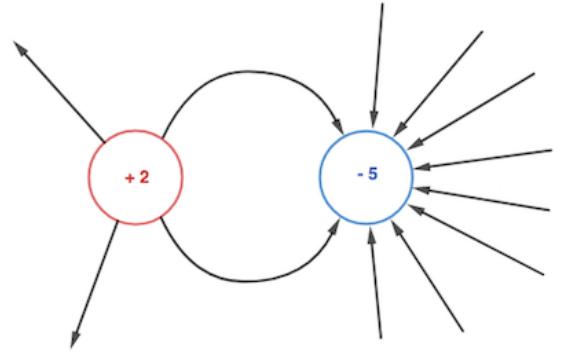
Electric field lines represent an electric field.
For an isolated positive charge:
field lines point:
away from +
For an isolated negative charge:
field lines point:
toward −

Like magnetic field lines, their direction represents the direction of a force on a defined test object.
For electric fields, that test object is a:
positive test charge
Similarities Between Electric and Magnetic Field Lines
Electric and magnetic field-line diagrams share several features.
Both:
- represent invisible fields
- show field direction
- indicate relative field strength through line density
- do not cross
- show the direction of force on a defined test object
- can be used to visualize interactions at a distance
Field-line diagrams are therefore useful models in both electricity and magnetism.
Important Difference: Where the Lines Go
There is an important difference.
Electric field lines
For ordinary electrostatic diagrams, electric field lines can:
- begin on positive charges
- end on negative charges
- extend to or from infinity
Magnetic field lines
Magnetic field lines:
always form closed loops
They do not simply begin at a north pole and terminate permanently at a south pole.
Outside the magnet they travel N → S, but inside they return S → N.
Why Magnetic Field Lines Form Loops
Electric charges can exist individually.
For example, an object can have:
- net positive charge
- net negative charge
This allows electric field lines to originate or terminate on electric charge.
Ordinary magnets, however, are observed with both:
- north pole
- south pole
Cutting a magnet does not isolate the poles.
Instead, each piece develops both poles.
This is reflected by the closed-loop structure of magnetic field lines.
Electric vs Magnetic Field Lines
| Electric Field Lines | Magnetic Field Lines |
|---|---|
| Represent electric fields | Represent magnetic fields |
| Direction defined using positive test charge | Direction defined using north magnetic pole/compass |
| Point away from positive charge | Outside magnet, leave north pole |
| Point toward negative charge | Outside magnet, enter south pole |
| Can begin or end on charges | Form continuous closed loops |
| Closer lines represent stronger field | Closer lines represent stronger field |
| Never cross | Never cross |
Comparing a Dipole with a Bar Magnet
An electric dipole consists of:
+Q and −Q
A bar magnet contains:
N and S poles
Their external field patterns can look somewhat similar.
However, there is an important distinction.
Electric field lines can begin on +Q and end on −Q.
Magnetic field lines continue through the magnet to form closed loops.
Therefore, similar-looking diagrams represent physically different fields.
Field-Line Density
Suppose two regions of the same magnetic field diagram have different line spacing.
Region A
Lines are close together.
Region B
Lines are widely separated.
Then:
field at A > field at B
provided the diagram uses a consistent field-line representation.
Field-line density provides a qualitative comparison rather than automatically giving a numerical value.
Strong and Weak Regions Around a Bar Magnet
Near the north and south poles:
field-line density is high
Therefore:
field is strong
Far from the magnet:
field-line density is lower
Therefore:
field is weaker
This is why small magnetic objects experience much stronger forces close to many permanent magnets.
Sketching Field-Line Diagrams
A good magnetic field-line diagram should follow several rules:
- include arrows showing direction
- show N → S outside a permanent magnet
- use continuous curves
- never allow lines to cross
- use closer spacing to represent stronger fields
- show appropriate symmetry where expected
- continue lines through the magnet when showing complete loops
A diagram should communicate both:
direction and relative strength
Interpreting a Field-Line Diagram
When given a magnetic field diagram, ask:
What direction does the field point?
Follow the arrows.
Where is the field strongest?
Look for the greatest field-line density.
Where is the field weakest?
Look for widely spaced lines.
Is the field uniform?
Look for straight, parallel, equally spaced lines.
Where are the poles?
Outside a permanent magnet, lines leave N and enter S.
These rules allow a large amount of information to be obtained from a simple diagram.
Example: Identifying an Unknown Pole
Suppose field-line arrows are shown leaving the left end of a magnet.
Outside a magnet:
field lines leave north
Therefore:
left end = N
The other end must be:
S
Similarly, if field lines enter an end of a magnet, that end is the south pole.
Example: Comparing Field Strength
Suppose point A has five field lines passing through a small region around it, while the same-sized region around B contains only two in a consistently drawn diagram.
We can conclude qualitatively:
B_A > B_B
The field is stronger around A.
We cannot determine an exact numerical ratio merely by counting lines unless the diagram has specifically been constructed for that purpose.
Three-Dimensional Fields
Magnetic fields exist in three dimensions.
A two-dimensional field-line diagram shows only a representation or slice of the complete field.
For example, a bar magnet's field extends:
- above the magnet
- below the magnet
- beside the magnet
- around it in three dimensions
The familiar flat diagram is therefore a simplified model of a three-dimensional field.
Why Field-Line Diagrams Are Useful
Field-line diagrams allow us to predict:
- compass orientation
- magnetic force directions
- strong and weak field regions
- interactions between magnets
- approximate uniformity of fields
- effects of changing magnet arrangements
They turn an invisible field into a model that can be analyzed visually.
Common Mistakes
Mistake: Drawing magnetic field lines from south to north outside a magnet.
Outside a magnet, they point N → S.
Mistake: Saying magnetic field lines stop at the south pole.
They continue through the magnet and form closed loops.
Mistake: Drawing magnetic field lines that cross.
A magnetic field can have only one direction at each location.
Mistake: Saying closely spaced lines represent a weak field.
Closely spaced lines represent a stronger field.
Mistake: Thinking magnetic field lines are physical objects.
They are a model used to represent a field.
Mistake: Assuming the field is equally strong everywhere around a bar magnet.
It is generally strongest near the poles.
Mistake: Drawing field lines directly from one north pole into another north pole.
Like poles produce a field pattern that bends away from the region between them.
Mistake: Assuming electric and magnetic field lines behave identically.
Magnetic field lines form closed loops, while electrostatic field lines can begin and end on charges.
Key Terms
Magnetic field — region in which magnetic forces can act.
Magnetic field line — imaginary line used to represent the direction and relative strength of a magnetic field.
Field direction — direction in which the north-seeking end of a compass would point.
Field-line density — relative concentration of field lines used to represent field strength.
Magnetic field strength — measure of the strength of a magnetic field, represented by B.
Tesla (T) — SI unit of magnetic field strength.
Uniform magnetic field — field having approximately constant strength and direction.
Non-uniform magnetic field — field whose strength or direction changes with position.
North pole — magnetic pole from which external magnetic field lines emerge.
South pole — magnetic pole into which external magnetic field lines enter.
Compass — small freely rotating permanent magnet used to determine magnetic-field direction.
Right-hand grip rule — rule used to determine magnetic-field direction around a current-carrying wire.
Electric field line — line representing the direction of an electric field.
Key Takeaways
- Magnetic field lines are used to represent magnetic fields.
- The tangent to a field line gives the magnetic-field direction at that point.
- Outside a permanent magnet, magnetic field lines point N → S.
- Inside the magnet, they return S → N.
- Magnetic field lines therefore form continuous closed loops.
- Magnetic field lines never cross.
- Closely spaced field lines represent stronger magnetic fields.
- Widely spaced field lines represent weaker magnetic fields.
- Bar magnets produce curved, non-uniform magnetic fields.
- Magnetic fields are generally strongest near the poles of permanent magnets.
- A uniform field is represented by straight, parallel, equally spaced lines.
- A compass can determine magnetic-field direction.
- Iron filings can reveal the shape of a magnetic field.
- Unlike poles produce connecting field patterns associated with attraction.
- Like poles produce field patterns that bend away from the region between them.
- Electric currents also produce magnetic fields.
- Around a straight wire, magnetic field lines form concentric circles.
- Electric and magnetic field-line diagrams both show direction and relative strength.
- Electric field lines can begin or end on electric charges.
- Magnetic field lines always form closed loops.
Check Your Understanding
- Define a magnetic field.
- What does a magnetic field line represent?
- In which direction do magnetic field lines point outside a bar magnet?
- In which direction do they travel inside the magnet?
- Explain why magnetic field lines form closed loops.
- Where is the magnetic field generally strongest around a bar magnet?
- What does closely spaced field lines indicate?
- What does widely spaced field lines indicate?
- Why can magnetic field lines never cross?
- Describe the magnetic field pattern around a bar magnet.
- Describe the field pattern between opposite magnetic poles.
- Describe the field pattern between two like magnetic poles.
- How can a compass be used to determine magnetic-field direction?
- How can iron filings be used to investigate a magnetic field?
- What does a uniform magnetic field look like on a field-line diagram?
- Describe the magnetic field around a straight current-carrying wire.
- State the right-hand grip rule.
- Give two similarities between electric and magnetic field-line diagrams.
- Give one important difference between electric and magnetic field lines.
- A student draws magnetic field lines leaving a north pole and stopping when they reach the south pole. Explain what is incorrect about the diagram.